









PFAS-free means that a product is made without intentionally added per- and polyfluoroalkyl substances, or that the finished product meets a defined PFAS testing threshold required by a buyer, regulation, or certification program. In food packaging, tableware, and disposable foodservice products, this claim matters because PFAS have historically been used to improve oil, grease, water, and heat resistance.
Per- and polyfluoroalkyl substances, commonly called PFAS or “forever chemicals,” are a large family of synthetic chemicals known for their strong carbon-fluorine bonds. These bonds make certain PFAS highly persistent in the environment and resistant to natural breakdown. Because of this persistence, regulators, foodservice brands, retailers, and packaging buyers are paying closer attention to PFAS-free claims in paper, molded fiber, bagasse, and other plant-fiber food packaging.
For food packaging buyers, the practical question is not only “what is PFAS free?” but also: how can PFAS-free food packaging be verified? This guide explains what PFAS-free means, how it differs from PFOA-free and BPA-free, why it matters in food-contact materials, and what documents buyers should request before using PFAS-free claims in the market.
Quick Answer: What Does PFAS-Free Mean?
PFAS-free means a product is made without intentionally added PFAS and/or has passed relevant PFAS or fluorine testing according to a defined requirement. In food packaging, the most important point is that the claim should apply to the finished product, not only to the raw material.
- PFAS-free is broader than PFOA-free: PFOA is only one type of PFAS.
- PFAS-free is different from BPA-free: BPA is mainly related to certain plastics and resins, while PFAS are fluorinated chemicals often associated with grease and water resistance.
- PFAS-free does not automatically mean compostable: compostability depends on material, formulation, certification, and disposal conditions.
- For food packaging buyers: ask for supplier declarations, third-party test reports, food-contact documents, and destination-market compliance review.

Understanding PFAS and Their Impact
PFAS stands for per- and polyfluoroalkyl substances. It is not a single chemical, but a large class of fluorinated substances used in many industrial and consumer applications. Some PFAS have been used in non-stick cookware, stain-resistant textiles, water-repellent materials, firefighting foams, and grease-resistant food packaging.
The reason PFAS became widely used is also the reason they create concern: many PFAS are resistant to heat, water, oil, and chemical degradation. In food-contact packaging, PFAS may be used to help paper or molded fiber resist grease and moisture. However, because certain PFAS persist in the environment and may be associated with health risks, many brands and regulators are moving toward PFAS-free packaging alternatives.
Key point: PFAS-free is not simply a marketing phrase. For food packaging, it should be supported by manufacturing control, supplier declaration, and appropriate test results.
What Does PFAS-Free Mean in Food Packaging?
In food packaging, PFAS-free generally means that PFAS are not intentionally added to the product during manufacturing. However, the exact meaning can vary by regulation, buyer specification, laboratory method, and product category. This is why buyers should avoid relying on a label alone.
For plant-fiber packaging such as paperboard, molded fiber, and sugarcane bagasse tableware, a stronger PFAS-free claim normally includes two parts:
- No intentionally added PFAS: the manufacturer does not add PFAS-based grease-proofing agents or fluorinated treatments.
- Testing evidence: the finished product is tested using appropriate PFAS, total fluorine, or total organic fluorine methods required by the target market or buyer.
For example, California AB1200 restricts PFAS in plant-fiber-based food packaging and sets a total organic fluorine threshold. In the U.S., the FDA announced that PFAS grease-proofing substances used in paper and paperboard food packaging are no longer being sold by manufacturers for food-contact use in the U.S. market. These regulatory developments make PFAS-free verification especially important for foodservice packaging buyers.
For a deeper procurement-focused guide, see PFAS-Free Packaging: What Buyers Must Ask in 2025.
PFAS-Free vs Fluorine-Free vs PFOA-Free vs BPA-Free
Packaging labels can be confusing because different chemical claims refer to different scopes. A product may be PFOA-free but not necessarily PFAS-free. A product may be BPA-free but still have nothing to do with PFAS. Buyers should understand the difference before approving packaging artwork or marketing claims.
| Claim | What It Usually Means | What It Does Not Automatically Mean | Buyer Verification |
|---|---|---|---|
| PFAS-Free | No intentionally added PFAS and/or test results meet a defined PFAS requirement. | It does not automatically prove compostability, plastic-free status, or suitability for all hot/oily foods. | Ask for finished-product PFAS test report, supplier declaration, and food-contact compliance documents. |
| Fluorine-Free | The product has low or non-detectable fluorine based on a screening test. | It may not identify every individual PFAS compound. | Ask whether the test is total fluorine, total organic fluorine, or targeted PFAS analysis. |
| PFOA-Free | The product does not contain PFOA, one specific PFAS compound. | It does not mean the product is free from all PFAS. | For broader assurance, request PFAS-free or no intentionally added PFAS documentation. Learn more in What is PFOA Free?. |
| BPA-Free | The product does not contain bisphenol A, commonly associated with certain plastics and resins. | It does not address PFAS, PFOA, compostability, or fluorinated grease resistance. | Ask for BPA declaration and material-specific food-contact compliance documents. |
For a complete comparison of these claims, see PFAS Free vs. PFOA Free vs. BPA Free.
Health and Environmental Concerns Related to PFAS
Scientific and regulatory agencies continue to evaluate the health and environmental effects of different PFAS. Some PFAS have been associated with concerns related to immune response, cholesterol levels, liver effects, reproductive and developmental outcomes, thyroid function, and certain cancers. The level of concern depends on the specific PFAS compound, exposure route, dose, duration, and population group.
From an environmental perspective, many PFAS are persistent. They can move through water, soil, and food systems and may remain in the environment for long periods. This persistence is one reason PFAS are often called “forever chemicals.”
For foodservice packaging, the practical takeaway is clear: brands should reduce unnecessary PFAS exposure and select packaging that is properly tested, traceable, and appropriate for the intended food-contact use.

Why PFAS Matters in Bagasse, Paper, and Compostable Food Packaging
PFAS has been especially relevant in grease-resistant paper and molded fiber food packaging because these materials often need to handle oily, wet, or hot foods. Traditional PFAS treatments can improve resistance, but regulators and buyers are increasingly requiring PFAS-free alternatives.
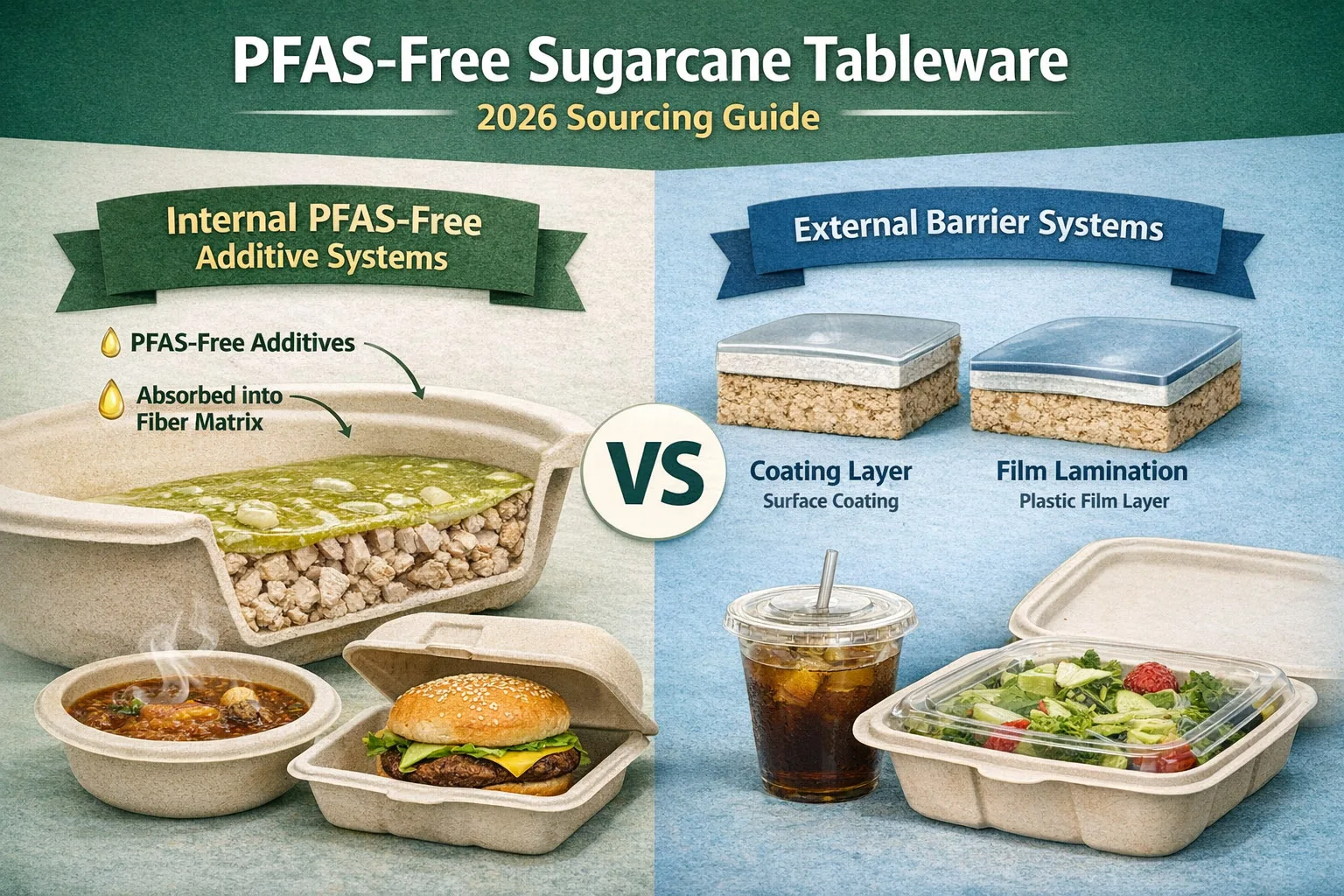
For sugarcane bagasse tableware, PFAS-free performance depends on product design, fiber structure, molding process, barrier treatment, and finished-product testing. A bagasse container may look natural and compostable, but buyers should still verify whether PFAS are intentionally added and whether the finished product meets required PFAS or fluorine limits.
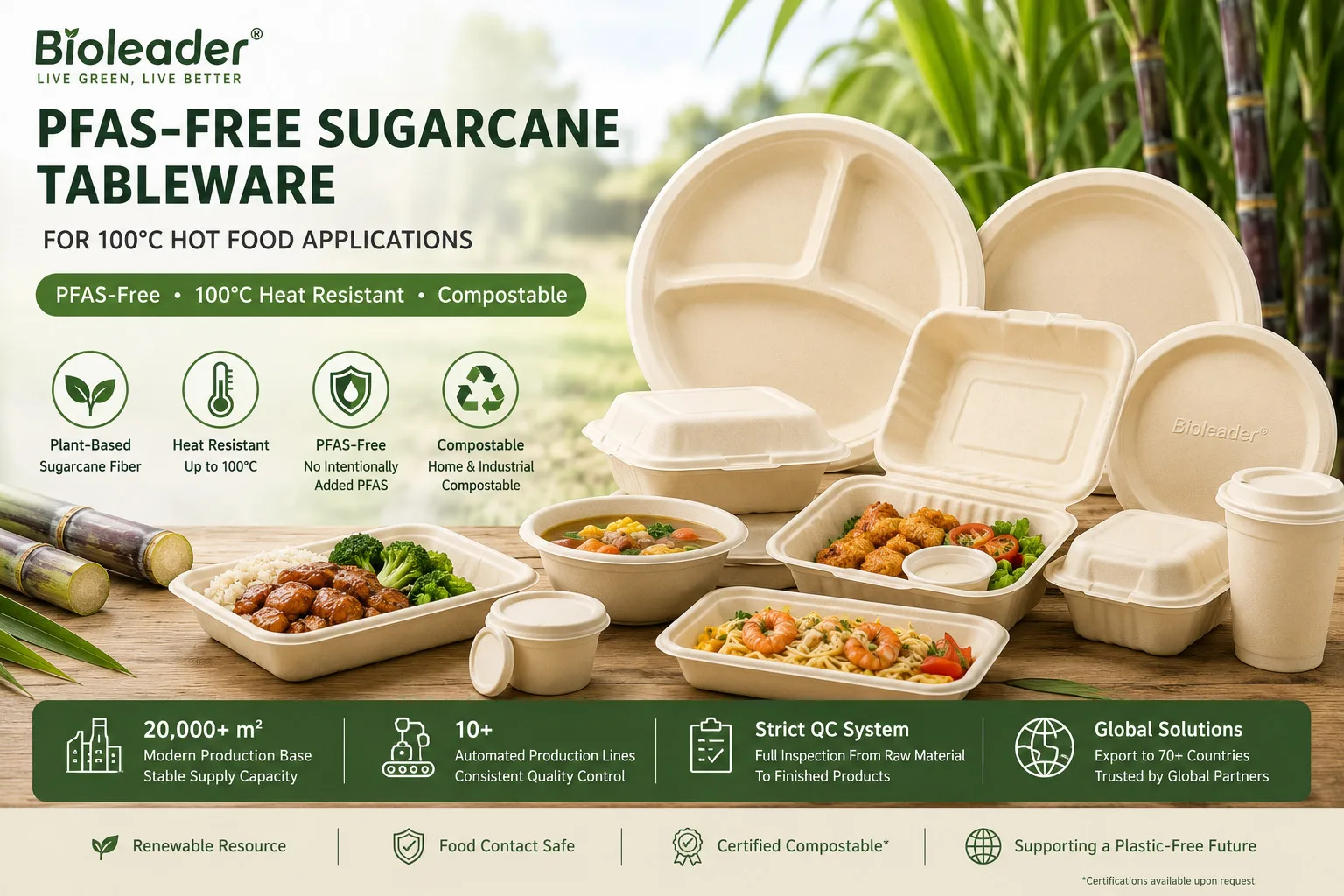
Bioleader® has published a specific guide answering a common buyer question: Is sugarcane bagasse tableware PFAS-free and BPA-free?. For buyers serving hot meals or oily takeaway food, the article PFAS-Free Sugarcane Tableware for 100°C Hot Food explains how manufacturing design and performance testing affect real-use suitability.
| Packaging Material | PFAS Relevance | Buyer Note |
|---|---|---|
| Sugarcane Bagasse / Molded Fiber | May require grease and moisture resistance for hot and oily foods. | Ask whether the finished bagasse food containers are made without intentionally added PFAS and tested for the target market. |
| Paper and Paperboard | Historically used PFAS grease-proofing in some food-contact paper applications. | Confirm coating type, PFAS status, food-contact documents, and compostability claims separately. |
| PLA-Coated or Bio-Based Coated Paper | PFAS status depends on the coating system and additives. | PLA is generally more suitable for cold or moderate applications unless the finished product is tested for heat and food-contact use. |
| PET and PP Plastic Packaging | PFAS-free status may still need verification, but these materials are not compostable. | Do not describe PET as biodegradable or compostable. |
Regulatory Actions and Industry Responses
PFAS regulation is evolving quickly. Foodservice packaging buyers should not treat PFAS-free claims as optional language only. They should review destination-market rules before launching packaging in the U.S., EU, California, or other regulated markets.
United States: FDA Food Packaging Phase-Out
The U.S. FDA announced that grease-proofing substances containing PFAS are no longer being sold by manufacturers for food-contact use in the U.S. market. This is especially relevant for paper and paperboard food packaging that historically used PFAS for oil and grease resistance.
United States: EPA Drinking Water PFAS Rule
The U.S. EPA finalized national drinking water regulation for several PFAS, including enforceable levels for PFOA and PFOS. Although drinking water regulation is not the same as food packaging regulation, it signals the broader regulatory and public-health importance of PFAS control.
California: AB1200 and Plant-Fiber Food Packaging
California AB1200 is highly relevant to plant-fiber food packaging because it restricts intentionally added PFAS and sets a total organic fluorine threshold for plant-fiber-based food packaging. This directly affects molded fiber, paper, paperboard, and similar foodservice packaging products.
European Union: PFAS Restriction Direction
In the EU, PFAS restriction discussions under REACH continue to move forward. ECHA’s scientific evaluation process reflects a long-term direction toward reducing non-essential PFAS uses, although final restrictions and exemptions may depend on application and use case.
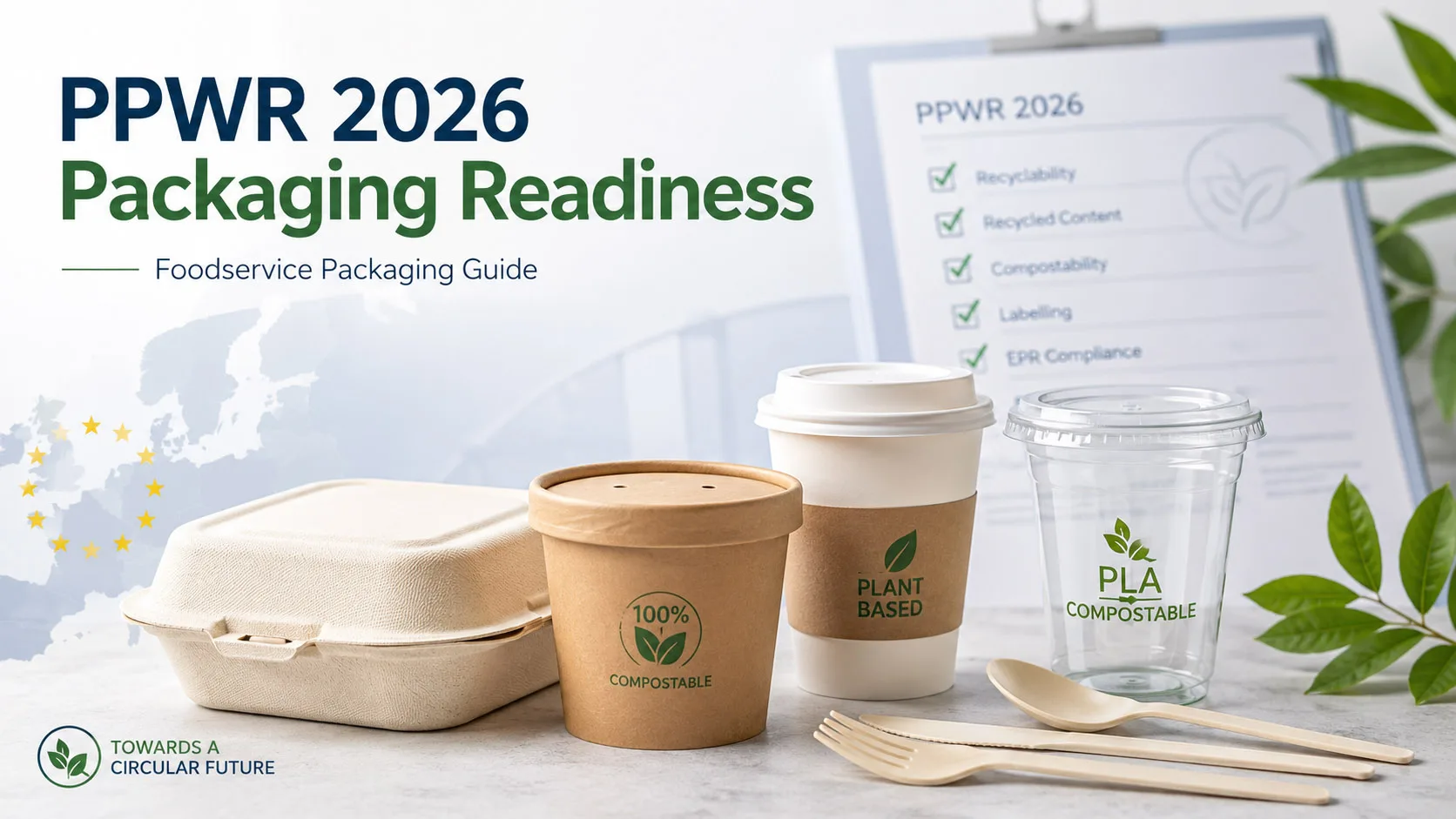
For a wider regulatory overview, see PFAS ban 2025 practical map and procurement guidance and how to transition to PFAS-free tableware before the 2026 packaging deadlines.
How to Verify PFAS-Free Food Packaging
The most reliable PFAS-free claim is supported by a clear verification process. Buyers should avoid accepting generic “eco-friendly” or “chemical-free” language without documentation. PFAS-free verification should normally include finished-product testing and supplier traceability.
| Verification Step | What to Check | Why It Matters |
|---|---|---|
| Supplier Declaration | Confirm no intentionally added PFAS in the product formulation or treatment. | Provides a basic manufacturing commitment. |
| Finished-Product Testing | Request PFAS, total fluorine, or total organic fluorine test reports, depending on the market requirement. | Finished products may differ from raw materials. |
| Detection Limit | Review the test method and reporting limit, not only the word “pass.” | Different labs and buyer standards may use different thresholds. |
| Food-Contact Compliance | Confirm FDA, LFGB, EU, or other applicable food-contact documents. | PFAS-free does not replace food-contact safety compliance. |
| Performance Testing | Test heat, oil, water, leakage, microwaving, freezing, and real food conditions where relevant. | PFAS-free packaging still needs to work in actual foodservice use. |
| Artwork and Claims Review | Check whether labels say PFAS-free, PFOA-free, BPA-free, compostable, biodegradable, or plastic-free. | Each claim has a different meaning and should be legally supportable. |
For deeper verification details, read PFAS-Free Packaging in 2025: What It Really Means and How to Verify Compliance. If your project includes custom printing, also review how to customize food packaging inks without breaking compliance.
Buyer Checklist: Questions to Ask Before Buying PFAS-Free Packaging
Before approving PFAS-free packaging for foodservice, takeaway, retail, or export, buyers should ask the following questions:
- Are PFAS intentionally added to the raw material, coating, mold-release system, or finished product?
- Does the PFAS-free claim apply to the finished product or only to one component?
- Can the supplier provide a third-party PFAS or fluorine test report?
- What is the test method and reporting limit?
- Does the product meet California AB1200 or other destination-market PFAS requirements?
- Does the product also need to be compostable, biodegradable, plastic-free, or recyclable?
- Does the product have food-contact compliance documentation?
- Has the product been tested with hot, oily, wet, acidic, or heavy foods?
- Can the supplier provide batch traceability and consistent production control?
- Is the packaging artwork making any claim that requires additional evidence?
PFAS-Free Does Not Automatically Mean Compostable
One common misunderstanding is that PFAS-free automatically means compostable, biodegradable, or plastic-free. This is not correct. PFAS-free only refers to the PFAS chemical claim. Compostability depends on the base material, additives, coating, product thickness, certification, and composting conditions.
For example, some PFAS-free molded fiber food containers may be compostable if the finished product is properly certified. Some PFAS-free plastic products may not be compostable at all. A buyer should evaluate each claim separately:
- PFAS-free: chemical claim related to fluorinated substances.
- BPA-free: chemical claim related to bisphenol A.
- Compostable: end-of-life claim requiring certification and suitable composting conditions.
- Biodegradable: broad claim that should not be used without clear conditions, timeframe, and evidence.
- Plastic-free: material claim that must be verified based on formulation and coating.
For broader performance guidance, see the 2025–2026 Global PFAS-Free Tableware Performance White Paper and the 2026 Global Sugarcane Bagasse Packaging White Paper.
Bioleader® PFAS-Free Food Packaging and Tableware Solutions
Bioleader® supplies plant-based and compostable food packaging solutions for foodservice distributors, restaurant chains, supermarkets, takeaway brands, catering operators, and packaging importers. For buyers moving away from intentionally added PFAS, Bioleader® offers PFAS-free options across selected sugarcane bagasse, paper-based, cornstarch, and compostable tableware product lines.
Buyers looking for PFAS-free disposable tableware can review Bioleader® compostable tableware manufacturer with PFAS-free options and PFAS-free compostable plates. For direct product examples, see BPA PFAS-free biodegradable food containers with lids.
For hot food, oily takeaway meals, and molded fiber packaging projects, buyers should confirm both PFAS-free compliance and real performance. Foodservice packaging must be safe, functional, legally supportable, and suitable for the target market.
For project support, buyers can review the Bioleader® catalog and price list or contact Bioleader® for samples, test documents, product specifications, and bulk quotation support.
FAQ About PFAS-Free Food Packaging
What does PFAS-free mean?
PFAS-free means that per- and polyfluoroalkyl substances are not intentionally added to the product, or that the finished product meets a defined PFAS or fluorine testing requirement. For food packaging, the claim should be supported by documentation and testing.
Is PFAS-free the same as PFOA-free?
No. PFOA is only one specific chemical within the broader PFAS family. A product can be PFOA-free but still contain other PFAS unless a broader PFAS-free claim is verified.
Is PFAS-free the same as BPA-free?
No. BPA and PFAS are different chemical concerns. BPA is mainly associated with certain plastics and resins, while PFAS are fluorinated chemicals often associated with grease, water, and heat resistance.
Why are PFAS used in food packaging?
Some PFAS have been used to provide oil, grease, and water resistance in paper, paperboard, and molded fiber packaging. Because of health, environmental, and regulatory concerns, buyers are increasingly moving to PFAS-free alternatives.
How can buyers verify PFAS-free food packaging?
Buyers should request a supplier declaration, finished-product PFAS or fluorine testing, food-contact compliance documents, and performance testing under real foodservice conditions.
Are PFAS-free food containers safe for hot and greasy foods?
Some PFAS-free food containers can be designed for hot and greasy foods, but buyers should verify heat resistance, oil resistance, leakage performance, and finished-product test data before use.
Are PFAS-free products also compostable?
Not always. PFAS-free is a chemical claim, while compostable is an end-of-life claim. Compostability must be verified separately through appropriate certification and local composting conditions.
What should foodservice brands ask before switching to PFAS-free packaging?
Brands should ask whether PFAS are intentionally added, whether finished-product testing is available, what test limits apply, whether the product meets destination-market regulations, and whether performance is suitable for the actual food application.
Conclusion
PFAS-free is an important food packaging claim, but it must be understood and verified correctly. It does not automatically mean PFOA-free, BPA-free, compostable, biodegradable, or suitable for every hot and oily food application. For foodservice buyers, the safest approach is to treat PFAS-free as part of a full compliance and performance review.
As regulators, retailers, and consumers pay closer attention to chemical safety in food-contact materials, PFAS-free packaging is becoming a practical requirement for many paper, molded fiber, and plant-based foodservice products. Buyers should work with suppliers that can provide clear documentation, finished-product testing, material transparency, and reliable production control.
For distributors, foodservice brands, and takeaway packaging buyers, Bioleader® offers PFAS-free packaging solutions across selected bagasse, paper-based, cornstarch, and compostable tableware product lines, helping businesses transition toward safer and more sustainable food packaging systems.
References
- U.S. EPA — Our Current Understanding of the Human Health and Environmental Risks of PFAS
- U.S. EPA — Per- and Polyfluoroalkyl Substances (PFAS) Drinking Water Regulation
- U.S. FDA — PFAS Used in Grease-Proofing Agents for Food Packaging No Longer Being Sold in the U.S.
- U.S. FDA — Market Phase-Out of Grease-Proofing Substances Containing PFAS
- California DTSC — Food Packaging Containing PFASs
- California DTSC — PFAS in Food Packaging FAQ
- ATSDR — How PFAS Impacts Your Health
- National Cancer Institute — PFAS Exposure and Risk of Cancer
- ECHA — Per- and Polyfluoroalkyl Substances (PFAS)