

Quick answer: Sugarcane bagasse fiber does not naturally contain PFAS or bisphenol A (BPA). However, the fiber source alone does not prove that every finished bagasse plate, bowl, clamshell or food container is PFAS-free or BPA-free. Buyers should evaluate the complete finished article, including grease-resistant treatments, coatings, inks, adhesives and other processing inputs, and request evidence that applies to the exact product or formulation being purchased.
Sugarcane bagasse tableware is typically made from the fibrous material left after sugarcane juice extraction. Because the base fiber is plant-derived, PFAS and BPA are not inherent components of the bagasse itself.
That is only the starting point for a food-contact compliance review. A molded-fiber container may also require resistance to oil, water, sauces and hot food. The additives or barrier chemistry used to achieve that performance can be more important to a PFAS or BPA claim than the agricultural origin of the fiber.

Does Sugarcane Bagasse Naturally Contain PFAS?
No. PFAS are a broad group of synthetic fluorinated substances. They are not naturally present in sugarcane fiber simply because the material comes from a plant.
The distinction matters because fluorinated chemistry has historically been used in some paper and fiber-based food packaging to improve resistance to grease, oil and moisture. A natural-fiber substrate therefore does not automatically prove that the finished product contains no intentionally added PFAS.
Buyer takeaway: “Made from bagasse” and “PFAS-free” are two separate statements. The first describes the main fiber source. The second requires information about the finished formulation and, where relevant, analytical evidence.
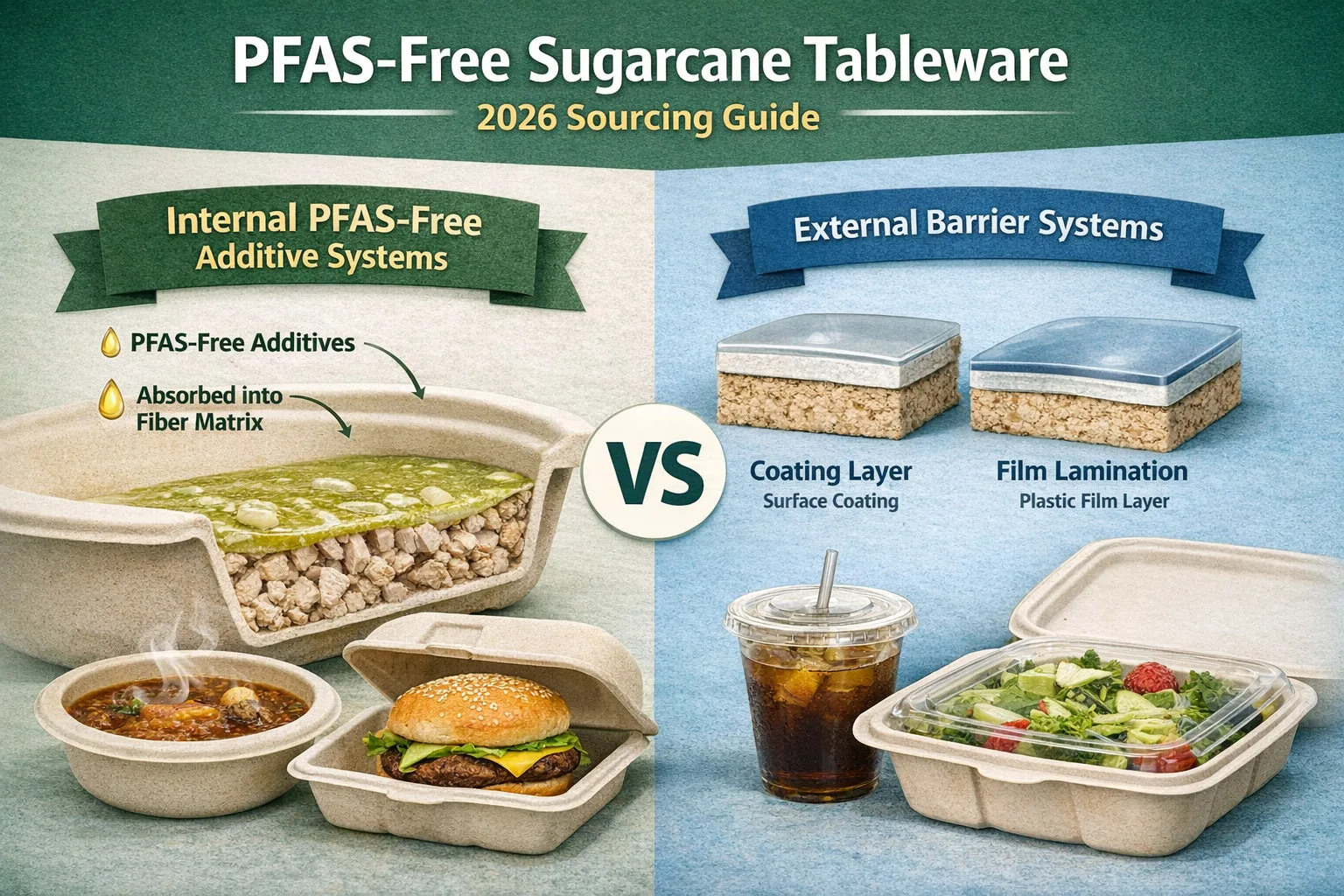
For modern molded sugarcane bagasse tableware, PFAS-free development requires manufacturers to achieve practical oil and moisture resistance using alternative barrier systems rather than relying on intentionally added fluorinated grease-proofing chemistry.
Why Was PFAS Chemistry Used in Fiber Food Packaging?
Untreated plant fiber absorbs oil and water. That becomes a practical problem when a food container is used for fried food, curry, meat juices, sauces or other high-moisture meals.
PFAS-containing grease-proofing substances were historically attractive because they could provide strong resistance to oil and water. The regulatory direction has since changed substantially.
In February 2024, the U.S. Food and Drug Administration announced that manufacturers were no longer selling PFAS-containing grease-proofing substances for food-contact paper and paperboard in the U.S. market. In January 2025, FDA determined that 35 related food contact notifications were no longer effective because those uses had been abandoned.
The practical manufacturing challenge is therefore not simply removing PFAS. A replacement barrier still has to perform during molding and during actual foodservice use.
Manufacturer insight: PFAS-free performance should be evaluated by product geometry and intended food use. A shallow plate carrying dry food does not create the same barrier demand as a deep bagasse food container holding hot, oily food for an extended takeaway period. Chemical formulation and functional testing should therefore be reviewed together.
For buyers comparing alternative grease-resistant systems, Bioleader® provides a separate technical guide to PFAS-free grease resistance technologies for sugarcane tableware.
Does Sugarcane Bagasse Naturally Contain BPA?
BPA is also not an inherent component of sugarcane bagasse fiber. Bisphenol A has historically been associated mainly with certain plastic and epoxy-resin applications rather than untreated plant pulp.
However, the finished food-contact article still needs to be considered. Depending on the construction, inks, adhesives, coatings or polymer components may introduce separate food-contact compliance questions.
This distinction has become more important in the European Union. Commission Regulation (EU) 2024/3190 establishes specific requirements concerning BPA and certain other bisphenols in food-contact materials and articles including adhesives, rubbers, ion-exchange resins, plastics, printing inks, silicones, varnishes and coatings.
Important: The regulation does not mean that sugarcane fiber itself suddenly becomes a BPA-risk material. It means buyers should examine any relevant components used to create the finished food-contact article instead of judging compliance from the fiber name alone.
PFAS-Free, PFOA-Free and BPA-Free Do Not Mean the Same Thing
These terms are frequently placed together in product descriptions, but they refer to different chemical questions.
| Claim | What It Addresses | What It Does Not Automatically Prove |
|---|---|---|
| PFAS-Free | Addresses the broader family of per- and polyfluoroalkyl substances, subject to the definition, test scope and claim basis being used. | It does not automatically establish BPA status, food-contact compliance or compostability. |
| PFOA-Free | Addresses PFOA, one individual substance within the broader PFAS family. | PFOA-free does not mean the product is free from every other PFAS. |
| BPA-Free | Addresses bisphenol A. | It does not establish PFAS status or prove compliance with every applicable food-contact requirement. |
For a more detailed explanation of these claims, see PFAS-Free vs. PFOA-Free vs. BPA-Free: How Buyers Should Compare the Claims.
What Does “No Intentionally Added PFAS” Mean?
“No intentionally added PFAS” is primarily a formulation and supply-chain statement. It means PFAS substances are not deliberately introduced into the product formulation or manufacturing process.
That statement is not identical to a laboratory result.
| Evidence Type | What It Can Show | Buyer Limitation |
|---|---|---|
| No Intentionally Added PFAS Declaration | Documents formulation and supplier-control intent. | It is not by itself a measurement of every PFAS that could be present. |
| Targeted PFAS Analysis | Measures specified PFAS compounds included in the analytical method. | It does not measure compounds outside the test panel. |
| Total Fluorine Screening | Measures overall fluorine and can act as a screening tool for fluorinated chemistry. | Fluorine is not automatically PFAS; additional evidence may be required to determine its source. |
| BPA Analysis or Declaration | Addresses bisphenol A. | It does not provide evidence of PFAS status. |
For procurement, the useful question is therefore not simply “Is it PFAS-free?” but “What does the supplier mean by PFAS-free, and what evidence supports that claim for this exact SKU?”
What Does the EU PPWR Require for PFAS?
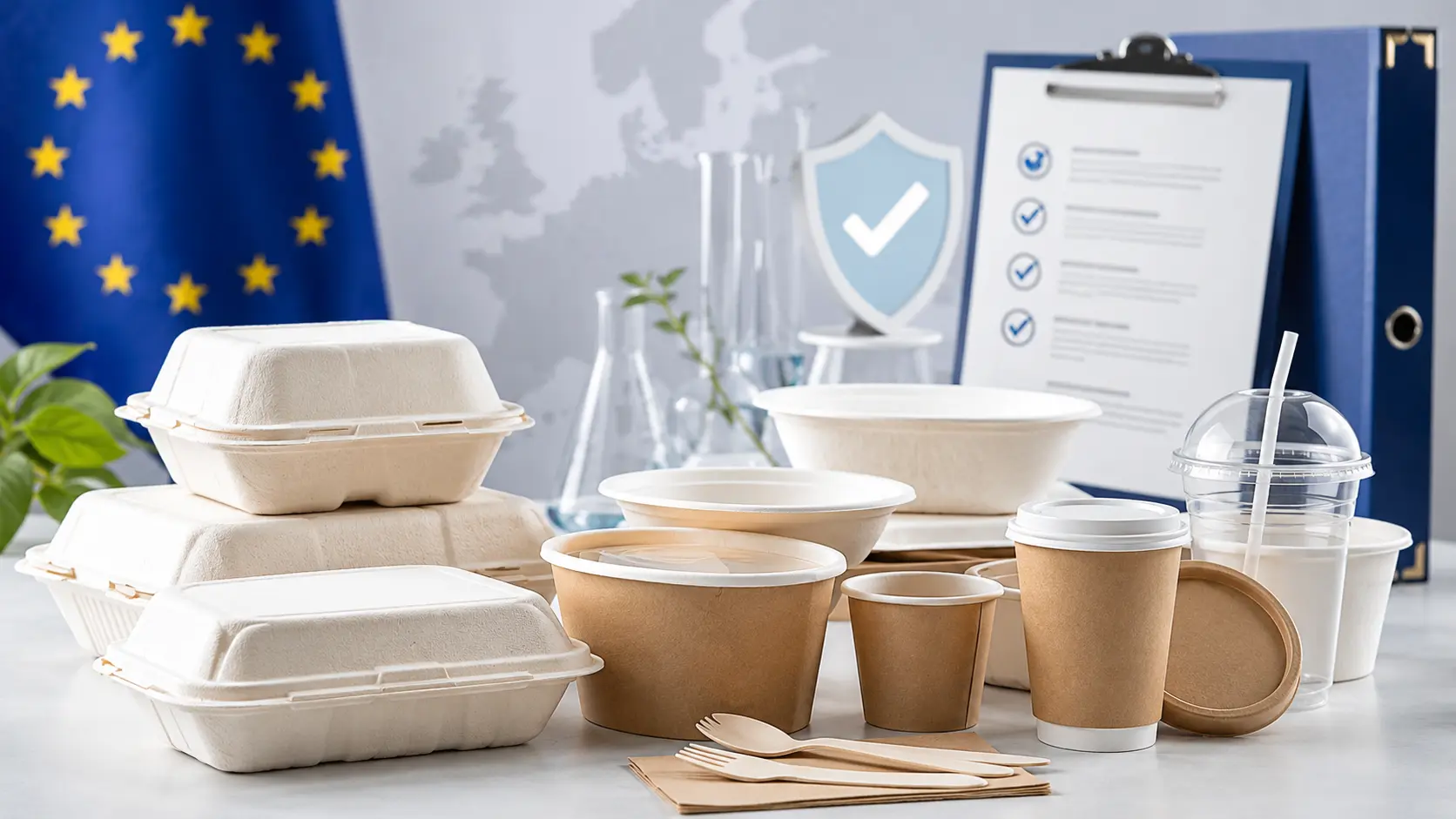
Regulation (EU) 2025/40 on packaging and packaging waste introduced specific PFAS concentration limits for food-contact packaging. From 12 August 2026, covered food-contact packaging cannot be placed on the EU market when PFAS concentrations are equal to or above the specified thresholds, unless another Union legal act already prohibits the packaging at that concentration.
| PPWR PFAS Criterion | Threshold |
|---|---|
| Any individual PFAS measured using targeted PFAS analysis, excluding polymeric PFAS from quantification | 25 ppb |
| Sum of PFAS measured using targeted PFAS analysis, where applicable after degradation of precursors, excluding polymeric PFAS from quantification | 250 ppb |
| PFAS including polymeric PFAS | 50 ppm |
The PPWR also states that where total fluorine exceeds 50 mg/kg, evidence may be required to show the quantity of fluorine attributable to PFAS or non-PFAS sources for preparation of the relevant technical documentation.
Scope warning: PPWR Article 5 applies these PFAS limits to food-contact packaging. Buyers should not automatically assume that every disposable plate, bowl or tableware format has the same legal classification. The product function and destination-market classification should be checked before applying a packaging requirement.
Bioleader® maintains a separate EU PPWR 2026 guidance page for foodservice packaging covering PFAS documentation, manufacturer and importer responsibilities, and Declaration of Conformity considerations.
What Has Changed for PFAS in U.S. Food Packaging?
The U.S. approach differs from the EU PPWR threshold system.
FDA announced in 2024 that PFAS-containing grease-proofing substances were no longer being sold by manufacturers for food-contact use on paper and paperboard packaging in the U.S. In January 2025, FDA determined that 35 related food contact notifications were no longer effective because production, supply or use had ceased.
This development is directly relevant to molded-fiber and paper food packaging because grease resistance has historically been one of the principal food-packaging uses for this chemistry.
Do not replace one vague claim with another. “FDA approved PFAS-free bagasse” is generally not the best procurement language. Buyers should instead ask whether the exact finished article complies with the applicable U.S. food-contact requirements and what PFAS-related documentation supports the supplied formulation.
Can PFAS-Free Bagasse Still Handle Oil and Hot Food?
Yes, but performance is formulation- and application-dependent.
PFAS-free molded fiber can be designed for practical grease and moisture resistance, but chemical compliance does not automatically guarantee satisfactory foodservice performance. The product still needs to be matched to the food, serving temperature, holding time and transport conditions.
A bagasse clamshell box carrying fried chicken may face prolonged contact with hot oil and steam. A bagasse bowl used for curry or other moist food faces a different combination of liquid exposure, temperature and holding time.
Sample approval: Test the actual food or a representative oil-and-water system at the intended serving temperature and holding time. Check for oil staining, seepage, bottom softening, rim deformation, lid fit and structural loss. A chemical test report and a functional food test answer different questions, and both can matter in buyer approval.
How Should Buyers Verify a PFAS-Free or BPA-Free Claim?
The safest B2B approach is to review a defined document package rather than approving a product from marketing wording alone.
Recommended buyer checks:
- Confirm whether the claim applies to the raw fiber, a material formulation or the complete finished SKU.
- Ask whether PFAS are intentionally added to the pulp, barrier formulation or other processing chemistry.
- Check the tested sample description and confirm that it matches the product being ordered.
- Review the analytical method, reporting limit and substances included in targeted PFAS analysis.
- If total fluorine is used as a screening method, understand that fluorine does not automatically identify a specific PFAS compound.
- Review BPA separately where coatings, inks, adhesives, plastics or other relevant components are present.
- Match the documentation to the destination market instead of relying on a supplier-wide certificate list.
This document-to-SKU principle also applies to broader molded-fiber quality control. Bioleader® explains the same sourcing logic in its Sugarcane Bagasse Tableware Quality Control Guide.
Bioleader® Existing PFAS and BPA Compliance Evidence
The original version of this article included three uploaded compliance-document images. They are retained here because first-party product documentation is more useful than replacing them with generic sustainability graphics.
However, a report image should not be treated as proof for every Bioleader® bagasse SKU. Buyers should verify the report number, tested sample, issue date, test method and product scope against the specific item being ordered.

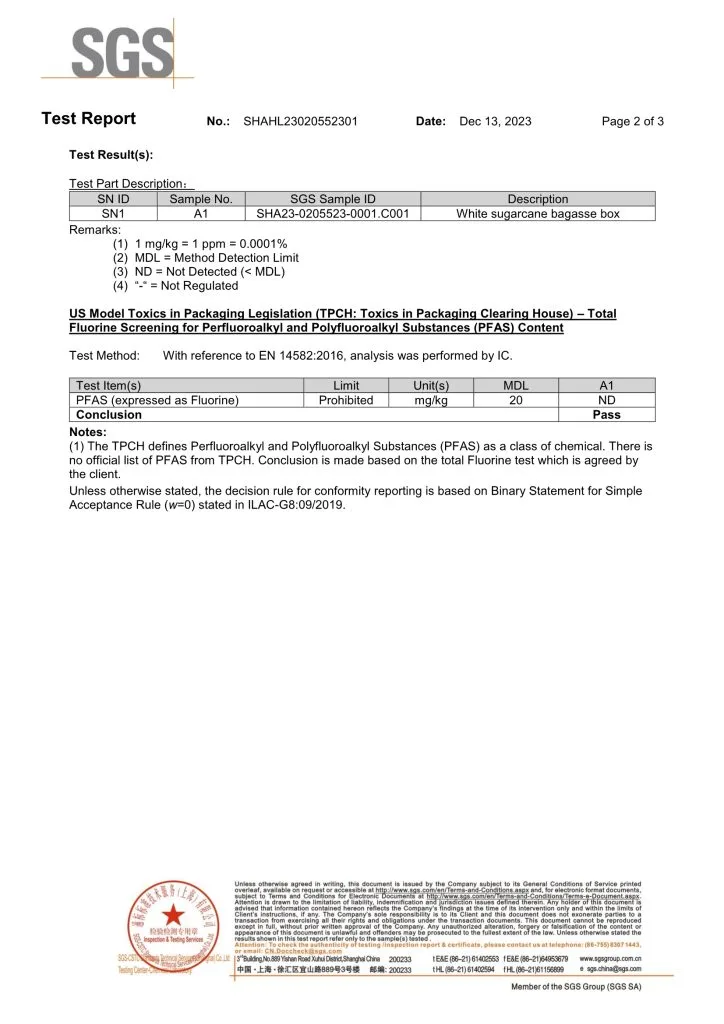

Current certificates and test-report resources can also be reviewed through the Bioleader® Certificates & Test Reports page. Buyers should still confirm which document applies to the product under quotation.
How Bioleader® Approaches PFAS-Free Bagasse Sourcing
Bioleader® manufactures molded sugarcane bagasse food containers, clamshell boxes, bowls, plates and trays for foodservice and export programs. For PFAS-sensitive projects, product selection should start with the intended food, temperature, holding time and destination market rather than with a generic “eco-friendly” specification.
Applicable product programs can be reviewed for PFAS-related formulation information, food-contact documents and available third-party testing during quotation or sample approval. Buyers sourcing for regulated markets should identify the exact SKU and required claim before artwork or bulk production is confirmed.
For a deeper technical explanation of barrier design and food-safety verification, see The Science Behind PFAS-Free Bagasse Tableware.
PFAS-Free vs. BPA-Free: A Practical Procurement Specification
| Buyer Requirement | Recommended Verification |
|---|---|
| PFAS formulation control | Ask whether PFAS are intentionally added and request an applicable formulation or supplier declaration. |
| PFAS analytical compliance | Define the destination-market thresholds and request appropriate targeted analysis, fluorine screening or other supporting evidence. |
| BPA requirement | Review the complete article, including relevant coatings, printing inks, adhesives or polymer components. |
| Food-contact compliance | Request documentation applicable to the exact SKU, intended food use and destination market. |
| Hot-food and grease performance | Test the actual food, temperature, contact time and delivery conditions separately from chemical-compliance testing. |
Frequently Asked Questions
Does sugarcane bagasse naturally contain PFAS?
No. PFAS are synthetic fluorinated substances and are not a natural component of sugarcane fiber. However, the PFAS status of finished bagasse tableware depends on the complete product formulation, including grease-resistant treatments, coatings and other processing inputs.
Can PFAS be used in molded-fiber food packaging?
PFAS-containing chemistry has historically been used in some fiber-based food packaging for grease and moisture resistance. Regulatory and market requirements have changed substantially, and modern PFAS-free molded-fiber products use alternative barrier systems. Buyers should verify the finished formulation rather than relying only on the fiber source.
Is sugarcane bagasse naturally BPA-free?
Bagasse fiber itself is not a natural source of BPA. The finished food-contact article may still contain coatings, inks, adhesives, plastics or other components that require separate review. BPA-free claims should therefore consider the complete construction rather than the pulp alone.
Does PFOA-free mean PFAS-free?
No. PFOA is one substance within the much broader PFAS family. A PFOA-free claim does not establish that all other PFAS are absent. Buyers should confirm the intended PFAS definition, formulation statement and analytical scope behind the supplier’s claim.
Does “no intentionally added PFAS” mean laboratory-tested PFAS-free?
Not necessarily. “No intentionally added PFAS” describes formulation intent and supply-chain control. Targeted PFAS analysis and total-fluorine screening are different forms of evidence. Procurement specifications should state which type of documentation or testing is required for the destination market.
Does a PFAS-free claim automatically prove EU PPWR compliance?
No. For food-contact packaging covered by Regulation (EU) 2025/40, compliance must be assessed against the applicable legal thresholds and technical-documentation requirements. A generic PFAS-free marketing statement does not by itself demonstrate compliance with the 25 ppb, 250 ppb and 50 ppm criteria.
References
- European Union — Regulation (EU) 2025/40 on Packaging and Packaging Waste
- European Commission — 2026 Guidance on Regulation (EU) 2025/40
- European Union — Commission Regulation (EU) 2024/3190 on BPA and Other Bisphenols in Food-Contact Materials
- U.S. FDA — PFAS Used in Grease-Proofing Agents for Food Packaging No Longer Being Sold in the U.S.
- U.S. FDA — Authorization for 35 PFAS-Related Food Contact Notifications No Longer Effective
- U.S. FDA — Authorized Uses of PFAS in Food Contact Applications
Conclusion: Sugarcane bagasse fiber does not inherently contain PFAS or BPA, but the fiber source alone cannot establish the chemical-compliance status of a finished food-contact article. Barrier chemistry, coatings, inks, adhesives and other manufacturing inputs must be considered where relevant.
For procurement, separate the questions clearly: determine whether PFAS are intentionally added, identify what analytical evidence is required, review BPA-relevant components, verify food-contact compliance for the destination market, and test foodservice performance under the actual use conditions. The strongest evidence is documentation that can be matched to the exact SKU and current production formulation.