Sugarcane Bagasse Tableware Quality Control: Quick Buyer Summary
Sugarcane bagasse tableware quality control is the practical process of verifying whether a molded fiber plate, bowl, tray, clamshell box or food container can perform consistently in real foodservice use and bulk export supply. The key checks include raw fiber quality, pulp consistency, molding density, thickness tolerance, edge trimming, surface finish, structural stiffness, oil and water resistance, PFAS-free documentation where relevant, lid fit, stacking, carton strength and container-loading protection.
For importers, distributors and foodservice brands, the real purchasing question is not simply whether bagasse is “eco-friendly.” The more important question is whether a specific SKU can handle the buyer’s food type, temperature, holding time, delivery route, storage condition, brand presentation and local compliance requirements. Bioleader® evaluates bagasse tableware from a manufacturer’s point of view: material selection, mold stability, sample approval, food-contact documentation, packaging design and pre-shipment inspection must work together as one repeatable QC system.
- Approve the product by application, not only by appearance.
- Check whether the sample, mold, material, thickness and packing method match the planned bulk order.
- Verify PFAS-free and grease-resistance claims at SKU level when the target market requires it.
- Test plates, bowls, trays, clamshell boxes and food containers differently because they fail in different ways.
- Include denesting, carton compression and container loading in the QC decision, not only surface inspection.
Introduction: Why QC Is The Buyer’s Real Risk Filter
Sugarcane bagasse tableware has become a mainstream molded fiber option for restaurants, catering operators, supermarket deli counters, takeaway chains, institutional foodservice programs and sustainable packaging distributors. It is made from plant-based fiber and can replace many conventional plastic or foam food packaging items in suitable applications. However, the material advantage alone does not guarantee order success.
In real export business, many complaints do not come from the word “bagasse” itself. They come from practical details: a clamshell hinge cracks after repeated opening, a plate bends under heavy meals, a bowl becomes soft with soup or curry, a tray does not denest smoothly during service, a lid does not match the container, or cartons arrive compressed after long-distance transport.
This guide focuses on practical sugarcane bagasse tableware quality control for B2B buyers. It explains what to inspect, why each check matters, what buyer risk it controls and how to ask a supplier for verification before bulk ordering. Buyers sourcing sugarcane bagasse tableware should treat QC as a purchasing system rather than a final visual check. The strongest sourcing decision combines sample testing, documentation review, supplier process control and carton-level transport planning.
Why Bagasse Tableware QC Matters For Importers, Distributors And Foodservice Brands
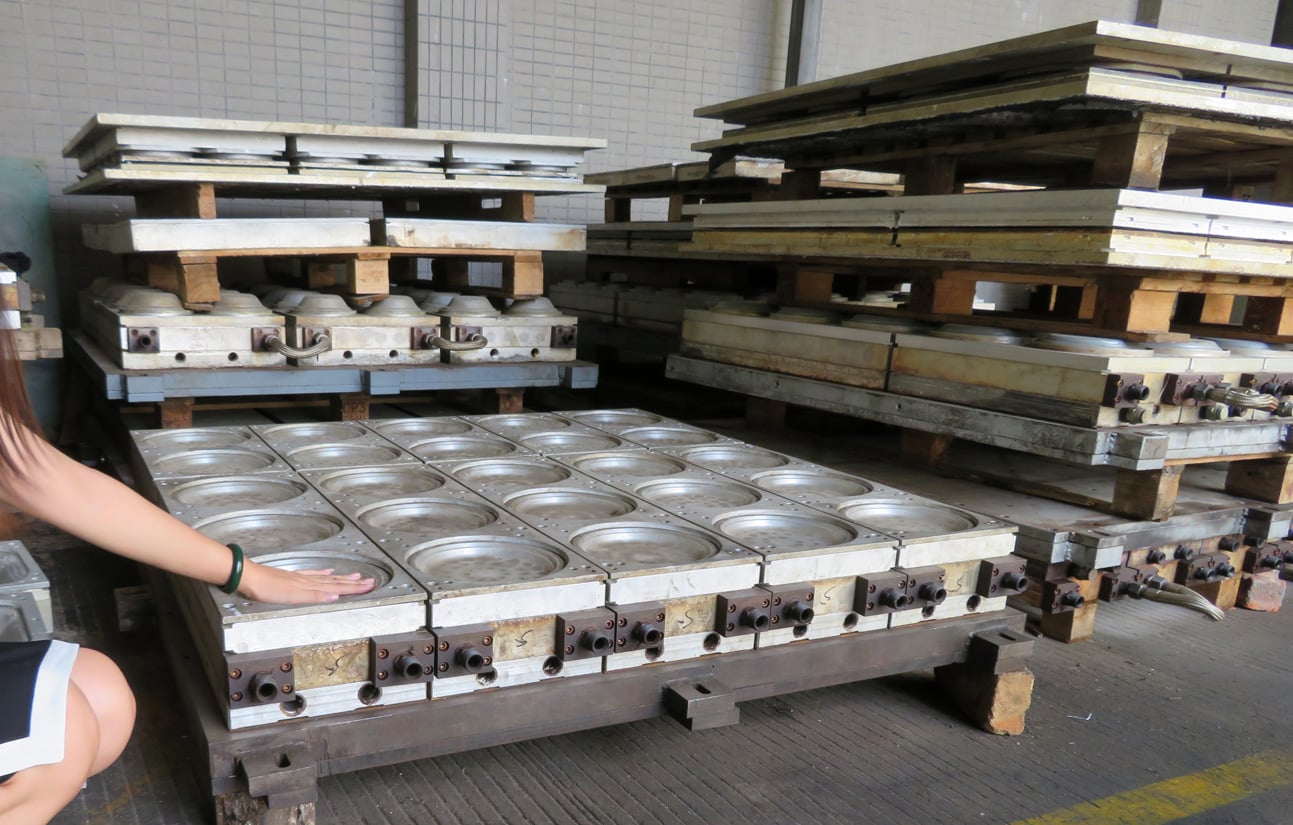
Bagasse tableware is produced through a molded pulp process. Quality depends on raw fiber preparation, pulp concentration, forming pressure, mold precision, drying temperature, trimming control, sorting discipline, packing method and warehouse storage. A small process variation can affect stiffness, edge quality, surface smoothness, oil resistance or stacking behavior.
For importers and distributors, poor QC can create downstream cost: customer returns, rejected shipments, unstable private label presentation, container space waste, carton damage claims and difficult reorder management. For foodservice brands, the risks are more direct: customers see weak plates, leaking boxes, deformed bowls or rough edges during actual dining and delivery.
QC also protects the buyer’s sustainability positioning. Buyers choosing bagasse packaging usually want a fiber-based solution that supports plastic reduction and foodservice functionality at the same time. If the product fails in use, the packaging story loses credibility even when the material choice is directionally correct.
Bioleader® buyer note: In molded fiber sourcing, the lowest unit price is not automatically the lowest total cost. A weak structure, poor nesting ratio or unsuitable carton can increase customer complaints, warehouse loss and freight cost. The better decision is to approve a specification that can be repeated safely across bulk orders.
Manufacturer Perspective: What Bioleader® Checks Before Bulk Production
From a manufacturer perspective, quality control starts before mass production. Bioleader® reviews the buyer’s food application, target market, product family, size, depth, mold structure, thickness expectation, surface requirement, lid compatibility, packing method and documentation needs before confirming a bulk order. This is especially important when buyers request private label cartons, mixed product families, PFAS-free options or export-ready container loading.
For molded fiber products, a reliable supplier should control the full chain: raw bagasse fiber preparation, pulp consistency, forming, drying, trimming, sorting, counting, packing and pre-shipment inspection. The supplier should also communicate application limits clearly. A plate for bakery items, a bowl for hot soup, a tray for supermarket display and a clamshell box for oily takeaway meals may require different acceptance standards.
Bioleader® does not treat QC as a paperwork exercise. It is a product-use decision. Our practical rule is simple: the approved sample must represent the same material, mold, thickness, surface finish, food-use condition and packing method intended for bulk production. If any of these factors change, the buyer should request confirmation again before shipment.
| Bioleader® factory judgement | Why it matters to buyers |
|---|---|
| The sample must match the final order specification. | A beautiful sample is not enough if mass production uses a different mold, weight, finish or packing method. |
| Food application must be defined before approval. | Dry bakery, hot rice, fried food, curry, soup and salad dressing create different risks. |
| Documentation must match the SKU and target market. | Generic material claims cannot replace product-specific food-contact or PFAS-free records where required. |
| Carton packing is part of product quality. | Good tableware can still arrive damaged if cartons are weak, overcompressed or poorly loaded. |
The 15-Point Sugarcane Bagasse Tableware Quality Control Framework
A strong inspection framework gives buyers a repeatable way to compare suppliers and samples. The following 15 checks are designed for practical B2B use before bulk ordering, especially for importers, distributors and foodservice operators that need stable quality across repeat shipments.
| QC check | What to inspect | Buyer risk | Supplier verification method |
|---|---|---|---|
| Raw fiber quality | Fiber cleanliness, natural color, odor and impurity control. | Visible black spots, unstable color, odor complaints or weak structure. | Ask how incoming fiber is screened, stored and controlled by production lot. |
| Pulp consistency | Uniform pulp distribution across rim, wall, base and corners. | Thin spots, uneven absorption, soft areas or inconsistent strength. | Request process control points for pulp concentration and forming stability. |
| Molding density | Firmness, molded definition and density across flat and curved areas. | Soft products, weak support and poor food presentation. | Compare weight, hand feel and molded definition across multiple samples. |
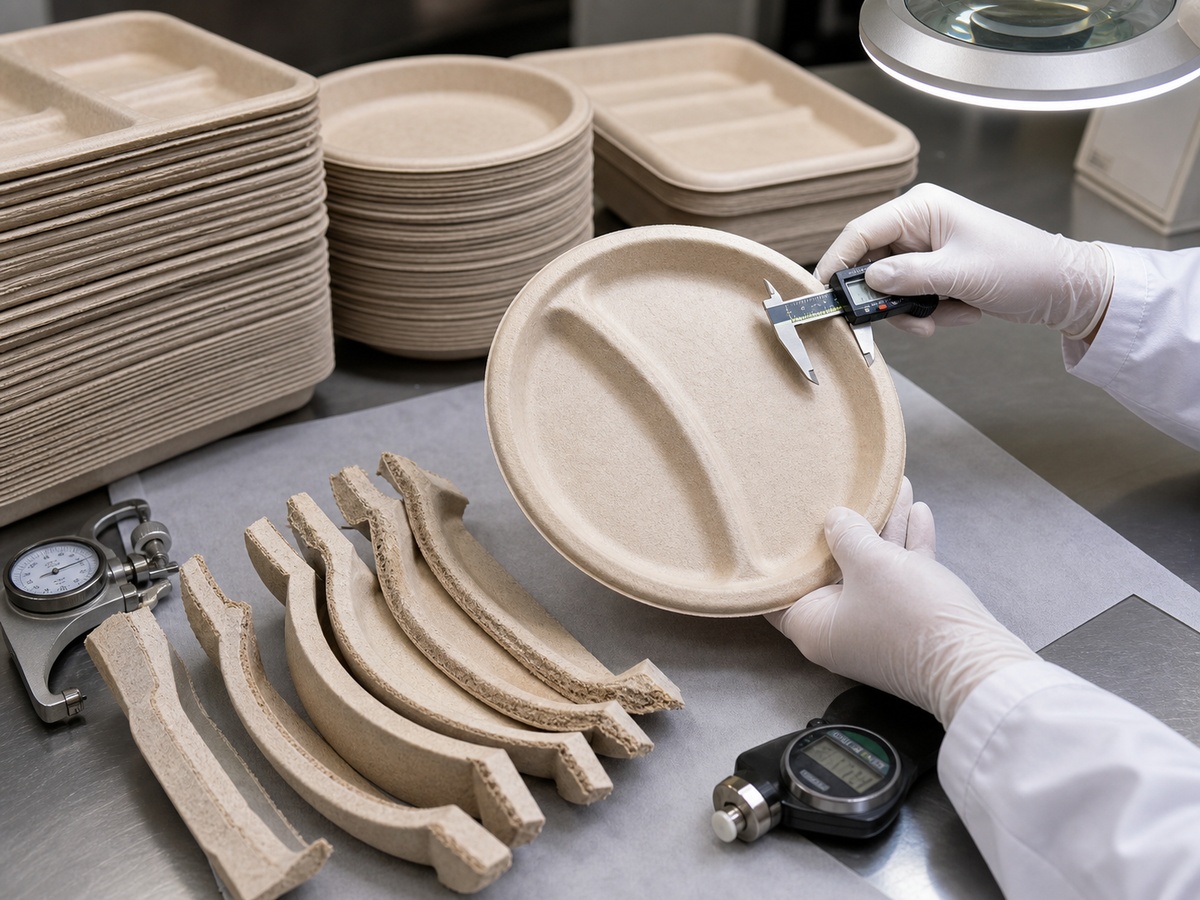
| Thickness and weight tolerance | Actual product weight and thickness against approved sample range. | Cost disputes, performance variation and weaker repeat shipments. | Use random sample weighing and define acceptable tolerance before production. |
| Edge trimming and burrs | Cut edges, rim smoothness, corner finishing and loose fibers. | Rough hand feel, poor retail appearance and user complaints. | Inspect rims and corners by sight and touch under normal lighting. |
| Surface smoothness | Food-contact surface, external finish, wrinkles, dents and fiber marks. | Brand perception issues and possible food residue retention. | Check both sides of samples from different positions in the stack. |
| Color consistency | Natural beige or white tone consistency between pieces and cartons. | Retail shelf inconsistency and private label presentation problems. | Compare samples from several cartons and define an acceptable color range. |
| Structural stiffness | Resistance to bending, twisting and loaded food handling. | Weak plates, sagging trays or unstable delivery packaging. | Test with realistic food weight instead of empty-product inspection only. |
| Bottom and sidewall support | Base flatness, sidewall strength and filled-food stability. | Spillage, deformation and poor takeaway experience. | Fill with representative food or equivalent weight and observe over time. |
| Oil and water resistance | Performance with water, sauce, oil, dressing or moist food. | Seepage, staining, softening or product collapse. | Run application-based observation tests using the buyer’s expected food condition. |
| PFAS-free option control | Whether PFAS-free performance and documentation are required for the SKU. | Compliance misunderstanding or unsuitable grease-resistance expectations. | Request SKU-specific declaration or testing documentation where relevant. |
| Heat resistance and microwave-use caution | Stability under intended hot food, holding or reheating condition. | Softening, deformation or consumer misuse claims. | Verify supplier instructions and avoid universal microwave claims. |
| Lid or accessory compatibility | Fit with matching lids, inserts, trays or packaging accessories. | Loose lids, poor closure, leakage and delivery complaints. | Test the exact product-and-accessory combination intended for the order. |
| Stacking, nesting and denesting | How products stack, separate and feed during service operations. | Slow service, damaged rims or stuck products in busy kitchens. | Test manual separation from a full stack, not only single pieces. |
| Carton compression and transport protection | Carton strength, inner packing, pallet condition and export loading method. | Crushed rims, deformed products and container unloading complaints. | Review carton specs, loading method and pre-shipment inspection photos. |
Buyer Inspection Checklist Table
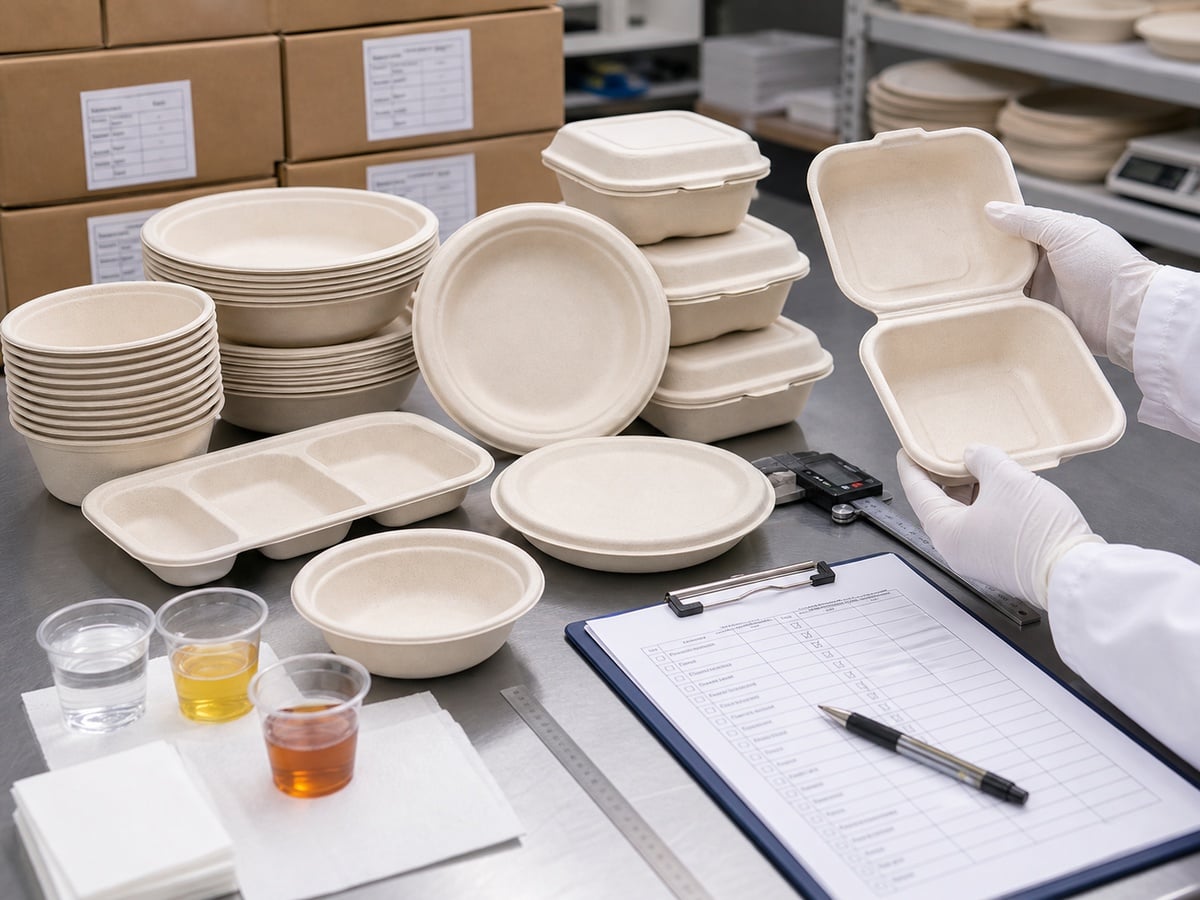
Buyers do not need a complex laboratory to catch many common risks. A practical checklist should combine visual inspection, handling tests, food-scenario testing and supplier documentation. The goal is to approve a product that fits the buyer’s application, not to force every molded fiber product into the same standard.
| Inspection area | Acceptance signal | Warning signal | Buyer action |
|---|---|---|---|
| Appearance | Clean surface, consistent color and smooth trimmed edge. | Dark spots, rough burrs, cracks, dents or uneven molded areas. | Request revised samples or define visual tolerance in writing. |
| Strength | Product supports expected food weight without sagging. | Plate bends, tray twists, bowl sidewall collapses or hinge cracks. | Ask for stronger structure, higher density or a different product format. |
| Food contact performance | Reasonable resistance under intended food, temperature and holding time. | Early oil staining, water absorption, softening or odor transfer. | Review application fit and grease-resistance requirements before approval. |
| Documentation | Supplier provides relevant food-contact and claim documentation for the SKU. | Only broad marketing statements are provided without product-specific support. | Hold approval until documentation matches the target market and product. |
| Packing | Products are protected, counted correctly and easy to unload. | Crushed edges, loose inner packing, weak cartons or poor pallet condition. | Review carton strength, pieces per carton and container loading method. |
Bioleader® practical judgement: A buyer should not approve a bagasse item only because the first sample looks clean. The better test is whether five to ten random pieces behave consistently under the buyer’s real food condition, real holding time and real handling process.
Sample Approval Workflow Before Bulk Ordering
A sample approval workflow should confirm that the sample represents the final production specification. For custom sugarcane pulp molded products, this is especially important because mold design, size, thickness, surface texture, embossing, lid fit and carton packing may differ from standard catalog products.
- Define the exact food application, including food type, temperature, oil level, water content, holding time and delivery condition.
- Request samples that match the intended size, shape, thickness, color, accessory requirement and packing plan.
- Inspect appearance, edge trimming, surface smoothness, weight, base flatness and structural stiffness across multiple pieces.
- Test the product with representative food or a realistic substitute under expected service conditions.
- Check denesting, stacking, lid fit and handling speed because these affect restaurant and catering efficiency.
- Review food-contact, PFAS-free option or grease-resistance documentation where relevant to the target market.
- Confirm inner packing, pieces per carton, carton dimensions, gross weight, pallet method and export protection.
- Approve a written sample standard with photos, product specification and supplier confirmation before mass production.
The approved sample should be kept as a reference for future production checks. If the supplier changes mold, material, coating approach, packing method or production site, the buyer should request a new confirmation sample before allowing bulk shipment.
PFAS-Free, Grease Resistance And Oil-Resistance Risks
Grease resistance is one of the most important and most easily misunderstood topics in bagasse tableware sourcing. Buyers may ask for PFAS-free options and still expect strong oil resistance for hot, oily or sauced food. These requirements should be discussed carefully because performance depends on product design, treatment method, food type, service temperature, holding time and market documentation requirements.
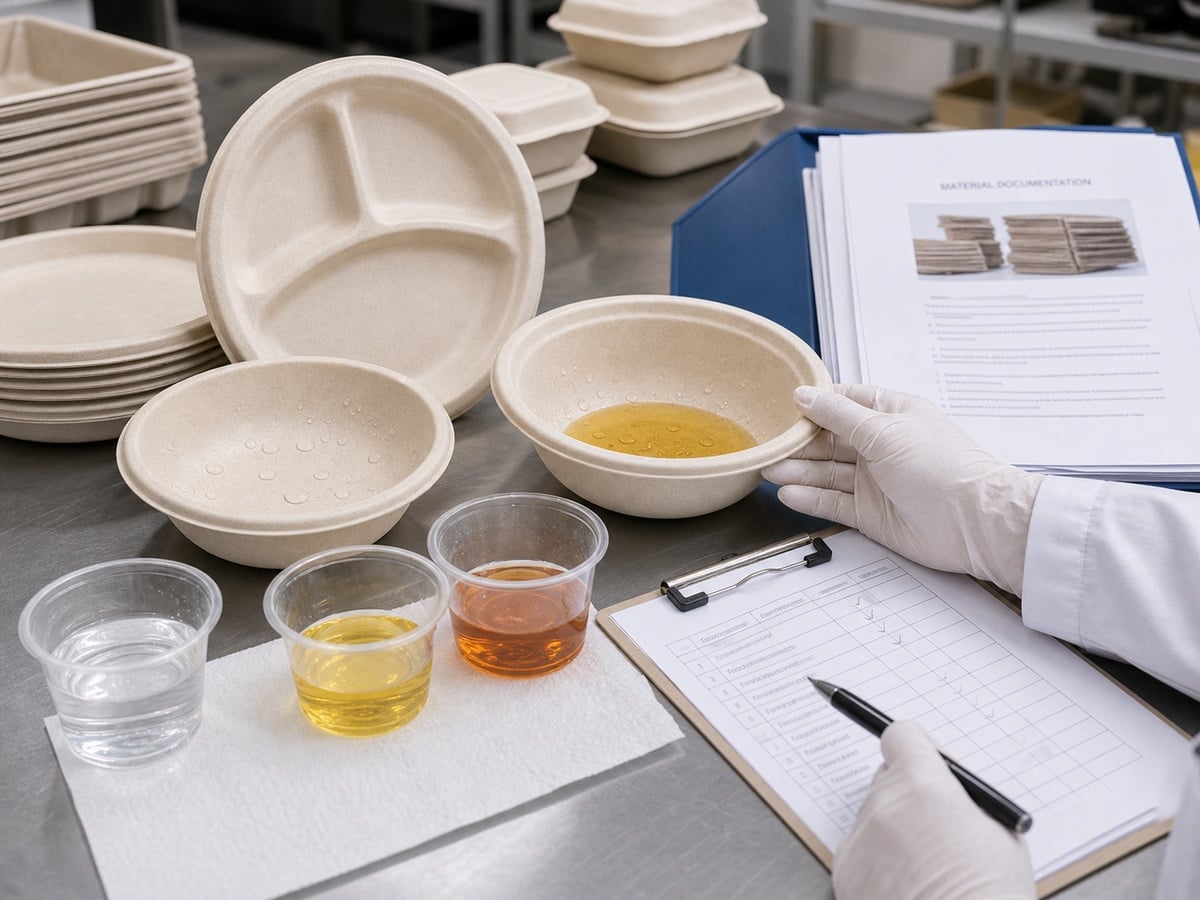
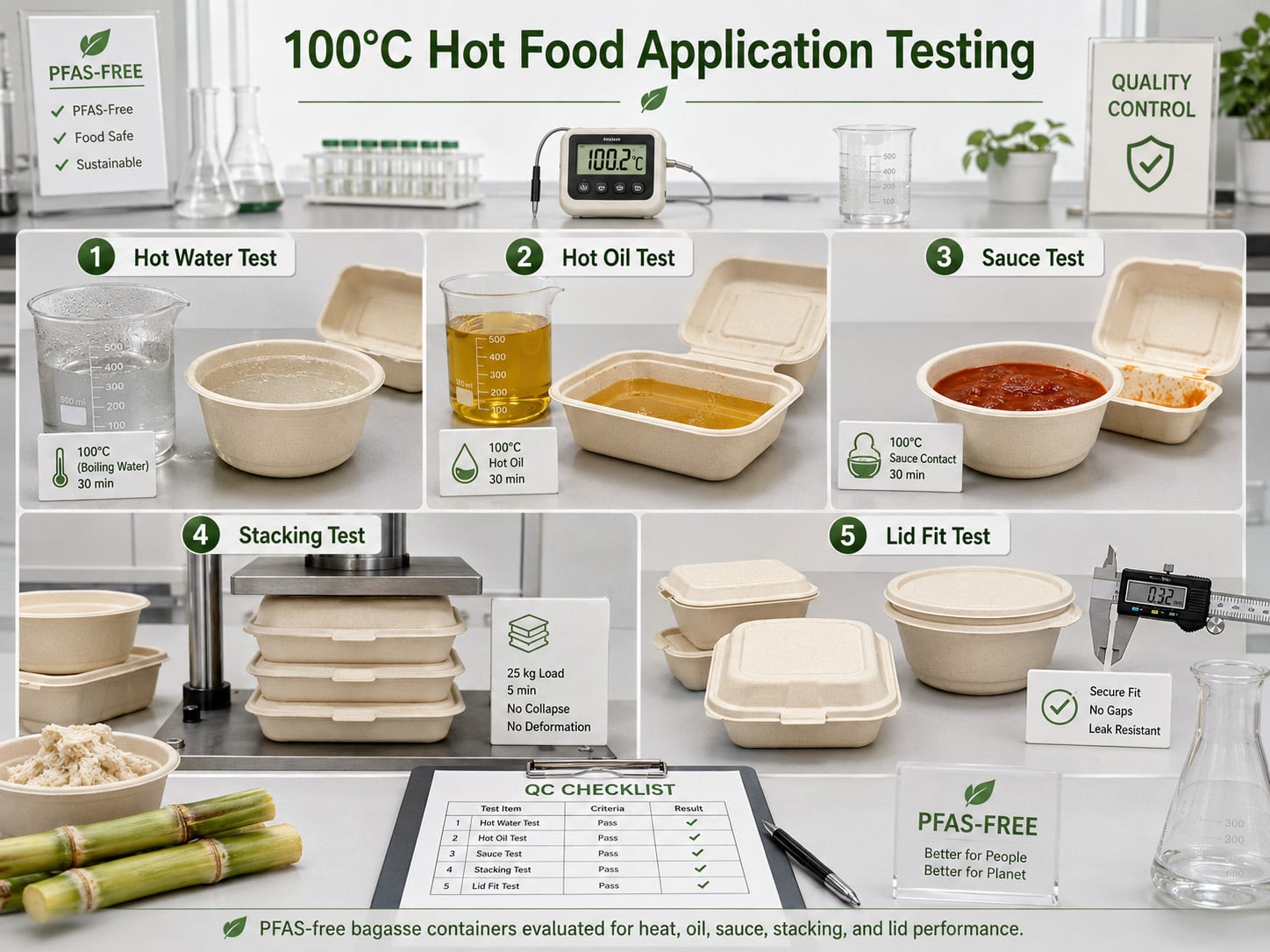
Buyers should treat PFAS-free grease resistance technologies for sugarcane tableware as a sourcing and verification topic, not a slogan. A supplier should explain what product option is being quoted, what documentation is available and what food application the product is suitable for. Where PFAS-free or total fluorine documentation is needed, the buyer should request SKU-specific records rather than relying on broad product-family statements.
It is also important to avoid overclaiming. PFAS-free bagasse tableware is not automatically suitable for every hot oily food. Fried food, chili oil, curry, cheese sauce, salad dressing and long delivery holding time can create different results. A buyer handling these foods should ask for application-based testing and confirm the expected use condition in writing. Related questions about PFAS and BPA in sugarcane bagasse tableware should be answered with documentation, not assumption.
| Buyer question | Correct sourcing approach |
|---|---|
| Does PFAS-free mean the product is suitable for all oily food? | No. PFAS-free status and oil-resistance performance should be checked separately under the intended food condition. |
| Can one PFAS-free document cover every product? | Buyers should request documentation that matches the relevant SKU, material option and target market requirement. |
| Should buyers test with water only? | No. Water testing is useful but not enough for oil, sauce, dressing, curry or long delivery holding time. |
| Can the supplier guarantee zero complaints? | No serious supplier should promise that. The correct approach is to define application limits, test conditions and acceptance standards. |
Product-Specific QC Differences
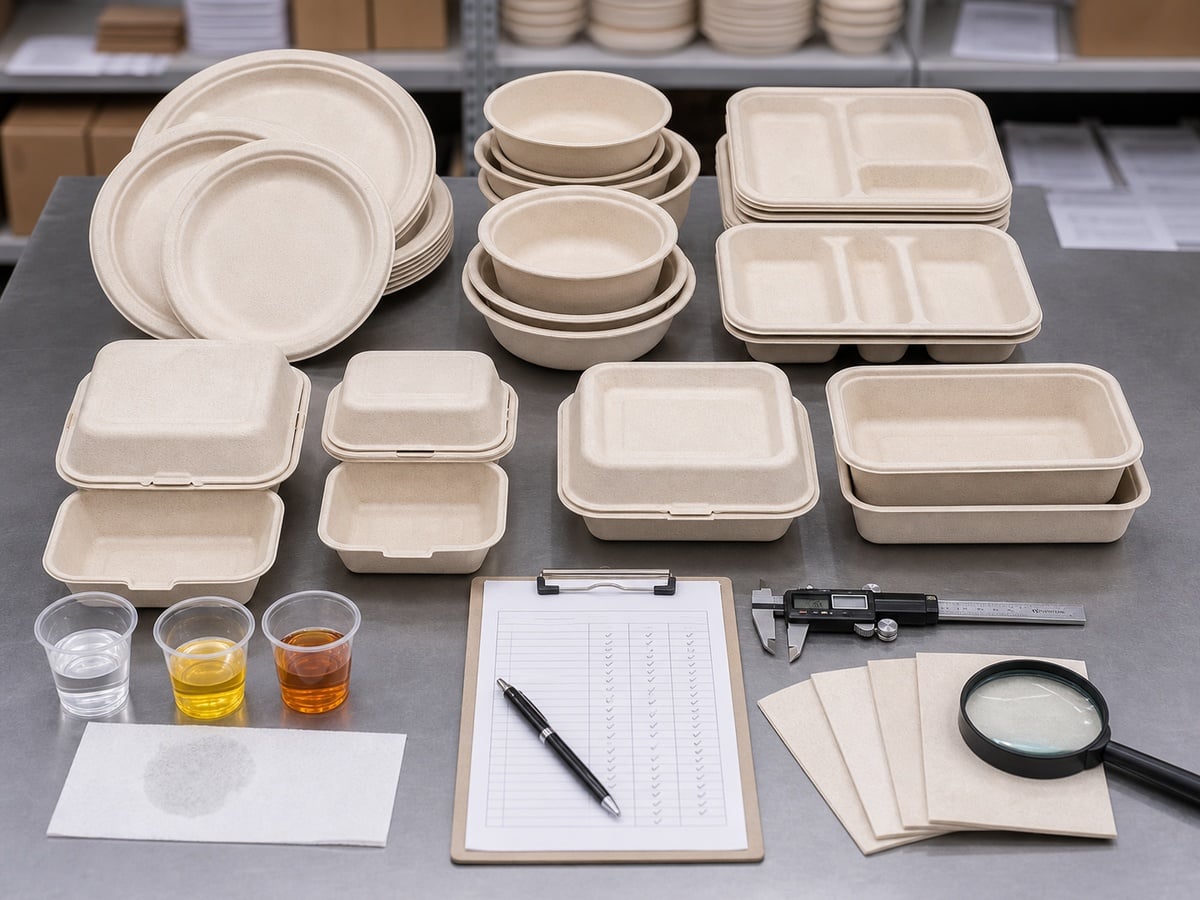
One QC standard cannot cover every molded fiber product in the same way. Bagasse plates, bagasse bowls, bagasse trays, bagasse clamshell boxes and bagasse food containers each have different failure points. Buyers should match inspection priorities to the product family.
| Product family | Main QC focus | Typical buyer risk | Bioleader® inspection judgement |
|---|---|---|---|
| Bagasse plates | Flatness, rim strength, cut resistance, surface smoothness and loaded-food support. | Plate bending under meals or poor presentation in catering service. | Test with realistic food weight, not only by hand feel. |
| Bagasse bowls | Sidewall stiffness, bottom support, capacity, oil/water resistance and stacking stability. | Sidewall softening, deformation or poor hand feel with hot food. | Check filled-food holding time and temperature condition before approval. |
| Bagasse trays | Compartment strength, corner definition, denesting and resistance to twisting. | Compartment collapse, stuck trays or poor supermarket display. | Inspect compartment edges and separation from full stacks. |
| Bagasse clamshell boxes | Hinge durability, lock closure, lid alignment, ventilation and stacking. | Loose closure, cracked hinge or poor takeaway delivery experience. | Open and close repeatedly and test with the intended food weight. |
| Bagasse food containers | Capacity, lid compatibility, base stability, food presentation and carton protection. | Loose lid, leakage, base deformation or crushed rims during transport. | Test the container and lid as one system before bulk confirmation. |
If a buyer needs bagasse trays with lids, accessory fit should be tested as part of the product, not treated as a separate add-on. Lid mismatch can create delivery complaints even when the tray itself is well molded.
Bulk Order, Carton Packing And Container Loading Implications
Bulk order quality is not only about the product on the table. It also depends on how the product is counted, bagged, stacked, packed into cartons, palletized and loaded for export. Molded fiber products are light but bulky, so carton dimensions and nesting efficiency affect freight cost, warehouse space, unloading efficiency and damage risk.
Before confirming a bulk order, buyers should ask for pieces per carton, carton dimensions, gross weight, inner packing method and loading quantity. Products that look strong individually may arrive with bent rims if carton compression is not controlled. Clamshell boxes may lose alignment if packed too tightly. Plates and trays may create denesting problems if stacking pressure is excessive.
For FOB China sourcing, Bioleader® recommends reviewing product specification and carton data together. A lower unit price may not be the best value if the carton loading is inefficient or the packing method increases damage risk. Export-ready QC should connect product inspection with carton-level protection and container-loading logic.
| Bulk order item | What buyers should confirm | Why it affects final cost |
|---|---|---|
| Pieces per carton | Whether the count is suitable for warehouse handling and customer resale. | Wrong packing units create repacking cost and distribution inefficiency. |
| Carton dimensions | Length, width, height and nesting efficiency. | Bulky cartons increase container space cost even when unit price looks low. |
| Carton strength | Compression resistance and protection during stacking. | Weak cartons can deform rims and corners during export transport. |
| Inner packing | Bag quantity, sleeve tightness and product separation. | Loose or excessive pressure can damage edges or make products difficult to use. |
| Loading plan | Container loading quantity, pallet option and mixed-SKU arrangement. | Poor loading causes wasted space, crushed cartons and unloading complaints. |
Buyer Decision Checklist Before Approving A Supplier
Before approving bulk sugarcane bagasse tableware, buyers should separate three issues: material suitability, product performance and supplier execution. A product may be made from the right material but still be unsuitable for the buyer’s food scenario or export route.
- Application match: Does the product match dry food, wet food, oily food, hot food, cold food or delivery use?
- Structure match: Is the thickness, density, rim strength and base stability strong enough for the expected food weight?
- Documentation match: Are food-contact, PFAS-free or other claim documents relevant to the exact SKU and target market?
- Accessory match: Have the matching lids, inserts or trays been tested together with the main product?
- Packing match: Are carton quantity, carton strength and container loading suitable for export?
- Repeat order match: Can the supplier repeat the same mold, weight range, color range and packing method in future orders?
Bioleader® recommends that buyers write these requirements into the purchase confirmation or sample approval record. Clear written standards reduce disputes and help both buyer and factory manage repeat shipments more efficiently.
Bioleader® Support For Bagasse Tableware QC Before Bulk Ordering
Bioleader® manufactures and supplies molded fiber packaging for B2B buyers, including plates, bowls, trays, clamshell boxes, food containers and related sugarcane bagasse tableware solution programs. The company supports bulk wholesale and export buyers with product matching, sample review, custom packaging discussion, documentation coordination and carton planning.
For buyers building a new product line, Bioleader® can help compare standard categories, private label requirements and application-specific performance needs. For repeat buyers, the discussion can focus on consistent product tolerance, packing efficiency, reorder planning and shipment reliability. The best result is not simply a lower piece price, but a product specification that can be repeated across bulk orders.
For distributors, foodservice brands and takeaway packaging buyers, Bioleader® offers bagasse packaging solutions across common foodservice formats, with a practical QC workflow covering sample confirmation, food-use review, SKU-level documentation support and export packing control.
FAQ: Sugarcane Bagasse Tableware Quality Control
How do buyers check sugarcane bagasse tableware quality?
Buyers should inspect fiber consistency, molding density, thickness, edge trimming, surface smoothness, stiffness, oil and water resistance, accessory fit, stacking, carton packing and relevant documentation. The most useful test uses the actual food type, service temperature, holding time and delivery condition expected in the buyer’s market.
Is bagasse tableware oil resistant?
Bagasse tableware can be designed for improved oil and moisture resistance, but performance depends on the product option, food type, temperature and holding time. Buyers should test samples with representative food and ask the supplier to clarify the quoted resistance level and supporting documentation.
Is PFAS-free bagasse tableware always suitable for hot oily food?
No. PFAS-free status and hot oily food performance should be reviewed separately. A PFAS-free option may still need application testing for chili oil, fried food, curry, cheese sauce or long delivery holding time. Buyers should request SKU-specific documentation and confirm the intended food use before bulk approval.
What should buyers test before ordering bagasse clamshell boxes?
Buyers should test hinge strength, lock closure, lid alignment, stacking stability, compartment support, denesting and performance with the intended food. Clamshell boxes for takeaway should also be checked after handling, bagging and delivery-style movement, not only as empty samples.
What documents should importers request from a bagasse tableware supplier?
Importers should request product specification, material declaration, food-contact documentation for the target market, PFAS-free or total fluorine documentation where relevant, sample approval records, packing details and pre-shipment inspection information. Required documents should match the exact SKU and order specification.
Are bagasse plates and bowls microwave safe?
Microwave suitability should be treated as product-specific and instruction-based. Some bagasse items may be suitable for limited reheating under supplier guidance, while others should not be promoted for microwave use. Buyers should verify the supplier’s product instructions and avoid universal microwave claims.
Why does the same bagasse product perform differently with different foods?
Food temperature, oil level, water content, acidity, weight and holding time all affect molded fiber performance. A product that works well for dry bakery items may not be suitable for hot oily meals or long-distance takeaway delivery without additional verification.
How does Bioleader® support bagasse tableware QC before bulk ordering?
Bioleader® supports buyers by reviewing application needs, product family selection, sample quality, grease-resistance expectations, documentation requirements, custom packaging details and export carton planning. This helps buyers confirm a practical specification before committing to bulk sugarcane bagasse tableware orders.
Conclusion: Quality Control Turns Bagasse Sourcing Into A Repeatable System
Sugarcane bagasse tableware quality control should help buyers make a sourcing decision, not only identify defects after shipment. The strongest approach checks product structure, food application, documentation, accessory fit and export packing before bulk production begins.
For B2B buyers, the practical rule is clear: approve the product that matches the food, the market, the brand and the logistics route. When quality checks are connected to real use conditions, bagasse tableware becomes easier to source, sell, store and reorder with confidence.