









Quick Summary: PFAS-Free Sugarcane Tableware for 100°C Hot Food
PFAS-free sugarcane tableware is becoming a critical packaging solution for restaurants, takeaway brands, caterers, supermarkets, and global foodservice distributors. For hot food applications up to 100°C under controlled use conditions, performance depends not only on removing intentionally added PFAS, but also on pulp quality, fluorine-free formula design, hot pressing, moisture control, lid matching, and strict production-line quality inspection.
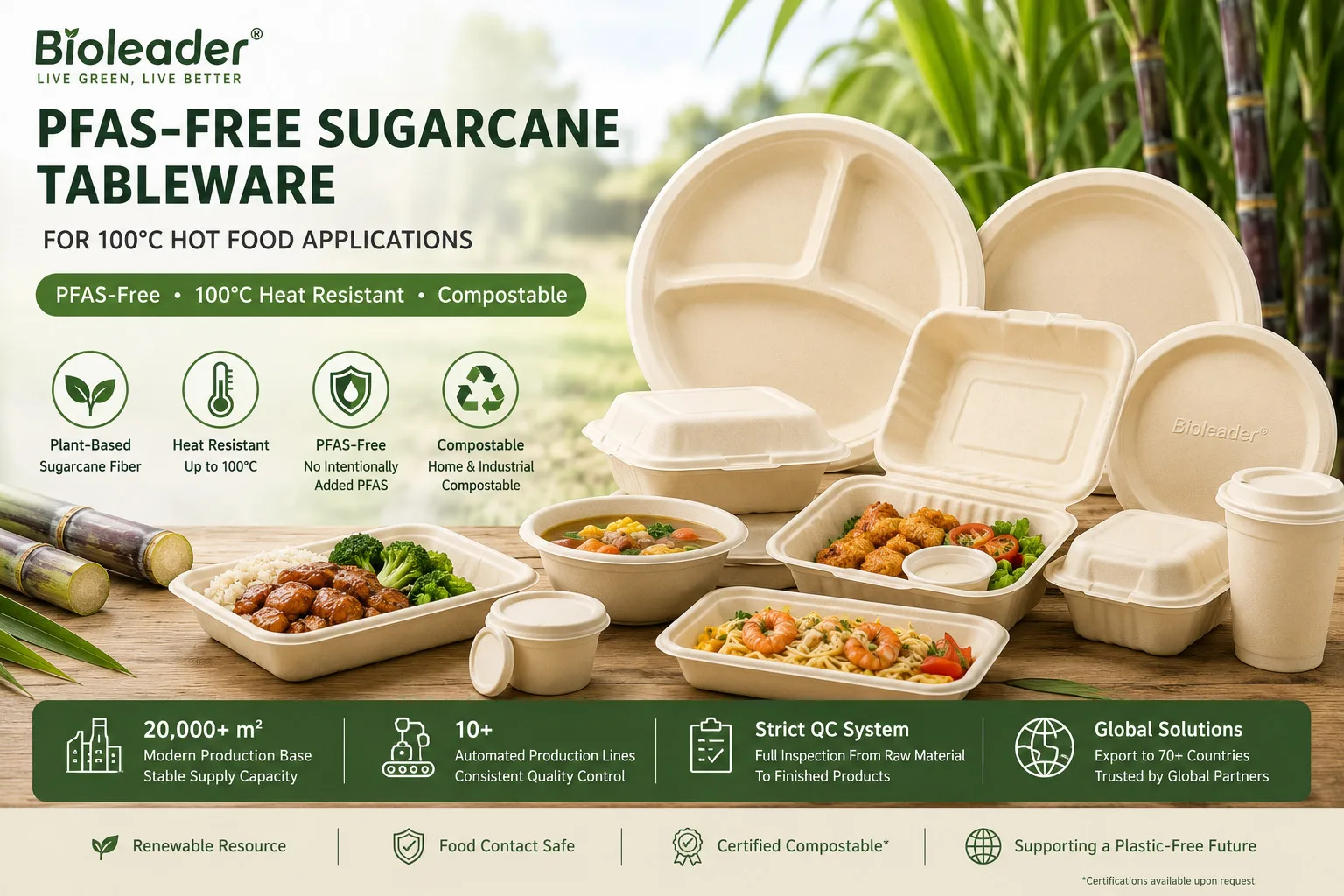
Renewable sugarcane bagasse fiber molded into compostable plates, bowls, trays, clamshells, and food containers.
Designed for hot food contact applications up to 100°C, depending on food type, oil level, sauce content, and holding time.
PFAS-free formula development, molded fiber production-line control, hot food testing, export packaging, and bulk order supply experience.
Reliable PFAS-free performance is a manufacturing capability, not just a sustainability claim or one-time sample result.
PFAS-Free Sugarcane Tableware for 100°C Hot Food: A Manufacturer’s Guide to Safer, Scalable Food Packaging
For foodservice brands, importers, distributors, and takeaway packaging buyers, PFAS-free sugarcane tableware is no longer a niche sustainability request. It is becoming a practical purchasing requirement driven by food safety expectations, changing packaging regulations, and the need for high-performance disposable containers that can handle hot meals, oil, sauce, steam, and delivery pressure.
However, one misunderstanding is becoming common in the market: many buyers assume that “PFAS-free” automatically means “ready for hot oily food.” In real manufacturing, that is not true. PFAS-free performance is not created by a single claim, a simple certificate, or one additive. For molded fiber tableware, reliable heat and grease resistance depends on the full production system: pulp selection, formula design, forming pressure, hot pressing, mold precision, drying control, edge structure, weight tolerance, and quality inspection.
As a manufacturer of biodegradable and compostable food packaging, Bioleader® approaches PFAS-free sugarcane tableware as an engineering solution. The goal is not only to remove intentionally added fluorinated chemicals, but also to build food containers that can support real foodservice applications, including hot rice meals, noodles, curry, grilled food, fried items, sauced dishes, and takeaway meals served close to 100°C under controlled use conditions.
Why PFAS-Free Sugarcane Tableware Is Becoming a Strategic Packaging Category
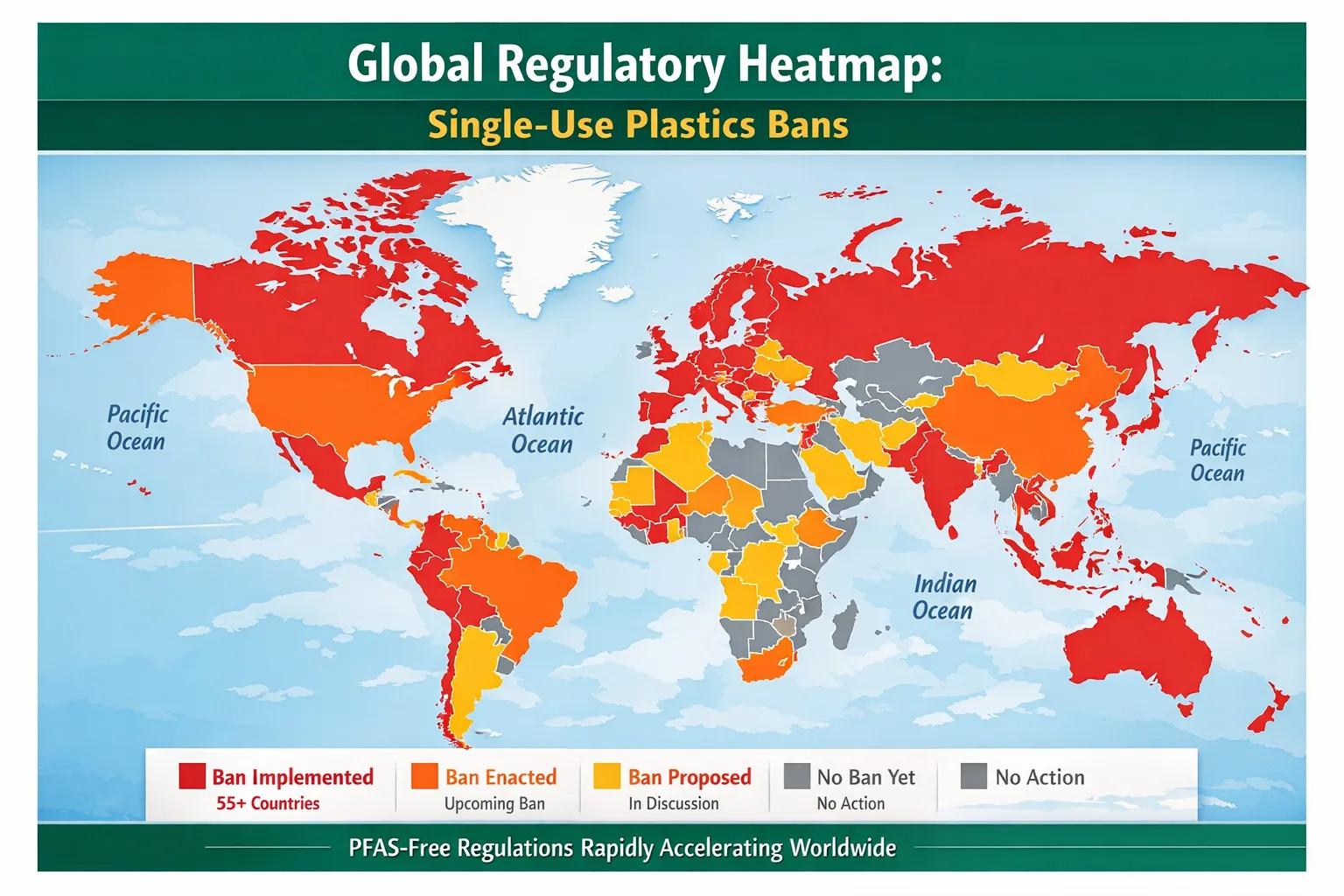
In the past, many foodservice buyers selected molded fiber packaging mainly because it was plant-based, compostable, or plastic-reducing. Today, the purchasing logic is changing. Buyers are no longer asking only whether a product is made from sugarcane bagasse. They are asking whether the product can meet stricter food-contact expectations, avoid intentionally added PFAS, perform in hot food applications, and remain stable in large-scale procurement.
This shift is especially important for takeaway and delivery packaging. A container used for cold salad has a different risk profile from a container used for 95°C rice, oily noodles, curry sauce, grilled chicken, or hot pasta. When heat, oil, moisture, and transport time combine, the packaging must resist penetration, deformation, edge wicking, lid mismatch, and stacking pressure.
For buyers sourcing sugarcane bagasse tableware, this means supplier selection should move beyond price comparison. The more important question is whether the supplier understands how to convert a PFAS-free material concept into a repeatable factory process.
Bioleader’s position is clear: PFAS-free sugarcane tableware should be evaluated as a performance packaging system, not as a simple eco label. A credible manufacturer must be able to discuss the formula, production process, quality control, application limits, and documentation required for the target market.
What “PFAS-Free and 100°C Heat Resistant” Really Means
In food packaging communication, the phrase “100°C heat resistant” must be used carefully. It should not be treated as a universal promise that every container can survive every cooking, reheating, or microwave scenario. In practical foodservice use, 100°C performance usually refers to the container’s ability to handle hot food contact, hot steam, hot water, or freshly cooked meals under defined conditions.
For molded fiber tableware, heat resistance is not only about whether the material can touch hot food. It includes several connected performance factors:
- Hot water resistance: how the container behaves when exposed to moisture and steam.
- Hot oil resistance: whether oil penetrates the fiber structure under elevated temperature.
- Sauce resistance: how the container handles mixed moisture, salt, acid, and fat.
- Holding time: whether the product remains stable during serving, delivery, or short-term storage.
- Edge wicking: whether liquid migrates through the rim, corners, or cut edges.
- Dimensional stability: whether the base, lid area, or sidewall deforms under heat and stacking.
This is why Bioleader® does not treat PFAS-free heat resistance as a single laboratory number. The better approach is to evaluate the complete use case: food temperature, oil level, sauce level, contact time, lid type, transport condition, and target compliance requirement.
For example, a bagasse food container used for hot rice and vegetables may need a different structure from a tray used for grilled meat with oily sauce. A bowl used for hot noodles may require attention to moisture resistance and lid condensation, while a clamshell used for fried food may require stronger oil resistance and ventilation behavior.
Manufacturer Insight
Bioleader treats PFAS-free heat resistance as a factory-engineered system, not as a single chemical replacement. In practical production, performance comes from the combined control of fiber preparation, formula selection, forming pressure, hot pressing temperature, drying balance, mold precision, product thickness, and final inspection.
From Sugarcane Pulp to Finished Tableware: Where Performance Is Created
Sugarcane bagasse is a renewable agricultural by-product. After juice extraction, the remaining fiber can be processed into molded pulp packaging such as plates, bowls, trays, clamshell boxes, and food containers. The material is attractive because it reduces dependence on conventional plastic and supports compostable foodservice packaging strategies.
But raw sugarcane fiber alone does not automatically become high-performance food packaging. The final result depends on how the fiber is refined, blended, formed, pressed, dried, trimmed, and inspected. This is where real manufacturing experience becomes valuable.
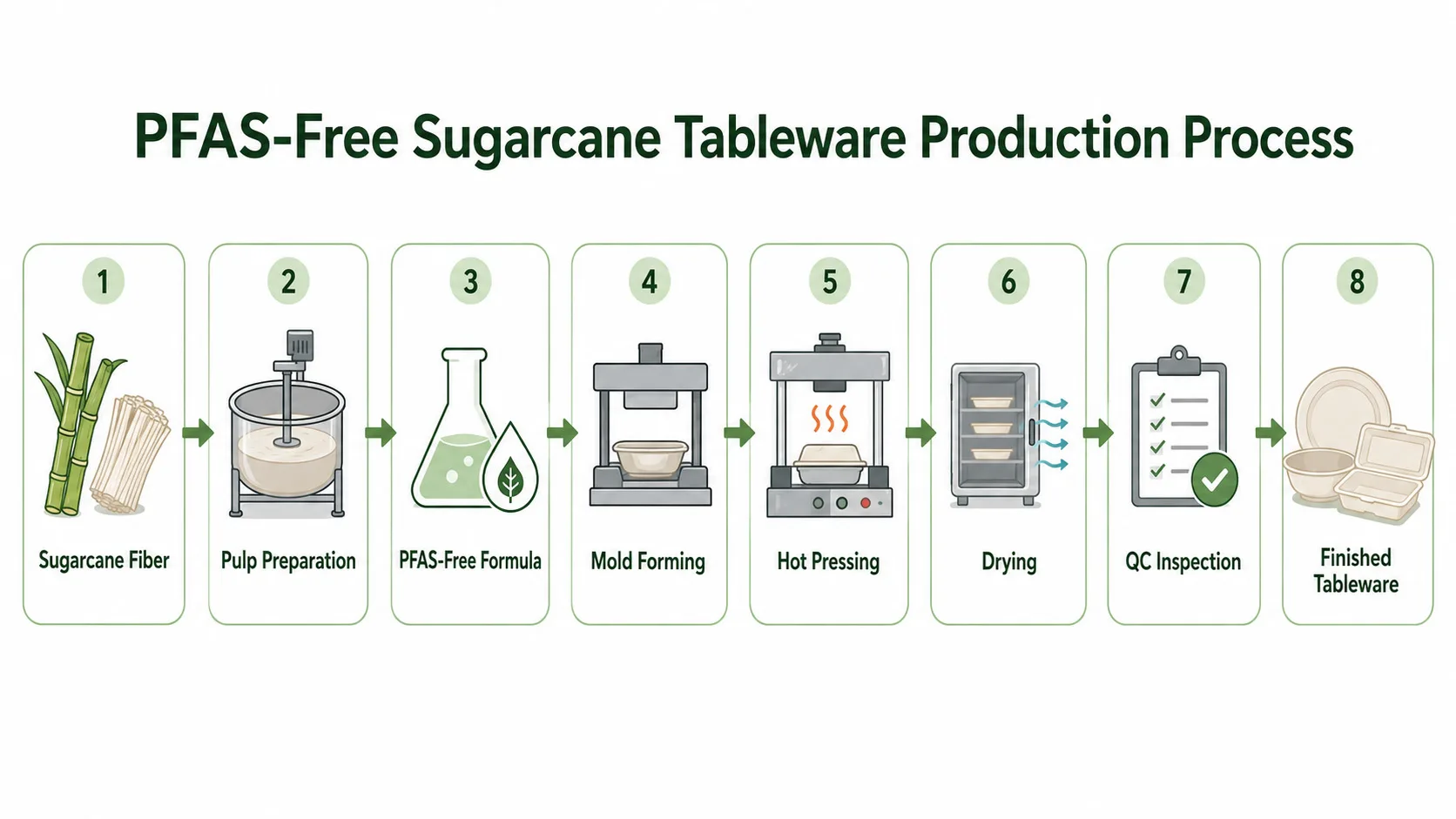
1. Pulp Selection and Fiber Preparation
The quality of molded fiber tableware starts with fiber consistency. Fiber length, cleanliness, moisture level, and pulp dispersion influence product strength and surface compactness. If the pulp is not properly prepared, the finished product may show weak edges, uneven thickness, rough texture, poor stacking behavior, or higher liquid penetration risk.
For PFAS-free products, pulp preparation becomes even more important because the product cannot rely on traditional fluorinated grease-proofing chemistry. The fiber network must be dense enough to support water and oil resistance through structure, bonding, and process control.
2. Formula Design for PFAS-Free Performance
Bioleader® develops PFAS-free sugarcane tableware through application-based formula logic. The formula used for dry foods does not need to be the same as the formula used for oily hot meals. A container for hot curry, fried chicken, or BBQ delivery may require higher wet strength, improved oil resistance, and stronger sidewall stability.
The purpose of a PFAS-free formula is not simply to replace one restricted substance with another. The goal is to build a balanced performance system that supports food-contact safety, compostability positioning, heat resistance, oil resistance, production efficiency, and commercial cost control.
3. Forming Pressure and Mold Accuracy
During forming, pulp is shaped into the required product structure. Vacuum forming and mold design influence thickness distribution, corner strength, rim flatness, and lid compatibility. Small differences in mold precision can affect whether a bagasse clamshell box closes properly, stacks well, and resists leakage in real delivery conditions.
For high-temperature PFAS-free applications, forming accuracy is especially important around corners, hinges, rims, and base panels. These areas are often the first points where hot oil, moisture, or sauce can create visible failure.
4. Hot Pressing and Surface Density
Hot pressing helps improve surface smoothness, density, shape stability, and moisture control. For sugarcane tableware used with hot food, this step is critical. A well-controlled hot pressing process can improve the compactness of the fiber surface, reduce roughness, strengthen the rim, and support better resistance to oil and water contact.
If hot pressing is inconsistent, the product may look acceptable at first glance but perform poorly during hot food testing. This is one reason sample testing alone is not enough. Buyers need confidence that the factory can reproduce the same performance during mass production.
5. Drying Curve and Moisture Balance
Moisture control is often underestimated. If the drying process is too aggressive, the product may become brittle or warped. If it is insufficient, the product may have higher moisture content, unstable stacking, or weaker resistance during hot food use. Proper drying helps maintain shape, improve storage stability, and reduce deformation risk.
For export orders, moisture balance also affects carton packing, container loading, warehouse storage, and long-distance shipping. A product that performs well immediately after production must also remain stable after transportation and storage.
Bioleader’s PFAS-Free Formula Logic: Application-Based, Not One-Size-Fits-All
One of the biggest mistakes in sourcing PFAS-free molded fiber packaging is asking only for “one PFAS-free product” without explaining the food application. In real foodservice packaging, different foods create different stress conditions.
Bioleader® evaluates each project through four practical questions:
- What food will be packed? Rice, noodles, salad, curry, BBQ, fried food, soup-side meals, desserts, or meal prep?
- What is the serving temperature? Room temperature, warm food, hot food, or near-boiling contact?
- What is the oil and moisture level? Dry, light oil, heavy oil, sauce, steam, or condensation?
- How long must the container hold performance? Dine-in, takeaway, delivery, chilled storage, or export retail packing?
This application-first method allows Bioleader® to recommend the right structure, weight, surface density, lid type, and testing approach. For example, bagasse bowls used for warm rice bowls may need different validation from trays used for high-oil grilled food. A food container used in a delivery platform may require better stacking and lid fitting than a plate used for quick-service dine-in meals.
The commercial value is simple: buyers get a packaging solution matched to the food, not a generic product pushed from a catalog.
Application Matrix: Matching Food Types to PFAS-Free Sugarcane Solutions
| Food Application | Main Packaging Risk | Recommended Product Direction | Key Test Focus |
|---|---|---|---|
| Hot rice meals | Steam, moisture, light oil | PFAS-free bagasse clamshell or food container | Hot water, condensation, base stability |
| Noodles and curry | Heat, sauce, oil, staining | Reinforced sugarcane food container or bowl | Hot sauce contact, edge wicking, hold time |
| BBQ and grilled meat | Hot oil, meat juice, high surface contact | High-performance PFAS-free tray or clamshell | Hot oil resistance, deformation, stacking |
| Fried food | Oil migration, trapped steam | Bagasse clamshell with suitable ventilation design | Oil contact, lid condensation, texture retention |
| Meal prep | Transport pressure, storage time, reheating expectation | Stronger molded fiber container with matched lid | Stacking, lid fit, food-contact safety review |
| Salad and cold food | Moisture, dressing, chilled storage | Standard or medium-performance PFAS-free bowl or tray | Moisture resistance, dressing contact, visual quality |
Production Capacity: Why Mass Production Stability Matters More Than Sample Success
Many suppliers can produce a small number of good-looking samples. The real test is whether they can keep the same performance in repeated bulk production. For PFAS-free sugarcane tableware, this is especially important because heat and oil resistance are sensitive to pulp consistency, formula dosage, moisture control, mold condition, hot pressing parameters, and production-line discipline.
Bioleader® focuses on repeatable production rather than one-time sample performance. In bulk orders, the key challenge is not only making one container pass an internal test, but making thousands or millions of containers maintain stable weight, thickness, shape, lid fit, stacking strength, and food-contact performance.
This is where a real manufacturer has an advantage over a pure trading company. A factory with production-line control can adjust process parameters, monitor batch differences, manage mold maintenance, optimize packing methods, and trace quality issues back to production variables. This creates a stronger foundation for long-term supply programs.
For buyers sourcing bagasse trays with lids, production stability is not a secondary detail. It directly affects customer complaints, restaurant operations, delivery experience, and brand reputation.
How Bioleader Builds E-E-A-T Through Manufacturing Experience
Bioleader® strengthens its credibility in PFAS-free sugarcane tableware through practical manufacturing knowledge, not generic sustainability claims. The company’s experience covers product design, molded fiber production, export packaging, compliance document support, sample testing, and application-based recommendations for international buyers.
- Experience: handling real buyer requirements for hot meals, oil resistance, delivery packaging, lid matching, and export shipment.
- Expertise: understanding how pulp refining, formula logic, hot pressing, drying, and QC testing affect final product performance.
- Authority: offering structured guidance for buyers preparing for stricter PFAS-free and food-contact packaging expectations.
- Trust: avoiding exaggerated claims and separating internal factory testing from third-party laboratory certification.
Quality Control: How PFAS-Free 100°C Performance Should Be Verified
Quality control for PFAS-free sugarcane tableware should be more detailed than a simple visual inspection. A product can look clean and well-formed but still fail under hot oil, sauce, steam, or delivery pressure. For this reason, Bioleader® recommends a layered validation approach.
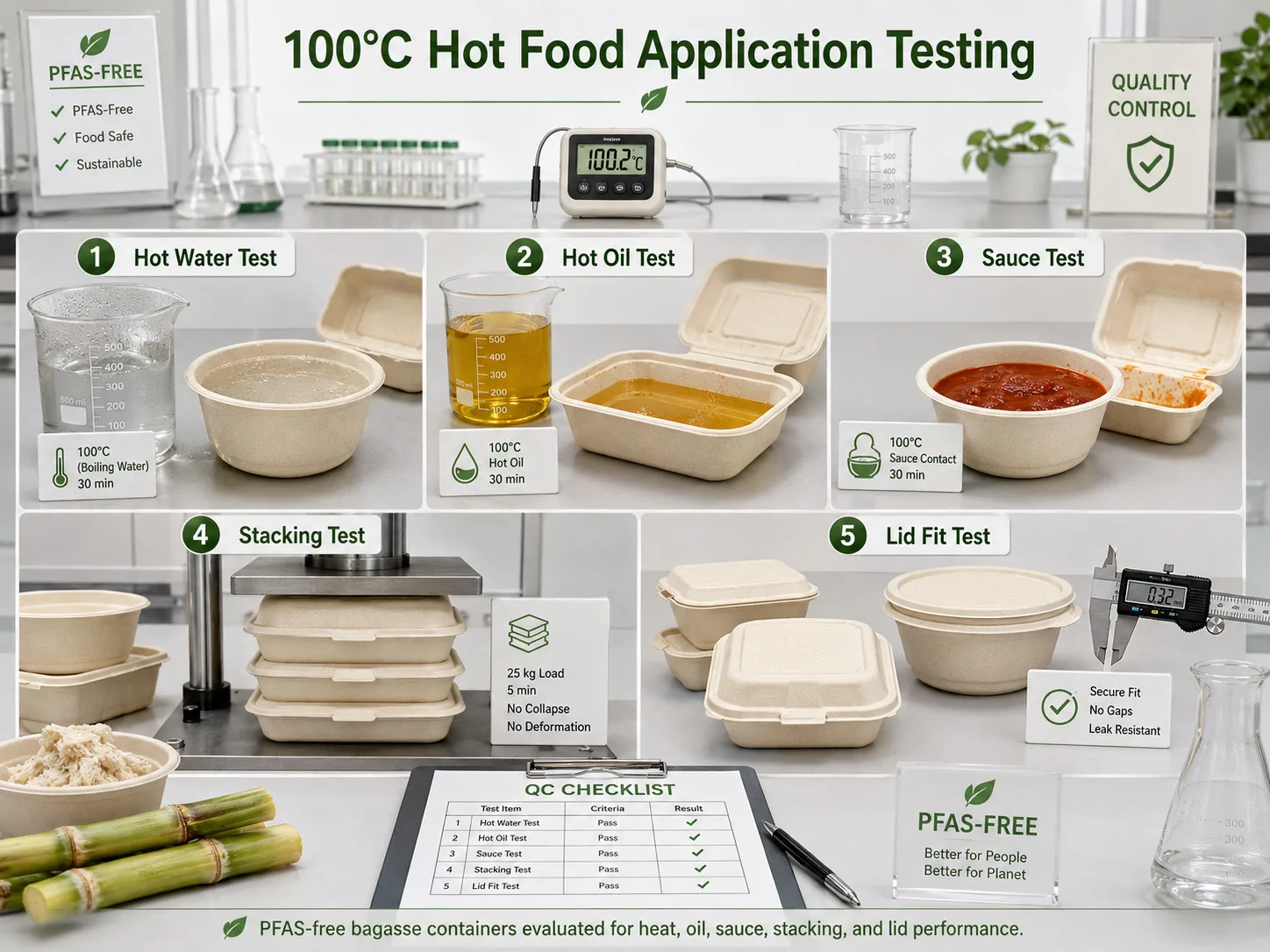
1. Formula and Material Declaration Review
For buyers targeting stricter markets, the first step is to review whether the supplier can provide a material declaration and confirm that no intentionally added fluorinated chemicals are used in the relevant formula. This supports compliance evaluation and helps importers build a more reliable documentation file.
2. Food Contact Testing
Food-contact requirements vary by target market. Buyers may require testing related to EU food contact regulations, FDA-related expectations, LFGB, or other market-specific requirements. The exact document package should be confirmed before mass production, especially when products are used for hot, oily, acidic, or long-contact foods.
3. PFAS-Related Screening
PFAS-free claims should be supported by appropriate testing where required. Depending on the market, buyers may request total fluorine, total organic fluorine, targeted PFAS analysis, or other screening methods. The testing method and threshold should match the buyer’s certification, retailer, importer, or regulatory requirement.
4. 100°C Hot Water and Hot Food Simulation
Internal factory testing can help evaluate whether a product is suitable for hot food applications. These tests may include hot water exposure, hot oil observation, sauce contact, edge wicking checks, and short-term holding tests. Internal testing is useful for product development and batch control, while formal compliance decisions should rely on third-party laboratory reports when required.
5. Structural and Export Packaging Inspection
For international orders, performance does not end at the production line. Carton packing, stack height, compression strength, container loading, and storage conditions also influence the final product condition. Bioleader® considers export packaging part of the overall quality system, especially for bulk orders shipped by sea.
Buyer Checklist: What to Confirm Before Ordering PFAS-Free Sugarcane Tableware
- Target market: EU, UK, US, Canada, Middle East, Japan, Australia, or local market.
- Food type: rice, noodles, curry, BBQ, fried food, salad, soup-side meal, dessert, or meal prep.
- Food temperature: cold, warm, hot, or near 100°C serving condition.
- Oil and sauce level: dry, light oil, heavy oil, watery sauce, acidic dressing, or mixed food.
- Required holding time: dine-in, takeaway, delivery, chilled storage, or retail packing.
- Lid requirement: no lid, bagasse lid, PET lid, PP lid, PLA lid, or custom lid matching.
- Microwave expectation: whether the buyer needs actual microwave-use testing or only hot food contact performance.
- Documentation: food-contact report, PFAS-free statement, total fluorine or PFAS-related screening, compostability certificate, or retailer-specific file.
- Order plan: sample testing, trial order, mixed container, repeat order, or private-label program.
Case Example: PFAS-Free Containers for Hot and Oily Takeaway Meals
A foodservice buyer preparing to replace conventional plastic and PFAS-treated packaging needed a molded fiber solution for hot takeaway meals. The food application included rice, grilled protein, vegetable sides, and sauces served at high temperature. The buyer’s main concern was not only whether the container was compostable, but whether it could resist oil and moisture during delivery.
In the first review, Bioleader® identified three risk points: oil migration at the base, moisture accumulation under the lid, and edge wicking at the rim. Instead of recommending a generic product, the team reviewed the food type, serving temperature, delivery time, lid requirement, and target compliance expectation.
The proposed solution included a stronger PFAS-free sugarcane container structure, improved surface density, suitable product weight, and matched lid evaluation. Internal testing focused on hot food simulation, short-term oil contact, lid fit, stacking behavior, and visual deformation after exposure.
The key lesson from this case is simple: PFAS-free packaging success depends on matching the product to the food application. The buyer did not need the most expensive structure for every menu item. Instead, different food categories were matched with appropriate sugarcane containers, trays, and bowls. This helped balance performance, sustainability goals, and procurement cost.
Product Solutions: How Bioleader Supports Different PFAS-Free Packaging Needs
Bioleader® supplies a wide range of molded fiber products for foodservice, takeaway, catering, supermarkets, meal prep, and institutional dining. The product selection can be adjusted based on food type, portion size, lid requirement, export market, and branding needs.
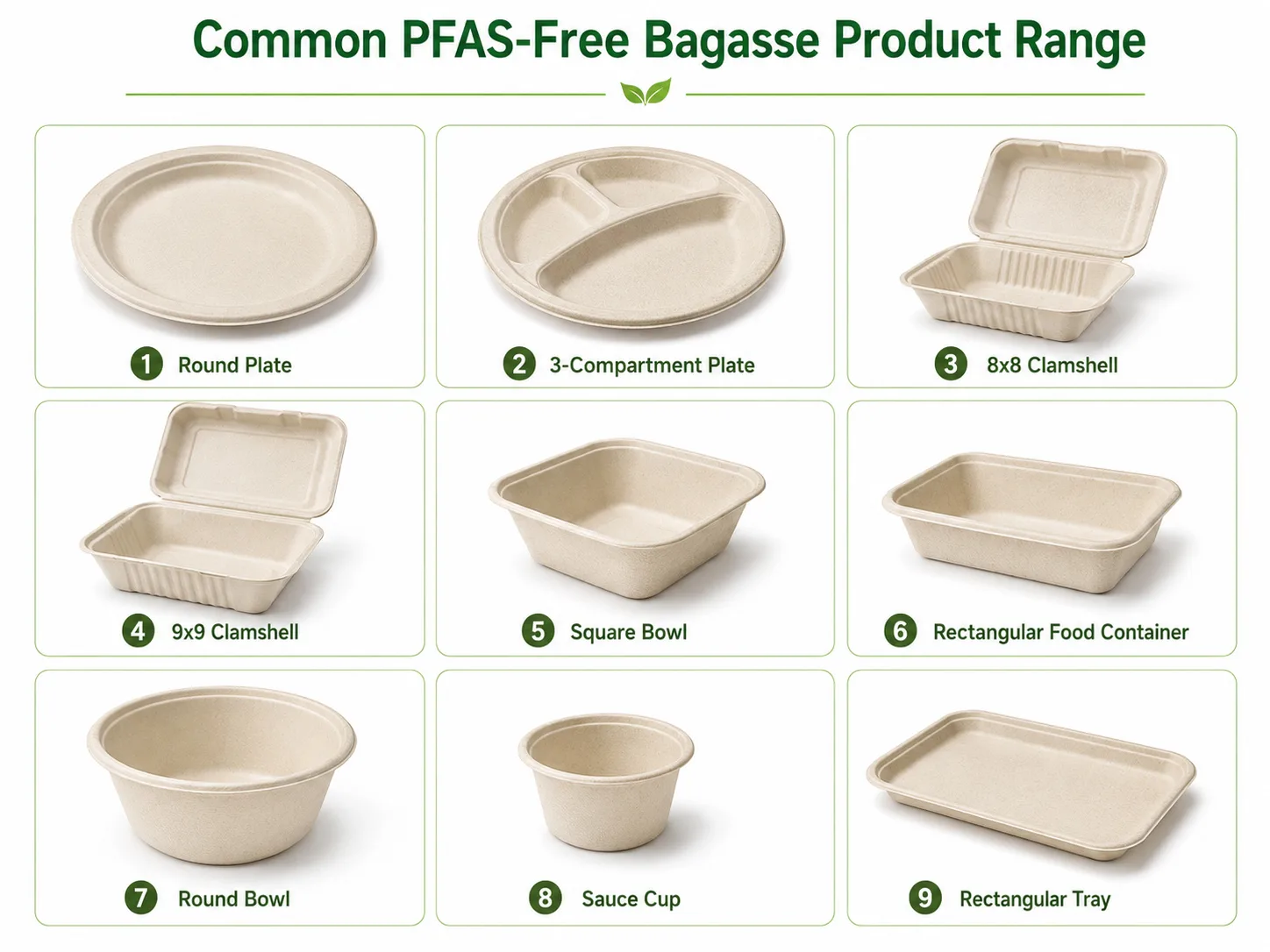
PFAS-Free Bagasse Clamshells
Clamshells are widely used for burgers, rice meals, grilled food, fried food, and takeaway sets. For hot food use, Bioleader® focuses on hinge strength, rim closure, base stability, and oil resistance. Buyers can review relevant options under bagasse clamshell packaging for different meal formats.
PFAS-Free Bagasse Bowls
Bowls are suitable for rice bowls, noodles, salad, poke, warm meals, and side dishes. For hot food, the key points are bottom stability, moisture resistance, lid compatibility, and hold-time performance. Buyers can compare capacity options through Bioleader’s bagasse bowl product range.
PFAS-Free Bagasse Trays and Plates
Trays and plates are used for catering, BBQ, supermarkets, ready meals, and institutional foodservice. High-performance PFAS-free versions should be evaluated for oil contact, cutting strength, edge stability, and stacking behavior. For buyers needing tray-and-lid systems, Bioleader® can support structural matching and export packing solutions.
Custom Molded Fiber Solutions
For brands with unique food formats, Bioleader® can evaluate custom molded fiber packaging projects. Custom development may include size adjustment, compartment layout, wall thickness, product weight, lid matching, carton packing, and sample validation. This is especially useful for meal kit brands, chain restaurants, supermarket food counters, and prepared-meal exporters.
Why Supplier Selection Should Include Factory Capability, Not Only Unit Price
Price is always important in disposable food packaging. But for PFAS-free high-temperature sugarcane tableware, the cheapest offer can become expensive if the product fails during real food use. Leakage, deformation, oil penetration, poor lid fit, and inconsistent batch quality can create operational losses that are far greater than a small unit price difference.
A strong supplier should be able to explain the relationship between formula, product weight, food type, temperature, and testing method. If a supplier only says “PFAS-free” without explaining application limits, buyers should be cautious. If a supplier cannot discuss hot oil performance, edge wicking, lid matching, or export packing, the product may not be suitable for demanding foodservice applications.
Bioleader® positions itself as a solution-oriented manufacturer. The company supports buyers with catalog selection, sample evaluation, product matching, export documentation support, and practical advice for different markets. This is especially valuable for importers and distributors building a long-term PFAS-free molded fiber product line.
Compliance Direction: What Global Buyers Should Watch in 2026
Global packaging compliance is moving toward more detailed chemical management, clearer labeling, better recyclability or compostability claims, and stronger supplier documentation. For food-contact molded fiber packaging, PFAS is one of the most important topics because these chemicals were historically used to provide oil and water resistance in paper-based food packaging.
In the European Union, Regulation (EU) 2025/40 introduces specific PFAS concentration limits for food-contact packaging from 12 August 2026. In the United States, the FDA announced in 2024 that grease-proofing substances containing PFAS are no longer being sold for food packaging use in the U.S. market. In North America’s compostable certification environment, BPI also requires no intentionally added fluorinated chemicals and testing related to organic fluorine limits.
For buyers, the practical takeaway is clear: PFAS-free documentation should become part of supplier qualification. At the same time, buyers should avoid relying only on a single claim. A better procurement file includes formula declaration, food-contact testing, PFAS-related screening where required, compostability documentation where relevant, and application-specific performance validation.
How Bioleader Helps Buyers Build a PFAS-Free Sugarcane Tableware Program
A successful PFAS-free transition is not just a product swap. It is a procurement program. Bioleader® supports buyers through a structured process that connects food application, product selection, performance validation, compliance review, and mass production planning.
- Requirement review: confirm product type, food application, capacity, temperature, lid type, target market, and order volume.
- Product recommendation: match the buyer’s food scenario with suitable sugarcane clamshells, bowls, plates, trays, or custom structures.
- Sample testing: provide samples for buyer-side food testing, temperature testing, lid fitting, and delivery simulation.
- Documentation support: prepare available food-contact reports, PFAS-free statements, compostability documents, and product specifications based on project needs.
- Bulk production planning: align MOQ, carton packing, lead time, mixed-container strategy, and shipment schedule.
- Ongoing optimization: adjust product recommendation based on customer feedback, menu changes, and market compliance updates.
This process helps buyers reduce risk and move faster from sample testing to stable supply. It also strengthens Bioleader’s role as a long-term manufacturing partner rather than a one-time packaging vendor.
Final Recommendation: Choose a Manufacturer That Understands Both Compliance and Food Performance
The next stage of sugarcane tableware is not only about being plant-based. It is about being PFAS-free, food-contact safe, application-tested, and scalable in production. Buyers need packaging that can support real hot food operations while aligning with stricter chemical management expectations.
Bioleader® believes that the strongest PFAS-free sugarcane tableware strategy combines three elements: responsible material selection, disciplined factory production, and application-based buyer support. For hot food applications close to 100°C, this approach is more reliable than simply choosing the lowest-cost molded fiber product or accepting a generic PFAS-free claim.
For importers, distributors, restaurant chains, meal prep brands, and foodservice packaging buyers, the key question is no longer “Can this product be PFAS-free?” The better question is: Can this manufacturer deliver PFAS-free performance consistently for my real food application?
That is where Bioleader® aims to build long-term value: helping buyers source safer, stronger, and more commercially practical PFAS-free sugarcane tableware for global foodservice markets.
FAQ: PFAS-Free Sugarcane Tableware for Hot Food
1. Does PFAS-free sugarcane tableware mean it is automatically safe for 100°C hot food?
No. PFAS-free means the product is designed without intentionally added PFAS-related grease-proofing chemistry, but hot food performance depends on formula, fiber density, product structure, hot pressing, drying, and testing. Buyers should test the product with their actual food type, temperature, oil level, and holding time.
2. Can Bioleader’s PFAS-free sugarcane tableware be used for hot oily meals?
Bioleader® can recommend PFAS-free sugarcane tableware options for hot oily meals, but the correct product depends on the application. Hot rice, fried food, curry, BBQ, and sauced dishes may require different product structures and validation methods. Samples should be tested before bulk ordering.
3. Is 100°C heat resistance the same as microwave safety?
No. Hot food contact and microwave use are different requirements. A product may be suitable for hot food contact but still require separate microwave-use validation. Buyers who need microwave claims should confirm the exact SKU, food type, test conditions, and required documentation before making marketing claims.
4. What documents should buyers request for PFAS-free sugarcane tableware?
Depending on the target market, buyers may request a PFAS-free statement, material declaration, food-contact test reports, compostability certification, total fluorine or PFAS-related screening, product specification sheet, and packaging details. The document package should match the importer’s market and retailer requirements.
5. Why does production-line control matter for PFAS-free molded fiber products?
PFAS-free performance is sensitive to pulp quality, formula consistency, forming pressure, hot pressing, moisture control, product weight, and mold condition. Without stable production-line control, a sample may perform well while bulk production shows inconsistent oil resistance, deformation, or lid fit.
6. How should buyers start a PFAS-free sugarcane tableware project with Bioleader?
Buyers should provide the target product type, food application, capacity, serving temperature, oil and sauce level, lid requirement, target market, order quantity, and certification needs. Bioleader® can then recommend suitable products, samples, and a validation plan before mass production.