Executive Summary: Why PFAS-Free Compliance Matters in 2026
PFAS-free packaging has moved beyond a general environmental preference. In several major foodservice markets, restrictions on per- and polyfluoroalkyl substances now affect packaging design, supplier qualification, technical documentation, and purchasing decisions.
The requirements are not identical worldwide. The European Union now has specific PFAS concentration limits for food-contact packaging under the Packaging and Packaging Waste Regulation (PPWR), while the United States continues to apply a combination of state-level restrictions and procurement requirements. Other markets are also reviewing PFAS use, chemical disclosure, and food-contact packaging controls.
For foodservice buyers, importers, distributors, and private-label brands, the practical questions are therefore no longer only “Does this supplier offer PFAS-free packaging?” Buyers also need to ask:
- What exactly was tested?
- Was the test Total Fluorine, Total Organic Fluorine, or targeted PFAS analysis?
- What detection limit was used?
- Does the report apply to the actual SKU, material, coating, color, and formulation being purchased?
- Has the formulation changed since the report was issued?
- Which legal requirement is the documentation intended to support?
This updated guide explains how PFAS-free packaging should be evaluated in 2026, with particular attention to EU PPWR limits, fluorine screening, targeted PFAS testing, supply-chain controls, and practical buyer verification.
What “PFAS-Free Packaging” Really Means Under 2026 Compliance Requirements
The term PFAS-free is widely used in food packaging, but it should not be treated as a universal laboratory definition.
In commercial procurement, a credible PFAS-free claim normally combines two different forms of evidence:
- Formulation evidence: confirmation that PFAS are not intentionally added to the relevant coating, barrier system, pulp formulation, processing aid, adhesive, ink, or other product component where applicable.
- Analytical evidence: laboratory testing appropriate to the product, applicable regulation, risk level, and destination market.
A statement such as “no intentionally added PFAS” is not identical to a laboratory result showing fluorine below a specified detection limit. Likewise, a Total Fluorine result does not identify individual PFAS compounds, and targeted PFAS analysis does not measure every possible fluorinated substance.
Product Categories That May Require PFAS Verification
PFAS evaluation is especially relevant to food-contact packaging where oil, grease, moisture, heat, or release performance may historically have been improved through fluorinated chemistry. Depending on the market and product construction, relevant formats can include:
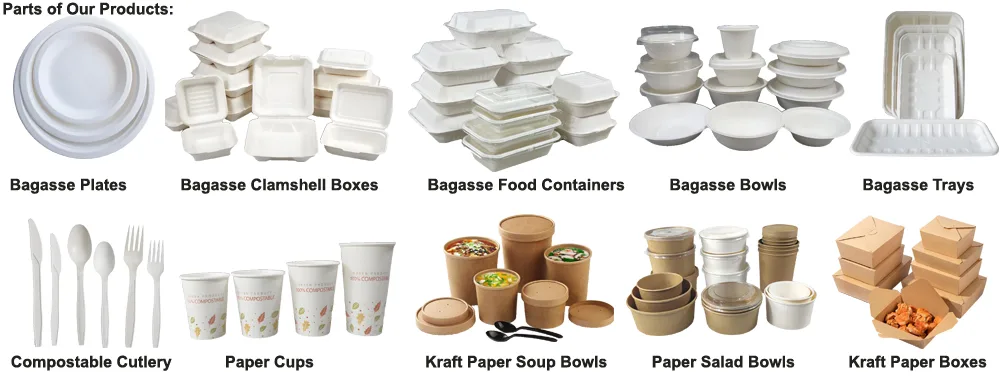
- Sugarcane bagasse clamshells, trays, plates, bowls, and molded-fiber containers
- Kraft paper bowls, soup cups, takeaway boxes, and salad containers
- Paper lids, molded-fiber lids, wraps, and grease-resistant liners
- Paperboard packaging using water-based, aqueous dispersion, PE, PLA, or other barrier structures
- Paper bags and foodservice wraps requiring grease resistance
- Multi-layer food containers where coatings, adhesives, inks, or barrier layers form part of the finished food-contact structure
- Other foodservice products, including PLA and CPLA products, where product-specific chemical documentation is required by the buyer or destination market
Material appearance alone is not evidence. A natural brown molded-fiber container is not automatically PFAS-free, just as a water-based coating is not automatically PFAS-free, recyclable, or compostable simply because it is described as “water-based.”
Bioleader® recommends reviewing the complete packaging structure rather than judging a product only by its paper, fiber, or plant-based appearance.

The 2026 PFAS Regulatory Landscape: What Food-Packaging Buyers Need to Know
PFAS restrictions differ significantly between jurisdictions. Buyers should therefore verify the law applicable to the destination market rather than applying one country’s threshold globally.
European Union: PPWR PFAS Limits for Food-Contact Packaging
The most important regulatory development for EU foodservice packaging is Regulation (EU) 2025/40 on Packaging and Packaging Waste (PPWR).
From 12 August 2026, food-contact packaging must not be placed on the EU market where PFAS concentrations are equal to or above the applicable limits established in Article 5(5).
| EU PPWR PFAS Requirement | Limit | Analytical Context |
|---|---|---|
| Any individual PFAS | 25 ppb | Targeted PFAS analysis; polymeric PFAS excluded from quantification |
| Sum of targeted PFAS | 250 ppb | Sum of targeted PFAS, where applicable with prior degradation of precursors; polymeric PFAS excluded from quantification |
| PFAS including polymeric PFAS | 50 ppm | Where Total Fluorine exceeds 50 mg/kg, additional evidence may be required to distinguish PFAS-related fluorine from non-PFAS fluorine |
The three thresholds should not be collapsed into one number. The 25 ppb and 250 ppb thresholds concern targeted PFAS analysis, while the 50 ppm level addresses the broader PFAS requirement including polymeric PFAS.
How the European Commission’s 2026 Guidance Uses Total Fluorine Screening
The European Commission has also issued 2026 guidance addressing implementation and enforcement of the PPWR PFAS provisions.
Under the Commission’s recommended stepwise approach, Total Fluorine (TF) can be used as an initial screening step. Where Total Fluorine is below 50 mg/kg, the sample could be considered compliant under that recommended enforcement approach. Where the fluorine result requires further investigation, additional analysis can be used to determine whether fluorine is associated with PFAS or non-PFAS sources and to assess targeted PFAS limits.
The Commission also notes that, based on the evidence currently available, samples compliant with the first Total Fluorine screening step were also compliant with the subsequent testing steps.
Importers working on EU projects can also use Bioleader®’s PPWR 2026 Foodservice Packaging Checklist and EU PPWR 2026 Guidance for Foodservice Packaging to organize product, testing, and technical-file requirements.
United States: State-Level Rules Require Market-Specific Review
The United States does not use one nationwide food-packaging PFAS rule equivalent to the EU PPWR. Several states have enacted restrictions affecting intentionally added PFAS in food packaging, but the covered materials, definitions, thresholds, certification requirements, and implementation dates vary.
For this reason, a supplier declaration prepared for one state should not automatically be assumed to satisfy every U.S. market. Buyers should identify the destination state and verify the product against the law and procurement requirements that apply there.
The distinction between no intentionally added PFAS and analytical concentration limits is particularly important. Some U.S. requirements focus primarily on intentionally added PFAS, whereas the EU PPWR includes explicit numerical concentration limits.
Canada, Australia, New Zealand, and Asia-Pacific Markets
PFAS policy is also evolving outside the EU and United States, but requirements should not be generalized into a single “global PFAS standard.” Chemical restrictions, food-contact rules, environmental reporting requirements, and procurement expectations vary by country.
For exporters, the safer approach is to verify four items before confirming a compliance claim:
- The destination country or state
- The exact food-contact product and material structure
- The specific legal or customer requirement
- The available report or declaration covering that product scope

The Hidden Layers of PFAS Risk in Packaging Supply Chains
One of the most common procurement mistakes is assuming that PFAS risk comes only from the visible coating on the finished container.
In practice, a finished packaging structure may involve pulp or paper, internal sizing agents, grease barriers, release agents, coatings, inks, adhesives, laminations, recycled content, and processing aids. Any relevant component should be considered when evaluating the product’s chemical-compliance evidence.
Paper Mills, Pulp Formulations, and Coating Providers
For fiber and paper packaging, upstream material changes can affect the finished product even when the converter or molded-fiber factory does not intentionally change the final design.
Potential risk points may include:
- Changes in grease-resistant additives
- Substitution of coating chemistry
- Use of recycled fiber containing residual fluorinated substances
- Processing aids or mold-release systems
- Different raw-material suppliers used for different production batches
This is why buyers should ask whether the laboratory report applies to the actual material and formulation being supplied, rather than accepting a generic certificate folder.
Composite and “Eco-Looking” Materials
Visual appearance is an unreliable indicator of composition. A container may look like paper, bamboo fiber, bagasse, or starch while containing other resins, coatings, binders, or functional additives.
Similarly, terms such as “plant-based,” “biodegradable,” “compostable,” and “plastic-free” do not establish PFAS status.
Outsourcing, Formulation Changes, and Repackaging Risks
Supply-chain traceability becomes more important when goods are sourced from multiple factories or when formulations change without corresponding updates to compliance documentation.
Commercial buyers should pay particular attention to:
- Factory identity
- Product code and product family
- Raw-material supplier changes
- Coating or barrier-system changes
- Color and printing changes where relevant
- Test-report issue date and sample description
A test report with a familiar laboratory logo is useful only when the tested sample and test scope are relevant to the product being purchased.
The Technical Side: How PFAS Is Actually Evaluated in Packaging
PFAS verification often becomes confusing because Total Fluorine, Total Organic Fluorine, targeted PFAS analysis, and precursor analysis measure different things.
They should not be presented as interchangeable methods.
Total Fluorine (TF) Screening
Total Fluorine measures the overall fluorine present in the tested sample. It does not by itself identify whether the fluorine comes from PFAS, another organic fluorinated substance, or an inorganic fluorine source.
For EU PPWR enforcement, Total Fluorine has become particularly relevant because the Commission’s current recommended approach uses 50 mg/kg as the initial screening level.
A low Total Fluorine result can therefore provide meaningful screening evidence, but the laboratory report should clearly state:
- The sample tested
- The analytical method
- The measurement unit
- The method detection limit
- The actual result
Total Organic Fluorine (TOF)
Total Organic Fluorine focuses on fluorine associated with organic compounds. TOF can be useful as a broader screening tool for organic fluorinated substances, but it still does not identify individual PFAS compounds.
TOF should therefore not be described as the same thing as Total Fluorine, and neither TF nor TOF should automatically be described as targeted PFAS analysis.
Targeted PFAS Analysis
Targeted PFAS analysis measures specified PFAS compounds using analytical methods capable of quantifying very low concentrations. Techniques such as LC-MS/MS are commonly used for many targeted PFAS panels.
Depending on the analytical panel, testing may include compounds such as PFOA, PFOS, PFHxS, and other specified PFAS.
However, targeted analysis has an important limitation: it measures the PFAS compounds included in the selected method or panel. It should not be described as proving the absence of every possible PFAS molecule.
Precursor and TOP Analysis
Where required, precursor analysis or approaches such as the Total Oxidizable Precursor (TOP) assay can help evaluate PFAS precursors that may not be fully represented in a conventional targeted panel.
The appropriate method depends on the regulation, laboratory capability, material system, and reason for testing.
| Testing Approach | What It Indicates | Main Limitation | Typical Role |
|---|---|---|---|
| Total Fluorine (TF) | Overall fluorine content | Does not identify PFAS or distinguish organic/inorganic fluorine by itself | Broad screening; relevant to the current EU PPWR enforcement approach |
| Total Organic Fluorine (TOF) | Organic fluorine content | Does not identify individual PFAS | Screening for organic fluorinated substances |
| Targeted PFAS Analysis | Specified individual PFAS | Limited to compounds covered by the method or panel | Quantification against targeted PFAS requirements |
| Precursor / TOP Analysis | Potential oxidizable PFAS precursors | Specialized method requiring appropriate interpretation | Additional investigation where precursor assessment is required |

The Compliance Workflow: How Companies Can Verify PFAS-Free Packaging in 2026
A practical PFAS verification program does not need to become an unnecessarily complicated laboratory exercise. The goal is to build a traceable connection between the product specification, formulation controls, testing evidence, and destination-market requirement.
Step 1 — Define the Exact Product and Market
Start by documenting:
- Product code or SKU
- Material
- Food-contact surface
- Coating or barrier structure
- Printing or color requirements
- Destination country or state
- Required certification, declaration, or test report
This prevents buyers from requesting a generic “PFAS certificate” that may not actually correspond to the product being sourced.
Step 2 — Review Material and Formulation Information
For paper and molded-fiber packaging, buyers should confirm whether grease, oil, and water resistance are achieved through fluorine-free chemistry and whether the supplier can identify the relevant barrier or additive system.
For coated paper products such as kraft paper bowls and food containers, the complete structure matters. PE, PLA, water-based coatings, adhesives, printing, and other layers should be evaluated according to their actual composition and intended use.
Step 3 — Review the Laboratory Report
Do not evaluate a test report only by looking at the laboratory name or the word “PASS.”
Buyer checklist for PFAS test reports:
- Who is the report client?
- What exact sample description appears on the report?
- What material and product were tested?
- Which analytical method was used?
- Was the test TF, TOF, targeted PFAS, or another method?
- What is the method detection limit?
- What unit is used: ppb, µg/kg, mg/kg, or ppm?
- What result was reported?
- When was the report issued?
- Does the tested sample match the current product formulation?
Step 4 — Confirm Scope Before Bulk Production
For private-label, regulatory, tender, and long-term supply programs, buyers should confirm whether the existing report is applicable to the product being ordered.
If a specification changes materially, additional testing may be appropriate. Relevant changes can include:
- New coating chemistry
- Different pulp or paper source
- New grease-resistant additive
- Different printing or lamination structure
- Material substitution
Step 5 — Maintain Risk-Based Ongoing Verification
Not every shipment necessarily requires a full PFAS analytical program. A more practical approach is risk-based verification that considers formulation stability, supplier controls, market requirements, customer specifications, and previous test history.
For high-risk or compliance-sensitive programs, buyers may establish periodic or batch-specific testing according to their internal quality system.
Bioleader® recommends that buyers document what is required before production rather than waiting until goods arrive at the destination market.
Red Flags: Warning Signs of Weak PFAS Compliance Evidence
The following warning signs do not automatically prove non-compliance, but they indicate that a buyer should request more evidence before approval:
- A “PFAS-free” claim with no description of the applicable product or formulation
- A test report that does not identify the tested sample clearly
- A supplier using “PFOA-free” as if it means all PFAS are excluded
- A Total Fluorine report being presented as a targeted 25 ppb PFAS test
- A targeted PFAS panel being described as proof that every possible PFAS is absent
- A compostability certificate being used as PFAS evidence
- A water-based coating automatically being described as PFAS-free without formulation or test evidence
- A report for one product family being presented as covering unrelated materials and SKUs
- Outdated reports despite significant formulation or supplier changes
- No ability to identify the relevant factory, material, or coating system
Buyers comparing PFAS-free, PFOA-free, and BPA-free claims should evaluate each statement independently rather than treating them as equivalent safety certifications.

Typical PFAS Compliance Actions by Buyer Type
Different buyers require different levels of documentation. The following examples describe common procurement approaches rather than named customer cases.
Foodservice Distributors
A distributor carrying multiple molded-fiber and paper SKUs may begin by separating products according to material, coating structure, and destination market. PFAS declarations and test reports can then be mapped to the relevant SKU family rather than stored as a generic supplier certificate.
Restaurant and Takeaway Brands
Restaurant groups replacing conventional food containers may compare bagasse and plastic container options while evaluating food temperature, holding time, grease resistance, PFAS requirements, compostability claims, and local waste infrastructure.
For molded-fiber bowls, trays, and clamshells, buyers can also compare current bagasse bowl and container specifications before requesting applicable test documents.
Private-Label and Tender Projects
Private-label projects often require more formal document mapping because artwork, material declarations, food-contact requirements, compostability logos, and PFAS evidence may all need to correspond to the final product specification.
For these programs, Bioleader® recommends confirming certificate scope and available evidence before printing, tooling, or bulk production.
Catering, Institutional, and Delivery Packaging
Institutional foodservice buyers often evaluate complete meal-packaging systems rather than a single container. This can include bowls, clamshell packaging, plates, lids, cutlery, and paper accessories.
Each material family should be verified using the appropriate documentation instead of assuming that one PFAS or compostability report covers the entire packaging set.
Why PFAS-Free Packaging Does Not Automatically Mean Lower Performance
Historically, PFAS chemistry was attractive in some fiber and paper applications because it could provide strong oil and grease resistance. Moving away from PFAS therefore requires manufacturers to reconsider material formulation, barrier chemistry, molding conditions, fiber structure, and intended-use performance.
However, PFAS-free performance should be evaluated by the actual product test and use condition rather than by assuming that every fluorine-free solution performs identically.
Fluorine-Free Barrier and Additive Systems
Modern molded-fiber products can use fluorine-free barrier technologies and internal additive systems to provide water and grease resistance.
Performance can vary according to:
- Food temperature
- Oil temperature
- Holding time
- Food acidity
- Container geometry
- Fiber density
- Barrier formulation
Buyers sourcing hot-food packaging can review Bioleader®’s guide to PFAS-free sugarcane tableware for 100°C hot-food applications. Product-specific temperature and oil-resistance performance should still be confirmed for the selected specification.
Water-Based Coatings
Water-based and aqueous dispersion coatings can provide grease and moisture resistance in some paper food-packaging applications. However, “water-based” describes the coating system and does not automatically prove PFAS-free status, recyclability, plastic-free construction, or compostability.
For example, a kraft paper bowl should be evaluated according to the actual coating formulation and intended use rather than the paper substrate alone.
Bagasse Molded-Fiber Engineering
Sugarcane bagasse provides a renewable molded-fiber base with useful rigidity and foodservice functionality, but the final grease and moisture performance depends on product design and formulation.
Bioleader®’s technical guide to PFAS-free sugarcane tableware grease-resistance technologies explains how fluorine-free systems can be selected for different foodservice requirements.
CPLA and Other Compostable Materials
CPLA is commonly used where compostable cutlery requires higher heat resistance than standard PLA. PFAS status, compostability, and food-contact suitability remain separate questions and should be documented according to the actual product.
Buyers can review Bioleader®’s CPLA cutlery guide when comparing material and compostability requirements.
Bioleader®’s PFAS-Free Compliance Framework
Bioleader® supplies foodservice packaging across sugarcane bagasse, paper-based packaging, PLA, CPLA, and other material systems. PFAS documentation should be evaluated according to the selected product rather than applied automatically across the entire portfolio.
For buyers specifically sourcing PFAS-free compostable tableware, Bioleader® provides a dedicated product and compliance page combining product categories, test evidence, PPWR information, and compostability documentation.
SGS Total Fluorine Supporting Evidence for a Tested Bagasse Sample
A published SGS supporting report covers a tested white sugarcane bagasse box.
| Tested Material | White sugarcane bagasse box |
|---|---|
| Laboratory | SGS-CSTC Standards Technical Services |
| SGS Report No. | SHAHL23020552301 |
| Method | With reference to EN 14582:2016, analysis by IC |
| Test Item | Total Fluorine screening for PFAS |
| Method Detection Limit | 20 mg/kg |
| Result | ND (<20 mg/kg) |
| Report Date | 13 December 2023 |
Buyers can review the SGS PFAS / Total Fluorine Screening Test Report and browse Bioleader®’s Certificates & Test Reports page for other available documentation.
For applicable sugarcane bagasse products, Bioleader® can also discuss different PFAS-free performance requirements according to food temperature, oil exposure, holding conditions, and destination-market documentation needs.
Buyers planning a transition from conventional grease-resistant fiber products can review the PFAS-Free Tableware Transition Guide before approving new specifications.
Final Recommendations for Global Buyers
PFAS verification in 2026 should be based on evidence and product scope rather than marketing terminology.
Before approving a PFAS-free food packaging supplier, verify:
- The destination market: identify the applicable EU, U.S. state, or other market requirement.
- The exact SKU: confirm material, coating, color, size, and formulation.
- The supplier declaration: determine whether it covers no intentionally added PFAS and which components are included.
- The laboratory method: distinguish TF, TOF, targeted PFAS, and precursor analysis.
- The detection limit and unit: do not compare ppm, mg/kg, ppb, and targeted-analysis thresholds without understanding what was measured.
- The test-report scope: confirm that the tested sample relates to the product being purchased.
- Formulation changes: establish how documentation is reviewed if materials or coatings change.
- Performance: test hot-food, grease, moisture, and holding-time requirements separately from chemical compliance.
- Compostability: verify EN 13432, BPI, OK Compost, AS 5810, or other applicable claims independently from PFAS evidence.
For EU buyers, PFAS verification should also be integrated with broader PPWR technical documentation. Bioleader®’s PPWR Declaration of Conformity guide explains why product scope, supporting reports, and technical documentation should be mapped to the actual packaging supplied.
PFAS-free packaging remains an important part of the broader shift toward safer food-contact materials, but credible compliance depends on precise claims, suitable testing, transparent documentation, and clear boundaries around what each report actually proves.
For a wider view of the market transition, see how bagasse tableware is contributing to the PFAS-free packaging shift.
Frequently Asked Questions About PFAS-Free Packaging
1. What does PFAS-free packaging mean in 2026?
PFAS-free packaging should not be treated as one universal laboratory definition. In procurement, the claim normally combines formulation controls such as no intentionally added PFAS with analytical evidence appropriate to the product and applicable market. Buyers should confirm exactly what was tested and what the supplier declaration covers.
2. What are the EU PPWR PFAS limits for food-contact packaging?
From 12 August 2026, Regulation (EU) 2025/40 sets limits of 25 ppb for any individual PFAS measured by targeted analysis, 250 ppb for the sum of targeted PFAS, and 50 ppm for PFAS including polymeric PFAS. The analytical context of each threshold is different, so the three values should not be treated as interchangeable.
3. Is Total Fluorine the same as PFAS?
No. Total Fluorine measures overall fluorine in the sample and does not identify whether that fluorine comes from PFAS, other organic fluorinated substances, or inorganic sources. It can nevertheless be useful as a screening measurement, including under the European Commission’s current PPWR enforcement approach.
4. What is the difference between Total Fluorine, TOF, and targeted PFAS testing?
Total Fluorine measures overall fluorine, Total Organic Fluorine focuses on organic fluorine, and targeted PFAS analysis measures specified individual PFAS compounds. Each method answers a different analytical question and should be selected according to the product and applicable compliance requirement.
5. Does ND <20 mg/kg mean a packaging product meets the EU PPWR screening level?
For a Total Fluorine test, a result of ND below a 20 mg/kg detection limit is below the European Commission’s current 50 mg/kg Step-1 Total Fluorine screening level. The conclusion applies to the tested sample and should not automatically be extended to other SKUs, formulations, or materials.
6. Is PFAS-free packaging automatically compostable?
No. PFAS-free and compostable are separate claims. PFAS testing evaluates fluorinated substances or specified PFAS, while compostability certification evaluates biodegradation and disintegration under defined composting conditions. Buyers should verify both claims independently where both are required.
7. Does a water-based coating automatically mean PFAS-free?
No. “Water-based” describes a coating system and does not automatically establish PFAS-free status, recyclability, compostability, or plastic-free construction. Buyers should review the actual formulation and applicable product-specific evidence.
8. What should buyers request from a PFAS-free packaging supplier?
Buyers should request the product specification, material and coating information, no-intentionally-added-PFAS declaration where applicable, relevant laboratory reports, detection limits, sample descriptions, current certificate scope, and confirmation that the documentation applies to the selected SKU and destination market.
Official and Supporting References
- Regulation (EU) 2025/40 on Packaging and Packaging Waste — Article 5(5), PFAS concentration limits for food-contact packaging.
- European Commission 2026 PPWR Guidance — Commission interpretation and recommended approach relating to PFAS requirements and Total Fluorine screening.
- New York State Department of Environmental Conservation — PFAS in Food Packaging — official explanation of New York’s restriction on intentionally added PFAS in covered food packaging.
- SGS Test Report SHAHL23020552301 — Total Fluorine supporting test evidence for the tested white sugarcane bagasse box.