









Continuous update notice: Bioleader® will continue reviewing and updating this guide and its downloadable PPWR EU DoC template as new delegated acts, implementing acts, harmonised standards, common specifications, official European Commission guidance and testing methods are published. Buyers should use the latest version and complete a product-specific conformity review before issuing any declaration.
Quick answer: A PPWR EU Declaration of Conformity is not a general certificate for an entire packaging catalogue. It is a controlled legal document prepared by the responsible manufacturer for an identified packaging type or clearly defined product family, supported by technical documentation and product-specific evidence.
For sugarcane bagasse containers, paper cups and paper bowls, the evidence file may include material specifications, component weights, food-contact reports, PFAS-related evidence, compostability certificates where applicable, factory-system documents, product performance records and supplier change-control information.
The certificate, report, product, manufacturing unit and declared claim must match. A certificate for one material, lid, colour, coating or product construction should not automatically be applied to another SKU.
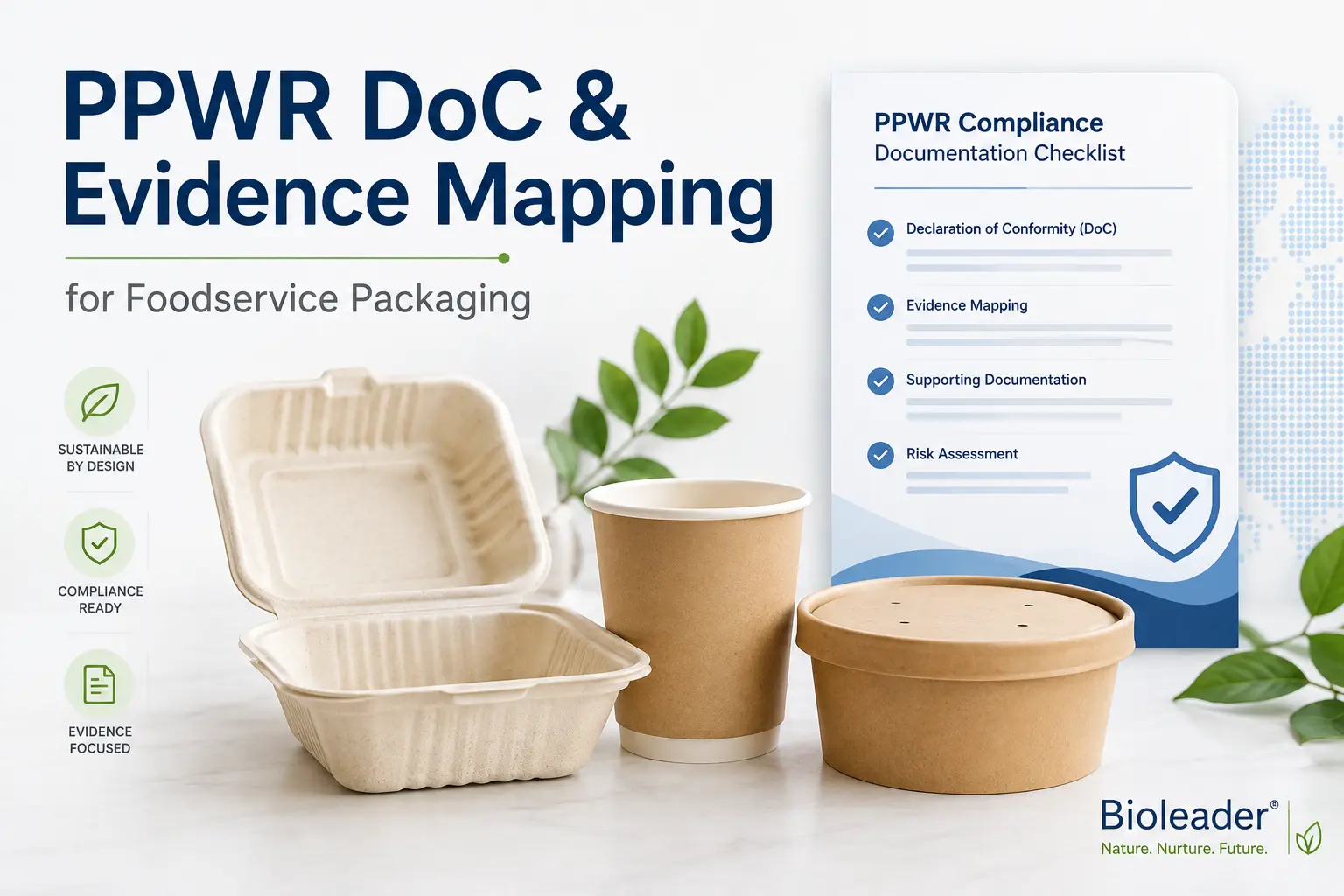
Bioleader® has prepared a concise working template for manufacturers and packaging buyers. The 2-page PDF follows the Annex VIII declaration structure and adds practical fields for product identification, SKU, batch or lot reference, material structure, intended use, packing configuration, technical-file references and authorised signature. A second-page quick guide provides common foodservice packaging material examples and a short pre-signing checklist.
Download the Current PPWR EU DoC Template
PPWR EU Declaration of Conformity Template for Foodservice Packaging
2-page practical template · Version 4.0 · Updated September 2026
- Annex VIII EU Declaration of Conformity structure
- Product, SKU, batch / lot and packaging identification fields
- Material structure, intended use and packing configuration fields
- Common Bioleader® foodservice packaging examples and pre-signing checklist
↓ Download the PPWR EU DoC Template (PDF)
For a broader explanation of PPWR dates, recyclability, recycled content, PFAS, labelling and importer implementation, review the EU PPWR Compliance White Paper for importers and brands.
What Is a PPWR EU Declaration of Conformity?
A PPWR EU Declaration of Conformity is the manufacturer’s formal statement that an identified packaging type complies with the applicable requirements laid down in or pursuant to Articles 5 to 12 of Regulation (EU) 2025/40.
The declaration follows the structure set out in Annex VIII. It includes a declaration number, unique packaging identification, manufacturer details, a traceable description of the packaging, references to relevant Union legislation and technical specifications, notified-body information where applicable, additional information, and the place, date, name, function and signature for the declaration.
The declaration is the final layer of a wider conformity process. Before signing it, the responsible manufacturer must establish the technical documentation required under Annex VII and determine which PPWR requirements apply to the packaging.
A laboratory report, food-contact declaration, compostability certificate, factory audit or supplier statement can support the technical file, but none of these documents automatically replaces the PPWR Declaration of Conformity.
Core distinction: A test report demonstrates a defined test result. A certificate confirms a defined certification scope. A PPWR Declaration of Conformity connects the identified packaging to the applicable legal requirements and supporting evidence under the responsibility of the manufacturer.
What the Downloadable PPWR EU DoC Template Includes
The Bioleader® PDF is a concise 2-page working template for preparing a packaging-specific EU Declaration of Conformity. It is not an official approval, certificate or pre-completed declaration, and it does not automatically cover an entire product catalogue.
The v4.0 template includes:
- Annex VIII declaration structure with a controlled EU Declaration of Conformity number and packaging identification fields.
- Practical traceability fields for product or packaging name, SKU, size, batch / lot / production-date code and optional PO or order reference.
- Packaging description fields covering the component, intended use, material structure and final packing configuration.
- Technical-documentation references for Annex VII files, supporting evidence and applicable technical specifications.
- Quick-fill guidance covering common Bioleader® materials, typical foodservice packaging examples and a short checklist before signing.
Use limitation: Complete the template for the actual packaging, responsible manufacturer, material and component configuration, intended use and applicable legal requirements. The template simplifies the declaration format; it does not replace the underlying Annex VII technical documentation or conformity assessment.
Is the Product Packaging, Service Packaging or Tableware?
Not every disposable foodservice item is automatically packaging under PPWR, even when it is made from bagasse, paper or another packaging material.
The intended use, point of filling, sales arrangement and market-placement structure must be reviewed before preparing the declaration.
| Product or Use Scenario | Typical PPWR Treatment | Important Qualification |
|---|---|---|
| Bagasse clamshell supplied to a restaurant and filled at the point of sale | May qualify as service packaging | Confirm the intended use, branding, final configuration and responsible manufacturer. |
| Paper cup supplied empty to a café and filled with a drink at the point of sale | May qualify as service packaging | Printing, trademark ownership and design control may affect the manufacturer role. |
| Paper soup bowl supplied with a separate lid | Packaging combination | The bowl, coating, printing and lid should be identified and mapped separately. |
| Empty disposable plate sold to a consumer for private household use | May not be packaging | The actual intended use and sales arrangement should be documented. |
| Disposable knife, fork or spoon | Generally not packaging by itself | The wrapper, pouch, box or assembled kit may still be packaging. |
| Pre-filled takeaway container sold with food | Sales packaging or a packaged-product unit | Final filling, sealing, branding and market-placement responsibilities must be reviewed. |
For example, a finished bagasse clamshell box supplied for restaurant filling may be treated differently from an empty plate sold directly to a household consumer.
Manufacturer insight: Start by documenting what the item is, who orders it, who controls the design, whose trademark appears on it, where it is filled and who first places the final packaging configuration on the EU market.
Who Should Prepare and Sign the PPWR Declaration?
Under PPWR, “manufacturer” is a legal role. It is not always the company that physically forms or converts the packaging.
For packaging supplied in its final form, the manufacturer role should be determined from the actual manufacturing, design and branding arrangement. Where packaging is designed or manufactured under another company’s name or trademark, that company will normally fall within the PPWR manufacturer definition, subject to the specific micro-enterprise exception and the exact commercial circumstances. An importer or distributor also becomes the manufacturer when it places packaging on the market under its own name or trademark, or modifies packaging already placed on the market in a way that could affect compliance.
| Commercial Scenario | Likely PPWR Manufacturer | Required Action |
|---|---|---|
| Standard packaging supplied without a buyer’s name or trademark | The manufacturer role should be determined from the actual manufacturing and design arrangement | Confirm who manufactures the packaging, who ordered or controlled the specification, and whether another company’s name or trademark changes the manufacturer role. |
| Packaging designed or manufactured under a buyer’s name or trademark | The buyer or brand owner will normally be the manufacturer | Confirm the legal manufacturer before artwork approval and before the declaration is issued; check the PPWR micro-enterprise exception where relevant. |
| Importer or distributor places packaging on the market under its own name or trademark | The importer or distributor assumes manufacturer obligations | Complete the conformity assessment and DoC under the correct legal entity. |
| Distributor resells unchanged packaging under the original manufacturer’s identity | The original manufacturer remains the manufacturer | The distributor or importer must still fulfil its own PPWR verification and traceability obligations. |
| Importer or distributor modifies a lid, coating, material, construction or other feature in a way that may affect conformity | The modifying operator may become the manufacturer | Reassess conformity and update the technical documentation before market placement. |
The European Commission’s 2026 PPWR guidance confirms that the manufacturer role depends on the design/manufacturing arrangement, branding and the final packaging configuration. For additional Bioleader® implementation guidance, see the EU PPWR 2026 guidance for foodservice packaging.
Decision rule: Identify the legal manufacturer first. Then prepare the Annex VII technical documentation and Annex VIII declaration under that entity’s responsibility.
A PPWR DoC Is Only the Final Layer of the Evidence File
A defensible PPWR declaration should be traceable through three connected evidence layers: product identification, supporting evidence and conformity documentation.
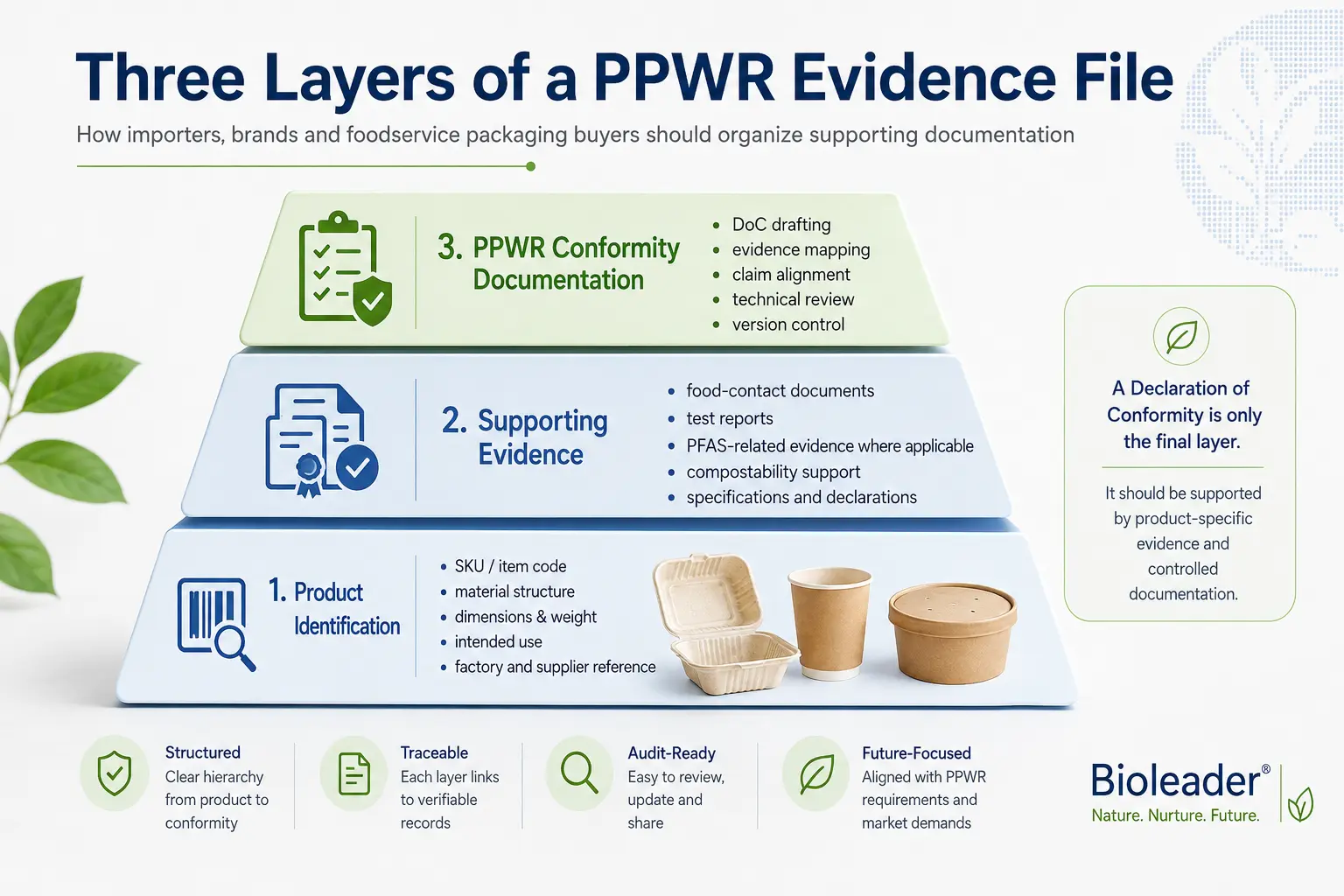
Layer 1: Product Identification
- SKU and product reference.
- GTIN or another controlled identification code.
- Product type and intended foodservice use.
- Dimensions, capacity and unit weight.
- Material composition.
- Colour and formulation.
- Coating or barrier system.
- Lid or closure material.
- Ink, adhesive, label, sleeve or window.
- Manufacturing unit and production location.
- Batch, lot or traceability method.
- Product and document version.
Layer 2: Supporting Evidence
- Product specifications and technical data sheets.
- Food-contact reports and declarations applicable to the intended use.
- Heavy-metal or restricted-substance evidence where applicable.
- PFAS declarations and analytical reports for relevant food-contact packaging.
- Compostability reports or certification within the actual product scope.
- Material-origin or chain-of-custody documents where relevant.
- Heat, oil, leakage, microwave, stacking or delivery-performance records.
- Factory quality and environmental-management documentation.
- Supplier declarations and formulation controls.
- Change-notification agreements.
- Environmental evidence such as a product carbon-footprint statement where applicable.
Layer 3: PPWR Conformity Documentation
- Packaging-classification assessment.
- Economic-operator and manufacturer-role assessment.
- Articles 5–12 applicability table.
- Annex VII technical documentation.
- Annex VIII EU Declaration of Conformity.
- Authorised signature and issue date.
- Revision and retention records.
- Corrective-action process where non-conformity is identified.
Evidence-file test: A reviewer should be able to start with the declaration number, identify the exact packaging type, locate the applicable evidence, confirm the production unit and determine whether any later material, supplier, coating, lid or artwork change affected conformity.
Evidence Mapping for Sugarcane Bagasse Food Packaging
Bagasse compliance evidence should be mapped to the finished product, not only to sugarcane fibre as a raw material.
Bioleader® supplies a range of sugarcane bagasse tableware and food packaging, including clamshells, takeaway containers, bowls, plates and trays. The PPWR treatment of each item depends on its intended packaging use and commercial arrangement.
| Evidence Area | Typical Supporting Documents | Scope Questions |
|---|---|---|
| Product identification | Specification sheet, drawing, unit weight, colour, dimensions and item code | Does the document identify the exact natural or white SKU and its production unit? |
| Food contact | Applicable FDA, EU food-contact, LFGB or related test reports | Does the report cover the material, product type, food use, temperature and contact time? |
| PFAS | Supplier declaration, targeted analysis, total-fluorine or other relevant analytical evidence | Does the evidence cover the selected formulation, colour, barrier system and finished item? |
| Compostability | EN 13432, OK Compost, BPI, AS 5810 or other applicable certificates and reports | Does the certificate cover the finished product, formulation, thickness, colour and any coating or ink? |
| Performance | Heat, oil, leakage, microwave, stacking and delivery testing | Do the test conditions match the intended application? |
| Factory systems | BRC, ISO 9001, ISO 14001, NSF or social-compliance audit documents | Is the document factory-level evidence rather than finished-product conformity proof? |
| Environmental evidence | Product carbon-footprint or other lifecycle-related documentation | Does the scope identify the production entity, declared unit, reporting period and system boundary? |
A bagasse food container may be supplied with an integrated fibre lid, a separate fibre lid, a PET lid or a PP lid. Buyers reviewing bagasse food containers should record each component instead of describing the entire combination only as “sugarcane packaging.”
Lid warning: A compostable bagasse base supplied with a PET or PP lid should not be described as an entirely compostable packaging combination unless the claim clearly excludes the plastic lid and gives accurate disposal instructions.
For round and moulded-fibre formats, the same rule applies to bagasse bowls and matching lids. Different lids may require different product-combination records or declaration versions.
Before accepting a compostability claim, procurement teams should also review how to verify truly compostable food packaging.
Bagasse evidence rule: Match the certificate and report to the exact finished product, formulation, colour, barrier treatment, lid configuration, production unit and intended application.
Evidence Mapping for Paper Cups
A paper cup is a multi-component packaging system, not simply a sheet of paper formed into a cup.
The evidence file may need to identify:
- Paperboard grade and supplier.
- Paperboard weight.
- PE, PLA, water-based or other barrier coating.
- Coating weight and application side.
- Side-seam and bottom-seal structure.
- Printing ink and artwork version.
- Adhesive or sealing material where used.
- Cup size, rim diameter and capacity.
- Intended hot- or cold-drink use.
- Separate lid material and product code.
- Outer sleeve or secondary packaging where applicable.
Buyers comparing paper cup formats should not assume that all coating systems have the same food-contact, recycling or composting pathway.
| Paper Cup Component | Evidence Focus | Common Documentation Error |
|---|---|---|
| Paperboard | Material specification, source, food-contact suitability and chain of custody where claimed | Using an FSC document as proof that the complete cup is recyclable or compostable |
| PE coating | Polymer identity, coating weight, food-contact use and recycling implications | Marketing the cup as plastic-free |
| PLA coating | PLA specification, food-contact conditions and finished-product compostability scope | Assuming a PLA coating automatically makes every finished cup compostable |
| Water-based barrier | Actual formulation, coating weight, food-contact documents and end-of-life assessment | Using “water-based” as a complete environmental claim without defining the coating |
| Ink and printing | Ink system, print area, migration controls and artwork version | Using a report for an unprinted cup without reviewing a newly printed version |
| Lid | PP, PET, PLA, CPLA, paper or other material; product code and fit | Failing to list the lid as a separate component |
Claim boundary: Paper-based does not automatically mean plastic-free, recyclable or compostable. The coating, lid, printing system, local collection infrastructure and finished-product evidence determine which claims may be supportable.
Evidence Mapping for Paper Bowls and Separate Lids
A paper bowl and its lid may form one commercial packaging set while remaining two different technical material systems.
For a coated paper soup bowl, the technical file should identify the bowl body, coating, bottom construction, ink, adhesive and intended temperature range.
The lid should be mapped separately:
- PP lid: May offer heat resistance and microwave suitability under defined conditions, but requires its own plastic and food-contact information.
- PET lid: Provides high transparency for cold or ambient applications but should not be described as microwave-safe or compostable.
- PLA lid: Is generally intended for cold-use applications and requires separate temperature and compostability review.
- Paper lid: Requires identification of paperboard, lining, coating, sealing layer and any plastic component.
- Bagasse lid: Requires finished-product fibre, barrier, PFAS, food-contact and compostability scope review.
A paper bowl used for soup, noodles or hot takeaway food may require different food-contact and performance evidence from a paper salad bowl used for cold foods and refrigerated display.
| Configuration Change | Technical-File Impact | DoC Action |
|---|---|---|
| Same bowl with a different lid material | Component structure and evidence package change | Update the covered configuration or issue a separate controlled version. |
| Blank bowl changed to printed bowl | Ink, artwork and migration review may change | Update the technical file and artwork record. |
| PE lining changed to PLA or another barrier | Food-contact and end-of-life evidence changes | Repeat the applicable conformity review. |
| Soup application changed to frozen dessert application | Temperature and food-contact conditions change | Confirm that existing reports cover the new intended use. |
| Different manufacturing plant introduced | Traceability, process and supporting evidence may change | Review whether the declaration and technical documentation remain valid. |
How to Map Bioleader® Certificates to the Correct SKU
A certificate displayed on a supplier website should be treated as preliminary evidence until its scope has been matched to the exact SKU being purchased.
Bioleader®’s certificates and test reports page groups available evidence by product category, including sugarcane bagasse products, paper packaging, PLA cups, cornstarch tableware, CPLA cutlery and manufacturing-system documentation.
For bagasse products, the available evidence framework may include food-contact reports, compostability documents, PFAS-related evidence, microwave-performance information and factory-system certifications. For paper packaging, the evidence framework may include food-contact reports, paper and paperboard testing, FSC chain-of-custody documentation and PFAS-, PFOA- or PFOS-related reports.
These documents should be reviewed using the following five-step method:
- Confirm the certificate holder.
Check whether the certificate or report belongs to Bioleader®, a production unit, a material supplier or another related entity. - Confirm the covered product or material.
Determine whether it applies to a raw material, product series, finished product, coating, lid or factory system. - Confirm the construction.
Check formulation, thickness, colour, coating, print, adhesive and component structure. - Confirm the market and intended use.
Review the food type, temperature, contact duration, destination market and applicable standard. - Record the scope in the SKU file.
Store the report number, issue date, validity status, covered product and evidence limitation.
Certificate-to-SKU Scope Check
- Does the product name or code match?
- Does the material match?
- Does the colour match?
- Does the coating match?
- Does the lid match?
- Does the manufacturing unit match?
- Does the food-contact use match?
- Does the destination market match?
- Is the certificate or report still valid?
- Does the permitted claim match the actual evidence?
PFAS evidence requires particular care. The article on PFAS-free packaging verification explains why buyers should review the test method, sample identity, reporting limit and claim scope instead of relying only on the words “PFAS-free.”
Factory Certifications Are Supporting Evidence, Not Finished-Product Proof
Management-system and factory-audit documents demonstrate process controls, but they do not prove that every SKU complies with every PPWR requirement.
Documents such as ISO 9001, ISO 14001, BRC Packaging Materials, NSF supplier-assurance audits and social-compliance assessments can support supplier qualification. They may demonstrate that a manufacturing unit operates defined systems for quality, environment, traceability, hygiene, corrective action or responsible business practices.
However, they do not automatically prove:
- That a specific SKU meets the PPWR PFAS limits.
- That a specific finished item is industrially or home compostable.
- That a paper cup is recyclable in every Member State.
- That a paper bowl and plastic lid share the same end-of-life pathway.
- That a product is food-contact suitable under every temperature and food condition.
- That the legally responsible manufacturer has completed the Annex VII conformity assessment.
Correct use: Factory certifications support supplier confidence and process control. Product-specific reports, specifications and conformity documentation support the individual packaging declaration.
Where Product Carbon Footprint Verification Fits into the File
A verified product carbon footprint can support an environmental evidence file, but it does not by itself demonstrate PPWR conformity, compostability, food-contact safety or PFAS compliance.
A relevant sugarcane-pulp tableware production unit can provide a third-party greenhouse-gas verification statement for a declared unit of 1 kg of compostable paper tableware.
The statement records:
- Product carbon-footprint preparation according to ISO 14067:2018.
- Verification according to ISO 14064-3:2019.
- A cradle-to-gate system boundary.
- A verified result of 2.2694 kg CO₂e per 1 kg declared unit for the stated reporting period.
- Verification by TÜV Austria Shanghai.
View the Greenhouse Gases Verification Statement
Scope limitation: The verified result should not be presented as the carbon footprint of every Bioleader® bagasse SKU. Applicability must be confirmed against the named production entity, declared product, reporting period, system boundary and selected product. The result excludes downstream transport, use and end-of-life stages outside the cradle-to-gate boundary.
Environmental claims should remain aligned with the evidence scope. Bioleader®’s EU Greenwashing Rules 2026 guide explains why quantified or comparative claims should not extend beyond the verified boundary.
How to Use the PPWR EU DoC Template
Use the template as the final working structure for a product-specific conformity file, not as a document to sign immediately after download.
- Select one packaging type or controlled product family.
Define which sizes and variants genuinely share the same material construction and supporting evidence. - Confirm that the item is packaging under PPWR.
Review the intended use, point of filling and commercial arrangement. - Identify the legal manufacturer.
Review branding, design control, final processing, modification and market-placement arrangements. - Identify the exact packaging configuration.
Record material, coating, lid, ink, adhesive and other relevant components. - Review the applicable Articles 5–12 requirements.
Determine which PPWR requirements apply to the identified packaging and retain the supporting assessment in the technical file. - Complete the Annex VII technical documentation.
Keep specifications, calculations, reports, certificates and other evidence traceable to the packaging identification. - Complete the Annex VIII declaration.
Use the v4.0 template to record the declaration number, packaging identification, manufacturer details, applicable legislation, technical references and authorised signature. - Retain and update the file.
Reassess conformity when design, materials, suppliers, production sites, standards or other relevant conditions change.
Download the Current Template · v4.0
PPWR EU Declaration of Conformity Template for Foodservice Packaging
2-page practical template · Version 4.0 · Updated September 2026
- Annex VIII EU Declaration of Conformity structure
- Product, SKU, batch / lot and packaging identification fields
- Material structure, intended use and packing configuration fields
- Common Bioleader® foodservice packaging examples and pre-signing checklist
Eight Common PPWR Declaration and Evidence-Mapping Mistakes
1. Treating a Raw-Material Certificate as Finished-Product Proof
A fibre, resin, coating or paper certificate may support the file, but the finished product can include additional components that change the compliance result.
2. Using One Declaration for an Undefined Product Catalogue
A declaration should cover one clearly identified packaging type or a controlled family whose variants and evidence boundaries are explicitly defined.
3. Ignoring Lids, Coatings, Inks and Adhesives
A paper bowl with a PET lid is not technically the same packaging system as the same bowl with a paper or PP lid.
4. Assuming the Physical Factory Is Always the Legal Manufacturer
Private-label branding, design control, final processing and modification may change the manufacturer-role assessment.
5. Treating a Laboratory Report as the PPWR Declaration
A report contains test findings. It does not replace the manufacturer’s conformity assessment and Annex VIII declaration.
6. Using Compostability Evidence as PFAS Proof
Compostability and PFAS are different evidence areas. A compostability certificate does not automatically demonstrate compliance with the PPWR PFAS limits.
7. Presenting a Cradle-to-Gate Carbon Result as a Full Lifecycle Claim
A cradle-to-gate result does not include every transport, use or end-of-life stage. The public claim must preserve that boundary.
8. Failing to Update the File After a Product Change
A new coating, lid, supplier, manufacturing plant, colour, print system or intended use may require technical-file and declaration updates.
Claim-control warning: Terms such as “eco-friendly,” “plastic-free,” “PFAS-free,” “recyclable” and “compostable” should be used only where the exact wording is supported by the selected product’s evidence and destination-market conditions.
Buyer Checklist Before Accepting a Supplier DoC
A buyer should accept a PPWR declaration only when it can be traced to the exact product and supporting technical file.
- The packaging type or controlled product family is clearly identified.
- The item’s packaging classification has been reviewed.
- The responsible manufacturer has been confirmed.
- The EU importer and other relevant economic operators are identified.
- All materials, coatings and components are recorded.
- The lid is separately identified where applicable.
- The certificate holder and production unit have been checked.
- Certificate and test-report scope matches the selected SKU.
- Food-contact conditions match the intended use.
- PFAS evidence has been reviewed for relevant food-contact packaging.
- Compostability evidence matches the finished-product construction where a claim is made.
- Factory-system documents are not being used as substitutes for product evidence.
- The Articles 5–12 applicability review has been completed.
- The declaration has a controlled number, version and issue date.
- The supplier has agreed to notify material, formulation and process changes.
Procurement teams can combine this checklist with Bioleader®’s guide on how importers evaluate compostable packaging suppliers.
How Many Products Can One Declaration Cover?
One declaration may cover a controlled product family only when the covered variants are clearly defined and supported by the same applicable evidence.
It may be reasonable to group several sizes where they share:
- The same material formulation.
- The same colour.
- The same barrier or coating system.
- The same ink and printing conditions.
- The same intended application.
- The same manufacturing unit.
- The same conformity-assessment conclusions.
- The same certificate and report scope.
Separate declaration versions or product-combination records may be appropriate where products have:
- Different lid materials.
- Different coatings or linings.
- Different colours or barrier treatments.
- Different manufacturing sites.
- Different branded and unbranded configurations.
- Different intended food-contact conditions.
- Different compostability or PFAS evidence.
Practical rule: A declaration may cover a controlled family, but it should never rely on an undefined phrase such as “all bagasse products” or “all paper cups.”
Bioleader® Support for Product-Specific PPWR Evidence Mapping
For importers, distributors, foodservice brands and private-label buyers, Bioleader® can support product-specific evidence review for selected sugarcane bagasse packaging, paper cups and paper bowls.
Available supplier-side support may include:
- Product specifications and drawings.
- Dimensions, capacity and unit-weight information.
- Material, coating and component details.
- Available food-contact reports.
- Available PFAS-related declarations or test evidence.
- Applicable compostability support within the verified scope.
- Factory-system and audit documents.
- Product-performance and application information.
- Production and carton traceability.
- Certificate-to-SKU mapping support.
- Export packing and commercial documentation.
Buyers can review Bioleader®’s wider sugarcane bagasse packaging solutions and paper food packaging solutions before selecting the products to be included in a technical-file review.
Document availability and applicability depend on the selected SKU, construction, manufacturing unit, destination market, intended use and intended claim.
Contact Bioleader® for product-specific document review and quotation
Final Conclusion
The strongest PPWR declaration is not the longest document. It is the declaration with the clearest connection between an identified packaging configuration, the responsible manufacturer and a controlled technical file.
For bagasse containers, paper cups and paper bowls, buyers should map relevant coatings, lids, inks, adhesives, colours and production units before accepting broad compliance claims.
Bioleader® will continue updating the downloadable PPWR EU DoC template as the PPWR technical framework develops. Keep the version used for each project and review later revisions before approving new products, artwork, claims or declarations.
Latest PPWR EU DoC Template · v4.0
PPWR EU Declaration of Conformity Template for Foodservice Packaging
2-page practical template · Version 4.0 · Updated September 2026
- Annex VIII EU Declaration of Conformity structure
- Product, SKU, batch / lot and packaging identification fields
- Material structure, intended use and packing configuration fields
- Common Bioleader® foodservice packaging examples and pre-signing checklist
Frequently Asked Questions
Is the downloadable Bioleader® PDF an official EU Declaration of Conformity?
No. It is a working template based on the Annex VIII model structure. It becomes a product-specific EU Declaration of Conformity only after the responsible manufacturer has completed the applicable conformity assessment, established the required technical documentation, completed the declaration for the identified packaging and signed it for and on behalf of the manufacturer.
Can one PPWR Declaration of Conformity cover several packaging sizes?
It may cover a clearly defined product family where the included sizes share the same material formulation, coating, colour, component structure, manufacturing unit, intended use and supporting evidence. The covered variants must be explicitly identified. One declaration should not be used for an undefined catalogue of products.
Does a compostability certificate automatically support the complete PPWR declaration?
No. A compostability certificate can support the compostability evidence within its verified scope, but it does not automatically demonstrate food-contact compliance, PFAS compliance, packaging minimisation, labelling compliance, recyclability or fulfilment of every applicable PPWR requirement.
Should a paper bowl and its plastic lid be listed separately?
Yes. The bowl and lid should be identified as separate components with their own material, weight, supplier and supporting evidence. The packaging combination may be managed in one technical file, but the declaration or covered configuration must clearly identify which lid is included.
Can a Chinese supplier sign the PPWR declaration for an EU private-label customer?
For standard packaging supplied without an EU customer’s name or trademark, a Chinese packaging producer may be the PPWR manufacturer, but the role should be determined from the actual manufacturing, design and branding arrangement. For packaging designed or manufactured under an EU customer’s own name or trademark, the customer will normally be the PPWR manufacturer, subject to the specific micro-enterprise exception and the exact commercial circumstances. The Chinese factory should then normally provide the technical evidence as the supplier rather than issue the declaration as manufacturer. Importers and distributors can also become manufacturers in the cases defined by PPWR Article 21.
Does a product carbon-footprint verification prove PPWR compliance?
No. A product carbon-footprint verification is supplementary environmental evidence. It does not replace the PPWR conformity assessment, food-contact documents, PFAS evidence, compostability evidence, product specifications or the Annex VIII EU Declaration of Conformity.
When should a PPWR Declaration of Conformity be updated?
It should be reviewed whenever the product design, material, coating, lid, colour, ink, adhesive, supplier, production unit, intended use, relevant legal requirement, technical specification or supporting evidence changes in a way that may affect conformity.