









What the 2026 EU PPWR Means for Takeaway & To-Go Packaging: PFAS, Reuse, Labeling & 2035 Roadmap
I. Why PPWR Matters for Takeaway Packaging
The European Union’s Packaging and Packaging Waste Regulation, Regulation (EU) 2025/40, replaces the former packaging-directive framework with a directly applicable EU Regulation. It entered into force on 11 February 2025 and has generally applied since 12 August 2026.
For takeaway, to-go, and food-delivery packaging, PPWR is more than a legal text. It affects how packaging is designed, documented, labelled, supplied, reused and ultimately assessed for recyclability.
However, buyers should avoid treating 12 August 2026 as the date on which every future PPWR requirement became mandatory. The Regulation contains multiple application dates and several obligations depend on delegated or implementing acts.
For takeaway-packaging buyers, the most practical long-term priorities are:
- Control substances of concern and product evidence, including the Article 5(5) PFAS limits for affected food-contact packaging.
- Prepare packaging for recyclability, minimisation and re-use milestones as the relevant PPWR provisions phase in.
- Build technical documentation and labeling readiness without prematurely treating future QR-code or harmonised-label requirements as already mandatory for every package.
Bioleader®’s EU PPWR Compliance White Paper provides a deeper article-by-article execution framework for importers and brands.
PPWR Compliance White Paper — PDF
II. Key PPWR Milestones for Takeaway Packaging: 2026–2035
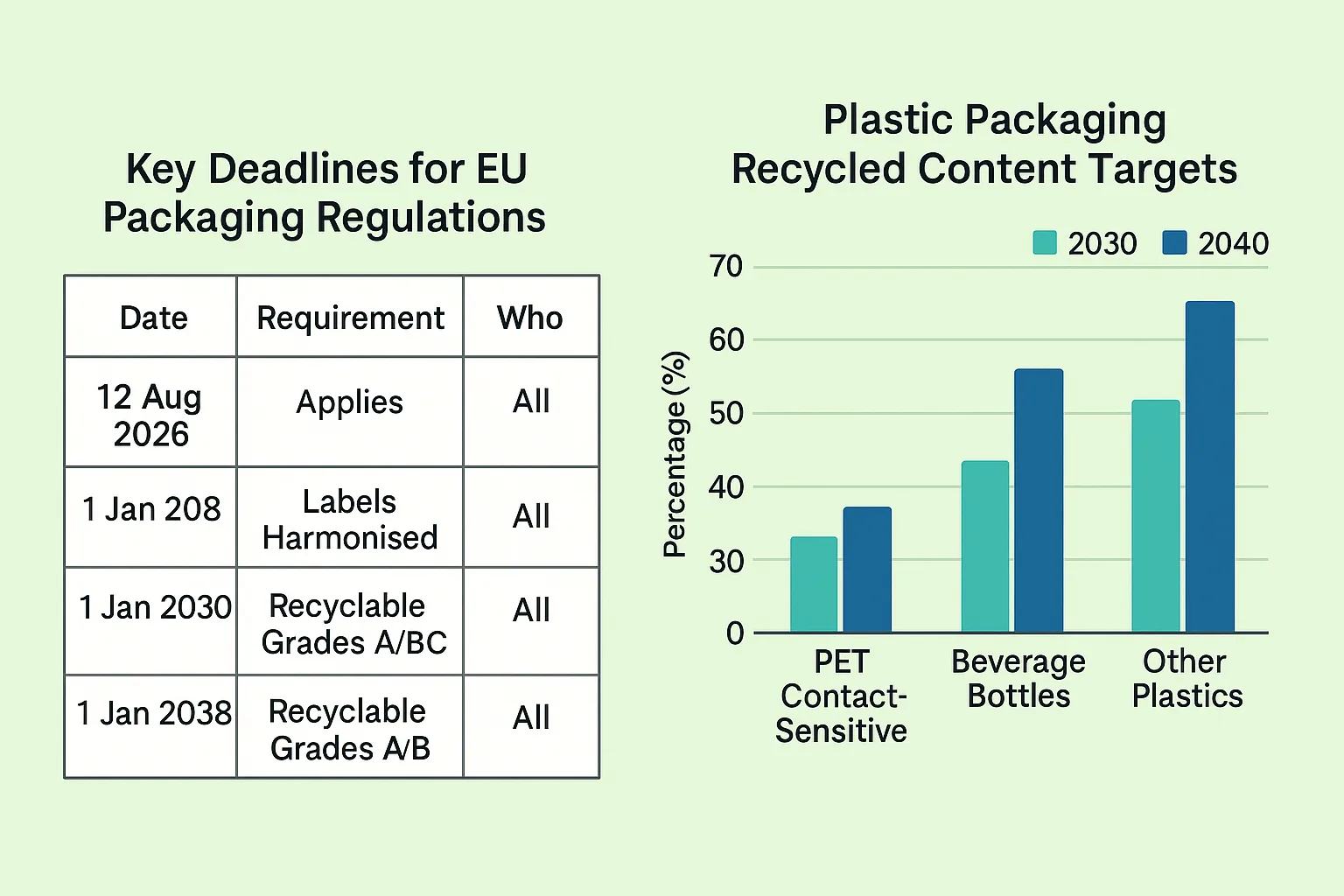
| Regulatory Area | Current PPWR Timeline | Takeaway Packaging Impact |
|---|---|---|
| PFAS in Food-Contact Packaging | Article 5(5) limits have applied since 12 August 2026: 25 ppb individual targeted PFAS, 250 ppb sum of targeted PFAS, and 50 ppm PFAS including polymeric PFAS. | Buyers should verify product-specific evidence for affected food-contact packaging rather than relying on broad “PFAS-free” catalog claims. |
| General Recyclability Requirement | Article 6(1) applies from the Regulation’s general application date. More detailed design-for-recycling criteria and performance grades phase in from 1 January 2030 or 24 months after the relevant delegated acts enter into force, whichever is later. | Packaging structures selected today should be reviewed for future sorting and recycling compatibility, but buyers should not claim that the 2030 grade system is already fully applicable. |
| Recycled at Scale | The recycled-at-scale requirement follows from 1 January 2035 or five years after the relevant implementing acts enter into force, whichever is later. | Long-term material choices should consider whether packaging can move through real collection, sorting and recycling infrastructure at scale. |
| Harmonised Packaging Labels | General material-composition labels apply from 12 August 2028 or 24 months after the relevant implementing acts enter into force, whichever is later. | Brands should plan artwork flexibility but should not yet treat one assumed icon or QR format as final unless the applicable implementing specifications are confirmed. |
| Reusable Packaging Label & Digital Carrier | Reusable packaging placed on the market from 12 February 2029 or 30 months after the relevant implementing act enters into force, whichever is later, must carry the applicable reusable label and supporting QR code or other standardised digital data carrier, subject to the Regulation’s scope and exceptions. | Reusable takeaway systems should build traceability and consumer information into system design rather than adding a QR code at the last minute. |
| Takeaway Refill / Re-use | HORECA operators must provide a system for consumers to bring their own containers by 12 February 2027. By 12 February 2028, covered final distributors must offer a reusable packaging option within a re-use system, subject to applicable exemptions including the micro-enterprise exemption in Article 33. | Restaurant and takeaway operators should distinguish refill-by-customer obligations from supplier packaging requirements and from later reusable-packaging labeling rules. |
| Packaging Minimisation | Article 10 minimisation requirements apply from 1 January 2030. Separate Article 24 empty-space obligations contain their own dates, including 12 February 2028 for minimising empty space in sales packaging. | Buyers should right-size packaging and avoid unnecessary layers while preserving food protection, hygiene, transport stability and product functionality. |
These milestones show why PPWR should be managed as a phased compliance program rather than one August 2026 event.
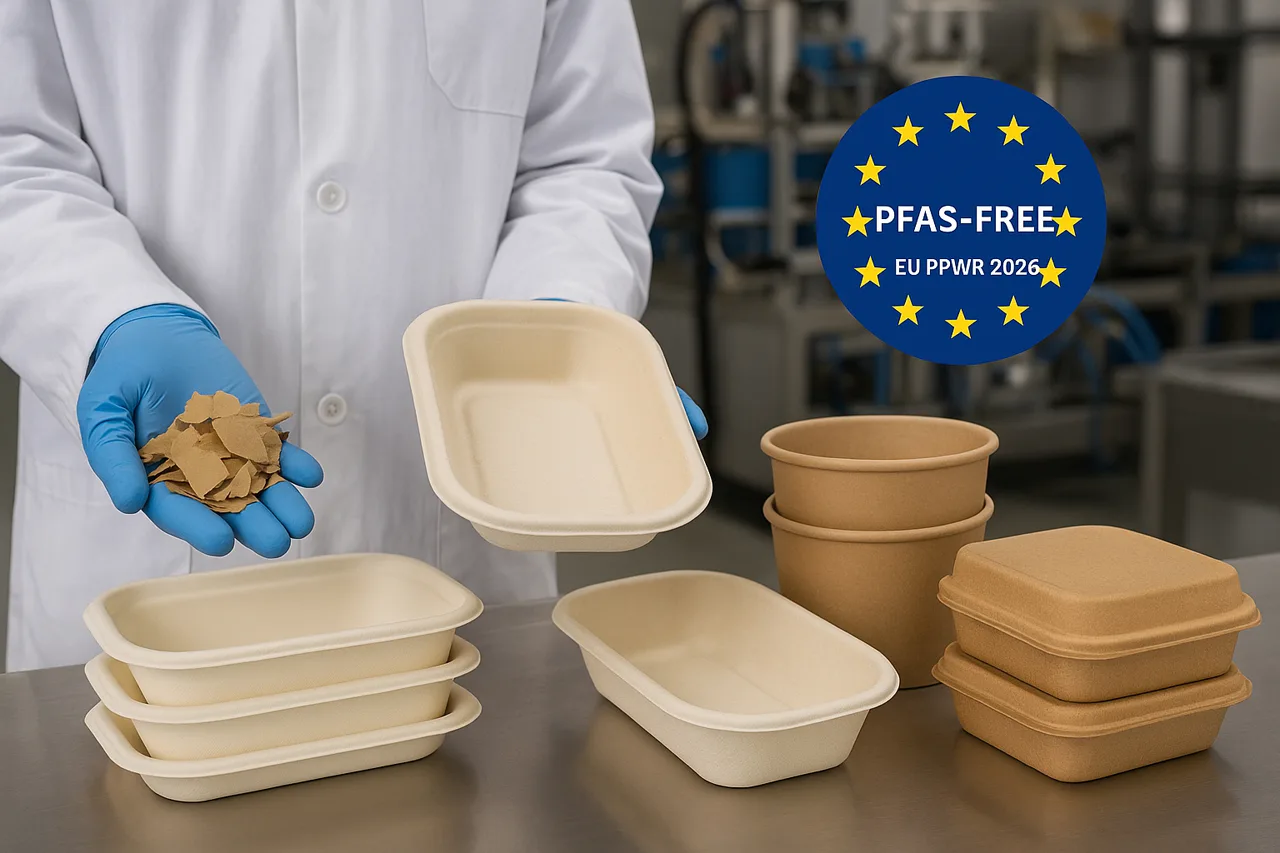
III. PFAS-Free Transition: From Risk to Current Compliance
PFAS have historically been used in some paper and molded-fiber barrier systems to improve oil and grease resistance. For EU food-contact packaging, the issue is now governed by measurable Article 5(5) limits rather than a general sustainability preference.
Since 12 August 2026, food-contact packaging must not be placed on the EU market where PFAS concentrations are equal to or above the applicable limits:
- 25 ppb for any individual PFAS measured by targeted PFAS analysis, excluding polymeric PFAS from that targeted quantification.
- 250 ppb for the sum of targeted PFAS, where applicable after prior degradation of precursors, excluding polymeric PFAS from targeted quantification.
- 50 ppm for PFAS including polymeric PFAS.
The European Commission’s 2026 guidance recommends a practical stepwise enforcement approach. Total Fluorine may be used first as a screening measurement. Where Total Fluorine is below 50 mg/kg, the sample could be considered compliant at the first screening step under the current guidance. Where it exceeds that level, further fluorine-source investigation and targeted or precursor analysis may be appropriate.
Buyers should therefore avoid directly comparing a Total Fluorine result in mg/kg with the 25 ppb or 250 ppb targeted-PFAS limits as though the analytical measurements were equivalent.
For deeper verification logic, review Bioleader®’s PFAS-Free Packaging in 2026: What It Means and How to Verify Compliance.
For companies still replacing older molded-fiber products or weak supplier files, the PFAS-Free Tableware Transition Guide for 2026 provides an application-level audit and testing roadmap.
What This Means for Barrier Technology
PPWR does not require every food-contact package to use one specific barrier chemistry. Buyers should assess replacement systems according to the actual product structure, food type, temperature, holding time, grease exposure and evidence available.
Depending on the product, possible approaches may include water-based or other non-fluorinated barrier systems, internal sizing technologies, coating-free molded-fiber structures, or alternative packaging designs. Performance and regulatory suitability should be confirmed for the intended application rather than assumed from the barrier name alone.
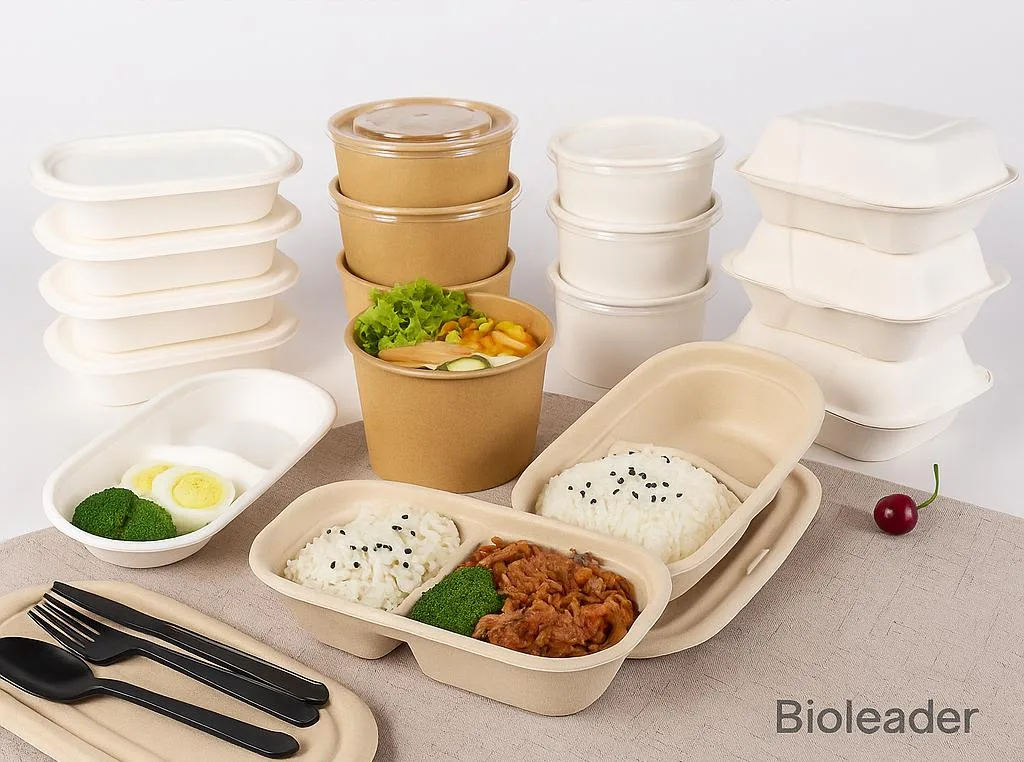
- Bagasse food containers can be evaluated for hot meals, oily foods, takeaway and delivery applications.
- Kraft paper food containers should be reviewed by board structure, barrier system, food-contact documentation and intended end-of-life claim.
Buyer Action Plan:
- Identify affected food-contact packaging SKUs and current barrier systems.
- Request product-specific supplier declarations and relevant laboratory evidence.
- Check the sample identity, analytical method, reporting or detection limit, issue date and scope of the evidence.
- Test alternative products with real menu conditions before approving bulk replacement.
- Maintain change control where the formulation, coating, supplier, color or material structure changes.
For technical comparison of bagasse grease-resistance routes, see PFAS-Free Sugarcane Tableware: Internal Additives vs Barrier Systems.
IV. Recyclability and Design-for-Recovery
PPWR introduces a staged recyclability framework. Article 6(1) requires packaging to be recyclable, while the detailed design-for-recycling performance-grade system phases in later.
From 1 January 2030 or 24 months after the relevant delegated acts enter into force, whichever is later, packaging generally must meet the applicable design-for-recycling criteria and fall within recyclability performance grades A, B or C, subject to the Regulation’s specific provisions and exceptions.
For the recycled-at-scale requirement, the relevant milestone is 1 January 2035 or five years after the relevant implementing acts enter into force, whichever is later.
This distinction matters. A product should not be advertised today as automatically “PPWR 2030 recyclable” simply because it contains fibre or a mono-material plastic. Future recyclability assessments depend on harmonised criteria, packaging category, integrated and separate components, sorting compatibility, and the applicable delegated acts.
For takeaway products, buyers should already review:
- Whether integrated and separate components can enter compatible collection and sorting streams.
- Whether a coating, laminate, adhesive or attached lid unnecessarily complicates recycling.
- Whether a mono-material structure is technically feasible without compromising food safety or product performance.
- Whether fibre-based packaging is actually compatible with the intended paper or fibre-recycling route in the destination market.
- Whether consumer disposal instructions can be supported by the actual packaging structure and local system.
Bioleader®’s sustainable takeaway packaging page provides a commercial starting point for comparing takeaway formats across different material systems.
V. Digital Labeling: A Phased Compliance Layer
The original PPWR discussion around QR codes and digital labeling is often oversimplified. Not every packaging unit is required to carry a digital product passport or QR code immediately in 2026.
For general packaging material labels, Article 12 provides that harmonised material-composition labeling applies from 12 August 2028 or 24 months after the relevant implementing acts enter into force, whichever is later.
For reusable packaging, the timeline is different. Reusable packaging placed on the market from 12 February 2029 or 30 months after the relevant implementing act enters into force, whichever is later, must carry the applicable label informing users that it is reusable. Further information on reusability is then provided through a QR code or other standardised, open digital data carrier, subject to the scope and exceptions in Article 12.
For takeaway-packaging brands, current preparation can include:
- Maintaining accurate product-composition data in ERP, PIM or technical files.
- Keeping artwork areas adaptable for future EU harmonised labels.
- Separating optional marketing QR codes from future legally required digital carriers.
- Ensuring disposal and material information on current packaging is accurate and not misleading.
For broader implementation guidance, review Bioleader®’s EU PPWR 2026 Guidance for Foodservice Packaging.
VI. Packaging Minimization: Efficiency as a Future Compliance Requirement
Packaging minimisation should be discussed with the correct timeline.
Under Article 10, from 1 January 2030, the manufacturer or importer must ensure that packaging placed on the market is designed so that its weight and volume are reduced to the minimum necessary to maintain packaging functionality.
Separate Article 24 requirements apply to empty space. For sales packaging, economic operators must reduce empty space to the minimum necessary by 12 February 2028. For grouped, transport and e-commerce packaging, the maximum 50% empty-space ratio applies by 1 January 2030 or three years after the relevant implementing act enters into force, whichever is later.
For takeaway brands, good preparation already includes:
- Reassessing portion size against container volume.
- Avoiding unnecessary secondary wraps, sleeves or inserts.
- Reducing unnecessary headspace while preserving food quality, closure and safety.
- Optimising multi-compartment designs for actual menu requirements.
- Improving master-carton and shipping efficiency without compromising transport protection.
Minimisation should never be interpreted as simply making packaging thinner. Functional performance, food protection, hygiene, structural strength and regulatory requirements remain relevant.
VII. Strategic Roadmap 2026–2035
| Phase | Timeline | Core Tasks |
|---|---|---|
| Phase 1: Verify Current Compliance | August 2026–February 2027 | Review Article 5(5) PFAS exposure, supplier files, food-contact packaging SKUs, environmental claims and EU importer documentation. HORECA operators should prepare the bring-your-own-container refill system required by February 2027. |
| Phase 2: Refill, Re-use and Label Preparation | 2027–2029 | Implement applicable takeaway refill and reusable-offer obligations, review micro-enterprise exemptions where relevant, prepare artwork flexibility, and track the status of harmonised labeling implementing acts. |
| Phase 3: Design for Recycling and Minimisation | 2028–2030+ | Prepare packaging structures for the Article 6 design-for-recycling criteria, recyclability grades, Article 10 minimisation requirements, and Article 24 empty-space requirements as their application dates are reached. |
| Phase 4: Recycled at Scale | 2030–2035+ | Track the implementing methodology and demonstrate that packaging can participate in collection, sorting and recycling systems at the scale required by the PPWR framework. |
This roadmap converts PPWR into a sequence of product-development, procurement, technical-documentation and operating tasks instead of treating the Regulation as a single deadline.
For a more procurement-focused version, use the PPWR 2026 Checklist for Foodservice Packaging Buyers.
VIII. How Export Manufacturers Can Support EU Buyer Readiness
For Chinese and Asian food-packaging manufacturers exporting to Europe, PPWR creates a higher evidence threshold. Material names alone do not establish compliance.
Bagasse, kraft paper, PLA, CPLA and other bio-based materials may support specific sustainability or foodservice objectives, but each product must still be assessed according to its actual packaging function, composition, food-contact use, coating or barrier system, PPWR requirements and destination-market rules.
Prepared suppliers can support EU buyers by providing:
- Product-specific technical specifications identifying dimensions, weight, material structure, coating or barrier system and intended use.
- Food-contact documentation relevant to the product and destination market.
- PFAS-related evidence appropriate to affected food-contact packaging.
- Compostability documentation such as EN 13432, BPI, ASTM D6400 or TÜV evidence only where it actually covers the selected product and claim.
- Traceability and controlled specifications for repeat production and formulation changes.
- Artwork and labeling flexibility as EU harmonised labeling requirements are finalised and phased in.
Bioleader®’s PFAS-Free compostable tableware page allows buyers to compare molded-fiber tableware options, while the Certificates & Test Reports section provides access to available supporting documents.
For broader product sourcing, buyers can review paper food packaging, bagasse food containers, and compostable cold-drink cup options according to the actual application and market.
IX. Opportunities Beyond Compliance
- Product differentiation: Better-documented PFAS-free, recyclable, reusable or compostable packaging options can help buyers compare products more confidently when the claims are properly supported.
- Operational efficiency: Right-sizing and better packing density can reduce unnecessary material and logistics cost while supporting future minimisation requirements.
- Customer trust: Clear material information and controlled environmental claims reduce ambiguity for distributors, restaurants and end users.
- Supplier qualification: Manufacturers with organised technical files, traceable specifications and repeatable product quality are easier for EU importers to approve.
- Portfolio flexibility: Combining bagasse, paper, PLA, reusable systems and conventional recyclable plastics where appropriate can be stronger than forcing every application into one material.
For buyers, the competitive advantage is therefore not “choosing the greenest-looking package.” It is building a portfolio that connects product function, regulation, infrastructure and evidence.
X. Future Outlook: From Regulation to Practical Circular Packaging
Between 2026 and 2035, the PPWR framework will progressively move from general application into more detailed design-for-recycling, labeling, minimisation, re-use and recycled-at-scale requirements.
By 2030 and beyond, takeaway-packaging buyers are likely to place greater emphasis on:
- Better-documented PFAS-free food-contact packaging where the Article 5(5) requirements apply.
- Packaging structures designed around harmonised recyclability criteria rather than generic recyclable claims.
- Harmonised material labels as the Article 12 requirements become applicable.
- QR codes or other standardised digital carriers where PPWR specifically requires them, particularly for reusable packaging.
- A combination of reusable systems and optimised single-use packaging depending on the foodservice channel, service model and applicable legal requirement.
- More rigorous technical documentation connecting packaging claims to the actual product.
Takeaway packaging is therefore moving toward a more traceable and evidence-driven model, but not every future technology or material solution should be treated as mandatory before the relevant PPWR provisions apply.
FAQ: EU PPWR 2026 and Takeaway Packaging
1. When did the EU PPWR start to apply?
Regulation (EU) 2025/40 entered into force on 11 February 2025 and has generally applied since 12 August 2026. However, many requirements have later application dates or depend on delegated or implementing acts, so buyers should review each relevant provision separately.
2. What PFAS limits now apply to EU food-contact packaging?
Since 12 August 2026, Article 5(5) sets three limits: 25 ppb for an individual targeted PFAS, 250 ppb for the sum of targeted PFAS, and 50 ppm for PFAS including polymeric PFAS. Total Fluorine above 50 mg/kg triggers a separate evidentiary issue under the Regulation and should not be confused with the 50 ppm PFAS limit.
3. Does Total Fluorine below 50 mg/kg prove every PPWR PFAS limit is met?
Under the European Commission’s current 2026 guidance, a sample with Total Fluorine below 50 mg/kg could be considered compliant at the first screening step. However, Total Fluorine screening and targeted PFAS analysis are different measurements. Buyers should review the analytical method, sample scope and applicable verification need.
4. When must takeaway restaurants allow customers to bring their own containers?
By 12 February 2027, covered final distributors in the HORECA sector that offer hot or cold beverages or ready-prepared food in takeaway packaging must provide a system allowing consumers to bring their own container to be filled.
5. When must takeaway businesses offer reusable packaging?
By 12 February 2028, covered HORECA final distributors must give consumers the option of obtaining relevant takeaway beverages or ready-prepared food in reusable packaging within a re-use system. Article 33 includes an exemption for qualifying micro-enterprises.
6. When do harmonised EU packaging labels become mandatory?
General harmonised material-composition labels apply from 12 August 2028 or 24 months after the relevant implementing acts enter into force, whichever is later. Reusable packaging has a separate timeline beginning from 12 February 2029 or 30 months after the relevant implementing act enters into force, whichever is later.
7. Is every takeaway package required to have a QR code?
No. PPWR does not impose an immediate universal QR-code requirement on every takeaway package. Digital-carrier requirements apply in defined contexts, including reusable packaging under Article 12. Buyers should distinguish optional marketing QR codes from mandatory PPWR digital information requirements.
8. Does “recyclable” mean “compostable” under PPWR?
No. Recyclability and compostability are separate end-of-life concepts. A compostable package is not automatically recyclable, and a recyclable package is not automatically compostable. Buyers should verify the applicable material, certification, collection route and PPWR requirement for each product.
9. What should takeaway-packaging buyers request from suppliers?
Buyers should request product specifications, material and coating information, applicable food-contact documentation, PFAS-related evidence where relevant, compostability certification where applicable, traceability information, and documentation that clearly matches the selected SKU rather than a general company-level sustainability claim.
Buyer Action Summary
Current priority: Review affected EU food-contact packaging against the Article 5(5) PFAS requirements and confirm that supplier evidence matches the actual product.
2027 priority: HORECA takeaway operators should implement the applicable bring-your-own-container refill system.
2028 priority: Prepare for the reusable takeaway offer obligation, sales-packaging empty-space requirements, and the first potential harmonised-label application dates subject to implementing-act timing.
2030 priority: Prepare packaging for design-for-recycling grades, Article 10 minimisation, relevant recycled-content requirements and other 2030 PPWR milestones.
2035 priority: Track recycled-at-scale methodology and verify whether selected packaging participates in operational collection, sorting and recycling systems at the required scale.
Procurement principle: Do not select bagasse, paper, PLA, CPLA, PP, PET or any other material based on the material name alone. Begin with food temperature, holding time, barrier requirements, destination-market infrastructure and the evidence available for the specific packaging structure.
Bioleader® Support for EU Takeaway Packaging Buyers
Bioleader® supplies multiple foodservice packaging families including sugarcane bagasse containers, trays and bowls, paper cups and paper food packaging, PLA cold cups, CPLA cutlery, cornstarch-based tableware and related takeaway packaging formats.
For EU-facing sourcing projects, buyers can request product specifications, available test reports and certificates, sample evaluation and commercial information for the selected product. Documentation scope may vary by material, SKU, formulation and destination market.
Buyers comparing molded-fiber solutions can begin with Bioleader®’s PFAS-Free compostable tableware page. For broader takeaway formats, review sustainable takeaway packaging solutions.
For current EU PPWR documentation questions, the PPWR Declaration of Conformity guide explains how technical files, product identity and supplier evidence connect to conformity responsibilities.
Regulatory and Related References
- Regulation (EU) 2025/40 on Packaging and Packaging Waste — EUR-Lex
- European Commission 2026 Guidance for Regulation (EU) 2025/40
- European Commission FAQ on the Packaging and Packaging Waste Regulation
- Bioleader® EU PPWR Compliance White Paper
- Bioleader® PPWR 2026 Foodservice Packaging Checklist
- Bioleader® EU PPWR 2026 Guidance for Foodservice Packaging