By 2026, biodegradable cutlery procurement is no longer a symbolic sustainability choice but a compliance-driven, material-science-based sourcing decision.
Buyers must evaluate cutlery not only by “biodegradable” labels, but by verified degradation pathways, real-use performance, regulatory alignment, and long-term supply stability.
Cornstarch-based and certified compostable cutlery currently offer the most scalable balance between usability, cost control, and environmental credibility, while wooden cutlery remains limited to narrow, low-moisture use cases.
Manufacturer capability—material transparency, certification readiness, and production scalability—has become more critical than individual product SKUs.
Biodegradable cutlery procurement in 2026 requires evaluating not only material labels, but verified degradation behavior, manufacturer capability, regulatory alignment, and total lifecycle cost.
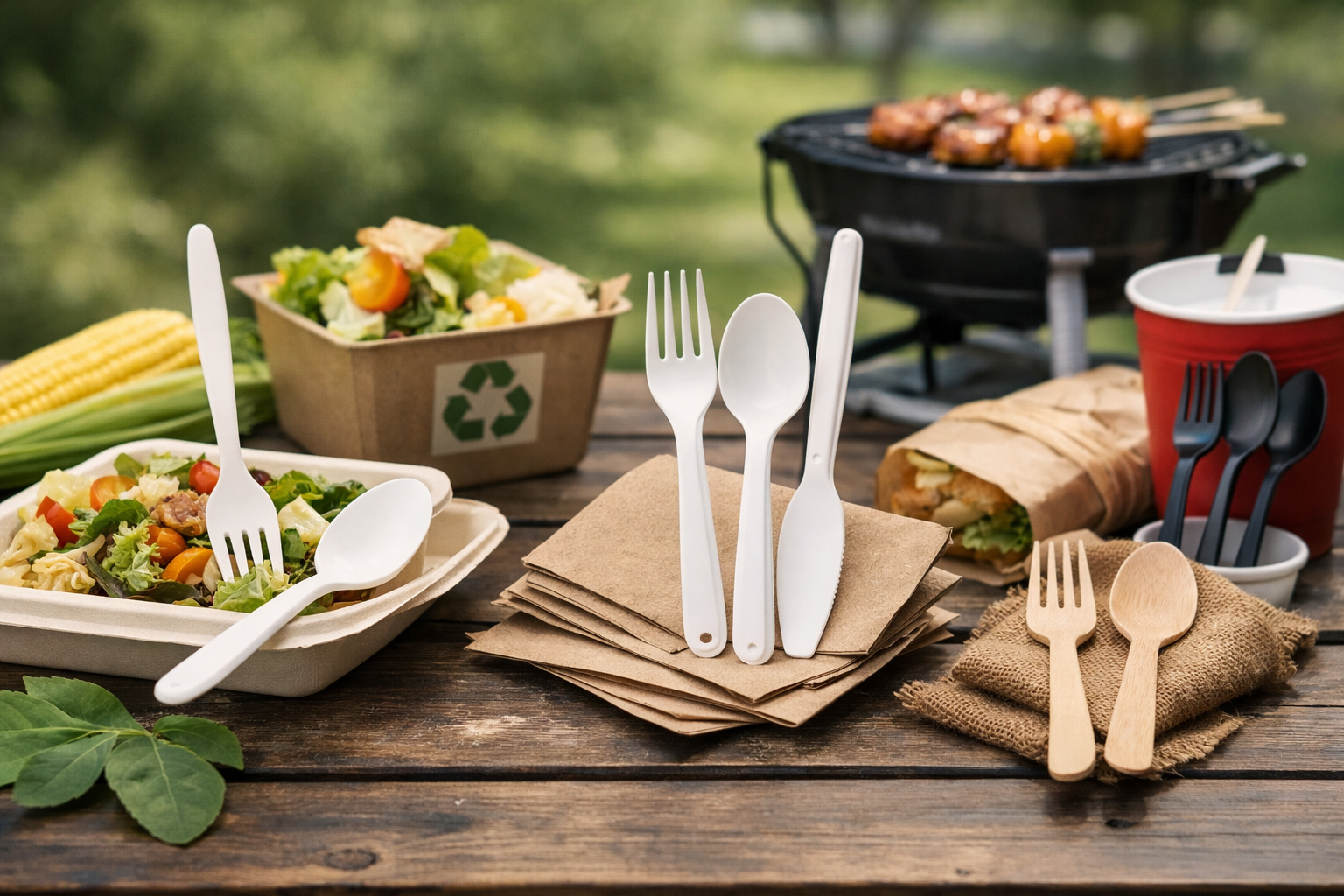
Manufacturer Comparison, Material Science, and Strategic Selection Framework
As global regulations on single-use plastics accelerate, biodegradable cutlery has moved from a niche sustainability option to a core procurement category for foodservice operators, retailers, and international distributors.
By 2026, procurement decisions around forks, spoons, and knives will no longer be driven solely by unit price. Instead, buyers must balance material science, degradation behavior, regulatory compliance, supply-chain stability, and real-world usability.
This guide provides a science-based, procurement-oriented framework for evaluating biodegradable and compostable cutlery. It is designed to support long-term sourcing decisions, not short-term marketing claims.
Executive Summary
Not all “biodegradable” cutlery behaves the same in real disposal environments
Material selection directly impacts usability, cost stability, and compliance risk
Wooden cutlery is often misunderstood and has structural limitations
Cornstarch-based and certified compostable cutlery offer better scalability
Manufacturer capability is more critical than individual product SKUs
By 2026, procurement strategies must prioritize standardization, traceability, and lifecycle cost, not appearance alone

1. Why 2026 Marks a Turning Point for Cutlery Procurement
1.1 Regulatory Pressure Is Becoming Structural
Across the EU, North America, and parts of Asia-Pacific, disposable plastic cutlery is increasingly restricted through:
Direct bans
Mandatory substitution policies
ESG-linked procurement requirements
Extended Producer Responsibility (EPR) frameworks
As a result, foodservice operators and distributors can no longer rely on petroleum-based cutlery without regulatory and reputational exposure.
Biodegradable cutlery is now evaluated not as a “green alternative,” but as a compliance-driven procurement necessity.
1.2 Sustainability Claims Are Under Scrutiny
Regulators and corporate buyers are increasingly challenging vague claims such as:
“Eco-friendly”
“Green”
“Natural”
Procurement teams are now expected to verify:
Material composition
Degradation pathways
Certification compatibility
Disposal infrastructure alignment
This shift favors material transparency and data-backed performance, rather than aesthetics.
Why Biodegradable Cutlery Procurement Changed After 2025
Regulatory pressure, extended producer responsibility (EPR), and ESG-linked purchasing policies require buyers to demonstrate not only what material a product is made from, but how it behaves after disposal.
As a result, biodegradable cutlery is now evaluated as a regulated consumable with lifecycle implications, rather than a marketing accessory.
2. Defining Biodegradable vs. Compostable Cutlery (Scientifically)
Before comparing products, it is essential to clarify terminology.
2.1 Biodegradable Cutlery
Biodegradable cutlery refers to products made from materials that can be broken down by microorganisms into water, carbon dioxide, and biomass over time. However:
The timeframe may vary widely
Environmental conditions matter
Biodegradability alone does not guarantee environmental benefit.
2.2 Compostable Cutlery
Compostable cutlery meets defined standards (e.g. EN 13432, ASTM D6400) requiring:
Complete disintegration within a specified timeframe
No toxic residue
Compatibility with controlled composting systems
Compostability is verifiable and certifiable, making it more suitable for regulated procurement environments.
What Actually Matters in Biodegradable Cutlery Materials
Cornstarch-based cutlery offers a plant-derived, scalable solution with stable molding performance and predictable disposal behavior.
Certified compostable cutlery prioritizes regulatory clarity and industrial composting compatibility.
Wooden cutlery, while plastic-free, often introduces taste transfer, moisture absorption, and inconsistent structural strength, limiting its suitability for standardized foodservice systems.
3. Material Landscape: Scientific and Practical Comparison
3.1 Core Material Categories
The table below compares common cutlery materials across performance, degradation behavior, cost, and application suitability.
Biodegradable Cutlery Material Comparison
| Material Type (Product Name) | Degradation Pathway & Time | Environmental Reliability | Cost Level | Mechanical & Thermal Performance | Suitable Applications | Key Advantages | Primary Limitations |
|---|---|---|---|---|---|---|---|
| Cornstarch Cutlery | Biodegrades under industrial composting; partial degradation possible in controlled home composting (approx. 3–6 months) | High | Low–Medium | Good rigidity; moderate heat resistance; stable for cold and warm foods | Takeaway meals, fast food, catering, delivery platforms | Cost-efficient, scalable production, familiar user experience | Not suitable for prolonged high-temperature exposure |
| PLA / PBS Cutlery | Industrial composting required; controlled degradation within 3–6 months | Medium–High | Medium | Improved heat resistance compared to starch-based materials | Cold to medium-temperature foods, institutional catering | Better thermal stability, clean appearance | Limited degradation without industrial composting infrastructure |
| Certified Compostable Cutlery (EN 13432 / ASTM D6400) | Fully compostable under certified industrial composting conditions; 3–6 months with no toxic residue | High (certified) | Medium–High | Consistent mechanical strength; designed to meet compliance thresholds | Public-sector procurement, regulated markets, ESG-driven programs | Clear regulatory alignment, third-party verification | Dependent on composting infrastructure availability |
| Wooden Cutlery | Natural degradation in open environments; timeframe varies from months to several years | Medium | Low–Medium | Low moisture resistance; prone to splintering and deformation | Dry foods, short-term use, low-moisture applications | Plastic-free appearance, renewable raw material | Taste transfer, poor user experience, inconsistent strength |
| Conventional Plastic Cutlery (PP / PS) | Non-biodegradable; persists in the environment for decades | Low | Low | Excellent durability and heat resistance | Historically universal foodservice use | Low cost, high performance | Regulatory restrictions, high environmental impact |
*Actual degradation depends on disposal conditions.
How Manufacturers Influence Sustainability Outcomes More Than Products
Traceable raw materials, batch-level quality control, certification readiness, and production scalability directly affect compliance risk and supply continuity.
Manufacturers capable of delivering multi-material portfolios and standardized cutlery sets reduce procurement complexity and improve long-term sourcing resilience.
In practice, buyers increasingly prefer solution-oriented suppliers rather than single-SKU vendors.
4. Cornstarch Cutlery: A Scalable Plant-Based Solution
Cornstarch-based cutlery is one of the most widely adopted biodegradable options due to its balance between performance, cost, and scalability.

Key Technical Characteristics
Derived primarily from renewable starch sources
Molded into rigid, plastic-like forms
Compatible with high-volume production
Lower carbon footprint compared to petroleum plastics
In practice, cornstarch cutlery is particularly suitable for:
Quick-service restaurants
Food delivery platforms
High-volume catering
Retail meal kits
Its cost stability and user familiarity make it a practical default for large-scale deployment.
(Example reference: Bioleader manufactures cornstarch-based cutlery designed for high-volume foodservice use, with standardized specifications suitable for export markets.)
5. Compostable Forks and Spoons: Compliance-Oriented Choice
Certified compostable forks and spoons play a distinct role in procurement strategies where regulatory compliance and documentation are critical.

When Compostable Cutlery Is Preferable
Public-sector tenders
Corporate ESG-driven procurement
Regions with industrial composting infrastructure
Brands requiring third-party certification alignment
These products are not chosen for aesthetics, but for verifiable end-of-life performance.
6. Wooden Cutlery: A Commonly Misunderstood Alternative
Wooden cutlery is often perceived as inherently sustainable. However, scientific and operational analysis reveals important constraints.

Structural and Functional Limitations
Absorbs moisture and oils
Alters food taste
Rough mouthfeel and splinter risk
Inconsistent mechanical strength
Limited suitability for soups or sauces
From a lifecycle perspective, wooden cutlery may not always outperform plant-based molded alternatives, especially in high-volume or standardized foodservice systems.
Wooden cutlery remains suitable for short-duration, low-moisture applications, but is not optimal as a universal replacement.
7. Manufacturer Capability: The Real Procurement Variable
Material choice alone does not determine success. Manufacturer capability is often the decisive factor.
Key Evaluation Criteria for Biodegradable Cutlery Manufacturers
| Criterion | Why It Matters |
|---|---|
| Material traceability | Ensures consistent environmental performance |
| Certification readiness | Reduces regulatory risk |
| Production scalability | Supports long-term contracts |
| Quality control systems | Minimizes batch variability |
| Product range depth | Simplifies procurement |
| Export experience | Avoids compliance and logistics issues |
Manufacturers capable of supplying individual utensils, standardized cutlery sets, and multi-material portfolios provide greater procurement resilience.
(As an example, suppliers like Bioleader position themselves not as single-product vendors, but as integrated biodegradable cutlery solution providers.)
8. Biodegradable Cutlery Sets: Operational Efficiency Advantage
Cutlery sets (fork + spoon + knife, optionally napkin) offer:
Reduced SKU complexity
Improved inventory control
Consistent user experience
Easier compliance documentation
For large foodservice operators, standardized sets often deliver lower total cost of ownership, even if unit prices appear higher.
9. Cost Analysis: Moving Beyond Unit Price
Effective procurement evaluates lifecycle cost, not just purchase price.
Hidden Cost Components
Product failure and breakage
Customer complaints and replacement
Supply disruption risk
Compliance penalties
Brand perception impact
In many cases, slightly higher-cost biodegradable cutlery reduces total operational risk.
10. Strategic Outlook: Procurement Beyond 2026
Key trends shaping the next phase:
Material transparency will be mandatory
Certification alignment will increase
Supplier consolidation will accelerate
Multi-material portfolios will dominate
Lifecycle metrics will replace visual “eco cues”
Strategic Takeaway: How to Source Biodegradable Cutlery for 2026 and Beyond
Cornstarch-based and certified compostable cutlery currently represent the most balanced options for high-volume foodservice applications.
Wooden cutlery should be treated as a situational alternative rather than a universal solution.
Looking ahead, procurement strategies that prioritize material transparency, supplier capability, and lifecycle cost analysis will outperform appearance-driven or price-only decisions.
Conclusion
Biodegradable cutlery procurement is no longer a symbolic sustainability action. It is a technical, regulatory, and operational decision.
Organizations that adopt material-aware, manufacturer-focused, and lifecycle-driven strategies will be best positioned for regulatory compliance, cost stability, and credible sustainability performance beyond 2026.
Is cornstarch cutlery suitable for large-scale foodservice operations?
Yes. Cornstarch-based cutlery is widely adopted in high-volume foodservice due to its cost efficiency, stable molding performance, and compatibility with most takeaway and quick-service meal formats.
When should certified compostable cutlery be prioritized over biodegradable options?
Certified compostable cutlery is preferred in regulated markets, public-sector procurement, and ESG-driven programs where third-party standards such as EN 13432 or ASTM D6400 are required.
Why do many buyers move away from wooden cutlery after initial trials?
While wooden cutlery appears environmentally friendly, it often causes taste transfer, moisture absorption, and inconsistent strength, leading to higher complaint rates in real foodservice use.
What should international buyers look for when selecting a biodegradable cutlery manufacturer?
Key factors include material traceability, certification readiness, scalable production capacity, consistent quality control, and export experience with food-contact compliance.
Can biodegradable cutlery be supplied as standardized sets for retail or food delivery?
Yes. Many manufacturers offer biodegradable cutlery sets that reduce SKU complexity, simplify logistics, and ensure a consistent sustainability message across channels.
References
European Commission — Single-Use Plastics Directive and Plastic Reduction Policies, European Union
U.S. Environmental Protection Agency (EPA) — Biodegradable Plastics and Composting Standards, United States
ASTM International — ASTM D6400 Standard Specification for Compostable Plastics, ASTM International
European Committee for Standardization (CEN) — EN 13432 Packaging and Compostability Requirements, CEN
Ellen MacArthur Foundation — Global Commitment on Plastic Packaging and Circular Economy, Ellen MacArthur Foundation
United Nations Environment Programme (UNEP) — Plastics, Sustainability, and Environmental Impact Reports, UNEP
Food Packaging Forum — Bioplastics and Food Contact Materials: Scientific Assessments, Food Packaging Forum
McKinsey & Company — Sustainable Packaging and Consumer Goods Procurement Insights, McKinsey Sustainability Practice