White Paper Overview
1. Executive Summary: Sugarcane Bagasse Packaging Enters a New Capacity, Compliance and Performance Cycle
Sugarcane bagasse packaging is moving into a more strategic phase in 2026. For more than a decade, molded fiber food packaging was mainly positioned as an eco-friendly substitute for plastic and foam. Today, the market conversation is changing. Global buyers are no longer asking only whether a food container is biodegradable or compostable. They are asking whether the supplier can deliver stable capacity, verified food-contact compliance, PFAS-free performance, reliable hot-food resistance, export documentation, and long-term supply security.
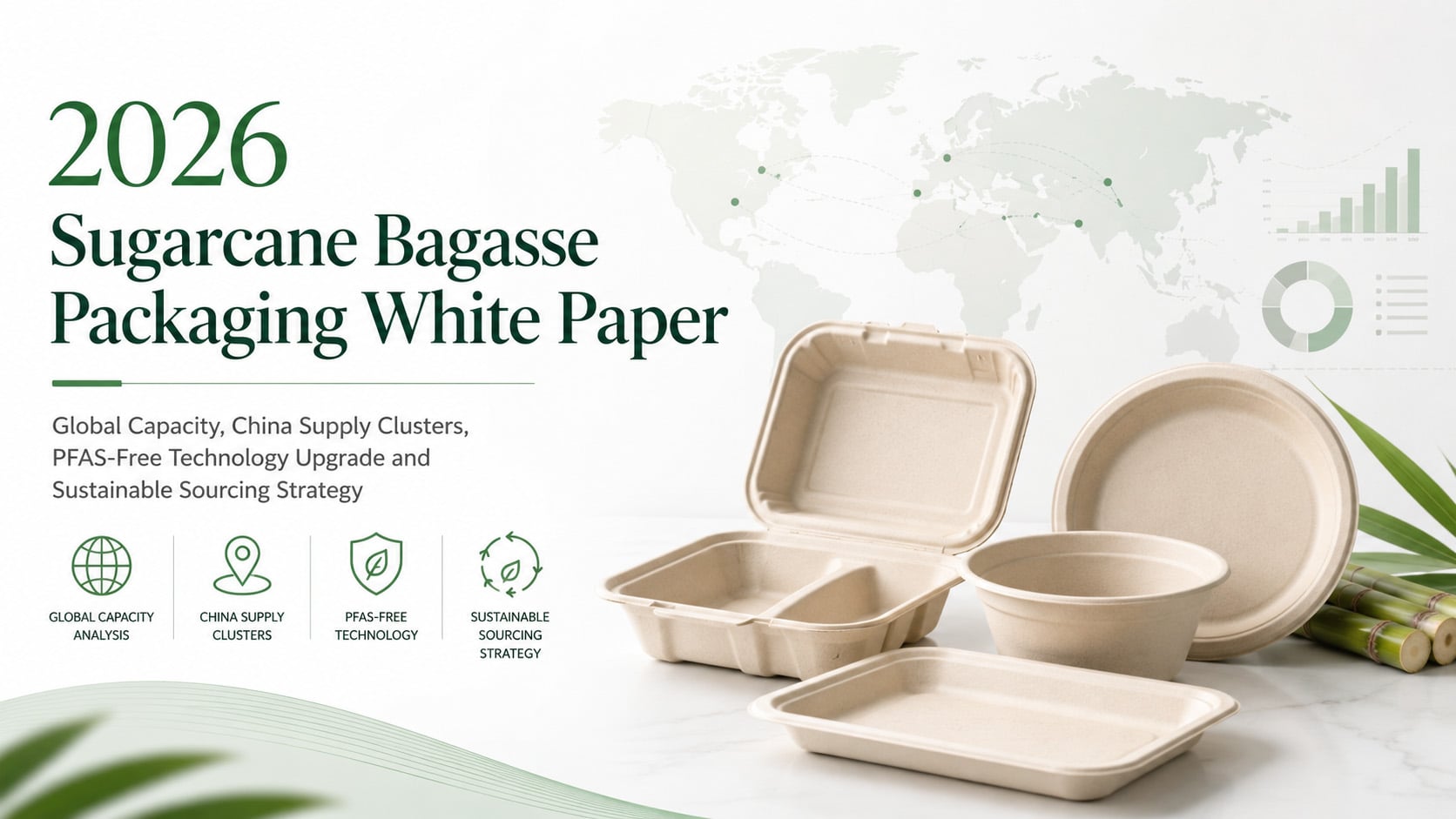
This white paper examines the global capacity structure, raw material map, China’s manufacturing clusters, technology upgrade path and sourcing risks behind the next generation of sugarcane bagasse foodservice packaging.
Download the Full White Paper PDF
Get the complete 2026 Sugarcane Bagasse Packaging White Paper, including global capacity analysis, China supply clusters, PFAS-free technology upgrades, market trends, sourcing risks and a practical buyer checklist.
Download the 2026 Bagasse Packaging White Paper (English Version)
This white paper focuses on sugarcane bagasse molded fiber foodservice packaging, including clamshell containers, plates, bowls, trays, compartment lunch boxes, sauce cups, and fiber-based lids. It does not treat all molded pulp packaging as the same category. Industrial molded pulp, egg trays, electronics protection packaging, and medical pulp packaging belong to the broader molded fiber industry, but they do not reflect the same raw material logic, food-contact requirements, compliance risks, or buyer expectations as bagasse tableware.
The key finding is clear: global sugarcane resources are widely distributed, but export-ready bagasse tableware manufacturing capacity is much more concentrated. Brazil and India remain the world’s largest sugarcane-producing countries, while Thailand, China, Pakistan, Mexico, and several Latin American countries also contribute significant sugarcane output. However, the presence of sugarcane does not automatically create a mature food-grade molded fiber packaging supply chain. Converting agricultural residue into certified, consistent, food-safe, and export-ready tableware requires pulping know-how, forming equipment, mold engineering, thermal pressing control, additive management, food-contact testing, packaging systems, and international trade execution.
Raw Material
Sugarcane is global, but usable bagasse supply depends on collection, pulping, quality control and competing industrial uses.
Manufacturing Capacity
Food-grade molded fiber capacity depends on equipment, molds, recipes, forming stability and export execution.
Buyer Priority
2026 sourcing decisions are moving from basic biodegradability to PFAS-free compliance, heat resistance and supply security.
Core Industry Viewpoint
Raw material availability answers only one question: Is bagasse available? It does not answer the more important commercial question: Can this raw material be converted into stable, compliant, scalable and export-ready food packaging?
China plays a central role in this equation. China is not the world’s largest sugarcane producer, but it has become one of the most important manufacturing and export bases for sugarcane bagasse tableware and molded fiber food packaging. This advantage comes from a multi-province industrial system: Guangxi provides a major raw-material anchor through sugarcane and bagasse resources; Zhejiang, Guangdong, Fujian, Shandong, Anhui and other provinces support large-scale manufacturing, equipment, mold development, export logistics, and customer delivery.
For international buyers, the most relevant point is not simply where sugarcane is grown. The more practical question is where buyers can source a complete, reliable and compliant packaging solution. This is why global importers, foodservice distributors, restaurant groups, catering suppliers and private-label packaging brands continue to evaluate China-based suppliers for
sugarcane bagasse tableware
, clamshell boxes, trays, plates, bowls, and matching compostable packaging systems.
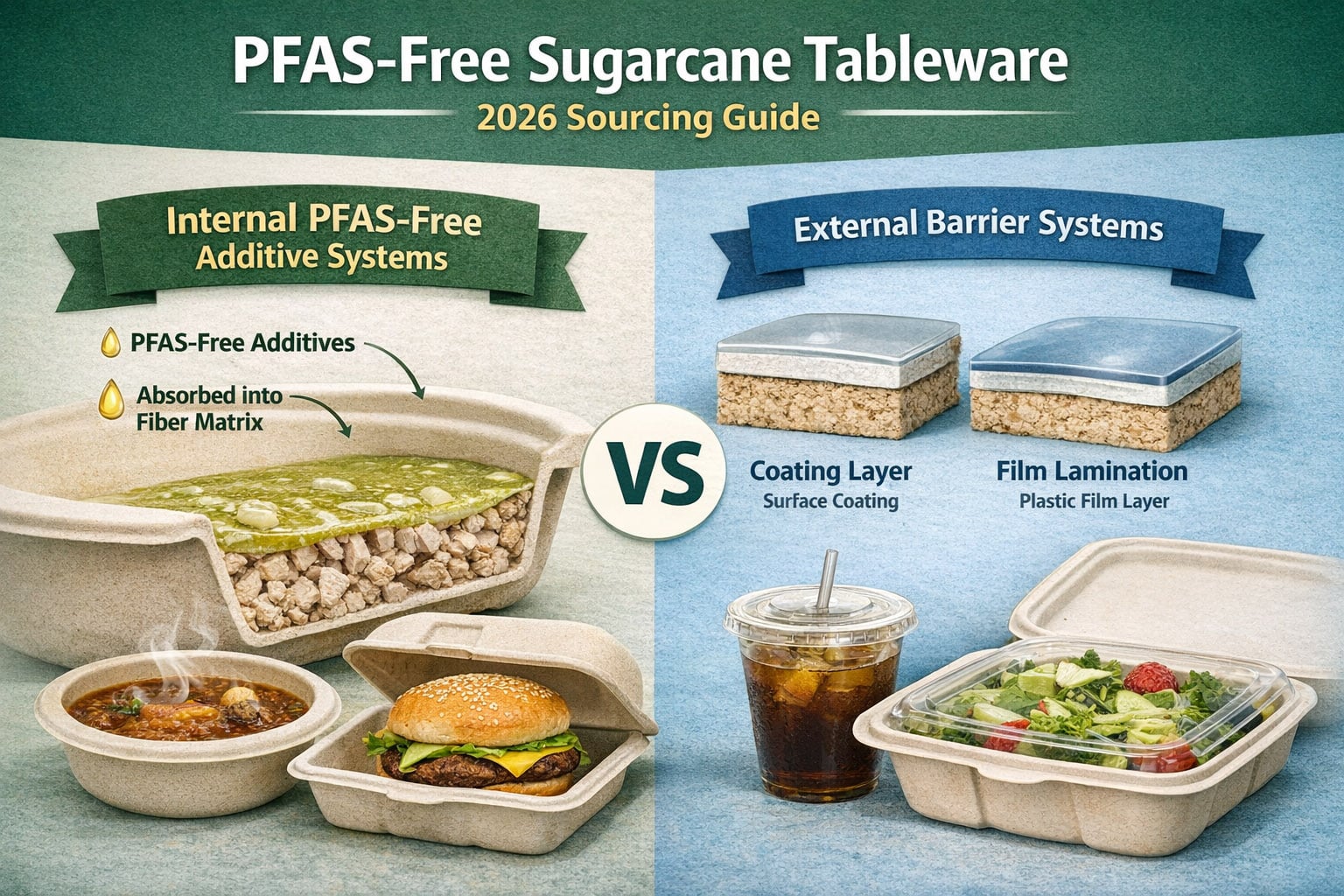
At the same time, the industry is entering a technology upgrade cycle. Early bagasse tableware was mainly built around conventional waterproof and oil-resistant additives. From 2023 to 2025, many suppliers started moving toward low-temperature PFAS-free products to meet buyer and regulatory pressure. By late 2025 and into 2026, a more advanced segment began emerging: high-temperature PFAS-free bagasse packaging, designed to serve hot, oily, saucy and takeaway food applications without relying on intentionally added PFAS chemistry. This 1.0 to 3.0 upgrade path will become one of the most important competitive differences in the next stage of the market.
Regulatory pressure is another key driver. In the United States, PFAS restrictions for plant-fiber food packaging have changed buyer expectations. In the European Union, the Packaging and Packaging Waste Regulation is pushing foodservice packaging toward stricter waste reduction, recyclability, documentation and compliance requirements. These policies are not isolated events. They reflect a broader shift: food packaging is no longer judged only by price and appearance, but by regulatory readiness, material transparency and end-of-life credibility.
Against this background, Bioleader® positions itself as an export-oriented supplier of biodegradable and compostable food packaging, with product coverage across bagasse containers, trays, bowls, plates, paper food packaging, PLA cups, and compostable cutlery. For buyers comparing options across Asia, Europe and North America, suppliers with a broader product matrix and documented compliance support are becoming more valuable than single-item factories. A complete product range such as
bagasse food containers
allows importers and distributors to consolidate sourcing, reduce supplier risk, and build more consistent sustainable packaging programs.
Executive Takeaways for Global Buyers
- Bagasse is a global raw material, but food-grade molded fiber capacity is not evenly distributed.
- China remains a central manufacturing and export base for bagasse tableware.
- Guangxi is critical for China’s sugarcane and bagasse resource foundation.
- PFAS-free performance is shifting from a marketing claim to a sourcing requirement.
- The next competitive stage is high-temperature PFAS-free bagasse packaging.
- Buyers should evaluate suppliers by capacity, compliance, application performance and documentation, not unit price alone.
2. Scope & Definitions: What This White Paper Covers
The molded fiber packaging industry contains several overlapping categories. To avoid data confusion, this white paper defines its scope carefully. The focus is not the entire molded pulp packaging market. Instead, the analysis focuses on sugarcane bagasse molded fiber tableware and foodservice packaging used for takeaway, catering, restaurants, institutional dining, supermarkets, meal kits, and ready-to-eat food applications.
This distinction matters because total molded pulp packaging data often includes protective packaging for electronics, industrial inserts, egg trays, medical trays, wine shippers, and other non-food applications. Those products may use recycled paper, wood pulp, bamboo pulp, wheat straw, bagasse, or mixed fibers. Their performance requirements are different from food packaging. A molded pulp electronics insert does not need to handle hot curry, oily fried rice, barbecue sauce, soup, microwave reheating, or direct food-contact migration testing.
2.1 Key Terms Used in This White Paper
| Term | Meaning in This White Paper | Why It Matters for Buyers |
|---|---|---|
| Sugarcane Bagasse | The fibrous residue left after juice is extracted from sugarcane stalks. | It is the agricultural by-product foundation for many molded fiber food containers, plates, bowls and trays. |
| Bagasse Tableware | Disposable plates, bowls, trays, clamshells and other foodservice items made primarily from sugarcane fiber pulp. | This is the main product category discussed in the white paper. |
| Molded Fiber Food Packaging | Food-contact packaging formed from plant-based fiber pulp through molding, pressing and drying. | This category includes bagasse packaging but can also include bamboo, wood pulp, wheat straw or blended fiber products. |
| Pulp Molded Disposable Tableware | Disposable foodservice products made through pulp molding processes. | This term is often used in Chinese industry reports and securities research when discussing production capacity. |
| PFAS-Free Bagasse Packaging | Bagasse packaging produced without intentionally added PFAS-based oil-resistant chemistry. | This is becoming a major sourcing requirement for North American, European and premium foodservice markets. |
| High-Temperature PFAS-Free Bagasse Packaging | A more advanced generation of PFAS-free bagasse packaging designed for hot, oily, saucy and takeaway food applications. | This is the emerging 3.0 upgrade path for higher-value foodservice applications. |
2.2 What Is Included
This white paper covers the main foodservice formats made from sugarcane bagasse and related molded fiber materials. These include
bagasse packaging
for takeaway meals, compostable clamshell containers, round and rectangular bowls, compartment trays, molded fiber plates, sauce cups, cup carriers, food trays, and matching fiber lids.
These products are commonly used in restaurants, coffee shops, fast-casual chains, school dining, airline catering, corporate canteens, supermarkets, delis and food delivery platforms.
Included Analysis Areas
- Sugarcane and bagasse raw material availability
- China’s manufacturing clusters
- Representative Chinese producers
- Global market players
- PFAS-free technology upgrades
- Certification expectations
- Export documentation and buyer risk
2.3 What Is Not the Main Focus
This white paper does not primarily analyze egg trays, electronics packaging, industrial molded pulp shockproof inserts, wine bottle pulp trays, medical molded pulp trays, or general paperboard packaging. These categories are important parts of the molded fiber industry, but they do not follow the same commercial logic as foodservice bagasse tableware.
The reason is practical. Foodservice packaging must meet a more complex combination of performance and compliance expectations. It may need to resist oil, water, heat, sauces and stacking pressure. It may also require food-contact testing, PFAS-related documentation, compostability certificates, labeling support, export cartons, retail-ready packaging, and SKU-level specification control. A product that performs well as an industrial insert may not be suitable for direct food-contact use.
2.4 Why Definitions Matter for Capacity Analysis
Many market reports use broad terms such as “molded pulp packaging” or “molded fiber packaging.” These terms are useful for macro-level industry analysis, but they can be misleading when used to evaluate bagasse tableware capacity. A country may have large molded pulp output, but if that output is mainly egg trays or industrial protective packaging, it does not necessarily translate into food-grade bagasse container capacity.
Likewise, a country may produce large volumes of sugarcane but have limited capability in food-contact pulp molding. Sugarcane production creates potential bagasse supply. It does not automatically create forming lines, molds, food-contact testing systems, PFAS-free recipes, export packaging standards or container shipment experience. For B2B buyers, capacity must be understood as usable commercial capacity, not only agricultural biomass availability.
Buyer-Oriented Definition of Capacity
In this white paper, meaningful capacity means the ability to deliver food-grade bagasse packaging at commercial scale, with stable quality, consistent specifications, export packaging, compliance documents, and repeatable lead time.
This is why the later sections of the white paper separate raw material regions from manufacturing regions. Brazil and India are essential to the global sugarcane map. Guangxi is essential to China’s sugarcane and bagasse resource base. But the mature manufacturing and export system for foodservice molded fiber packaging involves additional regions such as Zhejiang, Guangdong, Fujian, Shandong and other industrial clusters. For buyers reviewing suppliers, the critical question is not only “Where is the fiber?” but also “Where is the complete supply chain?”
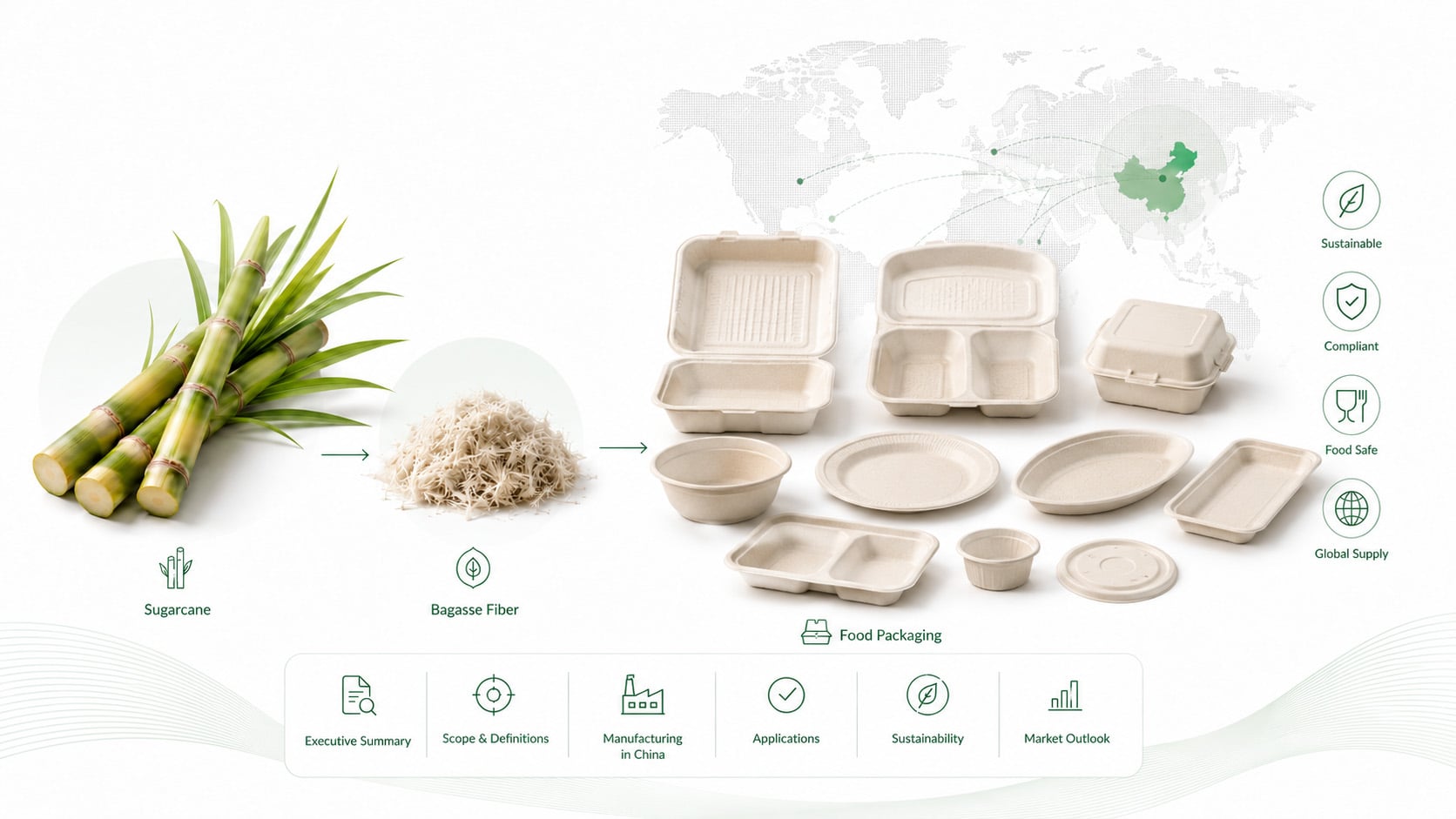
3. Global Bagasse Raw Material Map: Where Sugarcane Resources Are Located
Sugarcane bagasse packaging begins with sugarcane, but the relationship between sugarcane farming and bagasse tableware manufacturing is not linear. Sugarcane is an agricultural crop. Bagasse is an industrial by-product of sugar extraction. Bagasse pulp is a processed fiber input. Bagasse tableware is a food-contact molded fiber product. Each step requires infrastructure, investment, quality control and market access.
Global sugarcane output is large enough to support multiple downstream applications. FAO-based datasets show that annual global sugarcane production remains above two billion tonnes, making sugarcane one of the world’s most important agricultural crops by volume. Sugarcane bagasse typically accounts for a substantial portion of the processed cane mass, but not all bagasse is available for food packaging. A large share is used internally by sugar mills for steam, heat and power generation. Other portions may be used for pulp, paperboard, animal feed, bioenergy, panels or local industrial applications.
2B+ tonnes
Global sugarcane production remains at a two-billion-tonne scale annually.
37%
Brazil is projected to remain the largest sugarcane producer toward 2034.
23%
India is projected to remain the second-largest sugarcane producer toward 2034.
Guangxi
China’s most important sugarcane and bagasse resource anchor.
Important Distinction
Large sugarcane output creates raw material potential. It does not automatically create export-ready bagasse food packaging capacity. The commercial value is created when bagasse can be collected, cleaned, pulped, formed, tested, packed and delivered as consistent foodservice packaging.
3.1 Major Global Sugarcane Regions
The global sugarcane map is led by Brazil and India. OECD-FAO projections indicate that Brazil and India will remain the two dominant sugarcane producers toward 2034, with Brazil expected to account for roughly 37% of global sugarcane production and India around 23%. Thailand remains one of the most important sugarcane and sugar industry bases in Southeast Asia, while China, Pakistan, Mexico and other countries also play important roles in the broader sugarcane economy.
| Region | Raw Material Role | Relationship to Bagasse Food Packaging |
|---|---|---|
| Brazil | World-leading sugarcane production base with large sugar and ethanol industries. | Strong raw material foundation, but much bagasse is tied to mill energy, ethanol and industrial uses. It is not automatically a global tableware export center. |
| India | One of the world’s largest sugarcane-producing countries with huge domestic consumption. | Large raw material base and growing domestic demand, but export-ready molded fiber food packaging capacity is uneven across suppliers. |
| Thailand | Important Southeast Asian sugarcane and sugar industry country. | Strategically relevant for regional supply-chain diversification, especially as some Asian packaging groups evaluate overseas production bases. |
| Vietnam | Regional sugarcane and agricultural fiber base in Southeast Asia. | More relevant as a supplementary manufacturing and supply-chain diversification location than as a dominant global raw material source. |
| China | Important sugarcane producer, with Guangxi as the core sugarcane and sugar-producing region. | Not the largest sugarcane producer globally, but one of the strongest manufacturing and export bases for bagasse tableware. |
| Mexico and Latin America | Regional sugarcane production and sugar industry base. | Potential for local fiber-based packaging development, but large-scale export-ready foodservice tableware capacity remains more fragmented. |
3.2 Brazil and India: Raw Material Giants, Not Automatically Tableware Capacity Centers
Brazil and India are central to the global sugarcane economy. Brazil’s sugarcane system is closely connected with sugar and ethanol production, while India combines large-scale sugarcane farming with major domestic sugar consumption. Both countries generate significant bagasse volumes. However, bagasse availability alone does not determine foodservice packaging leadership.
In Brazil, bagasse has long been used as an energy source within sugar mills. This creates an efficient internal industrial use, but it also means that not all bagasse is freely available for molded fiber food packaging. In India, raw material availability and domestic demand create opportunity, but supplier quality, automation, compliance documentation and export consistency can vary widely. For global buyers, these regions should be understood as important raw material foundations and future opportunity zones, rather than automatically equivalent to mature global bagasse tableware supply chains.
3.3 Southeast Asia: Thailand as a Strategic Raw Material and Manufacturing Bridge
Thailand is one of the most important sugarcane and sugar industry countries in Southeast Asia. It is also strategically relevant for packaging supply-chain diversification. For buyers and manufacturers looking beyond a single-country sourcing model, Thailand offers advantages in agricultural resources, regional trade access and proximity to broader Asian manufacturing networks.
Vietnam can be viewed as a supplementary regional base. It has agricultural fiber resources and manufacturing potential, but it should not be overstated as a dominant global sugarcane bagasse packaging hub. In 2026, the more realistic view is that Southeast Asia will become increasingly important for supply-chain resilience, tariff planning, regional production and selected export programs. However, it will take time for the region to match the full multi-SKU, mold-development, export-documentation and container-shipment ecosystem already built in China.
3.4 China: Guangxi as the Raw Material Anchor
China’s role in the bagasse packaging industry must be understood through two separate maps: the raw material map and the manufacturing map. On the raw material side, Guangxi is the most important region. Guangxi has long been China’s leading sugarcane and sugar-producing area, and its sugarcane economy supports a wide range of downstream by-product applications. In the 2024/2025 crushing season, Guangxi reported 11.35 million mu of sugarcane planting area and 6.465 million tonnes of sugar output, reinforcing its position as China’s key sugarcane base.
Guangxi’s importance does not mean all Chinese bagasse tableware is produced in Guangxi. Instead, Guangxi should be seen as China’s raw-material and upstream expansion anchor. The broader manufacturing system extends across multiple provinces. Zhejiang contributes large-scale pulp molded tableware producers and automated manufacturing capability. Guangdong has a long history of plant-fiber foodservice packaging manufacturing. Fujian, especially Xiamen and surrounding regions, connects equipment, molds, export trade and biodegradable packaging supply. Shandong brings agricultural fiber and molded pulp experience. Anhui and other provinces support broader paper and packaging production networks.
China’s Structural Advantage
China’s advantage is not based on raw material alone. It comes from the connection between Guangxi’s sugarcane and bagasse resources, multi-province molded fiber manufacturing, export-oriented packaging suppliers, port logistics, testing support, and the ability to serve global buyers with multiple product categories in one shipment.
3.5 From Bagasse to Food Packaging: The Conversion Chain
Agricultural crop
Fiber by-product
Fiber preparation
Forming and pressing
Foodservice product
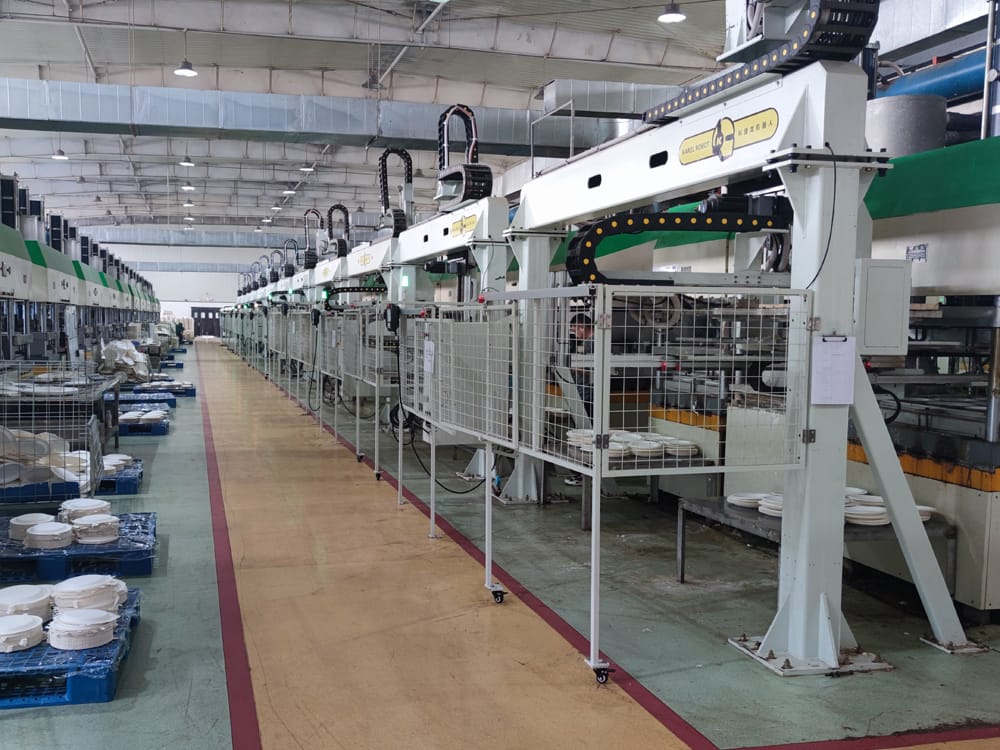
The conversion of sugarcane bagasse into foodservice packaging involves several industrial steps. After sugarcane juice extraction, bagasse must be collected and stabilized. It may then be cleaned, depithed, pulped and refined into fiber suitable for molding. For food packaging, the fiber mix, moisture level, pulp consistency, forming pressure, drying process, hot pressing and additive system all affect final product quality.
For ordinary molded pulp packaging, basic forming capability may be enough. For direct food-contact bagasse tableware, the requirements are much higher. Containers must hold hot food, oily food, sauces, rice, noodles, salads, grilled meals and delivery meals without collapsing, leaking or transferring unwanted substances. This is why buyers increasingly evaluate suppliers not only by raw material claims, but also by food-contact testing, PFAS-free documentation, temperature performance, oil-resistance level, weight consistency and packaging quality.
In practical procurement, buyers sourcing
bagasse food containers for catering and foodservice
should distinguish between three levels of supply capability: raw material availability, molded fiber production capacity, and export-ready foodservice packaging capability. The third level is the one that matters most for international B2B sourcing.
3.6 Raw Material Conclusion: Why the Manufacturing Map Matters More Than the Farming Map
The global raw material map explains where bagasse can come from. It does not fully explain where high-quality bagasse tableware can be produced at scale. Brazil and India are raw material giants. Thailand is a strategic Southeast Asian base. Guangxi is China’s key sugarcane and bagasse anchor. But mature foodservice packaging supply depends on more than fiber.
The real industrial barrier is the ability to transform agricultural residue into consistent, compliant and application-ready food packaging. This includes fiber preparation, recipe control, mold engineering, production automation, hot-pressing stability, PFAS-free performance, food-contact compliance, export documentation, carton packing, container loading and after-sales support. This is why the next section of the white paper turns from raw material geography to manufacturing capacity, with China as the central production and export case.
4. China’s Manufacturing Dominance: Why China Became the Core Capacity Center for Bagasse Tableware
China’s position in the global sugarcane bagasse packaging industry should not be understood only through agricultural raw materials. China is not the world’s largest sugarcane producer, but it has built one of the most complete industrial systems for molded fiber foodservice packaging. This system combines raw material access, pulping, mold engineering, automated forming, hot pressing, export packing, testing support, port logistics and international customer service.
For global buyers, this means China is not simply a low-cost sourcing destination. It is a manufacturing ecosystem capable of supporting multi-SKU, private-label, export-ready, compliance-oriented bagasse packaging programs.
4.1 China’s Capacity Position Must Be Defined by Product Category
Capacity analysis in the molded fiber industry must be handled carefully. If all molded pulp packaging products are counted together, the category includes industrial protective packaging, egg trays, electronics packaging, medical trays, wine packaging and foodservice tableware. In that broad category, China is a major player but not the entire global market.
However, when the analysis is narrowed to pulp molded disposable tableware and export-ready bagasse food packaging, China’s role becomes much more significant. Public industry and securities research data indicate that China has already formed a large-scale production base for disposable molded pulp tableware. This is especially relevant for products such as clamshell boxes, plates, bowls, trays and compartment lunch containers used in takeaway, catering and institutional foodservice.
Broad Molded Pulp
Includes industrial packaging, egg trays, protective inserts and foodservice products.
Foodservice Tableware
Includes plates, bowls, trays, clamshells and direct food-contact containers.
Export-Ready Capacity
Requires compliance documents, stable quality, packaging control and container shipment experience.
Capacity Viewpoint
China’s strongest position is not simply in total molded pulp volume. Its strategic advantage is in commercially usable, export-ready, multi-format molded fiber foodservice packaging capacity.
4.2 Why China’s Bagasse Tableware Supply Chain Is Difficult to Replace Quickly
China’s manufacturing advantage comes from the coordination of multiple production layers. A buyer sourcing one bagasse clamshell may only see the finished product. But behind that product is a supply system that includes pulp preparation, mold design, forming machine selection, wet pressing, hot pressing, trimming, inspection, testing, inner packaging, outer cartons, labeling and container loading.
This integrated capability is why China remains highly relevant to importers, distributors and private-label packaging brands. A supplier may need to provide not only one food box, but also matching bagasse bowls, plates, trays, sauce cups, fiber lids, compostable cutlery and paper food packaging. This combination is difficult to build quickly in regions where only raw material exists but manufacturing infrastructure is incomplete.
| Supply Chain Layer | China’s Advantage | Buyer Value |
|---|---|---|
| Raw Material Access | Guangxi and other regions provide sugarcane and bagasse resource support. | Supports long-term material planning and product development. |
| Mold Engineering | Strong mold development capability for plates, bowls, trays, clamshells and custom shapes. | Allows faster SKU expansion and private-label customization. |
| Production Equipment | Mature forming, pressing, drying, trimming and packing equipment ecosystem. | Improves production consistency and delivery reliability. |
| Product Matrix | Wide range of clamshells, plates, bowls, trays, lids and related food packaging. | Helps buyers consolidate suppliers and reduce sourcing complexity. |
| Export Execution | Experience with cartons, labels, mixed containers, documents and port shipment. | Reduces import risk and supports repeat purchasing programs. |
4.3 China’s Multi-Province Production Logic
China’s bagasse packaging competitiveness is not built by one province alone. Guangxi is central to the raw material story, but manufacturing capacity is distributed across several industrial clusters. This multi-province structure gives China flexibility. Some regions are closer to sugarcane and bagasse pulp. Others are stronger in equipment, molds, trade services, export logistics or mature factory management.
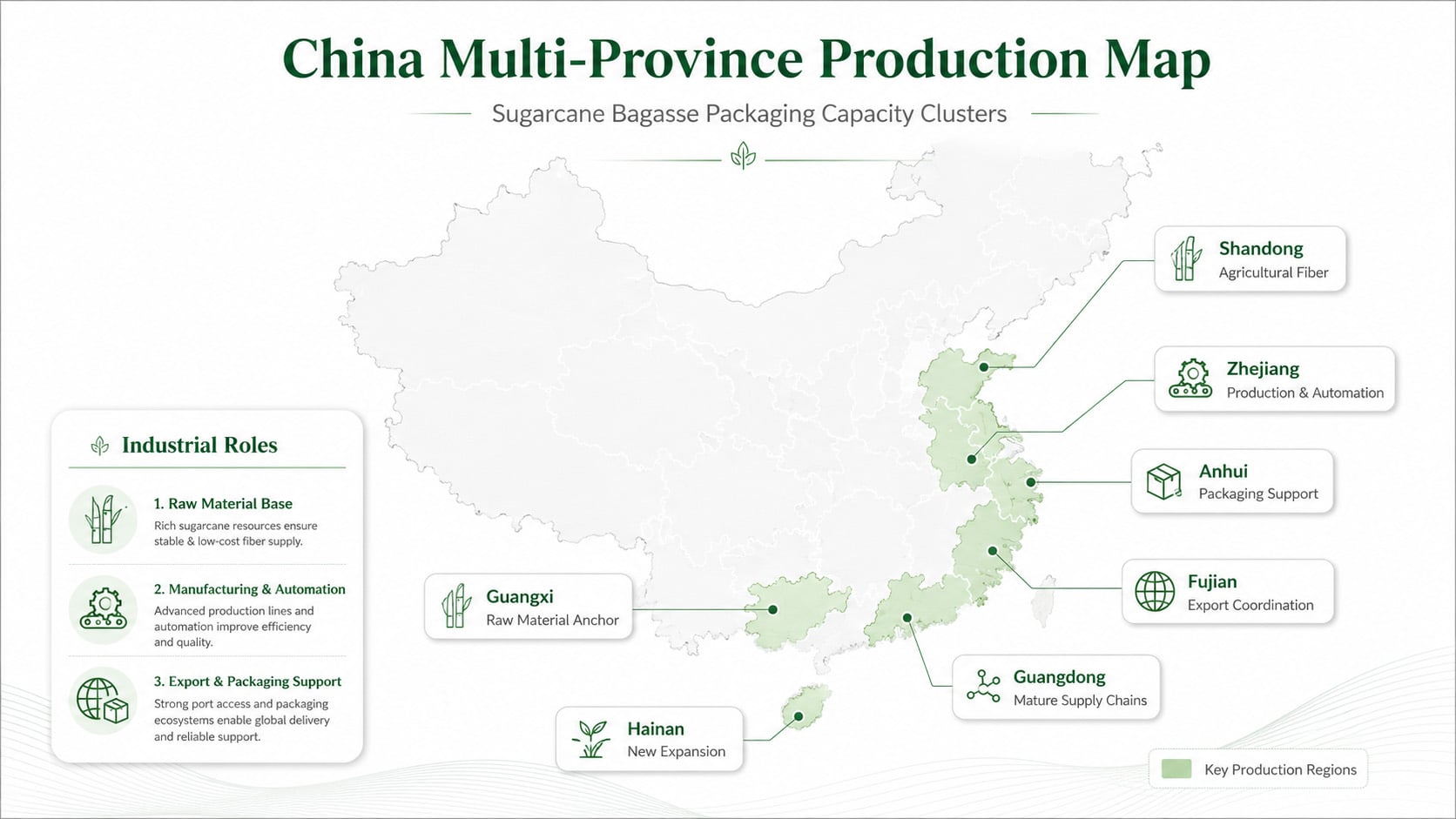
| Region | Industrial Role | Strategic Meaning |
|---|---|---|
| Guangxi | Sugarcane, bagasse, bagasse pulp and raw-material-linked expansion projects. | China’s most important upstream resource anchor for bagasse packaging. |
| Zhejiang | Large molded fiber tableware producers, automation and export customer networks. | Important production and industry benchmark region. |
| Guangdong | Early plant-fiber tableware manufacturing, mature South China supply chains. | Connects manufacturing, market demand and export trade services. |
| Fujian | Equipment, molds, export-oriented biodegradable packaging supply and Xiamen trade organization. | Strong role in export coordination and integrated packaging solutions. |
| Shandong | Agricultural fiber, straw-based molded fiber and broader pulp molding experience. | Adds industrial depth beyond sugarcane-only raw material logic. |
| Anhui | Paper products, packaging conversion and molded fiber supporting capacity. | Supports the broader food packaging manufacturing ecosystem. |
| Hainan | Selected new molded fiber tableware and equipment-linked project development. | Represents regional expansion beyond traditional coastal manufacturing bases. |
4.4 China’s Advantage Is System-Level, Not Single-Factory-Level
A common sourcing mistake is to compare suppliers only by unit price. In bagasse tableware, the stronger comparison is system capability. A factory with a low price but weak documentation, unstable weight control, poor lid matching, limited PFAS-free testing, or no mixed-container export experience may create higher total cost for importers.
By contrast, export-oriented suppliers with broader product matrices can support buyers across several categories, including bagasse plates, bowls, trays, containers, paper food packaging and compostable cutlery. This matters because many foodservice distributors now prefer complete packaging programs rather than isolated product sourcing.
Buyer Takeaway
China’s long-term advantage is not just low production cost. It is the ability to combine raw material access, mold development, mass production, compliance support, export packaging and multi-category delivery into one sourcing system.
5. China Capacity Clusters and Representative Manufacturers
A serious capacity analysis should not present China as one single production block. China’s molded fiber tableware industry is built around regional clusters, listed-company projects, private manufacturers, foreign-invested operations and raw-material-linked expansion bases. Some companies are strong in tableware exports. Some are linked to equipment manufacturing. Some are tied to bagasse pulp and agricultural fiber resources. Others operate as part of larger packaging groups.
The following companies are not presented as a ranking. They are selected as representative capacity samples because they appear in public industry reports, securities research, government project documents or widely recognized market discussions. The purpose is to help global buyers understand the structure of China’s bagasse and pulp molded foodservice packaging supply base.
Important Method Note
This section avoids treating company self-promotion as the main evidence base. For non-Bioleader companies, the white paper should rely primarily on third-party industry reports, securities research, government filings and public project documents. Bioleader® is included separately as an export-oriented supplier case because this white paper is published by Bioleader.
5.1 Representative Chinese Manufacturers and Capacity Samples
| Company / Group | Region | White Paper Positioning |
|---|---|---|
| Zhejiang Zhongxin Environmental Protection Technology Group | Zhejiang / Guangxi / Thailand-linked expansion | One of the most visible Chinese pulp molded tableware companies in public market discussions; useful as a leading-scale capacity benchmark. |
| Zhejiang Jingsheng Environmental Protection | Zhejiang | Representative Zhejiang molded fiber tableware producer with publicly discussed plant-fiber molded tableware capacity. |
| Guangdong Shaoneng Group Luzhou Technology | Guangdong | A long-standing plant-fiber molded tableware producer, representing Guangdong’s early manufacturing base. |
| Far East & Geotegrity / Far East Zhongqian | Fujian / Hainan | Representative of equipment manufacturing plus molded fiber tableware production integration, with regional expansion relevance. |
| Bioleader® | Xiamen / Thailand supply-chain layout | A China-based export supplier of biodegradable and compostable food packaging with a broader solution capability beyond single-item bagasse tableware. Bioleader® combines sugarcane bagasse clamshells, bowls, plates, trays and fiber lids with paper food packaging, PLA cold cups and compostable cutlery systems, helping international buyers build complete sustainable foodservice packaging programs. Its value lies in export execution, multi-category sourcing, private-label support, mixed-container planning, compliance document coordination, and the ongoing transition toward higher-performance PFAS-free bagasse packaging for hot-food applications. |
| Shandong Tianhe / Shandong Quanlin Straw High-Tech-related system | Shandong | Represents Shandong’s agricultural-fiber and molded pulp packaging foundation, including straw and plant-fiber material pathways. |
| Guangxi Fospack Environmental Protection Technology | Guangxi | A representative Guangxi-based capacity sample connected with the region’s raw-material and bagasse packaging development logic. |
| Guangxi Huabao Fiber Products | Guangxi | Useful as a raw-material-linked bagasse fiber and molded tableware project sample in Guangxi. |
| Guangxi Qiaowang Paper Molded Products | Guangxi | Government documents show a 40,000-ton annual paper molded tableware and industrial packaging project, making it a useful regional capacity sample. |
| YUTO Tech / Zhejiang Jiadebao-related system | Guangdong / Zhejiang / Guangxi-related layout | Represents large packaging groups entering or expanding in the pulp molded tableware segment. |
| Sabert Zhongshan | Guangdong | A useful example of international food packaging brand supply-chain participation in China’s manufacturing ecosystem. |
5.2 What These Companies Reveal About China’s Capacity Structure
These companies show that China’s bagasse tableware capacity is not concentrated in one business model. Some enterprises are scale manufacturers. Some are connected with equipment technology. Some are located close to sugarcane and bagasse raw materials. Some are part of larger packaging groups. Some focus on export customers and multi-category sustainable food packaging supply.
This diversity matters because global buyers are not all sourcing the same product. A restaurant distributor may need standard plates and bowls. A supermarket may need trays with better rigidity. A meal-kit brand may need a certified clamshell or bowl system. A coffee chain may need paper cups, bagasse lids and compostable cutlery together. A private-label importer may need custom cartons, barcode labels and mixed container loading.
This is where China’s broad supplier base creates commercial flexibility. Buyers can compare different supplier profiles and choose between raw-material-linked projects, large-scale tableware factories, export service suppliers, and integrated packaging solution providers. For product planning, categories such as bagasse trays with lids are becoming increasingly important for supermarkets, meal prep, hot food, deli and takeaway applications.
5.3 Why Representative Samples Are Better Than a Simple Ranking
A simple “Top 10” ranking may be attractive for search traffic, but it is not the best format for a serious white paper. Molded fiber capacity changes quickly. New projects come online, old lines are upgraded, overseas facilities are added, and demand cycles affect utilization rates. A capacity ranking based on one year may become outdated quickly.
A representative sample approach is more reliable. It allows the white paper to identify the most important types of capacity without overstating exact ranking. For B2B buyers, this is also more useful. The key question is not only which company is the largest, but which supplier type is most suitable for the buyer’s target market, compliance requirements, product mix, order volume and risk tolerance.
Scale Manufacturer
Suitable for large-volume standard tableware and long-term supply programs.
Raw-Material-Linked Producer
Useful for buyers concerned about fiber supply, bagasse pulp access and upstream integration.
Export Solution Supplier
Valuable for mixed-SKU sourcing, documents, packaging, private label and container shipment execution.
5.4 Bioleader® in the Chinese Supply Chain Context
Within this broader Chinese capacity landscape, Bioleader® is positioned as an export-oriented supplier rather than a single-product factory. Its value is not limited to one bagasse SKU. The company supports broader biodegradable food packaging programs, combining molded fiber food containers with paper food packaging, PLA cup options and compostable cutlery.
This model fits a growing buyer preference: sourcing a complete sustainable packaging line from fewer suppliers. A buyer may begin with bagasse clamshells or bowls, then expand into paper soup bowls, PLA cold cups, CPLA cutlery or custom foodservice packaging. For brands comparing material choices, Bioleader’s educational content such as Is Bagasse Eco-Friendly? can also support buyer education and internal decision-making.

Buyer Takeaway
China’s bagasse tableware supply base should be evaluated by supplier type, not by name recognition alone. The strongest sourcing strategy compares scale, compliance, product matrix, documentation, export execution and application performance together.
6. The Upgrade Roadmap of Bagasse Tableware: From 1.0 to 3.0
The bagasse tableware industry is not standing still. The most important change from 2023 to 2026 is not only capacity expansion. It is technology upgrading. Buyers increasingly need to know what kind of bagasse tableware they are purchasing: conventional oil-resistant products, low-temperature PFAS-free products, or high-temperature PFAS-free products designed for more demanding hot food applications.
This upgrade path explains why two products that look similar may have very different prices, performance limits, compliance risk and application suitability.
6.1 Bagasse Tableware 1.0: Conventional Waterproof and Oil-Resistant Era
The first generation of commercial bagasse tableware focused on replacing foam plastic and conventional disposable plastic food containers. The main market question was simple: could molded fiber products hold food, resist water and oil, and provide a more sustainable image for restaurants, catering companies and takeaway platforms?
In this 1.0 stage, many products used conventional waterproof and oil-resistant additive systems. These products often performed well in hot food and oily food scenarios, and they were widely accepted in markets where PFAS restrictions were not yet strict. The cost structure was relatively competitive, the production process was mature, and the product could replace foam boxes, plastic plates and low-end disposable containers in many foodservice applications.
1.0 Stage Solved One Problem
The first generation solved the practical replacement question: Can molded fiber tableware replace foam and plastic in everyday foodservice? But it did not fully solve the long-term PFAS-free compliance question.
6.2 Bagasse Tableware 2.0: Low-Temperature PFAS-Free Era
From 2023 to 2025, the market began moving into a second stage. Regulatory pressure, retailer requirements and importer due diligence pushed many suppliers to develop products without intentionally added PFAS. This was especially important for North American and European buyers, where PFAS-related restrictions and buyer policies began to reshape sourcing decisions.
In this 2.0 stage, low-temperature PFAS-free bagasse tableware became increasingly common. These products are suitable for many dry, cold, room-temperature or lightly oily food applications. They are especially relevant for plates, bowls, salad containers, bakery items, light meals, school dining, office catering and short-time takeaway use.
However, 2.0 products have a clear limitation. Without traditional fluorinated oil-resistant systems, some products may show weaker resistance to high-temperature oil, hot sauces, soup, curry, grilled meat, fried rice or other heavy-oil takeaway foods. This does not mean 2.0 products are poor quality. It means buyers must match product grade with real food application.
2.0 Buyer Question
Low-temperature PFAS-free products answer the compliance question, but buyers must still ask: Can this product handle my actual food temperature, oil level and holding time?
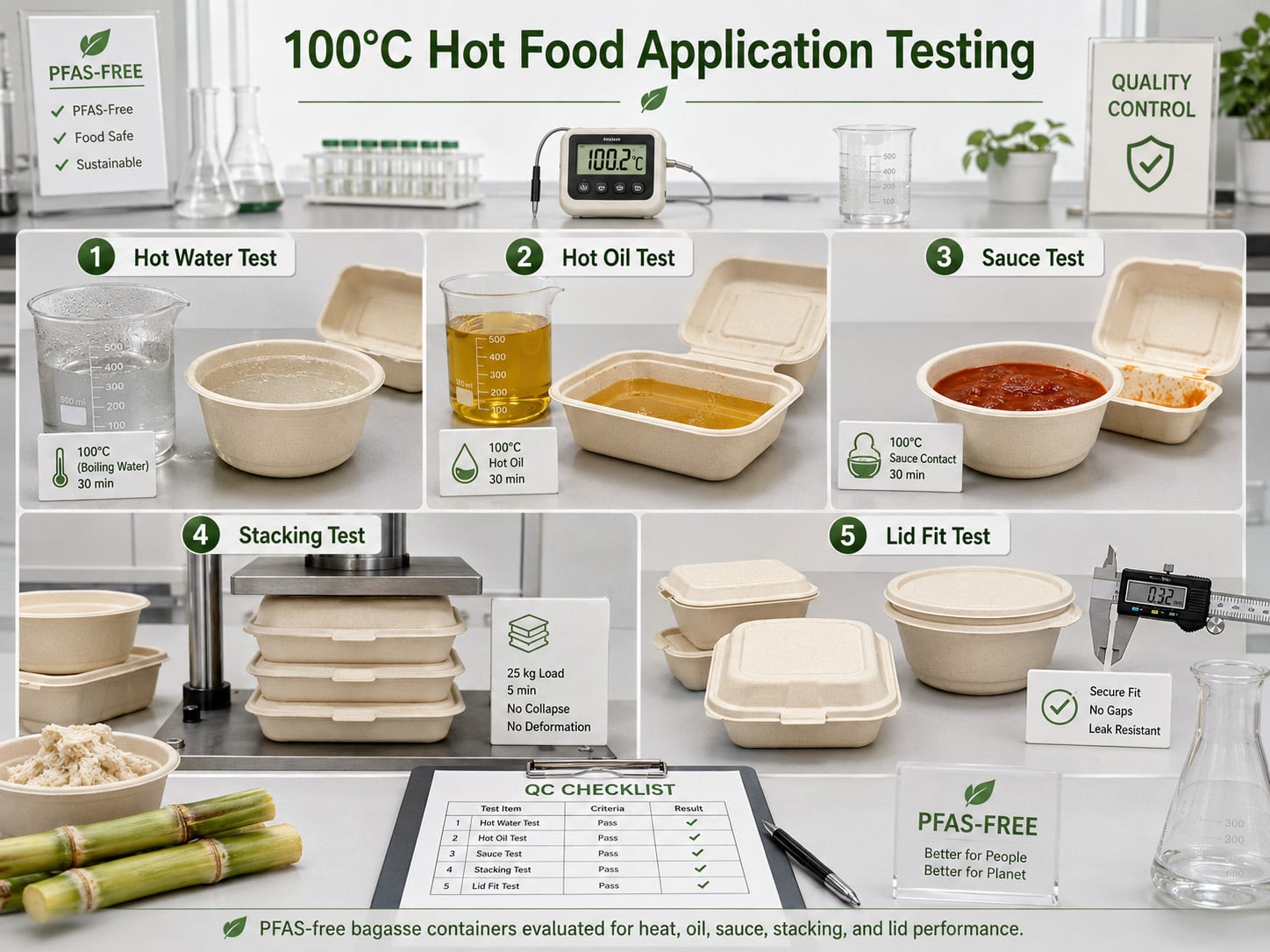
6.3 Bagasse Tableware 3.0: High-Temperature PFAS-Free Era
By late 2025 and into 2026, part of the industry began moving toward a more advanced 3.0 stage: high-temperature PFAS-free bagasse tableware. This is not just a marketing upgrade. It requires better recipe control, fiber structure management, hot-pressing stability, barrier performance, product testing and food-contact documentation.
The purpose of 3.0 is to solve two problems at the same time: PFAS-free compliance and hot food performance. This is especially important for restaurants, meal kits, supermarkets, hot bars, school meals, airline catering and delivery platforms serving oily, saucy or high-temperature foods.
For buyers, this upgrade is important because it reduces the risk of choosing between compliance and performance. In the past, some buyers accepted conventional oil-resistant products because they worked well with hot food. Others shifted to PFAS-free products but faced concerns about hot oil resistance. The 3.0 direction is to combine both: no intentionally added PFAS, stronger heat and oil resistance, and better documentation readiness.
Bioleader® and selected advanced suppliers are moving toward this higher-performance PFAS-free direction, especially for export markets where customers need stronger documentation and real food application reliability. For buyers comparing material systems, related solutions such as biodegradable compostable cutlery can also be combined with bagasse containers to build a complete plastic-reduction packaging program.
6.4 Three Generations of Bagasse Tableware Compared
| Generation | Period | Core Technology | Strength | Limitation | Best-Fit Market |
|---|---|---|---|---|---|
| 1.0 Conventional Oil-Resistant Bagasse | Early stage to around 2022 | Traditional waterproof and oil-resistant additive systems. | Good water and oil resistance, mature production, competitive cost. | Potential PFAS compliance risk in stricter markets. | Traditional foodservice and lower-regulation markets. |
| 2.0 Low-Temperature PFAS-Free Bagasse | 2023–2025 | No intentionally added PFAS; suitable for dry, cold, room-temperature or light-oil applications. | Improved compliance profile and relatively controllable cost. | Limited performance with hot oil, heavy sauces and long holding time. | Cold food, light meals, salads, bakery, plates and short-time takeaway. |
| 3.0 High-Temperature PFAS-Free Bagasse | Late 2025 and 2026 onward | PFAS-free recipe combined with upgraded hot-food and oil-resistance performance. | Balances compliance with hot food performance and premium buyer expectations. | Higher technical barrier and higher cost than basic PFAS-free products. | Premium export markets, hot food delivery, meal kits, chains, schools, airlines and supermarkets. |
6.5 Why the 3.0 Upgrade Will Change Supplier Selection
The 3.0 upgrade will make supplier evaluation more technical. Buyers can no longer compare bagasse products only by size and unit price. Two 9-inch clamshells may look similar, but one may be conventional oil-resistant, one may be low-temperature PFAS-free, and another may be high-temperature PFAS-free. Their performance, cost, compliance documents and end-market suitability can be very different.
This is especially important for buyers in markets where foodservice packaging is exposed to PFAS-related scrutiny. A buyer sourcing hot food containers must ask for more than a catalog. The right questions include: What is the PFAS-free grade? What temperature and oil conditions has the product been tested under? Is the product suitable for sauces, fried food, curry or rice meals? Are food-contact documents available? Is the same recipe used for mass production?
This upgrade logic also connects with broader material education. Buyers comparing molded fiber, PLA, paper and compostable plastics can review technical background through related resources such as the difference between bagasse and PLA, especially when building a complete takeaway packaging portfolio.
Ask About PFAS Grade
Confirm whether the product is conventional, low-temperature PFAS-free or high-temperature PFAS-free.
Test Real Food Conditions
Use hot oil, sauces, rice, noodles, soup or curry according to the real target application.
Verify Documentation
Check food-contact reports, PFAS-related documents, compostability support and product specification sheets.
6.6 Technology Roadmap Conclusion
The future competition in bagasse tableware will not be defined only by who can produce more pieces. It will be defined by who can produce compliant, stable and application-ready products under stricter global buyer requirements. The 1.0 stage proved that molded fiber could replace plastic and foam. The 2.0 stage responded to PFAS-free compliance pressure. The 3.0 stage aims to combine PFAS-free compliance with hot food performance.
This is why the next phase of the market will reward suppliers that can integrate material science, production control, testing documentation and export execution. For buyers, the core sourcing question is changing from “Can you make bagasse tableware?” to “Can you make the right grade of bagasse tableware for my food, my market and my compliance risk?”
7. Global Market and Overseas Players
The global bagasse and molded fiber food packaging market is not shaped by manufacturing capacity alone. It is also shaped by overseas brands, regional foodservice channels, PFAS-free compliance pressure, compostability programs, and the purchasing standards of chain restaurants, retailers, importers and distributors.
China remains central to large-scale export-ready production, but overseas players are important because they influence buyer expectations, product standards, branding language and end-market adoption.
7.1 How Overseas Players Should Be Understood
Overseas companies should not be compared with Chinese manufacturers only by factory output. Many international players operate as brand owners, foodservice packaging distributors, regional converters, technical innovators, or channel leaders. Some control end-market relationships with restaurant chains, supermarkets, institutional catering groups and composting programs. Others influence material language, PFAS-free expectations, packaging design and consumer trust.
This distinction matters because the global industry is divided into different roles. China is highly relevant for large-scale, multi-SKU, export-oriented molded fiber tableware. Overseas companies are highly relevant for market education, compliance interpretation, retail distribution, foodservice channel penetration and premium packaging positioning.
| Market Role | Typical Strength | Impact on Bagasse Packaging |
|---|---|---|
| Manufacturing Base | Scale production, molds, forming lines, export packing and multi-category supply. | Determines cost, availability, lead time and product range. |
| Brand Owner | Market recognition, sustainability messaging and retailer relationships. | Shapes how buyers and consumers understand compostable packaging. |
| Regional Distributor | Local stock, customer service, restaurant supply channels and compliance communication. | Connects source factories with end users in foodservice markets. |
| Technical Innovator | Barrier coatings, PFAS-free chemistry, forming technology and material innovation. | Raises performance expectations for hot food, oil resistance and regulatory readiness. |
7.2 North America: PFAS-Free Demand and Foodservice Channel Pressure
North America is one of the most influential markets for PFAS-free food packaging. The region is shaped by state-level PFAS restrictions, corporate sustainability targets, restaurant chain specifications, institutional purchasing rules and strong distributor networks. In this market, the packaging question is not only whether a product is compostable, but whether it can pass compliance review, maintain real food performance and fit existing foodservice operations.
Major North American foodservice packaging players and brands have helped normalize molded fiber, plant-fiber, paper-based and compostable alternatives. Examples often discussed in the market include Footprint, Genpak, Pactiv Evergreen / EarthChoice, Eco-Products, World Centric and Sabert. Their importance is not only factory capacity. Their greater influence is channel visibility, specification setting, brand adoption and PFAS-free messaging.
For Chinese export suppliers, North America remains attractive but demanding. Buyers increasingly expect product-level documentation, PFAS-free statements, food-contact testing, compostability support and clear application guidance. This is why suppliers should not position molded fiber only as “eco-friendly.” They must explain whether the product is suitable for hot food, oily food, short holding time, delivery, microwaving, refrigeration, freezing or institutional dining.
North America Buyer Signal
The North American market is pushing bagasse packaging from a basic biodegradable claim toward verified PFAS-free performance, food-contact compliance, application testing and distributor-ready documentation.
7.3 Europe: Regulation, Packaging Waste Reduction and Material Accountability
Europe is another major driver of sustainable food packaging change. The EU Packaging and Packaging Waste Regulation creates a more harmonized framework for packaging requirements across member states. For foodservice packaging buyers, this means that material selection, labeling, recyclability, waste reduction, restricted substances and documentation are becoming more strategic procurement issues.
European packaging groups and brand owners have helped move fiber-based packaging from a niche alternative into a mainstream discussion. Companies such as Huhtamaki, Stora Enso and Sabert Europe are often associated with paper, fiber, molded fiber, renewable materials or foodservice packaging innovation. Their role is especially important in product design, regional compliance interpretation and premium customer education.
However, Europe’s high compliance expectations do not eliminate the need for international sourcing. In many cases, buyers still depend on Asian manufacturing capacity for standard disposable foodservice products. The key change is that sourcing from Asia must now be supported by stronger documentation and clearer material claims. This creates opportunities for export-oriented suppliers that can provide bagasse products together with paper-based alternatives such as paper soup bowls, water-based coated paper packaging and compostable accessories.
7.4 Australia, New Zealand and Asia-Pacific: Compostable Branding and Foodservice Education
Australia and New Zealand have developed strong consumer-facing sustainability narratives around compostable packaging. Brands and distributors in this region often emphasize compostability, plant-based materials, responsible sourcing and end-of-life education. BioPak and Detpak are among the better-known names in regional market discussions.
The Asia-Pacific region is more diverse. Some markets are driven by regulation, some by tourism and hospitality, some by food delivery growth, and some by export manufacturing. In many Asian markets, bagasse packaging competes not only with plastic but also with paper, PP, PET, PLA and cornstarch-based materials. The strongest suppliers will be those that can help buyers select the right material by food type, temperature, use duration and disposal pathway.
This is why material education matters. For cold beverages, buyers may compare molded fiber packaging with compostable PLA cups. For hot soup and takeaway meals, they may compare bagasse bowls, paper bowls and PP-coated paper containers. For cutlery and takeaway kits, they may evaluate CPLA, cornstarch and wood options.
7.5 Overseas Players vs. China-Based Source Factories
The relationship between overseas brands and Chinese source factories should not be viewed as simple competition. In many product categories, they are part of the same global supply chain. Overseas players define end-market needs, channel expectations and compliance language. Chinese manufacturers and export suppliers provide scale, product diversity, private-label production and shipment execution.
| Comparison Dimension | China-Based Suppliers | Overseas Brands / Regional Players |
|---|---|---|
| Core Role | Large-scale manufacturing, OEM/ODM, private label and mixed-container sourcing. | Branding, local distribution, channel relationships and customer education. |
| Strength | Cost structure, product range, tooling, export packing and multi-SKU capacity. | Market access, sustainability language, local compliance interpretation and stock programs. |
| Challenge | Need stronger compliance communication, PFAS-free verification and premium differentiation. | Higher cost base, limited manufacturing flexibility and dependence on supply-chain partners. |
| Buyer Value | Best suited for importers, distributors, chains and private-label buyers seeking source-level control. | Best suited for buyers needing local stock, brand assurance and regional service. |
7.6 Global Market Conclusion
Overseas players are important because they shape the market language, channel expectations and compliance direction of bagasse packaging. China-based suppliers are important because they support scale, product diversity and export execution. The strongest global sourcing model will increasingly combine both: overseas market insight and China-based manufacturing capability.
For Bioleader®, this creates a clear strategic position. The company does not need to compete only as a low-cost factory. It can compete as a source-level packaging partner for buyers who need molded fiber food packaging, paper food packaging, PLA beverage packaging and compostable cutlery systems under one export-ready sourcing framework.
8. Market Demand Trends 2026: From Eco-Friendly Claims to Compliance-Ready Sourcing
The 2026 market is not only growing; it is becoming more selective. Buyers are moving from simple material substitution toward structured sourcing decisions based on compliance, food application, performance grade, documentation, supply continuity and total landed cost.
This shift is especially important for bagasse food packaging because the same material family can produce very different performance outcomes depending on formula, process, product shape, PFAS-free grade and supplier control.
8.1 Trend One: PFAS-Free Becomes a Sourcing Requirement, Not a Marketing Label
PFAS-free food packaging is becoming one of the most important procurement filters in North America and Europe. For plant-fiber packaging, buyers increasingly ask whether PFAS has been intentionally added, whether total fluorine or total organic fluorine testing is available, and whether the supplier can provide consistent documentation across production batches.
This trend directly affects bagasse tableware because traditional grease resistance was often achieved through oil-resistant treatment systems. As buyers shift toward PFAS-free sourcing, suppliers must prove that their products can still perform under real food conditions. This is one of the main reasons the industry is moving from conventional 1.0 products to low-temperature PFAS-free 2.0 products and high-temperature PFAS-free 3.0 products.
8.2 Trend Two: Hot Food Delivery Pushes the Market Toward Higher-Performance Bagasse
Food delivery, takeaway meals, meal prep, ready-to-eat food and institutional dining are placing higher performance demands on disposable packaging. A food container may need to hold rice, noodles, curry, fried food, hot vegetables, sauces or grilled meals during transport. It may be stacked, sealed, carried by riders, stored under heat lamps or opened after a long delivery time.
This creates stronger demand for bagasse containers and bowls that combine rigidity, oil resistance, water resistance and lid compatibility. It also means that buyers should test products with real foods, not only water or room-temperature samples. For brands considering alternatives to plastic, educational resources such as clamshell packaging analysis can help compare material structure, use cases and application risks.
8.3 Trend Three: Buyers Are Moving from Single Items to Packaging Systems
A restaurant chain, distributor or importer rarely needs only one container. A complete foodservice packaging program may include plates, bowls, trays, clamshells, paper soup bowls, PLA cold cups, cutlery kits, napkins, sleeves, labels, cartons and private-label packaging. This changes the supplier selection process.
Instead of buying one bagasse product from one supplier and another paper product from another supplier, buyers increasingly prefer suppliers that can coordinate multiple materials and formats. This reduces communication cost, simplifies compliance review, improves container loading planning and supports consistent brand presentation.
Single-Item Sourcing
Focused on one SKU, one price, one shipment and limited supplier responsibility.
System Sourcing
Covers multiple SKUs, materials, certifications, packaging, labels, mixed containers and repeat programs.
Strategic Supplier Role
Supplier becomes part of product planning, compliance support and long-term packaging transition.
8.4 Trend Four: Supermarkets and Ready-to-Eat Food Expand Tray Demand
Supermarket deli counters, fresh prepared meals, meal kits, cold-chain foods and ready-to-eat meals are creating new opportunities for molded fiber trays. These applications require different performance from standard restaurant clamshells. Trays may need better rigidity, stacking strength, surface smoothness, lid compatibility, labeling space or potential sealing compatibility.
Bagasse trays will continue to grow where buyers want to reduce black plastic trays, foam trays or conventional plastic food packs. However, the application must be clearly defined. A tray for fresh fruit is different from a tray for hot grilled meat. A tray for short shelf life is different from a tray for refrigerated prepared food. This is why suppliers need to provide application guidance rather than generic “biodegradable tray” claims.
8.5 Trend Five: Institutional Dining Drives Standardized Formats
Schools, universities, hospitals, airlines, corporate cafeterias and public institutions are important demand drivers for molded fiber tableware. These buyers often prefer standardized formats, including multi-compartment trays, plates, bowls and cutlery kits. They may also require documentation, stable supply, carton labeling and repeated delivery schedules.
For institutional buyers, the most important factors are not only appearance and eco-friendly branding. They must also consider stacking, storage efficiency, portion control, wet food performance, oil resistance, lid or film compatibility, and cost per meal. This creates demand for suppliers with stable production control and consistent specification management.
8.6 Trend Six: Material Selection Becomes More Application-Specific
The market is becoming more sophisticated. Buyers are no longer assuming that one eco-material fits every use case. Bagasse is strong for many hot food containers, plates and trays. PLA is suitable for cold drink cups and clear cold applications. Paper bowls are widely used for soups, noodles and takeaway meals. Cornstarch and CPLA materials are relevant for cutlery and selected disposable foodservice items.
A serious sourcing strategy should build a material map by food type. For example, cold beverages may be better supported by PLA cups, while hot soups may need paper soup bowls or fiber lids. Cutlery kits may use CPLA or cornstarch. Buyers evaluating plastic-free programs can compare options through related categories such as cornstarch tableware and other compostable foodservice product systems.
8.7 Trend Seven: China Plus Overseas Layout Becomes a Long-Term Strategy
Global buyers are becoming more aware of tariff exposure, shipping disruption, anti-dumping risk, customs policy changes and supply-chain concentration. This does not mean China will lose its central role. Instead, it means more buyers will prefer suppliers that understand both China-based manufacturing and overseas supply-chain planning.
Thailand is likely to remain one of the most important overseas directions for Asian molded fiber and biodegradable packaging supply chains. Its agricultural base, regional trade position and manufacturing potential make it attractive for long-term diversification. For suppliers with both China coordination and overseas planning capability, this creates a stronger platform for serving international buyers.
2026 Market Conclusion
The market is moving from product substitution to strategic sourcing. Buyers will increasingly choose suppliers that can explain material selection, PFAS-free grade, application performance, documentation readiness, packaging systems and long-term supply strategy.
9. Product Capacity and Application Matrix: Which Bagasse Products Will Grow Fastest?
Capacity is not only about total tonnes or total pieces. Different bagasse products place different demands on molds, forming efficiency, drying control, trimming accuracy, stacking strength, lid matching and oil resistance. For buyers, the most important question is not only which products are available, but which products are suitable for the target food application and market requirement.
The following matrix connects product type, demand trend, production challenge and the commercial value of 3.0 high-temperature PFAS-free upgrades.
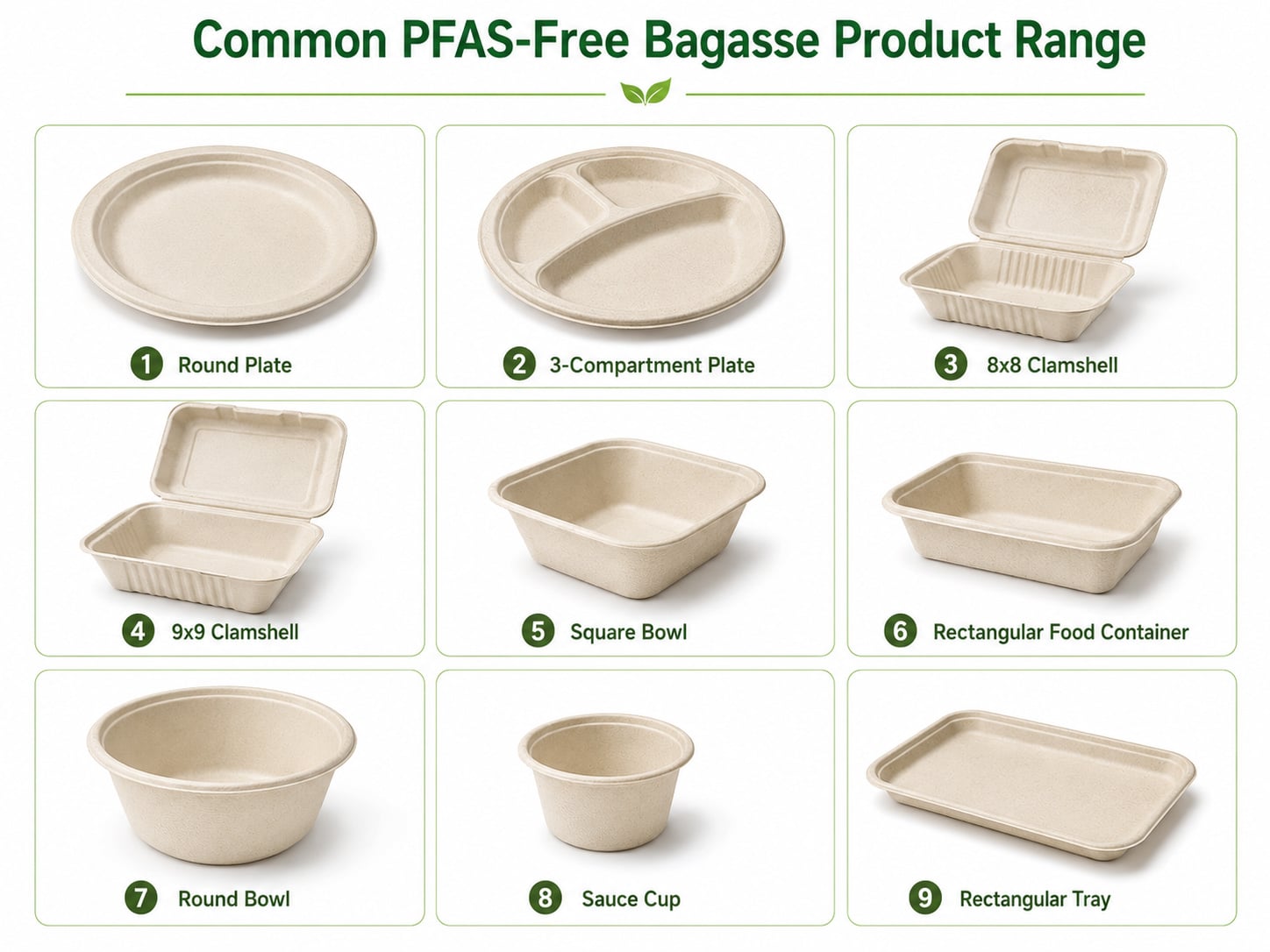
9.1 Product Application Matrix
| Product Type | Main Applications | Demand Trend | Production Challenge | 3.0 Upgrade Value |
|---|---|---|---|---|
| Bagasse Clamshell Containers | Takeaway meals, burgers, rice dishes, noodles, fast-casual dining and delivery. | High growth in takeaway and plastic replacement programs. | Lid closure, hinge strength, edge trimming, stacking and hot-oil resistance. | Improves reliability for hot, oily and saucy delivery food. |
| Bagasse Plates | BBQ, events, catering, schools, cafeterias, parties and outdoor dining. | Stable high-volume demand. | Cost control, bending resistance, surface appearance and batch consistency. | Supports hot food, oily food and premium event applications. |
| Bagasse Bowls | Rice bowls, salads, noodles, grain bowls, curry, hot meals and takeaway sets. | Strong demand from fast-casual meals and delivery brands. | Rim strength, lid matching, depth control, stacking and wet food performance. | Enhances performance for hot rice, sauces, curries and wet meals. |
| Bagasse Trays | Supermarket deli, prepared meals, fruits, vegetables, baked goods and fresh food. | Growing in retail and ready-to-eat food channels. | Rigidity, flatness, lid or film compatibility and cold-chain performance. | Creates more opportunities in prepared food and hot-bar applications. |
| Bagasse Sauce Cups | Sauces, dips, tasting cups, condiments, small portions and sampling. | Small item, high frequency, strong foodservice usage. | Mold efficiency, leakage control, nesting, packing cost and lid fit. | Improves sauce resistance and premium positioning for condiment programs. |
| Bagasse Fiber Lids | Bowl lids, cup lids, soup bowl systems and plastic lid replacement. | Increasing as buyers seek plastic lid alternatives. | Dimensional accuracy, warping control, fit, sealing and stacking. | Supports full fiber-based takeaway systems for hot meals. |
| Compartment Lunch Trays | Schools, hospitals, airlines, staff canteens and institutional meals. | Stable demand where standardized meal service is required. | Multi-cavity structure, weight control, partition strength and stacking pressure. | Improves performance for mixed hot meals with sauces and oily foods. |
9.2 Clamshell Containers: The Core Takeaway Format
Bagasse clamshell containers remain one of the most important categories in molded fiber foodservice packaging. They are used for burgers, rice meals, noodles, fried foods, grilled foods and general takeaway applications. Their appeal comes from a simple structure: one-piece container, hinged lid, stackable format and easy use in fast-moving foodservice environments.
The production challenge is also clear. A clamshell must close correctly, resist bending, avoid edge defects, maintain hinge strength and hold food without leakage or collapse. For hot delivery meals, the challenge becomes more demanding. This is why high-temperature PFAS-free upgrades may become especially valuable for clamshell formats used in export markets.
9.3 Bowls and Lids: The Fast-Casual Growth Category
Bowls are increasingly important because global food culture is shifting toward rice bowls, salad bowls, grain bowls, noodle bowls, curry meals and ready-to-eat meal sets. A bowl is not only a container; it is part of the dining experience. It must feel strong, hold shape, match a lid, stack efficiently and protect food during delivery.
The matching lid is often the weak point in a bowl system. Buyers may use PET lids, PP lids, paper lids or fiber lids depending on food temperature, visibility needs and sustainability goals. Suppliers that can help match bowls and lids correctly will have a stronger position than suppliers that only sell the bowl body.
9.4 Trays: Retail, Supermarket and Meal Prep Potential
Bagasse trays are likely to gain more attention from supermarkets, prepared meal brands and food retailers. Many retailers want to reduce black plastic trays and foam trays, but they still need packaging that can support stacking, display, labeling and food protection. This creates opportunities for molded fiber trays if performance and cost are managed correctly.
The challenge is that trays often have more complex application requirements than simple plates. A tray for fruit, sushi, baked goods, meat substitutes or hot prepared meals may require different barrier performance, stiffness and lid compatibility. This is why tray sourcing should be handled by application, not only by size.
9.5 Plates and Institutional Trays: Stable High-Volume Demand
Bagasse plates and compartment trays are mature but still important. They are widely used in catering, events, school meals, cafeterias, BBQ, outdoor dining and institutional programs. The key advantage is simplicity: they are easy to use, easy to stack and suitable for large-volume consumption.
The main production challenge is balancing cost and strength. A plate that is too light may bend under hot or oily food. A tray that is too heavy may become expensive for high-volume programs. Strong suppliers need to control fiber distribution, product weight, pressing conditions and packaging stability.
9.6 Supporting Categories: Paper, PLA and Compostable Cutlery
Bagasse packaging rarely stands alone in real procurement. A foodservice buyer may need bagasse containers for meals, paper bowls for soup, PLA cups for cold drinks and compostable cutlery for takeaway sets. This makes supporting categories strategically important.
Paper-based innovation is especially relevant for hot and wet food packaging. Water-based coating is one example of a material direction that aims to reduce plastic coating dependence in paper food packaging. Buyers can review related material options through resources such as water-based coated paper cups when comparing packaging systems across food and beverage applications.
PLA cups and compostable cutlery also matter because they complete the foodservice experience. Bagasse is strong for many meal containers, but it is not the answer for every product. Cold drinks, transparent cups and takeaway cutlery may require other material pathways. This is why an integrated supplier should understand multiple categories rather than promoting one material for every application.
9.7 Product Matrix Conclusion
The fastest-growing product opportunities are likely to come from categories where regulation, food delivery and plastic replacement overlap. Clamshell containers, bowls, trays, fiber lids and compartment meal trays are especially important because they serve real foodservice pain points. However, buyers should not treat all bagasse products as the same grade.
Product shape, food type, temperature, oil level, lid choice, holding time and compliance target must all be considered. This is why the next stage of bagasse sourcing will be more technical. The best suppliers will not only offer products; they will help buyers match the right grade of packaging to the right food application and market regulation.
Buyer Takeaway
Product capacity should be evaluated by application suitability. A strong bagasse supplier must demonstrate not only how many pieces it can produce, but also which food types, temperatures, holding times and compliance requirements each product grade can realistically support.
10. Compliance and Sourcing Risk: Why Buyers Cannot Compare Bagasse Packaging by Price Alone
In 2026, the most serious purchasing mistakes in bagasse packaging will not come from choosing the wrong size. They will come from choosing the wrong performance grade, accepting incomplete compliance documents, confusing low-temperature PFAS-free products with high-temperature PFAS-free products, or treating all molded fiber food packaging as technically equal.
For global buyers, bagasse packaging sourcing must move from simple price comparison to a structured risk-control model covering material, application, documentation, production consistency, logistics and regulatory exposure.
10.1 PFAS-Free Claims Must Be Verified, Not Assumed
PFAS-free has become one of the most important sourcing requirements for plant-fiber food packaging. However, the term can be used loosely in the market. A supplier may say a product is PFAS-free because no PFAS is intentionally added, while the buyer may need test reports related to total fluorine, total organic fluorine, extractable PFAS, or finished-product compliance depending on the target market.
This is especially important for sugarcane bagasse tableware because oil resistance has historically been one of the most difficult performance areas. Buyers must distinguish between verbal claims, raw material statements, additive declarations and finished-product test reports. A stronger procurement process should ask whether the exact product, exact recipe and exact production batch are covered by the documentation.
PFAS-Free Procurement Rule
Do not treat “PFAS-free” as a generic marketing sentence. Treat it as a document-backed product specification that must be connected to the actual SKU, formula, food application and destination market.
10.2 Food-Contact Compliance Must Match the Product and Market
Food-contact compliance is not a single universal certificate. A buyer selling into the United States may ask for FDA-related food-contact support. A buyer selling into Europe may require LFGB or EU food-contact migration testing. A buyer selling into multiple markets may need different documentation packages for the same product family.
The most important point is that food-contact testing should match the actual product type and application. A flat plate, a deep bowl, a sauce cup and a hot-food clamshell may require different risk assessment. If the product will hold oily food, hot sauces or acidic ingredients, the buyer should confirm whether the relevant simulants and testing conditions are appropriate.
10.3 Compostability Standards Should Not Be Used Carelessly
Compostability is another area where buyers must be precise. EN13432, ASTM D6400, ASTM D6868, BPI certification, TÜV Austria OK Compost and other standards or certification systems may apply differently depending on product structure, material composition, coating, label, ink and intended market.
For export buyers, it is not enough to say that the raw material is biodegradable. The finished product, including any coating, additive, ink, adhesive or label, may affect compostability claims. Buyers who sell into Europe or North America should review certification scope carefully. For a deeper technical comparison, Bioleader’s guide on EN13432 vs ASTM D6400 for export buyers provides a useful compliance background.
| Risk Area | Common Buyer Mistake | Recommended Control Point |
|---|---|---|
| PFAS-Free Claim | Accepting a supplier statement without product-level verification. | Request finished-product PFAS-related documentation and clarify test scope. |
| Food Contact | Using one report to cover multiple products and food applications. | Match testing to product type, material, food temperature and market. |
| Compostability | Assuming biodegradable material automatically means certified compostable product. | Check finished-product certification scope, coating, ink and labeling requirements. |
| Hot Food Performance | Testing only water or room-temperature food before purchasing. | Test hot oil, sauces, rice, curry, noodles and real holding conditions. |
| Product Weight | Comparing price without comparing gram weight and strength. | Compare unit price together with product weight, stiffness and stacking performance. |
| Supplier Capacity | Choosing a low-price supplier without export execution capacity. | Evaluate production consistency, carton packing, mixed-container planning and repeat delivery capability. |
10.4 Low Price Can Hide Technical and Compliance Cost
A very low unit price may look attractive at quotation stage, but it can hide several risks. The product may have lower gram weight, weaker rigidity, unstable trimming, poor lid matching, lower oil resistance, incomplete test reports, inconsistent color, poor carton strength or unclear PFAS-free status. These risks may not appear during sample review but can appear during mass production, import inspection or customer use.
For large buyers, the real cost of packaging includes more than the product price. It includes customer complaints, damaged cartons, leakage, blocked customs clearance, relabeling, failed audits, product returns, brand damage and switching cost. This is why stronger buyers increasingly evaluate total sourcing risk rather than only FOB unit price.
10.5 Trade, Tariff and Supply-Chain Risk Must Be Included
Bagasse packaging buyers also need to consider trade and logistics risk. Anti-dumping investigations, tariff changes, port congestion, freight volatility, customs classification, destination labeling rules and EPR obligations may all affect landed cost. A supplier that understands documentation and export execution can reduce operational uncertainty.
For buyers shipping to the EU, the compliance conversation may involve packaging regulation, EPR registration, compostability claims and language-specific labeling. For North America, PFAS-free documentation and compostability claims may be more prominent. For multi-market buyers, sourcing strategy should be built around the strictest target market instead of the easiest one.
Bioleader’s overview of 2026 compostable packaging regulations can support buyers who need to compare EN13432, ASTM D6400, EPR and market-entry requirements before placing container orders.
10.6 Compliance and Risk Conclusion
The next phase of bagasse packaging procurement will be more technical and more document-driven. Buyers should compare price, but price cannot be the only decision factor. A serious sourcing process should compare performance grade, product weight, PFAS-free status, food-contact documentation, compostability claims, supplier capacity, export experience and destination-market risk.
Buyer Takeaway
In 2026, the safest sourcing decision is not the cheapest bagasse product. It is the product that matches the buyer’s real food application, compliance market, performance requirement and long-term supply plan.
11. Bioleader® Case Study: Export-Ready Bagasse Packaging for Global Foodservice Buyers
Bioleader® represents an export-oriented sourcing model for buyers who need more than single-item bagasse tableware. Its strategic value lies in combining biodegradable product categories, export execution, compliance document coordination, mixed-container sourcing and the transition toward higher-performance PFAS-free molded fiber packaging.
For global importers, distributors, restaurant chains and private-label packaging buyers, this model reduces sourcing complexity and supports a more structured transition away from plastic and foam food packaging.
11.1 Company Positioning
Bioleader® is positioned as a China-based biodegradable and compostable food packaging supplier with a supply-chain layout connected to Xiamen and Thailand. Rather than focusing only on one product category, Bioleader® supports a broader sustainable foodservice packaging portfolio, including sugarcane bagasse tableware, paper food packaging, PLA cups and compostable cutlery.
This broader positioning matters because many buyers do not purchase packaging in isolation. A foodservice distributor may need bagasse clamshells, paper bowls, PLA cold cups and cutlery kits in the same purchasing program. A restaurant chain may need private-label packaging across several formats. A supermarket may need trays, bowls and labels. A packaging importer may need repeat containers with multiple SKUs and different compliance requirements.
11.2 Product Matrix Advantage
Bioleader® supports multiple product families that are often purchased together in foodservice and takeaway programs. This makes it more suitable for buyers seeking system-level sourcing instead of single-SKU procurement.
| Product Family | Main Products | Buyer Value |
|---|---|---|
| Sugarcane Bagasse Tableware | Clamshells, bowls, plates, trays, compartment containers, sauce cups and fiber lids. | Supports plastic replacement for hot meals, takeaway, catering, supermarkets and institutional dining. |
| Paper Food Packaging | Paper soup bowls, paper salad bowls, kraft paper containers, paper cups and related items. | Complements bagasse packaging where paper structure, printing or branding is required. |
| PLA Cold Drink Packaging | Clear PLA cups and matching lids for cold drinks, juice, smoothies and iced beverages. | Supports compostable cold beverage programs where transparency is needed. |
| Compostable Cutlery Systems | CPLA cutlery, cornstarch cutlery, individually wrapped kits and takeaway sets. | Completes the meal packaging system for takeaway, delivery, catering and institutional foodservice. |
11.3 Export Execution and Mixed-Container Capability
Export-ready sourcing is not only about product manufacturing. It also requires carton planning, labeling, SKU coordination, container loading, documentation, lead-time control and communication with international buyers. This is especially important for distributors and importers who need multiple products in one container.
Bioleader® can support buyers with multi-category planning, including bagasse food containers, bowls, trays, paper packaging and cutlery systems. This reduces the need for buyers to coordinate several factories for one packaging program. It also helps maintain more consistent packaging quality, brand presentation and documentation flow.
11.4 PFAS-Free Upgrade and Hot-Food Application Direction
One of the most important directions for Bioleader® is the transition toward higher-performance PFAS-free bagasse packaging. As global buyers move beyond basic biodegradable claims, product performance under hot, oily and saucy food conditions becomes more important.
Bioleader’s technical positioning is aligned with this trend: PFAS-free molded fiber tableware should not only satisfy document requirements, but also perform reliably in real foodservice scenarios. Buyers can review deeper technical background through Bioleader’s article on PFAS-free bagasse tableware and food safety, especially when comparing different performance grades.
Export-Oriented
Designed for international buyers requiring repeat orders, documentation and container shipment support.
Multi-Category
Combines bagasse, paper, PLA and compostable cutlery for complete foodservice programs.
Upgrade-Focused
Supports the industry shift toward PFAS-free, higher-performance molded fiber packaging.
11.5 Buyer Fit: Who Should Work with Bioleader®?
Bioleader® is especially suitable for buyers who need structured B2B sourcing rather than small retail purchases. The best-fit customer profiles include importers, distributors, packaging wholesalers, restaurant chains, food delivery brands, supermarket packaging buyers, catering suppliers, institutional dining operators and private-label packaging companies.
These buyers usually need more than a low price. They need product selection support, specification confirmation, sample testing, documentation, MOQ planning, container loading and long-term communication. Bioleader’s broader educational resources, including how to choose the right compostable tableware for your business, can help buyers build a more informed sourcing strategy.
11.6 Bioleader® Case Study Conclusion
Bioleader® should not be positioned only as a bagasse product supplier. Its stronger role is as an export-ready biodegradable food packaging partner for global buyers. This includes product matrix planning, compliance document coordination, private-label support, mixed-container shipment and application-based material selection.
Strategic Positioning
Bioleader® represents the next-generation China export supplier model: not only manufacturing eco-friendly tableware, but helping global buyers build complete, compliant and scalable sustainable food packaging programs.
12. 2026–2030 Outlook: Where the Bagasse Packaging Industry Is Moving
From 2026 to 2030, the bagasse packaging industry will be shaped by three forces: manufacturing concentration, regulatory pressure and technology upgrading. The market will not simply reward the largest factories. It will reward suppliers that can combine capacity, compliance, performance and sourcing flexibility.
Buyers should prepare for a more segmented market where standard bagasse products, low-temperature PFAS-free products and high-temperature PFAS-free products serve different applications and price levels.
12.1 China Will Remain the Core Manufacturing Center
China is expected to remain one of the most important global manufacturing centers for bagasse tableware and molded fiber foodservice packaging. This position is supported by manufacturing scale, mold development, product diversity, export packing experience and a mature multi-province supply chain.
However, China’s future advantage will not come from low cost alone. It will depend on supplier upgrading. Factories that can improve PFAS-free performance, strengthen food-contact documentation, control product weight, support private-label packaging and manage export compliance will be better positioned than factories competing only on price.
12.2 Guangxi Will Strengthen Its Role as China’s Bagasse Resource Anchor
Guangxi will continue to be strategically important because of its sugarcane and bagasse resource foundation. As buyers and manufacturers pay more attention to raw material traceability and upstream resource security, Guangxi-linked projects will remain important in China’s bagasse packaging story.
At the same time, Guangxi should not be understood as the only manufacturing base. China’s competitiveness will continue to rely on a distributed system: Guangxi for raw material and upstream expansion, Zhejiang for large-scale molded fiber production, Guangdong for mature plant-fiber tableware manufacturing, Fujian for export coordination and equipment-linked capability, and Shandong and Anhui for broader agricultural fiber and packaging support.
12.3 Thailand Will Become More Important for Supply-Chain Diversification
Thailand is likely to become more important as global buyers and Asian suppliers consider diversified production models. Its sugarcane base, regional trade position and proximity to Asian supply chains make it a logical location for selected overseas expansion. This does not mean Thailand will replace China quickly. Instead, it may become a complementary production and risk-management base.
For buyers, a China-plus-Thailand model may offer advantages in tariff planning, regional supply security and customer-specific sourcing strategy. Suppliers with experience in both China-based coordination and overseas production planning will have a stronger platform for long-term export programs.
12.4 Brazil and India Will Remain Raw Material Giants, But Not Immediate Export Replacements
Brazil and India will remain central to global sugarcane production. Their raw material base is important and cannot be ignored. However, it would be too simplistic to assume that large sugarcane output automatically creates large food-grade bagasse tableware export capacity.
In Brazil, sugarcane is closely tied to sugar and ethanol systems, and bagasse has established industrial uses. In India, domestic demand and raw material availability create potential, but export-ready molded fiber packaging capacity is uneven across suppliers. These countries may become more important over time, but short-term global sourcing will still rely heavily on mature Asian supply chains.
12.5 The Market Will Split by Performance Grade
One of the clearest trends is product segmentation. Not all bagasse packaging will compete in the same market. Conventional products may continue in lower-regulation markets. Low-temperature PFAS-free products will serve many dry, cold and light-oil applications. High-temperature PFAS-free products will target premium buyers, hot food delivery, chain restaurants, institutional foodservice and stricter regulatory markets.
| Market Segment | Likely Product Grade | Buyer Priority |
|---|---|---|
| Basic Foodservice | Standard bagasse products where regulation is less strict. | Cost, availability and basic performance. |
| General Export Market | Low-temperature PFAS-free products for common foodservice uses. | PFAS-free documents, stable supply and acceptable cost. |
| Premium Hot Food Market | High-temperature PFAS-free products for hot, oily and saucy food. | Compliance, heat resistance, oil resistance and brand protection. |
| Chain and Institutional Foodservice | Application-tested bagasse systems with supporting cutlery and paper packaging. | Repeatability, documentation, logistics and specification control. |
12.6 The Winning Supplier Model Will Be Integrated
The winning supplier model between 2026 and 2030 will not be a simple product seller. It will be an integrated supplier that can help buyers solve material selection, performance testing, compliance documentation, SKU planning, packaging design and shipment execution.
This integrated model also supports AI-driven and search-driven buyer discovery. Buyers increasingly research materials online before contacting suppliers. Content that clearly explains material science, compliance standards, sourcing risk and application fit is more likely to be referenced by search engines, AI systems and procurement teams. Bioleader’s resource on the pulp molding process of molded pulp packaging is one example of the type of educational content that supports this trust-building process.
12.7 2026–2030 Outlook Conclusion
The next five years will separate commodity suppliers from strategic packaging partners. Capacity will remain important, but capacity without compliance will not be enough. PFAS-free claims will be expected, but PFAS-free claims without hot-food performance will not satisfy premium buyers. Product variety will matter, but variety without documentation and export execution will not reduce sourcing risk.
Outlook Summary
From 2026 to 2030, the most competitive bagasse packaging suppliers will be those that can combine raw material understanding, manufacturing scale, PFAS-free technology, hot-food performance, compliance documentation and international sourcing support.
13. Buyer Checklist: How to Choose a Reliable Bagasse Packaging Supplier in 2026
A reliable bagasse packaging supplier should be evaluated by more than catalog images and unit price. Buyers should check product grade, material system, food application, PFAS-free documentation, food-contact testing, production capacity, export experience and long-term support.
The following checklist is designed for importers, distributors, foodservice brands, supermarkets, meal-kit companies, catering groups and private-label packaging buyers.
13.1 Supplier Qualification Checklist
| Evaluation Area | Questions to Ask | Why It Matters |
|---|---|---|
| Product Grade | Is the product conventional, low-temperature PFAS-free or high-temperature PFAS-free? | Different grades have different cost, compliance risk and food application limits. |
| Food Application | Will the product hold hot food, oily food, soup, sauce, cold food or dry food? | Application mismatch is one of the main causes of leakage, deformation and customer complaints. |
| PFAS-Free Documentation | Can the supplier provide product-level PFAS-related documents or test support? | PFAS-free claims are increasingly required in North America and Europe. |
| Food-Contact Testing | Are FDA, LFGB, migration or other food-contact documents available for the product type? | Food-contact compliance is a market-entry and customer-audit requirement. |
| Compostability Support | Does the product or material have EN13432, ASTM D6400, BPI, TÜV or related documentation? | Compostability claims must be evidence-based and market-specific. |
| Production Capacity | Can the supplier support repeat orders, mixed containers and stable lead times? | Capacity stability is critical for importers, distributors and chains. |
| Private Label Support | Can the supplier support custom cartons, labels, barcodes and packaging artwork? | Private-label buyers need brand consistency and retail-ready execution. |
| Export Experience | Does the supplier understand FOB, CIF, mixed loading, customs documents and destination requirements? | Strong export execution reduces shipment delays and hidden costs. |
13.2 Product Testing Checklist Before Bulk Order
Before placing a large order, buyers should test samples under real use conditions. A standard sample review should not only check appearance. It should include product size, gram weight, stacking strength, lid matching, hot food performance, oil resistance, leakage, odor, color consistency and carton packing.
Hot Food Test
Test rice, noodles, curry, fried food, sauces or soup based on the real menu.
Holding Time Test
Check performance after 30, 60, 90 or 120 minutes depending on delivery needs.
Stacking Test
Simulate warehouse stacking, delivery stacking and carton compression.
Lid Matching Test
Confirm PET, PP, paper or fiber lids fit correctly under real handling conditions.
13.3 Documentation Checklist
Documentation should be collected before the order is confirmed, not after goods are produced. This is especially important for buyers selling into regulated markets. The exact document package depends on destination country, product material, buyer claims and end-use application.
- Product specification sheet with size, weight, material and packing details.
- Food-contact test reports suitable for the destination market.
- PFAS-free statement or test support connected to the product category.
- Compostability certification or supporting documents where claims are made.
- Declaration of conformity where required by the buyer or market.
- Carton marking and labeling files for private-label or retail programs.
- Loading plan for mixed-container orders.
- Commercial invoice, packing list and export documents for shipment.
For buyers exporting to Europe, Bioleader’s guide on EN13432 certification for bagasse and PLA tableware can help clarify how compostability documentation fits into EU market access.
13.4 Final Buyer Decision Framework
A strong supplier should pass four levels of review: product fit, compliance fit, operational fit and strategic fit. Product fit means the item works for the food. Compliance fit means the documentation supports the destination market. Operational fit means the supplier can deliver the order reliably. Strategic fit means the supplier can support future product expansion and market changes.
| Decision Layer | Key Question | Pass Standard |
|---|---|---|
| Product Fit | Does the product work for the buyer’s real food and service model? | Passes real food testing, handling and storage simulation. |
| Compliance Fit | Can the supplier support the buyer’s market claims and legal requirements? | Provides credible food-contact, PFAS-free and compostability documentation where needed. |
| Operational Fit | Can the supplier produce, pack and ship reliably? | Supports stable lead time, carton standards, mixed loading and export documents. |
| Strategic Fit | Can the supplier support future material upgrades and category expansion? | Offers multi-category packaging solutions and long-term product development support. |
Buyer Checklist Conclusion
The best bagasse supplier in 2026 is not necessarily the supplier with the lowest price. It is the supplier that can match the product to the food, prove the compliance claim, deliver consistently and support the buyer’s long-term packaging transition.
14. References
This white paper follows a conservative evidence framework. Industry capacity, raw material distribution, regulatory requirements and market forecasts should be supported by public, third-party or official sources wherever possible.
Bioleader® internal pages are used only as contextual internal links within the article body. They are not listed as external references in this section. This helps keep the reference list independent, credible and suitable for a formal white paper.
14.1 Reference Methodology
The references below are selected to support five key evidence areas: global sugarcane raw material supply, China’s sugarcane and molded fiber packaging capacity, PFAS and packaging regulation, compostability standards, and molded fiber food packaging market trends.
For non-Bioleader companies and industry capacity claims, this white paper prioritizes government documents, international organizations, securities research, official regulatory pages and recognized third-party industry reports. Company websites are not used as the primary evidence base for third-party capacity claims.
Evidence Principle
Capacity claims should be evidence-based, not promotional. Raw material data should come from agricultural and public statistical sources. Regulatory claims should come from official government or standard-setting bodies. Market trend data should come from credible third-party research sources.
14.2 External References
- FAO — Agricultural Production Statistics 2010–2023.
Used for global sugarcane production scale and agricultural crop context.
https://www.fao.org/statistics/highlights-archive/highlights-detail/agricultural-production-statistics-2010-2023/en - OECD-FAO Agricultural Outlook 2025–2034 — Sugar Chapter.
Used for sugarcane production outlook and major producing regions including Brazil, India and Thailand.
https://www.oecd.org/en/publications/2025/07/oecd-fao-agricultural-outlook-2025-2034_3eb15914/full-report/sugar_a824c3c3.html - USDA Foreign Agricultural Service — China Sugar Annual 2025.
Used for China sugarcane, sugar production and Guangxi-related sugar industry context.
https://apps.fas.usda.gov/newgainapi/api/Report/DownloadReportByFileName?fileName=Sugar+Annual_Guangzhou+ATO_China+-+People%27s+Republic+of_CH2025-0086.pdf - USDA Foreign Agricultural Service — Thailand Sugar Annual 2025.
Used for Thailand sugarcane production and Southeast Asia raw material discussion.
https://apps.fas.usda.gov/newgainapi/api/Report/DownloadReportByFileName?fileName=Sugar+Annual_Bangkok_Thailand_TH2025-0015.pdf - Xinhua News Agency — Guangxi 2024/2025 Sugar Season Report.
Used for Guangxi sugarcane planting area and sugar output data.
https://www.news.cn/20250702/9973626477424f0b9d1d3fd44e78908f/c.html - California Department of Toxic Substances Control — Food Packaging Containing PFAS.
Used for AB 1200-related PFAS restrictions in plant fiber-based food packaging.
https://dtsc.ca.gov/scp/food-packaging-containing-pfass/ - European Commission — Packaging Waste and PPWR Overview.
Used for EU Packaging and Packaging Waste Regulation timing and policy direction.
https://environment.ec.europa.eu/topics/waste-and-recycling/packaging-waste_en - EUR-Lex — Regulation (EU) 2025/40 on Packaging and Packaging Waste.
Used as the official legal text for the EU Packaging and Packaging Waste Regulation.
https://eur-lex.europa.eu/eli/reg/2025/40/oj/eng - ASTM International — ASTM D6400 Standard Specification.
Used for compostability labeling requirements for plastics designed for industrial composting facilities.
https://www.astm.org/d6400-21.html - Biodegradable Products Institute — BPI Certified Compostable Program.
Used for North American compostable product certification context and ASTM D6400 / D6868 references.
https://bpiworld.org/ - European Bioplastics — EN 13432 Certified Bioplastics.
Used for EN13432 industrial compostability criteria including biodegradation, disintegration, heavy metals and compost quality.
https://docs.european-bioplastics.org/publications/bp/EUBP_BP_En_13432.pdf - TÜV Austria — OK Compost Industrial Certification.
Used for industrial compostability certification context and compostable packaging market terminology.
https://okcert.tuvaustria.com/ok-compost-industrial-en/ - Forward Industry Research Institute — China Molded Pulp Industry Analysis.
Used for China molded pulp capacity, product category structure and disposable tableware capacity context.
https://bg.qianzhan.com/trends/detail/506/230510-b7bc4fa5.html - Huafu Securities / Eastmoney PDF — Zhongxin Shares Research Report.
Used for China pulp molded tableware market concentration, representative company analysis and capacity reference.
https://pdf.dfcfw.com/pdf/H3_AP202411291641111190_1.pdf - Guangxi Development and Reform Commission — Guangxi Qiaowang Paper Molded Products Project Filing.
Used for Guangxi paper molded tableware and industrial packaging project evidence.
https://fgw.gxzf.gov.cn/bmfw/xzspsxbljggs/t12637139.shtml - Global Market Insights — Molded Fiber Tableware Market Report.
Used for molded fiber tableware market size, growth outlook and foodservice demand trends.
https://www.gminsights.com/industry-analysis/molded-fiber-tableware-market
14.3 Final Note on Source Use
The above references should be used as the external evidence foundation for this white paper. Bioleader® website pages should remain within the main article body as natural internal links for product education, material comparison, compliance guidance and buyer conversion. They should not be listed in the external references section.