









Reviewed and updated: August 2026. This guide retains its original 2025 structure while updating regulatory, performance, compostability, PFAS, sourcing, and buyer-verification guidance.
- Best-fit applications: hot meals, takeaway boxes, plates, bowls, trays, and foodservice containers where molded-fiber rigidity is required.
- Not an automatic claim: bagasse appearance alone does not prove home compostability, plastic-free construction, PFAS compliance, microwave suitability, or a fixed degradation time.
- Buyer priority: review the complete container-and-lid structure, intended food conditions, product specification, available test reports, and local waste infrastructure.
Industry Background: The Rise of Sugarcane Bagasse in Sustainable Packaging
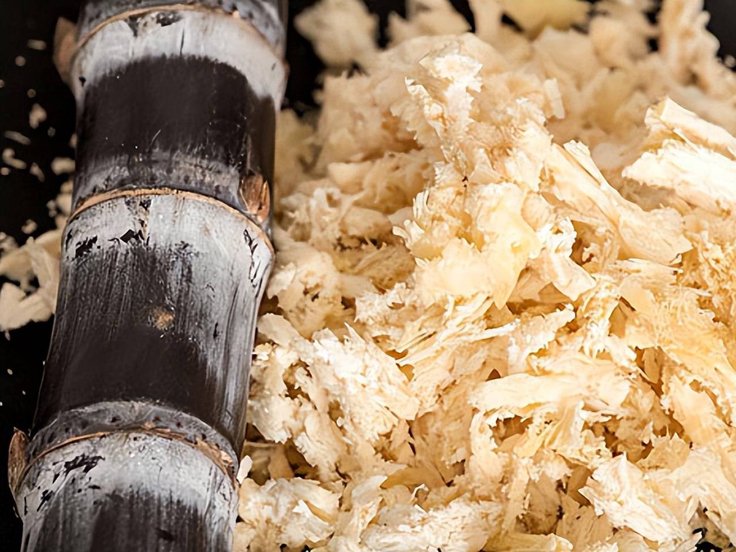
In the global push to reduce plastic waste, sugarcane bagasse has emerged as an unlikely hero. Bagasse is the dry, fibrous residue left after extracting juice from sugarcane stalks. Traditionally, mountains of bagasse were discarded or burned as waste, but today this byproduct is being upcycled into eco-friendly tableware and packaging. Because global sugarcane production is measured in billions of tonnes each year, bagasse is available at substantial scale in major sugar-producing regions. Transforming this agricultural waste into products like plates, bowls, and containers creates a circular economy solution that reduces waste and dependence on plastics.
From Waste to Resource
The shift toward bagasse tableware is driven by both environmental necessity and technological advances. As single-use plastics clog landfills and oceans, regulators and businesses have sought compostable alternatives. Sugarcane bagasse – once considered trash – is now a valuable resource. Companies collect the fibrous pulp from sugar mills and convert it into sturdy disposable tableware, turning agricultural waste into a commodity. This can reduce disposal pressure at sugar mills and provide a non-wood fiber source for molded packaging. The actual environmental benefit still depends on fiber processing, energy use, transport, product formulation, and end-of-life management. The result is a win-win: reduced waste for sugar producers and sustainable material for packaging manufacturers.
Drivers of Adoption
Several converging trends have propelled bagasse into the spotlight. Environmental regulations are tightening (as discussed later), pushing industries away from plastics. Consumer preferences are shifting too – today’s customers and foodservice clients increasingly demand eco-friendly packaging as part of brand sustainability. Foodservice operators, caterers, distributors, and institutional buyers have increasingly evaluated molded-fiber packaging as plastic restrictions and sustainability requirements expand. This broader commercial adoption has helped move bagasse from a niche material into a mainstream option for selected foodservice applications. In short, bagasse has rapidly evolved from an obscure agrarian leftover to a rising star of sustainable packaging, backed by strong ecological and economic incentives.
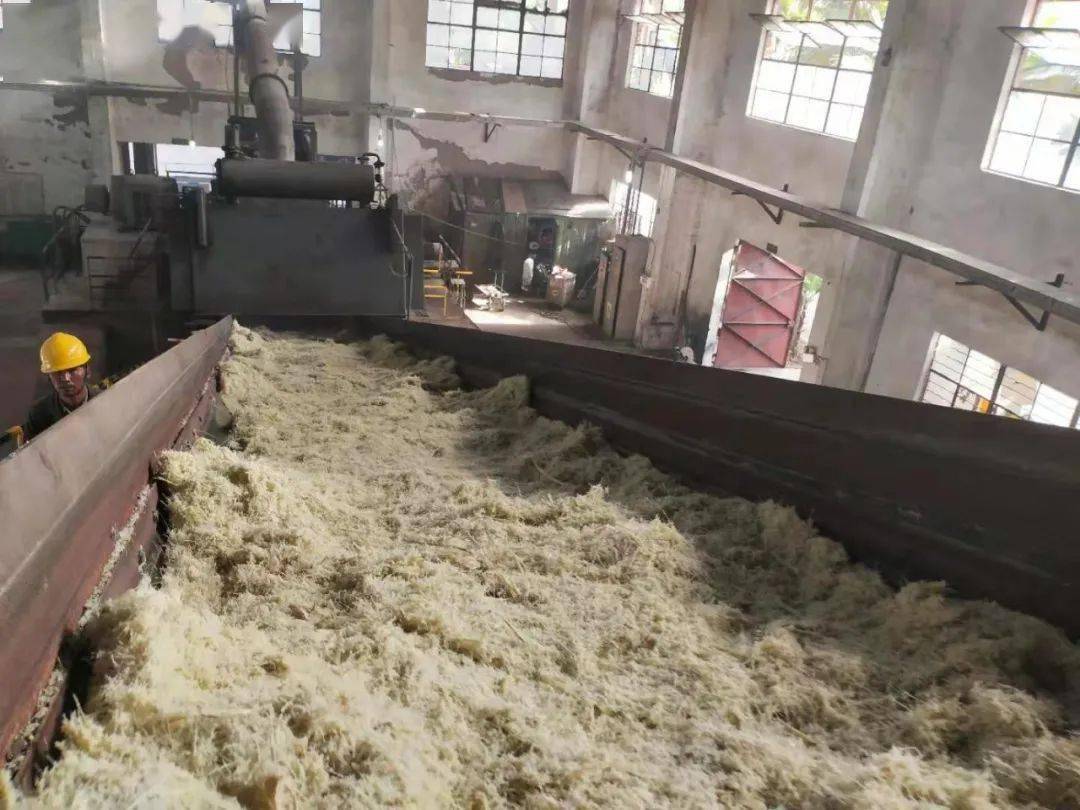
Manufacturing Process of Bagasse Tableware
Producing tableware from sugarcane bagasse involves an efficient, clean process that contrasts sharply with petroleum-based plastics. The manufacturing journey takes bagasse from farm residue to finished plate in a few streamlined steps:
1. Collection of Raw Material
After sugarcane stalks are crushed for juice, the remaining fibrous pulp (bagasse) is collected instead of being discarded or burned. Sugar mills typically set aside this bagasse for reuse. By capturing it at the source, manufacturers ensure a steady supply of raw fiber while also reducing waste at the sugar mill.
2. Cleaning and Preparation
The freshly collected bagasse is thoroughly washed to remove impurities, sticky sugar residues, and dirt. This cleaning step is crucial – clean, controlled fiber preparation is essential for consistent food-contact products. Once washed, the bagasse may be dried or directly moved to pulping. (In many operations, bagasse is dried and baled for transport if the tableware factory is off-site.) Proper preparation ensures the material is hygienic and consistent for molding.
3. Pulping
The clean bagasse fibers are mixed with water and mechanically pulped into a slurry. This creates a wet, soupy paper-like pulp. The pulping recipe varies by factory and product specification. Manufacturers may use washed natural fiber, whitening processes, wet-strength agents, retention aids, or barrier additives depending on the required appearance and performance. Buyers should therefore evaluate the finished product formulation and available food-contact documentation rather than assume that every molded-fiber item uses the same chemistry.
4. Molding and Shaping
Next, the bagasse pulp is poured into molds to form the desired products. Manufacturers use custom metal molds for plates, clamshell boxes, bowls, cups, lids, and more. The molds close on the pulp and apply heat and pressure, which causes the water to drain and the fibers to interlock into a rigid shape. This molded fiber process is similar to making thick paper or egg cartons, but with higher pressure for durability. The combination of heat and pressure “cures” the pulp, solidifying the product. Within minutes, the slurry takes on the form of a sturdy plate or container. This step is highly versatile – by swapping molds, the same pulp can create a wide range of tableware designs.
5. Drying and Finishing
After molding, the products are still slightly damp. They are transferred to drying ovens or drying racks to remove any remaining moisture. Thorough drying (often at moderate heat) ensures the items won’t deform or grow mold in storage. At this stage, some products might receive surface treatments – for example, a light food-safe coating or spray to enhance water and oil resistance (the barrier system may rely on fiber density, product design, PFAS-free additives, or a product-specific coating, depending on the application). The dried items are then trimmed of any excess fiber, and stacks of plates or containers are sorted and counted.
6. Quality Assurance
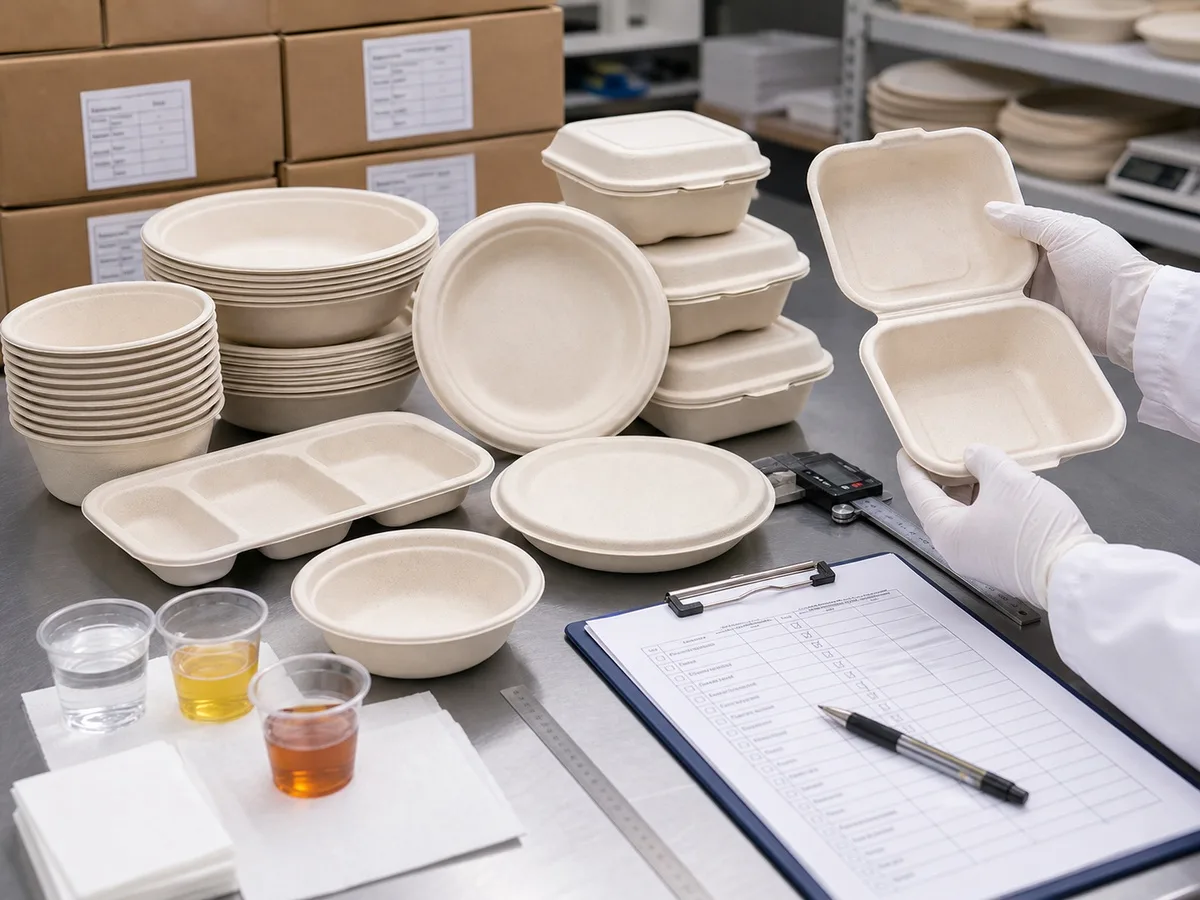
Finally, the bagasse tableware undergoes quality control. Each batch is checked to ensure consistent thickness, proper molding (no cracks or underformed areas), and performance criteria like leak resistance and structural integrity. Quality-control plans may include dimensional checks, lid-fit checks, visual inspection, moisture control, leak or oil-resistance testing, and product-specific food-contact testing. Export buyers should verify that the reports and declarations supplied correspond to the selected item, material structure, production site, and intended market.
Overall, bagasse tableware production is efficient and eco-friendly. Water, heat, pressure, fiber preparation, and controlled additives may all be involved. Suitability for food contact and composting should be supported by product-specific evidence rather than inferred from appearance alone. Buyers comparing bagasse products should review the finished structure and intended use. By the end, what started as soggy sugarcane waste is now a clean, sturdy plate or container ready for use.
Product Categories and Use Cases
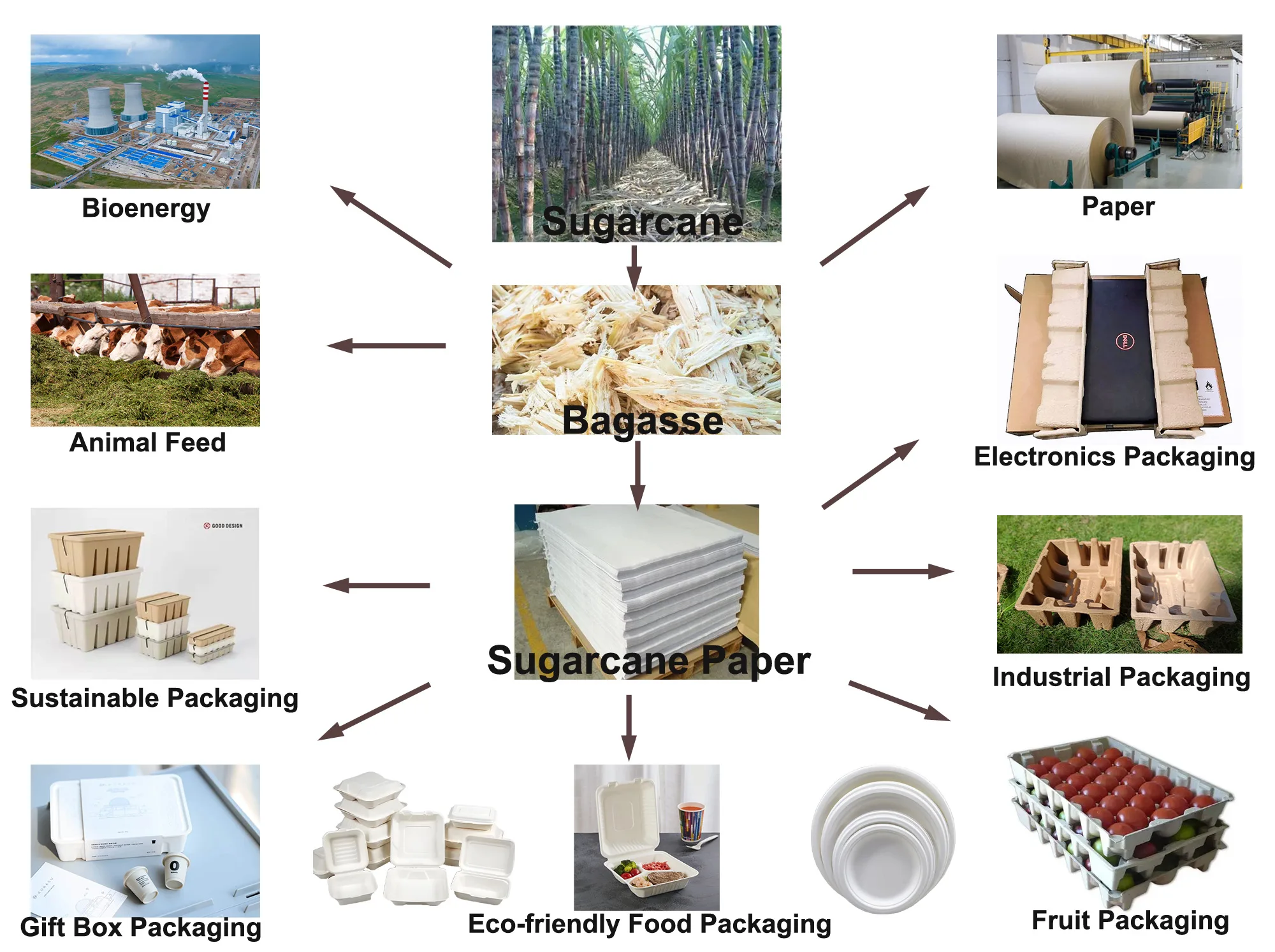
Bagasse-based tableware comes in a broad array of product types, covering many needs of the food service and packaging industry. Thanks to molding technology, bagasse can be formed into everything from a small sauce cup to a large serving tray. Below are the primary product categories and their common use cases:
Plates and Bowls
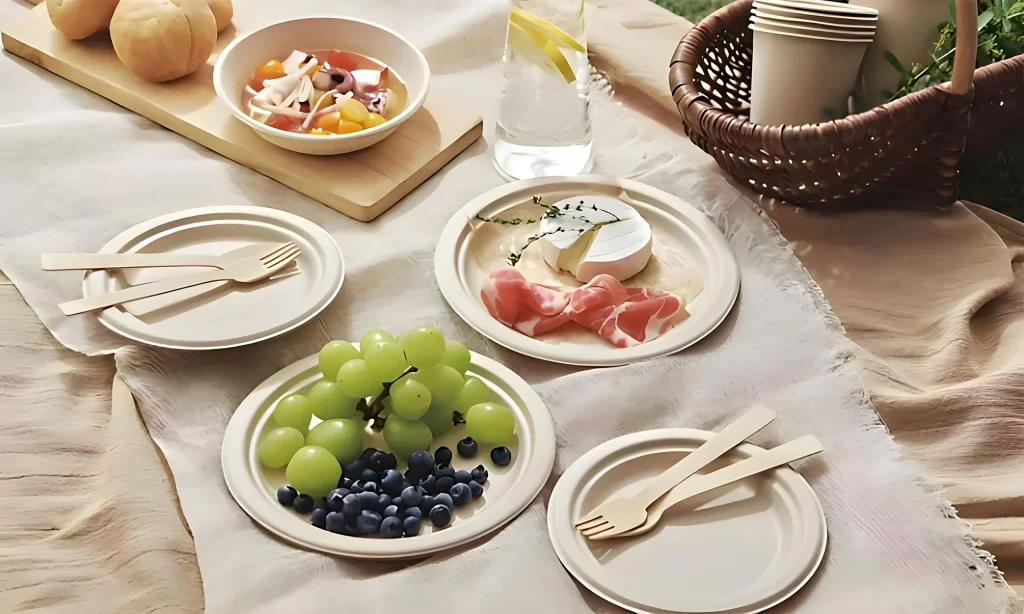
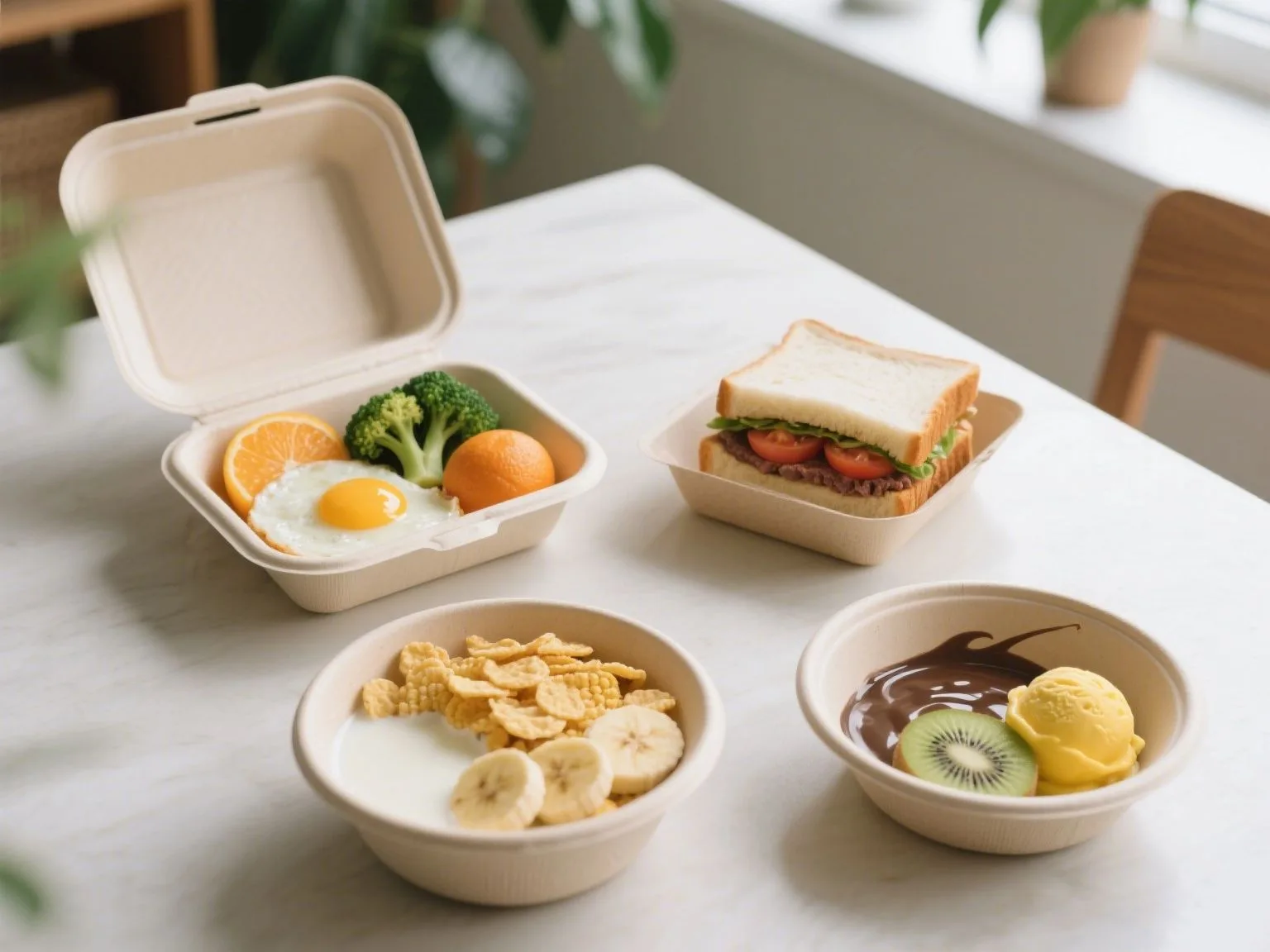
Flat plates (round or square) and deep bowls are among the most popular bagasse items. They are used for serving meals, salads, soups, and desserts in restaurants, cafeterias, catered events, and even at home. Bagasse plates and bowls come in various sizes (from small 6-inch appetizer plates up to large 12-inch dinner plates). Many are designed for hot dishes and oily foods, but holding time, food composition, product weight, and barrier formulation affect actual performance. For instance, a bagasse bowl can safely hold hot soup or curry – when the selected bowl has been designed and tested for that food, temperature, and holding time. These products are a direct sustainable replacement for disposable plastic or foam dinnerware at parties, offices, or food courts.
Hinged Clamshell Containers
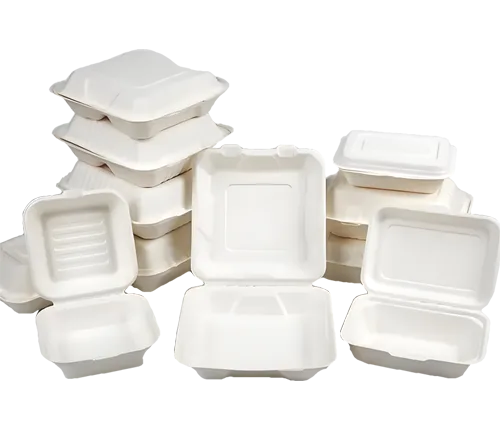
Takeout boxes made from bagasse are widely used for food delivery and grab-and-go meals. These clamshell containers have an attached lid and typically come with one or multiple compartments. Common formats include burger boxes, lunch boxes with 2–3 sections, and large meal containers. They are popular for restaurants and street food vendors because they are sturdy enough for hot, greasy foods and maintain structural integrity during transport. Bagasse clamshells can handle everything from saucy curries to burgers and fries, offering a compostable alternative to Styrofoam boxes. Their secure, hinged lids help prevent spills. Use cases span from Asian takeout meals, to barbecue and fast food packaging, to school cafeterias replacing foam trays.
Food Containers with Lids
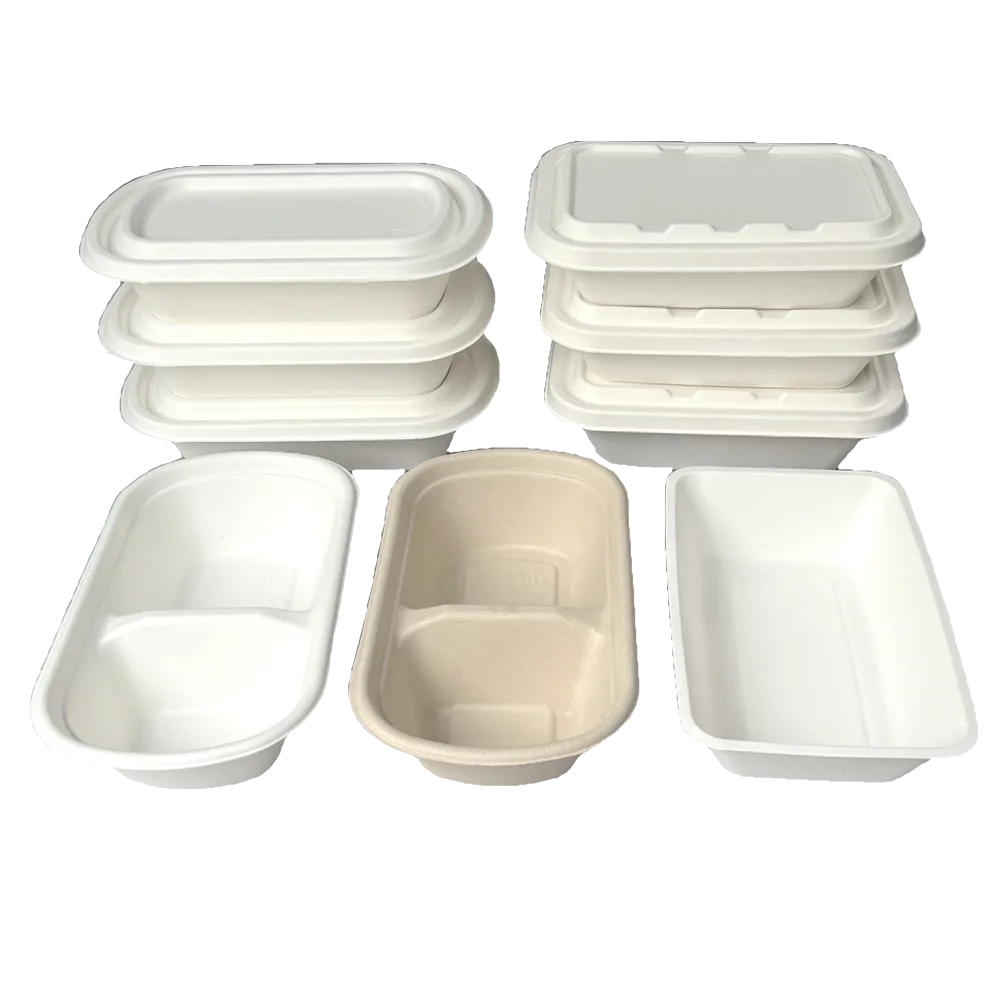
In addition to clamshells, bagasse is used for deli cups, bowls with lids, and takeout trays that have separate bagasse or bioplastic lids. For example, there are bagasse soup bowls and round containers paired with either bagasse flat lids or compostable PLA lids for liquids. These are used by salad shops, soup kitchens, and gourmet takeout shops for items like ramen, poké bowls, or grain bowls. Bagasse trays with clear compostable lids are also common for packaging produce or cold foods – providing visibility with a PLA window but a sturdy fiber base. Such containers illustrate how a molded-fiber base may be paired with a separate lid. The compostability and disposal route of the complete pack depend on the lid material, coatings, inks, adhesives, and local acceptance. (Note: if a plastic lining or lid is used, the package may not be accepted in all jurisdictions’ compost streams – see regulatory section – but many designs avoid conventional plastics entirely.)
Cups and Cup Lids
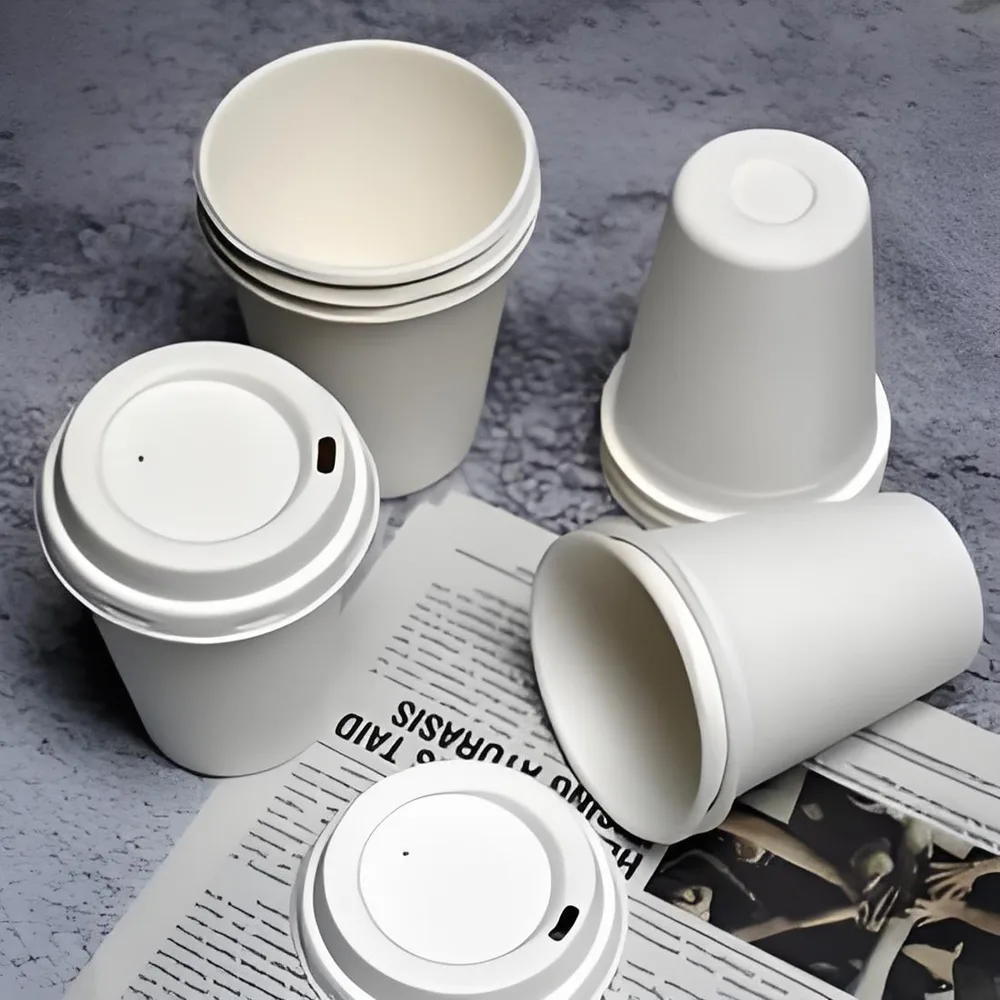
While paper is more typical for disposable cups, bagasse fiber is also used in certain cup designs and especially cup lids. Bagasse cup lids for hot drinks have gained popularity – for example, some coffee chains use bagasse-based lids for paper cups, replacing plastic lids. These fiber lids can be molded to fit standard cup sizes and are heat-tolerant and sip-friendly (with a drink opening). Whole cups made of bagasse are less common (since holding liquids for extended periods can be challenging without a liner), but there are short-term cups and portion cups (for condiments or samples) made from bagasse. They work well for serving condiments, sauces, or tastings, and eliminate plastic portion cups. Some fiber cups use a coating or additive system to extend liquid-holding time. Buyers should confirm the exact coating chemistry, temperature range, compostability evidence, and compatibility with the intended beverage. Use cases include smoothie cups with bagasse lids, water cups at events, and espresso cups that can be composted after the event.
Trays and Platters
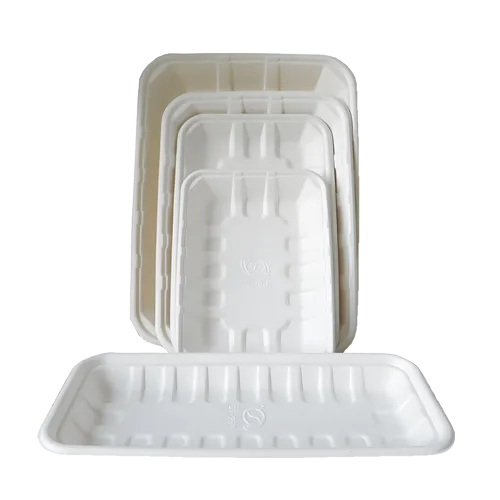
Bagasse can be molded into larger serving trays and plates with multiple compartments. For example, school lunch trays (with sections for different foods) are now made from bagasse in some cafeterias, replacing plastic or foam trays. Similarly, catering platters and produce trays (for fruits, vegetables, or meat packaging) can be made of bagasse. These trays offer strength and can be used with film overwrap or dome lids for display purposes. Many molded-fiber trays are suitable for cold storage or short microwave reheating, subject to the product specification; lids and films must be evaluated separately. Airlines and event caterers have started using bagasse compartment trays for meal service to demonstrate their commitment to sustainability.
Packaging Inserts and Others
Beyond tableware, sugarcane bagasse is also used for protective packaging in non-food industries. Molded fiber inserts for electronics, appliances, cosmetics, and glassware can be made from bagasse just like from recycled paper. For instance, some mobile phones or cosmetics come nestled in a bagasse pulp tray instead of foam. This category is slightly outside “tableware,” but it showcases bagasse’s broader utility. Its shock-absorbing and cushioning properties make it suitable for packaging fragile items. By using bagasse inserts, companies further reduce plastic foam waste. Additionally, bagasse fiber has been explored in cutlery when mixed with other materials (though most compostable cutlery is PLA or starch-based, some R&D is ongoing on high-fiber content utensils).
Key Advantages Across Categories:
Across these categories, sugarcane bagasse tableware offers several practical advantages: it uses a renewable agricultural fiber, can be molded into rigid foodservice formats, and is available for plates, bowls, trays, clamshells, and lidded containers. Many products are suitable for hot meals, oily foods, takeaway service, refrigeration, or short microwave reheating. However, these capabilities are not identical across every SKU.
Performance note: Buyers should verify food temperature, contact time, oil and moisture level, lid material, microwave instructions, freezer conditions, and any coating or additive system. “Bagasse” describes the main fiber source; it does not by itself confirm plastic-free status, PFAS performance, home compostability, or a universal temperature limit.
Based on Bioleader®’s experience serving foodservice packaging buyers, material selection should begin with the actual meal and distribution process. A dry bakery item, a hot curry, a chilled salad, and a meal held for delivery may require different container weights, closures, and barrier solutions.
Environmental Impact and Biodegradability
One of the main reasons buyers consider sugarcane bagasse tableware is that it uses a fibrous byproduct of sugar production rather than relying entirely on virgin fossil-based resin. That does not make every bagasse product environmentally identical. Fiber preparation, energy source, product weight, additives, coatings, transport distance, food waste contamination, and disposal infrastructure all influence the final result.
Biodegradability & Compostability
Untreated plant fiber is biodegradable, but a finished food container should not be assessed only by its visible fiber body. The complete article may include wet-strength chemistry, oil- and water-resistance additives, coatings, printing inks, adhesives, or a separate lid. These components can affect whether the final product qualifies as industrially compostable, home compostable, recyclable, or suitable only for general waste in a particular market.
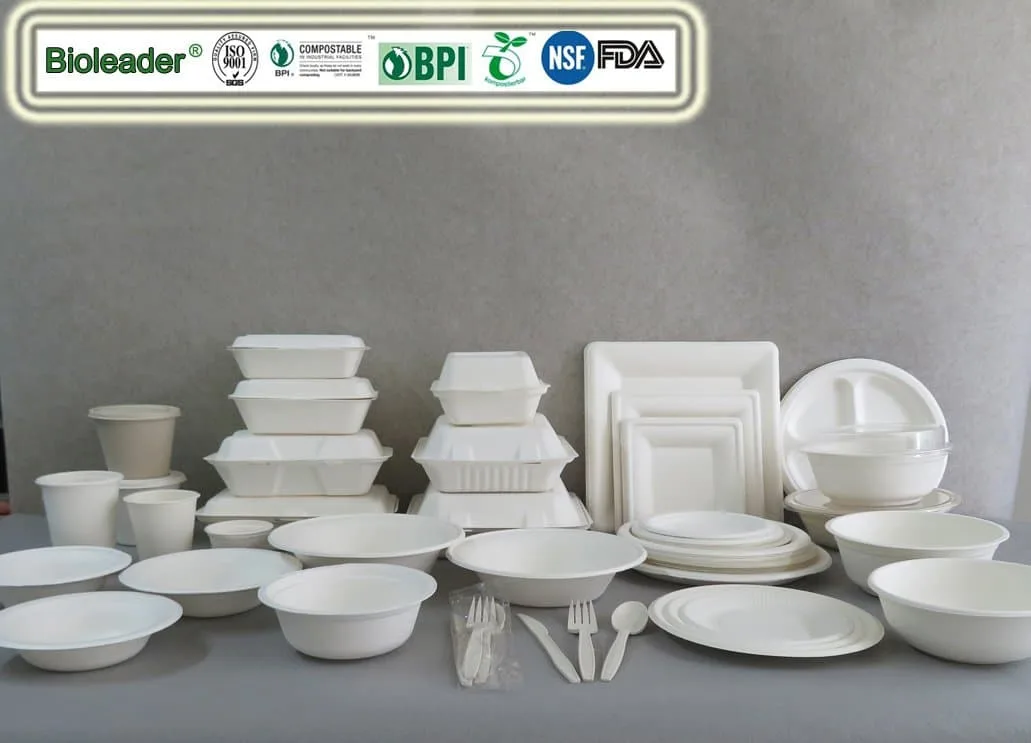
Industrial compostability is assessed under defined conditions involving temperature, moisture, oxygen, microbial activity, disintegration, biodegradation, and compost-quality criteria. Standards such as EN 13432, ASTM D6400, ASTM D6868, or equivalent national standards may be relevant depending on the material structure and destination market. Certification should be checked at the product or family level; a certificate held for one formulation should not automatically be applied to every item in a supplier’s catalog.
Key distinction: “Biodegradable” describes the ability of a material to break down through biological activity under suitable conditions. “Compostable” normally requires defined performance criteria and controlled testing. “Home compostable” is a separate claim and should be supported by evidence specifically covering lower-temperature home-compost conditions.
Actual disintegration time varies with product thickness, density, formulation, size, shredding, compost temperature, aeration, and facility practice. For this reason, a universal promise such as “all bagasse products disappear in 60 or 90 days” is not reliable. Landfills are also not composting systems: limited oxygen and moisture can slow decomposition and may contribute to methane generation from organic materials.
Use of Agricultural Fiber
Bagasse can improve resource efficiency by directing a sugar-industry residue into molded products. This may reduce demand for some virgin fossil-based materials and provide an additional use for non-wood fiber. However, bagasse also has competing uses, including energy generation and pulp applications. A credible environmental assessment should therefore consider the regional supply chain and the alternative use of the fiber rather than treating the raw material as impact-free.
Carbon Footprint and Life-Cycle Boundaries
Life-cycle comparisons between bagasse, paper, PLA, PP, PET, and expanded polystyrene can produce different results because studies use different assumptions. Important variables include allocation of agricultural impacts, electricity mix, water treatment, factory efficiency, product mass, freight distance, reuse or recycling rates, composting availability, landfill gas capture, and food waste effects.
It is reasonable to describe bagasse as a renewable, waste-derived fiber option with the potential to reduce dependence on conventional plastic. It is not appropriate to publish a fixed percentage carbon reduction for all bagasse products unless the calculation is supported by a product-specific life-cycle assessment using a transparent functional unit and comparable system boundaries.
Plastic Pollution and Complete-Packaging Design
A molded-fiber base can reduce the amount of conventional plastic used in a food package, particularly when it replaces foam or rigid plastic formats. Nevertheless, a pack with a PET, PP, or PLA lid still contains a plastic component. Likewise, a coating may alter compostability or recycling routes. Buyers should review the complete packaging structure rather than label the entire pack “plastic-free” because the base looks like paper or plant fiber.
When bagasse items are certified for an accepted composting stream and collected with food waste, they may help divert food-soiled serviceware from conventional recycling streams where contamination is problematic. The same complete-structure review applies to paper food packaging, because coatings and food contamination can change the disposal route. Where composters do not accept packaging, the theoretical compostability claim may provide little operational benefit. Local acceptance must therefore be verified before disposal instructions are printed.
A previous version implied that all fiber products are biodegradable and compostable. The accurate position is that the finished article, certification scope, and disposal conditions must be reviewed separately.
Claims that industrial compost was cheaper than sending mixed waste cannot be generalized. Collection fees, contamination rules, processing contracts, and local infrastructure vary by location.
PFAS and Chemical Considerations
Grease resistance in molded fiber has historically been associated with fluorinated chemistry in some products. Current procurement should distinguish between no intentionally added PFAS, targeted PFAS testing, total fluorine screening, and broader high-performance fluorine-free barrier systems. These are related but not interchangeable forms of evidence.
Bioleader® recommends matching the PFAS documentation to the selected item and intended market. Buyers should confirm the tested sample, method, laboratory, reporting limit, report date, product code, and whether the evidence covers the finished container, lid, coating, ink, and adhesive configuration.
Responsible Environmental Claims
Accurate claims should reflect both material capability and local reality. Appropriate wording includes “made primarily from sugarcane bagasse fiber,” “designed for industrial composting where accepted,” or “available with PFAS-related documentation for selected products.” Claims such as “zero impact,” “marine biodegradable,” “guaranteed home compostable,” or “completely toxin-free” should not be used without specific and relevant evidence.
Manufacturer insight: The strongest sustainability claim is not the broadest claim. It is the one that can be traced to the selected SKU, complete material structure, intended use, test method, and disposal route.
Global Regulatory Landscape
Regulation of single-use food packaging is moving beyond simple material labels. Importers increasingly need to consider restrictions on specific plastic formats, food-contact safety, PFAS and other substances, compostability claims, labeling, producer-responsibility obligations, and local waste-collection rules. The following overview is a sourcing guide, not legal advice; destination-specific requirements should be confirmed before placing an order.
Europe
The EU Single-Use Plastics Directive continues to restrict selected plastic products, including single-use plastic cutlery and plates, and expanded-polystyrene food and beverage containers and cups. A product made wholly or partly from plastic may remain within the Directive’s scope even when that plastic is bio-based or described as biodegradable. This is why buyers should distinguish an uncoated molded-fiber article from a fiber article containing a plastic coating or plastic component.
Regulation (EU) 2025/40 on packaging and packaging waste, commonly called the PPWR, entered into force in February 2025 and applies from 12 August 2026. It establishes lifecycle requirements for packaging, including substance controls, design, minimisation, recyclability, labeling, documentation, and obligations for economic operators. It should not be summarized as a general rule that all foodservice packaging must be compostable. The correct compliance route depends on the packaging format, function, material structure, and specific PPWR provisions.
EU PFAS note: From 12 August 2026, PPWR Article 5(5) restricts PFAS in food-contact packaging at defined thresholds, including 25 ppb for any PFAS measured by targeted analysis, 250 ppb for the sum of targeted PFAS, and 50 ppm for PFAS including polymeric PFAS. Technical documentation and the analytical approach require careful review; a generic “PFAS-free” statement is not a substitute for product-specific evidence.
For food-contact safety, all food-contact materials placed on the EU market must comply with the general framework of Regulation (EC) No 1935/2004 and be manufactured under Commission Regulation (EC) No 2023/2006 on good manufacturing practice. Regulation (EU) No 10/2011 is specific to plastic materials and components; it should not be cited as the sole legal basis for an uncoated bagasse article. National rules and recommendations for paper, board, and plant-fiber materials may also apply.
For EU sourcing, buyers should request a product description, complete composition, intended-use conditions, declaration or compliance statement as applicable, supporting migration or chemical testing, traceability information, PFAS evidence, and any compostability certificate being used for marketing. Importers should also confirm whether local extended-producer-responsibility registration, labeling, or reporting obligations apply.
United States
The United States does not operate under one nationwide ban covering all single-use foodservice plastics. Requirements vary by federal food-contact rules, state law, city ordinances, institutional purchasing requirements, compostable-product labeling rules, and PFAS restrictions. A product accepted in one state or municipality may require different claims or documentation in another.
California AB 1200 has prohibited the sale or distribution of plant-based food packaging containing intentionally added PFAS or PFAS at or above 100 ppm measured as total organic fluorine since January 2023. Other states have adopted their own PFAS and food-packaging restrictions, with definitions, effective dates, and evidence expectations that may differ.
“FDA certified” is not an appropriate blanket description for bagasse tableware. Suppliers should instead provide relevant food-contact compliance information for the fiber product, additives, coatings, colorants, inks, and other components. Where a compostable claim is made, buyers should determine which standard, certification body, labeling rule, and local organics program are relevant. ASTM D6400 is principally associated with compostable plastics, while ASTM D6868 addresses certain items with biodegradable plastic coatings or additives on paper or other substrates; the applicable route depends on the product structure.
Procurement teams serving multiple U.S. states should maintain a destination matrix covering PFAS, compostable labeling, foam bans, accepted materials, and local collection infrastructure. A national restaurant or distributor may choose one conservative specification for operational simplicity, but that decision should still be supported by SKU-level evidence.
Asia-Pacific (APAC)
Asia-Pacific includes both major manufacturing regions and fast-changing end markets. China, India, Australia, New Zealand, Japan, South Korea, and Southeast Asian countries use different combinations of national rules, state or provincial restrictions, municipal policies, food-contact standards, and waste-management programs. Plastic-reduction policies are common, but the permitted alternatives and labeling conditions are not uniform.
Buyers should avoid assuming that a product described as biodegradable in one country can be marketed with the same claim elsewhere. Compostability standards, certification recognition, PFAS expectations, import documentation, language requirements, and disposal instructions may differ. Australia, for example, uses its own industrial and home-compostability standards, while other markets may rely on EN, ASTM, ISO, or national methods.
Regional demand also supports broader portfolios of bagasse food containers. For APAC sourcing and export, the practical approach is to start with the destination market and work backward: identify the restricted product type, intended use, food-contact requirements, claim wording, labeling, waste route, and importer obligations. Then match those requirements to the exact container, lid, coating, packing, and documents offered by the manufacturer.
Compliance Priorities for International Buyers
| Verification Area | What Buyers Should Confirm | Common Mistake |
|---|---|---|
| Material structure | Fiber type, additives, coating, lid, ink, adhesive, and any plastic component | Calling the whole pack plastic-free because the base is molded fiber |
| Food-contact use | Food type, temperature, contact time, reheating, freezing, and test conditions | Applying one report to all foods and temperatures |
| PFAS evidence | Test method, thresholds, sample identity, report date, and legal destination | Relying only on a supplier declaration without understanding the test scope |
| Compostability | Applicable standard, certificate holder, covered SKU, facility acceptance, and label wording | Equating biodegradable, industrial compostable, and home compostable |
| Importer duties | Technical file, traceability, EPR, labeling, customs classification, and local registration | Assuming the manufacturer alone carries all market obligations |
For importers comparing sugarcane bagasse tableware, Bioleader® can organize available product specifications, test reports, declarations, and samples for the selected item. Documentation availability may vary by product and market, so it should be reviewed before bulk production.
Market Trends, Demand Forecasts, and Pricing
The commercial outlook for sugarcane bagasse tableware remains positive, but published market-size figures should be interpreted carefully. Some reports measure molded-fiber tableware only; others include broader bagasse packaging, pulp products, or all compostable foodservice packaging. Different base years, currencies, regions, and product definitions can produce substantially different headline values.
Market Growth and Demand Drivers
Rather than relying on one market-value estimate, buyers can observe several durable demand drivers:
- restrictions on expanded polystyrene and selected single-use plastic products;
- PFAS controls affecting plant-fiber food packaging;
- foodservice brands replacing foam or rigid plastic in selected applications;
- growth in takeaway, delivery, catering, institutional dining, and prepared meals;
- buyer demand for consolidated product programs covering plates, bowls, clamshells, trays, and lids;
- greater scrutiny of compostability claims and complete material structures.
These drivers support long-term demand for sugarcane bagasse packaging, but they do not mean bagasse will replace every packaging material. Clear cold-food display, long liquid-holding periods, high-barrier shelf-life packaging, retort applications, and some automated filling lines may still require other materials or hybrid structures.
Regional Demand Patterns
Demand is strongest where regulation, foodservice volume, distributor networks, and waste-management systems align. Europe and parts of North America have significant demand for molded-fiber takeaway packaging, while Asia remains important both as a manufacturing base and as a group of large domestic markets. Australia and New Zealand also use fiber alternatives in response to state and national plastic restrictions.
Regional demand should be evaluated by product type rather than by one global number. A disposable bagasse plate, a hinged burger box, a compartment meal tray, and a lidded soup bowl have different buyers, packing densities, performance requirements, and freight economics.
Some regional manufacturers and investors are exploring bagasse tableware plants, but qualification should focus on actual production capability, documentation, quality control, and logistics rather than investment announcements.
Pricing Benchmarks and Cost Drivers
Factory pricing varies substantially by size, product weight, natural or white appearance, pulp formulation, barrier system, lid option, packing method, order quantity, custom mold, embossing, printing, certification scope, and production location. For bulky molded-fiber products, freight and container utilisation can materially affect landed cost.
| Cost Driver | Why It Matters | Buyer Action |
|---|---|---|
| Product weight and geometry | More fiber and deeper shapes increase material use and carton volume | Compare dimensions, gram weight, stack height, and usable capacity |
| Barrier requirement | Oil, water, alcohol, acidity, and long holding times may require a different formulation | Describe the actual food and test duration before requesting price |
| Lid system | Bagasse, PET, PP, or PLA lids differ in price, visibility, heat performance, and disposal route | Quote the base and lid as one operational system |
| Order volume | Mold setup, production planning, packing, and export handling are spread across the order | Compare realistic annual volume, not only a small trial quantity |
| Carton and pallet plan | Low-density products often reach container volume before weight limits | Request carton dimensions, pieces per carton, CBM, and loading plan |
| Testing and customization | New molds, logo embossing, special packs, and additional reports add cost and time | Separate standard-product cost from project-specific development |
Quoting a universal per-piece price in a general guide can mislead buyers because a light plate and a heavy lidded container are not comparable. Landed-cost analysis should include product price, lid, inner packing, cartons, pallets, freight, duty, destination charges, warehousing, damage allowance, and local compliance costs.
Market Trends to Watch
- PFAS-free barrier development: buyers are asking for both chemical evidence and practical oil- and water-resistance performance.
- Complete-packaging assessment: procurement teams increasingly evaluate the base, lid, film, label, ink, and adhesive together.
- Lightweighting with functional validation: manufacturers seek lower fiber weight without compromising rigidity, nesting, or leak performance.
- Standardisation: distributors prefer families of products sharing common lid sizes, carton logic, and documentation.
- Local waste compatibility: compostable claims are being examined against actual collection and facility acceptance.
- Supply diversification: larger buyers may qualify multiple molds or production locations to reduce disruption risk.
Bioleader®’s product portfolio allows buyers to compare bagasse clamshell boxes, bagasse food containers, plates, bowls, and trays within one sourcing program. Final pricing should be based on confirmed SKUs, quantities, lid combinations, packaging, and destination.
Case Studies and Real-World Examples
The original version of this guide used highly specific but insufficiently documented waste-reduction and cost-saving figures. For a high-ranking sourcing guide, a more reliable approach is to describe common implementation scenarios and the evidence buyers should collect during a pilot. The following examples are representative procurement workflows, not claims about named Bioleader® customers.
Implementation Scenario 1: Takeaway Restaurant
A restaurant replacing foam clamshells first identifies its highest-volume meals and separates dry, oily, saucy, and high-moisture applications. It then tests container size, hinge strength, lid closure, condensation, grease resistance, holding time, stacking, and delivery performance. The selected item may work well for burgers and rice meals but require a heavier structure or different closure for soup-heavy dishes.
Evidence to collect: leak observations at defined intervals, food temperature, visible deformation, lid opening during transport, customer complaints, carton consumption, and cost per completed meal pack. Buyers can also compare design considerations for bagasse clamshell boxes and bagasse burger boxes.
Implementation Scenario 2: Caterer or Event Venue
Caterers often use plates, bowls, compartment trays, and cutlery across multiple menu types. A practical pilot should include hot meals, oily foods, desserts, cold salads, and service under real event timing. Waste signage and bin placement matter as much as the product certificate; compostable items placed in general waste do not automatically deliver a composting benefit.
Evidence to collect: service speed, plate rigidity, user handling, contamination in waste bins, composter acceptance, and the difference between purchased units and units actually captured in an organics stream.
Implementation Scenario 3: Distributor Portfolio Conversion
A distributor may compare several suppliers for a standard line of 6-inch to 10-inch plates, bowls, hinged boxes, and lidded containers. The decision should not be based only on unit price. Consistent dimensions, stable gram weight, carton strength, mixed-container loading, repeat production, documentation control, and complaint handling can have greater commercial impact.
Evidence to collect: dimensional tolerance, lid compatibility, batch consistency, carton CBM, damage rate, documentation revision control, and supply continuity.
Implementation Scenario 4: Multi-Site Foodservice Brand
A multi-site operator usually needs one specification that can function across different menus and jurisdictions. Procurement should map local plastic restrictions, PFAS rules, compostable labeling, and waste acceptance. The operator may select molded fiber for hot meals while retaining clear PET, PP, or PLA solutions where visibility, microwave use, or cold-drink performance requires a different material.
Evidence to collect: site-by-site regulatory requirements, product performance, staff training needs, waste-provider acceptance, and the operational cost of maintaining multiple packaging specifications.
Sample evaluation protocol: Test the exact finished product with the intended food. Record food temperature, fill weight, holding time, transport conditions, microwave or freezer exposure, leakage, softening, lid fit, odour, and user handling. A passing result for one meal does not automatically cover every food category.
These implementation scenarios show why a controlled trial is more valuable than an unsupported sustainability claim. Buyers can use Bioleader® samples and available specifications to establish a repeatable acceptance standard before confirming bulk production.
Bagasse vs. PLA, Paper, Plastic: Material Comparison
Bagasse, PLA, paper, and conventional plastics serve different packaging functions. The best choice depends on food temperature, visibility, barrier requirements, holding time, reheating, local regulations, and disposal infrastructure. The table below compares typical characteristics; product-specific specifications take priority over general material descriptions.
| Feature | Bagasse Tableware | PLA Bioplastic | Paper / Paperboard | Conventional Plastic |
|---|---|---|---|---|
| Main feedstock | Primarily sugarcane bagasse fiber; finished products may also contain additives or coatings. | Bio-based polymer commonly produced from fermented plant sugars. | Wood pulp, recycled fiber where suitable, or other cellulose fiber; often combined with a barrier layer. | Petroleum- or gas-derived polymers such as PP, PET, PE, or PS. |
| Typical applications | Plates, bowls, clamshells, meal trays, takeaway containers, and molded lids. | Clear cold cups, cold-food containers, windows, films, and some coated structures. | Hot cups, soup bowls, salad bowls, cartons, wraps, and printed takeaway boxes. | Clear cold packaging, microwaveable PP containers, long-hold lids, films, and high-barrier formats. |
| Hot-food suitability | Often suitable for hot meals; temperature and holding time depend on product design and testing. | Standard amorphous PLA is normally intended for cold applications and can soften at elevated temperatures. CPLA or crystallised structures have different performance. | Depends heavily on paper grade, construction, seam, and coating. Paper alone is not automatically liquid- or grease-resistant. | Varies by polymer. PP may suit selected hot-food and microwave uses; PET and PS have different limitations. |
| Microwave use | Many products permit short reheating, subject to SKU instructions. Lids must be checked separately. | Standard clear PLA cups and lids should not be treated as microwave-safe unless specifically validated. | Depends on coating, inks, adhesives, and construction. Follow the finished-product specification. | Some PP containers are microwave-suitable; PET, PS, and mixed structures should not be assumed suitable. |
| Liquid and grease barrier | Ranges from short foodservice hold to enhanced PFAS-free barrier systems. Performance is formulation-specific. | Good liquid barrier for suitable cold applications, but heat limits remain important. | Usually requires PE, PLA, water-based dispersion, wax, PP, or another barrier for demanding foods. | Generally strong liquid and grease resistance, depending on seal and container design. |
| Transparency | Opaque. | Can provide high clarity for cold drinks and chilled food. | Opaque unless combined with a transparent window or lid. | PET and some PP formats provide visibility; foam and pigmented plastics are opaque. |
| Compostability | May be industrially or home compostable when the complete formulation is certified; not automatic for every item. | Generally requires industrial composting and appropriate certification; standard PLA is not a home-compost default. | Uncoated, food-soiled fiber may be compostable where accepted. Plastic coatings and additives can change the route. | Conventional PP, PET, PE, and PS are not compostable. |
| Recyclability | Food-soiled molded fiber is often not accepted in conventional paper recycling; local rules vary. | Dedicated PLA recycling is limited and PLA can interfere with conventional plastic streams if incorrectly sorted. | Clean, compatible paper may be recyclable; food contamination and coatings can prevent acceptance. | Technical recyclability varies, but actual collection and food contamination strongly affect recycling rates. |
| PFAS / chemical review | PFAS and barrier chemistry should be verified for the selected product. | Review polymer additives, colorants, coatings, and food-contact use. | Review coatings, wet-strength agents, inks, adhesives, and recycled-fiber restrictions. | Review polymer type, additives, migration conditions, and temperature limitations. |
| Primary buyer advantage | Rigid molded-fiber format for many hot-food and takeaway applications. | Bio-based clarity for cold food and beverages. | Excellent printability and broad format flexibility. | Wide performance range, sealing options, clarity, and established processing. |
| Primary limitation | Bulkier freight, opaque appearance, and product-specific barrier performance. | Heat sensitivity and dependence on industrial composting infrastructure. | Barrier layers may complicate recycling or composting. | Fossil-resource use, persistent litter, and increasing regulatory pressure on selected formats. |
Bagasse often provides a useful balance for hot meals and molded takeaway packaging, while a PLA cup remains relevant for clear cold-drink applications. Paper is strong for printing and folded cartons, and PP or PET may remain appropriate where microwave performance or clear display is essential. A responsible buyer chooses by function and evidence, not by assuming one material is universally superior.
Bioleader® material-selection approach: Compare the food, temperature, holding time, visibility, closure, barrier, disposal route, and market requirements first. Then select among bagasse, PLA, CPLA, cornstarch, paper-based packaging, PET, or PP as appropriate.
Supply Chain and Logistics Insights
Switching to bagasse tableware requires more than approving a sample. Buyers must understand raw-material sourcing, production control, packing density, lead-time variability, freight, documentation, and inventory planning. Molded-fiber products are lightweight but relatively bulky, so logistics can materially influence landed cost.
Global Production Hubs
China, India, Thailand, Vietnam, and other sugarcane-producing regions have developed significant molded-fiber capacity. China is one of the main export manufacturing hubs, supported by established pulp supply, tooling, converting, packing, and port infrastructure. Production also exists in other regions, sometimes using local bagasse or imported pulp.
A buyer should not select a supplier only by country. More useful questions concern the production site, molding equipment, pulp source, barrier formulation, traceability, quality system, testing capability, export experience, and backup capacity.
Raw Material Sourcing and Seasonality
Sugarcane harvesting is seasonal, but large manufacturers can buffer production through dried bagasse, baled fiber, market pulp, and inventory planning. Supply can still be influenced by crop conditions, energy use at sugar mills, pulp prices, transport, and demand from competing applications.
For long-term programs, buyers should ask whether the factory uses one pulp source or multiple qualified sources, how incoming fiber is inspected, and whether a change in pulp or additive formulation triggers revalidation.
Manufacturing and Quality Control
The supply chain may involve separate sugar mills, pulp processors, molded-fiber factories, coating or printing operations, and packing sites. The selected supplier should be able to explain which steps are controlled internally and which are outsourced.
Relevant quality controls may include:
- incoming pulp and additive approval;
- moisture, weight, dimension, colour, and appearance checks;
- molding completeness, trimming, and edge quality;
- lid fit, closure strength, stacking, and nesting;
- oil, water, heat, microwave, or freezer tests matched to product claims;
- food-contact, PFAS, compostability, and other third-party reports where applicable;
- batch traceability and controlled retention of records.
Certifications such as ISO management systems or BRCGS Packaging Materials may provide additional confidence, but they do not replace SKU-specific performance and compliance evidence.
Shipping and Logistics
Bagasse plates, bowls, and clamshells generally reach container volume limits before weight limits. Product nesting, stack height, inner bags, carton dimensions, palletisation, and mixed-SKU planning therefore affect freight efficiency.
Before comparing quotations, request:
- pieces per bag and carton;
- carton dimensions and gross weight;
- CBM per SKU and estimated container loading;
- pallet option and pallet dimensions;
- loading photos or a loading plan for mixed orders;
- shipping marks and carton-strength specification.
Production and transit times change with season, customization, certification work, port congestion, routing, and destination clearance. Buyers should use confirmed order-specific schedules rather than fixed lead-time statements copied from an old catalog or blog.
Local Distribution
Local distributors offer smaller order quantities, faster replenishment, and reduced import complexity. Factory-direct purchasing may provide better unit economics and customization at larger volumes. The correct model depends on annual demand, warehouse capacity, cash flow, required assortment, and tolerance for international lead time.
Supply Reliability
Reliable supply requires more than nominal factory capacity. Buyers should review seasonal shutdowns, maintenance schedules, mold ownership, qualified backup molds, pulp sources, packaging-material availability, power constraints, and contingency plans. High-volume programs may justify dual qualification or safety stock for critical SKUs.
Storage and Handling
Bagasse products should be stored in clean, dry, ventilated conditions and protected from moisture, direct sunlight, strong odours, pests, and crushing. Cartons should remain off the floor and should not be exposed to prolonged high humidity. Shelf-life statements, where used, should come from the supplier’s product specification and packaging validation rather than a universal industry assumption.
Customs and Import Regulations
Customs classification, tariff treatment, product description, country of origin, and import documentation vary by destination and final product structure. Buyers should confirm the applicable HS classification with their customs broker instead of relying on one generic code for all molded-fiber products. The invoice and packing list should clearly identify product type, material, quantity, and packing.
Importers may also need food-contact documents, declarations, PFAS evidence, certificates of origin, fumigation or pallet documents, labeling, EPR registration, or other market-specific files. Requirements should be mapped before shipment.
Environmental Logistics
Ocean freight usually offers better emissions efficiency than air freight for high-volume imports, but shipping impact still depends on distance, container utilisation, route, and product density. Improving nesting and loading efficiency can reduce both cost and transport impact. For smaller or urgent orders, local stock may be more practical than repeated low-volume air shipments.
Integration with Operations
Before rollout, confirm that the new products fit dispensers, shelves, delivery bags, sealing equipment, carton racks, and serving procedures. Kitchen and warehouse teams should test stack separation, closure speed, heat handling, condensation, and carton ergonomics. Operational compatibility can prevent a technically acceptable product from creating avoidable labour or service problems.
Logistics checklist: SKU dimensions, gram weight, pieces per carton, carton CBM, container load, pallet option, production schedule, shipping route, documents, warehouse conditions, and reorder point.
Challenges and Innovations in the Bagasse Sector
Sugarcane bagasse tableware is a mature molded-fiber category, but ongoing improvement is still required. The main challenges concern barrier performance, chemical transparency, composting infrastructure, dimensional consistency, logistics, and accurate environmental claims.
Challenges:
1. PFAS-free performance: Removing intentionally added fluorinated grease barriers is essential in many markets, but buyers still expect resistance to hot oil, sauces, moisture, and delivery holding. The question of whether bagasse containers that still handle greasy fries or curries are suitable must be answered with product-specific heat, grease, and holding-time tests. A supplier must balance chemistry, fiber density, product weight, and performance without making unsupported “chemical-free” claims.
2. Composting infrastructure: Certification does not guarantee local collection. Some composters accept certified foodservice packaging, while others reject it because of contamination, processing time, or difficulty distinguishing it from conventional plastic. Disposal instructions should match the actual service area.
3. Long liquid-holding applications: Molded fiber can perform well for many meals, but extended contact with hot soup, acidic liquids, alcohol, or high oil loads may require a heavier structure or enhanced barrier. The intended food and time must be tested.
4. Product consistency: Fiber moisture, pulp source, molding pressure, drying, trimming, and additives can influence weight, colour, warpage, lid fit, and leakage. Stable process control is important for distributors and automated foodservice operations.
5. Appearance and printing: The natural fiber surface communicates sustainability but may not reproduce fine graphics as sharply as coated paper or plastic. Embossing, label application, sleeve printing, or outer-carton branding may be more suitable than heavy direct printing for some projects.
6. Freight efficiency: Bagasse products are bulky. Poor nesting or oversized cartons can erase part of the unit-price advantage. Design and packing optimisation must therefore be considered alongside product strength.
7. Claim control: “Biodegradable,” “compostable,” “home compostable,” “plastic-free,” “PFAS-free,” and “recyclable” are not interchangeable. Misuse of these terms creates regulatory and reputational risk.
Innovations:
1. Fluorine-free barrier systems: Manufacturers are developing water-based dispersions, bio-based or biodegradable barrier chemistries, fiber-surface treatments, and improved pulp formulations. Performance and compostability must be verified for each system rather than assumed from the coating name.
2. Fiber engineering: Better pulp refining, blends with compatible plant fibers, controlled additives, and improved dewatering can increase rigidity, surface density, and wet strength while reducing unnecessary product weight. Improvements should be evaluated within the complete pulp molding process.
3. Mold and rim design: Tooling improvements can strengthen hinges, rims, compartment walls, and sealing surfaces. Better mold precision also improves lid fit and nesting consistency.
4. Lightweighting: Reducing gram weight can save fiber and freight, but only when validated against bending, leakage, stack compression, and heat performance. Lightweighting should be a measured engineering change, not simply a lower-cost substitution.
5. Mono-material and compatible-lid development: More projects are evaluating molded-fiber lids or simplified material combinations to reduce disposal confusion. However, transparent display or high-moisture applications may still require a separate plastic or bioplastic lid.
6. Digital documentation: Buyers increasingly expect product-level evidence maps linking SKU codes to specifications, declarations, test reports, certificates, revision dates, and markets. This improves importer review and prevents one certificate from being applied too broadly.
7. Automated inspection: Vision systems, checkweighers, dimensional gauges, and controlled performance testing can improve consistency in high-volume production. The value comes from documented acceptance criteria, not from the technology label alone.
Bioleader® manufacturing perspective: Innovation should solve a defined buyer problem—such as hot-oil resistance, lid fit, lower carton volume, or clearer compliance evidence—without weakening food-contact safety or creating a misleading end-of-life claim.
Buyer’s Guide: Checklist for Procurement Teams
Procurement teams should evaluate sugarcane bagasse tableware as a complete packaging and supply program. The following checklist protects performance, compliance, and commercial continuity without assuming that every molded-fiber item has identical properties.
- Define the food application. Record food type, fill temperature, oil and moisture level, acidity, alcohol content if relevant, holding time, delivery time, microwave use, refrigeration, and freezing.
- Confirm the complete structure. Identify the fiber body, additives, coating, lid, film, label, ink, and adhesive. Do not evaluate the base separately from the complete pack.
- Review food-contact evidence. Check that reports or declarations correspond to the selected SKU, intended food, temperature, contact duration, production site, and destination market.
- Verify PFAS documentation. Distinguish no-intentionally-added declarations, targeted PFAS testing, total fluorine screening, and market-specific thresholds.
- Validate compostability claims. Confirm the standard, certificate number, certificate holder, covered product family, valid period, labeling conditions, and local facility acceptance.
- Test samples under real conditions. Measure leakage, softening, odour, deformation, lid fit, stack strength, microwave behaviour, freezer behaviour, and performance after transport.
- Compare equivalent specifications. Check dimensions, usable capacity, gram weight, compartment size, carton quantity, and lid combination. Do not compare prices for visibly similar but materially different products.
- Review quality control. Ask how the factory controls pulp, additives, weight, dimensions, moisture, trimming, barrier performance, metal detection where relevant, traceability, and complaint investigation.
- Plan MOQ and customization. Standard products, embossed logos, printed items, new molds, special colours, retail packs, and additional testing may have different minimum quantities and timelines. Confirm current project terms before publishing or ordering.
- Calculate landed cost. Include cartons, pallets, CBM, freight, duties, destination charges, warehousing, breakage, and local compliance costs.
- Check disposal infrastructure. Confirm whether the local organics collector accepts foodservice packaging and what labeling or sorting instructions are required.
- Control revisions. Keep approved samples, specifications, artwork, reports, and certificates under revision control so later production matches the qualified product.
Supplier Evaluation Questions
| Question | Why It Matters |
|---|---|
| Which factory and mold will produce this SKU? | Links the quotation, sample, quality records, and documents to a defined production source. |
| What is the full formulation and lid material? | Prevents incomplete plastic-free, compostable, or microwave claims. |
| Which reports apply to this exact item? | Avoids using a certificate or test from a different product family. |
| What are the tested food, temperature, and time conditions? | Shows whether the evidence matches the buyer’s use. |
| How is PFAS controlled and verified? | Clarifies declaration, analytical method, thresholds, and batch control. |
| What are carton dimensions and container loading? | Allows accurate landed-cost and warehouse planning. |
| How are changes in pulp, additives, or production controlled? | Protects consistency after the first approved order. |
Common Purchasing Mistakes
- Choosing by unit price without comparing product weight, dimensions, and carton CBM.
- Assuming a bagasse base makes the whole pack plastic-free.
- Using a compostability certificate from one SKU to market an entire catalog.
- Ignoring the lid’s heat and microwave limitations.
- Testing with water only when the real food is oily, acidic, or hot.
- Printing disposal claims before confirming local facility acceptance.
- Ordering a custom mold before confirming annual demand, tolerance, and lid system.
Sample Approval Record
A written sample record should include the product code, mold, dimensions, gram weight, colour, lid code, food tested, starting temperature, holding time, microwave or freezer conditions, observations, photos, acceptance result, date, and approver. This record becomes the baseline for production inspection and future supplier reviews.
Bioleader® buyer support: For selected sugarcane bagasse tableware solutions, buyers can request product specifications, available food-contact and PFAS-related documents, packing information, and samples before confirming bulk production. Available documentation and customization terms vary by SKU.
Conclusion
Sugarcane bagasse tableware is a practical molded-fiber option for many plates, bowls, trays, clamshells, and takeaway containers. Its strongest value comes from combining agricultural fiber, useful rigidity, and foodservice functionality. Its limitations must be treated with equal care: barrier performance is product-specific, composting depends on certification and local infrastructure, lids may change the material claim, and regulations continue to evolve.
For procurement teams, the safest approach is evidence-based selection. Define the food and use conditions, review the complete structure, qualify samples, verify the applicable documents, and calculate landed cost. This protects both sustainability goals and day-to-day foodservice performance.
For distributors, foodservice brands, and takeaway packaging buyers, Bioleader® offers product options across bagasse plates, bagasse bowls, bagasse trays, clamshells, and food containers. Buyers can review the Bioleader® catalog and product range or contact Bioleader® to discuss the intended food application and required evidence.
FAQ
1. What is sugarcane bagasse and why is it used for tableware?
Sugarcane bagasse is the fibrous material remaining after juice extraction. It can be processed into molded pulp for plates, bowls, trays, clamshells, and food containers. Its main advantages are renewable fiber content, molded rigidity, and suitability for many foodservice applications.
2. Is all bagasse tableware compostable?
No universal claim should be made. Compostability depends on the complete formulation, including additives, coatings, inks, adhesives, and lids. Buyers should check the applicable standard, certificate scope, and local composting acceptance for the selected product.
3. How long does bagasse tableware take to decompose?
There is no single guaranteed time for every product or disposal environment. Disintegration depends on thickness, formulation, temperature, moisture, aeration, microbial activity, and whether the item is processed in an industrial or home-compost system. Certified claims should be read under their defined test conditions.
4. Is bagasse tableware microwave and freezer safe?
Many molded-fiber products are designed for short microwave reheating and cold storage, but the product specification controls. The lid, coating, film, and food type must be evaluated separately. A PET or PLA lid, for example, should not automatically be treated as microwave-safe.
5. Is sugarcane bagasse tableware safe for food contact?
It can be suitable for food contact when manufactured with compliant materials and supported by relevant testing or documentation. “Natural fiber” alone is not proof. Buyers should review the selected SKU, additives, barrier system, intended food, temperature, contact time, and destination-market requirements.
6. Does bagasse mean PFAS-free or plastic-free?
No. Bagasse identifies the main fiber source. PFAS status requires appropriate formulation control and evidence. Plastic-free status requires review of the complete pack, including coatings, lids, films, labels, inks, and adhesives.
7. How does bagasse compare with PLA, paper, PP, and PET?
Bagasse is often selected for rigid hot-food and takeaway containers. PLA is generally used for clear cold applications, paper offers strong printability but may require a barrier layer, PP can suit selected hot-food and microwave uses, and PET is common for clear cold-food packaging. The correct material depends on function, temperature, visibility, holding time, and disposal route.
8. What should wholesale buyers verify before ordering?
Confirm product dimensions, capacity, gram weight, lid material, food conditions, barrier performance, microwave and freezer instructions, food-contact documents, PFAS evidence, compostability scope, carton CBM, MOQ, customization terms, and destination-market obligations. Samples should be tested with the intended food before bulk production.
References and Compliance Notes
This article is a commercial sourcing guide. Regulations, standards, certifications, and product reports must be reviewed in their current official versions and applied to the selected market and SKU.
- European Union: Directive (EU) 2019/904 on single-use plastics; Regulation (EU) 2025/40 on packaging and packaging waste; Regulation (EC) No 1935/2004 on food-contact materials; Commission Regulation (EC) No 2023/2006 on good manufacturing practice; and product-specific or national measures where applicable.
- United States: applicable federal food-contact requirements, California AB 1200, state PFAS and food-packaging laws, compostable-product labeling rules, and local ordinances.
- Compostability: EN 13432, ASTM D6400, ASTM D6868, ISO methods, AS 4736, AS 5810, and certification-program requirements may apply depending on the product structure and market.
- Product evidence: specifications, declarations, third-party laboratory reports, certificates, and factory quality records should match the selected item and intended use.
Originally published in 2025 and reviewed in August 2026 to improve regulatory accuracy, buyer verification, and product-claim clarity.