


Quick answer: Sugarcane bagasse tableware is molded fiber foodware made primarily from the fibrous residue left after sugarcane juice extraction. For foodservice buyers, the main formats include containers, clamshell boxes, bowls, plates, open trays, lidded trays, compartment formats, catering trays and custom molded packaging. The right choice depends on the food, serving temperature, oil or sauce exposure, lid requirement, holding time and destination-market compliance—not simply whether the product is described as “bagasse.”
Sugarcane bagasse tableware covers far more than a single takeaway box. The same molded-fiber manufacturing platform can produce shallow plates, deep bowls, hinged clamshells, compartment meal trays and lidded delivery containers, but those formats do not behave identically in service.
For a restaurant, distributor or packaging importer, product shape is only the first decision. A bowl carrying hot soup has different requirements from a plate used at an event, while a curry delivery tray must deal with oil, sauce, lid pressure and transport time. This guide groups the market into ten practical formats and explains what buyers should check before comparing samples or quotations.


What Counts as Sugarcane Bagasse Tableware?
Bagasse is the fibrous material remaining after sugarcane stalks are crushed to extract juice. In molded food packaging, the fiber is processed into pulp, formed in a mold and dried or hot-pressed into a three-dimensional article. The finished structure gets much of its rigidity from fiber bonding, product geometry, wall thickness and forming conditions rather than from a folded paperboard construction.
This distinction matters because “plant-based tableware” is not one material family. PLA cups, CPLA cutlery, cornstarch utensils, coated paper bowls and molded bagasse products can all appear in the same sustainable food-packaging program while having very different heat behavior, end-of-life routes and regulatory considerations.
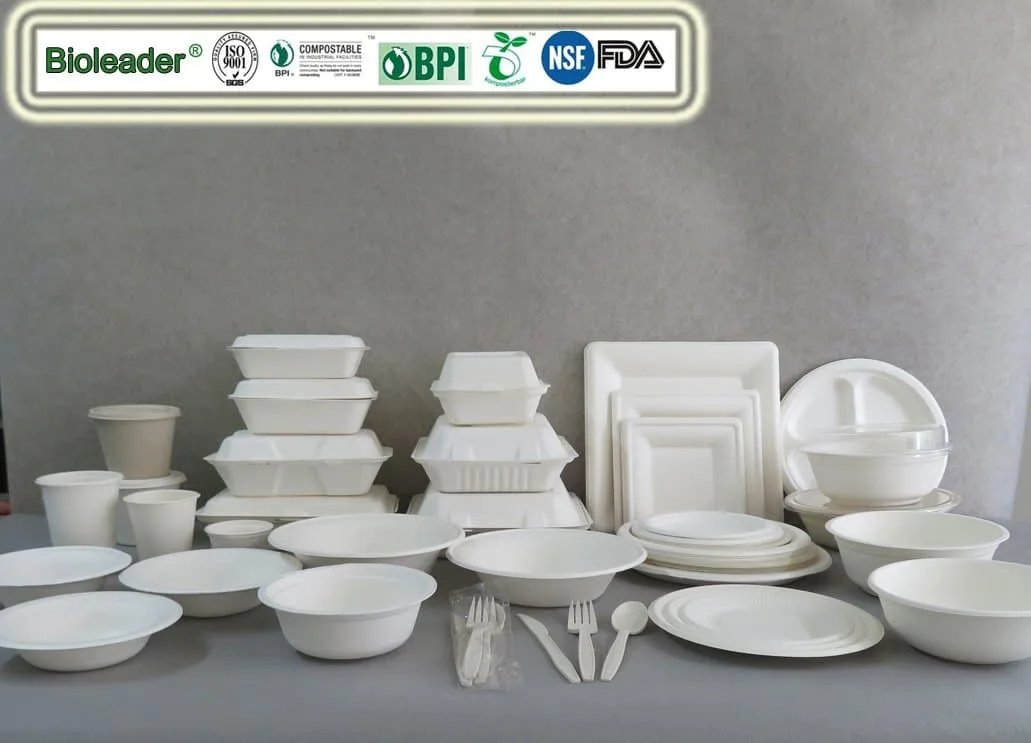
Material clarification: Disposable cutlery and beverage cups should not automatically be classified as bagasse tableware. Bioleader® supplies compostable cutlery and PLA cup solutions as separate material systems. Buyers should identify the actual material instead of relying on broad terms such as “plant-based” or “biodegradable.”
For a deeper material explanation, see Bioleader®’s guide to what bagasse tableware is and how molded fiber performance is controlled.
10 Sugarcane Bagasse Tableware Formats at a Glance
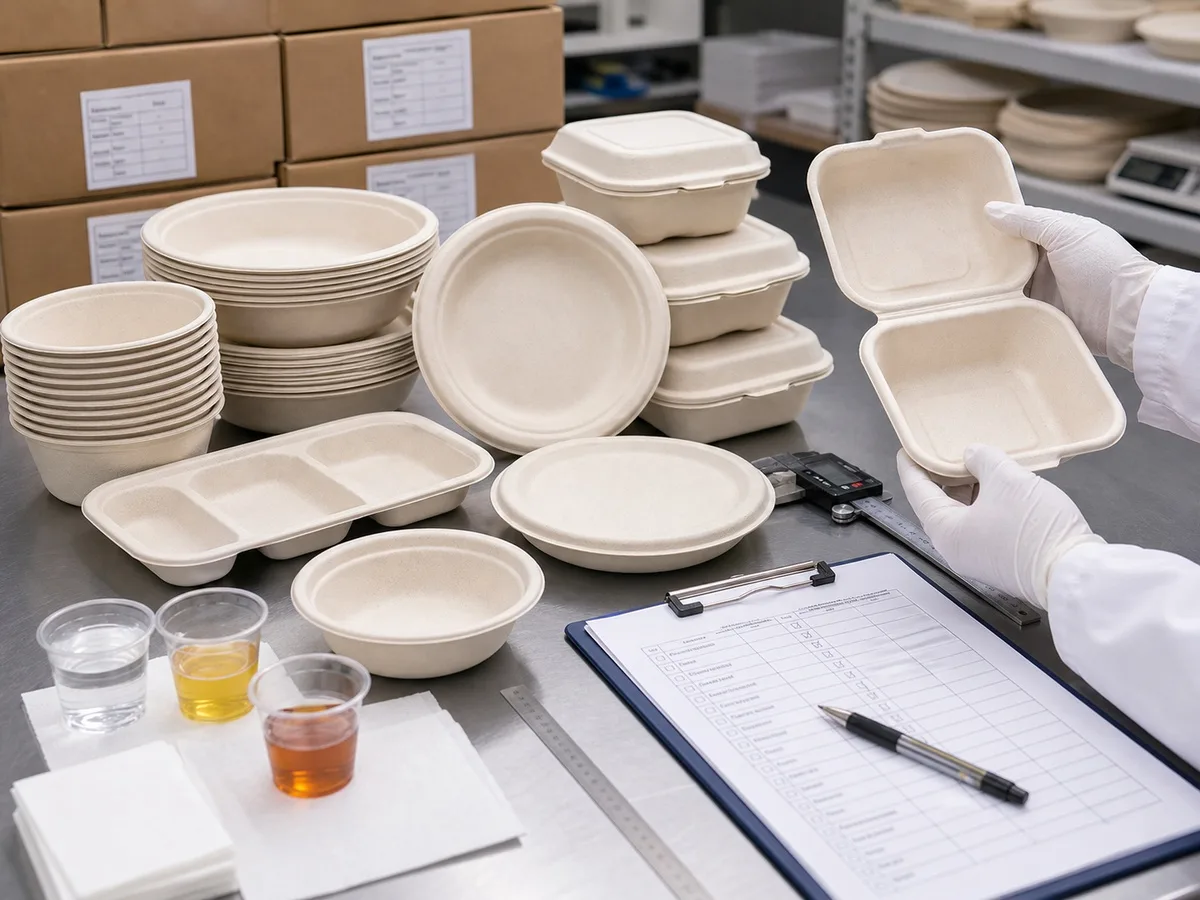
The ten groups below are best understood as commercial formats and configurations rather than ten completely different materials. Several use the same molded-fiber base but solve different foodservice problems.
| Bagasse Format | Typical Foodservice Use | Closure or Lid | Main Buyer Check |
|---|---|---|---|
| Food containers | Rice meals, pasta, meal prep, takeaway | Separate or matched lid depending on model | Capacity, depth, oil resistance and lid fit |
| Clamshell boxes | Burgers, fried food, sandwiches, full meals | Integrated hinged lid | Hinge strength, closure and stack stability |
| Bowls | Soup, noodles, salad, grain bowls and desserts | Bagasse, PP or PET lid depending on design | Rim fit, liquid holding and serving temperature |
| Plates | Events, catering, cafeteria and dine-in service | Usually open | Rigidity, diameter and portion load |
| Open trays | Meat, prepared meals, bakery, catering | Open, film-sealed or separately covered | Depth, edge geometry and food weight |
| Trays with lids | Delivery, meal prep, supermarket and takeaway | Matched bagasse, PP or PET lid | Lid compatibility, transport and condensation |
| Compartment containers | Rice meals, curries, sides and combo meals | Hinged or separate lid | Compartment separation and sauce migration |
| Compartment plates and meal trays | Canteens, schools, catering and institutional meals | Usually open or separately covered | Portion layout and resistance to bending |
| Large catering and serving trays | Buffets, events and group foodservice | Application-dependent | Load capacity and handling stability |
| Custom molded bagasse packaging | Private-label programs and special food formats | Designed with the packaging system | Mold, dimensions, production volume and approval testing |
10 Common Types and How Buyers Use Them
1. Bagasse Food Containers
Bagasse food containers are one of the broadest molded-fiber categories because they can be produced in rectangular, square, round and multi-compartment formats. They are commonly used for rice dishes, pasta, prepared meals and takeaway combinations.
For procurement, capacity alone is not enough. Two containers marketed at a similar volume can have different usable depth, rim design and stacking behavior. Buyers should compare the actual food portion, container weight, nesting performance and whether the chosen lid remains secure after the food has been packed hot.
2. Bagasse Clamshell Boxes
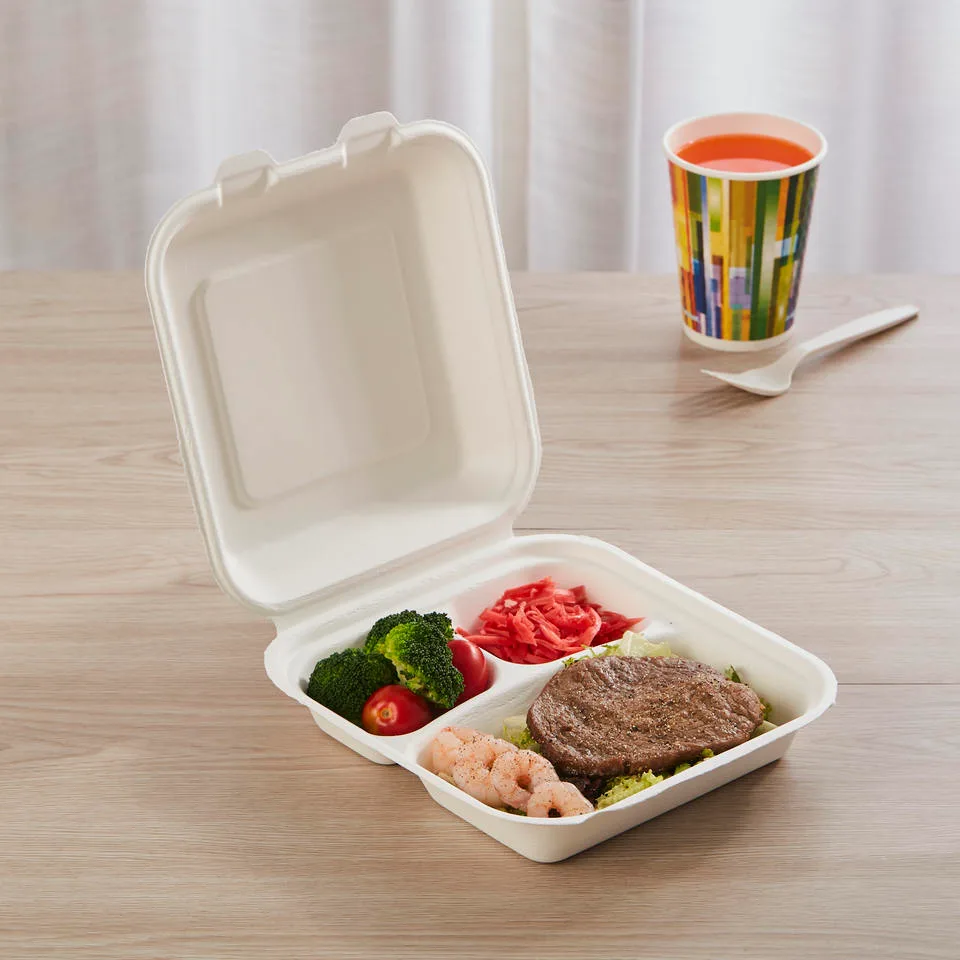
Bagasse clamshell boxes combine the base and lid in one molded piece. They are widely used for burgers, fried chicken, sandwiches, rice meals and takeaway dishes because restaurant staff can fill and close them without managing a separate lid SKU.
The practical weak points are usually the hinge and closure rather than the center of the box. A sample should be checked after hot filling, stacking and transport. If the food is heavy or sauce-rich, the buyer should also examine edge deformation and whether pressure from stacked boxes causes the lid to open.
3. Bagasse Bowls
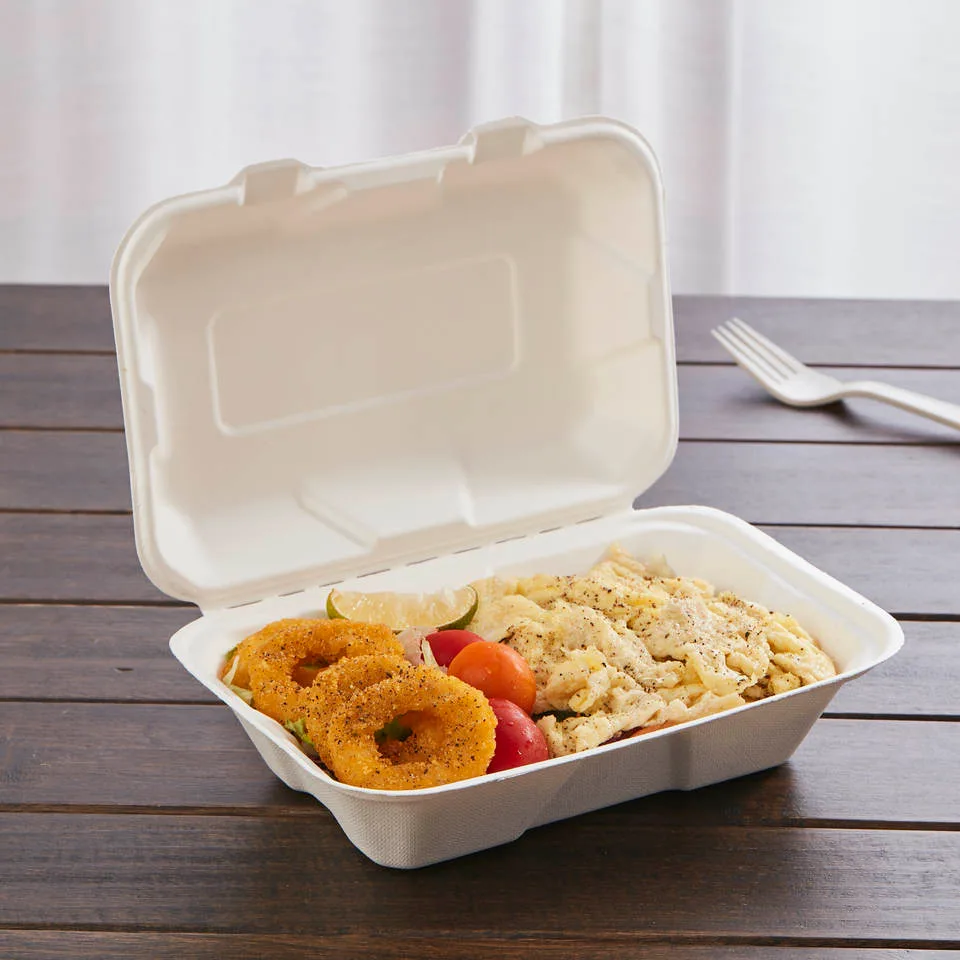
Bagasse bowls are used for noodle dishes, salads, grain bowls, desserts and some soup applications. Here the rim matters almost as much as the bowl body because lid retention depends on consistent rim dimensions.
For hot or liquid-heavy food, do not approve a bowl only because it feels rigid when dry. Test the exact food, temperature and holding time. A lid also needs separate evaluation: a molded-fiber bowl fitted with a PET or PP lid is no longer the same material system as an all-fiber configuration.
4. Bagasse Plates
Bagasse plates are commonly specified for catering, cafeterias, festivals, parties and other service situations where the pack does not need a lid. Single-section and compartment versions serve different menus.
A buyer serving dry bakery items does not need the same plate specification as a caterer serving curry, grilled meat or oily side dishes. Plate diameter, edge height, compartment layout and resistance to bending under a loaded meal should be considered together.
5. Open Bagasse Trays
Bagasse trays cover shallow and deeper formats used for prepared food, catering, fresh-food presentation, bakery items and meal service. Open trays are particularly useful when product visibility, quick service or downstream sealing is more important than an integrated closure.
Tray performance changes with geometry. Long shallow trays can flex differently from compact deep trays even when both use similar pulp formulations. For heavier foods, buyers should check base stiffness, corner strength and how the tray behaves when carried from one edge.
6. Bagasse Trays with Lids
For delivery and retail programs, bagasse trays with lids provide a different sourcing proposition from open trays. The base may be molded fiber while the lid can be bagasse, PET or PP depending on the application and product design.
The lid choice changes more than appearance. Transparent lids improve food visibility but introduce another material into the pack. Heat, condensation, stacking pressure, reheating instructions and the desired end-of-life claim should therefore be specified for the complete pack, not only the fiber base.
7. Compartment Bagasse Food Containers
Two-, three- and multi-compartment containers are useful when a menu contains rice, protein, vegetables, sauces or side dishes that should remain separated. The buyer should pay attention to compartment-wall height and the way the lid contacts those walls.
A container can look well divided when empty but still allow sauce migration after transport. For delivery programs, the more useful test is to pack the real menu, close the lid, hold it for the expected delivery time and then tilt the package as it would move inside a delivery bag.
8. Compartment Plates and Meal Trays
Compartment plates and open meal trays are common in cafeterias, institutional catering, schools and large-volume meal programs. Unlike closed takeaway containers, these products are often selected primarily for portion control, speed of service and resistance to bending.
The correct layout depends on the menu. A three-compartment tray designed for a dry Western meal may not be suitable for a rice-and-curry program with a high volume of sauce. Compartment size should therefore be treated as a foodservice specification, not a cosmetic feature.
9. Large Catering and Serving Trays
Large molded-fiber trays can support buffet service, group catering, event meals and food presentation. At this size, load distribution becomes more important. A tray that performs well with pastries may behave differently when carrying meat, sauces or several dense food portions.
For catering buyers, sample approval should include lifting and carrying the loaded tray rather than testing it only on a flat table. Edge stiffness and base deflection can determine whether the format works operationally.
10. Custom Molded Bagasse Packaging
Standard catalog items cover many foodservice applications, but some projects require a custom footprint, unusual compartment layout, embossed branding or a pack designed around a specific meal or retail display.
Custom molded bagasse packaging should begin with the food and operating conditions, not with mold drawings alone. Product dimensions, fill weight, lid system, target market, annual volume, carton requirements and sample approval criteria all affect whether a custom mold makes commercial sense.


How to Choose the Right Bagasse Tableware
The fastest way to select a bagasse product is not to begin with the catalogue. Start with the meal.
Buyer specification checklist
- Food type: dry, moist, oily, acidic, sauce-heavy or liquid.
- Serving temperature: cold, room temperature, hot-filled or reheated.
- Holding time: immediate service, 30-minute delivery, meal prep or refrigerated storage.
- Closure: open plate, hinged clamshell, bagasse lid, PP lid, PET lid or another matched system.
- Transport: dine-in, takeaway, stacked delivery, airline catering or supermarket display.
- End-of-life claim: determine whether compostability, plastic-free construction or another claim must be supported for the destination market.
- Compliance: ask which food-contact, PFAS and compostability documents apply to the exact SKU being purchased.
- Commercial terms: confirm MOQ, custom molding, embossing, packaging configuration and container-loading requirements before final quotation comparison.
Manufacturer insight: “Bagasse” does not define performance by itself. Pulp composition, forming pressure, product weight, wall thickness, edge geometry, moisture control and barrier formulation can change how two visually similar containers behave with the same hot meal. In production, we pay particular attention to rim strength, dimensional consistency, nesting, oil and water resistance and lid fit because these are the points most likely to affect foodservice use or bulk-order consistency.
Microwave, Hot Food and Grease Resistance: Avoid One-Word Specifications
Many molded bagasse food containers are designed for hot-food service and short microwave reheating, but “microwave safe” should not be treated as an unlimited product property. The finished SKU, food type, starting temperature, heating duration and lid material all matter.
The same applies to grease resistance. A container holding room-temperature salad dressing is under a different load from one holding fried chicken, curry or hot cooking oil. Buyers evaluating demanding menus should specify the actual condition rather than asking only whether the product is “oil-proof.”
A more useful sample test:
- Pack the actual menu at the real serving temperature.
- Close the exact lid that will be ordered.
- Hold the package for the expected delivery or service period.
- Check the base, corners, rim and compartment walls for softening, staining or leakage.
- Stack the packs as they would be transported.
- Perform the intended reheating or refrigeration step only if that use is part of the final operating procedure.
This type of test gives procurement teams more information than a generic heat-resistance number taken from a material datasheet.
Food Contact, PFAS and Compostability: Three Different Questions
These claims are often placed next to one another in a product catalogue, but they answer different questions.
| Claim | What It Actually Addresses | What the Buyer Should Verify |
|---|---|---|
| Food-contact compliance | Whether the material and finished article are suitable for the intended food-contact use under the relevant market framework. | Documentation applicable to the exact material structure, SKU, food type and intended conditions of use. |
| PFAS-free | A chemical claim concerning per- and polyfluoroalkyl substances. | Whether the claim means no intentionally added PFAS, Total Fluorine screening, targeted PFAS analysis or another defined test basis. |
| Compostable | Whether a finished product can meet defined biodegradation, disintegration and ecotoxicity requirements under specified composting conditions. | Relevant finished-product certification or test evidence and whether it refers to industrial or home composting. |
| Plastic-free | Whether plastic polymers are absent from the claimed product construction. | The complete pack, including coating, additives, lid and any film or label—not only the bagasse base. |
For buyers selling into the EU, food-contact materials are subject to the general requirements of Regulation (EC) No 1935/2004 and good manufacturing practice requirements. The EU Packaging and Packaging Waste Regulation also places specific restrictions on PFAS in food-contact packaging. These rules make SKU-level documentation more important than broad statements such as “our factory is food-safe.”
In the United States, food-contact evaluation likewise depends on the substance, intended food type and conditions of use. The FDA has also completed the phase-out of PFAS-containing grease-proofing agents formerly sold for paper and paperboard food packaging. Procurement teams sourcing molded fiber should therefore ask what chemistry is used to achieve oil and water resistance rather than assuming that a fiber product is automatically PFAS-free.
Bioleader® explains the distinction in more detail in its PFAS-free food packaging buyer guide and technical article on PFAS-free bagasse tableware and food-contact performance.
Buyer takeaway: A compostability certificate does not replace food-contact evidence, a PFAS declaration does not prove compostability, and a bagasse base does not make a PET or PP lid compostable. Evaluate each claim separately against the finished SKU.
What Should Importers Ask a Bagasse Supplier?
A serious sourcing discussion should move beyond “Do you make bagasse boxes?” The supplier needs enough information to recommend the right format and document package.
- Which food will the container hold?
- What is the filling or serving temperature?
- How long will the food remain in the container?
- Does the application require microwave reheating or refrigerated storage?
- Is a transparent lid required?
- Will the product be used for oily or sauce-heavy food?
- Which country or market will receive the goods?
- Which food-contact, PFAS or compostability documentation is required?
- Is the project plain, embossed, private label or custom molded?
- What quantity is required for each SKU?
For larger sourcing programs, Bioleader®’s 2026 Global Sugarcane Bagasse Packaging White Paper provides a broader framework covering materials, performance, compliance and B2B procurement.
Bioleader® bagasse sourcing support
Bioleader® manufactures molded sugarcane bagasse food containers, clamshells, bowls, plates, trays and lidded food-packaging formats for export foodservice programs. Buyers can compare standard SKUs before moving into custom molds, and product selection can be matched to menu type, lid requirement, destination market, sample-testing conditions and bulk-order planning.
For demanding hot-food or grease applications, specify the performance requirement before sample approval rather than selecting only by shape or unit price.
Frequently Asked Questions
What are the main types of sugarcane bagasse tableware?
The main commercial formats include food containers, clamshell boxes, bowls, plates, open trays, trays with lids, compartment containers, compartment meal trays, larger catering trays and custom molded food-packaging formats. These products may use similar molded bagasse fiber but differ in geometry, closure system, food application and performance requirements.
Are bagasse containers microwave safe?
Many molded bagasse containers are designed for short microwave reheating, but the claim should be verified for the exact SKU and intended use. Food temperature, heating time, product construction and lid material all matter. A PP, PET or other separate lid should not automatically be assumed to have the same microwave suitability as the bagasse base.
Can bagasse tableware hold oily or saucy food?
Bagasse packaging can be engineered for oily and moist foods, but real performance varies with formulation, product geometry, temperature and holding time. Buyers sourcing packaging for curry, fried food, grilled meat or other high-grease meals should test the real menu under the expected delivery conditions rather than relying on a generic “oil-resistant” description.
Is all sugarcane bagasse tableware PFAS-free?
No. Bagasse describes the fiber source, not the complete chemical formulation. PFAS-free should be treated as a separate product claim and supported with an appropriate declaration or analytical evidence. Buyers should also distinguish between no intentionally added PFAS, Total Fluorine screening and targeted PFAS testing because these are not interchangeable forms of evidence.
Is all bagasse tableware compostable?
Bagasse fiber is biodegradable, but a commercial compostability claim should be assessed on the finished product, including additives, coatings and other components. Where compostability is a procurement requirement, ask for applicable certification or test evidence for the specific SKU and confirm whether the claim refers to industrial or home composting conditions.
Which bagasse packaging is best for food delivery?
Clamshell boxes, compartment containers and trays with matched lids are common starting points for delivery. The right choice depends on the meal. Hot oily dishes place more stress on the base and barrier system, while soup or sauce-heavy food requires close attention to rim design, lid fit and leakage during transport.
What should a B2B buyer test before ordering bagasse tableware?
Test the exact food, serving temperature, holding time, lid and transport condition that will be used commercially. Check leakage, softening, staining, closure strength, stacking stability and dimensional consistency. Buyers should also verify the documentation required for the destination market and confirm MOQ, packing configuration and customization requirements before bulk approval.
References
- European Commission — Food Contact Materials and Regulation (EC) No 1935/2004 framework.
- European Union — Regulation (EU) 2025/40 on packaging and packaging waste (PPWR), including requirements for substances in food-contact packaging.
- U.S. Food and Drug Administration — Packaging & Food Contact Substances.
- U.S. Food and Drug Administration — Food Types & Conditions of Use for Food Contact Substances.
- U.S. Food and Drug Administration — Authorized Uses and Phase-Out of PFAS in Food Contact Applications.
- Biodegradable Products Institute — Commercial and Home Compostability Certification framework and applicable ASTM assessment standards.
Conclusion: The useful question is not simply “Which bagasse product looks right?” A foodservice buyer should match the format to the actual meal, temperature, oil or liquid exposure, holding time, lid and destination-market requirements. A clamshell may be convenient for fast takeaway, a lidded tray may perform better in delivery, and a compartment container may solve portion separation—but none of those choices should be approved from catalogue photos alone.
For bulk sourcing, compare the finished SKU under real service conditions and review the corresponding documentation before moving to price negotiation. That approach gives a much more reliable result than treating every product carrying the word “bagasse” as technically equivalent.

One Response
I had no idea there were so many types of sugarcane bagasse disposable tableware—this article’s breakdown by category really helped me understand the options!