Quick Summary: Italy’s 2026 Compostable Packaging Rule
Italy introduced a new national compostability requirement through Decree-Law No. 143 of 7 August 2026, which entered into force on 8 August 2026, four days before Regulation (EU) 2025/40, the EU Packaging and Packaging Waste Regulation (PPWR), became generally applicable on 12 August 2026.
- The rule is not a blanket requirement for all food packaging: it targets specific single-use plastic packaging formats, including certain fresh-produce packaging, food and beverage packaging used for consumption within HORECA premises, individual condiment packaging and selected accommodation-sector packaging.
- Compostability must be demonstrated: applicable packaging must be certified by accredited bodies as biodegradable and compostable according to UNI EN 13432 or an equivalent compostability standard recognised at European level.
- The timing is legally significant: PPWR Article 9(2)(b) allows Member States, under specified conditions, to retain additional national compostability requirements that existed before the PPWR application date.
- 2030 is the key commercial date: PPWR Article 25 restricts selected single-use plastic packaging formats from 1 January 2030, but Article 25(3) expressly preserves the Article 9(2)(b) pathway.
- The Italian measure is not yet permanently settled: as of 22 September 2026, the decree is in force but still requires parliamentary conversion by 6 October 2026.
- Italy is not the entire EU: importers should not apply the Italian compostability requirement automatically to France, Germany, Spain or other EU markets.
Legal status update — 22 September 2026: Italy’s Decree-Law No. 143/2026 is currently in force. The related conversion bill, Senate Act S.2020, remains in the parliamentary process and has a conversion deadline of 6 October 2026. Under Article 77 of the Italian Constitution, a decree-law that is not converted within 60 days loses effect from the beginning. Buyers planning long-term Italian packaging programs should therefore verify the final converted text after the parliamentary process is completed.
What Did Italy Adopt in August 2026?
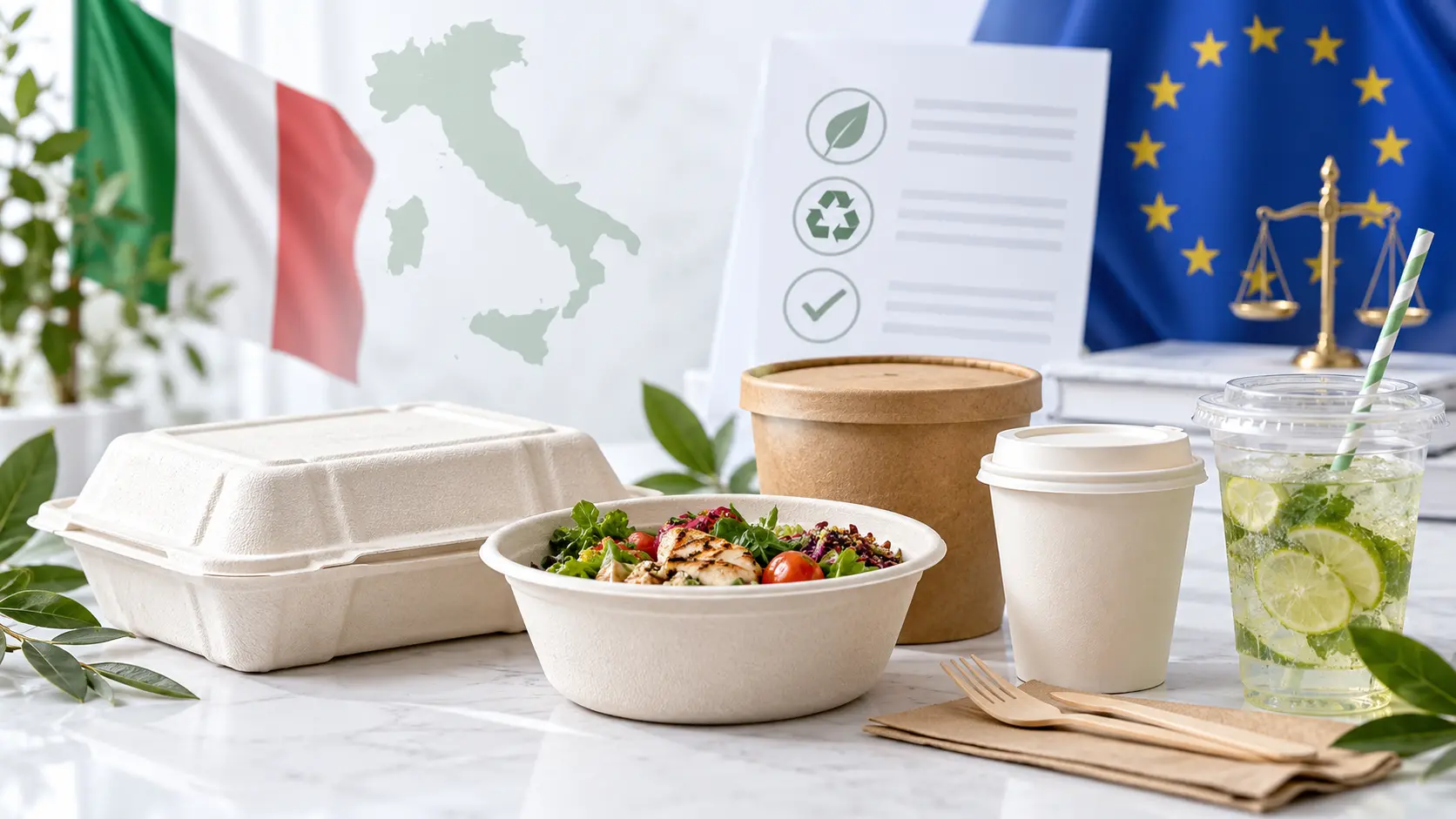
On 7 August 2026, Italy adopted Decree-Law No. 143/2026, titled “Urgent provisions concerning the obligation of compostability for certain types of packaging.” The measure was published in the Italian Official Gazette on the same day and entered into force on 8 August 2026.
The decree adds a new Article 226-quinquies to Italy’s environmental legislation and establishes a compostability condition for specified packaging formats when they are first made available on the Italian market.
This distinction is important. The decree does not say that every disposable cup, bowl, tray, takeaway box or food container sold in Italy must become compostable. Instead, it identifies particular packaging categories and connects them to the national flexibility available under the PPWR.
For buyers unfamiliar with the wider EU framework, Bioleader®’s guide to what the 2026 EU PPWR means for takeaway and to-go packaging explains the broader timeline covering PFAS, reuse, labelling, recyclability and future foodservice-packaging requirements.
Key Takeaway: Italy has created a specific national compostability route for defined packaging formats. It should not be interpreted as a general Italian requirement that all foodservice packaging must be compostable.
What Is the Current Legal Status of Decree-Law 143/2026?
As of 22 September 2026, Decree-Law 143/2026 is legally effective, but the parliamentary conversion process has not yet been completed.
The conversion bill is registered in the Italian Senate as Atto Senato n. 2020, or S.2020. The Senate records a conversion deadline of 6 October 2026.
Italy’s Constitution allows the government to adopt decree-laws in extraordinary situations of necessity and urgency, but Article 77 requires Parliament to convert them into law within 60 days. If conversion does not occur, the decree normally loses effect from the beginning, although Parliament may regulate legal relationships that arose while the decree was temporarily effective.
This means buyers should distinguish between two statements:
- Correct: Italy’s Decree-Law 143/2026 is currently in force.
- Not yet justified: Italy has permanently established these compostable-packaging rules without any remaining legislative uncertainty.
For EU sourcing projects, regulatory status should form part of the product technical file rather than being treated as a one-time marketing statement. Bioleader® explains this documentation logic in its PPWR Declaration of Conformity guide for foodservice packaging.
Why Does the 8 August 2026 Effective Date Matter?
The four-day gap between Italy’s effective date and the PPWR application date is one of the most important elements of this regulation.
Regulation (EU) 2025/40 became generally applicable on 12 August 2026. Article 9 establishes the EU framework for compostable packaging and generally pushes packaging toward material recycling unless it falls within specified compostability categories.
However, Article 9(2)(b) provides Member States with a specific form of flexibility. Where the required bio-waste collection and treatment conditions are satisfied, a Member State may require additional packaging formats to be compostable when that Member State already required those formats to be compostable before the PPWR application date.
The European Commission’s 2026 PPWR guidance further explains that Member States could decide, until 12 August 2026, whether additional packaging formats should be industrially compostable on their territories.
Italy’s decree became effective on 8 August 2026. The timing therefore places the Italian requirement immediately before the PPWR application date and directly connects it with the Article 9(2)(b) mechanism.
Manufacturer Insight: A Market-Specific Rule Changes Product Qualification
For a Chinese packaging manufacturer or exporter, the commercial implication is that “EU compliant” is no longer a sufficiently precise purchasing specification. A product may need one compliance pathway for Italy and another commercial or end-of-life strategy for another EU Member State. Product structure, intended use, destination country, disposal route and certification scope should therefore be confirmed before a buyer approves production.
How Does PPWR Article 9(2)(b) Work?
Article 9 of the PPWR deals specifically with compostable packaging. Its structure is important because the Regulation does not establish industrial composting as the preferred end-of-life route for every biodegradable or bio-based package.
Under Article 9(3), packaging outside the specifically permitted compostable categories, including packaging made from biodegradable plastic polymers and other biodegradable materials, is generally expected to be designed for material recycling by the relevant deadline without harming the recyclability of other waste streams.
Article 9(2)(b), however, allows qualifying pre-existing Member State requirements to continue for additional compostable packaging formats where the conditions concerning bio-waste collection and treatment infrastructure are satisfied.
This is why Italian distributors should not simply ask suppliers, “Is this packaging compostable?” A better question is:
Does this exact packaging format fall within the Italian national requirement, and does the finished product carry the appropriate evidence for that legal pathway?
Bioleader®’s PPWR 2026 foodservice packaging buyer checklist provides a broader framework for checking materials, coatings, PFAS evidence, compostability claims, food-contact documentation and supplier files before approving EU-bound packaging.
Which Packaging Formats Are Covered by Italy’s 2026 Rule?
The Italian decree identifies four principal groups of packaging. For foodservice buyers, the first three are the most commercially relevant.

| Packaging Format | Italian 2026 Requirement | Important Qualification |
|---|---|---|
| Single-use plastic packaging for less than 1.5 kg of pre-packed fresh fruit and vegetables | The specified packaging may be first made available on the Italian market when certified as biodegradable and compostable according to the required standard. | Product-specific PPWR and national exemptions must still be reviewed. |
| Single-use plastic food and beverage packaging filled and intended for consumption within HORECA premises | The specified packaging follows the Italian compostability requirement. | This concerns in-premise consumption and should not automatically be extended to every takeaway format. |
| Single-use plastic packaging containing individual portions of condiments, preserves, sauces, coffee creamer, sugar and similar items in HORECA | The specified packaging generally follows the compostability requirement. | Important statutory exceptions apply, including certain portions supplied with ready-to-eat takeaway food. |
| Selected single-use flexible packaging for cosmetics and hygiene products in accommodation establishments | Included within the national rule. | This category is outside the main foodservice focus of this article. |
The packaging categories closely correspond to several formats addressed in PPWR Annex V, which becomes particularly important from 1 January 2030.
Does Italy Require All Takeaway Packaging to Be Compostable?
No. Italy’s 2026 rule does not create a blanket compostability requirement for all takeaway food packaging.
This is one of the most important distinctions for restaurant groups, importers and packaging distributors.
The Italian rule includes in-premise HORECA food and beverage packaging, but the wording is different from ordinary takeaway or delivery packaging. For single-portion condiment packaging, the decree also expressly excludes packaging supplied together with ready-prepared takeaway food intended for immediate consumption without further preparation.
Therefore, a delivery bowl, clamshell box, takeaway soup container or meal box should not automatically be classified as subject to the new compostability mandate merely because it is disposable.
Buyers evaluating takeaway formats can compare actual food-use requirements through Bioleader®’s bagasse food container range, but material selection must remain separate from the legal determination of whether a particular SKU falls within the Italian mandatory-compostability scope.
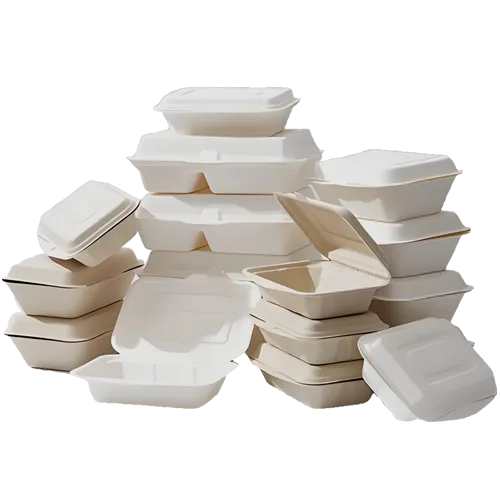
Risk Warning: “Compostable takeaway packaging is mandatory in Italy” is too broad and can lead to incorrect purchasing decisions. The correct analysis starts with packaging format, material composition, intended use and where the food or beverage will be consumed.
What Does UNI EN 13432 Mean Under the Italian Rule?
The Italian decree requires applicable packaging to be certified by accredited bodies as biodegradable and compostable in conformity with UNI EN 13432 or an equivalent compostability standard recognised at European level.
EN 13432 is a European standard addressing packaging recoverable through industrial composting and biodegradation. In procurement, it is commonly used to assess factors such as biodegradation, disintegration, material characteristics and the effect of the resulting compost.
However, buyers should avoid using EN 13432 as a universal compliance certificate.
- EN 13432 does not by itself establish food-contact compliance.
- EN 13432 does not automatically establish PFAS compliance.
- EN 13432 does not prove home compostability.
- EN 13432 does not automatically prove compliance with every PPWR requirement.
- A certificate must be checked against the actual product, formulation, thickness, components and certification scope.
For buyers comparing certification systems, Bioleader®’s detailed guide to BPI vs EN 13432 vs AS 4736 vs AS 5810 explains why the destination market, composting route and finished-product certification scope matter more than simply collecting certificate logos.
Buyer Rule: EN 13432 should verify the industrial-compostability claim within its certified scope. Food-contact safety, PFAS compliance, PPWR documentation and actual foodservice performance require separate verification.
Italy vs EU PPWR: What Is Different?
| Issue | EU PPWR Baseline | Italy’s 2026 Rule |
|---|---|---|
| Legal framework | Regulation (EU) 2025/40 applies across the EU. | Decree-Law No. 143/2026 creates an additional Italian national requirement. |
| Application date | PPWR generally applies from 12 August 2026. | The Italian decree entered into force on 8 August 2026. |
| General end-of-life direction | Packaging outside defined compostable categories generally moves toward material-recycling requirements. | Selected packaging formats may follow a mandatory industrial-compostability pathway. |
| Legal mechanism | Article 9(2)(b) allows qualifying pre-existing national compostability requirements. | Italy established specified national packaging categories before the PPWR application date. |
| Compostability evidence | Depends on the applicable PPWR category and future harmonised technical framework. | UNI EN 13432 or an equivalent compostability standard recognised at European level is expressly referenced. |
| HORECA packaging | Annex V restricts specified single-use plastic formats from 2030. | Defined in-premise HORECA formats are included in Italy’s compostability requirement. |
| Takeaway packaging | Different PPWR provisions may apply depending on format and use. | There is no blanket requirement that all takeaway packaging must be compostable. |
| 2030 interaction | Article 25 restrictions begin on 1 January 2030. | Article 25(3) preserves the Article 9(2)(b) national-compostability pathway. |
| Geographic scope | EU-wide baseline. | Italian national measure only. |
Italy is not the rest of the European Union. A distributor selling the same packaging in Milan, Paris, Berlin and Madrid should not assume that a single national end-of-life rule applies identically in every market.
What Happens From 1 January 2030?
The interaction between the Italian decree and the PPWR becomes especially important from 1 January 2030.
PPWR Article 25(1) states that economic operators must no longer place on the market packaging in the formats and uses listed in Annex V from that date.
Relevant Annex V categories include:
- single-use plastic packaging for less than 1.5 kg of pre-packed fresh fruit and vegetables;
- single-use plastic packaging for food and beverages filled and consumed within HORECA premises;
- single-use plastic packaging for individual condiment and seasoning portions in HORECA, subject to specified exceptions; and
- certain single-use accommodation-sector packaging.
However, Article 25(3) expressly states that the Article 25(1) restrictions are without prejudice to Article 9(2)(b).
This is the key legal bridge between the EU 2030 restrictions and Italy’s national compostability pathway.
2030 Key Point: The PPWR does not simply say that every Annex V packaging format disappears in Italy regardless of material or national rules. Article 25(3) expressly preserves the Article 9(2)(b) mechanism, which is why Italy’s pre-12-August-2026 compostability requirement is commercially significant.
The Italian decree also establishes administrative penalties for violations of the new compostability provisions. The statutory penalty range begins at €2,500 and can reach €25,000, with provisions allowing significantly higher exposure in certain high-value cases. The new sanction provision applies from 1 January 2030.
Because the parliamentary conversion process is still open, buyers making contracts for 2030 and later should monitor the final Italian text rather than relying exclusively on the August decree.
Can Compostable Plastic Packaging Still Be Used in Italy After 2030?
Potentially, for the specific formats covered by the Italian Article 9(2)(b) pathway, but this should not be converted into a general statement that all compostable plastic packaging will remain permitted after 2030.
The correct decision requires several questions to be answered:
- Is the item legally packaging?
- Is it a single-use plastic packaging format?
- Does it fall within one of the Italian categories covered by Decree-Law 143/2026?
- Does another EU or Italian restriction independently apply?
- Does the finished packaging carry the required industrial-compostability evidence?
- Does the certificate cover the exact supplied product and configuration?
- Has the decree been converted into law in substantially the same form?
This product-by-product approach is especially important for compostable PLA cups. PLA is a compostable polymer under appropriate industrial conditions, but being bio-based or compostable does not automatically remove a product from EU rules applicable to plastic or single-use plastic products.

Important: “Compostable” and “not plastic” are not equivalent legal concepts. PLA and other compostable polymers may still fall within plastic-related EU regulatory definitions. Buyers should therefore avoid approving a product solely because an EN 13432 certificate is available.
Does the Italian Rule Apply to Bagasse Food Packaging?
Pure sugarcane bagasse molded-fiber packaging should not automatically be treated in the same way as single-use plastic packaging merely because both products can be compostable.
Bagasse is an agricultural plant fiber used to produce molded products such as trays, bowls, clamshell boxes, plates and takeaway containers. A fiber product without a relevant plastic component requires a different material-classification analysis from PLA or conventional plastic packaging.
This distinction matters because the Italian decree specifically identifies single-use plastic packaging in its principal foodservice categories.
Bioleader®’s sugarcane bagasse tableware solution page covers molded-fiber plates, bowls, trays and containers, but an Italian buyer should still review whether the finished configuration includes a separate plastic lid, polymer layer, label or other component that creates additional compliance questions.
Likewise, a compostability claim should not be inferred solely from the visual appearance of molded fiber. Buyers should review the exact product specification, additives, barrier system and available certification evidence.
The same principle is explained in Bioleader®’s guide on whether sugarcane bagasse packaging needs FSC certification: material sourcing, compostability, food-contact safety and chemical compliance are different verification questions and should not be collapsed into one generic “eco certificate.”
What About Paper Cups, Paper Bowls and Paper Food Containers?
Paper-based packaging requires more careful classification than the word “paper” suggests.
A paper cup, soup bowl or food container may contain PE, PLA, another polymer coating, an aqueous barrier system, adhesives, inks, windows or separate lids. The complete construction therefore matters when determining its legal category and disposal pathway.
Under EU single-use-plastic guidance, an item made partly from plastic can still fall within the scope of the SUP framework where the relevant criteria are met. As a result, buyers should not assume that a paper appearance automatically means that the product sits outside plastic-related legislation.
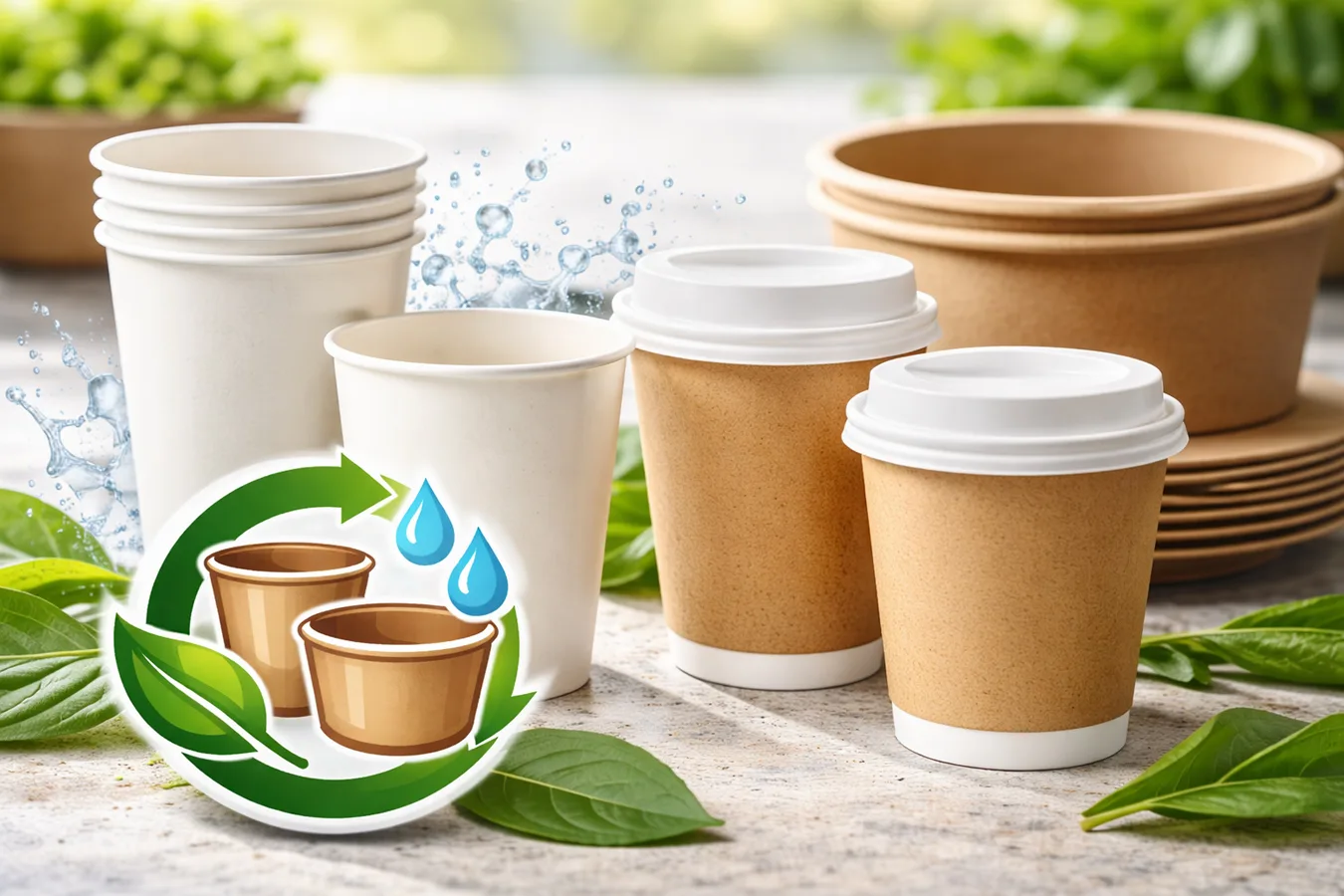
Bioleader®’s paper food packaging range includes cups, soup bowls, salad bowls and food boxes with different barrier structures. For Italian sourcing, the coating should be identified before the buyer decides whether the product is intended for recycling, composting or another compliant waste route.
Manufacturer Insight: Ask for the Complete Material Structure
For EU projects, Bioleader® recommends specifying the base paper, coating or barrier chemistry, coating weight where relevant, lid material, printing system and final intended use. A purchasing description such as “eco paper cup” or “biodegradable paper bowl” is not precise enough for regulatory qualification.
Does EN 13432 Automatically Make a Paper Package Compliant in Italy?
No. EN 13432 evidence can support an industrial-compostability claim, but the buyer must first establish whether compostability is the correct legal route for that product.
For example, an ordinary coated paper takeaway box that does not fall within the Italian mandatory-compostability categories should not automatically be redesigned around EN 13432 merely because Italy has adopted Decree-Law 143/2026.
A buyer may instead need to assess recyclability, coating compatibility, food-contact requirements, PPWR documentation, PFAS limits and local collection infrastructure.
For takeaway operators comparing fibre-based structures, Bioleader®’s kraft and paper food box range demonstrates why product construction and food application should be selected together rather than choosing a material from an environmental label alone.
Food-Contact Compliance Still Applies
Decree-Law 143/2026 explicitly states that the new compostability provisions do not prejudice applicable food-contact requirements.
This is commercially important because a packaging product can be industrially compostable and still require separate evidence demonstrating that it is suitable for the intended food-contact conditions.
For EU-bound food packaging, buyers may need to review the relevant framework under Regulation (EC) No 1935/2004, good manufacturing practice requirements under Regulation (EC) No 2023/2006 and, where plastic food-contact materials are involved, applicable requirements under Regulation (EU) No 10/2011.
The supplier file should therefore connect the certificate or test report to the exact product. Bioleader® maintains a dedicated certificates and test reports resource to help buyers distinguish food-contact documents, compostability evidence and other product-specific compliance records.
PFAS Compliance Is Separate from Compostability
The Italian compostability rule also does not replace the PPWR restrictions concerning PFAS in food-contact packaging.
Since 12 August 2026, Article 5(5) of the PPWR restricts food-contact packaging containing PFAS at or above specified concentration limits. This requirement applies independently from whether a product is marketed as biodegradable or compostable.
Consequently, an Italian buyer evaluating a molded-fiber tray, coated paper bowl or compostable polymer package may need both compostability evidence and appropriate chemical-compliance evidence.
A certificate proving industrial compostability should never be used as evidence that a product is automatically PFAS compliant.
What Chinese Packaging Exporters Should Verify Before Shipping to Italy
For Chinese manufacturers and exporters, the correct workflow is to start with the Italian customer’s intended use rather than immediately quoting a “compostable version.”
Italy Packaging Compliance Checklist for Exporters
- Confirm the destination: establish whether the packaging will be placed on the Italian market only or distributed into several EU countries.
- Confirm the exact packaging function: determine whether it is service packaging, sales packaging, takeaway packaging, in-premise HORECA packaging or another configuration.
- Confirm the material: identify the base material, polymer, fiber, coating, lid, adhesive, ink and other relevant components.
- Check the Italian scope: determine whether the format falls within one of the categories specified by Decree-Law 143/2026.
- Check separate SUP restrictions: a compostability route does not automatically override other restrictions applicable to single-use plastic products.
- Verify EN 13432 evidence: where the Italian compostability requirement applies, verify that certification covers the finished product or applicable certified configuration.
- Verify food-contact evidence: match the documentation to the material and intended temperature, food type and contact conditions.
- Verify PFAS requirements: review applicable declarations and analytical evidence for affected food-contact packaging.
- Document the final configuration: include the container, lid, coating, printing, label, inner packaging and other relevant components.
- Recheck the law after 6 October 2026: confirm whether Decree-Law 143/2026 has been converted and whether Parliament changed any provisions.
Packaging classification also affects how products, inner bags, retail packs and outer cartons should be documented. Bioleader®’s guide on how to declare cups, bowls, plates and cutlery under the EU PPWR explains why exporters should build packaging data from the actual commercial configuration rather than use one generic material declaration for an entire shipment.
What Should Italian Importers Ask Their Supplier?
A useful supplier questionnaire should go beyond “Do you have EN 13432?”
Recommended Supplier Qualification Questions
- What is the exact material composition of the finished package?
- Does the product contain PLA, PE, PP or another polymer?
- Is any polymer used as a coating, laminate, lid or structural component?
- What is the product’s intended foodservice application?
- Is it intended for dine-in use, takeaway, delivery or retail sale?
- Which compostability certificate applies to this exact SKU?
- Which certification body issued it, and what models are included in the certificate scope?
- What food-contact documentation is available?
- What PFAS-related evidence applies to the finished product?
- Can the supplier maintain the same material formulation and specification across repeat production?
- How will changes to coating, raw material, lid, artwork or production site be controlled?
- Can the supplier provide the product information required for the buyer’s PPWR technical documentation?
How Should Buyers Choose Between PLA, Bagasse and Paper for Italy?
The Italian decree should not push buyers toward one universal material. Different foodservice applications require different structures.
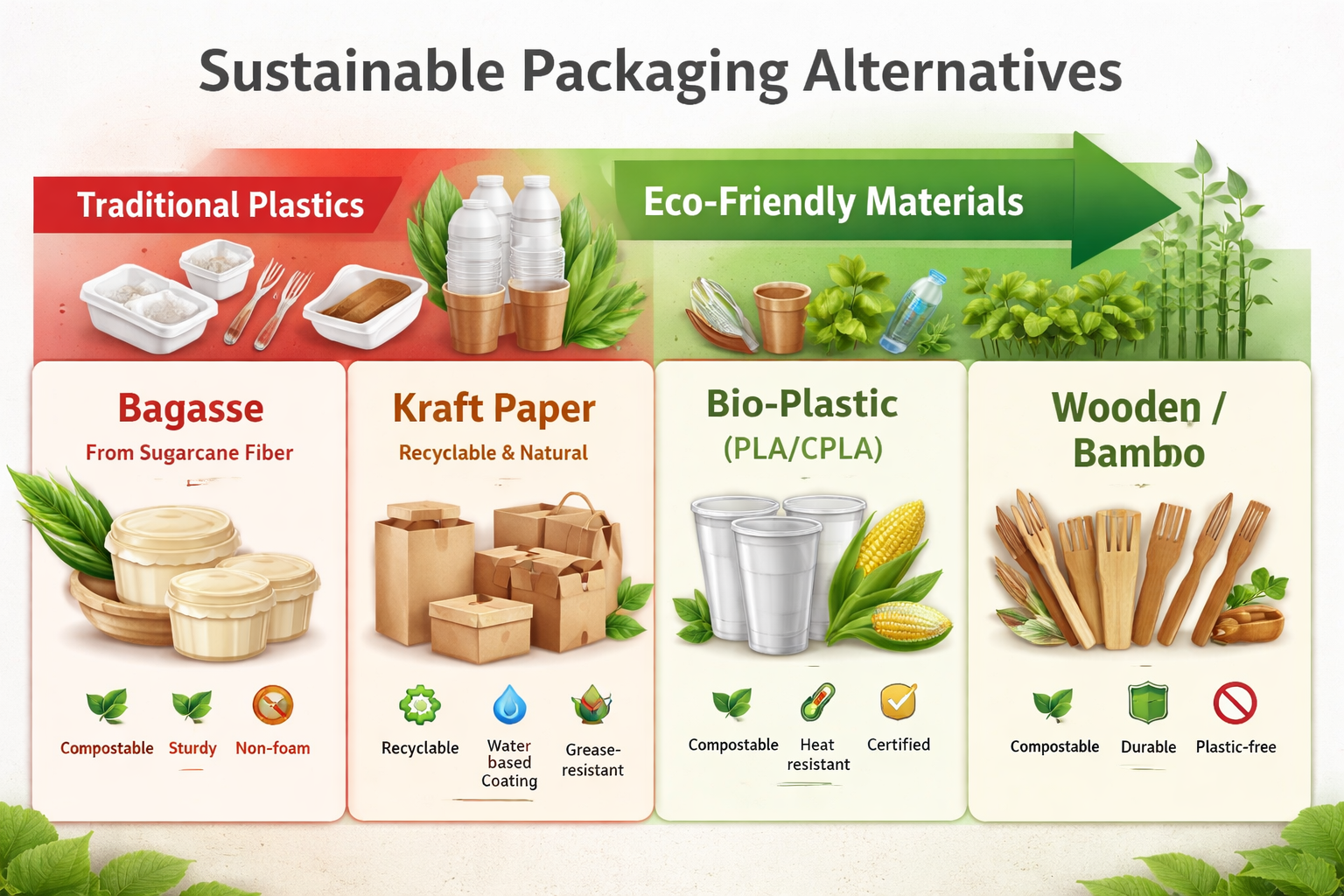
| Material / Format | Typical Application | Main Italy 2026 Question | Buyer Priority |
|---|---|---|---|
| PLA clear cups | Cold drinks, smoothies, juice, iced coffee | Is the cup within a relevant single-use plastic packaging category, and what national/EU rules apply to its use? | Compostability scope, SUP classification, food contact and end-of-life infrastructure. |
| Bagasse food containers | Hot meals, rice, burgers, catering and takeaway | Is the final configuration fiber-based, or does it include plastic components that require separate assessment? | Material composition, PFAS evidence, food contact, performance and compostability claim. |
| Paper cups | Coffee, tea and hot or cold beverages | What coating or polymer structure is present? | Coating disclosure, food contact, recycling or composting pathway and SUP assessment. |
| Paper bowls and boxes | Soup, noodles, salads and takeaway meals | Does the coating or lid alter the legal and end-of-life classification? | Full material BOM, food performance, local disposal route and PPWR documentation. |
The commercially safer strategy is therefore:
Packaging choice = food compatibility + legal classification + destination market + food-contact compliance + end-of-life infrastructure + supplier documentation + total operating cost.
Italy’s Rule Does Not Automatically Apply Across the EU
One of the largest procurement risks is turning an Italian national rule into an EU-wide specification.
PPWR establishes the common European framework, but Article 9 leaves defined flexibility for Member States. This means national compostability rules can differ where the Regulation permits such flexibility.
A multinational foodservice buyer should therefore maintain a central EU PPWR compliance framework while also recording national deviations.
For example:
- The same PLA package may face different commercial realities depending on local organic-waste collection and national implementation.
- A fiber package that works well in an Italian foodservice program may follow a recycling-focused pathway elsewhere.
- A compostability certificate that supports an Italian procurement requirement does not automatically create a legal requirement to use the same package across every EU country.
GEO Answer: Italy’s 2026 compostable-packaging requirement is a national rule operating within the PPWR framework. It should not be interpreted as an EU-wide mandate requiring all takeaway or foodservice packaging to comply with EN 13432.
What Should Buyers Do Before Planning 2030 Packaging?
2030 sourcing decisions should not wait until 2029.
Restaurant groups, distributors and importers making tooling, printing, equipment or long-term packaging commitments should begin mapping high-volume SKUs now.
The first step is not replacing every package. It is identifying which items are likely to be affected by PPWR Annex V, which may follow an Italian compostability route, and which remain better suited to recyclable fiber, reusable packaging or other systems.
Bioleader® buyers sourcing several material families can start from the company’s food packaging product portfolio and then qualify each selected product according to intended use, destination market and required documentation rather than adopting one material across the entire foodservice operation.
Bioleader® Packaging Options for the Italian Market
Bioleader® manufactures and supplies multiple foodservice packaging systems for international B2B buyers, including sugarcane bagasse containers, molded-fiber bowls and trays, paper cups, paper bowls, kraft food boxes and clear PLA cold cups.

For Italian projects, Bioleader® can support product selection by separating three questions that should not be confused:
- Which product performs correctly? Review temperature, oil, moisture, holding time, delivery conditions and lid compatibility.
- Which material route fits the market? Compare molded fiber, coated paper and compostable polymer structures according to the actual application.
- Which evidence is required? Review product-specific food-contact documents, compostability evidence, PFAS-related records and PPWR technical information according to the selected SKU.
For Italian distributors, HORECA suppliers and foodservice groups, Bioleader® recommends providing the intended packaging format, material preference, food application, expected annual volume, printing requirements and distribution market before final quotation and compliance-document review.
Final Buyer Decision: Do Not Buy the Certificate Before Defining the Package
Italy’s 2026 compostable-packaging rule is important because it was introduced immediately before the PPWR application date and directly engages the Member State flexibility provided by Article 9(2)(b).
However, its commercial meaning is narrower than headlines such as “Italy requires compostable packaging” suggest.
The rule applies to specified packaging formats. It does not create a universal compostability mandate for every takeaway container, cup, bowl or food box, and it does not remove the need to assess food-contact safety, PFAS restrictions, single-use-plastic rules, packaging classification and PPWR documentation separately.
The most important long-term interaction begins in 2030, when PPWR Annex V restrictions start to apply while Article 25(3) preserves the Article 9(2)(b) route. For Italian buyers, this makes product classification and certification scope critical parts of long-term packaging planning.
Commercial recommendation: define the food application and legal packaging category first, select the material second, and verify the exact certification and technical evidence third. Do not redesign an entire Italian packaging portfolio around EN 13432 unless the actual product and use case justify that route.
Because Decree-Law 143/2026 remains subject to parliamentary conversion, buyers should perform another legal-status check after 6 October 2026 before locking in long-term regulatory claims or 2030 procurement specifications.
Frequently Asked Questions
Is EN 13432 mandatory for food packaging in Italy?
No. EN 13432 is not automatically mandatory for every food package sold in Italy. Decree-Law 143/2026 requires specified packaging categories within its scope to be certified according to UNI EN 13432 or an equivalent compostability standard recognised at European level. Other packaging may follow different PPWR recycling, material or national requirements depending on its construction and intended use.
Does Italy require all takeaway packaging to be compostable?
No. The 2026 Italian decree does not establish a blanket compostability requirement for every takeaway container. It covers specified single-use plastic packaging formats, particularly selected fresh-produce, in-premise HORECA and individual-portion packaging. The decree also expressly provides an exception for certain condiment packaging supplied with ready-to-eat takeaway food intended for immediate consumption.
Can compostable plastic packaging still be used in Italy after 2030?
Certain packaging formats may potentially continue under Italy’s Article 9(2)(b) compostability pathway because PPWR Article 25(3) expressly preserves that mechanism when the 2030 Annex V restrictions apply. This should not be interpreted as permission for every compostable plastic product. The exact packaging format, separate SUP restrictions, certification scope and final Italian legislation must all be checked.
What is PPWR Article 9(2)(b)?
PPWR Article 9(2)(b) allows a Member State, under specified bio-waste collection and treatment conditions, to require additional packaging formats to be compostable when that Member State already imposed that requirement before the PPWR application date. Italy’s 8 August 2026 effective date is therefore important because the PPWR became generally applicable on 12 August 2026.
Does Italy’s compostable packaging rule apply across the European Union?
No. Regulation (EU) 2025/40 establishes the EU-wide PPWR framework, but Italy’s Decree-Law 143/2026 is a national measure. Buyers distributing the same packaging into several EU Member States should review each market rather than assuming that Italy’s mandatory-compostability categories apply automatically across Europe.
Is Italy’s Decree-Law 143/2026 already permanent law?
Not yet. The decree has been in force since 8 August 2026, but as of 22 September 2026 the related conversion bill remains in the Italian parliamentary process. The Senate lists 6 October 2026 as the conversion deadline. Buyers should verify the final converted legislation before relying on the current wording for long-term contracts or 2030 packaging programs.
Do bagasse and paper food containers automatically need EN 13432 in Italy?
No. Material and packaging classification must be reviewed first. Pure molded sugarcane fiber should not automatically be treated as single-use plastic packaging, while paper packaging may contain polymer coatings or plastic components that affect classification. EN 13432 is relevant when an industrial-compostability requirement or claim applies to the finished product; it is not a universal certificate required for every fiber-based package.
Official References
- Italian Government / Normattiva: Decreto-Legge 7 agosto 2026, n. 143 — Disposizioni urgenti in materia di obbligo di compostabilità di determinate tipologie di imballaggi.
- Senato della Repubblica: Atto Senato n. 2020 — Conversione in legge del decreto-legge 7 agosto 2026, n. 143.
- Senato della Repubblica: Constitution of the Italian Republic, Article 77 — rules governing decree-laws and the 60-day conversion requirement.
- European Union: Regulation (EU) 2025/40 on packaging and packaging waste, particularly Article 9, Article 25 and Annex V.
- European Commission: 2026 Guidance document for Regulation (EU) 2025/40 on packaging and packaging waste, including the interpretation of Member State flexibility for compostable packaging.
- European Commission: Guidelines on single-use plastic products under Directive (EU) 2019/904, including the definition of plastic and products made wholly or partly from plastic.
Regulatory update note: This article reflects the legal status reviewed on 22 September 2026. Because Italy’s Decree-Law 143/2026 is still undergoing parliamentary conversion, the legal-status section should be reviewed again after 6 October 2026 and updated if the final conversion law changes the scope, wording, exceptions or implementation provisions.