Quick Answer: Does Bagasse Packaging Need FSC Certification?
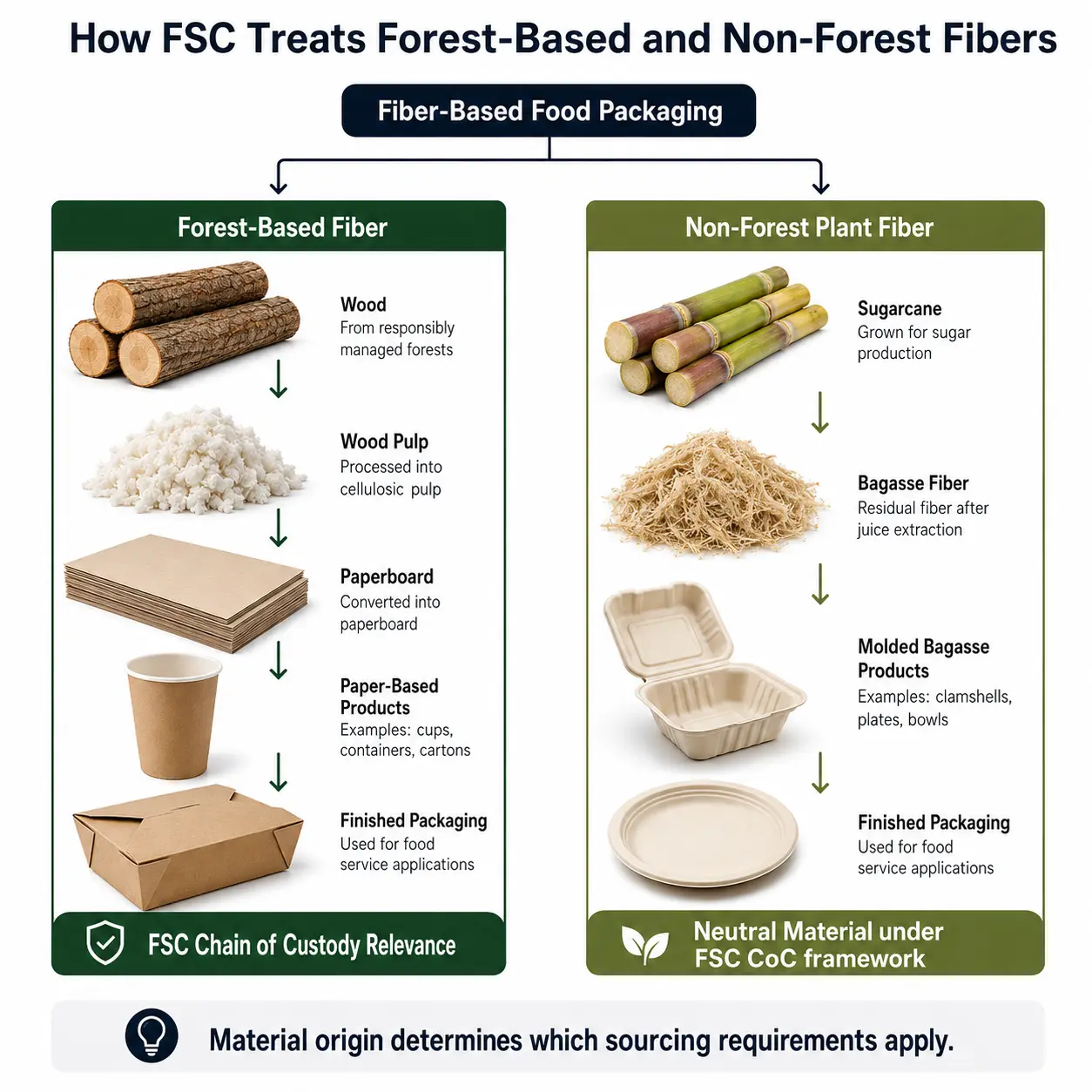
Usually, FSC certification is not the primary certification used to verify the sugarcane bagasse fiber itself. Sugarcane bagasse is an agricultural residue and a non-wood plant fiber rather than conventional forest-based wood pulp. Under the FSC Chain of Custody framework, materials originating outside a forest matrix can be classified as “neutral materials,” which are treated differently from FSC-controlled forest-based inputs.
For buyers sourcing molded bagasse food packaging, the more relevant checks normally include material composition, food-contact compliance, compostability evidence, PFAS-related testing, product performance, and supplier quality documentation. FSC becomes more relevant when the finished product or its packaging contains functional forest-based components such as paper or paperboard.
Does Sugarcane Bagasse Packaging Need FSC Certification?
When procurement teams source paper cups, kraft food boxes, paperboard cartons, and molded fiber packaging together, FSC is often added to the same supplier qualification checklist. This can create confusion when the product being purchased is made from sugarcane bagasse rather than conventional wood pulp.
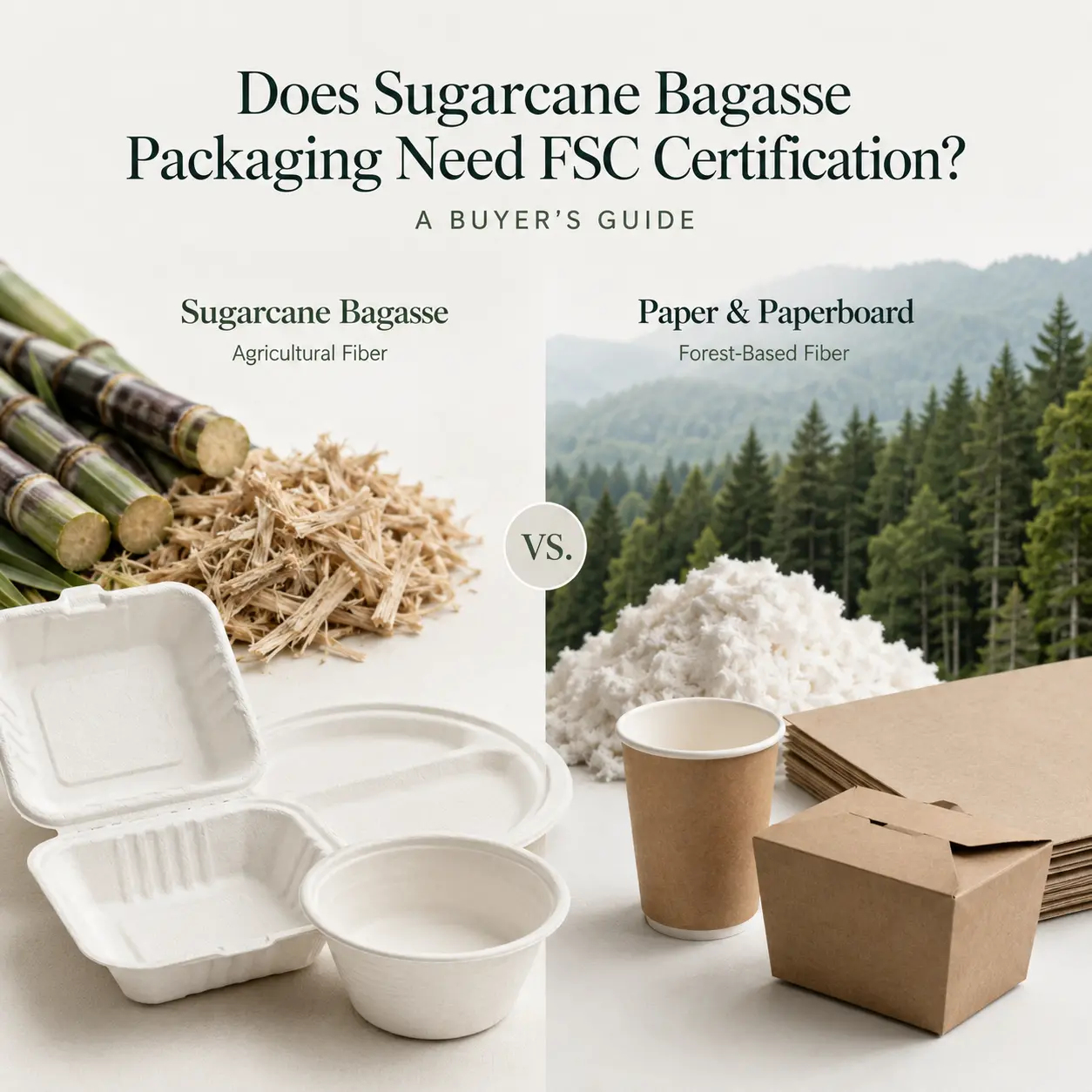
The first distinction is straightforward: FSC is primarily a forest-sourcing and chain-of-custody system, while sugarcane bagasse is an agricultural fiber. These are not the same material category and should not automatically be evaluated with exactly the same certification logic.
The Forest Stewardship Council describes its Chain of Custody system as a mechanism for tracking forest-based materials through sourcing, processing, manufacturing, trading, and distribution. The current FSC Chain of Custody Certification Standard defines material originating outside a forest matrix as “neutral material” and specifically gives non-wood plant fibers as an example.
Key Takeaway: A buyer should not assume that a molded sugarcane bagasse plate, bowl, tray, or clamshell needs the same FSC documentation as a wood-pulp paper cup or kraft paper box. The correct compliance documents depend on the actual material and the claim being verified.
What Is Sugarcane Bagasse?
Sugarcane bagasse is the fibrous residue remaining after sugarcane stalks are crushed to extract juice. Instead of treating this fiber only as an agricultural by-product, manufacturers can process it into pulp and form it into molded foodservice products such as plates, bowls, trays, clamshell containers, and takeaway food containers.
This raw-material origin is what separates sugarcane bagasse tableware from conventional kraft paper, paperboard, and wood-pulp-based disposable products. Although both may ultimately contain cellulose fibers and both can look like “paper packaging” to a buyer, their sourcing pathways are different.
Bioleader® manufactures molded fiber formats including bagasse food containers, bagasse clamshell boxes, bowls, plates, and trays for foodservice applications. For procurement purposes, buyers should identify the actual fiber source before deciding which certification belongs on the documentation checklist.
What Does FSC Certification Actually Cover?
FSC should not be treated as a universal environmental certificate for every plant-based packaging material. Its central purpose is to provide assurance concerning responsibly managed forests and the controlled chain through which eligible forest-based material moves.
According to FSC, Chain of Custody certification is designed for organizations that produce and distribute forest-based products. For products carrying an FSC claim, applicable forest-based components and the organizations controlling those materials must comply with FSC requirements.
This makes FSC highly relevant to materials such as wood pulp, paper, paperboard, kraft paper, wooden items, and other eligible forest-based inputs. For example, FSC sourcing is directly relevant when a buyer specifies FSC paper for paper cups.
FSC does not, by itself, prove that a food package is safe for food contact, compostable, PFAS-free, microwave suitable, grease resistant, or appropriate for a particular export market. Those questions require separate evidence.
Important distinction: FSC certification answers a fiber-sourcing and chain-of-custody question. It should not be used as a substitute for food-contact testing, compostability verification, PFAS testing, or actual foodservice performance evaluation.
How Does FSC Treat Non-Forest Materials Such as Bagasse?
This is the technical point that matters most for procurement teams.
The FSC Chain of Custody standard defines a neutral material as material originating outside a forest matrix, meaning a non-forest-based material. Its examples include non-wood plant fibers as well as certain synthetic or inorganic materials. The standard further states that neutral materials used within FSC product groups are exempt from FSC Chain of Custody control requirements.
Sugarcane is an agricultural crop rather than a forest source, and bagasse is the fibrous residue generated after sugar extraction. Therefore, the sugarcane fiber itself should not automatically be treated in the same way as FSC-controlled wood pulp.
This does not mean that “bagasse is FSC-certified.” It means something different: the non-forest material and the FSC-controlled forest material need to be distinguished correctly.
Manufacturer Insight: Avoid Asking One Certificate to Prove Everything
In export projects, Bioleader® sometimes sees purchasing specifications originally written for paper products reused for molded bagasse tableware. A checklist may therefore request FSC, food-contact compliance, compostability, PFAS testing, and factory certificates as though every document verifies the same thing.
A better supplier-approval process separates the questions. First confirm the raw material. Then verify food-contact safety, chemical requirements, compostability claims, product performance, and factory quality systems independently. This produces a much more meaningful compliance file than collecting unrelated certificates without understanding their scope.
Why Is Bagasse Different from Kraft Paper and Paperboard?
The confusion is understandable because bagasse tableware is often described commercially as molded fiber, pulp tableware, sugarcane paper plates, or fiber food packaging. Visually, it can also resemble paper-based foodservice packaging.
However, the procurement question should be based on fiber origin rather than appearance.
| Buyer Question | Kraft Paper / Paperboard Packaging | Sugarcane Bagasse Packaging |
|---|---|---|
| Typical primary fiber source | Wood-based pulp | Sugarcane agricultural residue |
| FSC relevance | Directly relevant when FSC forest-fiber sourcing is specified | Bagasse fiber itself is non-forest material and should not be treated like conventional FSC wood pulp |
| Main sourcing evidence | Paper source, FSC claim where required, coating structure and supplier documentation | Fiber composition, product specification and supplier material documentation |
| Food-contact compliance | Must be verified separately | Must be verified separately |
| Compostability | Not demonstrated by FSC | Not demonstrated by FSC; verify product-specific evidence where the claim is required |
| PFAS status | Not demonstrated by FSC | Not demonstrated by FSC; verify separately |
| Heat, oil and leakage performance | Depends on paper structure, coating and design | Depends on fiber formulation, forming process, barrier system and product design |
This distinction becomes particularly important for distributors purchasing several packaging categories from one supplier. An FSC request may be appropriate for the paper portion of the order while different evidence is more appropriate for bagasse bowls, bagasse plates, or molded fiber trays.
Can a Bagasse Product Ever Be Associated with an FSC Claim?
Buyers should avoid another oversimplification: saying that a product containing bagasse can “never” have anything to do with FSC.
A finished packaging system may contain multiple materials. For example, an item could combine agricultural fiber with a functional paper or paperboard component. FSC rules assess forest-based components, product groups, sourcing inputs, certificate scope, and the conditions under which an FSC claim or trademark may be made.
FSC also makes an important distinction between a product and its packaging. Under its Chain of Custody standard, forest-based packaging can be considered separately from the product contained inside it. This means a molded bagasse product and an FSC-certified paperboard outer package should not automatically be treated as one identical material claim.
Buyer risk warning: Never conclude that the entire product is FSC-certified simply because its carton, sleeve, paper label, or another forest-based component carries an FSC claim. Check exactly which component and product scope the certificate or claim covers.
Why Do Buyers Frequently Request FSC for Bagasse Tableware?
Many restaurant groups, distributors, importers, supermarkets, and catering companies use standardized sustainable-packaging questionnaires. These questionnaires may have been created originally for paper cups, cartons, napkins, kraft boxes, and other forest-fiber packaging.
When the same form is later sent to a bagasse tableware manufacturer, the FSC field often remains even though the raw material has changed.
There are four common reasons for this:
- Procurement teams group all fiber-based packaging under the general term “paper packaging.”
- Internal ESG policies may use FSC as a standard requirement for forest-derived paper and fiber but fail to distinguish agricultural residue fibers.
- Retailer onboarding forms may use one certification template for several packaging materials.
- Buyers may understand FSC as a general sustainability certificate rather than a forest-focused sourcing and Chain of Custody system.
The correct supplier response is therefore not simply “no FSC.” A technically useful response explains why the material is different and which evidence should be reviewed instead.
What Should Buyers Verify When Purchasing Bagasse Food Packaging?
If FSC is not the primary document for verifying sugarcane bagasse fiber, what should an importer or procurement manager request?
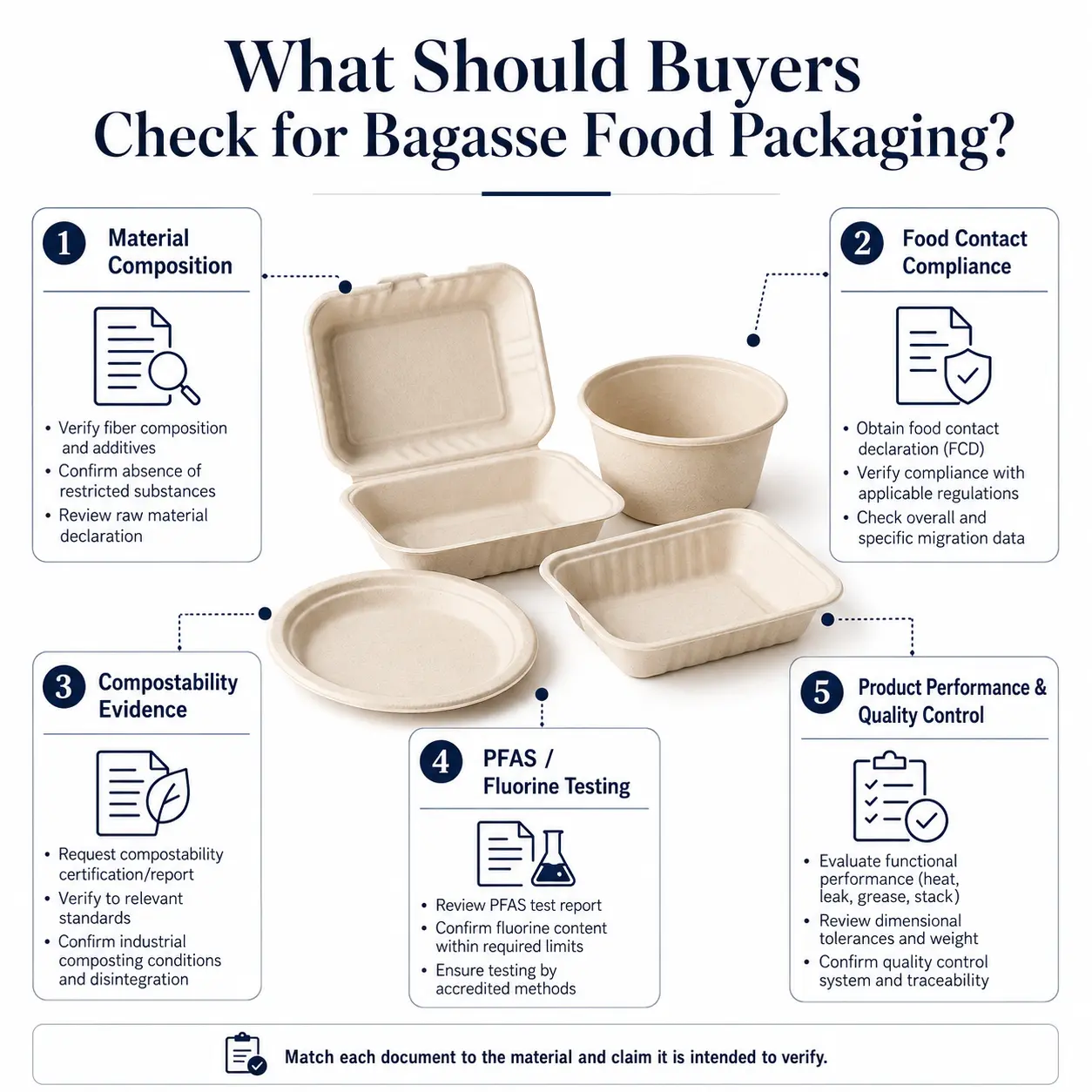
Bagasse Packaging Buyer Compliance Checklist
- Material composition: Confirm the primary fiber source and whether other plant fibers, paper fibers, additives, coatings, or barrier materials are present.
- Food-contact documentation: Verify evidence relevant to the destination market and the intended food-contact conditions.
- Compostability evidence: If the product is sold as certified compostable, check the applicable standard, certification body, certificate scope, product model, and disposal environment.
- PFAS-related documentation: Confirm how the supplier supports PFAS claims, including applicable declarations or analytical testing.
- Performance testing: Assess hot food, water, oil, sauce, microwave, freezer, stacking, lid fitting, and delivery conditions according to the intended application.
- Factory quality systems: Check whether manufacturing controls, batch consistency, traceability, inspection procedures, and relevant management certifications support repeat production.
- Product-specific records: Do not assume that a certificate for one material, product family, or factory automatically covers every SKU.
1. Food-Contact Compliance Is Separate from FSC
Food-contact safety should be evaluated independently from forest sourcing. In the European Union, food-contact materials are governed by the general framework established under Regulation (EC) No 1935/2004 and other applicable measures. In the United States, packaging components and food-contact substances must be assessed under the applicable FDA regulatory framework and their intended conditions of use.
For a bagasse importer, the practical question is not “Does it have FSC?” but rather: Does the available food-contact evidence correspond to this material, this product, and my intended use?
Bioleader® maintains a dedicated Certificates & Test Reports resource where buyers can review documentation categories for sugarcane bagasse products and other food packaging materials.
2. Compostability Is Not Proven by FSC
FSC-certified fiber and certified compostability are separate concepts. A product can contain responsibly sourced forest fiber without being compostable, while a bagasse product can follow a compostability certification route without the sugarcane fiber itself being FSC-certified.
For European packaging, EN 13432 is a recognized reference for packaging intended for recovery through industrial composting and biodegradation. Buyers should verify whether a specific certificate actually covers the product they intend to purchase rather than assuming that “bagasse” automatically means certified compostable.
This distinction is particularly important for molded fiber products combined with lids, coatings, labels, inks, or other components. The end-of-life claim should reflect the complete packaging configuration being sold.
3. PFAS Compliance Is Also a Separate Question
FSC does not determine whether molded fiber food packaging contains intentionally added PFAS or meets a buyer’s fluorine-related specification. These are chemical-compliance questions and require different supporting evidence.
For buyers evaluating grease-resistant molded fiber, Bioleader® has published a detailed technical explanation in The Science Behind PFAS-Free Bagasse Tableware. The key purchasing principle is simple: a natural fiber appearance, compostability claim, or FSC logo does not by itself establish PFAS status.
Procurement teams dealing with hot and oily food applications can also review PFAS-Free Sugarcane Tableware for 100°C Hot Food, which focuses on the relationship between chemical requirements and real foodservice performance.
4. Material Composition Should Be Verified Before Certification
Before requesting certificates, establish exactly what is being purchased.
A molded plate described as “eco-friendly fiber” could contain sugarcane bagasse, bamboo fiber, wood pulp, other plant fiber, or a blend. A takeaway tray may also be sold with a separate PET, PP, PLA, or molded-fiber lid. Each configuration can create different sourcing, food-contact, compostability, and recycling considerations.
For that reason, Bioleader® recommends starting supplier qualification with the product specification and material composition rather than starting with a generic list of certificate names.
Recommended Sample Evaluation Before Bulk Purchase
Certification review should be combined with physical product evaluation. For bagasse packaging, buyers should test the actual sample with the food it will contain, especially where heat, oil, moisture, delivery time, lid retention, stacking, refrigeration, or reheating can affect performance.
A document can verify a defined compliance requirement, but it cannot replace application testing for the buyer’s real service conditions.
5. Factory Certification Is Not the Same as Product Certification
Another common procurement error is to combine FSC, food-contact reports, compostability certificates, ISO systems, BRC-related factory controls, and chemical test reports under the single heading “product certifications.”
These documents serve different purposes.
| Document Type | What It Primarily Helps Verify | What It Does Not Automatically Prove |
|---|---|---|
| FSC Chain of Custody | Eligible forest-based sourcing and chain of custody | Food safety, compostability or PFAS status |
| Food-contact report / compliance documentation | Suitability against specified food-contact requirements and test conditions | Forest sourcing or compostability |
| Compostability certificate | Conformity with the specified compostability certification scheme and scope | FSC sourcing or every food-contact requirement |
| PFAS / fluorine-related test | Defined chemical test result under the stated method and detection conditions | FSC sourcing or general compostability |
| Factory management certification | Defined manufacturing or quality-management systems | Automatic certification of every finished SKU |
What If Your Company Requires FSC as Part of a Procurement Policy?
If a retailer or foodservice company has an internal rule stating that all paper and fiber packaging must be FSC-certified, the first step is to clarify whether the policy was intended specifically for forest-based fiber or whether it was written broadly enough to include agricultural-residue fiber.
Procurement teams can ask three questions:
- Is the FSC requirement intended to control wood and forest-derived fiber sourcing?
- Is the product actually made from forest-derived fiber, agricultural residue fiber, or a combination of both?
- If the product contains both, which component is expected to carry the FSC claim?
This clarification often prevents a supplier from being incorrectly rejected simply because a certification written for wood-pulp paper has been applied to a different raw-material category.
Practical Example for Procurement Teams
If a buyer purchases molded bagasse clamshells together with FSC paper cups, the documentation should not necessarily be identical. FSC sourcing documentation may be directly relevant to the forest-based cupstock, while the molded bagasse clamshell should be evaluated through its sugarcane-fiber composition, food-contact documentation, compostability claims, PFAS requirements, and performance specifications.
The objective is not to collect the largest possible number of certificates. It is to collect the correct evidence for each material and claim.
How Bioleader® Supports Bagasse Packaging Buyers
Bioleader® supplies molded sugarcane fiber packaging for restaurants, distributors, wholesalers, foodservice operators, catering businesses, supermarkets, meal-prep brands, and private-label packaging programs.
The product range includes bagasse clamshell boxes, bagasse food containers, bagasse bowls, bagasse plates, and bagasse trays with lids.
For B2B sourcing projects, the practical objective is to match the compliance file to the product and destination market instead of presenting unrelated certificates as interchangeable sustainability claims.
Buyers who need a broader technical overview of molded sugarcane products can refer to the Comprehensive Guide to Sugarcane Bagasse Tableware. For procurement teams reviewing broader material and market requirements, the 2026 Global Sugarcane Bagasse Packaging White Paper provides additional technical and sourcing context.
Buyer Recommendation
When requesting quotations for sugarcane bagasse packaging, send the supplier your destination market, food type, serving temperature, holding time, required product size, lid requirement, compostability target, PFAS specification, food-contact requirements, branding needs, estimated quantity, and any retailer-specific compliance checklist.
This allows the manufacturer to identify which documents are actually relevant before samples, testing, certification review, and bulk production begin.
Bagasse vs FSC Paper: The Procurement Decision in One Table
| If You Are Buying… | Primary Material Question | Is FSC a Key Check? | Other Major Checks |
|---|---|---|---|
| Kraft paper box | What is the paper fiber source? | Yes, if FSC sourcing is specified | Food contact, coating, printing, performance |
| Paper cup | What cupstock and coating are used? | Yes, if FSC-certified cupstock is required | Food contact, coating type, heat performance |
| Pure molded bagasse plate | Is the fiber actually sugarcane bagasse and what else is in the formulation? | Not normally the primary proof for the bagasse fiber itself | Food contact, compostability, PFAS, performance |
| Bagasse food container | What is the fiber composition and barrier system? | Not normally the primary proof for the bagasse fiber itself | Food contact, PFAS, hot/oily food performance, compostability |
| Mixed fiber / multi-component package | Which components are agricultural fiber and which are forest-based? | Potentially relevant to applicable forest-based components | Component-level compliance and finished-package claims |
The buyer’s rule: Do not choose certificates by the visual appearance of the packaging. Identify the raw material first, identify the claim you need to verify second, and then request the document that actually answers that question.
FAQ: FSC Certification and Sugarcane Bagasse Packaging
Is sugarcane bagasse FSC certified?
Sugarcane bagasse should not automatically be described as FSC-certified fiber. It comes from sugarcane, an agricultural crop, rather than conventional forest-based wood pulp. FSC Chain of Custody rules distinguish non-forest materials from forest-based inputs. If an individual finished product contains FSC-controlled forest-based components, those components and any FSC claim must be assessed according to the applicable FSC rules and certificate scope.
Does bagasse packaging need FSC certification?
For a molded product made from sugarcane bagasse, FSC is generally not the primary document used to verify the bagasse fiber itself. Buyers should instead prioritize material composition, destination-market food-contact requirements, compostability evidence where claimed, PFAS-related documentation, product testing, and supplier quality controls.
Why does FSC apply differently to bagasse and kraft paper?
Kraft paper is normally produced from wood pulp and therefore has a direct connection to forest-fiber sourcing. Sugarcane bagasse is an agricultural residue and non-wood plant fiber. FSC Chain of Custody rules distinguish materials originating outside a forest matrix from forest-based materials, so the sourcing documentation should not automatically be treated as identical.
Can a product containing bagasse carry an FSC claim?
Potentially, a multi-material or composite product may include both non-forest bagasse fiber and forest-based components that fall within FSC Chain of Custody requirements. Whether an FSC claim is permitted depends on the actual product composition, FSC product group, eligible forest inputs, certification scope, and applicable FSC trademark rules. Buyers should verify the claim rather than assuming that the bagasse fiber itself is FSC-certified.
What certificates should I request for bagasse food containers?
Start with the intended market and use. Typical due diligence may include product specifications, material composition, relevant food-contact documentation, compostability certification where that claim is required, PFAS or fluorine-related evidence where applicable, factory quality documentation, and real-use testing for hot, oily, wet, frozen, microwave, takeaway, or delivery conditions.
Does FSC certification mean a food container is compostable?
No. FSC and compostability address different questions. FSC focuses on eligible forest-based sourcing and Chain of Custody, while compostability standards evaluate whether a product meets defined biodegradation, disintegration, and other requirements under specified composting conditions. A product should not be marketed as certified compostable merely because its paper or fiber is FSC-certified.
Does FSC certification prove that packaging is PFAS-free?
No. FSC does not verify PFAS content. PFAS-related claims require separate chemical-compliance documentation or appropriate analytical testing. This is particularly relevant for molded fiber food packaging used with oily or hot foods, where grease resistance and chemical formulation must be evaluated independently from fiber-sourcing certification.
Conclusion: Ask for the Right Certification for the Right Material
Sugarcane bagasse packaging should not be evaluated as though it were simply another type of FSC paper. Bagasse originates from agricultural sugarcane residue, while FSC Chain of Custody primarily controls eligible forest-based materials and claims.
For buyers sourcing molded bagasse tableware, the more important procurement process is to verify what the product is made from, whether it is suitable for food contact, whether compostability claims are properly supported, whether PFAS-related requirements are met, and whether the product performs under its actual foodservice conditions.
Where paper, paperboard, sleeves, cartons, labels, or other forest-based components are involved, FSC can still be relevant to those components. The correct approach is therefore not “FSC or no FSC,” but matching each certification and test report to the material and claim it is intended to verify.
Bioleader® supports international buyers sourcing sugarcane bagasse tableware with product selection, material specifications, compliance documentation review, sample evaluation, OEM/private-label requirements, and bulk export supply. Buyers can provide their target market and compliance checklist before quotation so the relevant product and documentation route can be evaluated from the beginning.
References
- Forest Stewardship Council — FSC-STD-40-004 V3-1, Chain of Custody Certification
- Forest Stewardship Council — Chain of Custody Certification
- Forest Stewardship Council — What the FSC Labels Mean
- European Commission — Food Contact Materials
- U.S. FDA — Packaging & Food Contact Substances
- European Bioplastics — EN 13432 and Industrial Compostability