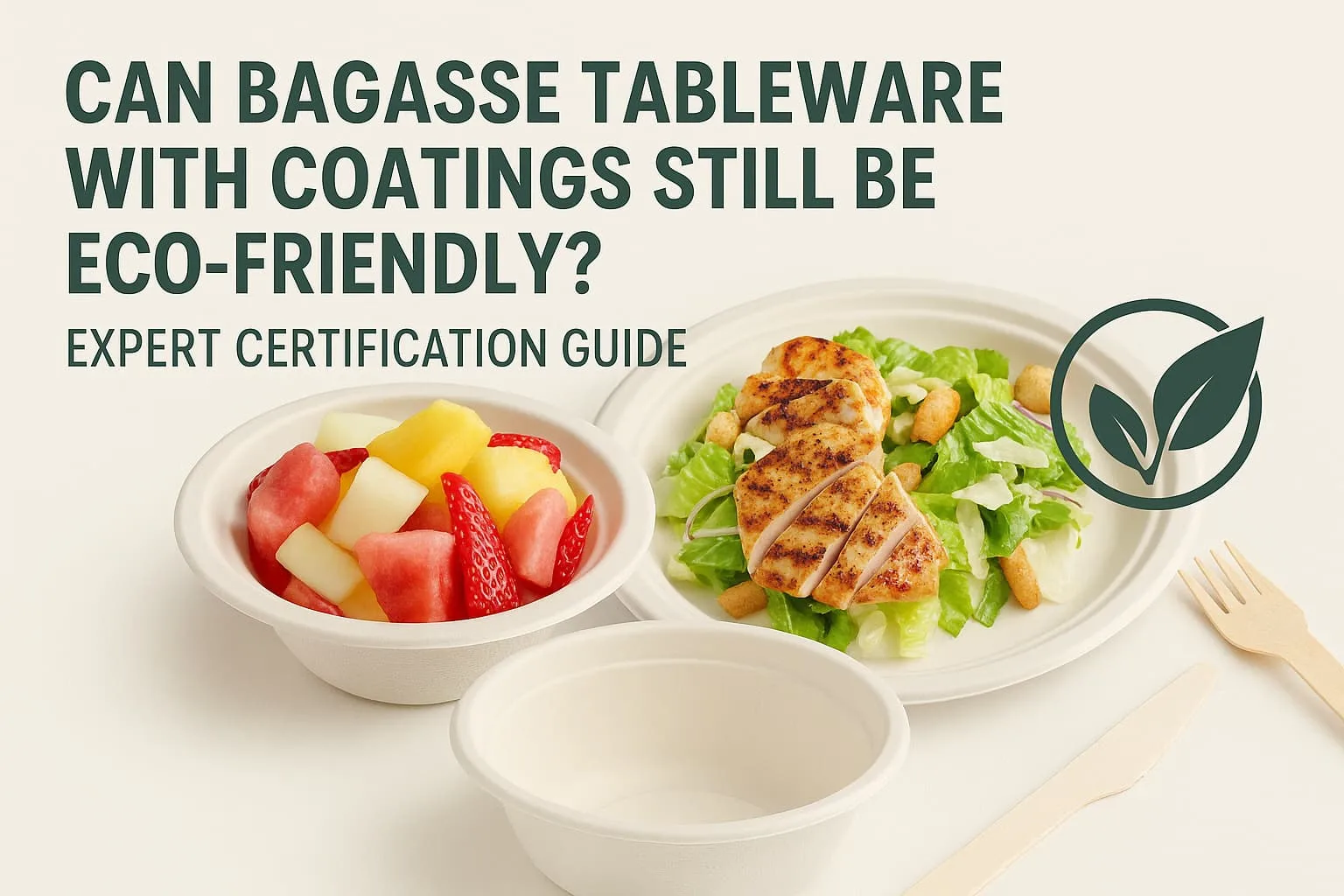
Réponse rapide : l'emballage en bagasse a-t-il besoin de la certification FSC ?
En général, la certification FSC n'est pas la certification principale utilisée pour vérifier la fibre de bagasse de canne à sucre elle-même. La bagasse de canne à sucre est un résidu agricole et une fibre végétale non ligneuse, plutôt que de la pâte de bois conventionnelle issue de forêts. Dans le cadre de la chaîne de contrôle FSC, les matériaux provenant de l'extérieur d'une matrice forestière peuvent être classés comme “ matériaux neutres ”, qui sont traités différemment des intrants forestiers contrôlés par FSC.
Pour les acheteurs qui se procurent des emballages alimentaires moulés en bagasse, les vérifications les plus pertinentes incluent normalement la composition des matériaux, la conformité au contact alimentaire, les preuves de compostabilité, les tests liés à PFAS, les performances du produit et la documentation qualité du fournisseur. FSC devient plus pertinent lorsque le produit fini ou son emballage contient des composants fonctionnels d'origine forestière, tels que du papier ou du carton.
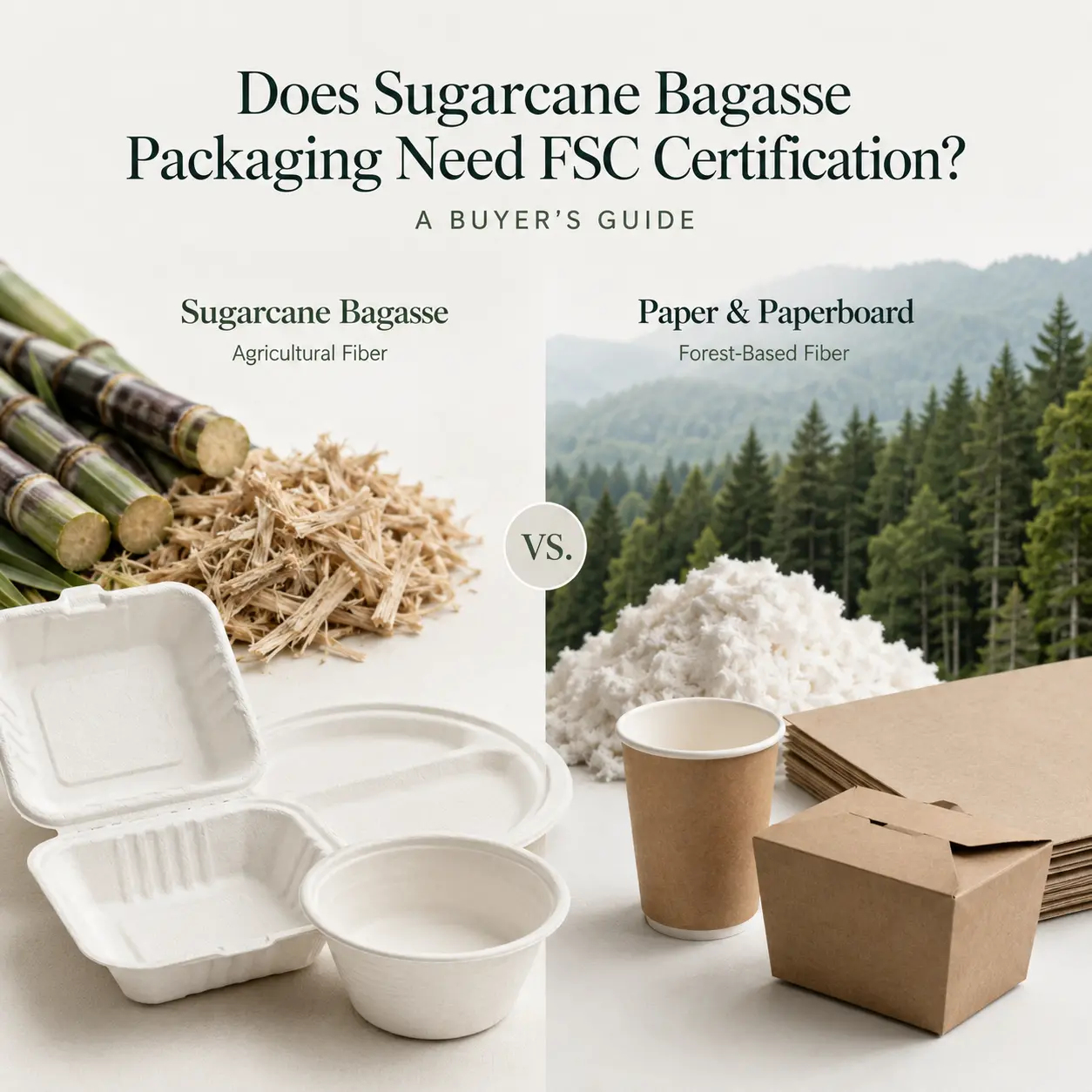
L'emballage en bagasse de canne à sucre a-t-il besoin de la certification FSC ?
Lorsque les équipes d'approvisionnement se procurent ensemble des gobelets en papier, des boîtes alimentaires en kraft, des cartons et des emballages en fibre moulée, FSC est souvent ajouté à la même liste de qualification des fournisseurs. Cela peut créer une confusion lorsque le produit acheté est fabriqué à partir de bagasse de canne à sucre plutôt que de pâte de bois conventionnelle.
La première distinction est simple : FSC est principalement un système de chaîne de contrôle et d'approvisionnement forestier, tandis que la bagasse de canne à sucre est une fibre agricole. Ce ne sont pas les mêmes catégories de matériaux et ils ne doivent pas automatiquement être évalués avec exactement la même logique de certification.
Le Forest Stewardship Council décrit son système de chaîne de contrôle comme un mécanisme pour suivre les matériaux d'origine forestière à travers l'approvisionnement, la transformation, la fabrication, le commerce et la distribution. La norme actuelle de certification de la chaîne de contrôle FSC définit les matériaux provenant de l'extérieur d'une matrice forestière comme des “ matériaux neutres ” et donne spécifiquement les fibres végétales non ligneuses comme exemple.
Point clé : Un acheteur ne doit pas supposer qu'une assiette, un bol, un plateau ou une barquette moulé en bagasse de canne à sucre nécessite la même documentation FSC qu'un gobelet en papier de pâte de bois ou une boîte en papier kraft. Les documents de conformité corrects dépendent du matériau réel et de la revendication vérifiée.
Qu'est-ce que la bagasse de canne à sucre ?
La bagasse de canne à sucre est le résidu fibreux restant après que les tiges de canne à sucre sont broyées pour en extraire le jus. Au lieu de traiter cette fibre uniquement comme un sous-produit agricole, les fabricants peuvent la transformer en pâte et la former en produits de restauration moulés tels que des assiettes, des bols, des plateaux, des barquettes et des contenants alimentaires à emporter.
Cette origine de matière première est ce qui sépare vaisselle jetable en bagasse de canne à sucre du papier kraft conventionnel, du carton et des produits jetables à base de pâte de bois. Bien que les deux puissent finalement contenir des fibres de cellulose et que les deux puissent ressembler à des “ emballages en papier ” pour un acheteur, leurs voies d'approvisionnement sont différentes.
Bioleader® fabrique des formats en fibre moulée, notamment contenants alimentaires en bagasse, boîtes à couvercle articulé en bagasse, des bols, des assiettes et des plateaux pour les applications de restauration. À des fins d'approvisionnement, les acheteurs doivent identifier la source réelle de la fibre avant de décider quelle certification doit figurer sur la liste de contrôle de la documentation.
Que couvre réellement la certification FSC ?
FSC ne doit pas être traité comme un certificat environnemental universel pour chaque matériau d'emballage à base de plantes. Son objectif central est de fournir une assurance concernant les forêts gérées de manière responsable et la chaîne contrôlée par laquelle les matériaux forestiers éligibles se déplacent.
Selon FSC, la certification de la chaîne de contrôle est conçue pour les organisations qui produisent et distribuent des produits à base de forêt. Pour les produits portant une revendication FSC, les composants forestiers applicables et les organisations contrôlant ces matériaux doivent se conformer aux exigences FSC.
Cela rend FSC très pertinent pour des matériaux tels que la pâte de bois, le papier, le carton, le papier kraft, les articles en bois et d'autres intrants forestiers éligibles. Par exemple, l'approvisionnement FSC est directement pertinent lorsqu'un acheteur spécifie du papier FSC pour gobelets en papier.
FSC ne pas, à lui seul, prouver qu'un emballage alimentaire est sûr pour le contact alimentaire, compostable, sans PFAS, adapté au micro-ondes, résistant à la graisse ou approprié pour un marché d'exportation particulier. Ces questions nécessitent des preuves distinctes.
Distinction importante : La certification FSC répond à une question d'approvisionnement en fibres et de chaîne de contrôle. Elle ne doit pas être utilisée comme substitut aux tests de contact alimentaire, à la vérification de la compostabilité, aux tests PFAS ou à l'évaluation réelle des performances en restauration.
Comment FSC traite-t-il les matériaux non forestiers tels que la bagasse ?
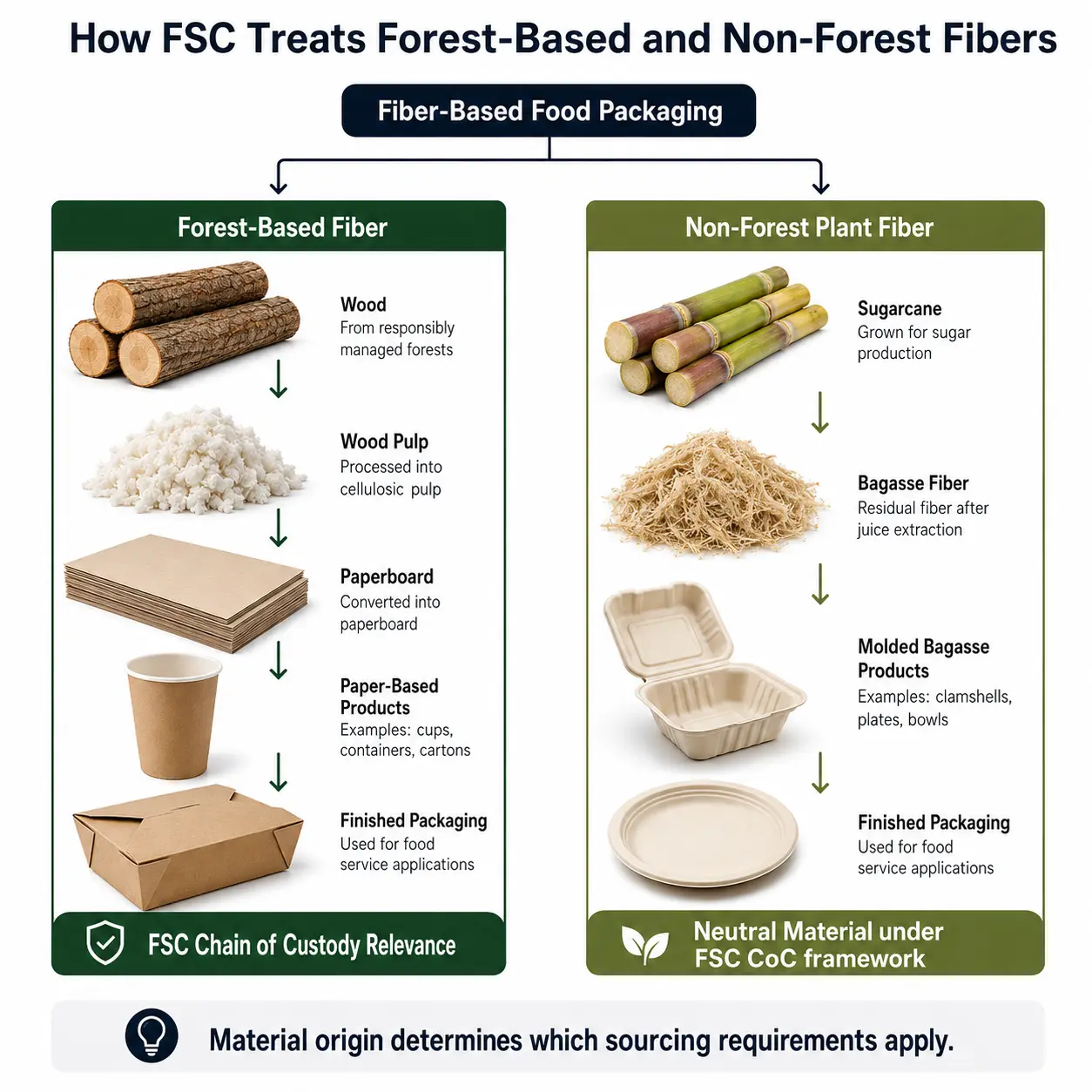
C'est le point technique le plus important pour les équipes d'approvisionnement.
La norme de chaîne de contrôle FSC définit un matériau neutre comme un matériau provenant de l'extérieur d'une matrice forestière, c'est-à-dire un matériau non forestier. Ses exemples incluent les fibres végétales non ligneuses ainsi que certains matériaux synthétiques ou inorganiques. La norme stipule en outre que les matériaux neutres utilisés dans les groupes de produits FSC sont exemptés des exigences de contrôle de la chaîne de contrôle FSC.
La canne à sucre est une culture agricole plutôt qu'une source forestière, et la bagasse est le résidu fibreux généré après l'extraction du sucre. Par conséquent, la fibre de canne à sucre elle-même ne doit pas automatiquement être traitée de la même manière que la pâte de bois contrôlée par FSC.
Cela ne pas signifie pas que “ la bagasse est certifiée FSC ”. Cela signifie quelque chose de différent : le matériau non forestier et le matériau forestier contrôlé par FSC doivent être correctement distingués.
Aperçu du fabricant : évitez de demander à un seul certificat de tout prouver
Dans les projets d'exportation, Bioleader® voit parfois des spécifications d'achat initialement rédigées pour des produits en papier réutilisées pour la vaisselle en bagasse moulée. Une liste de contrôle peut donc demander FSC, la conformité au contact alimentaire, la compostabilité, les tests PFAS et les certificats d'usine comme si chaque document vérifiait la même chose.
Un meilleur processus d'approbation des fournisseurs sépare les questions. Confirmez d'abord la matière première. Ensuite, vérifiez indépendamment la sécurité du contact alimentaire, les exigences chimiques, les allégations de compostabilité, les performances du produit et les systèmes de qualité de l'usine. Cela produit un dossier de conformité beaucoup plus significatif que de collecter des certificats sans rapport sans comprendre leur portée.
Pourquoi la bagasse est-elle différente du papier kraft et du carton ?
La confusion est compréhensible car la vaisselle en bagasse est souvent décrite commercialement comme de la fibre moulée, de la vaisselle en pâte, des assiettes en papier de canne à sucre ou des emballages alimentaires en fibre. Visuellement, elle peut également ressembler à des emballages de restauration à base de papier.
Cependant, la question d'approvisionnement doit être basée sur l'origine de la fibre plutôt que sur l'apparence.
| Question de l'acheteur | Emballage en papier kraft / carton | Emballage en bagasse de canne à sucre |
|---|---|---|
| Source de fibre primaire typique | Pâte à base de bois | Résidu agricole de canne à sucre |
| Pertinence de FSC | Directement pertinent lorsque l'approvisionnement en fibres forestières FSC est spécifié | La fibre de bagasse elle-même est un matériau non forestier et ne doit pas être traitée comme de la pâte de bois conventionnelle FSC |
| Principales preuves d'approvisionnement | Source de papier, revendication FSC le cas échéant, structure du revêtement et documentation du fournisseur | Composition des fibres, spécification du produit et documentation matérielle du fournisseur |
| Conformité au contact alimentaire | Doit être vérifiée séparément | Doit être vérifiée séparément |
| Compostabilité | Non démontré par FSC | Non démontré par FSC ; vérifier les preuves spécifiques au produit lorsque la revendication est requise |
| Statut PFAS | Non démontré par FSC | Non démontré par FSC ; vérifier séparément |
| Performance à la chaleur, à l'huile et à l'étanchéité | Dépend de la structure du papier, du revêtement et de la conception | Dépend de la formulation des fibres, du processus de formage, du système barrière et de la conception du produit |
Cette distinction devient particulièrement importante pour les distributeurs qui achètent plusieurs catégories d'emballages auprès d'un même fournisseur. Une demande FSC peut être appropriée pour la partie papier de la commande, tandis que des preuves différentes sont plus appropriées pour bols en bagasse de canne à sucre, assiettes en bagasse de canne à sucre, ou les plateaux en fibre moulée.
Un produit en bagasse peut-il jamais être associé à une revendication FSC ?
Les acheteurs doivent éviter une autre simplification excessive : dire qu'un produit contenant de la bagasse ne peut “ jamais ” avoir quoi que ce soit à voir avec FSC.
Un système d'emballage fini peut contenir plusieurs matériaux. Par exemple, un article pourrait combiner une fibre agricole avec un composant fonctionnel en papier ou en carton. Les règles FSC évaluent les composants à base de forêt, les groupes de produits, les intrants d'approvisionnement, la portée du certificat et les conditions dans lesquelles une revendication ou une marque FSC peut être faite.
FSC fait également une distinction importante entre un produit et son emballage. Selon sa norme de chaîne de contrôle, l'emballage à base de forêt peut être considéré séparément du produit contenu à l'intérieur. Cela signifie qu'un produit moulé en bagasse et un emballage extérieur en carton certifié FSC ne doivent pas automatiquement être traités comme une seule et même revendication matérielle.
Avertissement de risque pour l'acheteur : Ne concluez jamais que l'ensemble du produit est certifié FSC simplement parce que son carton, sa manche, son étiquette en papier ou un autre composant à base de forêt porte une revendication FSC. Vérifiez exactement quel composant et quelle portée de produit le certificat ou la revendication couvre.
Pourquoi les acheteurs demandent-ils fréquemment FSC pour la vaisselle en bagasse ?
De nombreux groupes de restauration, distributeurs, importateurs, supermarchés et entreprises de restauration collective utilisent des questionnaires standardisés sur les emballages durables. Ces questionnaires peuvent avoir été créés à l'origine pour les gobelets en papier, les cartons, les serviettes, les boîtes en kraft et autres emballages en fibres forestières.
Lorsque le même formulaire est ensuite envoyé à un fabricant de vaisselle en bagasse, le champ FSC reste souvent présent même si la matière première a changé.
Il y a quatre raisons courantes à cela :
- Les équipes d'approvisionnement regroupent tous les emballages à base de fibres sous le terme général “ emballages en papier ”.”
- Les politiques ESG internes peuvent utiliser FSC comme exigence standard pour le papier et les fibres dérivés de la forêt, mais ne parviennent pas à distinguer les fibres de résidus agricoles.
- Les formulaires d'intégration des détaillants peuvent utiliser un modèle de certification pour plusieurs matériaux d'emballage.
- Les acheteurs peuvent comprendre FSC comme un certificat de durabilité générale plutôt que comme un système d'approvisionnement et de chaîne de contrôle axé sur la forêt.
La réponse correcte du fournisseur n'est donc pas simplement “ pas de FSC ”. Une réponse techniquement utile explique pourquoi le matériau est différent et quelles preuves doivent être examinées à la place.
Que doivent vérifier les acheteurs lors de l'achat d'emballages alimentaires en bagasse ?
Si FSC n'est pas le document principal pour vérifier la fibre de bagasse de canne à sucre, que doit demander un importateur ou un responsable des achats ?
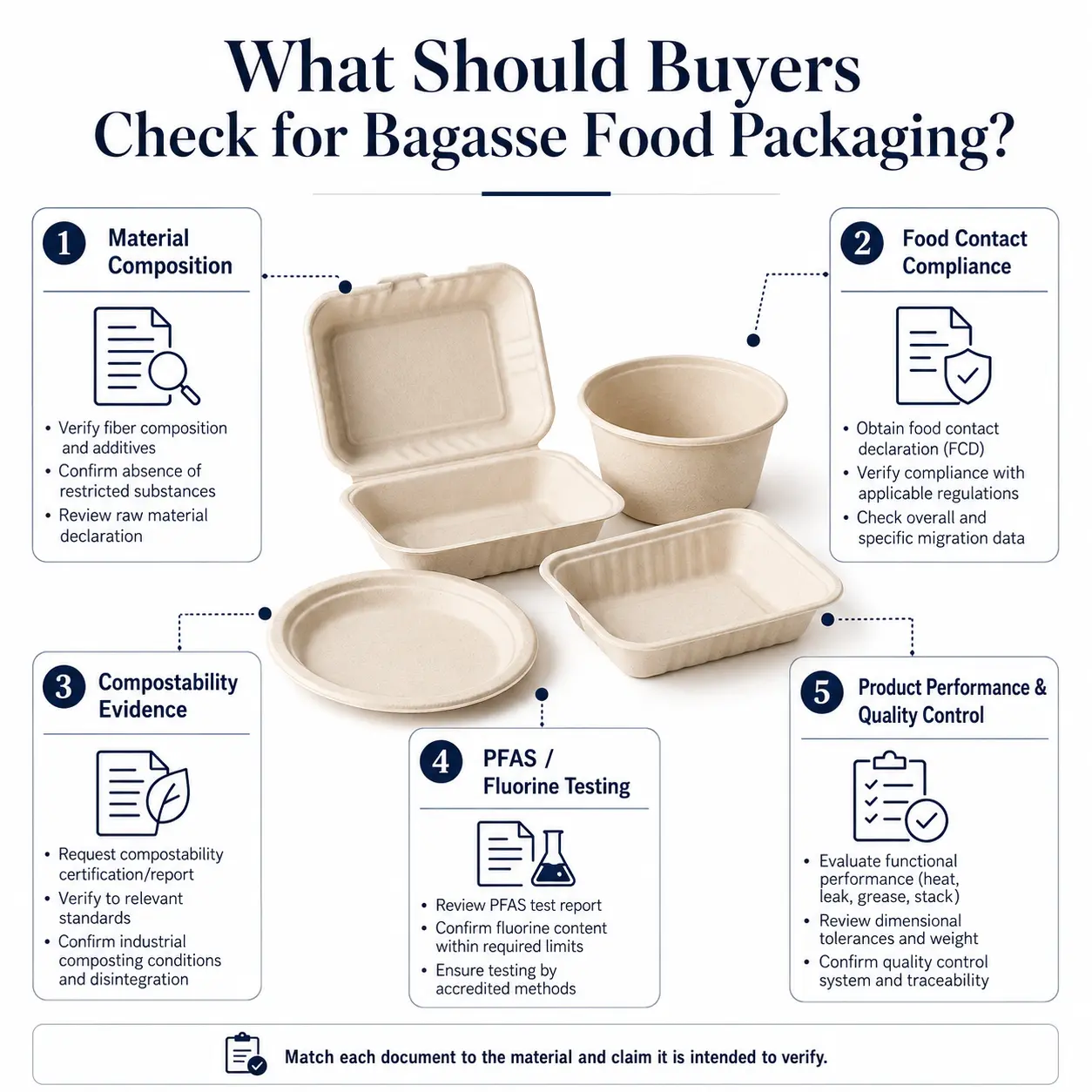
Liste de contrôle de conformité pour l'acheteur d'emballages en bagasse
- Composition du matériau : Confirmez la source de fibres primaire et si d'autres fibres végétales, fibres de papier, additifs, revêtements ou matériaux barrières sont présents.
- Documentation sur le contact alimentaire : Vérifiez les preuves pertinentes pour le marché de destination et les conditions de contact alimentaire prévues.
- Preuves de compostabilité : Si le produit est vendu comme compostable certifié, vérifiez la norme applicable, l'organisme de certification, la portée du certificat, le modèle de produit et l'environnement d'élimination.
- Documentation liée à PFAS : Confirmez comment le fournisseur étaye les revendications PFAS, y compris les déclarations applicables ou les tests analytiques.
- Tests de performance : Évaluez les aliments chauds, l'eau, l'huile, les sauces, le micro-ondes, le congélateur, l'empilage, l'ajustement des couvercles et les conditions de livraison en fonction de l'application prévue.
- Systèmes qualité de l'usine : Vérifiez si les contrôles de fabrication, la cohérence des lots, la traçabilité, les procédures d'inspection et les certifications de gestion pertinentes soutiennent une production répétée.
- Enregistrements spécifiques au produit : Ne supposez pas qu'un certificat pour un matériau, une famille de produits ou une usine couvre automatiquement chaque référence.
1. La conformité au contact alimentaire est distincte de la certification FSC
La sécurité au contact alimentaire doit être évaluée indépendamment de l'approvisionnement forestier. Dans l'Union européenne, les matériaux en contact avec les aliments sont régis par le cadre général établi par le règlement (CE) n° 1935/2004 et d'autres mesures applicables. Aux États-Unis, les composants d'emballage et les substances en contact avec les aliments doivent être évalués dans le cadre réglementaire FDA applicable et leurs conditions d'utilisation prévues.
Pour un importateur de bagasse, la question pratique n'est pas “ Est-ce que c'est certifié FSC ? ” mais plutôt : Les preuves de contact alimentaire disponibles correspondent-elles à ce matériau, ce produit et mon usage prévu ?
Bioleader® maintient une ressource dédiée Certificats et rapports d’essai où les acheteurs peuvent consulter les catégories de documentation pour les produits en bagasse de canne à sucre et d'autres matériaux d'emballage alimentaire.
2. La compostabilité n'est pas prouvée par la certification FSC
La fibre certifiée FSC et la compostabilité certifiée sont des concepts distincts. Un produit peut contenir de la fibre forestière issue de sources responsables sans être compostable, tandis qu'un produit en bagasse peut suivre une voie de certification de compostabilité sans que la fibre de canne à sucre elle-même soit certifiée FSC.
Pour les emballages européens, EN 13432 est une référence reconnue pour les emballages destinés à la valorisation par compostage industriel et biodégradation. Les acheteurs doivent vérifier si un certificat spécifique couvre réellement le produit qu'ils ont l'intention d'acheter, plutôt que de supposer que “ bagasse ” signifie automatiquement compostable certifié.
Cette distinction est particulièrement importante pour les produits en fibre moulée combinés à des couvercles, des revêtements, des étiquettes, des encres ou d'autres composants. La déclaration de fin de vie doit refléter la configuration complète de l'emballage vendu.
3. La conformité PFAS est également une question distincte
FSC ne détermine pas si les emballages alimentaires en fibre moulée contiennent du PFAS ajouté intentionnellement ou répondent à la spécification de l'acheteur concernant le fluor. Ce sont des questions de conformité chimique et nécessitent des preuves différentes.
Pour les acheteurs évaluant la fibre moulée résistante à la graisse, Bioleader® a publié une explication technique détaillée dans La science derrière la vaisselle jetable en bagasse de canne à sucre sans PFAS. Le principe d'achat clé est simple : une apparence de fibre naturelle, une allégation de compostabilité ou un logo FSC n'établit pas en soi le statut PFAS.
Les équipes d'approvisionnement traitant des applications alimentaires chaudes et grasses peuvent également consulter Vaisselle en bagasse de canne à sucre sans PFAS pour aliments chauds 100°C, qui se concentre sur la relation entre les exigences chimiques et les performances réelles en restauration.
4. La composition du matériau doit être vérifiée avant la certification
Avant de demander des certificats, établissez exactement ce qui est acheté.
Une assiette moulée décrite comme “ fibre écologique ” pourrait contenir de la bagasse de canne à sucre, de la fibre de bambou, de la pâte de bois, d'autres fibres végétales ou un mélange. Un plateau à emporter peut également être vendu avec un couvercle séparé en PET, PP, PLA ou en fibre moulée. Chaque configuration peut créer des considérations différentes en matière d'approvisionnement, de contact alimentaire, de compostabilité et de recyclage.
Pour cette raison, Bioleader® recommande de commencer la qualification des fournisseurs par la spécification du produit et la composition du matériau plutôt que par une liste générique de noms de certificats.
Évaluation d'échantillon recommandée avant l'achat en gros
L'examen de la certification doit être combiné à une évaluation physique du produit. Pour les emballages en bagasse, les acheteurs doivent tester l'échantillon réel avec l'aliment qu'il contiendra, en particulier lorsque la chaleur, l'huile, l'humidité, le délai de livraison, la rétention du couvercle, l'empilage, la réfrigération ou le réchauffage peuvent affecter les performances.
Un document peut vérifier une exigence de conformité définie, mais il ne peut pas remplacer les tests d'application pour les conditions de service réelles de l'acheteur.
5. La certification d'usine n'est pas la même chose que la certification de produit
Une autre erreur courante d'approvisionnement consiste à regrouper FSC, les rapports de contact alimentaire, les certificats de compostabilité, les systèmes ISO, les contrôles d'usine liés à BRC et les rapports de tests chimiques sous le titre unique “ certifications de produit ”.”
Ces documents servent des objectifs différents.
| Type de document | Ce qu'il aide principalement à vérifier | Ce que cela ne prouve pas automatiquement |
|---|---|---|
| Chaîne de contrôle FSC | Approvisionnement forestier éligible et chaîne de contrôle | Sécurité alimentaire, compostabilité ou statut PFAS |
| Rapport de contact alimentaire / documentation de conformité | Adéquation aux exigences de contact alimentaire spécifiées et aux conditions de test | Approvisionnement forestier ou compostabilité |
| Certificat de compostabilité | Conformité au schéma de certification de compostabilité spécifié et à sa portée | Approvisionnement FSC ou chaque exigence de contact alimentaire |
| Test PFAS / lié au fluor | Résultat de test chimique défini selon la méthode et les conditions de détection indiquées | Approvisionnement FSC ou compostabilité générale |
| Certification de gestion d'usine | Systèmes de fabrication ou de gestion de la qualité définis | Certification automatique de chaque SKU fini |
Et si votre entreprise exige la certification FSC dans le cadre d'une politique d'approvisionnement ?
Si un détaillant ou une entreprise de restauration a une règle interne stipulant que tous les emballages en papier et en fibre doivent être certifiés FSC, la première étape consiste à clarifier si la politique a été conçue spécifiquement pour la fibre forestière ou si elle a été rédigée de manière suffisamment large pour inclure la fibre de résidus agricoles.
Les équipes d'approvisionnement peuvent se poser trois questions :
- L'exigence FSC vise-t-elle à contrôler l'approvisionnement en bois et en fibres d'origine forestière ?
- Le produit est-il réellement fabriqué à partir de fibres d'origine forestière, de fibres de résidus agricoles ou d'une combinaison des deux ?
- Si le produit contient les deux, quel composant est censé porter la mention FSC ?
Cette clarification évite souvent qu'un fournisseur soit incorrectement rejeté simplement parce qu'une certification écrite pour le papier à base de pâte de bois a été appliquée à une catégorie de matières premières différente.
Exemple pratique pour les équipes d'approvisionnement
Si un acheteur achète des barquettes moulées en bagasse avec des gobelets en papier FSC, la documentation ne doit pas nécessairement être identique. La documentation d'approvisionnement FSC peut être directement pertinente pour le carton à base de fibres forestières, tandis que la barquette moulée en bagasse doit être évaluée en fonction de sa composition en fibres de canne à sucre, de sa documentation sur le contact alimentaire, de ses allégations de compostabilité, des exigences PFAS et de ses spécifications de performance.
L'objectif n'est pas de collecter le plus grand nombre possible de certificats. Il s'agit de collecter les preuves correctes pour chaque matériau et chaque allégation.
Comment Bioleader® soutient les acheteurs d'emballages en bagasse
Bioleader® fournit des emballages moulés en fibres de canne à sucre pour les restaurants, les distributeurs, les grossistes, les opérateurs de restauration, les traiteurs, les supermarchés, les marques de préparation de repas et les programmes d'emballage en marque propre.
La gamme de produits comprend boîtes à couvercle articulé en bagasse, contenants alimentaires en bagasse, bols en bagasse de canne à sucre, assiettes en bagasse de canne à sucre, et de barquettes en bagasse avec couvercles.
Pour les projets d'approvisionnement B2B, l'objectif pratique est d'adapter le dossier de conformité au produit et au marché de destination plutôt que de présenter des certificats sans rapport comme des allégations de durabilité interchangeables.
Les acheteurs qui ont besoin d'un aperçu technique plus large des produits moulés en canne à sucre peuvent se référer au Guide complet sur la vaisselle en bagasse de canne à sucre. Pour les équipes d'approvisionnement qui examinent des exigences plus larges en matière de matériaux et de marché, le Livre blanc 2026 sur les emballages mondiaux en bagasse de canne à sucre fournit un contexte technique et d'approvisionnement supplémentaire.
Recommandation de l'acheteur
Lorsque vous demandez des devis pour des emballages en bagasse de canne à sucre, envoyez au fournisseur votre marché de destination, le type d'aliment, la température de service, le temps de maintien, la taille de produit requise, l'exigence de couvercle, l'objectif de compostabilité, la spécification PFAS, les exigences de contact alimentaire, les besoins de marquage, la quantité estimée et toute liste de contrôle de conformité spécifique au détaillant.
Cela permet au fabricant d'identifier les documents réellement pertinents avant le début des échantillons, des tests, de l'examen de la certification et de la production en série.
Bagasse vs papier FSC : la décision d'approvisionnement en un tableau
| Si vous achetez… | Question principale sur le matériau | FSC est-il un contrôle clé ? | Autres contrôles majeurs |
|---|---|---|---|
| Boîte en papier kraft | Quelle est la source des fibres de papier ? | Oui, si l'approvisionnement FSC est spécifié | Contact alimentaire, revêtement, impression, performance |
| Gobelet en papier | Quel carton et quel revêtement sont utilisés ? | Oui, si un carton certifié FSC est requis | Contact alimentaire, type de revêtement, performance thermique |
| Assiette pure en bagasse moulée | La fibre est-elle réellement de la bagasse de canne à sucre et qu'y a-t-il d'autre dans la formulation ? | Pas normalement la preuve principale pour la fibre de bagasse elle-même | Contact alimentaire, compostabilité, PFAS, performance |
| Contenant alimentaire en bagasse de canne à sucre | Quelle est la composition des fibres et le système barrière ? | Pas normalement la preuve principale pour la fibre de bagasse elle-même | Contact alimentaire, PFAS, performance pour aliments chauds/gras, compostabilité |
| Fibres mélangées / emballage multicomposants | Quels composants sont en fibres agricoles et lesquels sont à base de fibres forestières ? | Potentiellement pertinent pour les composants à base de fibres forestières applicables | Conformité au niveau des composants et allégations de l'emballage fini |
La règle de l'acheteur : Ne choisissez pas les certificats en fonction de l'apparence visuelle de l'emballage. Identifiez d'abord la matière première, identifiez ensuite l'allégation que vous devez vérifier, puis demandez le document qui répond réellement à cette question.
FAQ : Certification FSC et emballages en bagasse de canne à sucre
La bagasse de canne à sucre est-elle certifiée FSC ?
La bagasse de canne à sucre ne doit pas automatiquement être décrite comme une fibre certifiée FSC. Elle provient de la canne à sucre, une culture agricole, plutôt que de la pâte de bois conventionnelle d'origine forestière. Les règles de chaîne de contrôle FSC distinguent les matériaux non forestiers des intrants d'origine forestière. Si un produit fini individuel contient des composants d'origine forestière contrôlés par FSC, ces composants et toute allégation FSC doivent être évalués conformément aux règles FSC applicables et à la portée du certificat.
Les emballages en bagasse ont-ils besoin de la certification FSC ?
Pour un produit moulé fabriqué à partir de bagasse de canne à sucre, FSC n'est généralement pas le document principal utilisé pour vérifier la fibre de bagasse elle-même. Les acheteurs devraient plutôt prioriser la composition du matériau, les exigences de contact alimentaire du marché de destination, les preuves de compostabilité lorsqu'elles sont alléguées, la documentation liée à PFAS, les tests de produit et les contrôles qualité du fournisseur.
Pourquoi FSC s'applique-t-il différemment à la bagasse et au papier kraft ?
Le papier kraft est normalement produit à partir de pâte de bois et a donc un lien direct avec l'approvisionnement en fibres forestières. La bagasse de canne à sucre est un résidu agricole et une fibre végétale non ligneuse. Les règles de chaîne de contrôle FSC distinguent les matériaux provenant de l'extérieur d'une matrice forestière des matériaux d'origine forestière, de sorte que la documentation d'approvisionnement ne doit pas automatiquement être traitée comme identique.
Un produit contenant de la bagasse peut-il porter une allégation FSC ?
Potentiellement, un produit multi-matériaux ou composite peut inclure à la fois de la fibre de bagasse non forestière et des composants d'origine forestière qui relèvent des exigences de chaîne de contrôle FSC. La possibilité d'une allégation FSC dépend de la composition réelle du produit, du groupe de produits FSC, des intrants forestiers éligibles, du périmètre de certification et des règles de marque FSC applicables. Les acheteurs doivent vérifier l'allégation plutôt que de supposer que la fibre de bagasse elle-même est certifiée FSC.
Quels certificats dois-je demander pour les contenants alimentaires en bagasse ?
Commencez par le marché et l'utilisation prévus. Une diligence raisonnable typique peut inclure les spécifications du produit, la composition des matériaux, la documentation pertinente sur le contact alimentaire, la certification de compostabilité lorsque cette allégation est requise, les preuves relatives à PFAS ou au fluor le cas échéant, la documentation qualité de l'usine et des tests d'utilisation réelle pour les conditions chaudes, grasses, humides, congelées, micro-ondes, à emporter ou de livraison.
La certification FSC signifie-t-elle qu'un contenant alimentaire est compostable ?
Non. FSC et la compostabilité répondent à des questions différentes. FSC se concentre sur l'approvisionnement éligible d'origine forestière et la chaîne de contrôle, tandis que les normes de compostabilité évaluent si un produit répond aux exigences définies de biodégradation, de désintégration et autres dans des conditions de compostage spécifiées. Un produit ne doit pas être commercialisé comme certifié compostable simplement parce que son papier ou sa fibre est certifié FSC.
La certification FSC prouve-t-elle que l'emballage est sans PFAS ?
Non. FSC ne vérifie pas la teneur en PFAS. Les allégations liées à PFAS nécessitent une documentation distincte de conformité chimique ou des tests analytiques appropriés. Cela est particulièrement pertinent pour les emballages alimentaires en fibre moulée utilisés avec des aliments gras ou chauds, où la résistance à la graisse et la formulation chimique doivent être évaluées indépendamment de la certification de l'approvisionnement en fibres.
Conclusion : demandez la bonne certification pour le bon matériau
L'emballage en bagasse de canne à sucre ne doit pas être évalué comme s'il s'agissait simplement d'un autre type de papier FSC. La bagasse provient de résidus agricoles de canne à sucre, tandis que la chaîne de contrôle FSC contrôle principalement les matériaux et les allégations éligibles d'origine forestière.
Pour les acheteurs qui se procurent de la vaisselle en bagasse moulée, le processus d'approvisionnement le plus important consiste à vérifier de quoi le produit est fait, s'il est adapté au contact alimentaire, si les allégations de compostabilité sont correctement étayées, si les exigences liées à PFAS sont respectées et si le produit fonctionne dans ses conditions réelles de service alimentaire.
Lorsque du papier, du carton, des manchons, des cartons, des étiquettes ou d'autres composants d'origine forestière sont impliqués, FSC peut toujours être pertinent pour ces composants. La bonne approche n'est donc pas “ FSC ou pas de FSC ”, mais faire correspondre chaque certification et rapport d'essai au matériau et à l'allégation qu'il est censé vérifier.
Bioleader® aide les acheteurs internationaux à se procurer vaisselle jetable en bagasse de canne à sucre avec la sélection de produits, les spécifications des matériaux, l'examen de la documentation de conformité, l'évaluation des échantillons, les exigences OEM/marque privée et l'approvisionnement en vrac pour l'exportation. Les acheteurs peuvent fournir leur marché cible et leur liste de contrôle de conformité avant la demande de devis afin que la route produit et documentation pertinente puisse être évaluée dès le début.
Références
- Forest Stewardship Council — FSC-STD-40-004 V3-1, certification de chaîne de contrôle
- Forest Stewardship Council — Certification de chaîne de contrôle
- Forest Stewardship Council — Ce que signifient les étiquettes FSC
- Commission européenne — Matériaux en contact avec les aliments
- U.S. FDA — Emballages et substances en contact avec les aliments
- European Bioplastics — EN 13432 et compostabilité industrielle