









Quick Summary: Global Plastic Restrictions Are Changing Food Packaging Procurement
Global plastic restrictions are no longer focused only on banning specific disposable products. In 2026, food packaging regulations are increasingly moving toward compliance verification, recycling responsibility, data reporting, reverse logistics, recycled-content calculation, and clearer sustainability claims. For restaurants, importers, distributors, and foodservice operators, packaging procurement now requires a careful review of material performance, certifications, end-of-life systems, and supplier documentation.
- Regulations are shifting: The main policy signal is moving from simple plastic bans toward reporting, recycling systems, producer responsibility, and claim verification.
- Procurement risk is rising: Buyers need to confirm whether packaging is accepted in the destination market, not only whether it is marketed as eco-friendly.
- Material selection is becoming strategic: Bagasse, PLA, CPLA, and paper packaging each fit different food applications and disposal pathways.
- Future packaging orders require proof: Suppliers should provide certificates, food-contact documents, PFAS-related evidence, material specifications, and end-of-life guidance.
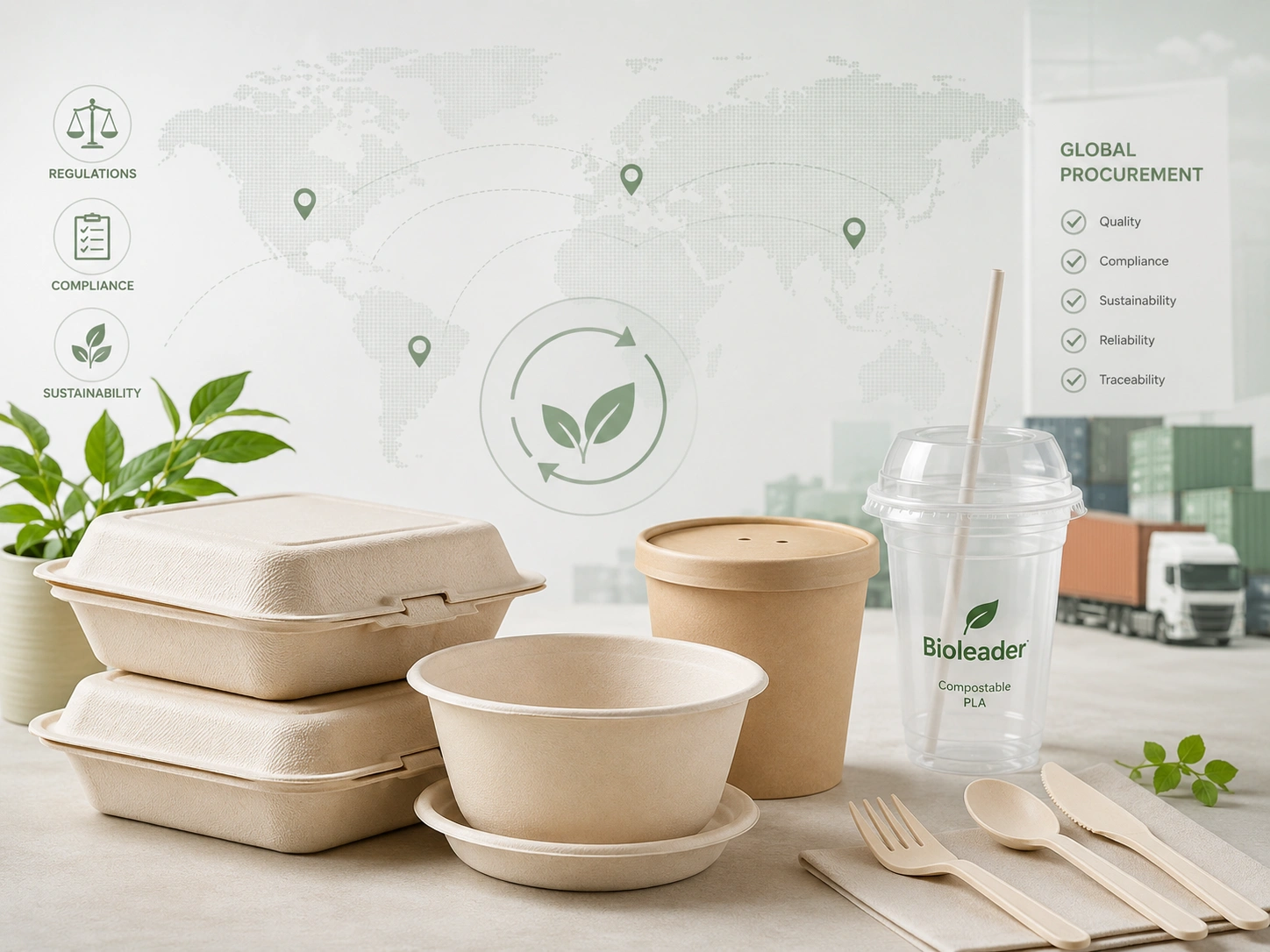
The global food packaging industry is entering a new procurement phase. Instead of asking only “Which material can replace plastic?”, buyers now need to ask a more difficult question: “Can this packaging meet food performance, local regulation, documentation, and end-of-life requirements in the target market?”
This change matters for restaurants, food delivery platforms, catering operators, supermarkets, importers, and packaging distributors. Sustainable packaging selection is no longer only an environmental decision. It has become a compliance and supply chain decision connected with regulation, customer expectations, material claims, and operational risk.
Bioleader® supplies biodegradable and compostable food packaging solutions for global B2B buyers, including sugarcane bagasse tableware, bagasse food containers, PLA cups, paper food packaging, and compostable cutlery. As global plastic restrictions become more detailed, buyers increasingly need packaging partners that understand both product performance and documentation requirements.
Key takeaway: The future of sustainable food packaging is not simply replacing plastic with another material. Successful procurement must combine suitable materials, verified certifications, responsible disposal pathways, and reliable supplier documentation.
The 30-Day Policy Signal: From Plastic Bans to Proof
Recent policy developments show that the regulatory focus is becoming more implementation-driven. The most important signal is not a sudden global wave of new total bans. Instead, the direction is toward reporting, verification, recycled-content calculation, reverse logistics, and clearer responsibility across the packaging value chain.
For food packaging buyers, this means the next procurement standard will be more evidence-based. Buyers will need to check whether suppliers can support product claims with documents, certificates, material information, testing, and end-of-life guidance.
| Region | Recent Policy Signal | What It Means for Food Packaging Buyers |
|---|---|---|
| China | Shanghai’s 2026 commercial green development work plan requires continued implementation of restrictions on plastic shopping bags and disposable plastic tableware, while strengthening daily supervision and half-year reporting for disposable plastic products. | Retail and foodservice buyers need clearer product records, alternative material documentation, and consistent store-level implementation. |
| European Union | Commission Implementing Decision (EU) 2026/1425 sets rules for calculation, verification, and reporting of recycled plastic content in single-use plastic beverage bottles. | European buyers are moving toward verifiable circularity claims. Suppliers need stronger material transparency and documentation. |
| United States | California SB 54 continues to regulate covered material including single-use packaging and single-use plastic food service ware under producer responsibility rules. | U.S. buyers must manage state-level requirements, covered material categories, recyclability, compostability, and producer responsibility obligations. |
| Brazil | Bahia opened public consultation on reverse logistics rules covering post-consumer products and packaging systems, including general packaging streams. | Latin American markets are moving toward recovery responsibility, reporting, and reverse logistics instead of only material substitution. |
Manufacturer insight: For export buyers, compliance-ready packaging is not only about certificates. It also requires stable specifications, consistent product weight, lid matching, carton packing, shipment documents, and the ability to explain where each product should and should not be used.
Global Plastic Restrictions Are Evolving Into Packaging Compliance Requirements
For many years, the discussion around single-use plastics focused mainly on bans and restrictions. Today, the regulatory direction is becoming more complex. Governments are increasingly asking businesses to demonstrate how packaging is managed after use, how claims are verified, and who is responsible for collection, reporting, or recovery.
Modern packaging compliance increasingly involves the following requirements:
- Waste reduction targets and unnecessary packaging reduction.
- Recycling and recovery responsibility through EPR or reverse logistics systems.
- Producer, importer, distributor, or retailer reporting obligations.
- Recycled-content calculation, verification, and traceability.
- Clearer verification of recyclable, compostable, biodegradable, and plastic-free claims.
- More detailed requirements for food-contact materials, coatings, additives, and PFAS-related declarations.
This shift creates a major change for food packaging buyers. Selecting a supplier only based on unit price is becoming insufficient. Importers, distributors, and restaurant groups increasingly need suppliers that can provide technical documents, compliance information, and consistent product specifications.
This is also why sustainability claims are receiving more attention. Buyers should move beyond general words such as “eco-friendly” and evaluate whether packaging claims are supported by certification, testing, and transparent supply chain information. For a broader brand-level framework, see Bioleader®’s guide on verified sustainable packaging credibility.
What Global Plastic Restrictions Mean for Food Packaging Buyers
The impact of changing regulations is not limited to manufacturers. Restaurants, catering companies, supermarkets, delivery platforms, and packaging distributors must also reconsider how they select disposable food packaging.
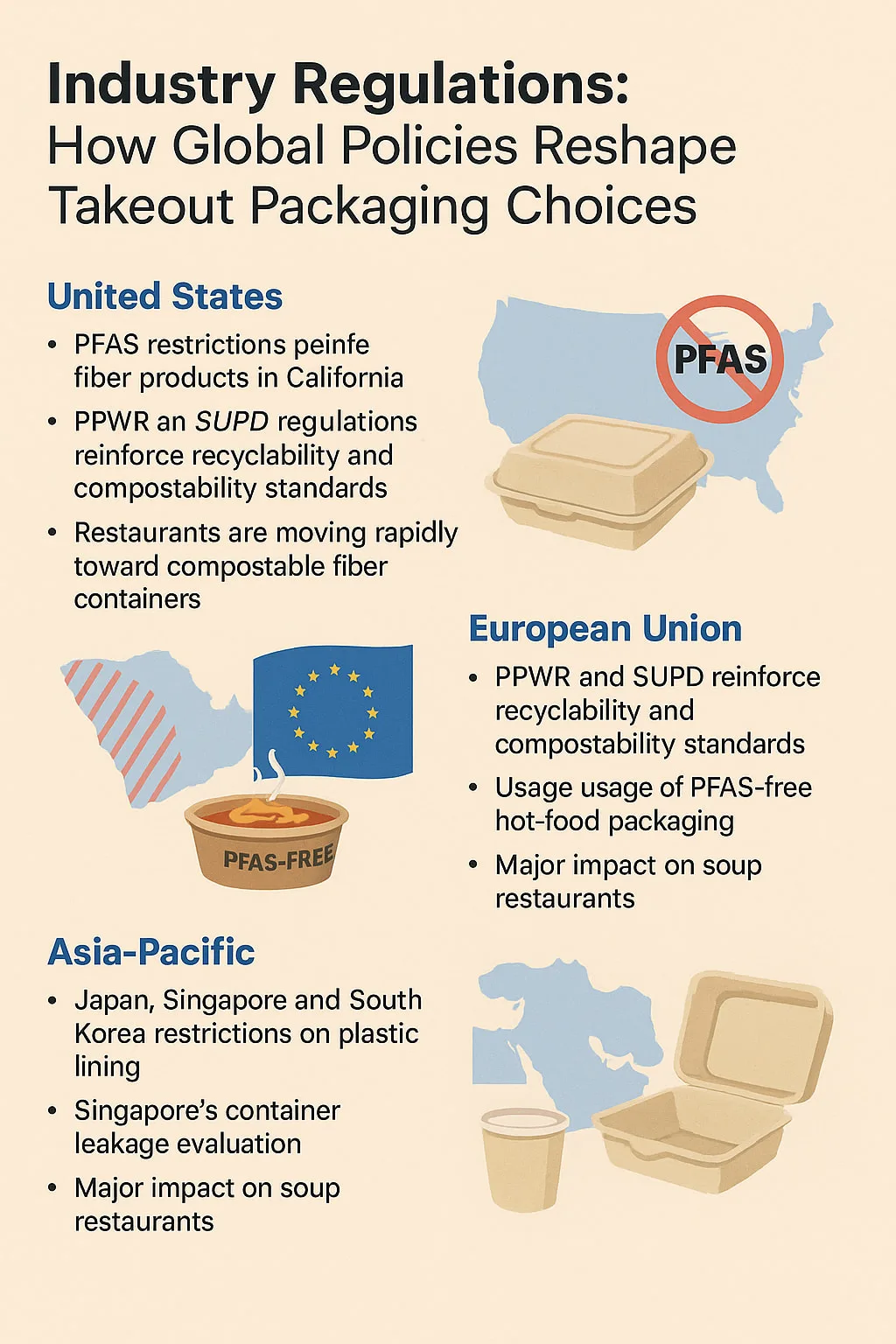
A compliant food packaging strategy requires buyers to evaluate several questions before placing bulk orders:
| Buyer Question | Why It Matters | Procurement Action |
|---|---|---|
| Is this packaging suitable for the food application? | Different foods require different levels of heat resistance, oil resistance, moisture protection, and structural strength. | Test the product with real menu items before confirming bulk production. |
| Does the supplier provide compliance documentation? | Certificates, test reports, and declarations help reduce import and regulatory risks. | Request finished-product documents, not only raw material certificates. |
| Is the packaging recyclable or compostable in the target market? | End-of-life systems differ significantly between countries, states, and cities. | Check local waste collection, recycling acceptance, and composting infrastructure. |
| Are coatings and additives compliant? | Food-contact materials increasingly require stronger chemical transparency, including PFAS-related verification. | Ask for PFAS-related declarations, total fluorine screening, and food-contact documentation where required. |
| Can the supplier support long-term supply? | Large buyers need stable production capacity, OEM capability, and consistent quality control. | Confirm MOQ, lead time, carton packing, container loading, and replacement supply plan. |
Procurement formula: Material + Application + Certification + Disposal System + Supplier Documentation = Sustainable Packaging Decision.
Why Replacing Plastic Alone Is Not Enough
A common misunderstanding is that replacing conventional plastic with another material automatically creates a sustainable packaging solution. In reality, packaging performance depends on the entire lifecycle.
For example, a compostable container may provide value when it is collected with food scraps and processed through suitable composting systems. However, the same product may not deliver the expected environmental outcome if it enters landfill, unsuitable recycling streams, or a market without composting infrastructure.
Similarly, recyclable packaging requires effective collection, sorting, and recycling infrastructure. A material may technically be recyclable, but actual environmental performance depends on whether the local system can recover and process it after foodservice use.
For buyers comparing packaging materials, understanding the difference between recycling, biodegradation, and composting is essential. Read Bioleader®’s detailed guide on recyclable vs biodegradable vs compostable packaging.
Procurement note: Sustainable packaging should not be selected only because of the material name. Buyers should evaluate the complete packaging system, including food application, transportation requirements, certifications, and local disposal conditions.
Regional Regulatory Trends Food Packaging Suppliers Should Watch
Although regulations differ between countries, the overall direction is similar: more transparency, stronger accountability, and greater attention to end-of-life management. For food packaging suppliers, the practical question is not only whether a product is “allowed,” but whether the supplier can help buyers operate safely under local rules.
China: Stronger Monitoring, Reporting, and Commercial-Sector Implementation
China’s approach is increasingly focused on reducing unnecessary single-use plastic consumption while strengthening reporting, supervision, and implementation across commercial sectors. Shanghai’s 2026 commercial green development work plan specifically refers to continued implementation of restrictions on plastic shopping bags and disposable plastic tableware, daily supervision in commercial places, and half-year information reporting for disposable plastic products.
For food packaging suppliers, this means buyers may increasingly request clearer product information, usage records, alternative material documentation, and evidence that packaging solutions meet practical requirements across stores, supermarkets, exhibitions, and commercial foodservice scenarios.
European Union: From Plastic Reduction Toward Verifiable Circular Packaging
The European market is moving beyond simple restrictions and placing stronger emphasis on recycling targets, packaging responsibility, environmental claims, and verified sustainability performance. Commission Implementing Decision (EU) 2026/1425 is not a tableware regulation, but it clearly shows the EU’s direction: recycled-content claims must be calculated, verified, and reported under a common method.
For exporters supplying European buyers, compostability claims, food-contact compliance, and material transparency are becoming increasingly important parts of supplier evaluation. Buyers looking to understand certification requirements can review Bioleader®’s guide on how to verify truly compostable food packaging.
United States: State-Level Requirements and SKU Complexity
In the United States, packaging regulations continue to develop through state-level initiatives. California SB 54 covers single-use packaging and single-use plastic food service ware, while other states and cities may use different approaches such as “skip the stuff” policies, EPR rules, or local material restrictions.
For national restaurant groups, distributors, and importers, this creates SKU complexity. The same product may need different instructions, claims, or acceptance checks depending on the market. For suppliers, flexibility and documentation become important because buyers may need recyclable, compostable, reduced-plastic, or paper-based solutions in different regions.
Brazil and Emerging Markets: Reverse Logistics and Recovery Responsibility
Brazil’s policy direction shows that emerging markets are not only discussing bans. Bahia’s reverse logistics consultation and draft framework point toward recovery responsibility, reporting, and system design for packaging materials. This is important for food packaging because imported packaging, retail packaging, and foodservice packaging may increasingly be viewed through the lens of recovery and shared responsibility.
For global buyers, this means selecting packaging suppliers that understand regional differences will become increasingly important. The future risk is not only whether a package is made from plastic, paper, fiber, or bioplastic. The bigger question is whether buyers can explain what happens to the package after use.
Choosing the Right Sustainable Packaging Material Under New Regulations
As global plastic restrictions become more focused on compliance and end-of-life management, buyers need to move away from choosing packaging based only on appearance or marketing claims. The correct packaging material depends on the food application, operating environment, transportation requirements, and available waste management systems.
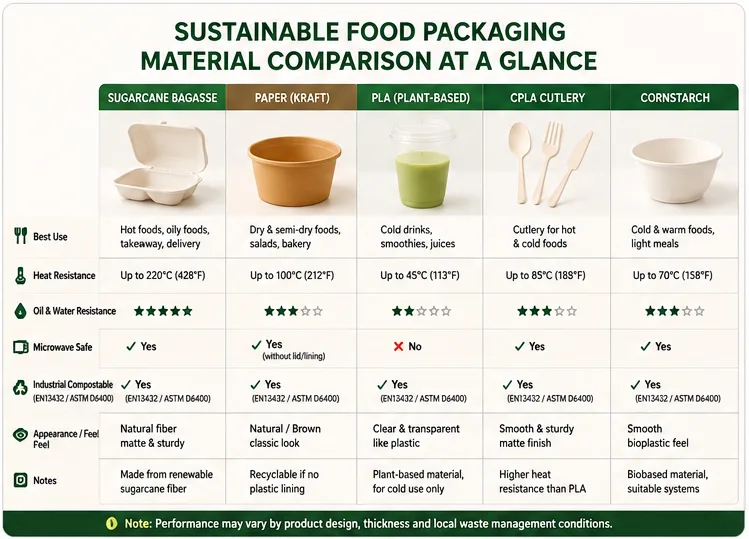
For restaurants, catering companies, supermarkets, and distributors, there is no single material that fits every situation. A successful sustainable packaging strategy usually combines different solutions for different food categories.
| Packaging Material | Best Application | Main Advantages | Important Buyer Considerations |
|---|---|---|---|
| Sugarcane bagasse tableware for plastic restriction markets | Hot meals, takeaway food, catering, fast food, meal boxes, and delivery applications. | Renewable fiber material, strong structure, good oil resistance, suitable for plates, bowls, trays, and containers. | Confirm composting pathway, food-contact compliance, PFAS-free status, and finished-product testing. |
| Bagasse food containers for takeaway meals | Rice meals, burgers, noodles, curry, prepared meals, and delivery food. | Strong molded fiber structure, leak-resistant performance, suitable replacement for many plastic takeaway containers. | Evaluate lid matching, stacking strength, transport distance, microwave suitability, and local composting acceptance. |
| Compostable PLA cups for cold drinks | Cold drinks, iced coffee, smoothies, juice bars, events, and beverage takeaway. | Crystal-clear appearance, plant-based material, suitable for brands requiring plastic-like transparency. | Designed mainly for cold drinks. Buyers should confirm industrial composting availability and avoid mixing PLA with conventional PET recycling streams. |
| CPLA and compostable cutlery for foodservice | Catering, takeaway meals, events, schools, and foodservice operations. | Suitable for replacing petroleum-based disposable cutlery where reuse is not practical. | Check certification scope, material composition, heat resistance, packing format, and local disposal instructions. |
| Paper soup bowls for hot takeaway food | Soup, noodles, curry, rice meals, hot takeaway, and delivery. | Good branding surface, multiple coating options, lid compatibility, and convenient foodservice handling. | Coating selection is critical. Buyers should compare PE, PLA, water-based coating, and target market requirements. |
| Paper food boxes for takeaway packaging | Takeaway meals, bakery products, snacks, lunch boxes, and retail food packaging. | Lightweight structure, printable surface, convenient storage and transportation. | Evaluate grease resistance, coating type, recycling conditions, printing requirements, and food application. |
For international buyers, material selection should also consider regulatory requirements. A packaging supplier should be able to explain not only what the product is made from, but also where it should be used, how it should be disposed of, and what documentation supports its environmental claims.
Manufacturer insight: The best sustainable packaging solution is application-specific. A cold beverage brand, a soup delivery company, an airline catering operator, and a supermarket meal-prep program may all require different materials even if they share the same sustainability goal.
Certification and Documentation Buyers Should Request From Suppliers
As sustainability regulations become stricter, buyers should evaluate suppliers based on documentation capability, not only product appearance or price. A professional packaging supplier should be able to provide relevant technical information covering materials, food contact safety, environmental claims, production consistency, and export documentation.
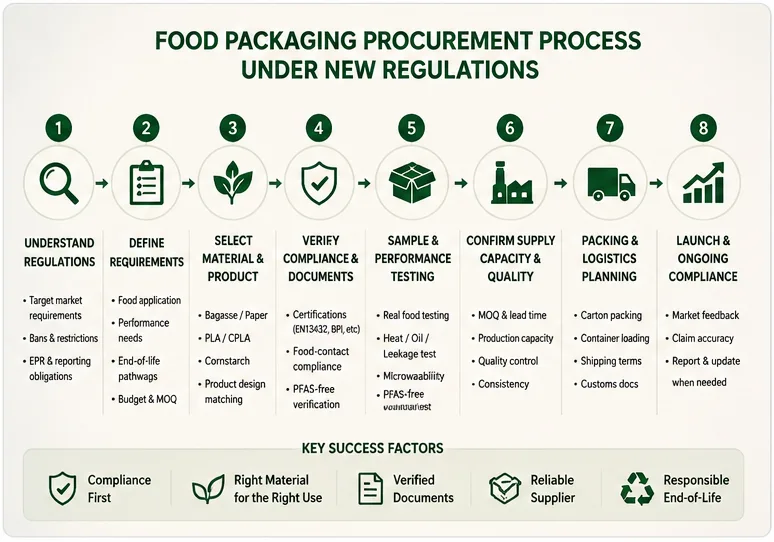
For compostable packaging, buyers should also understand the difference between industrial composting and home composting. A product certified for industrial composting should not be marketed as suitable for all disposal environments. Bioleader® explains this distinction in more detail in its article on industrial compost vs home compost.
Packaging Compliance Checklist for Buyers
- Material information: Request details about fiber sources, coatings, additives, product structure, and whether the item contains plastic lining or coating.
- Compostability certification: Check applicable standards such as EN 13432, ASTM D6400, BPI, or OK Compost depending on the target market.
- Food-contact compliance: Confirm FDA, LFGB, EU food contact, or other regional requirements where applicable.
- PFAS-free verification: For molded fiber and grease-resistant packaging, request PFAS-related declarations or testing documents when required. Buyers can review Bioleader®’s guide to PFAS-free packaging compliance.
- Performance testing: Evaluate heat resistance, oil resistance, leakage prevention, stacking strength, microwave suitability, and delivery durability.
- Supply capability: Confirm MOQ, production capacity, lead time, OEM capability, private label support, carton packing, and container loading plan.
- End-of-life guidance: Confirm whether the packaging should enter recycling, composting, organic waste collection, or general waste according to local rules.
- Finished-product scope: Make sure the certificate applies to the finished item, not only the resin, fiber, coating, or raw material.
This approach helps buyers avoid one of the biggest risks in sustainable packaging procurement: selecting a product that sounds environmentally responsible but does not match the actual disposal system or regulatory requirements in the destination market.
The Importance of Avoiding Greenwashing in Packaging Decisions
As sustainable packaging demand increases, environmental claims are becoming more closely examined by regulators, retailers, and consumers. Words such as “biodegradable,” “eco-friendly,” “green,” “plastic-free,” or “compostable” should not be treated as complete answers.
Buyers should ask clear supplier questions before making claims on product pages, menus, packaging labels, or tender documents:
- Under what conditions does this packaging break down?
- Is the finished product certified, or only the raw material?
- Does the coating, ink, adhesive, or additive affect compostability?
- Is the disposal pathway available in the target market?
- Can the supplier provide documentation that supports the exact claim?
For a deeper understanding of supplier verification, buyers can review how to verify truly compostable food packaging before relying on compostable or biodegradable claims.
Risk warning: Compostable does not mean marine biodegradable, landfill biodegradable, or suitable for every composting environment. Buyers should avoid broad disposal claims unless the claim matches the certificate, product scope, and local collection system.
The Future of Food Packaging Procurement: Compliance, Circularity and Transparency
The future competition in food packaging will not only depend on lower prices. Buyers increasingly need suppliers that can support compliance, documentation, customization, and reliable international supply.
For export manufacturers, the next competition point is not only price per carton. It is whether the supplier can provide stable specifications, finished-product testing, food-contact documents, PFAS-related declarations, compostability scope checks, carton packing, and container loading support.
| Principle | Meaning for Buyers | Supplier Capability Required |
|---|---|---|
| Compliance Ready | Packaging must be selected with regional rules and documentation needs in mind. | Certificates, declarations, food-contact documents, and finished-product test support. |
| Application Specific | Materials should be selected according to food type, temperature, logistics, and customer experience. | Product testing, lid matching, coating options, and usage guidance. |
| End-of-Life Responsible | Packaging decisions should consider recycling, composting, and local waste systems. | Clear disposal guidance and honest limits for compostable or recyclable claims. |
| Supply Chain Transparent | Buyers need reliable manufacturers with stable production and export experience. | MOQ planning, OEM/private label support, quality control, and export-ready packaging. |
How Bioleader® Supports Global Sustainable Packaging Transition
Bioleader® helps global foodservice buyers, importers, distributors, and restaurant brands source sustainable disposable packaging solutions that match different market requirements.
As a China manufacturer specializing in biodegradable and compostable food packaging, Bioleader® supplies a wide product portfolio including:
- Sugarcane bagasse tableware for restaurants, catering, delivery, and plastic restriction markets.
- Bagasse food containers and takeaway packaging for hot meals, oily foods, and delivery applications.
- Compostable PLA cups for cold beverages, smoothies, iced coffee, and event drinks.
- CPLA and compostable cutlery for foodservice, takeaway, catering, and events.
- Paper soup bowls and containers for hot soup, noodles, curry, and meal delivery.
- Paper food boxes and takeaway packaging for restaurants, bakeries, supermarkets, and retail food brands.
Bioleader® supports buyers with material selection, OEM customization, private label packaging, certification documents, bulk wholesale supply, and export-ready packaging solutions.
Buyer Decision Guide: Selecting Packaging According to Business Needs
| Buyer Type | Main Challenge | Recommended Direction | Bioleader® Support |
|---|---|---|---|
| Restaurant Chains | Large packaging volume, delivery requirements, and sustainability targets. | Bagasse containers, paper bowls, compostable cutlery, and customized packaging programs. | Bulk supply, OEM printing, product matching, and compliance support. |
| Importers and Distributors | Need stable supply, multiple product categories, and documentation. | Mixed sustainable packaging portfolio covering different food applications. | Factory production, export experience, certification support, and container planning. |
| Catering and Events | Large temporary waste volumes and customer sustainability expectations. | Compostable plates, bowls, trays, and cutlery where suitable infrastructure exists. | Event packaging combinations and customized supply solutions. |
| Supermarkets and Meal Brands | Need attractive packaging with reliable performance and branding options. | Paper bowls, salad containers, food boxes, and molded fiber packaging. | Private label support, printing, and packaging optimization. |
Conclusion: Sustainable Packaging Procurement Is Becoming a Strategic Decision
Global plastic restrictions are changing the way businesses evaluate food packaging. The future is not simply about replacing plastic products with alternative materials. It is about selecting packaging solutions that are compliant, functional, traceable, and suitable for real-world disposal systems.
For restaurants, distributors, and importers, the key question is no longer only “Which material is greener?” The better question is: “Which packaging solution delivers the right balance between food performance, regulatory compliance, supply reliability, and responsible end-of-life management?”
Bioleader® helps global buyers make this transition through certified compostable tableware, biodegradable food packaging, OEM solutions, bulk wholesale supply, and export-ready manufacturing capabilities.
FAQ: Global Plastic Restrictions and Food Packaging Procurement
What are the biggest changes in global food packaging regulations in 2026?
The biggest change is the shift from simple plastic bans toward broader packaging accountability. Regulations are increasingly focusing on reporting requirements, recycled-content verification, reverse logistics, producer responsibility, environmental claim verification, and supplier documentation.
Are plastic bans the main driver of sustainable packaging adoption?
Plastic restrictions are one important driver, but businesses are also responding to customer expectations, retailer requirements, corporate sustainability goals, packaging EPR rules, and increasing demand for transparent supply chains.
What documents should buyers request from packaging suppliers?
Buyers should request material specifications, food-contact documents, compostability certificates where applicable, PFAS-related declarations or test reports, performance testing data, carton packing information, and clear end-of-life guidance for the target market.
What certifications should buyers check for compostable packaging?
Buyers should check certifications based on their target market. Common references include EN 13432 in Europe, ASTM D6400 and BPI in North America, and OK Compost where relevant. The certificate should apply to the finished product, not only the raw material.
Are compostable containers accepted everywhere?
No. Compostable packaging depends on local collection systems and industrial composting infrastructure. Buyers should confirm whether their target market accepts compostable packaging before selecting a solution or making compostability claims.
What is the difference between recyclable and compostable packaging?
Recyclable packaging is processed into new materials through recycling systems, while compostable packaging is designed to break down through controlled composting processes. The better choice depends on the food application, contamination level, local waste infrastructure, and regulatory requirements.
How should restaurants prepare for future packaging regulations?
Restaurants should review their current packaging portfolio, reduce unnecessary packaging, evaluate sustainable alternatives, confirm supplier documentation, and select materials that match local disposal systems and foodservice performance requirements.
What sustainable packaging materials can replace single-use plastics?
Common alternatives include sugarcane bagasse tableware, bagasse food containers, compostable PLA cups, CPLA cutlery, kraft paper bowls, paper soup bowls, and paper food boxes. The right option depends on the food type, temperature, delivery model, and destination market.
References
- Shanghai Municipal Commission of Commerce: 2026 Commercial Energy Saving, Carbon Reduction and Green Development Work Plan
- EUR-Lex: Commission Implementing Decision (EU) 2026/1425
- European Commission: Single-use plastics policy
- CalRecycle: SB 54 Plastic Pollution Prevention and Packaging Producer Responsibility Act
- CalRecycle: Covered Material Categories List
- Government of Bahia: Public consultation on reverse logistics regulation
- Government of Bahia: Draft reverse logistics decree, June 2026
- U.S. EPA: Sustainable Materials Management Hierarchy
- European Bioplastics: EN 13432 certified bioplastics in industrial composting
- BPI: Certified compostable products and packaging