Industry Background: The Rise of Sugarcane Bagasse in Sustainable Packaging
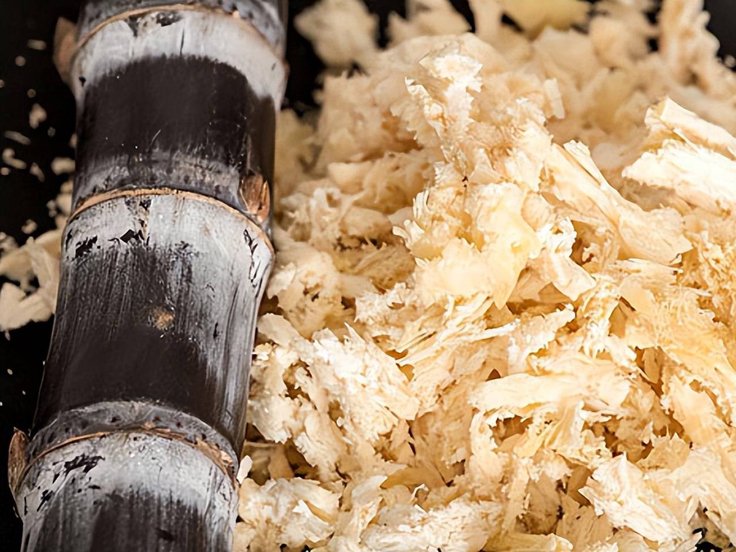
In the global push to reduce plastic waste, sugarcane bagasse has emerged as an unlikely hero. Bagasse is the dry, fibrous residue left after extracting juice from sugarcane stalks. Traditionally, mountains of bagasse were discarded or burned as waste, but today this byproduct is being upcycled into eco-friendly tableware and packaging. With worldwide sugarcane production exceeding 1.9 billion tons annually, the potential supply of bagasse is enormous. Transforming this agricultural waste into products like plates, bowls, and containers creates a circular economy solution that reduces waste and dependence on plastics.
From Waste to Resource
The shift toward bagasse tableware is driven by both environmental necessity and technological advances. As single-use plastics clog landfills and oceans, regulators and businesses have sought compostable alternatives. Sugarcane bagasse – once considered trash – is now a valuable resource. Companies collect the fibrous pulp from sugar mills and convert it into sturdy disposable tableware, turning agricultural waste into a commodity. This not only cuts down on pollution but also prevents additional resource extraction (no trees need to be cut down, unlike paper). The result is a win-win: reduced waste for sugar producers and sustainable material for packaging manufacturers.
Drivers of Adoption
Several converging trends have propelled bagasse into the spotlight. Environmental regulations are tightening (as discussed later), pushing industries away from plastics. Consumer preferences are shifting too – today’s customers and foodservice clients increasingly demand eco-friendly packaging as part of brand sustainability. Major multinational companies have taken notice: food chains like McDonald’s, Starbucks, and KFC have started integrating bagasse-based packaging to replace plastics, aligning with their public sustainability goals. These high-profile adoptions have validated bagasse in the marketplace and spurred broader interest across the packaging industry. In short, bagasse has rapidly evolved from an obscure agrarian leftover to a rising star of sustainable packaging, backed by strong ecological and economic incentives.
Manufacturing Process of Bagasse Tableware
Producing tableware from sugarcane bagasse involves an efficient, clean process that contrasts sharply with petroleum-based plastics. The manufacturing journey takes bagasse from farm residue to finished plate in a few streamlined steps:
1. Collection of Raw Material
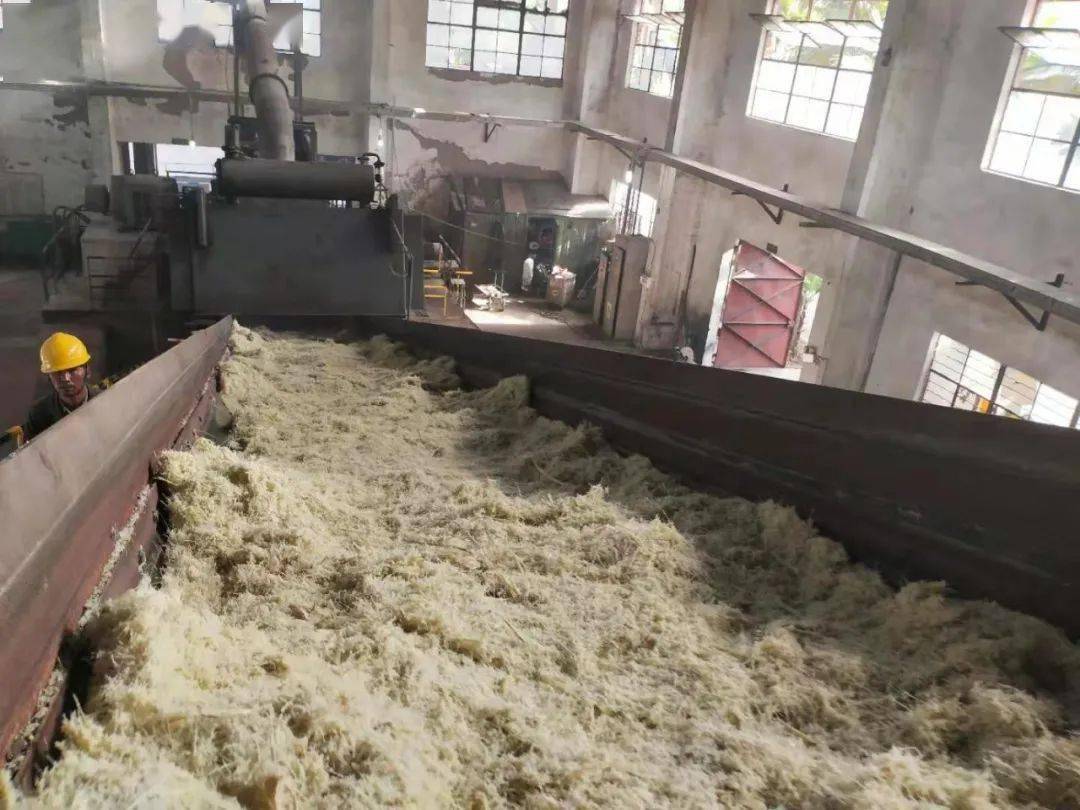
After sugarcane stalks are crushed for juice, the remaining fibrous pulp (bagasse) is collected instead of being discarded or burned. Sugar mills typically set aside this bagasse for reuse. By capturing it at the source, manufacturers ensure a steady supply of raw fiber while also reducing waste at the sugar mill.
2. Cleaning and Preparation
The freshly collected bagasse is thoroughly washed to remove impurities, sticky sugar residues, and dirt. This cleaning step is crucial – only clean, quality fiber yields food-safe tableware. Once washed, the bagasse may be dried or directly moved to pulping. (In many operations, bagasse is dried and baled for transport if the tableware factory is off-site.) Proper preparation ensures the material is hygienic and consistent for molding.
3. Pulping
The clean bagasse fibers are mixed with water and mechanically pulped into a slurry. This creates a wet, soupy paper-like pulp. Notably, bagasse pulping requires fewer chemicals than wood pulping, since the fibers are softer and were initially processed for sugar extraction. In many cases, no bleach or harsh additives are needed, keeping the material naturally safe for food contact. The result is a fibrous pulp that can be formed into shapes without requiring plastic binders.
4. Molding and Shaping
Next, the bagasse pulp is poured into molds to form the desired products. Manufacturers use custom metal molds for plates, clamshell boxes, bowls, cups, lids, and more. The molds close on the pulp and apply heat and pressure, which causes the water to drain and the fibers to interlock into a rigid shape. This molded fiber process is similar to making thick paper or egg cartons, but with higher pressure for durability. The combination of heat and pressure “cures” the pulp, solidifying the product. Within minutes, the slurry takes on the form of a sturdy plate or container. This step is highly versatile – by swapping molds, the same pulp can create a wide range of tableware designs.
5. Drying and Finishing
After molding, the products are still slightly damp. They are transferred to drying ovens or drying racks to remove any remaining moisture. Thorough drying (often at moderate heat) ensures the items won’t deform or grow mold in storage. At this stage, some products might receive surface treatments – for example, a light food-safe coating or spray to enhance water and oil resistance (though many bagasse products achieve this naturally or with additives that are PFAS-free, as discussed later). The dried items are then trimmed of any excess fiber, and stacks of plates or containers are sorted and counted.
6. Quality Assurance
Finally, the bagasse tableware undergoes quality control. Each batch is checked to ensure consistent thickness, proper molding (no cracks or underformed areas), and performance criteria like leak resistance and structural integrity. Food safety tests may be performed (for example, verifying no residual heavy metals or chemicals). Only products that meet strict food-contact standards (FDA, EU regulations, etc.) and pass durability tests move on to packaging for sale. This QA step is vital for maintaining reliability, especially for export markets that require certifications.
Overall, bagasse tableware production is efficient and eco-friendly. The process uses primarily water, heat, and pressure – no toxic chemicals or resins – resulting in a product that is safe for both consumers and compost facilities. By the end, what started as soggy sugarcane waste is now a clean, sturdy plate or container ready for use.
Product Categories and Use Cases
Bagasse-based tableware comes in a broad array of product types, covering many needs of the food service and packaging industry. Thanks to molding technology, bagasse can be formed into everything from a small sauce cup to a large serving tray. Below are the primary product categories and their common use cases:
Plates and Bowls
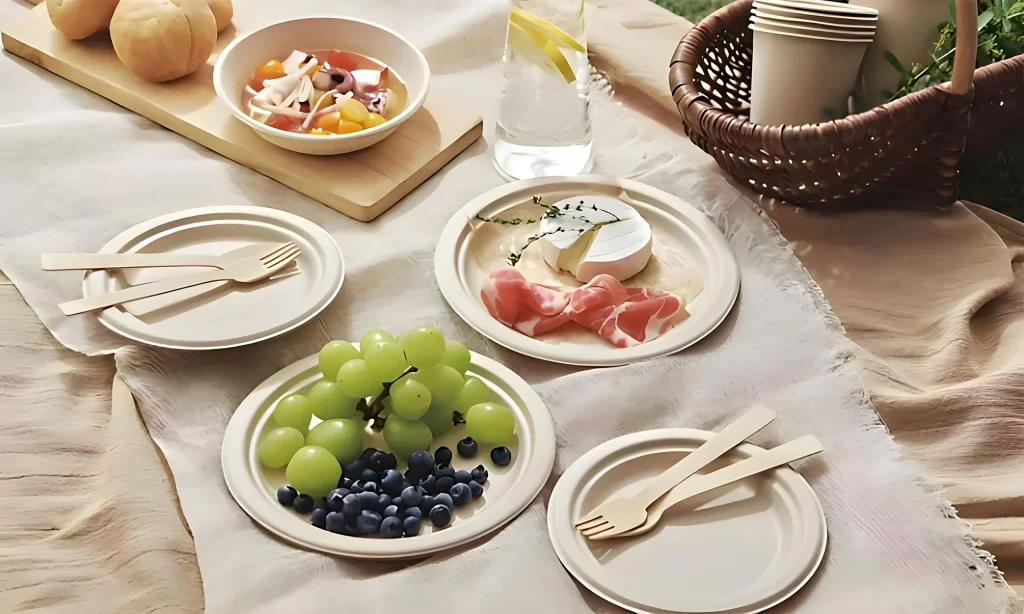
Flat plates (round or square) and deep bowls are among the most popular bagasse items. They are used for serving meals, salads, soups, and desserts in restaurants, cafeterias, catered events, and even at home. Bagasse plates and bowls come in various sizes (from small 6-inch appetizer plates up to large 12-inch dinner plates). They are durable and heat-resistant, making them suitable for hot dishes and oily foods without soaking through. For instance, a bagasse bowl can safely hold hot soup or curry – something paper bowls struggle with – because bagasse fiber has naturally good insulation and leak resistance. These products are a direct sustainable replacement for disposable plastic or foam dinnerware at parties, offices, or food courts.
Hinged Clamshell Containers
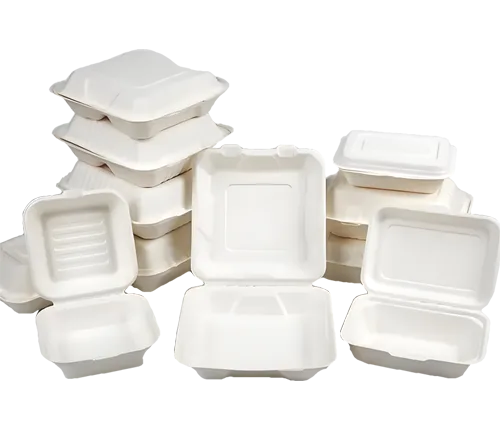
Takeout boxes made from bagasse are widely used for food delivery and grab-and-go meals. These clamshell containers have an attached lid and typically come with one or multiple compartments. Common formats include burger boxes, lunch boxes with 2–3 sections, and large meal containers. They are popular for restaurants and street food vendors because they are sturdy enough for hot, greasy foods and maintain structural integrity during transport. Bagasse clamshells can handle everything from saucy curries to burgers and fries, offering a compostable alternative to Styrofoam boxes. Their secure, hinged lids help prevent spills. Use cases span from Asian takeout meals, to barbecue and fast food packaging, to school cafeterias replacing foam trays.
Food Containers with Lids
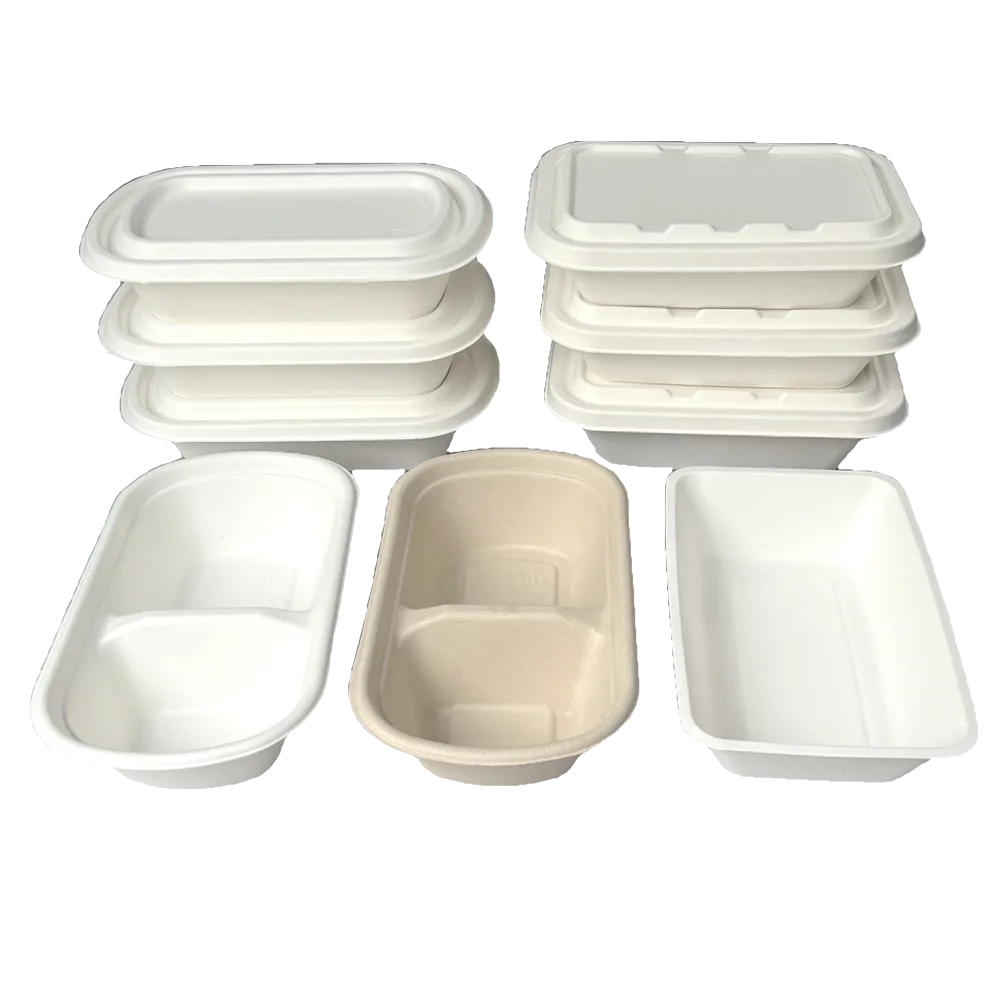
In addition to clamshells, bagasse is used for deli cups, bowls with lids, and takeout trays that have separate bagasse or bioplastic lids. For example, there are bagasse soup bowls and round containers paired with either bagasse flat lids or compostable PLA lids for liquids. These are used by salad shops, soup kitchens, and gourmet takeout shops for items like ramen, poké bowls, or grain bowls. Bagasse trays with clear compostable lids are also common for packaging produce or cold foods – providing visibility with a PLA window but a sturdy fiber base. Such containers illustrate how bagasse can integrate with other eco-materials (like a PLA lid film) to provide a fully compostable packaging solution. (Note: if a plastic lining or lid is used, the package may not be accepted in all jurisdictions’ compost streams – see regulatory section – but many designs avoid conventional plastics entirely.)
Cups and Cup Lids
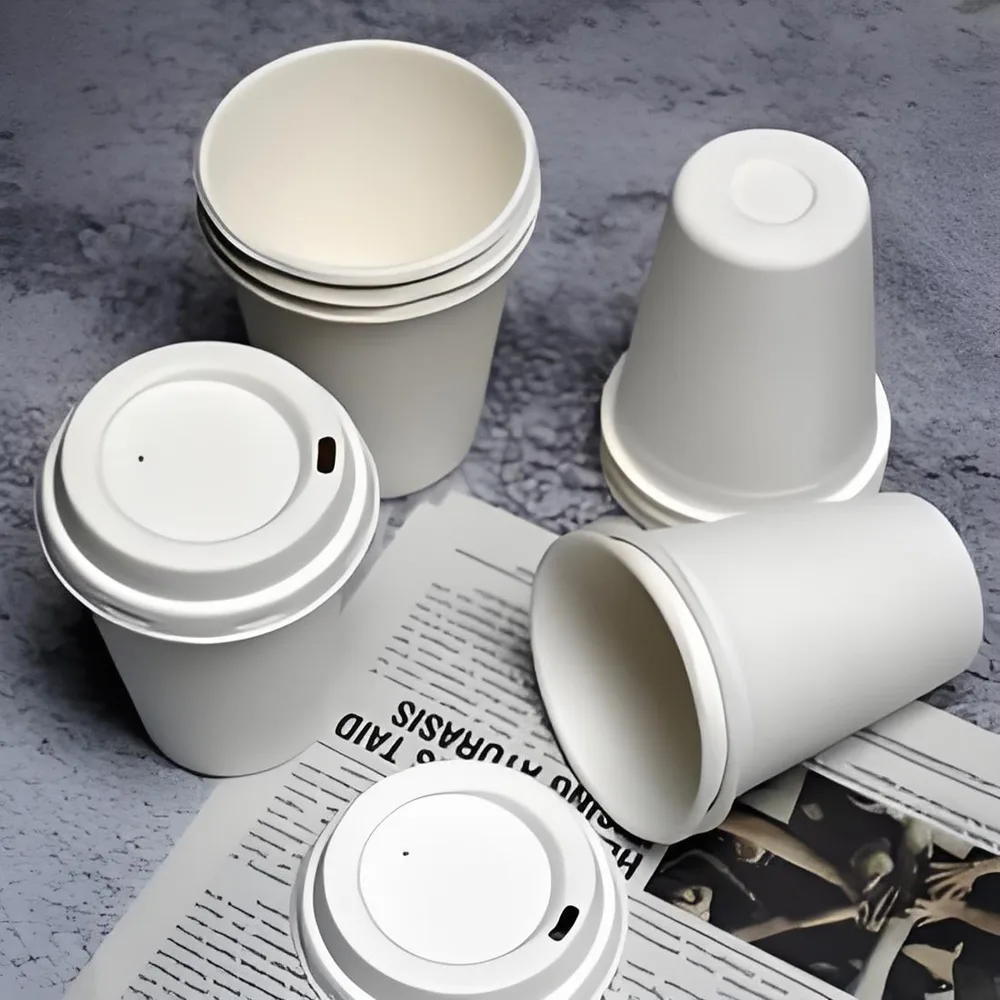
While paper is more typical for disposable cups, bagasse fiber is also used in certain cup designs and especially cup lids. Bagasse cup lids for hot drinks have gained popularity – for example, some coffee chains use bagasse-based lids for paper cups, replacing plastic lids. These fiber lids can be molded to fit standard cup sizes and are heat-tolerant and sip-friendly (with a drink opening). Whole cups made of bagasse are less common (since holding liquids for extended periods can be challenging without a liner), but there are short-term cups and portion cups (for condiments or samples) made from bagasse. They work well for serving condiments, sauces, or tastings, and eliminate plastic portion cups. In many cases, bagasse cups are lined with a plant-based coating (like a thin PLA or proprietary bio-coating) to hold beverages longer – those are still compostable as a unit. Use cases include smoothie cups with bagasse lids, water cups at events, and espresso cups that can be composted after the event.
Trays and Platters
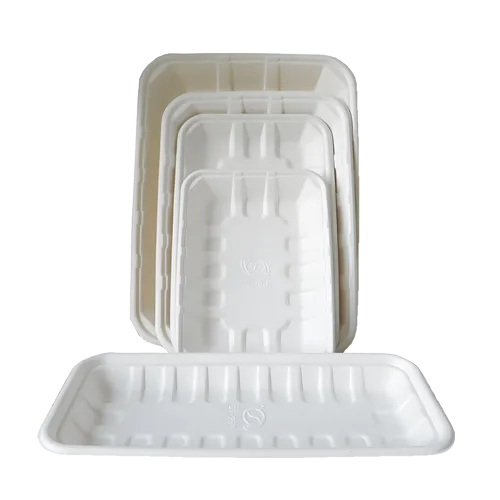
Bagasse can be molded into larger serving trays and plates with multiple compartments. For example, school lunch trays (with sections for different foods) are now made from bagasse in some cafeterias, replacing plastic or foam trays. Similarly, catering platters and produce trays (for fruits, vegetables, or meat packaging) can be made of bagasse. These trays offer strength and can be used with film overwrap or dome lids for display purposes. They are also microwavable and freezer-safe, adding to their versatility. Airlines and event caterers have started using bagasse compartment trays for meal service to demonstrate their commitment to sustainability.
Packaging Inserts and Others
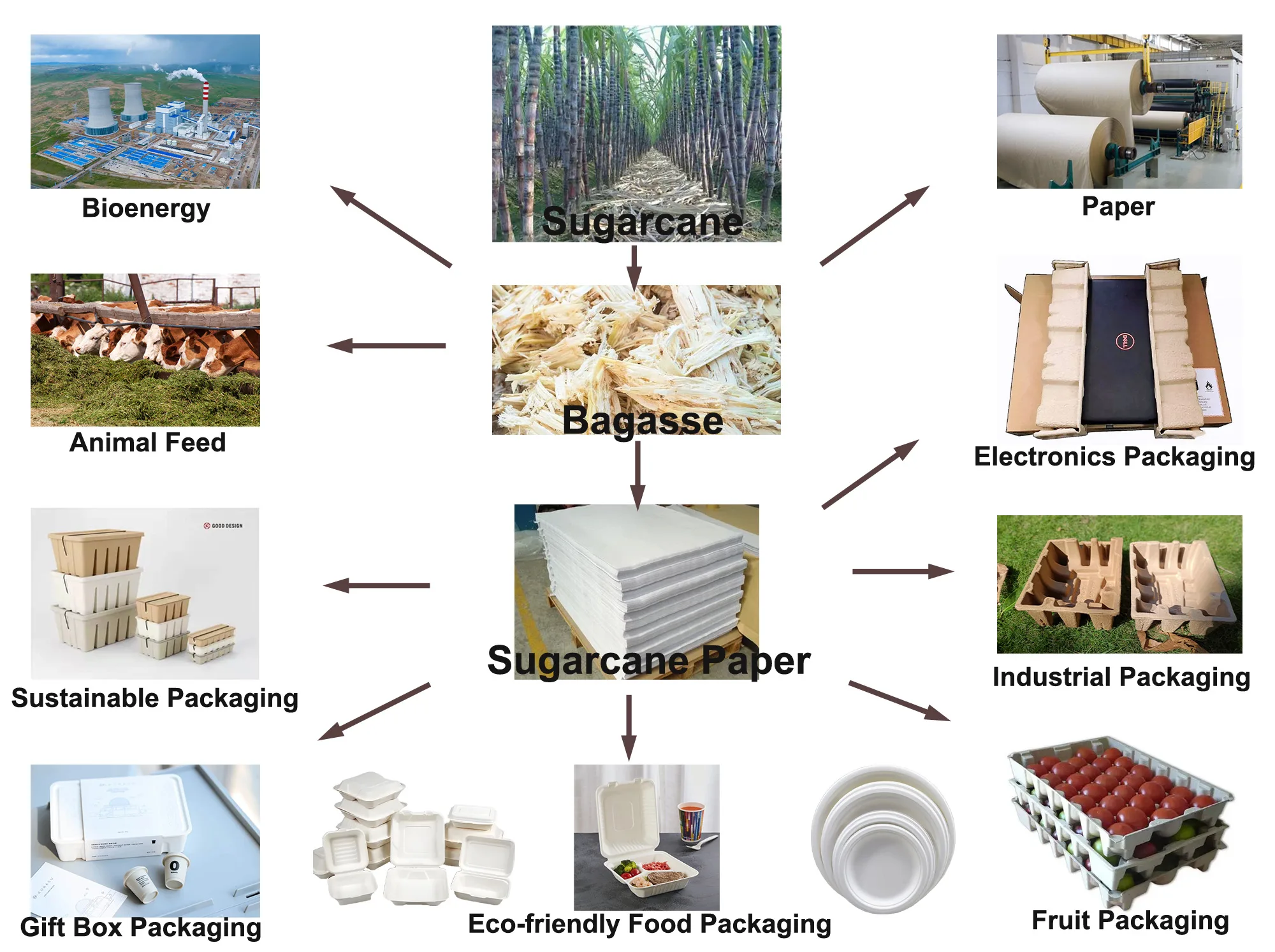
Beyond tableware, sugarcane bagasse is also used for protective packaging in non-food industries. Molded fiber inserts for electronics, appliances, cosmetics, and glassware can be made from bagasse just like from recycled paper. For instance, some mobile phones or cosmetics come nestled in a bagasse pulp tray instead of foam. This category is slightly outside “tableware,” but it showcases bagasse’s broader utility. Its shock-absorbing and cushioning properties make it suitable for packaging fragile items. By using bagasse inserts, companies further reduce plastic foam waste. Additionally, bagasse fiber has been explored in cutlery when mixed with other materials (though most compostable cutlery is PLA or starch-based, some R&D is ongoing on high-fiber content utensils).
Key Advantages Across Categories:
All these bagasse products share common benefits that explain their surging popularity. They are fully biodegradable and compostable, breaking down into soil in a matter of weeks under composting conditions. They are generally safe for microwave and freezer use (e.g. reheat a meal in a bagasse clamshell, or store leftovers in the fridge). Bagasse tableware is also notably sturdy: the fibrous construction gives it rigidity and insulating properties, so a hot item won’t easily burn your fingers or soak through. Unlike paper plates which often need a plastic or wax lining for grease, bagasse products naturally resist oil and water absorption. This makes them ideal for hot, greasy foods that paper or cardboard would fail with. From street food festivals to corporate cafeterias, bagasse tableware now spans a wide spectrum of uses, proving that sustainable options can meet the same practical needs as their plastic predecessors.
Environmental Impact and Biodegradability
One of the strongest arguments for sugarcane bagasse tableware is its impressive environmental profile. Compared to conventional plastics (and even compared to paper or bio-plastics), bagasse products tend to have lower lifecycle impacts and far superior end-of-life outcomes. Below we examine the key environmental factors:
Biodegradability & Compostability
Bagasse tableware is 100% plant-based and contains no synthetic plastics, which means it is both biodegradable and compostable. In the proper conditions, molded bagasse products break down very quickly – typically within 60 to 90 days in industrial composting facilities. In these facilities, controlled heat and humidity, along with microbial activity, turn used bagasse plates or containers into nutrient-rich compost in a matter of weeks. Even in a home compost bin, bagasse will decompose (though it might take a bit longer than 90 days depending on the compost heap conditions). This is a stark contrast to petroleum plastic: a plastic fork or Styrofoam box could persist for centuries in the environment, whereas a bagasse fork or clamshell will simply become soil with no toxic residue. In fact, if a bagasse item does escape waste management and ends up as litter, it will still biodegrade naturally over time, greatly reducing long-term pollution. (However, note that landfills are not ideal for any biodegradables – without oxygen and microbes, even bagasse decomposes slowly in a landfill, potentially generating methane. Composting is the preferred disposal route to maximize the environmental benefit.)
Lower Carbon Footprint
Studies show that bagasse-based products have a significantly smaller carbon footprint than traditional plastic or paper products. Much of the advantage comes from using waste biomass as the raw material and from the relatively energy-efficient production process. For example, a 2021 life cycle assessment in the Journal of Cleaner Production found that bagasse packaging emits 65–80% less CO₂ over its lifecycle compared to PET plastic packaging. This huge reduction is due to several factors: the feedstock is a waste byproduct (no emissions from farming just for the material, unlike paper from tree farming or PLA from corn fields), and the molding process uses less energy than plastic resin production and extrusion. Additionally, sugarcane plants absorb CO₂ as they grow; when we use the bagasse and then compost it, much of that carbon is returned to the soil rather than adding new carbon to the atmosphere. Bagasse products also tend to require less water and energy in manufacturing than wood-pulp paper alternatives. In summary, from cradle to grave, bagasse packaging can cut greenhouse gas emissions by more than half relative to conventional single-use plastics. Businesses focused on carbon footprint reduction and ESG targets find this aspect very attractive.
No Deforestation & Resource Efficiency
Unlike paper or wood-based products, bagasse does not necessitate any additional logging or land use. It leverages existing agricultural output. Every bagasse plate essentially repurposes material that already came from a harvest, meaning no extra trees or crops need to be planted and no forests cleared to supply that plate. This gives bagasse a big sustainability edge over paper in terms of land and resource use. It also alleviates pressure on forests and can help preserve biodiversity that might be impacted by expanded tree plantations. The bagasse vs. paper comparison is instructive: paper production relies on dedicated forestry (unless using recycled paper), whereas bagasse production piggybacks on the sugar industry’s output. This resource efficiency extends to the end of life as well – when composted, bagasse adds organic matter back to soil, effectively enriching it, whereas paper or wood (if landfilled) doesn’t return nutrients. Moreover, using bagasse helps avoid the common practice of burning it for disposal, which is still done in some areas and contributes to air pollution and CO₂ emissions. In many sugarcane-growing regions, excess bagasse that isn’t used for energy can become an open-burning issue; turning it into tableware mitigates that problem and provides economic value to farmers or sugar mills.
Reduced Plastic Pollution and Toxin-Free Decomposition
Bagasse products degrade without leaving behind microplastics or toxic residues. This is a critical point for environmental impact. Plastics break down into microscopic particles that persist in soil and water, entering the food chain. By contrast, when a bagasse container breaks down, it essentially becomes organic compost. No harmful chemicals are released – especially if the product is PFAS-free (discussed later under challenges). High-quality bagasse tableware is often bleached chlorine-free or left unbleached, and contains no additives like heavy metals or plastics, so its decomposition is clean. In fact, in compost, bagasse items can turn into beneficial mulch that aids soil health. Some municipalities count compostable packaging (like bagasse) towards organics recycling goals, helping divert waste from landfills. The reduction in lingering pollution is also important in marine environments – if a bagasse plate accidentally ends up in a river or ocean, it will swell, break apart, and be consumed by microorganisms, not sit around harming wildlife as plastic would.
Energy and Emissions in Production
It is worth noting that many sugar mills use bagasse as a biofuel to power their operations (cogeneration). In cases where tableware production is co-located with sugar production, bagasse can effectively fuel its own processing – the energy to run the molding machines or dry the products can come from burning a fraction of the bagasse or its byproducts. This further improves the emissions profile (renewable energy source instead of fossil electricity). Even when produced in standalone factories, bagasse tableware doesn’t require high-temperature petrochemical refining like plastics do. The result is significantly lower air emissions of CO₂ and pollutants per unit produced. A study in Journal of Industrial Ecology (2023) concluded that bagasse containers have 50–70% lower overall environmental impact than single-use plastic containers when considering factors like climate change, water use, and human health impacts.
In summary, sugarcane bagasse tableware offers a far more sustainable lifecycle than traditional disposable materials. It starts as a repurposed waste (saving resources), is produced with fewer emissions, and ends its life by safely returning to nature. For companies aiming to minimize environmental footprint and for governments aiming to curb plastic pollution, these attributes make bagasse an exemplary choice. Of course, to fully realize these benefits, proper composting and waste management must be in place (so that bagasse products actually biodegrade in a useful way rather than sit in an airless landfill). When handled correctly, the environmental payoff of bagasse is tremendous – it replaces plastics that might otherwise persist for generations with a product that leaves virtually no trace in a matter of months.
Global Regulatory Landscape
Government policies around the world are increasingly favoring materials like bagasse while putting pressure on single-use plastics. In this section, we highlight key regulations in Europe, the United States, and the Asia-Pacific (APAC) region that impact sugarcane bagasse tableware and sustainable food packaging.
Europe
Europe has been at the forefront of restricting single-use plastics and encouraging compostable or fiber-based alternatives. A milestone was the EU’s Single-Use Plastics Directive (SUPD), adopted in 2019 and implemented by member states starting in 2021. This directive bans many common single-use plastic items, regardless of whether they are made from conventional or bio-based plastics. Notably, plastic plates, cutlery, straws, stirrers, and polystyrene food containers are banned across the EU, which directly creates demand for substitutes like bagasse. The law made no exemption for “biodegradable” plastics – in the eyes of EU regulators, a plastic is a plastic, even if it’s PLA or other bio-plastic. For example, a compostable PLA plate is treated the same as a regular plastic plate and is not allowed under the SUPD. Likewise, a paper or cardboard plate with a plastic coating (even a biodegradable coating) is considered a plastic product and is banned. This nuance pushed businesses toward fiber products with no plastic linings, which is exactly where bagasse excels. Bagasse plates or containers without plastic coatings are explicitly allowed under EU rules and have become a go-to solution for compliance.
To complement the bans, the EU also set targets for reducing single-use food container consumption and required clearer labeling on items that contain plastic. For instance, cups that contain plastic (including bio-plastic) must carry a marking in the EU, whereas fiber-based cups without plastic do not. This gave bagasse an image advantage as well – no plastic means no special litter label required.
Building on the SUP Directive, the EU is finalizing a Packaging and Packaging Waste Regulation (PPWR) (as of late 2024) that will further promote sustainability. While still subject to final approval, the PPWR is expected to mandate that many forms of packaging be either reusable or compostable by certain dates. Early drafts indicate that some items (like tea bags, fruit stickers, and some coffee pods) must be compostable by 2030, and it sets standards for compostability (EN 13432) compliance. Bagasse products, which typically meet EN 13432 for compostability, should easily comply with these requirements. The PPWR also sets recycling targets but exempts compostable packaging from certain recycled content requirements since fiber packaging like bagasse isn’t recycled in the paper stream. In essence, the EU is carving out a role for compostable fiber packaging where it makes sense (especially for food-soiled items that wouldn’t be recycled). For example, plastic packaging used in restaurants for on-site consumption will be restricted – the EU is pushing for reusable systems there, but where single-use is needed, fiber is the preferred route.
Individual European countries have gone even further with their own rules. France, for instance, banned disposable plastic plates and cups even ahead of the EU timeline and has moved to ban many single-use plastics in produce packaging. Italy has promoted compostables heavily (though ironically tried to exempt some bio-plastics from the ban, causing debates with the EU). Germany now requires any restaurant offering takeout to also offer a reusable option (or allow customers’ containers) by 2023, which indirectly encourages sustainable disposables for those who opt out of reusables. Overall, Europe’s regulatory trend is clear: single-use plastic is on its way out, and natural or compostable materials are taking its place. This pro-plastic-ban, pro-compostable policy environment has made Europe one of the fastest-growing markets for bagasse tableware.
Importantly, European food safety regulations (like EU Regulation 10/2011 for food contact materials) also come into play – bagasse products must be proven food-safe (no harmful migration of chemicals). Most reputable suppliers get certifications for EU food contact. Additionally, starting in 2023, the EU imposed a near-total ban on PFAS chemicals in food packaging in some countries (e.g., Denmark led with a PFAS ban in paper/board food packaging). The EU is considering a union-wide PFAS restriction soon. Because some cheaper fiber products in the past contained PFAS for grease resistance, EU buyers now demand PFAS-free bagasse tableware (more on PFAS in Challenges section). Quality bagasse products meet this need, and some are certified under labels like “OK Compost HOME/Industrial” and “Plastic Free” to assure they contain no PFAS or plastics.
In summary, Europe’s regulatory landscape strongly favors sugarcane bagasse tableware: plastic options are being legislated away, and among the eco-friendly alternatives, unlined plant-fiber products are explicitly encouraged. European sustainability initiatives and waste directives will continue to drive adoption of bagasse in the coming years, positioning it as a compliance-friendly choice for companies operating in the EU.
United States
In the United States, the regulatory picture for single-use packaging is more fragmented – there’s no nationwide ban on plastic plates or containers, but state and local laws are increasingly filling the gap. This patchwork of regulations is nonetheless steering many buyers toward compostable and fiber-based tableware, especially on the coasts.
State Bans and Restrictions: Several states have implemented bans on specific single-use plastic items. For example, California banned polystyrene foam food containers in many jurisdictions and enacted statewide legislation (AB 1200) that specifically affects fiber food packaging: as of January 1, 2023, all plant fiber-based food packaging in California may not contain PFAS chemicals above 100 ppm total fluorine. This law effectively mandates PFAS-free bagasse tableware in California (manufacturers had to reformulate to remove PFAS). California also passed SB 54 (2022), a sweeping law requiring 100% of packaging to be recyclable or compostable by 2032, with interim targets. While SB 54 doesn’t outright ban plastics, it puts increasing pressure (and fees) on plastic packaging and favors materials that can be composted or recycled.
Other states like New York and Maine have banned foam takeout containers statewide. Maryland banned foam food service products as well (effective 2020). Washington and Oregon have banned plastic straws (unless requested) and are working on broader single-use plastic policies. Many states are targeting plastic bags and cutlery too. Notably, several states (California, New York, Oregon, etc.) have laws requiring that if compostable packaging is used, it must meet standards (ASTM D6400/D6868) and be properly labeled to avoid confusion.
Compostable Labeling Laws: Colorado recently passed a law requiring that starting July 1, 2024, any product marketed as “compostable” must be certified by a credible third party (like BPI or CMA) and clearly labeled as compostable. California has a similar “Truth in Labeling” law (SB 343) that forbids using chasing-arrows symbols or the term “compostable” or “biodegradable” unless very specific criteria are met, including certification and distinct labeling. These laws aim to ensure compostable items (like bagasse tableware) are legitimately compostable and easily identified, to prevent greenwashing. For buyers, this means reputable bagasse products should have certifications (e.g., BPI Certified Compostable in the US) – and many do. It also means colored markings or messages on the product might be required in some states (e.g., green or brown stripes) to distinguish them from regular plastic.
PFAS Bans: As mentioned, CA has banned PFAS in fiber food packaging. New York enacted a similar ban on PFAS in food packaging, effective December 2022. Washington State had earlier legislation to phase out PFAS in paper food packaging as alternatives became available (bagasse qualifies as an alternative). These chemical bans push manufacturers to ensure bagasse plates and bowls use only natural or polymer coatings that are PFAS-free. The good news: many suppliers now advertise PFAS-free bagasse products, using alternative grease-resistant treatments. As legislation spreads (more states considering PFAS bans), this will become a standard requirement for bagasse tableware in the US.
City Ordinances and Institutional Rules: Major cities like Seattle, San Francisco, New York City, and Washington D.C. have their own rules for food service disposables. Seattle, for instance, required as early as 2018 that all food service ware be either reusable or compostable. NYC banned single-use foam and encourages compostable wares (though compliance in all sectors is a work in progress). These local laws often specifically encourage things like “compostable plant fiber takeout containers” in place of plastic. Some cities also require large events or venues (sports arenas, airports) to use compostable food ware and provide compost bins on-site. State facilities are joining in too – California’s SB 1335 (effective 2021) mandates that state-run cafeterias (universities, prisons, etc.) can only purchase food packaging that is on a state-approved list of sustainable options (which includes molded fiber products that are PFAS-free and certified compostable). This kind of rule has made bagasse the default for many government cafeterias and parks. In short, if you operate a food service in many parts of the U.S., using bagasse tableware is either a compliance step or at least earns you goodwill with regulators and eco-conscious customers.
Federal Action: While no nationwide ban exists, the U.S. federal government has seen some movement. In 2022, the Biden Administration issued an order for federal facilities to phase out single-use plastic products where possible. Also, the FTC “Green Guides” (which govern environmental marketing claims) are under revision to potentially crack down on misleading “biodegradable” claims – certified compostable bagasse items should fare well under truthful marketing, whereas vague claims will not. The USDA BioPreferred Program labels some biobased products (including some bagasse items) to promote them. And the FDA regulates food-contact substances: bagasse fibers themselves are generally recognized as safe for food contact, and many suppliers ensure they have FDA compliance documentation for their products (especially when importing from Asia).
Overall, the U.S. regulatory environment is moving gradually but steadily in favor of bagasse and similar products. The lack of a single national law means companies often adopt voluntary policies or respond to consumer pressure, which has also been powerful. Big restaurant chains in the U.S. have announced sustainability pledges – e.g., Starbucks trialed molded fiber (bagasse) lids for certain drinks, and many chains now offer compostable fiber straws or cutlery in certain markets. Corporate ESG goals, plus the patchwork of state laws, often lead large purchasers to adopt one standard solution across all locations for simplicity (e.g., switching all locations to compostable clamshells even if not every state requires it). Bagasse fits these goals well since it is broadly accepted as environmentally friendly and avoids most regulatory pitfalls (just ensure it’s certified and PFAS-free).
In summary, while the U.S. doesn’t have an EU-style ban at the federal level, momentum at state and local levels – banning problematic plastics, requiring compostables, and banning PFAS – is pushing the market toward fiber compostable tableware. Procurement teams in the U.S. (especially for multi-state operations) increasingly choose options like bagasse to “future-proof” against upcoming regulations and to meet sustainability commitments, knowing that a growing number of jurisdictions prefer or even mandate such solutions.
Asia-Pacific (APAC)
The Asia-Pacific region presents a mix of aggressive anti-plastic policies in some countries and burgeoning opportunities for bagasse due to vast sugarcane agriculture. Let’s highlight a few key areas:
China: As the world’s largest producer of sugarcane and consumer of single-use plastics, China’s policies have significant impact. In January 2020, China announced an ambitious five-year plan to curb single-use plastics nationwide. By the end of 2020, China had banned certain items like plastic straws in the food service industry. The plan set phased targets through 2025; for example, by 2025, the consumption of single-use plastic tableware in the takeout sector in major cities must be reduced by 30%. Also by 2025, non-degradable plastic cutlery is to be largely phased out in major cities. Specifically, the production and sale of disposable foam plastic tableware was banned from the end of 2020. The regulations encourage alternatives like biodegradable plastics or fiber products. Bagasse tableware stands as a prime alternative, and indeed many Chinese manufacturers (including Bioleader) have scaled up production to meet domestic demand and export. While China’s initial focus included promoting “biodegradable plastics,” recent guidance has recognized the value of agricultural fibers too. On the ground, cities like Shanghai and Beijing have implemented waste sorting rules that favor compostables. However, a challenge in China is compost infrastructure – it’s still developing. Nonetheless, the Chinese government’s strong stance means bagasse and other compostables are gaining traction, particularly with big food delivery platforms (like Alibaba’s Ele.me and Meituan) piloting fiber-based containers to replace plastic ones. Given China’s massive scale, even a fraction shift to bagasse equates to billions of units.
India: India made headlines by implementing a nationwide ban on select single-use plastic items effective July 1, 2022. The ban covers a range of items with “low utility and high littering potential,” including plastic cutlery (forks, spoons, knives), plates, cups, straws, stirrers, plastic sticks for balloons, earbuds with plastic sticks, etc.. This bold move by one of the world’s most populous nations has dramatically increased interest in alternatives like bagasse. Indian companies have started or expanded production of bagasse plates and cups, and imports have also grown. The government’s goal is to eliminate problematic plastics and reduce the severe plastic pollution plaguing the country. Enforcement is a challenge (given the informal economy), but many businesses preemptively switched to biodegradable options. Bagasse is relatively accessible in India due to the large sugar industry; for instance, states like Uttar Pradesh and Maharashtra (big sugarcane producers) now have factories turning bagasse into tableware. The ban is part of India’s broader effort which also includes increasing thickness standards for plastic bags and expanding recycling, but clearly the opportunity for bagasse to fill the void of banned items is huge. Already, one can find in Indian markets plenty of “Areca leaf” plates and “bagasse plates” as eco-friendly options. The cultural acceptance of biodegradable plateware (think traditional leaf plates) may even smooth the transition for consumers.
Other APAC Countries: Many other countries in the Asia-Pacific region are implementing measures:
- Thailand has taken steps to reduce single-use plastics (banning plastic bags in major stores, etc.) and, as a major sugar producer, has companies making bagasse food containers. Some Thai hospitals and temples have switched to bagasse food ware as an example to the public.
- Malaysia and Indonesia have strategies to curb plastic usage, particularly plastic bags and Styrofoam food containers (various cities and states have bans or taxes). Bagasse products are gradually entering these markets, often imported from China or made by smaller local firms.
- Vietnam and Philippines – local governments have city-level bans on plastics in places (e.g., certain islands or cities banning plastic straws, bags, and encouraging alternatives). Local entrepreneurs have introduced bagasse packaging for takeout in response.
- Australia & New Zealand – While not large sugarcane producers (except parts of Australia), these countries are also cracking down on single-use plastics. Australia has state-level bans; for instance, South Australia and Queensland banned single-use plastic straws, stirrers, cutlery, and polystyrene containers. Australian businesses thus import a lot of bagasse ware for compliance. The Australian compostability standards (AS4736) are aligned with EN 13432, and many bagasse products meet them. New Zealand in 2023 banned various plastics like cutlery and plates nationwide. Bagasse is a popular solution there as well, available through foodservice distributors.
- Japan and South Korea have been a bit slower on bans but are promoting recycling and sustainable materials through policy and procurement. Japan’s government has encouraged biomass plastics and reduction of certain single-use plastics (like straws), and some big companies in Japan have trialed bagasse packaging for foods (leveraging the concept of “mottainai” – not wasting resources). South Korea has strong recycling but is also now banning plastic cups for dine-in and expanding rules for takeout packaging; interest in bagasse and pulp-molded products is growing.
In APAC, it’s worth noting that many sugarcane-growing developing countries have a dual role: they can supply bagasse material and also benefit from using the finished products to solve local waste issues. Countries like the Philippines, Thailand, Indonesia – all with sugar industries – could potentially develop local bagasse tableware manufacturing to both use up waste and reduce plastic imports. Some are already on this path with government support.
Regulatory Summary: The overall regulatory trend in APAC mirrors the rest of the world: single-use plastics are increasingly restricted, either through outright bans or gradual phase-outs, and sustainable packaging is being encouraged through government procurement and waste management policies. APAC’s role as a manufacturing hub is also crucial – for example, China and India’s policies not only affect their domestic markets but also their export products. As they push greener practices, the bagasse products exported to Europe or America also improve (e.g., being PFAS-free to meet Western regulations). Companies sourcing from APAC should keep an eye on these local regulations too, because a change (like China’s PFAS stance or energy quotas) can influence supply or cost.
In conclusion, around the world the regulatory winds are blowing in favor of materials like bagasse. Europe’s hard ban stance, America’s gradual but steady state-level changes, and APAC’s massive bans in countries like China and India all signal a future where eco-friendly tableware is the norm. For businesses, aligning procurement with these trends is not just about compliance, but also about demonstrating leadership in sustainability. Bagasse tableware uniquely sits at the intersection of meeting legal requirements, corporate ESG goals, and consumer expectations – a rare win-win-win facilitated by smart regulation.
Market Trends, Demand Forecasts, and Pricing
The market for sugarcane bagasse tableware has expanded rapidly in recent years and is poised for continued strong growth through 2025 and beyond. Below, we examine the current market size, projected growth, regional demand patterns, and pricing dynamics for bagasse-based tableware.
Market Growth and Size
What was once a niche product has become a substantial global industry. As of 2025, the global bagasse tableware market is valued at around $3.1 billion. Demand has been on a steady upswing – for instance, sales grew roughly 6.9% from 2023 to 2024, reflecting the quick adoption in food service and retail. Forecasts vary, but all agree on robust growth ahead. Future Market Insights projects a 6.5% compound annual growth rate (CAGR) from 2025 to 2035, which would see the market reach about $5.9 billion by 2035. Some other analyses are even more bullish: for example, one projection (possibly taking into account broader “sustainable packaging” growth) suggests the bagasse tableware products market could grow from $6.3 billion in 2025 to nearly $15 billion by 2034, implying a CAGR of ~10%. The differences in numbers come from what is counted (whether it’s purely “tableware” or includes other bagasse packaging), but the consensus is clear – demand is accelerating rapidly in the mid-2020s.
Several factors are driving this growth. Firstly, the earlier discussed regulatory changes globally are forcing a switch away from plastics, essentially creating a captive market for alternatives like bagasse. Secondly, consumer awareness and preference for sustainable options are at an all-time high; businesses are responding by making visible changes (e.g., switching to compostable plates) as part of their brand image. Thirdly, the improvement in product quality and variety (more sizes, better performance) has made bagasse tableware a viable choice for more use cases, converting doubters into adopters. The COVID-19 pandemic, while initially disrupting supply chains, also led to a surge in takeout and food delivery globally – many restaurants turned to compostable packaging during this time to align with the health and environmental consciousness of customers. All these factors contribute to a strong growth outlook.
Regional Demand Patterns
In terms of geography, Asia-Pacific (APAC) and North America are leading the market expansion, with Europe close behind. APAC’s dominance in 2024 is partly because it includes the manufacturing hubs (China, India) and large domestic markets embracing bagasse. For example, China and India’s plastic bans have caused huge internal demand for fiber alternatives. Many APAC countries also export bagasse products in large volumes. North America (U.S. and Canada) is another major market, propelled by big buyers like corporate dining services, restaurant chains, and the prevalence of certified compostable programs in cities. Europe is also significant – the EU’s strict laws mean almost all quick-service restaurants and caterers have switched to something like bagasse or paper, driving up volume. However, Europe also sees competition from other materials (some prefer wood or palm leaf plates in certain niches), but bagasse often wins on cost and availability.
One interesting note: Within the commercial segment, the foodservice industry (restaurants, cafes, hotels, catering) constitutes the largest end-use share – estimated around 60% or more of total demand. This makes sense: restaurants and catering need large quantities of plates, bowls, clamshells, etc., and have both regulatory and customer pressure to go green. The retail segment (i.e., selling packs of compostable plates to consumers in supermarkets) is smaller but growing as well; more people host events or use disposables at home and want sustainable options. Institutional buyers (schools, offices, hospitals) are another growth area – for instance, universities switching campus dining to compostable packaging can mean millions of units of bagasse products annually.
Regionally, Latin America and Africa are currently smaller markets for bagasse tableware, but Latin America, in particular, has potential due to its sugarcane industries (e.g., Brazil, Colombia) and slowly evolving waste policies. Brazil currently uses most bagasse for energy, but if its packaging regulations tighten (as they might, under global influence), we could see more bagasse tableware adoption there too.
Pricing Benchmarks
The cost of bagasse tableware has historically been a bit higher than cheap plastic or foam, but the gap is closing quickly. Key points on pricing and economics:
- Per-Unit Costs: As of 2025, a typical price for a standard disposable bagasse plate (9-inch) might be on the order of $0.05–$0.10 per plate when bought in bulk (wholesale), whereas a comparable thin plastic plate might have been $0.03–$0.05. Compostable bioplastic (PLA) plates or high-end paper plates could be $0.10 or more. So bagasse is in the competitive range, roughly 10–20% more expensive than the cheapest plastic on a per-unit basis under older pricing. However, when considering the elimination of externality costs (or added fees for plastic), bagasse can be cost-effective. In places with plastic taxes or where waste disposal costs for plastics are high, the economics tilt further toward bagasse.
- Bulk Purchasing and Scale: Importantly, buying in bulk significantly lowers the per-unit cost for bagasse tableware. Large chain restaurants that order millions of units get pricing that can rival, or even sometimes undercut, plastic. The manufacturing scale (especially in China) has grown so much that high-volume orders drive the unit cost down. Also, as more factories come online and technology improves, the production cost is decreasing. Economies of scale have already made bagasse dinnerware much cheaper in 2025 than it was in 2015. A decade ago, a bagasse clamshell might have cost several times the price of foam; now it’s often within a few cents. Some estimates show biodegradable/compostable materials’ cost premium shrinking to ~20-30% over traditional plastics, and that is expected to narrow further. In fact, one Australian packaging study noted that for certain products, “plastic-free packaging options can actually be cheaper on a per-unit basis” as volume increases – meaning we may reach parity for some items.
- Raw Material and Supply Influence: The cost of bagasse raw fiber is relatively low (it’s a waste product), but processing it into pulp does incur costs. Events that affect sugar production (like a bad harvest season or changes in sugar prices) can indirectly affect bagasse availability and price, though so far this has not been a major issue globally (bagasse is abundant). One factor in 2021–2022 was pandemic-related shipping costs – since many bagasse products are manufactured in Asia and shipped worldwide, the surge in freight costs temporarily made these products more expensive for importers. By 2023–2024, shipping rates normalized and that “COVID premium” on compostables went away, bringing prices back down. Fuel and energy costs can also influence production and transport costs for bagasse items, but as the industry localizes (e.g., some regional production in North America/Europe) this may stabilize.
- Pricing Outlook: With growing competition among suppliers and continued scale-up, bagasse tableware prices are expected to trend downward or remain stable even as demand rises. New entrants (factories in additional countries) could increase supply. However, introduction of advanced features (like specialty coatings or printing) could add a slight cost for premium products. On the flip side, if governments introduce carbon pricing or EPR (Extended Producer Responsibility fees) for packaging, conventional plastics might effectively become more expensive. For example, if a plastic container incurs a recycling fee or a carbon tax, its price to the buyer goes up, making the fiber alternative more financially attractive.
Already, in some scenarios, switching to bagasse can save money in waste disposal: a business might pay less for composting service than for landfilling trash, or avoid fines/fees associated with plastics. One case study earlier showed a UK caterer saved 20% on disposal costs by switching to compostables. Those kinds of savings aren’t reflected in the unit price but matter to the total cost of ownership.
Market Trends to Watch
A few notable trends in the marketplace:
- Product Innovation and Diversification: We’re seeing manufacturers expand their product lines (cups with better insulation, elegant designs for catering, etc.), which helps capture more market segments. This will likely lead to even more consumption as bagasse products become suitable for higher-end uses or new categories (e.g., cosmetics packaging inserts, festival drink cups).
- Strategic Partnerships and Branding: Some packaging suppliers are co-branding with big food brands to produce custom bagasse items (like a fast-food chain’s logo on a bagasse clamshell). This integration into brand identity underlines how mainstream it’s becoming. It’s also a marketing point – companies proudly advertise that their packaging is compostable bagasse.
- Manufacturing Technology Investments: As demand surges, investments in modern, high-capacity molding machines and even automation/AI in quality control are being made. These will improve production efficiency and output, helping keep costs low and quality high. Notably, some pulp molding machinery companies now cater specifically to bagasse fiber properties (improving cycle times and mold release for bagasse pulp).
- Supply Chain Developments: There is a movement in some regions to establish local production to reduce dependency on imports. For instance, companies in the Middle East (UAE, Saudi Arabia) are exploring bagasse tableware plants to serve local markets given their ban on plastics. Similarly, in North America, at least one U.S. pulp mill started producing molded fiber products using local agricultural fibers. If these efforts grow, they could reshape supply chains and possibly pricing (local production might be more expensive than Chinese imports currently, but offers stability and lower shipping emissions).
In conclusion, the market trajectory for sugarcane bagasse tableware in 2025 is strongly positive. Demand is high and climbing, across multiple continents, fueled by a mix of policy and preference. The industry is responding with greater production and innovation, which in turn lowers costs and makes adoption easier – a virtuous cycle. For businesses considering a switch, the market data suggests that not only is bagasse tableware widely available now, but it’s an economically viable choice that is likely to get even more cost-competitive in the near future. Early adopters have helped scale the industry; now late adopters are finding a mature market ready to serve their needs at reasonable cost. By all indications, bagasse tableware is not a passing trend but rather is becoming a standard fixture in packaging portfolios worldwide, with substantial growth still ahead.
Case Studies and Real-World Examples
Concrete case studies illustrate the practical benefits and outcomes of adopting bagasse tableware. Below, we highlight a few real-world examples from different contexts – from street food centers in Asia to catering businesses in Europe – that demonstrate the impact of switching to sugarcane bagasse packaging.
Case Study 1: Singapore’s Hawker Centres Go Green (2023).
Singapore is famous for its hawker centres (open-air food courts), which traditionally generated large amounts of disposable plastic and foam food container waste. In 2023, a pilot program was launched at several hawker centres to replace plastic takeout containers with sugarcane bagasse food containers for participating stalls. The results after several months were impressive: these hawker centres saw a 30% reduction in waste volume (by weight/volume of trash) because the bagasse containers were composted instead of trashed. Consumer response was positive – surveys showed improved customer satisfaction, as diners felt the containers were sturdier and more heat-resistant (no more melting foam or leaching plastics). Additionally, the centres reported that the switch helped their image; both locals and tourists appreciated the visible move toward eco-friendliness. This case proved that even in a fast-paced, budget-conscious food environment, bagasse containers could perform effectively and reduce environmental footprint. The success from 2023 has led Singapore to consider broader adoption in all hawker centres, aligning with the city-state’s zero-waste masterplan.
Case Study 2: UK Catering Company “EcoPlates” (2022).
EcoPlates (pseudonym) is a mid-sized catering and events company in the United Kingdom known for sustainable practices. In 2022, EcoPlates decided to switch all its single-use tableware from plastic to bagasse. They replaced plastic plates, bowls, and clamshells (previously used for event catering) with bagasse alternatives. After one year, they tracked the impact: plastic waste reduced by 8 tons annually, as they eliminated tens of thousands of plastic items. Because the bagasse items could be composted along with food waste at events, they also cut overall waste disposal costs by 20%. Sending organics to industrial compost was cheaper than sending mixed waste to landfill/incineration, saving money. Moreover, EcoPlates leveraged this change in their marketing and ESG reporting – and indeed, they noticed an uptick in client interest. They gained new contracts from environmentally conscious clients specifically because of their commitment to compostable service ware. The brand image improvement was tangible, even earning them positive media coverage in local news as a “green catering pioneer”. This case highlights that beyond direct environmental benefits, there are business and reputational advantages to adopting bagasse packaging.
Case Study 3: Corporate Cafeterias in the USA (2021).
A consortium of tech companies in California with large campus cafeterias jointly negotiated a switch to compostable packaging in 2021. They opted for bagasse clamshell boxes, plates, and cutlery sets (with CPLA or wooden cutlery). Over the next year, the combined campuses (tens of thousands of employees) diverted an estimated 250 tons of waste from landfill into compost. They found bagasse clamshells performed excellently for a variety of cuisines – from greasy bacon breakfasts to saucy pasta lunches, with minimal leaks or failures. Employees gave positive feedback on the change. One unexpected benefit: the companies could track and report the waste reduction and compost output as part of their sustainability metrics, contributing to their annual CSR reports. They also avoided potential future compliance issues, since California’s PFAS ban (2023) and compostable packaging rules were on the horizon – in other words, they “future-proofed” their operations. While this example is anonymized, it reflects a broader trend in Silicon Valley and other environmentally-progressive industries where workplaces are driving demand for bagasse serviceware as part of their climate and zero-waste goals.
Case Study 4: Fast-Food Chain Trials in North America (2022).
A global fast-food chain (with thousands of outlets) conducted trials at select locations in Canada and the U.S. using bagasse-based packaging. They introduced a molded bagasse fiber burger box and a bagasse beverage cup lid (replacing plastic) in a few cities. The trial found that the bagasse burger boxes kept food just as warm and intact as the foam boxes they had used before, with no significant increase in customer complaints. The fiber lids for drinks did not warp with hot coffee, and many customers didn’t notice the change except that their lid was matte white instead of plastic. The company monitored waste after-use: most of these items still went to trash due to limited compost facilities, but they realized that at least the fiber would degrade over time and not create microplastics. Encouraged by the results and consumer acceptance, the chain expanded use of bagasse packaging in multiple international markets. This case illustrates the testing process big companies go through – and shows that bagasse can meet even the stringent, high-volume demands of fast food service.
These case studies collectively demonstrate that bagasse tableware is practical, scalable, and beneficial in real-world settings. They show measurable waste reduction, cost savings in waste management, and positive public response. For procurement teams, such examples provide confidence that choosing bagasse isn’t just a feel-good move but one that has been proven in contexts similar to their own operations. Whether it’s a small hawker stall or a large multinational business, the switch to sugarcane bagasse packaging has yielded concrete benefits – strengthening the case for broader adoption.
(Sources for case data: Bioleader’s internal reports and blog highlights, as well as news releases. For instance, the Singapore and UK cases were reported in Bioleader’s 2025 sustainability blog.)
Bagasse vs. PLA, Paper, Plastic: Material Comparison
When choosing sustainable packaging, buyers often compare sugarcane bagasse with other materials like PLA bioplastic, traditional paper, or conventional plastic. Each has its pros and cons. The following table provides a side-by-side comparison of key features of bagasse tableware versus PLA, paper, and plastic:
| Feature | Bagasse Tableware | PLA Bioplastic | Wood/Paper | Conventional Plastic |
|---|---|---|---|---|
| Raw Material Source | Sugarcane waste (bagasse fiber) – a byproduct of sugar production. Uses existing agricultural waste, no extra crops or deforestation needed. | Corn starch or sugar (e.g. from corn, cassava). Requires cultivating crops specifically for plastic (uses land and resources). | Trees (wood pulp) or other plant fiber. Involves forestry or dedicated crops; can contribute to deforestation if not managed. Recycled paper can be used too (but not for greasy food without lining). | Petroleum (fossil fuel) – oil or natural gas. Non-renewable resource extraction, contributes to depletion of fossil fuels. |
| Compostability | Yes. Fully compostable in industrial facilities; many items also home-compostable. Breaks down in ~60-90 days industrially. Leaves no toxic residue. Certified under EN 13432/ASTM D6400 as compostable. | Yes (with conditions). Compostable only in industrial composting (requires high heat >55°C). PLA will not degrade effectively in home compost or nature. If improperly disposed, can persist. Needs ASTM D6400 compliant facility. | Sometimes. Uncoated paper products are biodegradable and compostable. However, if coated with plastic (PE or PLA) or lined (e.g. coffee cups), they are not compostable. Many paper food packages have plastic coatings that must be landfilled or recycled. Pure paper plates (no lining) compost quickly, but can get soggy in use. | No. Not compostable (except certain niche bio-based plastics). Conventional plastics do not biodegrade; they fragment into microplastics over hundreds of years. Banned from compost facilities. |
| Biodegradability | Yes. Naturally biodegradable in soil/sea (though slower than in compost). Breaks down into organic matter completely, given time and presence of microbes. | Partially. PLA is technically biodegradable under certain conditions (high heat, microbes). In normal soil or marine environments, PLA breaks down very slowly (years) or may just fragment. So outside of industrial compost, it behaves more like plastic. | Yes (if pure fiber). Paper will biodegrade in the environment, though thicker paper or coatings slow it. If coated or wet-strength treated, biodegradability is impaired. | No. Will persist for decades to centuries. Breaks into smaller pieces but doesn’t truly biodegrade. Causes long-term pollution. |
| Heat Resistance | High. Can typically withstand temperatures up to ~120°C (248°F) without deforming. Safe for hot foods and liquids. Bagasse plates and bowls can go in the microwave (reheat food) and handle hot oil or soup. Also freezer-safe (to about -20°C) with no issues. | Moderate/Low. PLA (polylactic acid) starts to soften at ~50-60°C (122-140°F). Hot liquids or meals can deform PLA containers (e.g. a PLA cup will warp with hot coffee). Not microwave-safe (will melt). Good for cold use (salad, cold drink cups), but not high-heat. (Note: special high-heat PLA exists, e.g. crystallized PLA can handle ~85°C, but it’s more costly.) | Varies. Paper by itself can tolerate moderate heat (~100°C) briefly but will soak/warp with hot liquids if not coated. Paper coffee cups rely on plastic lining to hold hot drinks. Oven-safe paper products (like baking parchment) exist with treatment. In general, plain paper plates are not great with piping hot, greasy food unless coated. | High (depending on plastic type). Many plastics (polypropylene, PET) can handle hot foods and microwave use (to a point) without structural failure. Polystyrene foam can handle warm food but will deform with very hot oil and is not microwave-safe (it can melt). Plastics vary: some melt at low temp, others (like CPET) can go in the oven. Overall, conventional plastics can be formulated for a wide temperature range, which was a historical advantage. |
| Water & Grease Resistance | High (naturally). Bagasse fiber has a waxy cellulose quality and can hold liquids and oily foods well. Most bagasse tableware is designed to be leak-proof for hours. It does not require a plastic lining for short-term use, unlike paper. For extended liquid holding (e.g., soup stored overnight), some bagasse products use a bio-based coating (often a very thin PLA or proprietary compostable coating) – still fully compostable. Bagasse is also breathable to an extent, reducing condensation. Importantly, modern bagasse products are made PFAS-free yet still grease-resistant due to improved molding and alternative plant-based additives. | Excellent water resistance (it’s essentially plastic). PLA containers are leak-proof for liquids (until they soften from heat). They resist oils and won’t soak through. However, PLA film is not great for hot oils (it can deform). Many PLA-coated cups/containers handle cold liquids and moderate heat fine. Grease won’t penetrate PLA plastic. So performance is similar to other plastics in resisting leaks, as long as temperature is controlled. | Low (unless coated). Standard paper absorbs water and oil, causing soggy containers and seepage. To hold liquids/grease, paper food packaging is usually lined with polyethylene or PLA plastic, or sometimes treated with a thin wax. That gives it leak resistance but means it’s no longer purely paper (affecting compostability/recyclability). Uncoated paper plates often get soft with juicy or oily foods. Thus, paper needs help from chemicals or liners for wet strength – which is a downside from a sustainability perspective. | High. Plastics are inherently waterproof and greaseproof (think of plastic bags, or a polystyrene container not soaking any liquid). No absorption, liquids bead off. This is a key functional advantage that made plastic ubiquitous. However, achieving this often required additives (and in fiber products, some manufacturers wrongly added plastic coatings to mimic this – which is now discouraged/banned in many regions). |
| Structural Strength | Strong and Rigid. Bagasse products have good rigidity – e.g., a bagasse plate doesn’t flex too much under a full meal’s weight. The fiber matrix gives it a sturdy feel (often more rigid than a thin plastic plate). They also insulate a bit (you can hold a hot bagasse bowl without burning fingers immediately). Bagasse clamshells have decent stacking strength (for to-go bags). One limitation: they are not as stretchable or impact-resistant as plastic – if bent sharply, they can crack. But overall, performance is high, suitable for most uses (even holding a juicy steak or a pile of rice). | Moderate. PLA utensils or cups can be made strong, but pure PLA is a bit brittle compared to PP plastic. PLA clamshells exist (usually blended with fibers), but 100% PLA containers (like deli tubs) are flexible but can crack if crushed. PLA lacks the fiber reinforcement that bagasse has, so it can flex more under weight. For example, a PLA cup full of liquid might flex more than a similar-sized bagasse bowl. That said, PLA can be blended or crystallized to improve strength. Still, in applications like cutlery, PLA needs fillers or crystallization to not snap under pressure. | Varies. Paper plates often have a “coated” or multi-ply construction to add strength. Dry paper is reasonably strong, but when supporting heavy or wet food, it may bend. Cardboard (like paperboard trays) are strong but usually thick and sometimes have plastic coatings. Fiber strength can be enhanced by shape (e.g., fluted paper trays). Compared to bagasse, typical single-use paper tableware (e.g. cheap paper plate) is flimsier and can collapse under a heavy meal unless it’s premium and coated. | Strong/Flexible. Plastics like polypropylene or polystyrene can be engineered for stiffness or flexibility as needed. A plastic fork can bend without breaking (usually), whereas a wooden or PLA fork might snap. Plastics have high tensile strength relative to thinness. Foam containers are rigid enough and cushion the food. So structurally, plastic still often outperforms – one reason it dominated. However, bagasse has proven adequate strength for most scenarios, even if plastic might be slightly superior in pure performance. |
| Chemical Safety | Very safe. Bagasse is a natural fiber with minimal additives. High-quality bagasse tableware is typically tested to be food-safe (no heavy metals, no fluorescence, etc.). It contains no BPA, no plasticizers, no chlorine (if unbleached or properly bleached). Importantly, due to recent regulations, leading suppliers ensure no PFAS in the product. Thus, bagasse items won’t leach harmful chemicals into food – a big plus for health-conscious consumers. | Generally safe (when properly formulated). PLA is made from food-grade plant sugars and doesn’t have BPA or phthalates that some petroplastics have. It’s often used for cold cups, straws, etc. However, if PLA is subjected to very high heat, it could release lactic acid (which is harmless) or smell a bit sweet – but not toxic. One consideration: additives in PLA (to enhance properties) must be food-grade. Overall, PLA is considered a food-safe material, and it’s approved by FDA for food contact. | Safe, but… Paper is perceived as safe, but coatings or inks can introduce chemicals. For example, many paper coffee cups had PFAS coatings (to resist leaks) until recently, which can leach. Printing inks or dyes on paper plates need to be food-grade. Pure cellulose is fine, but recycled paper sometimes has contaminants (so food-contact paper often can’t use post-consumer recycled fiber for safety reasons). If pure and untreated, paper is chemically safe, but one must watch for additives. | Varies. Conventional plastics can contain additives like plasticizers, stabilizers, or colorants that may not be entirely benign (e.g., some PVC or polycarbonate plastics contain phthalates or BPA). That said, most single-use food plastics (polypropylene, polyethylene, PET) are regarded as food-safe under normal use – but they can release microplastics or chemicals when heated or with oily foods over time. Styrofoam (polystyrene) has been known to leach styrene (a possible carcinogen) into hot foods. Plastics also can absorb flavors or odors. In contrast, bagasse being natural doesn’t have these issues. |
| End-of-Life Options | Compost (preferred): industrial or home compost. Landfill: will eventually biodegrade, but anaerobically (could generate methane; better to compost). Incineration: renewable biomass energy, and cleaner burn than plastic (no chlorine, etc.). Recycle? Not in the conventional sense – bagasse is not recyclable in paper streams once formed (contaminants from food). So composting is the main EoL route. If littered, it biodegrades and doesn’t harm wildlife long-term. | Industrial Compost (preferred): needs proper facilities. Landfill: will act like plastic (very slow to break down). Recycling: technically can be chemically or mechanically recycled if collected, but in practice very limited – PLA often contaminates plastic recycling if mixed. So, PLA usually ends up being burned or landfilled if not captured for compost. Incineration: can be incinerated for energy (it’s organic, so CO₂ neutral in theory, but still releases CO₂). If littered, it won’t decompose for a long time, potentially causing similar issues as plastic in oceans (though eventually it should break down more completely). | Recycle or Compost: Clean paper (without plastic) can be recycled in paper recycling. But food-soiled or wet paper generally cannot be recycled and should be composted. If paper has a plastic lining, it is not compostable and often not recyclable either (unless specialized facilities exist to separate lining). So those end up in landfill or incinerator. At end of life, uncoated paper is great (recycle or compost), coated paper is problematic. Landfill: paper will slowly break down, but can generate methane if buried (like any organic). Incineration: yields energy, paper is high energy content but also releases CO₂ that was captured from trees. | Recycle: some plastics can be recycled (PET, HDPE) if clean and collected, but food service items are often not recycled due to contamination. Landfill: most single-use plastic goes to landfill where it basically sits indefinitely (no degradation). Incineration: plastics can be burned for energy, but release fossil CO₂ and potentially toxic fumes if not scrubbed (e.g., burning PVC releases HCl, dioxins). Litter: extremely problematic, persists, harms wildlife. Plastics have the worst end-of-life environmental outcome of these materials. |
| Environmental Impact (Lifecycle) | Low impact overall: Made from renewable waste; no new land or fertilizers needed for raw material. Production energy and water use is lower than for paper or plastic. End-of-life can be sustainable via compost. 65–80% less CO₂ than plastic packaging across lifecycle. Also avoids the deforestation associated with virgin paper. One minor impact: if not composted, decomposing bagasse in landfill can emit methane (a potent GHG), but this is mitigated by proper composting or waste-to-energy. On balance, bagasse ranks very favorably in life-cycle assessments. | Moderate impact: Made from crops (renewable, but those crops require land, water, and energy to grow/harvest – could compete with food). Manufacturing PLA is somewhat energy-intensive (fermentation, polymerization), though usually less so than oil-based plastics. PLA’s carbon footprint is lower than PET or PS but not as low as bagasse fiber’s, because of the processing involved. If composted, its end-of-life is good (no long-term pollution). If landfilled, it provides no environmental benefit. Overall, PLA can reduce GHG emissions by ~25-50% compared to conventional plastic, but it’s still a manufactured polymer, not as natural as bagasse. | Moderate impact: If sourced from sustainably managed forests, paper’s raw material can be renewable, but there are concerns: forestry can impact ecosystems; papermaking uses a lot of water and energy, and typically involves chemicals (pulping, bleaching) which can pollute. Recycled-content paper reduces impact but can’t always be used for food contact. Paper has a higher carbon footprint than bagasse because of the forest stage and chemical processing (though less than plastic in many cases). End-of-life is better than plastic if composted or recycled. But if paper is lined with plastic, its environmental profile worsens (production of plastic + inability to compost). So paper can be a good option, but not as low-impact as using an agricultural waste like bagasse for an equivalent product. | High impact: Fossil resource extraction, high-energy manufacturing (cracking hydrocarbons, polymerization). Greenhouse gases: significantly higher – as one study noted, bagasse emits up to 80% less CO₂ than PET, implying plastic emits 5x more in some cases. Pollution: plastic production involves toxins, and plastic waste is a major pollution crisis. Plastics do not break down, causing wildlife harm and cleanup costs. Even if theoretically recyclable, plastics often end up in oceans or incinerators. The overall environmental impact of conventional single-use plastic is considered very negative, which is why many regulations target it. |
Sources: The above comparisons are based on multiple references, including environmental assessments, regulatory guidelines, and product specifications. For example, European authorities explicitly state that bagasse plates without plastic coatings are allowed while plastic or PLA plates are banned, underscoring bagasse’s privileged position in sustainability goals. Experts in green materials note that “bagasse packaging outperforms bioplastics like PLA in home compostability and beats paper in water and oil resistance”. Additionally, life-cycle studies (Journal of Industrial Ecology, 2023) found bagasse containers have 50–70% lower environmental impact than equivalent plastic ones.
In summary, sugarcane bagasse tableware offers a balanced high performance and low environmental impact profile relative to alternatives. It combines much of the strength and heat-resistance of plastic with the compostability of paper – all while using a waste-derived material. PLA and paper each have roles in sustainable packaging (for instance, PLA is useful for clear cups or lining and paper is familiar and recyclable when clean), but bagasse often hits the “sweet spot” for food service disposables. The biggest caveat is ensuring proper end-of-life (composting) and avoiding any plastic additives that would negate its advantages. When chosen and disposed of correctly, bagasse appears to deliver the best overall outcome among single-use materials in 2025, helping food industry players significantly shrink their ecological footprint.
Supply Chain and Logistics Insights
Switching to bagasse tableware not only involves evaluating the product features and cost, but also understanding the supply chain behind these products. As demand grows, buyers should be aware of how bagasse products are produced, transported, and supplied, to ensure reliable availability and optimize logistics. Here are key supply chain and logistics considerations:
Global Production Hubs
The production of bagasse tableware is concentrated in regions with ready access to sugarcane. China is the largest manufacturing hub – it has many factories (especially in Guangxi, Guangdong, Fujian provinces) that specialize in exporting bagasse plates and containers at scale. China’s sugar industry (like in Guangxi) supplies ample bagasse, and the government’s push for sustainable exports has supported this sector. India also has emerging manufacturers, given its sugarcane output; some Indian companies produce for domestic use and export to nearby markets. Other notable producers include South East Asia (Thailand, Vietnam) where sugarcane farming occurs, and a few facilities in Latin America (e.g., some pilot production in Mexico, Brazil) close to sugar mills. The United States and Europe currently have limited production – however, there are a couple of facilities (like in the U.S.) that use imported bagasse pulp or other fibers to make molded fiber products domestically on a smaller scale. By and large though, if you’re procuring bagasse tableware in Europe or North America, it likely originated in Asia. This global production distribution means buyers often deal with imported shipments, unless they purchase via local distributors who hold inventory.
Raw Material Sourcing and Seasonality
Bagasse raw material comes from sugarcane harvests. Sugarcane is typically harvested in cycles (e.g., annual or bi-annual harvest seasons). For example, in many regions harvest happens in the cooler months (like late fall into winter). This means bagasse supply is often seasonal – there’s an influx of fresh bagasse post-harvest. However, manufacturers mitigate this by drying and baling bagasse or making bagasse pulp that can be stored year-round. Some large producers have pulping facilities that convert raw bagasse into dried pulp sheets, which they can warehouse and use continuously to make products even out of harvest season. So, while seasonality of sugarcane exists, in practice supply is buffered. One thing to note is weather or crop yield: a poor sugarcane harvest (due to drought or flood) in a key region could slightly tighten bagasse availability or raise raw material cost. But since bagasse is a byproduct, it’s often surplus even in normal years (sugar mills sometimes even pay to dispose of it). Additionally, if sugar prices fluctuate, mills might burn more bagasse for energy or sell more for pulp depending on what’s more profitable. These dynamics are usually invisible to the end buyer but are part of supplier operations.
Manufacturing and Quality Control
The supply chain from raw bagasse to finished product involves multiple steps, sometimes done by different entities. In some cases, a sugar mill sells bagasse to a pulping plant, which turns it into pulp, which is then sold to a tableware molding factory. In other cases, integrated companies have the whole chain in-house (from bagasse collection to finished plates). Buyers should ensure that manufacturers follow international quality standards. Reputable factories have certifications like BRC (British Retail Consortium) Packaging certification or ISO 22000 for food safety, ensuring the products are consistently safe and high-quality. When evaluating suppliers, consider if they have internal quality labs (to test things like tensile strength, leak resistance, and compliance with FDA/EU regulations). Given the global nature, also check if the supplier can provide necessary documents for import: e.g. FDA compliance letters, EU food-contact test reports, compostability certificates (EN 13432/BPI). A hiccup in paperwork can stall a shipment at customs.
Shipping and Logistics
Bagasse tableware, being lightweight but bulky, presents some logistics challenges. Volume efficiency is a key issue: these products take up a lot of space relative to their weight (low “density”). For international shipping, this means containers “cube out” before they “weigh out.” Shipping costs can thus be significant, as you’re effectively shipping a lot of air. Manufacturers try to mitigate this by nesting products tightly and using compression packing for some items. For example, plates are tightly shrink-wrapped in stacks, and clamshells are nested and sometimes slightly compressed to reduce volume. Still, buyers often purchase in container-load quantities to minimize per-unit freight cost. A 40-foot shipping container can hold tens of thousands of pieces (depending on product dimensions).
For buyers in Europe/North America sourcing from Asia, typical lead times might be: production 3–6 weeks, ocean shipping 3–6 weeks, plus customs clearance a week or two. So it’s common to plan orders 2-3 months ahead. Inventory planning is crucial – you don’t want to run out of stock because the next shipment is on the water. Many larger buyers either keep safety stock or rely on distributors who warehouse products locally.
Local Distribution
An alternative to direct importing is buying through a local distributor or wholesaler. Many foodservice packaging distributors now carry bagasse items (often under white-label brands). They import in bulk and you can buy smaller quantities on-demand. This shifts the logistics burden to them. The trade-off is higher unit cost versus factory-direct, but with more flexibility and shorter lead times. For smaller businesses or those just starting with bagasse, this is a convenient route. Ensure your distributor is reputable and that their products have the necessary certifications (the distributor should provide spec sheets from the manufacturer). Also check consistency – you don’t want the product spec to change with the next batch (e.g., a different supplier’s plates mixed in).
Supply Reliability
So far, the bagasse tableware industry has shown resilience. Even during the height of COVID-19 disruptions, while there were delays, many suppliers continued production (some were even deemed essential as packaging for takeout food). However, some specific challenges emerged:
- Freight costs spikes (2021): significantly increased cost of imported bagasse goods in that period.
- Container shortages: lead times fluctuated.
- Energy rationing in China (some regions in 2021): Factories in China faced power cuts which temporarily slowed output; energy usage laws might affect heavily power-dependent operations, but bagasse molding is not as energy-heavy as some industries.
- Policy shifts: If a country like China decided to prioritize bagasse for bioenergy or impose export restrictions, that could impact global supply. On the contrary, China currently encourages exporting “environment-friendly” goods, so that’s unlikely in the near term.
For mission-critical supply, some large buyers are diversifying sources. For instance, they may have one supplier in China and one in another country (or at least multiple factories) to avoid single-sourcing risk. We are also seeing investments in new production facilities outside Asia, as mentioned. As the market matures, expect a more geographically distributed manufacturing base, which will shorten supply chains for some regions.
Storage and Handling
Once the products arrive, proper storage is important. Though bagasse plates are dry and have long shelf life, they should be kept in a cool, dry place. High humidity warehouses could cause slight softening or mold growth over very long periods (especially if not well ventilated). Fortunately, most are shrink-wrapped or in poly bags inside cartons which protects them. They are also generally pest-unattractive (no starches left to attract insects, since sugarcane juice is removed and the fiber is clean). Still, basic warehousing practices (pallets off the floor, away from walls) are advised. Also, extreme heat (like storing next to a furnace) could potentially darken or deform products over time, and direct sunlight might cause some degradation or warping. Treat them somewhat like paper goods for storage purposes.
Customs and Import Regulations
Bagasse products usually have smooth sailing through customs as long as documentation is in order. They are not food (so no FDA prior notice beyond being food-contact articles), and not chemical or restricted. One thing to ensure is that the products are clearly described (e.g., “Sugarcane fiber tableware – HS Code 4823.70” typically) and that any required phytosanitary statements are included (since it’s plant fiber, some countries might need assurance that it’s clean and pest-free – most suppliers provide a fumigation certificate or it’s pre-sterilized by production). Check if your country has any tariffs on tableware or products from certain origins – e.g., in recent trade disputes, some countries imposed extra tariffs on Chinese goods, which could include compostable tableware. This can affect landed cost significantly.
Environmental Logistics
If you are concerned about the carbon footprint of shipping heavy containers of tableware across the ocean (a valid consideration), there are a couple of points. Sea freight, on a per-unit basis, actually has a relatively low carbon impact (moving a container of 50,000 plates via ocean might only add a tiny fraction of a gram of CO₂ per plate). However, it’s not negligible, and long supply chains do have an environmental cost. Some companies mitigate this by purchasing carbon offsets for shipping or by exploring local manufacturing partnerships. As technology develops, perhaps more localized production could occur using regional agricultural fibers (there are efforts to use wheat straw, palm fiber, etc., in similar processes where bagasse is not available). But currently, sugarcane bagasse’s properties (hollow fibers, ideal pulp characteristics) make it king for this application, and shipping from bagasse-rich regions is still logical.
Integration with Operations
From a procurement perspective, when integrating bagasse products, ensure your operations team is aware of any differences. For example, if you switch to bagasse clamshells, they might take up a bit more storage space than foam ones did (due to nesting differences). Also, the weight per case might differ slightly – which could affect how staff handles them. If you use packaging machines or dispensers (like cup dispensers), verify the new items fit. Usually, bagasse plates and such are used manually, so no big changes needed, but it’s worth a quick check (e.g., some automated plate dispensers in cafeterias rely on plate rigidity/weight; bagasse plates should work, but test it).
In summary, the supply chain for bagasse tableware is global and rapidly scaling. Buyers should plan ahead for lead times if importing, consider buffer stock, and work closely with reliable suppliers or distributors. Logistics considerations like volume and storage are a bit different from conventional plastics but manageable. The encouraging part is that as demand has grown, supply chains have matured – there are now well-established routes to get these products wherever they’re needed, and expertise among freight forwarders and distributors in handling them. By understanding these aspects, procurement professionals can ensure a smooth transition to bagasse and keep their operations well-supplied with these sustainable products.
Challenges and Innovations in the Bagasse Sector
While sugarcane bagasse tableware offers many advantages, the industry is not without its challenges. Continued innovation is addressing these challenges, pushing the sector forward. In this section, we’ll outline the key challenges facing bagasse tableware and the emerging innovations aimed at overcoming them.
Challenges:
1. PFAS and Chemical Treatment Concerns: One of the biggest issues that came to light in recent years was the use of PFAS (per- and polyfluoroalkyl substances) in some molded fiber products as a grease-resistant agent. PFAS chemicals provide superb oil and water repellency, but they are linked to health risks and environmental persistence (nicknamed “forever chemicals”). Many early bagasse food containers (especially from some manufacturers pre-2020) had PFAS coatings to achieve near-waterproof performance. This has become unacceptable: regulatory bans (like those in CA, NY, Denmark, etc.) now prohibit intentionally added PFAS in food packaging. The challenge was to ensure grease resistance without PFAS. The industry responded swiftly – leading bagasse manufacturers reformulated products to be PFAS-free by using alternative coatings or improving the pulp molding process. However, ensuring PFAS-free status required investment and testing, and there’s still a need for vigilance (buyers should demand PFAS-free certification or testing from suppliers). The broader challenge is maintaining excellent performance (no leaks) while adhering to stricter chemical safety. This is largely being met (see Innovations below), but it’s a cautionary tale of how hidden chemicals can undermine a green product’s image. Thankfully, the trend is now PFAS-free: as one packaging company noted, “containers don’t need PFAS to keep the material durable” – meaning they found alternative ways to achieve needed properties.
2. Composting Infrastructure & End-of-Life Realities: Bagasse products are only as eco-friendly as their end-of-life handling. A challenge is that composting facilities are not yet ubiquitous in many regions. In Europe, the organics recycling infrastructure is fairly strong, and in many U.S. cities too, but there are still areas where compostable packaging will just end up in landfill due to lack of facilities or consumer knowledge. If landfilled, bagasse loses much of its environmental advantage (and can generate methane). So, one challenge is building out composting infrastructure and collection systems to actually compost these products. Some composters also worry about contamination – if they see a lot of “compostable” packaging that might include non-compostable lookalikes, they sometimes reject all. Educating consumers and ensuring clear labeling (e.g., “COMPOSTABLE” on the product) is part of addressing this. In short, bagasse packaging works best in a context where food waste and packaging are composted together; lacking that, companies have to accept that some benefits are forfeited, though even in landfill bagasse is better than plastic (no microplastics). An allied challenge is that composting standards (ASTM, EN) require disintegration within a certain time; bagasse generally meets them, but composters run on tight schedules. Any innovation that helps bagasse break down even faster or more completely in home compost would be welcome.
3. Water and Barrier Properties for Certain Uses: While bagasse is naturally quite water-resistant, extreme uses can push its limits. For instance, storing soup for many hours, or very high-temperature liquids (like boiling broth) for an extended period, or alcoholic beverages (alcohol can weaken fibers) – these scenarios can sometimes cause bagasse to seep or soften. Cold, acidic foods (like cola in a bagasse cup) can eventually soak in after a long time. The challenge is to extend the performance envelope of bagasse so it can truly replace all types of containers (e.g., hot beverage cups which currently still rely on paper+plastic). Achieving a longer liquid hold time without adding plastic liners is a technical hurdle. Some companies have addressed this with a bio-based coating (e.g., a biodegradable polymer or wax), but finding one that’s completely compostable, PFAS-free, and effective is a challenge. Another approach used is surface treatment during molding – e.g., spraying a starch-based solution or using higher pressure to create a tighter fiber mesh on the surface. Progress is being made, but it’s a point of innovation. Until solved, some applications (like a coffee cup for a to-go drink that must remain leak-proof for an hour) might not be served by 100% bagasse without a liner.
4. Aesthetics and Branding: Plain bagasse products are typically an off-white or light beige color (sometimes with visible fiber speckles). Some brands and high-end clients desire more aesthetically customizable packaging – vibrant colors, sharp printing, unique shapes. Bagasse is a bit limited here: it can be colored or printed, but printing on the fibrous surface doesn’t look as crisp as on paper or plastic, and most dyes would have to be compost-safe (no heavy metals). Achieving bright white bagasse usually involves bleaching, which companies try to minimize (unbleached natural look is often preferred for eco signal, but some clients want pure white). While not a functional challenge, the visual/branding aspect can be a barrier for certain uses (e.g., marketing-heavy packaging). Innovation is needed to allow better printing (perhaps using a thin clay coating or improved surface finish without hurting compostability) or color options through natural dyes.
5. Supply and Scale Constraints: If demand skyrockets, could supply keep up? Bagasse is widely available, but ramping up manufacturing requires capital expenditure in new molding machines, etc. The industry has been scaling, but any new factory has a lead time to build and optimize. A challenge for suppliers is forecasting and scaling without overshooting. The current trend indicates supply is ramping well, but if, say, an entire country or a giant fast-food chain overnight mandates bagasse, there could be short-term shortages or price spikes. We already saw some price volatility due to shipping, but that was external. Going forward, managing supply chain resilience (multiple production sites, stockpiling raw materials, etc.) will be important – especially to avoid any backlash like “we can’t get enough compostables, so we’re forced back to plastic.” Thus, one can say scaling production in a stable, geographically diversified way is both a challenge and a necessity.
6. Regulatory and Certification Compliance: As outlined, various jurisdictions have specific requirements (PFAS-free, certified compostable, labeling, etc.). For manufacturers, keeping up with this patchwork of rules is a challenge. For instance, the need to get multiple certifications: BPI for U.S., OK Compost for EU, plastic-free certifications, etc., adds cost and complexity. Small manufacturers may struggle with this. Also, new regulations could come – e.g., the EU might require home compostability for certain items in the future, or impose recyclability rules that indirectly affect compostables. Adapting formulations and designs to remain compliant (and ahead of regulations) is an ongoing task. One example: some EU countries suggested that if a product has too short a life or is not reusable, even if compostable it might be discouraged; this pushes innovation towards making even disposables more durable or multi-use in some contexts (like heavy-duty fiber plates that can be reused a few times).
7. Competition and Misleading Products: As the market grows, more players enter, and not all are equal. There have been cases of products labeled as “bagasse” or “compostable” that were adulterated (e.g., mixed with plastic to cut costs) or of inferior quality (collapse in use). This risks discrediting the product category if end-users have a bad experience. Ensuring consistent standards and perhaps industry self-regulation (or stricter enforcement of labeling laws) is needed so that one bad apple doesn’t spoil the bunch. It’s a challenge to maintain quality across a dispersed set of manufacturers globally. Innovations in authentication (like testing methods to quickly verify no plastic content, etc.) might be part of the solution here.
Innovations:
Despite the challenges above, the bagasse tableware sector is buzzing with innovation. Here are some key innovations addressing those challenges:
1. PFAS-Free Oil/Water Barrier Coatings: The top innovation priority has been finding alternatives to PFAS that still provide oil and water resistance. Researchers and companies have developed plant-based hydrophobic coatings. Examples include coatings made from carnauba wax, soy wax, or other natural waxes, which can be applied either by spraying or as a dip. These waxes are bio-based and compostable. Another approach is a bio-polymer dispersion, such as a coating made from polyhydroxyalkanoates (PHA) or other biodegradable polymers, which can be applied in a very thin layer. Some companies are using nano-cellulose coatings – essentially taking plant cellulose in nano form to create a tight network on the surface. This leverages the plant’s own material to seal the surface. There’s also work on enzyme-based coatings that repel water. One European supplier introduced a patented water-based coating that is PFAS-free and FDA-approved, and it’s being used on some bagasse food containers to give that extra hold-out time for liquids (for instance, making a soup bowl hold hot soup for 8 hours without leaking). The key is all these solutions must remain compostable and food-safe. Many have succeeded; evidence is that major municipalities (like San Francisco) have a list of approved fiber products that meet their strict no-PFAS standards – the market adjusted. Thus, PFAS-free bagasse containers that still handle greasy fries or curries are now standard. It’s a big innovation win, though continuous improvement is needed to match PFAS performance fully.
2. Enhanced Mold Design and Fiber Engineering: On the manufacturing side, innovations in mold design have improved product performance so that even without coatings, they do better. For instance, textured surfaces or special rim designs can improve strength and drip resistance. Some bagasse plates now have a tighter weave microtexture on the eating surface, achieved by very fine polishing of the mold and higher pressure, resulting in a less porous surface (hence less absorption). There’s also exploration of mixing fibers – e.g., adding a small percentage of longer fibers (like bamboo or wood pulp) to the bagasse pulp to increase wet strength and durability. One company has a blend of bagasse + bamboo fiber in their plates, claiming it combines the best qualities of both. Since all fibers are compostable, blends are fine. Nanocellulose additives are another innovation: by adding a bit of nanocellulose or hemicellulose extract back into the pulp, they can fill in gaps between fibers when dried, yielding a more grease-proof and strong product. This is cutting-edge stuff borrowed from paper science.
3. Microwave-Safe and Oven-Safe Improvements: Bagasse is inherently microwave-safe (no metal, no plastic), but some innovations target high-heat scenarios like ovens. There are now bagasse-based ovenable trays (lined with a very thin silicone or bio-coating) that can withstand 200°C in an oven, used for ready-meal packaging in Europe. These replace black plastic CPET trays. While not common in tableware yet, it shows the material’s potential when combined with heat-resistant coatings. Similarly, for freezer use, some companies certify their bagasse to -40°C, ensuring no embrittlement. These advancements open up new use cases (like frozen meal packaging, which then can be heated directly – a boon for circular economy because the consumer can compost the tray after eating).
4. Multi-Use and Reusable Fiber Tableware: A surprising innovation is an attempt to make “disposable” tableware more durable so it can be reused a number of times (blurring the line between single-use and reusable). Some startups have made washable molded fiber bowls and plates with a special surface treatment – they can survive maybe 10 dishwasher cycles before they start degrading. The idea is to offer a compostable item that, if it doesn’t get soiled, could be reused a few times by the consumer, then eventually composted. This is niche but addresses the concern that even compostables are single-use. If such products gain traction, it could further reduce waste volumes.
5. New Fiber Sources and Blends: Beyond sugarcane, innovators are looking at other agricultural fibers to supplement or alternate with bagasse, to ensure year-round supply and use local waste. We see wheat straw, rice straw, bamboo fiber, palm fiber being used in similar molding processes. Some products labeled “bagasse” might actually be a mix of bagasse and bamboo (to add strength) – which is fine. The innovation is optimizing pulp recipes for various fibers. This could allow factories in non-sugarcane regions (like wheat-growing areas) to use local straw in the bagasse process. It broadens the sustainable material base and reduces transportation of raw materials. A company in Canada, for example, is trialing wheat straw plates with tech similar to bagasse molding. The more this succeeds, the more diversified and resilient the supply chain becomes, and it keeps costs stable by not relying on just one crop.
6. Design Innovations for Better Logistics: To tackle the bulkiness issue, designers are innovating on how products stack or nest. For instance, bagasse cup lids have been redesigned to be nestable (earlier versions didn’t nest well, taking more space). Some plate designs allow slightly tighter nesting by having thinner rims. There’s even the concept of collapsible food containers made of molded fiber (still experimental) that could pop open to use and fold for disposal – though that might be too complex. At least, simpler things like stronger but thinner walls through better molding allow reducing thickness, thus reducing volume and weight per piece without losing strength. Over time, we might see slimmer, more refined bagasse products that are as strong but use less material – an innovation that benefits both logistics and cost.
7. Smart and Active Packaging: Looking further ahead, there’s interest in whether bagasse packaging can incorporate active packaging features – for example, adding an antimicrobial plant extract into the pulp so the plate can help food stay fresh a bit longer (good for packaged produce). Or embedding a natural scent blocker for takeaway containers so they don’t impart any “fiber” smell (some very sensitive noses detect a faint sugarcane scent, though most don’t). Even concepts like edible tableware overlap here (there are edible plates made of bran; bagasse isn’t edible, but the idea of zero-waste tableware through consumption or animal feed is floating around). Bagasse products might also integrate RFID tags or markings in the future to help in waste sorting (scanning could differentiate compostables from others on sorting lines). This is more speculative but shows the scope of innovation.
8. Bioplastic from Bagasse (PLA 2.0): Interestingly, bagasse is not only a product but also a feedstock for other sustainable materials. Innovations include converting bagasse into bioplastics. For instance, researchers have developed processes to break down bagasse into sugars and then ferment into lactic acid to make PLA. One study suggested that PLA made from bagasse could reduce carbon emissions by 65% vs petro-plastic. While this doesn’t directly change bagasse tableware, it means bagasse could indirectly replace even plastic items that fiber can’t (like clear films or bottles). It’s part of a bigger picture innovation where bagasse becomes a versatile bio-material platform – from packaging to biopolymers to even textiles (rayon can be made from dissolving pulp, which could come from bagasse).
9. Automation and Efficiency in Manufacturing: To meet demand, factories are innovating with automation – robotic stacking, quality inspection cameras, etc. While this is more of a manufacturing innovation, it drives down cost and improves consistency (which addresses quality challenges). Some plants now use AI vision systems to detect defects (untrimmed edges, etc.) and auto-sort products. This ensures that bulk orders have lower defect rates. It’s a behind-the-scenes improvement but crucial for scaling.
In summary, the challenges of bagasse tableware – whether technical (like grease resistance), infrastructural (composting access), or market-based (ensuring supply and consistency) – are actively being addressed through a variety of innovations. The sector has shown an impressive ability to adapt and evolve: when faced with the PFAS problem, it responded with new chemistry; when encountering performance limits, it’s tweaking fiber formulas and design; when scaling issues arise, it’s refining manufacturing and exploring more sources. These innovations give confidence that the bagasse sector will continue to improve and cement its role as a cornerstone of sustainable packaging.
For buyers and sustainability professionals, staying abreast of these innovations is valuable. It means newer generations of bagasse products will be even better – more heat-resistant, more leak-proof, possibly lighter or cheaper – and thus even easier to justify as replacements for traditional materials. It’s not a static field; it’s an exciting, dynamic one. Partnering with suppliers that are at the forefront of innovation will ensure you get the best that bagasse technology has to offer. The challenges that remain are not trivial, but neither are they insurmountable, as the trajectory of progress so far has shown.
Buyer’s Guide: Checklist for Procurement Teams
If you are a procurement professional or sustainability officer considering sugarcane bagasse tableware for your organization, it’s important to approach the purchase strategically. Here is a checklist of key factors and best practices to ensure you get quality products that meet your needs and deliver on sustainability promises:
- ✅ Verify Certifications and Compliance: Ensure that the bagasse products have relevant compostability certifications and food safety approvals. Look for labels like BPI Certified Compostable, OK Compost (Industrial/Home), or DIN CERTCO for compostability – these indicate the product meets ASTM D6400 or EN 13432 standards for biodegradability. For food safety, check for FDA compliance (21 CFR for food-contact substances) for the US, or EU Regulation (EC) No. 1935/2004 and related standards for Europe. Certifications from third parties like TÜV Austria or BRCGS (Packaging) add assurance. Having these in hand will also help if regulators or clients ask for proof of compliance.
- ✅ Insist on PFAS-Free and Plastic-Free Documentation: As discussed, eliminating harmful additives is crucial. Require a written guarantee or specification sheet from the supplier that the product is PFAS-free (and ideally tested to <100 ppm total fluorine). Also ensure no other plastics or non-biodegradable coatings are present (e.g., no polyethylene lining). Many suppliers will advertise “100% plastic-free” – but double-check in technical data. If possible, obtain a copy of their test results for fluorine or a compliance letter referencing laws like California AB 1200. This protects you from inadvertently buying products that could be banned or not truly compostable.
- ✅ Evaluate Product Samples for Performance: Request samples of the bagasse items and test them in real-world conditions. Simulate how you’ll use them: put a hot, greasy meal on a plate and see if it holds up (no soak-through, minimal bending). Pour soup in a container and let it sit to check for leaks. Try microwaving a plate of food on the bagasse plate to ensure it doesn’t deform or produce off odors. Also test lids for fit and function if using clamshells or cups. A hands-on evaluation will tell you if the product suits your particular food/beverage and usage duration. It’s better to catch any issues (like a slightly ill-fitting lid) before purchasing en masse.
- ✅ Consider Size, Design, and Compatibility: Bagasse products come in various designs – confirm that the sizes and formats match your needs. Dimensions can vary by supplier (one 9-inch plate might have a different lip height than another’s). Ensure plates/trays fit in any dispensers or holders you use. If you need compartment trays or lidded containers, ensure the compartments are the right volume and the lids (fiber or PLA) fit snugly. Check if the bagasse cup lids are compatible with the cups you use (if mixing suppliers, diameters must match). Little details, like whether a clamshell’s hinge is secure or if it stacks well, can affect operations. It might be worth doing a small pilot in one location to get feedback from kitchen staff or customers on the new packaging.
- ✅ Bulk Ordering and Inventory Planning: Work out your expected usage and consider ordering in bulk to get better pricing. Most manufacturers offer price breaks at container-load quantities. If you have space, it’s cost-effective to purchase larger quantities infrequently than small batches frequently, due to shipping economies. However, balance this with storage considerations – don’t order more than you can store properly (keeping them dry and clean). Also, consider the shelf life: while bagasse plates don’t “expire” per se, it’s good to use them within say 1-2 years so they’re in prime condition (some suppliers might suggest a 2-year shelf life just to be safe). Stagger shipments if needed to keep inventory fresh and manage cash flow.
- ✅ Supplier Vetting and Reliability: Choose a reputable supplier or distributor. Research the supplier’s track record: How long have they been producing bagasse items? Do they supply any well-known clients or markets (a sign of trustworthiness)? Ask about their production capacity and lead times – can they scale with you if your volume increases? Investigate if they have multiple factories or a contingency plan for supply disruptions. It’s also wise to ask about their sustainability practices: for example, do they source bagasse responsibly (not diverting it from critical uses), do they treat wastewater properly, etc. A responsible supplier often will have ISO 14001 (environmental management) or CSR reports. While not directly impacting the product’s performance, it aligns with the ethos of what you’re buying.
- ✅ Pricing and Total Cost Considerations: Of course, negotiate pricing, but also factor in the total cost of ownership. Bagasse items might unit-price higher than cheap plastic, but consider savings from waste disposal (as seen in the case study, compostable packaging can reduce trash volume and cost). If you are in a region with penalties for plastic use or requirements for compostable packaging, factor in the cost avoidance of fines or non-compliance. Additionally, consider intangible value: improved customer perception (possibly driving sales) and alignment with ESG goals (which can attract investors or partners). When making the business case internally, include these factors. Many procurement teams create a matrix scoring cost, compliance, and sustainability – bagasse often scores high on compliance/sustainability, balancing a slightly higher upfront cost.
- ✅ End-of-Life Plan and Partnerships: Ensure that using bagasse actually translates to environmental benefit by planning for its end-of-life. Coordinate with your waste management provider or local composting facility. Confirm that they accept compostable packaging (some industrial composters do, some don’t – policy varies). If not, consider pilot programs: perhaps you can start a compost collection at your site or participate in a composting service. If you operate in a venue (like a stadium or campus), work with facility management to provide compost bins and clear signage (“Compost: food and paper, including compostable plates, here!”). It’s a good practice to get products certified by the compost facility if they have an approval list. By closing the loop, you maximize the impact of your switch. Communicate this plan to stakeholders – e.g., let employees or customers know “These containers are compostable; please dispose of them in the compost bin.”
- ✅ Communication and Training: When introducing bagasse tableware to your operations, brief your staff and customers. For staff (kitchen, serving, janitorial), explain any handling differences (though minimal). Emphasize that these can go in compost waste (if you have that stream), so they know not to throw them in regular trash if compost is available. For customers (if applicable), consider putting up a note or signage: e.g., “We’ve switched to eco-friendly sugarcane fiber plates – they are 100% compostable! Thank you for helping reduce plastic waste.” This not only educates but also garners goodwill as people see the company is taking action. Any challenges (like maybe the new plates are slightly different in appearance or a lid fits differently) should be smoothed out with proper info so no one is caught off guard.
- ✅ Check Compatibility with Food & Use Case: If your use case has special requirements (say, you serve very acidic foods like vinegar-based salads, or you freeze food in the container, or you use it for hot syrupy desserts), double-check that the specific bagasse product can handle it. Most can handle a broad range, but extreme edge cases are worth validating. Bagasse can handle acidity and moderate alcohol content, but extremely strong solvents or 100% alcohol would not be typical anyway. If you do heat-sealing (for example, sealing film on a tray), confirm the bagasse tray’s rim is designed for that and test seal integrity. Bagasse trays often seal well with heat-sensitive film – some innovations even have a thin sealing layer built in – but it’s not universal.
- ✅ Customization Needs: If you want custom branding (logo embossing, etc.), discuss this with the supplier. Bagasse products can often be embossed with a logo or message during molding (this avoids ink printing and remains compostable). Many suppliers offer custom mold services if volumes are high enough, though there’s a lead time and cost. If branding is important, plan that into your timeline (making a custom mold could take a few weeks or more). Alternatively, you can print on bagasse with soy or water-based inks post-production (some do on the outside of clamshells or cups). Make sure any such printing uses food-safe, compostable inks. From a buyer’s perspective, clarify these needs early to get accurate quotes and samples.
- ✅ Monitor and Iterate: Once you’ve made the switch, monitor the outcomes. Track waste reduction (are you sending less trash out, more to compost?). Get feedback from staff: are the plates holding up? Any complaints or unexpected issues? And certainly, watch for any regulatory changes – e.g., if your area later requires that all packaging be reusable or some new rule on labeling, you might need to adapt. The landscape evolves, though bagasse is well-positioned for future regulations given current trends. It’s wise to maintain a dialogue with your supplier about any upcoming product improvements too – maybe in a year they’ll have an even better version, and you could upgrade.
By following this checklist, procurement teams can ensure they make a well-informed decision and implement it smoothly. The goal is not just to buy any compostable product, but to buy the right product from a reliable source and integrate it in a way that maximizes environmental benefit and cost-effectiveness. With due diligence done, you can then confidently enjoy the knowledge that your organization is serving meals in a truly sustainable manner – and perhaps even use that fact in marketing and ESG reporting. After all, switching to bagasse tableware is a tangible action towards sustainability that stakeholders can see and appreciate.
By addressing industry background, material science, regulatory context, market data, case studies, and practical implementation advice, this guide has aimed to provide a 360° view of sugarcane bagasse tableware in 2025. As the demand for eco-friendly packaging continues to rise, bagasse stands out as a proven, scalable solution. For B2B buyers and sustainability professionals, understanding this landscape enables not just compliance and cost savings, but also the opportunity to lead by example in the transition to a more sustainable economy. The innovations and trends highlighted indicate that bagasse tableware is not a static product – it’s evolving rapidly, further strengthening its role in replacing plastics. Embracing it now can put organizations ahead of the curve.
References
[1] Future Market Insights (2025). “Bagasse Tableware Products Market Report – Demand, Trends & Forecast 2025–2035.” (Market data on global bagasse tableware market size and growth projections).
[2] Hollie Stephens (2024). “Bagasse sweetens the case for compostable packaging,” Packaging Dive, Jan 4, 2024. (Industry article discussing the rise of sugarcane bagasse in food service packaging, with insights from the Foodservice Packaging Institute and market statistics).
[3] Parason (2023). “Sugarcane Bagasse Plate Making Machine and Raw Materials.” Parason Machinery Blog. (Technical overview of the bagasse tableware manufacturing process, machinery, and pulp preparation).
[4] Erick Nova (2023). “Bagasse vs. Plastic: Why Compostable Takeout Boxes Are the Future,” Splash Packaging Blog, Jan 07, 2023. (Compares environmental impacts of bagasse and plastic containers; notes bagasse composts in 60-90 days and has lower carbon footprint).
[5] European Commission (2021). “EU restrictions on certain single-use plastics.” (Summary of the Single-Use Plastics Directive, highlighting the 2021 ban on specific plastic items like plates and cutlery in the EU) – Available at EC Environment website.
[6] European Bioplastics (2021). “Single-Use Plastics Directive – Guidance.” (Clarification that single-use plates made of paper/cardboard or bagasse (without plastic coating) are allowed under EU rules). European Bioplastics policy factsheet.
[7] The Associated Press (2022). “India begins to ban single-use plastics including cups and straws,” NPR News, July 1, 2022. (News report on India’s nationwide ban of 19 single-use plastic items effective 2022, including disposable cutlery and plates).
[8] Xinhua News Agency (2020). “China reveals plan to cut plastic use by 2025,” Jan 19, 2020. (Official announcement of China’s policy to restrict and ban single-use plastics in phases up to 2025, including bans on plastic tableware and promotion of alternatives).
[9] Theresa Cottom (2019). “Bonnaroo music festival turns food waste into compost,” Waste Today Magazine, Nov 07, 2019. (Case study describing how Bonnaroo festival composted 180 tons of waste by using compostable food service items, primarily bagasse-based).
[10] Soulayma Hassan et al. (2024). “Valorisation of Sugarcane Bagasse for the Sustainable Production of Polyhydroxyalkanoates,” Sustainability, 16(5), 2200. (Academic article, contains data on global bagasse production and the ratio of bagasse yield from sugarcane processing).
[11] Bioleader (2023). “Is Bagasse Eco-Friendly? Unpacking the Truth About Sugarcane Waste and Sustainable Packaging,” Bioleaderpack.com blog, 2023. (In-depth white paper from Bioleader covering environmental benefits, an LCA comparison of bagasse vs plastic, and real-world case studies such as Singapore hawker centres and a UK catering business).