Sustainable food packaging buyers are asking a different question in 2026. Instead of accepting broad claims such as “eco-friendly,” “biodegradable,” or “sustainable,” procurement teams increasingly want to know exactly what has been tested, which standard applies, who issued the certification, what products are covered, and where the packaging is actually intended to be composted.
This shift is supported by recent packaging market research. Innova Market Insights reported in August 2026 that consumers are becoming more skeptical of unverified sustainability claims while showing greater trust in third-party certification and verified packaging credentials. For B2B food packaging buyers, this makes certification documentation increasingly important not only for sustainability communication, but also for supplier qualification, product claims, retailer approval and market access.
For compostable food packaging, four references frequently appear in international sourcing discussions: BPI, EN 13432, AS 4736 and AS 5810. They are related, but they are not interchangeable. In fact, they are not even the same type of framework: BPI is a certification organization and certification scheme, while EN 13432, AS 4736 and AS 5810 are technical standards.
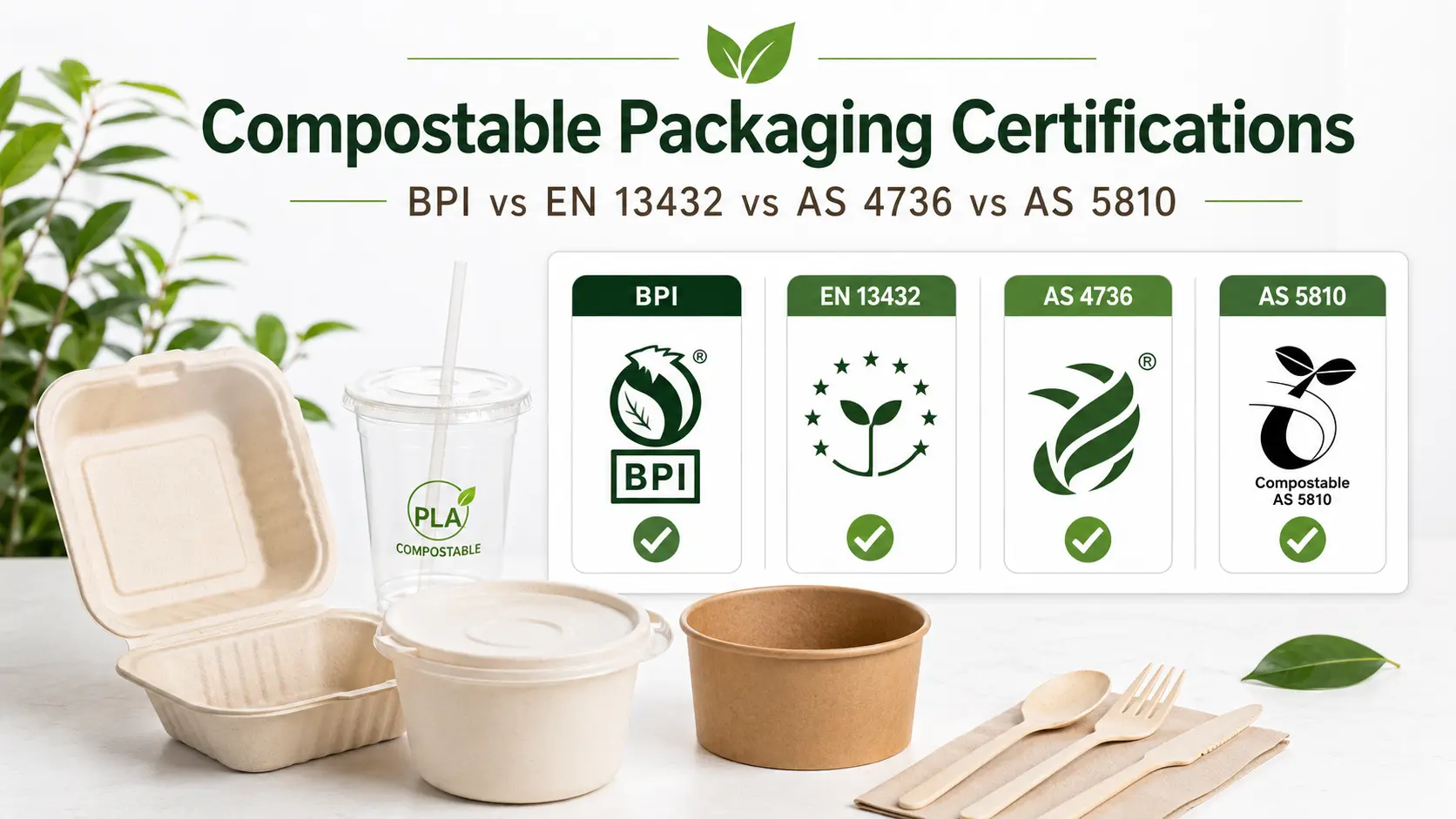
Quick Summary: BPI vs EN 13432 vs AS 4736 vs AS 5810
There is no single global compostability certification that automatically covers every food packaging market. Buyers should match the certification or standard to the destination market, composting route, finished product configuration and local disposal infrastructure.
- BPI: A North American third-party certification program. Its commercial compostability scheme uses ASTM D6400 as the base assessment standard. ASTM International lists ASTM D6400-26 as the current active edition as of September 2026. BPI also operates a separate home compostability certification program.
- EN 13432: A European standard for packaging recoverable through industrial composting and biodegradation. Certification marks may be issued through schemes operated by organizations such as TÜV AUSTRIA or DIN CERTCO.
- AS 4736: The Australian standard used for commercial compostability verification of eligible biodegradable plastic products.
- AS 5810: The Australian standard for products intended for home composting conditions.
- Important: Compostability certification does not automatically prove food-contact compliance, universal PFAS compliance, recyclability or acceptance by every composting facility.
Buyer decision formula: The right compostability certification = destination market + applicable standard + composting route + certified product scope + chemical compliance + local waste infrastructure.
What Is Compostable Packaging Certification?
Compostable packaging certification provides independent evidence that a material or finished product meets defined requirements for biodegradation, disintegration and environmental safety under specified composting conditions. However, buyers should distinguish between a standard, a certification scheme and a certification mark.

1. Compostability Standard
A standard defines the technical requirements and test criteria a material or product must satisfy. Examples include ASTM D6400, EN 13432, AS 4736 and AS 5810.
2. Certification Body or Certification Scheme
A certification organization evaluates testing, formulation information and other evidence to determine whether an eligible product meets the requirements of its certification program. BPI is one well-known example in North America, while TÜV AUSTRIA, DIN CERTCO and the Australasian Bioplastics Association operate relevant verification or certification programs in other markets.
3. Certification Mark
A certification mark is the approved symbol that may appear on an eligible certified product or its packaging. Possessing a material test report does not automatically authorize a manufacturer, converter, distributor or private-label buyer to print every certification logo.
Procurement warning: “Tested according to ASTM D6400,” “made from BPI-certified resin,” and “BPI Certified” do not necessarily mean the same thing. Always verify the exact finished product, certificate owner, product listing and permitted certification-mark usage.
Bioleader® maintains a dedicated Certificates & Test Reports resource covering available compostability, food-contact, PFAS-related and manufacturing documentation. Because certificates may apply to particular products, materials or configurations, buyers should request the latest document applicable to the SKU being sourced.
BPI Certification: What North American Buyers Should Know
BPI is one of the most recognized third-party compostability certification organizations for foodservice products and packaging in North America. For commercial compostability certification, BPI uses ASTM D6400 as its base assessment standard, with additional standards or assessment routes available for eligible product constructions.
As of September 2026, ASTM International lists ASTM D6400-26 as the current active edition. BPI has also highlighted the 2026 revision as a strengthening of biodegradation requirements for compostable products, including tighter treatment of individual constituents. Buyers reviewing older reports or specifications that cite D6400-23 should confirm the current certification-program and customer requirements rather than assuming that an older document is automatically invalid.
This distinction matters because ASTM develops technical standards, while BPI operates a certification program that evaluates eligible products against defined technical and program requirements.
For a more focused introduction to the North American system, see Bioleader®’s guide to BPI Certified Compostable Packaging. For the technical Europe-versus-North-America comparison, use Bioleader®’s EN 13432 vs ASTM D6400 buyer guide.

BPI Commercial Compostability
BPI commercial certification is designed for eligible items intended for managed commercial composting systems. In addition to compostability testing, BPI maintains requirements covering product eligibility, labeling and chemical considerations.
BPI-certified products can also be checked through its searchable product database. This is especially useful for importers and distributors because the buyer can compare the supplier name, product description and item information against the certification being presented.
BPI Home Compostability Is Now a Separate Certification Route
An important 2026 update is that buyers should no longer describe BPI simply as “commercial compostability only.” BPI launched a separate Home Compostability Certification Program beginning in late 2025. The home program is based on a different technical framework from its commercial certification and requires commercial certification as a prerequisite.
2026 update: When reviewing a BPI claim, ask whether the product is certified for commercial compostability, home compostability, or both. Do not infer home compostability from the ordinary BPI commercial certification mark alone. BPI’s searchable product catalogue identifies commercially certified items and separately indicates which listed items also hold home-compostability certification.
What Is EN 13432?
EN 13432 is a European standard, not a certification company. It defines requirements for packaging recoverable through composting and biodegradation, including biodegradation, disintegration, ecotoxicity and controlled limits for relevant substances.
This distinction is frequently misunderstood in international purchasing. A supplier may say that a product “meets EN 13432,” while another may present an OK compost INDUSTRIAL or Seedling certification based on an applicable certification scheme. Buyers should identify the actual certificate, certificate holder, product scope and certification body rather than relying only on the phrase “EN 13432 certified.”
For a dedicated explanation of the European framework, see Understanding EN 13432 Certification for Bagasse and PLA Tableware.

EN 13432 Primarily Addresses Industrial Composting
EN 13432 is associated with controlled industrial composting conditions. It should not be interpreted as automatic evidence that a package will compost effectively in an unmanaged backyard compost pile.
Certification schemes such as OK compost INDUSTRIAL use controlled industrial composting requirements, while home-compostability claims require a separate applicable certification route.
EN 13432 ≠ home compostability. A product designed and certified for industrial composting should not be marketed as home compostable unless separate evidence supports that claim.
For EU purchasing teams, Bioleader®’s PPWR 2026 foodservice packaging checklist provides the broader framework for checking compostability evidence together with food-contact, PFAS, labeling, material and supplier-document requirements.
What Is AS 4736?
AS 4736-2006 incorporating Amendment 1-2009 is the Australian standard used for commercial compostability verification of eligible biodegradable plastic products. The Australasian Bioplastics Association operates a Commercial Compostable Verification Programme associated with AS 4736 and the relevant Seedling trademark system.
AS 4736 shares certain technical principles with international industrial compostability standards, but buyers should not assume that an EN 13432 certificate, ASTM report or other foreign certificate automatically grants Australian verification or trademark rights. The ABA verification programme includes its own eligibility, testing, independent assessment and trademark requirements.
For Australian procurement, importers should verify whether the actual product is covered by the appropriate Australian verification or sublicensing arrangement rather than relying only on a supplier statement that the material has been tested elsewhere.
What Is AS 5810?
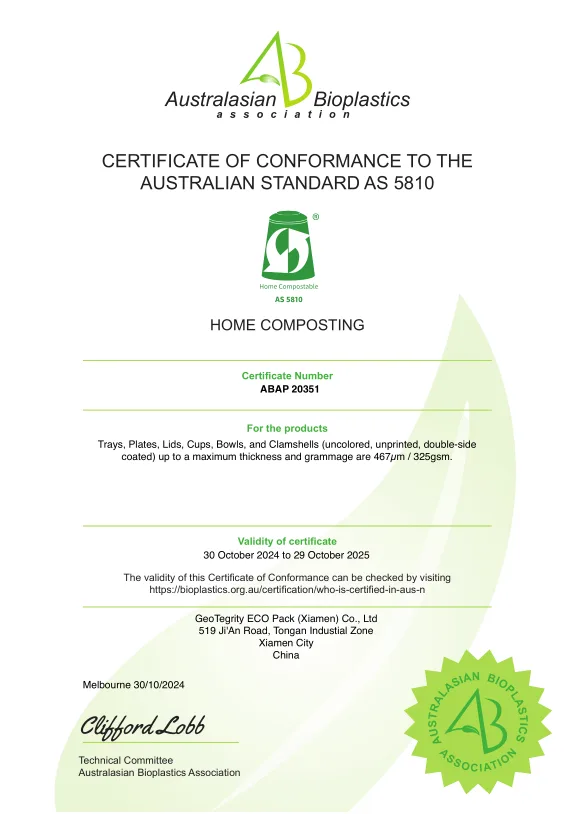
AS 5810-2010 is Australia’s standard for products intended to biodegrade in home composting systems. Home composting generally operates at lower and less controlled temperatures than commercial composting, so the verification conditions are different.
The Australasian Bioplastics Association manages the Home Compostable Verification Programme and associated Home Compostable logo for eligible products meeting AS 5810.
AS 5810 and AS 4736 should not be treated as interchangeable. The ABA specifically states that meeting AS 5810 does not automatically prove compliance with AS 4736 because the test conditions and requirements differ.
BPI vs EN 13432 vs AS 4736 vs AS 5810: Key Differences
| Framework | What It Is | Primary Market Context | Composting Route | Buyer Takeaway |
|---|---|---|---|---|
| BPI | Third-party certification organization and certification scheme | North America | Commercial; separate home certification also available | Verify the BPI product listing, SKU, certification type and current status. |
| EN 13432 | European technical standard for compostable packaging | Europe | Industrial composting | Check the certification body, scheme, certificate scope and finished product. |
| AS 4736-2006 + Amdt 1-2009 | Australian standard | Australia and New Zealand procurement context | Commercial composting | Verify appropriate Australian certification or sublicensing rather than assuming foreign certification is automatically equivalent. |
| AS 5810-2010 | Australian standard | Australia and New Zealand procurement context | Home composting | Use specifically when a genuine home-compostability claim is required. |
For buyers comparing the two major industrial-compostability references used in international trade, Bioleader® also provides a dedicated EN 13432 vs ASTM D6400 guide. This broader 2026 article should be used when the purchasing decision also involves BPI certification, Australian standards, certification scope and end-of-life requirements.
ASTM D6400 vs BPI: Are They the Same Thing?
No. ASTM D6400 is a technical standard, while BPI is a certification organization and certification scheme.
As of September 2026, ASTM D6400-26 is the current active ASTM edition. BPI uses ASTM D6400 as the base standard for commercial certification and may also use ASTM D6868 or ASTM D8410 for eligible constructions under its certification scheme.
This is one of the most common errors in compostable packaging procurement. A supplier may have laboratory data referencing ASTM D6400 without having a finished product listed as BPI Certified. Conversely, a valid BPI certification incorporates defined testing and certification-scheme requirements rather than functioning as a simple ASTM laboratory report.
For procurement purposes, buyers should ask:
- Is this only an ASTM D6400 test report?
- Is the finished product BPI Certified?
- Is the certification commercial, home compostable, or both?
- Is the supplier or brand authorized to use the certification mark?
- Does the product listing cover the exact thickness, color, printing and SKU being purchased?
ASTM D6400 vs EN 13432: Are They Equivalent?
ASTM D6400 and EN 13432 address similar industrial-compostability objectives, but buyers should not treat them as automatically interchangeable market credentials.
This article uses them only as part of the wider certification decision. For the detailed technical comparison—including ASTM D6400-26, product scope, home-compostability boundaries and buyer verification—see Bioleader®’s dedicated EN 13432 vs ASTM D6400 guide for export buyers.
For broader export planning, see Bioleader®’s 2026 Global Compostable Packaging Regulations Guide, which examines compostability requirements alongside EPR and market-specific packaging obligations.
AS 4736 vs AS 5810: Commercial Composting vs Home Composting
| Factor | AS 4736 | AS 5810 |
|---|---|---|
| Primary composting environment | Commercial composting | Home composting |
| Process conditions | Managed and controlled | Lower-temperature, less controlled household composting conditions |
| Typical claim | Commercially compostable | Home compostable |
| Automatic equivalence? | No | No |
| Buyer verification | Check AS 4736 verification and trademark scope | Check AS 5810 verification and Home Compostable logo scope |
This distinction matters particularly for foodservice brands promoting disposal instructions directly to consumers. A commercial-compostability certification cannot safely be rewritten as “put this in your home compost” without appropriate home-compostability evidence.
The ABA currently verifies commercial compostability to AS 4736-2006 incorporating Amendment 1-2009 and home compostability to AS 5810-2010. Its guidance also makes clear that conformance with one standard cannot simply be assumed to establish conformance with the other because the test conditions and requirements differ.
Which Compostability Certification Does a Food Packaging Buyer Actually Need?
The answer depends primarily on where the product will be sold, what the packaging is made from, what sustainability claim will appear on the product and where the packaging is expected to go after use.
For the United States and North American Foodservice Programs
Buyers commonly evaluate ASTM compostability standards together with BPI certification requirements. If BPI certification is requested, the exact finished product should be checked against the BPI certification database rather than accepting a generic raw-material certificate.
North American buyers sourcing transparent cold-drink packaging can review Bioleader®’s compostable PLA cups, while procurement teams should confirm the current certificate scope for the specific cup, lid and configuration selected.
For European Markets
EN 13432 remains an important technical reference for industrially compostable packaging in Europe. However, European packaging compliance is broader than EN 13432 alone. The EU Packaging and Packaging Waste Regulation, national waste systems, labeling requirements, food-contact rules and actual composting infrastructure also influence what can be marketed and how it should be disposed of.
For this reason, buyers should separate the question “Is the package compostable?” from the broader question “Is this packaging configuration compliant and appropriate for my EU market?”
For implementation, use Bioleader®’s PPWR 2026 foodservice packaging checklist to review compostability together with material structure, food-contact evidence, PFAS, labeling and supplier documentation.
For Australia and New Zealand
Buyers should determine whether the intended disposal claim is commercial compostability or home compostability. AS 4736 and AS 5810 serve different purposes, and certification or trademark rights should be checked for the actual finished product.
For Multi-Market Distribution
A distributor supplying North America, Europe and Australia may need more than one certification pathway. The most efficient approach is to define target markets before selecting the material, coating, printing structure and certification strategy.
Manufacturer Insight
Certification should be considered during product selection, not after production is complete. Changing a coating, increasing thickness, introducing printing, switching a lid or altering a formulation can affect whether an existing certification remains relevant to the finished product. For OEM and private-label projects, Bioleader® recommends defining the destination market and required claims before finalizing the packaging structure.
Does Compostability Certification Prove Food-Contact Safety?
No. Compostability and food-contact safety are separate compliance questions.
A package may demonstrate compostability performance while still requiring independent food-contact documentation for the intended destination market and food application.
Depending on the product material and market, buyers may need to review documents associated with frameworks such as FDA food-contact requirements, EC No. 1935/2004, applicable EU plastic food-contact requirements, LFGB testing or other national regulations.
Compostability certificate ≠ food-contact certificate. A responsible buyer should verify both independently.
This is why Bioleader® organizes its compliance documents and test reports by product type rather than presenting “eco-friendly” as a single universal compliance claim.
Does Compostability Certification Mean PFAS-Free?
Not automatically in every regulatory context. Buyers should distinguish between PFAS-related requirements inside a particular certification scheme and broader chemical compliance obligations imposed by the destination market.
BPI’s current commercial certification scheme includes restrictions relating to intentionally added fluorinated chemicals and total organic fluorine. The Australian verification programs also include restrictions concerning fluorinated chemicals for eligible certified products.
However, these scheme-specific requirements should not be treated as universal evidence that a packaging product satisfies every PFAS law, reporting threshold or food-packaging restriction worldwide.
For molded-fiber applications, Bioleader® discusses this issue in more detail in PFAS-Free Sugarcane Tableware for 100°C Hot Food. Buyers evaluating sustainability claims more broadly should also review How to Verify Truly Compostable Food Packaging.
Buyer warning: Do not use a generic compostability certificate as the only evidence for PFAS compliance. Review the certification scheme, formulation requirements, available PFAS statements or test reports, and the destination market’s current chemical restrictions separately.
What Does a Compostability Certificate Actually Cover?
This is one of the most important questions in B2B sourcing. A certificate may cover a specific formulation, thickness range, product family, component or finished item. Buyers therefore need to verify the certificate scope rather than checking only whether a PDF contains a recognizable logo.
Certificate Scope Checklist
- Certificate holder: Which company actually owns the certification?
- Product or SKU: Is the exact item being purchased listed or covered?
- Material formulation: Does the certified formulation match the supplied product?
- Thickness or grammage: Is the selected construction within the approved range?
- Color: Are colored and uncolored versions both covered where relevant?
- Coating or barrier: Is the complete coated structure covered?
- Printing and ink: Does custom printing affect certification scope?
- Lid: Is the lid certified separately or included with the container?
- Label or adhesive: Are additional components included in the certified configuration?
- Certification status: Is the certificate or database listing current?
The same principle applies to broader regulatory documentation. Bioleader®’s PPWR Declaration of Conformity guide explains why compliance evidence should be mapped to the correct material, product configuration and SKU rather than treated as a general company-level claim.
A Certified Raw Material Does Not Automatically Certify the Finished Package
This distinction is particularly important for converters and private-label buyers.
A certified resin, coated paper, pulp formulation or component may support a finished-product certification application, but the finished package can introduce additional variables such as thickness, printing, adhesives, coatings, labels and multilayer structures.
For this reason:
- A certified PLA resin does not automatically certify every PLA cup produced from it.
- A certified compostable coating does not automatically certify every coated paper bowl.
- A certified container does not automatically certify a separately sourced lid.
- A certified unprinted product does not always mean every custom-printed configuration can use the same certification mark without review.
For B2B procurement, the finished-product scope matters more than the sustainability reputation of the raw material.
How Compostability Certification Applies to Different Food Packaging Materials
Sugarcane Bagasse and Molded Fiber Packaging
Sugarcane bagasse tableware is produced primarily from molded plant fiber, but buyers should still examine the complete formulation. Oil- and water-resistance systems, additives, surface treatments, lids and printing can affect compliance evaluation.
This is particularly important for bagasse clamshells, bowls, plates and trays sold with strong claims such as “certified compostable,” “home compostable” or “PFAS-free.” The claim should correspond to the actual evidence available for the product family and destination market.
PLA Cups and Lids
PLA is one of the packaging materials most closely associated with industrial compostability certification. However, PLA is not automatically suitable for every composting environment merely because it is plant-derived.
For clear PLA cups, procurement teams should verify the cup and lid combination, product thickness, certification listing, printing configuration and intended commercial composting route.
CPLA and Compostable Cutlery
CPLA cutlery is commonly used where greater heat resistance is needed compared with standard PLA. Buyers sourcing biodegradable and compostable cutlery should confirm the exact resin formulation and finished-product certification rather than relying only on the term “CPLA.”
Cutlery bundled with napkins, paper sleeves or individual wrappers may also introduce additional packaging components with separate disposal routes.
Paper Cups, Bowls and Food Containers
Paper-based packaging illustrates why material names alone are insufficient. A paper bowl may use PE, PLA, water-based or other barrier technologies, and each structure can have a different end-of-life route.
Buyers reviewing Bioleader®’s paper food packaging should therefore specify the barrier structure before requesting compostability documentation.
For example, a PLA-coated paper bowl may be evaluated differently from a conventional PE-coated paper bowl. Paper substrate, barrier, printing, adhesive and lid should be treated as a packaging system rather than judged from the word “paper” alone.
Cornstarch-Based Tableware
The term “cornstarch tableware” is especially important to verify carefully because commercial formulations can vary significantly.
A buyer should never assume that every product marketed as cornstarch-based is automatically certified compostable. The actual polymer blend, additives and finished-product certification determine which claim can be supported.
Bioleader® offers different cornstarch tableware formats for foodservice applications, but certification and disposal claims should always be checked against the specific formulation and product selected.
How Buyers Can Verify a Compostability Certificate Before Ordering
10-Step Buyer Verification Process
- Request the full certificate rather than a cropped certificate image or certification logo.
- Identify whether the document refers to a standard, laboratory test or third-party certification.
- Confirm the certificate owner or licensee.
- Check the certificate or registration number.
- Match the product name or SKU to the item being purchased.
- Confirm the material, coating, thickness and color.
- Verify whether the container, lid, label and other components are included.
- Check whether custom printing changes the approved configuration.
- Search the certification body’s public database when one is available.
- Confirm that the certification matches the destination market and intended disposal route.
For OEM and Private-Label Projects
Before approving artwork or mass production, buyers should send the intended sustainability claim, certification mark, destination country and packaging configuration to the supplier for document review. This helps identify problems before printing thousands of cartons or finished packages with an unsupported compostability claim.
Common Compostability Certification Mistakes Importers Make
Mistake 1: Treating EN 13432 as a Certification Company
EN 13432 is a standard. Buyers should still identify the actual certification scheme and organization that evaluated the product.
Mistake 2: Treating ASTM D6400 and BPI as the Same Thing
ASTM D6400 provides technical requirements. BPI operates a third-party certification scheme that uses ASTM D6400 as its commercial base standard and adds program-specific requirements.
Mistake 3: Assuming Industrial Compostable Means Home Compostable
Industrial composting and home composting operate under different conditions. A commercial compostability claim does not automatically support a home-compostability claim.
Mistake 4: Checking Only the Raw Material Certificate
A resin or coating certificate does not necessarily cover the entire printed food container being imported.
Mistake 5: Ignoring the Lid
A compostable bowl supplied with a PET or PP lid is a mixed end-of-life system. Buyers should describe and label each component accurately.
Mistake 6: Assuming Certification Guarantees Local Composting Acceptance
Even a correctly certified compostable product may not be accepted by every municipal collection program or composting facility. Actual acceptance depends on local infrastructure, contamination policies, processing technology and collection rules.
Mistake 7: Using “Biodegradable” as a Substitute for Verified Compostability
Biodegradable describes a general degradation concept and does not by itself specify the environment, timeframe or certification requirements. Buyers seeking defensible claims should focus on a specific standard, certification scope and disposal route.
Why Verified Claims Matter More Than Generic “Eco-Friendly” Language
The packaging market is moving toward more specific and verifiable sustainability communication. Recent industry analysis shows increasing consumer skepticism toward unverified environmental claims while third-party certifications, clearer disposal instructions, QR codes and digital transparency are gaining relevance.
This changes how sustainable packaging should be presented online.
Instead of relying only on statements such as:
- Eco-Friendly
- Sustainable
- Green Packaging
- Biodegradable
a stronger B2B product-information structure is:
- Material composition
- Applicable compostability standard
- Certification body and certificate scope
- Food-contact documentation
- PFAS-related evidence where applicable
- Intended disposal route
- Destination-market compliance requirements
This evidence-based approach also helps buyers distinguish genuine compostability claims from vague sustainability marketing. Bioleader® discusses the broader greenwashing problem in Beyond Greenwashing: How to Verify Truly Compostable Food Packaging.
What Documents Should B2B Buyers Request?
| Document | What It Helps Verify | Buyer Check |
|---|---|---|
| Compostability certificate | Applicable compostability claim | Match certification scope to product and market. |
| Product listing or certification database record | Current third-party certification status | Check company, SKU and product configuration. |
| Food-contact test report | Suitability for intended food contact | Confirm material and destination-market requirements. |
| PFAS statement or applicable test report | Chemical compliance evidence | Check testing method, detection limits and applicable regulation. |
| Material declaration or TDS | Material composition and technical structure | Compare with actual ordered specification. |
| Product specification | Dimensions, weight, coating and performance | Ensure it corresponds to the certified configuration. |
| Artwork approval | Environmental claims and certification-logo usage | Verify marks and disposal instructions before printing. |
Bioleader® Approach to Compostability and Packaging Compliance
Bioleader® manufactures and supplies biodegradable and compostable food packaging for international B2B markets, including molded sugarcane bagasse tableware, PLA cold cups, compostable cutlery, cornstarch-based tableware and paper food packaging.
For export buyers, Bioleader® supports compliance review through available certification documents, food-contact reports, material information, PFAS-related documentation, technical data sheets and product specifications. The appropriate document set depends on the product, formulation, destination country and buyer requirement.
Rather than selecting packaging only because it carries a general “biodegradable” or “eco-friendly” description, buyers should first define the food application, destination market, intended disposal route and required certification framework. Bioleader® can then help match available product families and supporting documents to those requirements.
Buyers comparing multiple certified product families can also review Bioleader®’s compostable tableware solution before requesting product-specific certificate and test-report matching.
Buyer Recommendation: Certification Should Be Market-Specific, Not Marketing-Driven
The best compostability certificate is not simply the certificate with the most recognizable logo. It is the certification evidence that accurately matches the destination market, finished product, composting environment and sustainability claim being made.
For a U.S. foodservice buyer, this may mean checking a BPI product listing and ASTM-based commercial compostability evidence. For European procurement, it may mean evaluating EN 13432-related certification together with the evolving PPWR framework and national waste infrastructure. For Australian projects, the distinction between AS 4736 commercial compostability and AS 5810 home compostability can be decisive.
The procurement process should therefore move from:
“Is this packaging eco-friendly?”
to:
“What exactly is the material, what claim are we making, which standard supports it, what finished product is certified, and where will this package actually go after use?”
Conclusion
BPI, EN 13432, AS 4736 and AS 5810 solve different certification and market questions. No single document should be assumed to provide universal approval for every compostable packaging application or country.
For B2B importers, distributors, restaurant chains and private-label brands, the safest approach is to verify certification scope at SKU level and review compostability together with food-contact compliance, chemical requirements, product construction and local end-of-life infrastructure.
Bioleader® supports global buyers sourcing certified and compliance-ready food packaging from China. Buyers can review our Certificates & Test Reports and product categories, or provide the destination market and product requirements so the appropriate documentation can be evaluated before ordering.
Frequently Asked Questions
What certification should compostable food packaging have?
There is no single certification required for every market. North American buyers commonly evaluate BPI and ASTM-based certification, European buyers frequently reference EN 13432-related certification schemes, while Australia uses AS 4736 for commercial compostability and AS 5810 for home compostability. Buyers should verify the destination market, finished product scope and intended disposal system before selecting a certification requirement.
Is BPI the same as ASTM D6400?
No. ASTM D6400 is a technical compostability standard, while BPI is a third-party certification organization. BPI uses ASTM D6400 as the base assessment standard for its commercial compostability certification and applies additional eligibility, labeling and certification-scheme requirements. A laboratory report referencing ASTM D6400 does not automatically mean the finished product is BPI Certified.
Does BPI certification mean a product is home compostable?
Not automatically. BPI operates both commercial and home compostability certification routes. Its traditional commercial certification should not be interpreted as proof of home compostability. Buyers should check whether the exact BPI-certified product is specifically listed for home compostability as well as commercial compostability.
Is EN 13432 accepted in the United States?
EN 13432 is primarily a European compostability standard and should not automatically be treated as a substitute for North American certification requirements. A product exported to the United States may need ASTM-based evidence, BPI certification or other documentation depending on the product, buyer specification and applicable local rules. Multi-market buyers should evaluate each destination separately.
What is the difference between AS 4736 and AS 5810?
AS 4736 covers commercial compostability under managed composting conditions, while AS 5810 is designed for home composting environments. The test conditions differ, and compliance with one standard should not automatically be assumed to prove compliance with the other. Australian buyers should select the standard that matches the intended disposal claim.
Does compostable certification mean PFAS-free?
Not universally. Some certification schemes, including current BPI and Australian programs, contain restrictions relating to fluorinated chemicals. However, a compostability certificate should not be used as the sole evidence of compliance with every PFAS regulation. Buyers should separately review applicable PFAS statements, test reports, chemical restrictions and destination-market requirements.
How can buyers verify whether a compostability certificate covers the finished product?
Check the certificate owner, certification number, product name, SKU, formulation, thickness, color, coating, printing and other components such as lids and labels. Where available, search the certification body’s official product database. The most important question is whether the actual finished packaging configuration being ordered falls within the current certification scope.
References & Verification Sources
- ASTM International — ASTM D6400-26, current active edition.
- Biodegradable Products Institute — Compostability Certification, including commercial and home certification routes.
- BPI — Find Certified Products, searchable product-level certification database.
- Australasian Bioplastics Association — Certification, including AS 4736-2006 incorporating Amendment 1-2009 and AS 5810-2010.
- European Commission — 2026 PPWR Guidance, including current guidance on compostable packaging and EN 13432.
- Innova Market Insights — Sustainable Packaging Innovation in Food and Beverage 2026, published August 21, 2026.