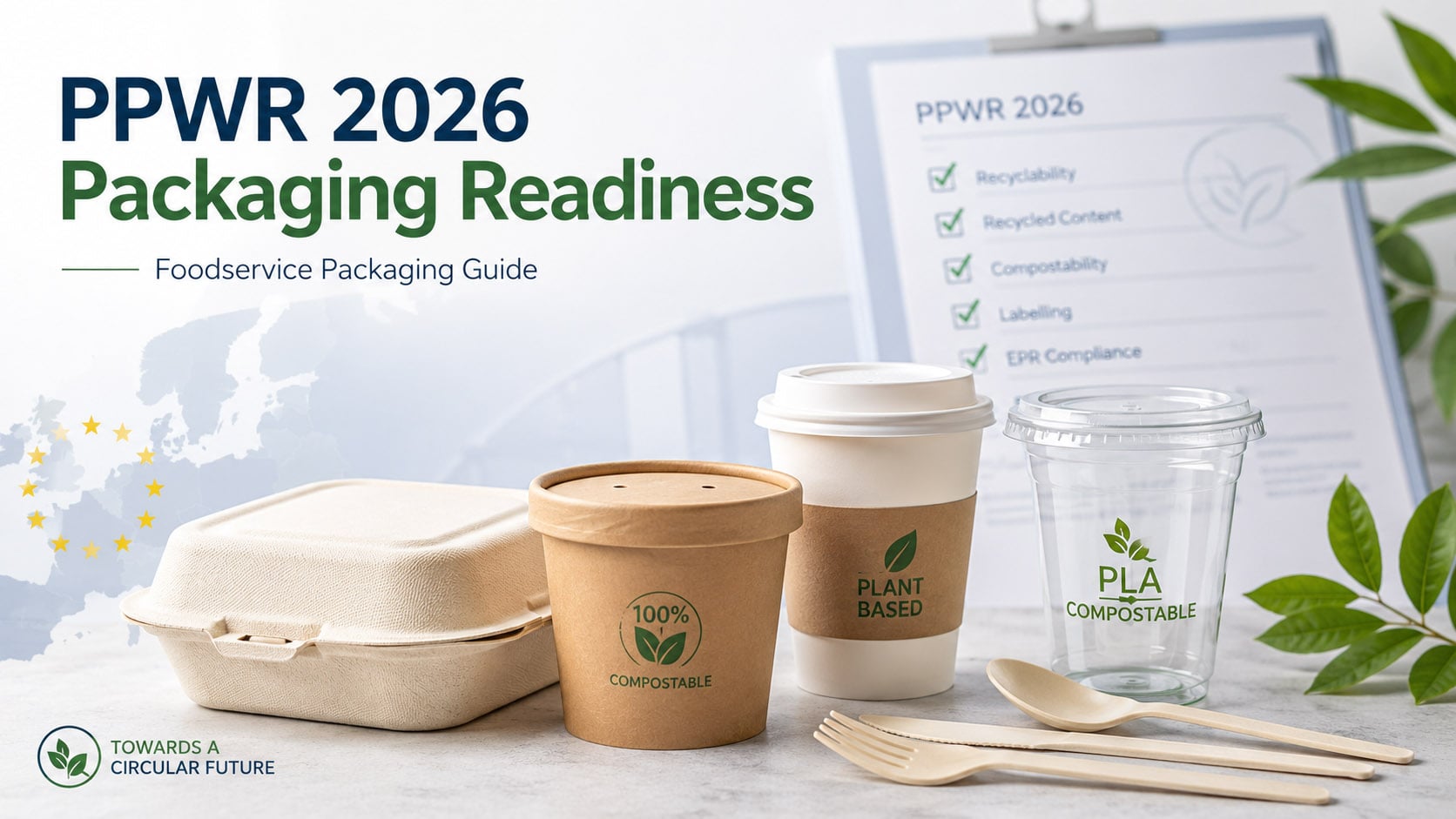
Regulatory Status — August 2026: Regulation (EU) 2025/40, the Packaging and Packaging Waste Regulation (PPWR), generally applies from 12 August 2026. However, the harmonised packaging-label specifications required under Article 12 follow later implementation dates. At the time of this update, Bioleader®’s review of EUR-Lex did not identify final Article 12(6) and Article 12(7) implementing acts establishing the complete harmonised label specifications and digital material-identification methodology. Exporters should therefore avoid redesigning EU packaging around assumed future PPWR pictograms before the official specifications are confirmed.
The EU Packaging and Packaging Waste Regulation has entered its implementation phase, but one practical question remains especially important for food packaging exporters: what exactly should be printed on packaging sold in Europe?
Buyers are increasingly asking about recycling marks, material codes, compostable logos, QR codes, reusable-packaging information and environmental claims. The difficulty is that PPWR is already generally applicable, while several harmonised labelling requirements have later application dates and depend on implementing acts that define the final formats and specifications.
For exporters of sugarcane bagasse tableware, paper food packaging, PLA cups and other takeaway packaging, the correct strategy in 2026 is therefore not to guess what the future EU label will look like. The priority is to maintain accurate material information, defensible environmental claims, editable artwork and product-specific compliance documentation while monitoring the final Article 12 rules.
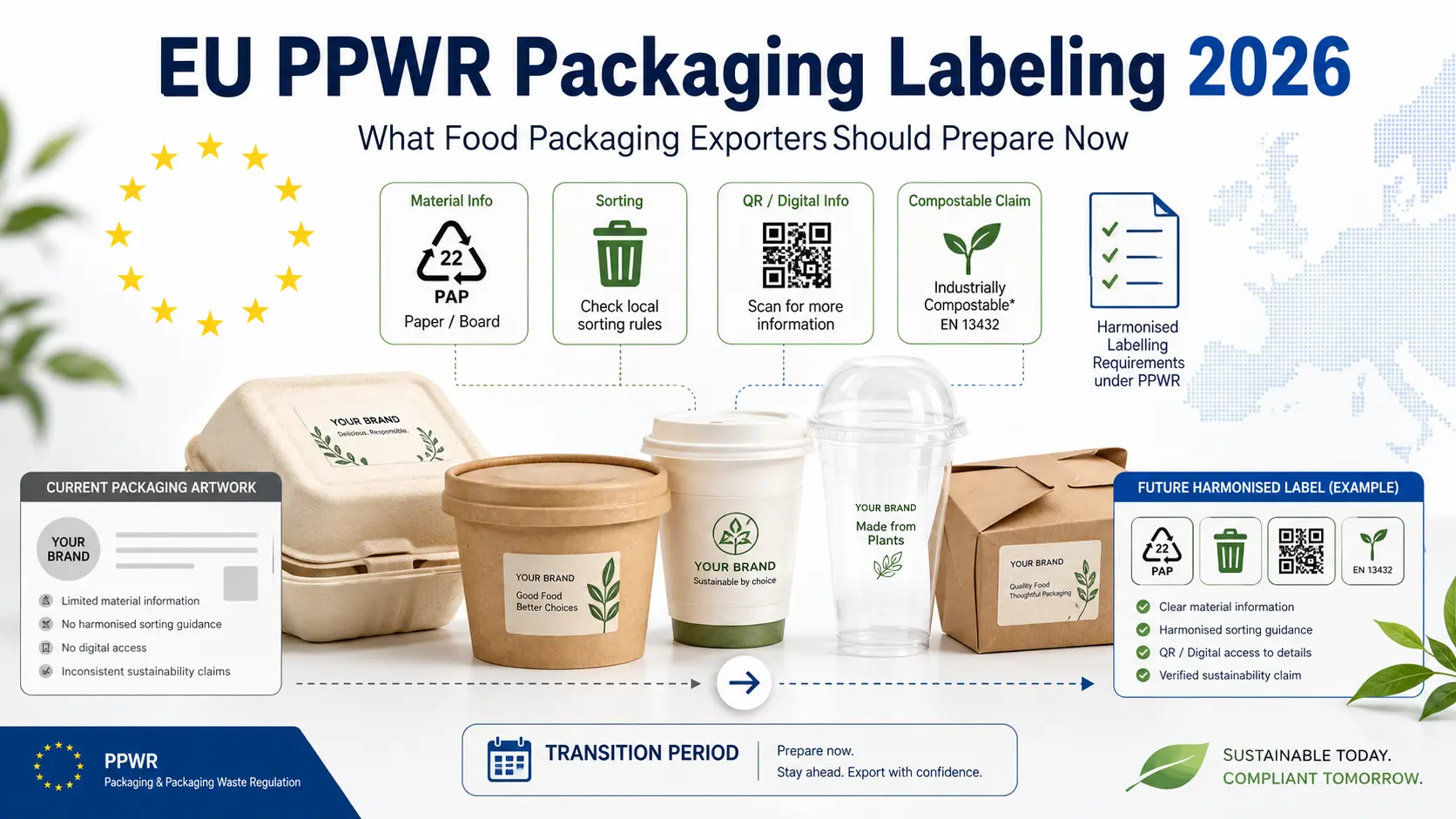
Quick Summary: What Should Food Packaging Exporters Know About PPWR Labels in 2026?
- PPWR generally applies from 12 August 2026, but the harmonised material-composition label is not automatically mandatory from that date.
- The Article 12 material-composition label applies from 12 August 2028 or 24 months after the relevant implementing acts enter into force, whichever date is later.
- The future harmonised label will use pictograms to help consumers identify packaging materials and sort packaging waste.
- Reusable packaging has a separate later labelling timetable and will require digital information about re-use systems and collection points.
- A QR code can provide additional information, but exporters should not assume that a QR code can universally replace a mandatory physical PPWR label.
- Commission Decision 97/129/EC remains relevant during the transition and is repealed from 12 August 2028.
- Certification marks such as compostability logos should only be printed when the product, certificate scope and logo-use authorization support the claim.
Buyer takeaway: In 2026, the safest artwork strategy is to verify current destination-market requirements, keep future PPWR label areas editable and avoid printing an unofficial “PPWR recycling label” before the harmonised specifications are formally adopted.
What Changed for PPWR Packaging Labels in August 2026?
Article 12 of Regulation (EU) 2025/40 required the European Commission to adopt implementing acts by 12 August 2026 establishing harmonised packaging labels, technical specifications and relevant digital formats for several PPWR labelling requirements.
This deadline is different from the date on which those harmonised labels become mandatory on packaging. The Regulation deliberately provides transition periods so manufacturers, importers, converters and brand owners have time to change packaging artwork, production systems and waste-sorting communication.
This distinction matters because some packaging discussions incorrectly interpret 12 August 2026 as the date when every food container, cup or bowl must already carry the final EU PPWR recycling pictogram.
That is not the correct reading of Article 12.
Bioleader® has already covered the broader implementation framework in its EU PPWR 2026 Guidance for Foodservice Packaging. This article focuses only on labelling, artwork and the practical decisions exporters need to make during the transition period.
When Do Harmonised PPWR Packaging Labels Become Mandatory?
For the harmonised material-composition label under Article 12(1), the key date is not simply 12 August 2026.
The requirement applies from:
12 August 2028 or 24 months from the date the relevant Article 12 implementing acts enter into force, whichever is later.
The future label is intended to provide information on packaging material composition and help consumers sort packaging waste correctly. It will be based on harmonised pictograms designed to work consistently across the EU market.
| PPWR Label Requirement | Key Timing | What Exporters Should Do in 2026 |
|---|---|---|
| Harmonised material-composition / sorting label | 12 August 2028 or 24 months after relevant implementing acts enter into force, whichever is later | Do not invent future pictograms. Keep artwork adaptable. |
| Reusable packaging label | 12 February 2029 or 30 months after the relevant implementing act enters into force, whichever is later | Prepare systems for both physical and digital re-use information. |
| Recycled-content or bio-based-content label | Harmonised from 12 August 2028 or 24 months after the relevant implementing act, whichever is later | These claims are voluntary, but future use must follow harmonised specifications. |
| Existing 97/129/EC material identification system | Applicable until 12 August 2028 | Check current EU and destination-country requirements before changing material codes. |
Important: “PPWR applies from 12 August 2026” and “PPWR harmonised labels become mandatory” are two different legal timelines. Exporters should not combine them into one deadline.
What Information Will the PPWR Harmonised Label Cover?
The core Article 12 label is designed to communicate material composition and waste-sorting information. The Regulation also establishes specific labelling approaches for reusable packaging, recycled or bio-based content, compostable packaging and certain digital information.
For food packaging buyers, the main areas to prepare for are:
- material composition and consumer sorting information;
- harmonised pictograms corresponding with waste-collection systems;
- specific information for packaging subject to PPWR compostability requirements;
- reusable-packaging identification and re-use-system information;
- voluntary recycled-content or bio-based-content communication;
- QR codes or other standardised digital data carriers where permitted or required;
- accurate environmental claims supported by technical documentation.
The long-term objective is to reduce the fragmented national packaging-label systems that currently make cross-border packaging artwork difficult for brands selling the same product in several EU Member States.
What Should Exporters Print on Food Packaging Right Now?
There is no responsible one-line answer such as “print this PPWR symbol now.” The correct 2026 approach depends on the destination market, packaging structure, current national requirements, buyer specifications and claims used on the artwork.
2026 Artwork Checklist for EU Food Packaging
- Confirm the packaging material: Bagasse, paper, PE-coated paper, PLA-coated paper, PLA, PET, PP and multi-component structures should not use the same disposal wording.
- Check current destination-country requirements: Transitional national systems may still affect packaging entering individual EU markets.
- Verify material identification: Do not invent new resin or material codes based on assumed future PPWR graphics.
- Review environmental claims: “Recyclable,” “compostable,” “plastic-free,” “bio-based” and similar claims should match the actual product construction and available evidence.
- Verify certification logos: A compostability certificate does not automatically authorize every buyer, importer or private-label brand to print the certification mark.
- Keep artwork editable: EU packaging artwork approved in 2026 may need modification when final harmonised PPWR specifications become operational.
- Record each approved version: Maintain artwork revision numbers and connect them with the correct product SKU and technical specification.
Manufacturer Insight: Avoid Locking Future PPWR Labels Into Expensive Packaging Too Early
For custom-printed paper cups, bowls, takeaway boxes and other high-volume foodservice packaging, artwork changes can require new printing plates, cylinders, samples or approval rounds. During the current PPWR transition, Bioleader® recommends keeping recycling and regulatory information in an editable artwork zone instead of building an assumed future EU pictogram permanently into the brand design.
What Material Code Should EU Food Packaging Use in 2026?
Before the new PPWR harmonised system takes over, Commission Decision 97/129/EC remains relevant to the EU packaging-material identification framework until 12 August 2028.
The European Commission’s 2026 PPWR guidance clarifies that use of the 97/129/EC abbreviation system is voluntary for manufacturers at EU level, but where a packaging-material identification system is used during this transition, the existing Decision remains the reference system. Exporters must also consider applicable Member State requirements.
Decision 97/129/EC is scheduled to be repealed from 12 August 2028 as the PPWR harmonised system replaces the old identification structure.
Practical rule: Do not replace an existing legally appropriate PAP, plastic or composite-material identification with an unofficial “PPWR code” simply because PPWR began applying in August 2026.
This issue is particularly relevant to paper cups, bowls and food boxes, because the final disposal route may depend not only on the paperboard but also on PE, PLA, aqueous barriers, adhesives and other components.
Can a QR Code Replace the Physical PPWR Label?
Not as a general rule.
Article 12 allows digital information to play an important role, but a QR code should not be treated as a universal substitute for the future physical harmonised material label.
For the material-composition label, economic operators may add a QR code or another standardised, open digital data carrier containing information about the destination of separate packaging components to help consumers sort the packaging correctly.
Reusable packaging is different. Under the later reusable-packaging rules, information about re-use systems, collection points and related tracking information is intended to be made available through a QR code or another standardised digital data carrier.
PPWR also treats some EPR information differently: the Commission’s 2026 guidance explains that physical EPR labels are not permitted under Article 12(9), with such information instead provided digitally.
| Information Type | Can QR / Digital Information Be Used? | Can Exporters Assume It Replaces the Physical Label? |
|---|---|---|
| Material sorting information | Yes, additional digital information can be provided. | No. Do not assume digital-only compliance. |
| Reusable packaging information | Yes. Digital information has a defined role. | The applicable Article 12 requirements must still be followed. |
| Recycled-content information | Digital information may be used where applicable. | Future harmonised specifications still apply. |
| EPR information | Yes. | PPWR provides for digital rather than physical EPR labelling. |
Can Exporters Print a Compostable Logo Under PPWR?
PPWR does not mean that any package described as biodegradable can automatically carry a compostable logo.
There are two separate questions:
- Does the packaging fall within an applicable PPWR compostability requirement or support a defensible compostability claim?
- Is the manufacturer, certificate holder, importer or brand authorized to use the specific third-party certification mark being printed?
For packaging covered by Article 9(1), and where applicable Article 9(2), Article 12 requires the future harmonised label to communicate that the material is compostable, that it is not suitable for home composting and that the packaging must not be discarded in nature.
This is different from independently using certification marks such as OK compost, Seedling or another third-party mark. Those logos remain subject to the applicable certification scheme, certified-product scope and trademark-use conditions.
Buyers needing to understand the difference between compostability standards and certification schemes should review Bioleader®’s guide to BPI vs EN 13432 vs AS 4736 vs AS 5810.
Certification warning: Never add a compostability logo to custom artwork only because the raw material supplier holds a certificate. Confirm whether the finished SKU, thickness, coating, printing and relevant license arrangement are covered.
What About “Recyclable,” “Bio-Based” and Other Sustainability Claims?
PPWR is moving EU packaging communication away from broad environmental marketing and toward claims that can be supported by defined regulatory criteria and technical documentation.
Article 14 is particularly relevant. Environmental claims concerning packaging properties regulated by PPWR must comply with the Regulation’s requirements and must identify whether the claim relates to the entire packaging unit, a component or a wider packaging portfolio.
This means food packaging artwork should avoid vague combinations such as:
- 100% sustainable packaging;
- fully recyclable without evidence of the relevant packaging structure and recycling route;
- home compostable when only industrial compostability evidence is available;
- plastic-free when a polymer coating or plastic lid is part of the supplied configuration;
- PFAS-free based only on an unrelated certificate or another product SKU.
For broader compliance preparation, Bioleader®’s PPWR 2026 Foodservice Packaging Checklist covers PFAS, material documentation, compostability, coating systems and supplier evidence beyond labelling alone.
How Should Importers Prepare Their Packaging Artwork Before the Final Label Rules?
The best response to an unfinished regulatory specification is not to stop packaging development. It is to build artwork and supplier documentation in a way that allows controlled changes later.
PPWR Label Readiness Checklist
- Define the exact EU destination countries for the product.
- Record the full material structure of each packaging component.
- Separate container, lid, sleeve, label and other components in the specification.
- Confirm the current material identification and sorting requirements.
- Verify every recyclable, compostable or bio-based claim before artwork approval.
- Confirm authorization before printing third-party certification logos.
- Reserve a flexible area for future harmonised PPWR information where practical.
- Keep the original AI, EPS or editable PDF artwork rather than only a flattened print file.
- Connect each artwork revision with the corresponding product SKU and specification.
- Review the artwork again when the relevant Article 12 implementing specifications become effective.
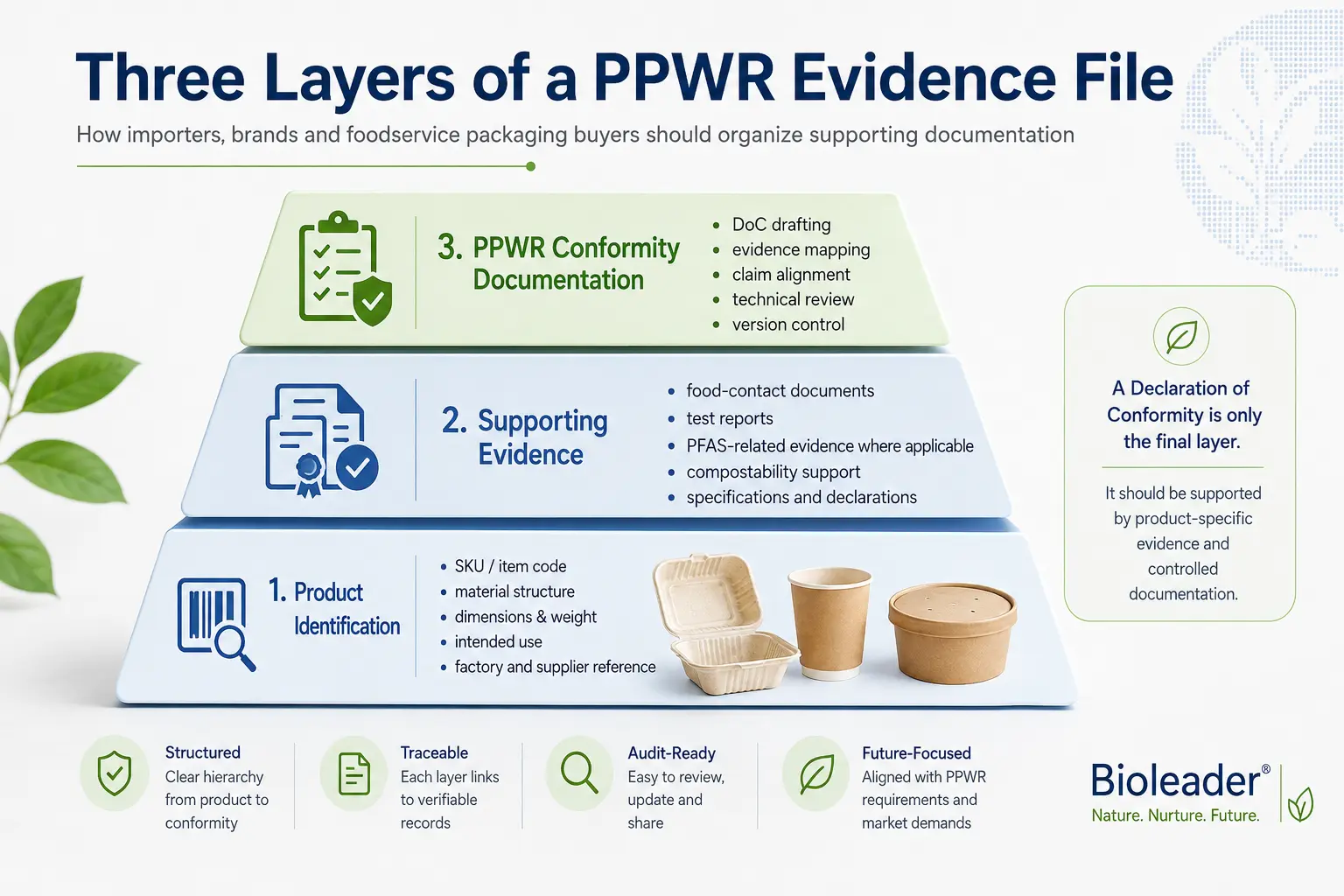
The same SKU-level approach should also be used for technical documentation. Bioleader®’s PPWR Declaration of Conformity and Evidence Mapping Guide explains how material specifications, reports, certificate scope and declarations should be connected to identifiable packaging products rather than treated as generic company-level documents.
What This Means for Bagasse, Paper and PLA Food Packaging
PPWR labelling preparation should reflect the actual material system rather than the marketing name of the product.
Sugarcane Bagasse Containers
For molded bagasse food packaging, buyers should distinguish the fibre substrate from any functional additives, barrier treatment, separately supplied lid, label or printed component. Compostability and disposal wording should match the evidence for the finished configuration.
Paper Cups, Bowls and Food Boxes
Paper packaging may contain PE, PLA, water-based barriers or other functional layers. A paper substrate alone does not determine the correct recycling or composting communication. The complete packaging construction should be recorded before final artwork approval.
PLA Cups
For compostable PLA cups, buyers should avoid communicating industrial compostability as though it were the same as ordinary plastic recycling or home composting. Cup, lid and printed components may also require separate review.
How Bioleader® Supports PPWR Label Readiness
Bioleader® manufactures and supplies foodservice packaging for European importers, distributors, restaurant groups and private-label projects. During the PPWR transition, buyers can request product specifications, material information, relevant food-contact reports, PFAS-related evidence, compostability documentation where applicable and artwork review information for selected packaging products.
Available supporting documents can be reviewed through the Bioleader® Certificates & Test Reports resource. Because compliance evidence may differ by material, SKU, coating and destination market, buyers should confirm the current document scope before using a certificate or test report in their own PPWR compliance file.
For custom printing projects, Bioleader® recommends confirming the destination country and required environmental claims before mass-production artwork is locked. This reduces the risk of reprinting packaging when PPWR labelling specifications or customer requirements change.
PPWR Packaging Label Checklist: What Is Clear and What Is Still Developing?
| Buyer Question | 2026 Position |
|---|---|
| Does PPWR apply from 12 August 2026? | Yes, generally, although individual obligations have different application dates. |
| Must every package already use the final harmonised PPWR sorting label? | No. The Article 12(1) harmonised-label obligation has a later application date. |
| Can we design our own future PPWR recycling pictogram? | No. Wait for the applicable official harmonised specifications. |
| Can existing material codes still matter? | Yes. Decision 97/129/EC remains part of the transition framework until 12 August 2028. |
| Can a QR code replace every physical label? | No. Digital information supplements or serves specific PPWR functions depending on the requirement. |
| Can a compostable logo be printed automatically? | No. Verify certification scope, logo authorization and the exact product configuration. |
| Should 2026 custom artwork remain editable? | Yes. This is one of the most practical ways to reduce future PPWR transition cost. |
Conclusion: Prepare the Artwork Now, but Do Not Guess the Final PPWR Label
The PPWR labelling transition creates an unusual situation for food packaging exporters: the Regulation is already generally applicable, but several harmonised labelling specifications operate on later timelines and depend on detailed implementing rules.
The correct response is not to ignore PPWR, but it is also not to invent labels before the official system is confirmed.
Exporters should prepare accurate material data, verify certification and environmental claims, maintain editable artwork, map compliance documents to individual SKUs and monitor the final Article 12 specifications.
For Bioleader® buyers, this approach is especially relevant to custom-printed bagasse containers, paper cups and bowls, takeaway boxes and compostable packaging supplied to EU distributors and foodservice brands. Buyers planning new European packaging projects can provide the destination country, product structure and proposed artwork so the available technical and compliance documentation can be reviewed before mass production.
Frequently Asked Questions
When do PPWR harmonised packaging labels become mandatory?
The harmonised material-composition label under Article 12(1) applies from 12 August 2028 or 24 months after the relevant implementing acts enter into force, whichever date is later. This should not be confused with 12 August 2026, when the PPWR generally began to apply.
Do food packaging exporters need to print a PPWR recycling label in 2026?
Exporters should comply with current applicable EU and Member State requirements, but they should not invent or anticipate the final harmonised PPWR pictograms. Packaging artwork created in 2026 should remain adaptable so that the official harmonised information can be added when the applicable specifications and transition dates are confirmed.
Can a QR code replace the PPWR packaging label?
Not generally. PPWR allows QR codes and other digital data carriers to provide certain packaging information, but digital communication does not automatically replace the required physical harmonised material label. Reusable packaging and some other information categories have specific digital requirements that should be evaluated separately.
Can exporters still use EU packaging material codes such as PAP in 2026?
Commission Decision 97/129/EC remains relevant during the transition and is repealed from 12 August 2028. The Commission’s 2026 guidance states that use of its abbreviation system is voluntary for manufacturers at EU level, while Member State requirements must also be considered. Exporters should verify the current destination-market rules before changing existing material identification.
Can compostable food packaging carry a compostability logo under PPWR?
A compostability logo should only be used when the product and certification scope support the claim and the relevant certification-mark rules allow its use. A certificate covering raw material or another SKU does not automatically authorize a custom-printed finished package to carry the same third-party certification mark.
Will PPWR require recycled-content information to be printed on every package?
No. The Commission’s 2026 guidance confirms that labels stating recycled-content or bio-based-content shares are voluntary. However, where economic operators choose to make those claims after the relevant harmonised requirements apply, the label must follow the applicable EU specifications and methodology.