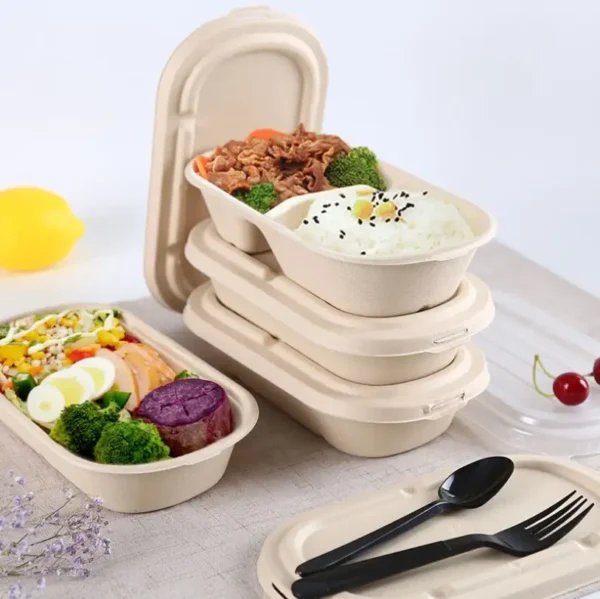










Quick Summary: The Ocean Is Not a Compost Bin
Marine biodegradability is often misunderstood in food packaging. The ocean is not a composting facility. Most biodegradable and compostable food packaging materials are designed to degrade under controlled composting, soil, or specific test conditions, not automatically in seawater.
- Biodegradable does not always mean marine biodegradable. A material may biodegrade in compost, soil, or laboratory conditions but remain highly persistent in seawater.
- Compostable does not mean ocean-safe. Industrial compostability standards such as EN13432 and ASTM D6400 do not prove marine biodegradability.
- Bio-based does not mean seawater-degradable. A plant-based material can still require controlled heat, moisture, oxygen, and microbial activity to break down.
- Fragmentation is not biodegradation. A material that cracks, powders, or becomes smaller in seawater has not necessarily been biologically converted into carbon dioxide, water, minerals, and biomass.
- Marine biodegradable claims must be product-specific. Buyers should ask whether the finished product, not only the resin, has marine biodegradation evidence under a relevant test or certification scope.
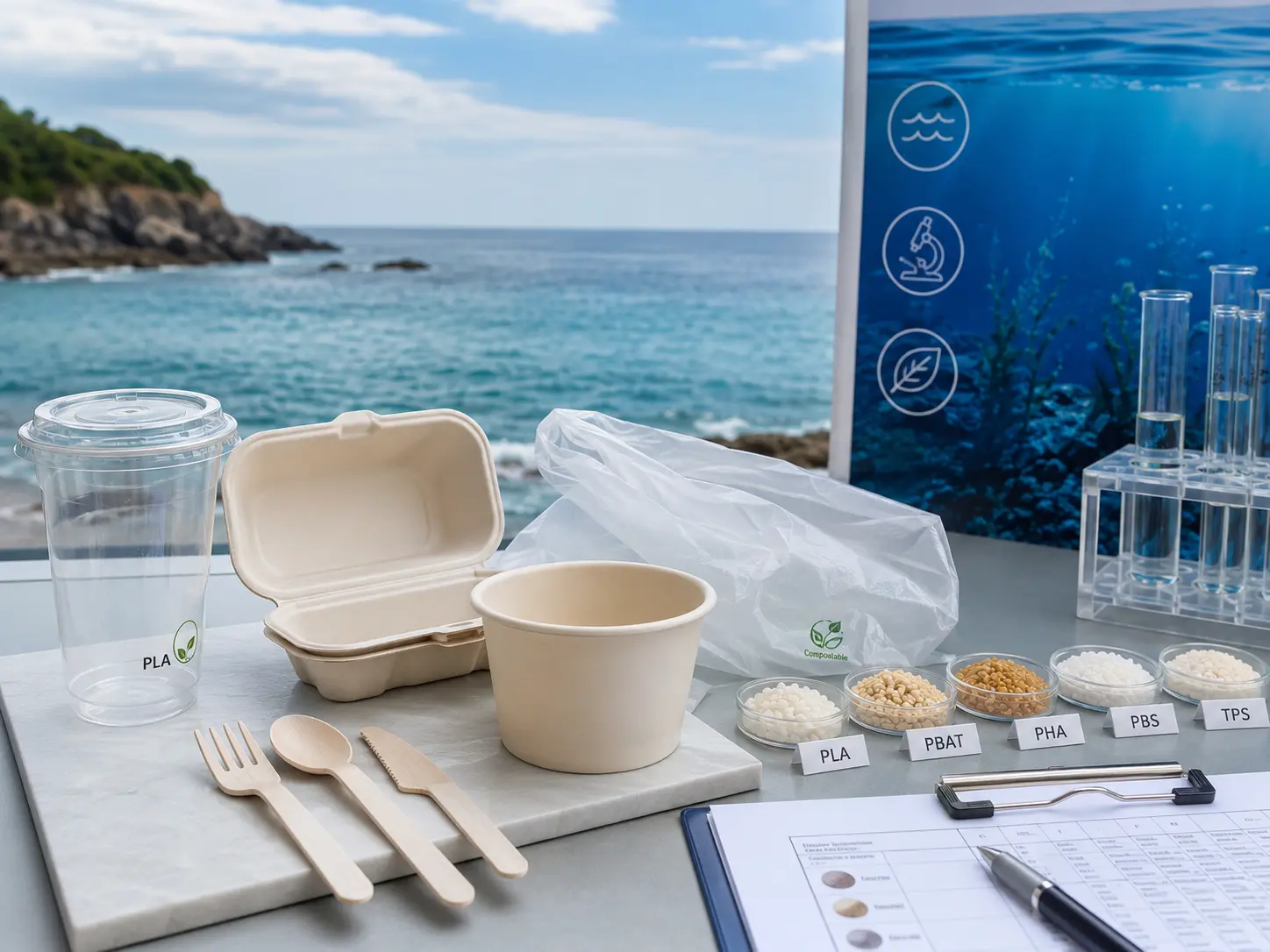
Why “Biodegradable” Does Not Always Mean Marine Biodegradable
The word “biodegradable” is often used as if it were a universal material property. In practice, biodegradation is not controlled by the material name alone. It depends on the material, environment, temperature, oxygen, microbial population, salinity, product thickness, additives, coating, ink, time frame, and disposal route.
For food packaging buyers, this distinction matters because recyclable, biodegradable and compostable packaging claims describe different end-of-life concepts. A package can be bio-based but not biodegradable, biodegradable but not compostable, or compostable in an industrial facility but not marine biodegradable.
This is why biodegradable vs compostable plastics should be evaluated by claim scope, test condition, product design, and destination market. “Biodegradable” alone does not tell a buyer where the product will degrade, how long it will take, or whether the finished packaging has been tested.
Key takeaway: Marine biodegradability is a separate claim. It cannot be assumed from industrial compostability, home compostability, bio-based content, or the word “eco-friendly.”
Why Seawater Is a Difficult Environment for Biodegradation
Seawater is a challenging environment for most biodegradable packaging materials because it does not provide the same conditions as a composting facility. Industrial composting systems are managed to create heat, moisture, oxygen, and active microbial populations. Seawater is colder, more diluted, more variable, and less predictable.
Temperature is one major reason. Many compostable materials degrade much faster at elevated composting temperatures than in cold or moderate seawater. PLA is a good example: it is useful for clear cold drink packaging, but standard PLA usually requires controlled composting conditions and should not be treated as ocean biodegradable.
Microbial activity is another major factor. Compost contains dense and active microbial communities, while seawater microbes are more dispersed and vary by location, depth, salinity, oxygen level, and nutrient availability. A package floating near the surface, sinking to the seabed, or being covered by sediment may face very different degradation conditions.
Physical weathering can also confuse the issue. Sunlight, waves, sand abrasion, and mechanical stress may weaken or break packaging into smaller fragments. However, smaller pieces are not the same as complete biological conversion. In seawater, a product may fragment before it fully biodegrades, creating a risk of persistent residues or microplastic-like particles.
Product design also matters. Thickness, crystallinity, coatings, wet-strength agents, printing inks, laminates, pigments, adhesives, and lids can all affect how a finished food package behaves in seawater. This is why buyers should not rely only on resin-level claims when evaluating marine biodegradability.
Industrial Composting vs Seawater: Two Completely Different Conditions
Many packaging buyers assume that a compostable material will also degrade in the ocean. This is the wrong starting point. Industrial composting and seawater are two very different environments. A product designed for industrial compost vs home compost should not be marketed as marine biodegradable unless separate marine evidence exists.
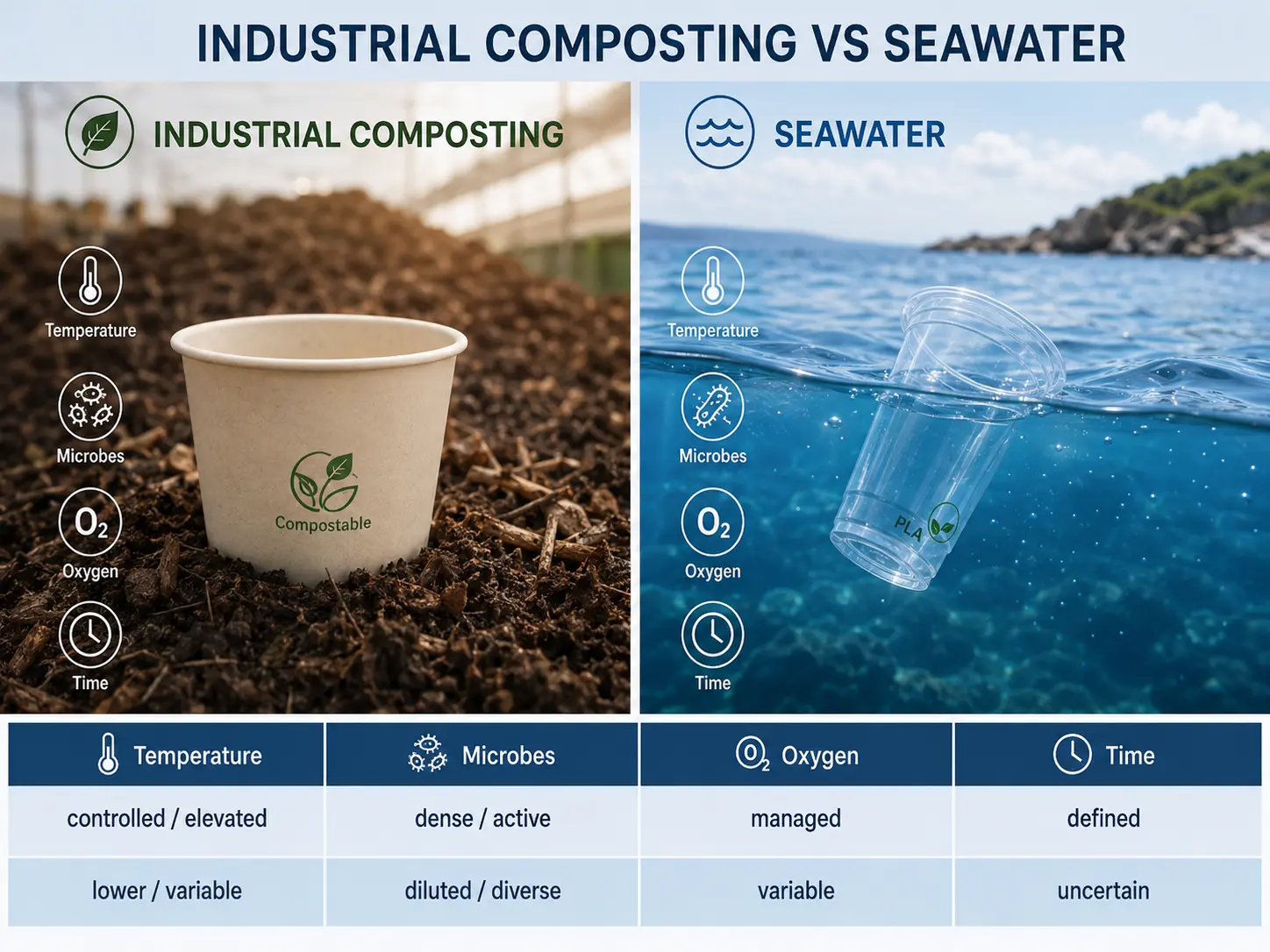
| Condition | Industrial Composting | Seawater | Buyer Meaning |
|---|---|---|---|
| Temperature | Controlled and elevated. | Lower, variable, and location-dependent. | A material that degrades in compost may remain slow in seawater. |
| Microbes | Dense, active, and managed microbial communities. | Diluted, diverse, and less predictable microbial populations. | Microbial conversion cannot be assumed from the material name. |
| Oxygen | Managed aeration supports biological activity. | Varies by depth, water movement, and sediment conditions. | Floating, sinking, and buried packaging can behave differently. |
| Moisture | Controlled moisture supports composting. | Constant water exposure with salinity. | Water exposure alone does not guarantee biodegradation. |
| Nutrients | Abundant organic matter supports microbial activity. | Often nutrient-limited compared with compost. | Biodegradation may be much slower in open water. |
| Time frame | Defined by composting standards and facility operation. | Highly uncertain and strongly site-specific. | Buyers should avoid vague claims such as “degrades naturally.” |
| Material design | Designed for controlled composting routes. | Usually not designed for ocean release. | Marine biodegradability needs separate product evidence. |
| Certification logic | EN13432 vs ASTM D6400 may apply to industrial compostability. | Marine biodegradation requires marine-specific testing or certification. | A compostability certificate is not a marine biodegradability certificate. |
When buyers compare which biodegradable packaging materials decompose fastest, the comparison must always specify the environment. “Fastest” in industrial compost does not mean fastest in seawater, soil, landfill, freshwater, or real foodservice waste streams.
Material-by-Material: PLA, PBAT, PHA, PBS, TPS, Bagasse and Paper
The safest way to discuss marine biodegradability is material by material, and product by product. Different polymers and fiber materials behave differently. Even within the same material family, formulation, thickness, processing, and additives can change performance. For a broader material map, buyers can review PLA, PHA and PBAT material differences before evaluating seawater claims.
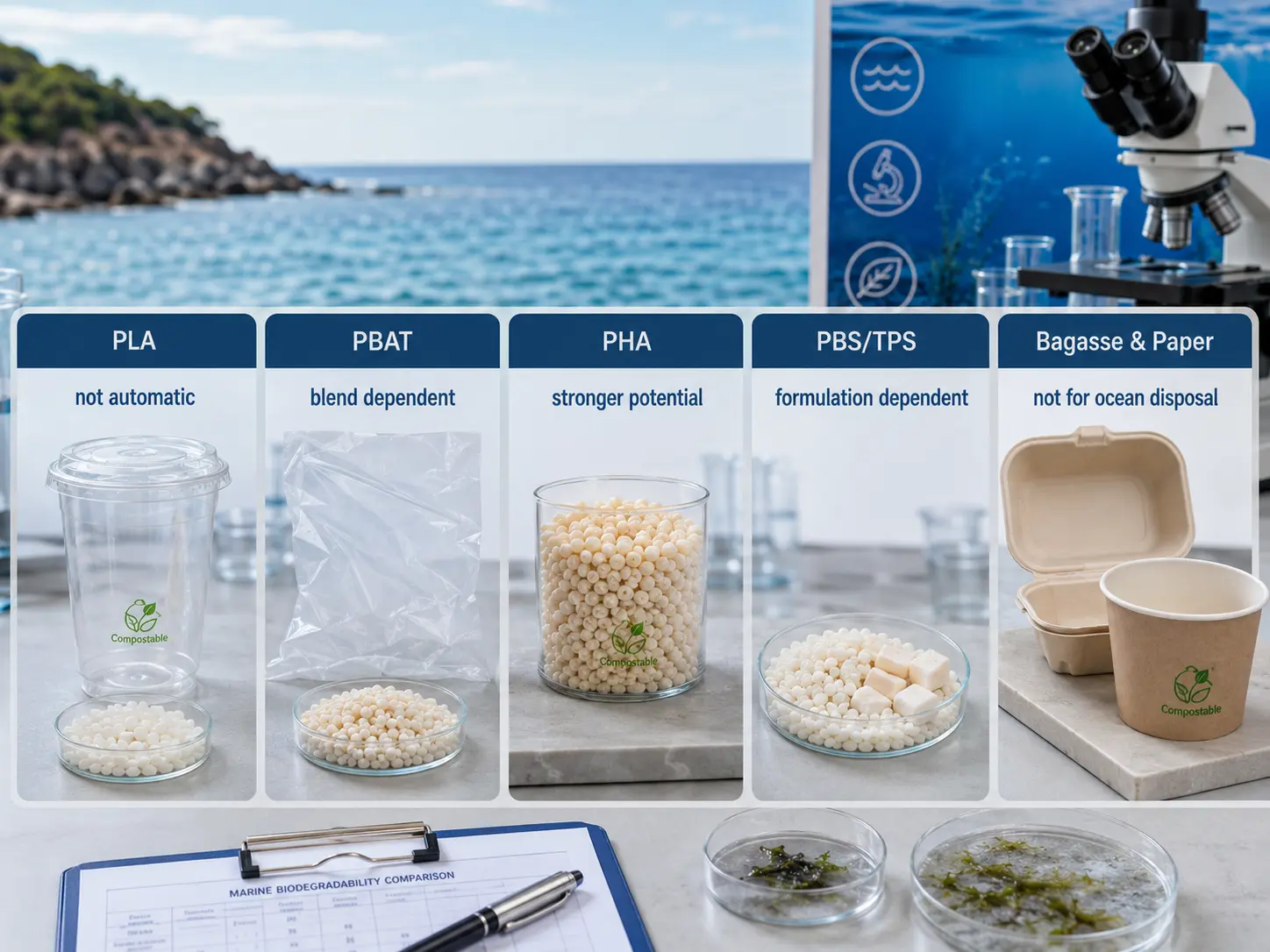
PLA: Useful for Clear Cold Cups, but Not Automatically Marine Biodegradable
PLA is a bio-based polymer commonly used for transparent cold drink cups, cold lids, and some rigid food packaging. It is commercially mature, attractive for beverage presentation, and suitable for cafés, juice bars, smoothie shops, events, and takeaway cold drinks.
However, what PLA is should not be confused with where PLA biodegrades. Standard PLA is not a material that should be described as ocean biodegradable without specific marine evidence. It usually depends on controlled composting conditions and does not behave like a fast-degrading material in ordinary seawater.
PLA is also temperature-sensitive. Buyers using PLA for beverage packaging should understand PLA cup heat resistance and storage tips, because temperature is central to both product performance and end-of-life behavior. In practical sourcing, PLA is best positioned as a cold-use packaging material with a controlled composting route, not as an ocean-disposal solution.
For cold beverage businesses, Bioleader® supplies compostable PLA cups for cold drinks and related PLA clear cup solutions. The correct claim should focus on cold-drink performance, plant-based material content where supported, and industrial compostability evidence where applicable, not on ocean-safe disposal.
PBAT: Flexible and Biodegradable, but Marine Claims Still Need Proof
PBAT is widely discussed because it provides flexibility in biodegradable films, bags, and blend systems. It can support certain biodegradable or compostable formulations, especially where flexibility is required. However, “PBAT biodegradable” does not automatically mean “PBAT marine biodegradable.”
PBAT is usually fossil-based rather than bio-based. Its performance depends heavily on formulation, blend ratio, thickness, product geometry, additives, and the specific test environment. A thin film may behave very differently from a thicker food packaging component. Buyers should ask whether the finished product has marine test evidence, not only whether the resin is described as biodegradable.
PHA and PHB: Stronger Marine Potential, but Still Product-Specific
PHA, including PHB and related PHA grades, is one of the few biopolymer families with stronger marine biodegradation potential than many mainstream compostable plastics. It deserves attention in discussions of marine biodegradability because some PHA materials can be more readily metabolized by microorganisms in natural environments.
However, PHA is not a universal promise. Buyers still need product-specific data. Grade, crystallinity, thickness, processing method, additives, pigments, and final product design can all influence degradation. For mainstream disposable foodservice packaging, PHA may also face cost, supply scale, processing stability, and commercial availability challenges.
The practical conclusion is balanced: PHA may be more relevant to marine biodegradation than PLA, but no buyer should accept a generic statement such as “PHA is ocean biodegradable” without finished-product evidence and clear test conditions.
PBS, TPS and Starch-Based Blends: Formulation Matters More Than the Name
PBS and TPS are often used in biodegradable blend systems. TPS means thermoplastic starch, and it can support starch-based or cost-efficient biodegradable products. However, starch-based does not automatically mean marine biodegradable. PBS and TPS are formulation-dependent materials, and their behavior depends on the complete product structure.
Buyers evaluating starch-based packaging should review the formulation, intended disposal route, compostability evidence, moisture resistance, heat resistance, and finished-product testing. Bioleader® offers cornstarch tableware for foodservice applications, but cornstarch-based products should still be matched to controlled disposal routes rather than ocean release.
For buyers who need more product-level guidance, Bioleader® cornstarch tableware solutions can help compare cornstarch plates, bowls, clamshells, and cutlery-style products according to food type, temperature, strength, cost, and certification requirements.
Bagasse and Paper: Fiber-Based Does Not Mean Ocean Disposal
Sugarcane bagasse and paper are fiber-based materials, so buyers may assume they are more natural and easier to biodegrade. That assumption is only partly useful. Food packaging is not just raw fiber. It may include coatings, wet-strength agents, inks, adhesives, lamination, lids, or barrier treatments that affect real degradation behavior.
In practical foodservice sourcing, bagasse vs PLA material comparison helps buyers understand why bagasse is often better for hot meals, oily food, trays, bowls, and clamshell containers, while PLA is better for clear cold drink presentation. However, neither comparison should be turned into a message that packaging can be released into seawater.
Bioleader® supplies sugarcane bagasse tableware for restaurants, takeaway, catering, and food delivery. These products are best positioned around food-contact safety, PFAS-free requirements where applicable, heat and oil resistance, compostability support, and controlled end-of-life systems, not marine disposal.
Fragmentation Is Not Biodegradation
One of the biggest misunderstandings in marine degradation is the difference between fragmentation and biodegradation. Fragmentation means the material becomes smaller. Biodegradation means microorganisms convert the organic carbon into carbon dioxide, water, mineral salts, and biomass under suitable conditions.
In seawater, sunlight, waves, abrasion, heat cycles, and mechanical stress may weaken a packaging item. It may crack, become brittle, lose visual integrity, or break into smaller particles. But smaller pieces are not proof of complete biodegradation. A fragment can persist, move through the water column, settle into sediment, or be ingested by organisms.
This is especially important for buyers reviewing “degradable,” “oxo-degradable,” or vague “breaks down naturally” claims. A product that physically breaks apart may still leave persistent residues. For responsible packaging procurement, the question is not only whether the product disappears visually, but whether it is biologically converted under documented and relevant conditions.
Buyer warning: If a supplier only shows visual disintegration photos, weight loss, or cracked samples, ask whether the test measures ultimate biodegradation, disintegration, ecotoxicity, and the exact exposure condition. Visual disappearance is not enough for a marine biodegradability claim.
Which Standards Are Relevant to Marine Biodegradability?
Standards and certifications are important, but they should not become the whole article. The main point is simple: a compostability certificate is not a marine biodegradability certificate. Buyers should understand which environment each standard addresses.
| Standard or Scheme | Main Relevance | Does It Prove Marine Biodegradability? | Buyer Interpretation |
|---|---|---|---|
| EN13432 | Compostability of packaging under controlled composting conditions. | No. | Useful for EU compostability discussions, but not proof of seawater degradation. |
| ASTM D6400 | Compostable plastics in municipal or industrial composting conditions. | No. | Relevant to North American compostability claims, not marine claims. |
| ISO 22403 | Intrinsic aerobic biodegradability and environmental safety of virgin plastic materials and polymers exposed to marine inocula under laboratory conditions. | Not by itself for every finished product claim. | Useful marine-related evidence, but buyers must check scope, sample type, product structure, and claim wording. |
| OK biodegradable MARINE | Product certification scheme related to biodegradation in seawater. | Closer to a marine claim when formally certified. | Buyers should verify the exact product, thickness, material, certificate scope, and permission to use the mark. |
| OK biodegradable WATER | Biodegradation in fresh water conditions. | No, not automatically. | Freshwater biodegradation should not be converted into a seawater claim without marine evidence. |
Buyers should treat marine biodegradability as a specific evidence file. The file should identify whether the test applies to resin, film, sheet, molded article, printed product, coated product, or the exact finished packaging item sold to the market.
What Food Packaging Buyers Should Ask Before Accepting Marine Claims
Marine biodegradability claims can create commercial, compliance, and reputational risk if they are too broad. Before accepting any marine claim, food packaging buyers should ask practical questions that connect the claim to the finished product and the real disposal route.
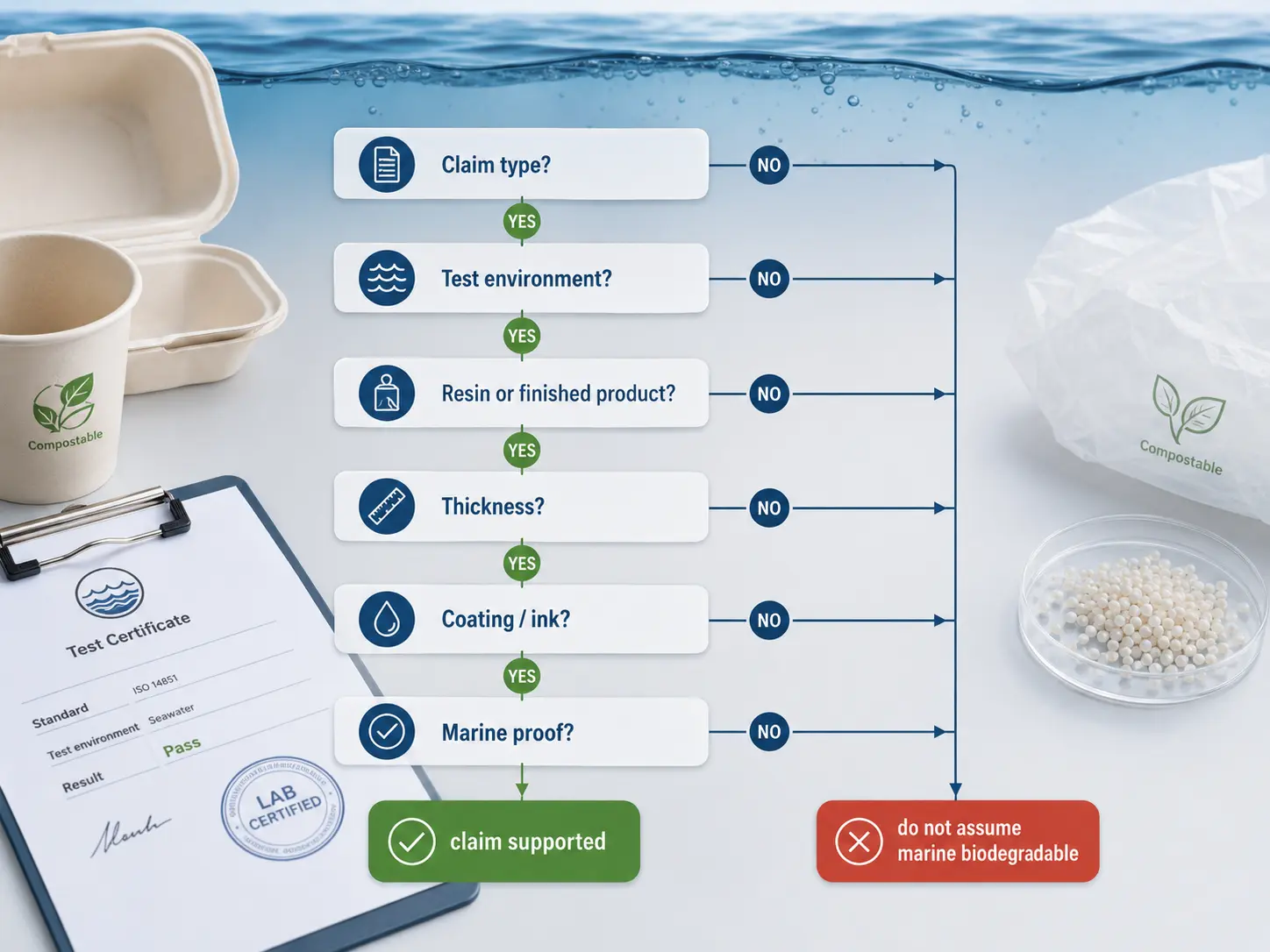
- What exactly is the claim? Is the supplier claiming biodegradable, compostable, bio-based, marine biodegradable, or ocean-safe?
- Which environment was tested? Was the test conducted in industrial compost, home compost, soil, freshwater, seawater, marine sediment, or a laboratory marine inoculum system?
- What was tested? Was the sample resin, film, sheet, raw material, molded product, printed packaging, coated packaging, or the actual finished food container?
- What was the sample thickness? Thin films may behave differently from rigid cups, clamshells, bowls, plates, trays, or cutlery.
- Does the product include coatings or inks? Coatings, wet-strength additives, printing inks, pigments, glue, and lids may change degradation behavior.
- Does the certification match the claim? Industrial compostability should not be used as evidence for marine biodegradability.
- Does the claim encourage littering? No biodegradable claim should imply that packaging can be safely discarded into the ocean or natural environment.
- What is the realistic end-of-life route? Buyers should ask where the product will actually go after use: composting facility, incineration, landfill, recycling, waste collection, or uncontrolled leakage.
Bioleader® View: Design for Controlled End-of-Life, Not Ocean Disposal
Bioleader® does not recommend using “marine biodegradable” as a general claim for disposable food packaging unless the exact finished product has product-specific marine biodegradation evidence. For most foodservice buyers, the safer and more responsible strategy is to match materials with controlled end-of-life routes.
For clear cold beverages, Bioleader® compostable PLA clear cups can support cafés, juice bars, bubble tea shops, cold brew brands, and event operators that need transparency and cold-drink presentation. The material message should focus on cold-use suitability and controlled composting support, not ocean disposal.
For hot meals, oily dishes, trays, clamshells, bowls, and takeaway food, sugarcane bagasse tableware solutions are often more practical than PLA because molded fiber provides better heat and food-holding performance. However, bagasse packaging should still be collected and treated through responsible waste systems rather than released into seawater.
For forks, spoons, knives, and sporks, compostable cutlery for foodservice and Bioleader® compostable cutlery solutions can help buyers match CPLA or cornstarch-based cutlery to application, temperature, rigidity, packing format, and certification requirements.
For buyers comparing multiple packaging families, Bioleader® recommends reviewing the sustainable packaging material sourcing guide before making product claims. The right question is not “Will this disappear in the ocean?” but “Which material, product design, certification, and disposal route match the buyer’s real foodservice operation?”
| Foodservice Need | Recommended Direction | Claim Boundary |
|---|---|---|
| Clear cold drinks | PLA cups and lids for cold-use applications. | Do not describe standard PLA as marine biodegradable without marine evidence. |
| Hot meals and oily food | Bagasse containers, bowls, plates, trays, and clamshells. | Fiber-based does not mean safe for ocean disposal. |
| Cutlery | CPLA or cornstarch-based cutlery depending on use case and market. | Compostability and marine biodegradability are separate claims. |
| Cost-sensitive tableware | Cornstarch tableware or blended formulations where suitable. | Starch-based does not automatically mean seawater biodegradable. |
| Material innovation projects | PHA or marine-related material evaluation with test evidence. | Use product-specific proof, not generic polymer promises. |
Conclusion: Marine Biodegradability Must Be Proven, Not Assumed
Marine biodegradability is not a slogan. It is a specific performance claim that depends on material chemistry, product design, test conditions, microbial activity, oxygen, temperature, salinity, thickness, and time. Most biodegradable and compostable packaging materials are not designed to disappear in seawater.
The safest commercial position for B2B food packaging buyers is clear: do not treat industrial compostability, bio-based content, or general biodegradability as proof of marine biodegradability. Ask for product-specific evidence, check the test environment, review the finished product structure, and avoid any claim that sounds like permission to litter.
For importers, distributors, restaurant chains, and foodservice brands planning a packaging transition, Bioleader® can support material selection, product matching, claim boundary review, certification document checking, OEM/private label planning, and bulk supply for export-ready compostable and biodegradable food packaging.
FAQ: Marine Biodegradability and Food Packaging
Does biodegradable plastic degrade in seawater?
Not necessarily. Biodegradation depends on the material, environment, temperature, microbes, oxygen, thickness, salinity, product formulation, and time. A plastic that biodegrades under industrial composting or laboratory conditions may degrade very slowly in ordinary seawater.
Is compostable packaging marine biodegradable?
No. Compostable packaging is designed to meet specific composting conditions, usually industrial or home composting depending on the certification. Marine biodegradability is a separate claim and requires marine-specific testing or certification evidence.
Does PLA degrade in the ocean?
Standard PLA should not be treated as ocean biodegradable. PLA is useful for clear cold drink cups and rigid cold-use packaging, but it usually needs controlled composting conditions to biodegrade efficiently. Buyers should not describe PLA packaging as ocean-safe without product-specific marine evidence.
Is PHA marine biodegradable?
Some PHA materials have stronger marine biodegradation potential than PLA, but buyers still need product-specific test data. PHA type, product thickness, processing method, additives, pigments, and final packaging design can all affect real marine biodegradation performance.
Is PBAT marine biodegradable?
PBAT may biodegrade under certain conditions and is often used in flexible biodegradable blends, but this does not automatically make it marine biodegradable. Buyers should verify formulation, product thickness, test environment, and finished-product certification before accepting a marine claim.
Can bagasse packaging be called marine biodegradable?
Not automatically. Bagasse is a fiber-based material, but finished food packaging may include coatings, wet-strength agents, inks, adhesives, lids, or barrier treatments. Bagasse packaging should be positioned for responsible collection and controlled end-of-life, not ocean disposal.
What certification proves marine biodegradability?
Buyers should look for marine-specific testing or certification evidence, such as ISO 22403-related test data or relevant product certification schemes like OK biodegradable MARINE where applicable. EN13432 and ASTM D6400 are compostability standards and do not prove marine biodegradability.
Does marine biodegradable mean safe to litter?
No. Marine biodegradability is not permission to discard packaging into the ocean. Even when a product has marine-related evidence, responsible waste prevention, collection, sorting, composting, recycling, or disposal remains necessary.
References
- United Nations Environment Programme: Biodegradable Plastics and Marine Litter: Misconceptions, Concerns and Impacts.
- European Commission: Biobased, Biodegradable and Compostable Plastics.
- ISO: ISO 22403:2020 Plastics — Assessment of Intrinsic Biodegradability in Marine Environments.
- TÜV AUSTRIA: OK biodegradable MARINE Certification Scheme.
- TÜV AUSTRIA: OK biodegradable Product Certification Overview.