









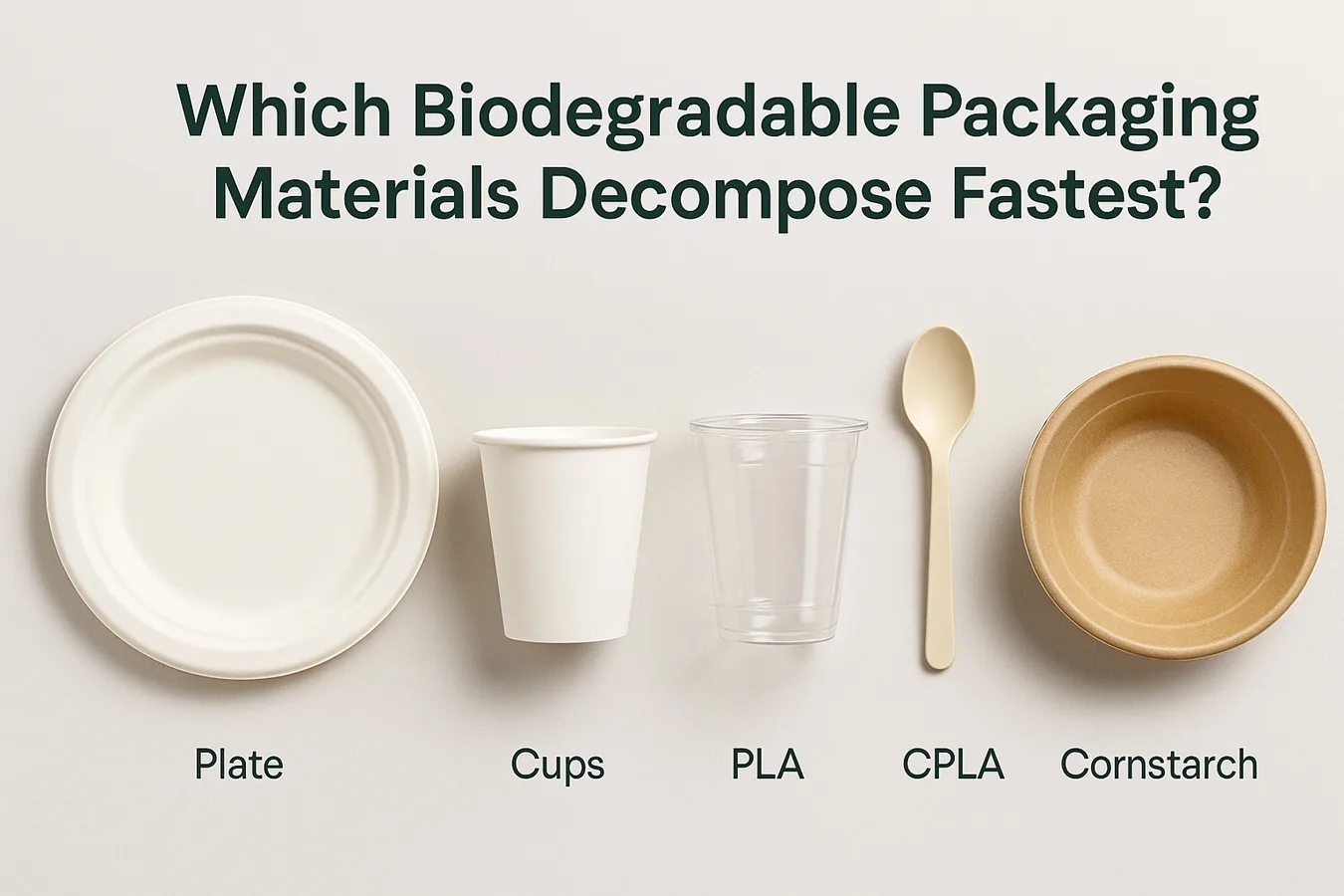
In 2025, “biodegradable” is everywhere on packaging—cups, bowls, bags, and cutlery. But for serious buyers, regulators, and distributors, the key question is no longer “Is it biodegradable?” but “How fast, how completely, and under what conditions does it actually break down?”
From sugarcane bagasse to PLA and cornstarch blends, not all “eco materials” behave the same in real composting and waste systems. Some will disappear within a few weeks in a compost pile; others need controlled industrial conditions; a few leave plastic residues that contradict the whole idea of circular packaging.
This article ranks the main biodegradable and compostable food packaging materials from most to least biodegradable, backed by published research, certification standards, and practical experience from export manufacturers like Bioleader®.
Biodegradable vs Compostable: Why the Distinction Matters
Before comparing materials, it’s important to distinguish two core concepts:
Biodegradable means a material can be broken down by microorganisms into water, CO₂, biomass, and (sometimes) mineral compounds. It does not specify time, conditions, or absence of harmful residues.
Compostable is stricter: the material must biodegrade within a defined timeframe (typically 90–180 days) under composting conditions, without toxic residues, and often with a specified level of disintegration (e.g., no fragments >2 mm after 12 weeks in EN 13432).
Key standards such as EN 13432 (EU) and ASTM D6400 (US) require:
At least 90% conversion to CO₂ within 180 days in industrial composting;
At least 90% physical disintegration (particles <2 mm) within 12 weeks;
No heavy metal exceedances and no negative effect on plant growth.
This means a product can be bio-based or partially biodegradable yet fail to meet these compostability standards if plastic components remain or degradation is too slow.
Ranking the Most Biodegradable Packaging Materials (Fastest to Slowest)
Below is a practical ranking of common food packaging materials based on:
Proportion of natural vs synthetic content
Decomposition speed under real composting conditions
Compatibility with home compost vs industrial compost
Risk of persistent plastic residues
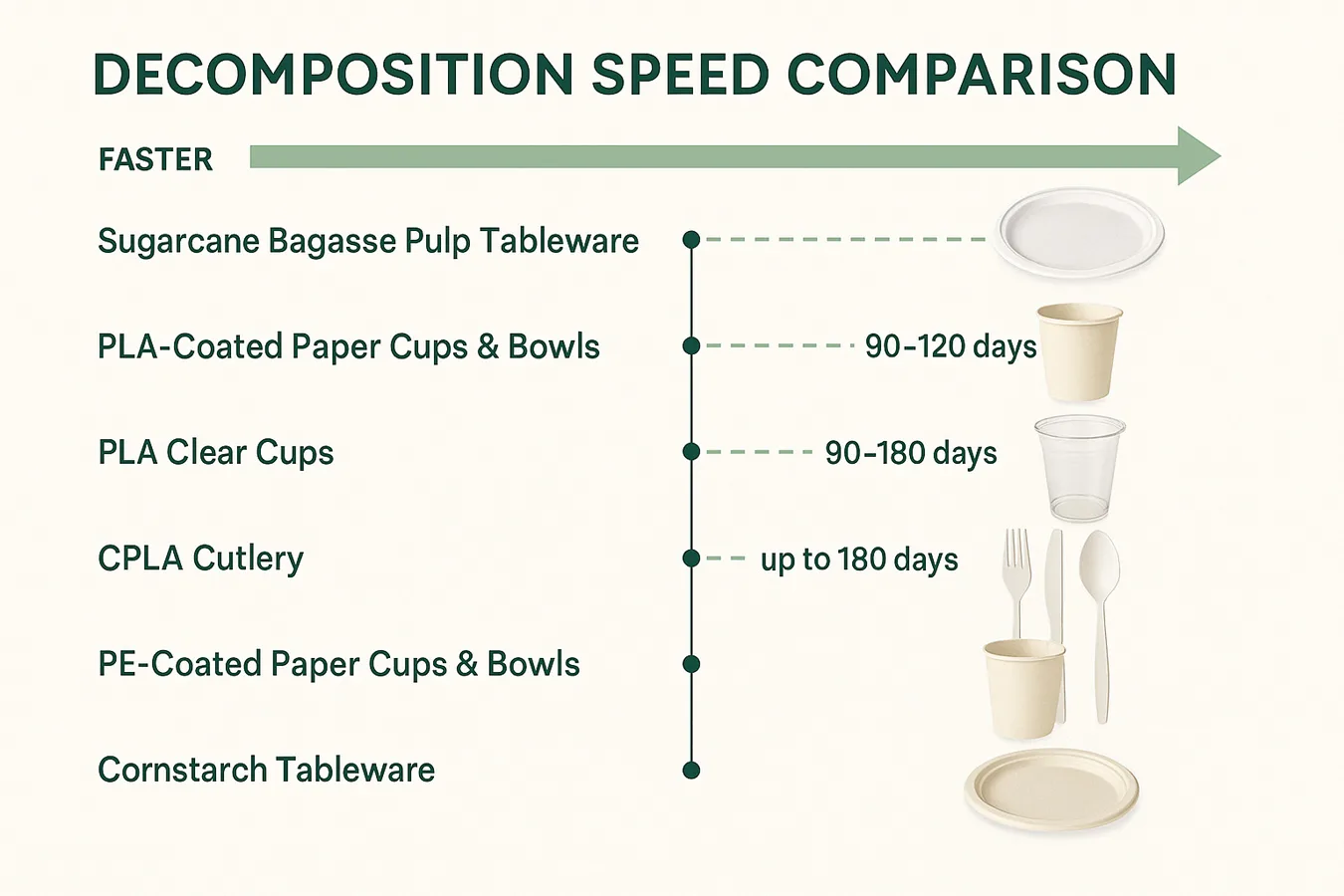
1. Sugarcane Bagasse Pulp Tableware
(Most biodegradable, truly compostable – even at home)
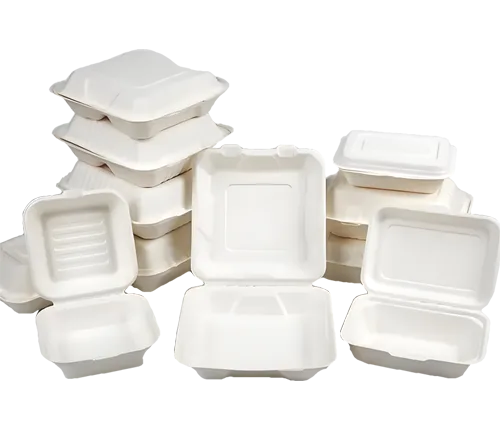
What it is
Bagasse is the fibrous residue left after extracting juice from sugarcane. When converted into molded pulp tableware, it becomes a high-fiber, plastic-free material.
Biodegradability & composting
Academic studies on agricultural residues show that lignocellulosic fibers (like bagasse) usually degrade within 45–90 days in active compost piles, depending on moisture and temperature.
Industrial composting trials aligned with EN 13432 and ASTM D6400 consistently show >90% disintegration of molded fiber items within the required timeframe, with no toxic residues reported for PFAS-free, additive-controlled products.
Because bagasse is essentially treated plant fiber, many field observations show it can break down in home compost conditions in less than a season when shredded or broken into smaller pieces.
Performance in use
Heat resistance often up to 100–120°C (suitable for hot foods and microwaving).
Natural oil and water resistance when combined with proper forming and optional bio-coatings.
Derived from a non-food, agricultural by-product, which reduces waste and improves resource efficiency.
Why it ranks #1
100% plant-based, no plastic core
Composts quickly under both industrial and well-managed home compost conditions
Leaves no microplastic residues when properly formulated and PFAS-free.
2. PLA-Coated Paper Cups & Paper Bowls
(High biobased content, industrially compostable)
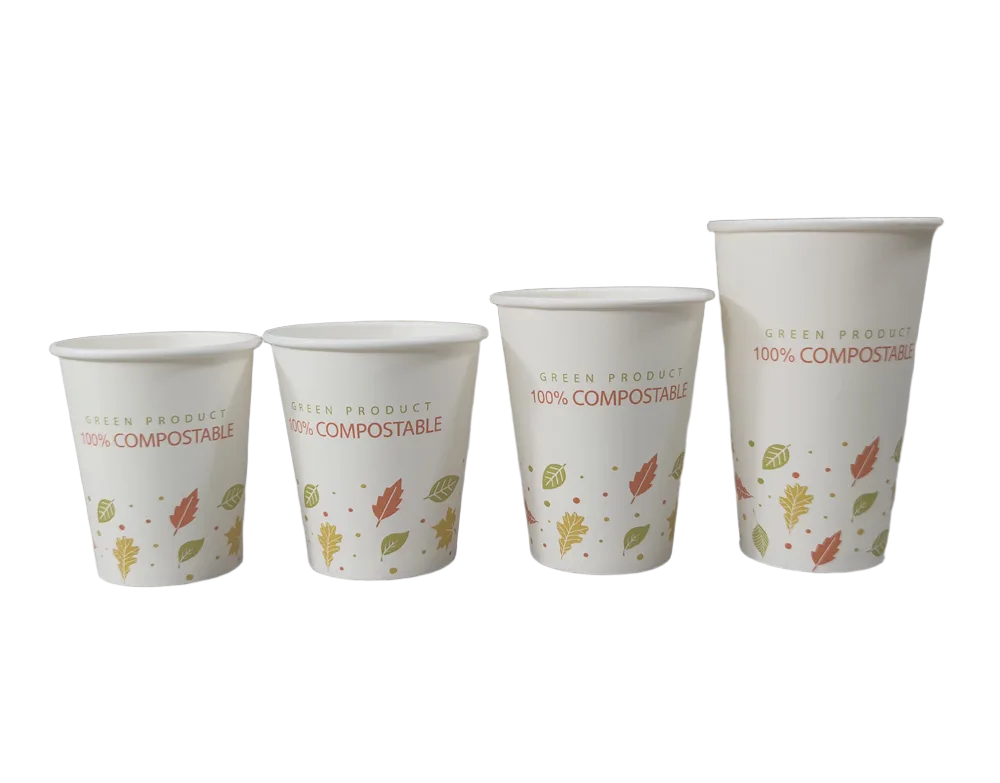
What it is
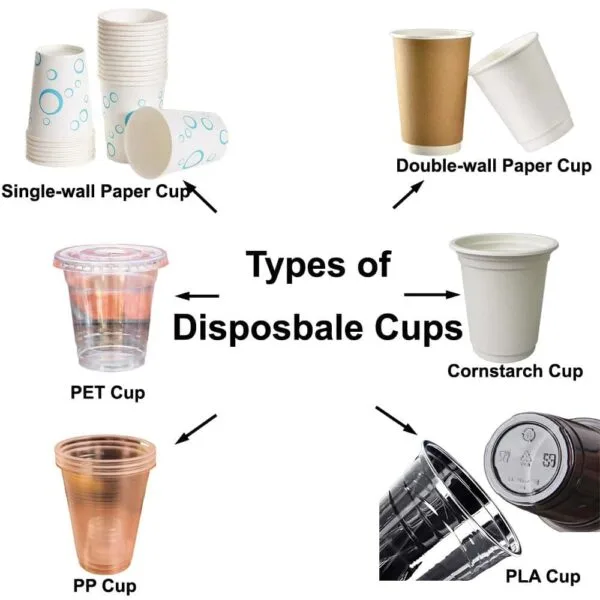
Conventional “paper cups” leak without a lining. Eco alternatives replace petroleum-based PE lining with a thin layer of PLA (polylactic acid), a bioplastic derived from corn or sugarcane.
Biodegradability & composting
PLA is certified under standards like EN 13432 and ASTM D6400 when processed in industrial composting at 55–60°C with controlled moisture and aeration.
Lab and field studies suggest full biodegradation of PLA coatings and films typically occurs within 90–120 days in such conditions, but much slower (or negligible) in cool, unmanaged environments like soil or seawater.
Paper fiber fraction decomposes relatively fast; the limiting factor is the PLA layer, which needs sustained high temperature.
Performance in use
Suitable for hot drinks (with proper board and coating specification) and hot soups.
Good barrier against oil and moisture.
Familiar “paper cup” look and feel, which eases consumer acceptance.
Why it ranks #2
High natural fiber content + compostable bioplastic coating.
Fully compostable in industrial facilities, but not ideal for home compost unless conditions are unusually warm and active.
3. PLA Clear Cups
(Fully bio-based plastic, but needs industrial composting)
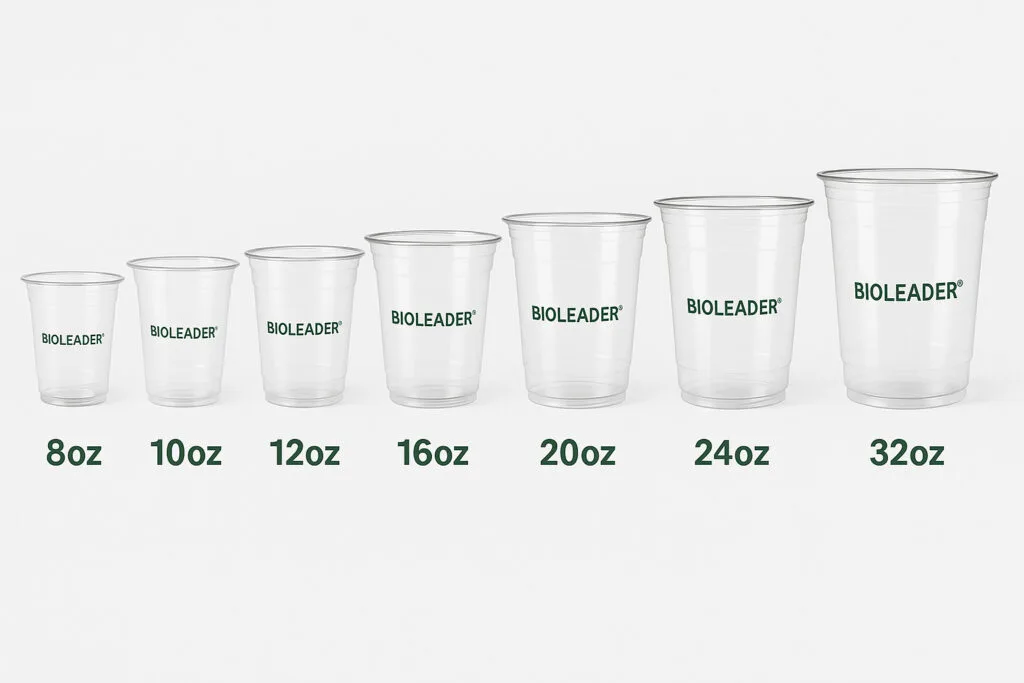
What it is
PLA clear cups are made from 100% PLA resin, extruded and thermoformed into transparent containers for cold beverages and desserts.
Biodegradability & composting
Under industrial composting (≥55°C), PLA clear cups can reach >90% biodegradation within 3–6 months, consistent with EN 13432/ASTM D6400 test reports.
At ambient temperatures, particularly in landfills or open environments, PLA is stable and degrades very slowly—studies show minimal breakdown over 1–2 years in soil or marine conditions without elevated heat.
Miscommunication often arises when buyers assume “compostable” = “will disappear in nature”; PLA cups require collection and proper industrial composting.
Performance in use
Excellent clarity, similar to PET; ideal for branding and product visibility.
Limited heat resistance (~40–50°C); not suitable for hot drinks.
Odorless and food-safe when certified.
Why it ranks #3
Fully bio-based and certifiably compostable, but only in industrial compost.
Slow to degrade in lower-temperature or uncontrolled environments.
4. CPLA Cutlery
(Heat-resistant PLA – compostable, but slower)
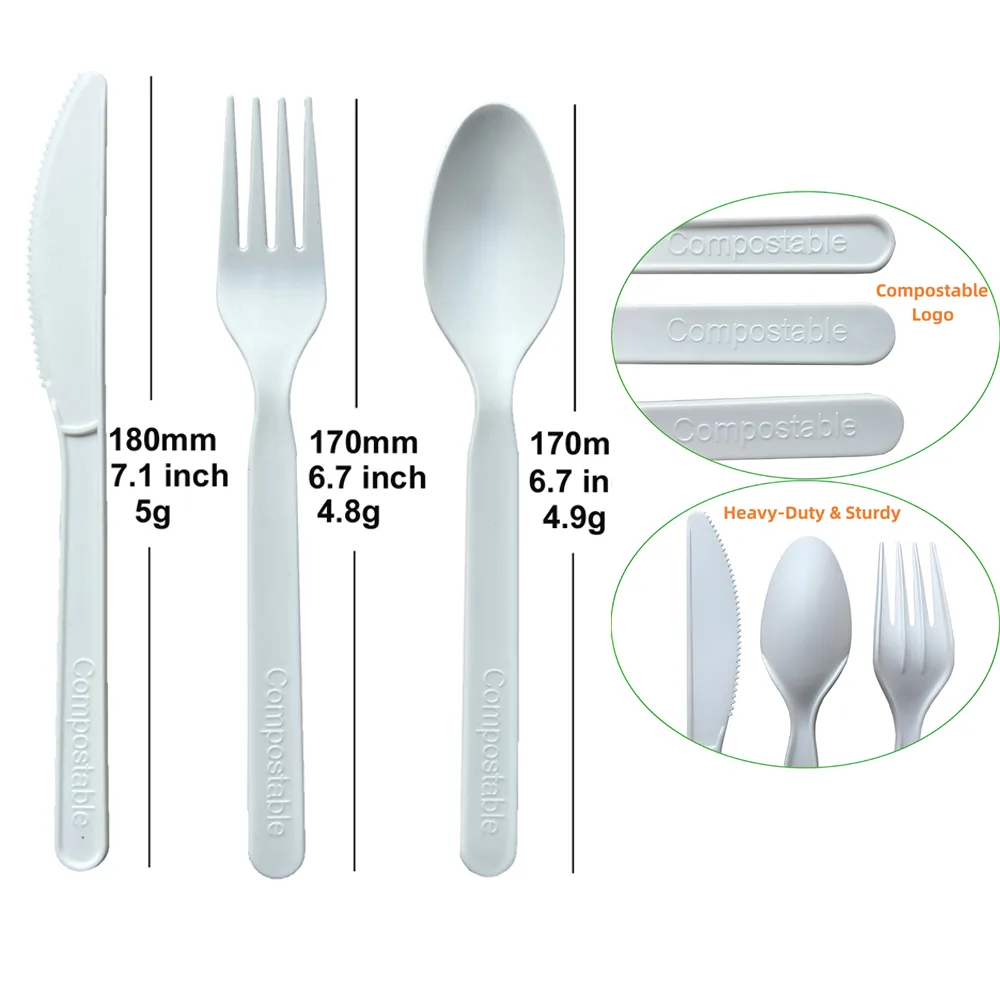
What it is
CPLA is crystallized PLA. Through controlled crystallization and additives, PLA’s heat resistance increases, enabling forks, knives, and spoons that tolerate up to 85–90°C.
Biodegradability & composting
The higher crystallinity improves thermal properties but slows biodegradation, because crystalline regions are more resistant to microbial attack.
Data from composting trials indicate that CPLA items often require closer to the upper limit of the 180-day window in EN 13432 environments to achieve full disintegration.
As with PLA, CPLA needs industrial composting conditions with elevated temperatures and good aeration.
Performance in use
Rigid, durable, and comfortable to use—very similar to conventional plastic cutlery.
Suitable for hot meals and coffee service.
Visually premium when color-matched for branding.
Why it ranks #4
Compostable, but slower degradation due to crystallinity.
Still reliant on industrial compost; not realistic for home or uncontrolled environments.
5. PE-Coated Paper Cups & Paper Bowls
(Partially degradable – plastic residue remains)

What it is
Traditional paper cups and bowls typically use polyethylene (PE) coating to provide water and oil resistance. PE is a conventional fossil-based thermoplastic.
Biodegradability & composting
The paperboard portion can biodegrade or compost if separated, but the thin PE layer does not comply with EN 13432 or ASTM D6400.
In practice, when PE-lined cups go into composting streams, the result is paper fiber + plastic flakes that must be screened out and landfilled.
Some “oxo-degradable” claims historically suggested additives would solve the problem; however, regulatory authorities and scientific reviews have criticized these as fragmentation, not true biodegradation, leading to microplastics.
Performance in use
Stable, good barrier performance, resistant to hot liquids.
Widely available and low cost.
Why it ranks #5
Not truly biodegradable or compostable as a finished product.
Best considered a transitional material, not suitable for strict eco-programs or plastic-reduction laws.
6. Cornstarch Tableware (Starch + Plastic Blends)
(Partially biodegradable, often not fully compostable)

What it is
Many “cornstarch” products on the market are starch-based bioplastics blended with PP, PE, or other polymers, or with modified PLA. They can have high bio-based content but still contain a significant percentage of conventional plastic.
Biodegradability & composting
The starch component can biodegrade relatively quickly, especially in compost or soil.
The synthetic polymer fraction persists, behaving similarly to conventional plastics and often failing EN 13432 or ASTM D6400 tests.
Some formulations may pass certain local or proprietary “biodegradability” tests, but careful reading of technical data sheets is essential to avoid greenwashing.
Performance in use
Reasonable heat resistance and mechanical strength.
Often marketed as “eco” and priced competitively.
Without transparent disclosure, buyers may mistakenly believe all cornstarch products are fully compostable.
Why it ranks #6 (least biodegradable in this list)
Often only partially biodegradable; part of the material remains as plastic.
Can be useful as a bio-based option, but not equivalent to certified compostable bagasse or pure PLA under recognized standards.
Technical Comparison: Biodegradability & Composting Conditions
Below is a consolidated comparison for quick evaluation and internal technical reviews:
| Rank | Material Type | Bio-based Content | Typical Degradation Time* | Composting Type | Microplastic Risk | Notes |
|---|---|---|---|---|---|---|
| 1 | Sugarcane bagasse pulp tableware | 100% plant fiber | 60–90 days (active compost) | Home & industrial | Very low | No plastic; relies on standard composting of lignocellulosic fibers |
| 2 | PLA-coated paper cups/bowls | High (paper+PLA) | 90–120 days (industrial at ≥55°C) | Industrial only | Low | Paper decomposes quickly; PLA layer needs high heat to compost |
| 3 | PLA clear cups | 100% PLA | 90–180 days (industrial) | Industrial only | Low | Minimal degradation at ambient temperature or in marine environment |
| 4 | CPLA cutlery | 90–100% PLA | Up to 180 days (industrial) | Industrial only | Low | Crystallinity slows biodegradation but remains certifiable |
| 5 | PE-coated paper cups/bowls | Mixed (paper+PE) | Paper: 60–90 days; PE: persists | Not compostable as a unit | High | Paper breaks down; PE remains as plastic flakes |
| 6 | Cornstarch tableware (starch+plastic blend) | Variable | Starch: 60–180 days; plastic: long | Partial at best | Medium–High | Starch degrades; synthetic fraction remains unless fully compostable |
*Approximate timeframes under optimized conditions; real-world results depend on compost system design, climate, and management.
Why Bagasse Stands Out as the Greenest Option
Considering feedstock origin, end-of-life behavior, and regulatory alignment, bagasse offers a strong combination of advantages:
Agricultural Waste Utilization
Bagasse is a by-product of sugar production. Using it for molded tableware replaces plastic and creates value from material that might otherwise be burned or landfilled.Fast, Complete Composting
Under typical composting conditions, bagasse behaves like high-fiber plant matter. It breaks down into CO₂, water, and humus without leaving synthetic residues when free of PFAS and plastic additives.Global Regulatory Fit
Many national and municipal bans on single-use plastics now explicitly prefer molded fiber and bagasse solutions because they are non-plastic by nature and align with EN 13432, ASTM D6400, and similar standards.Food Safety & Performance
When combined with food-contact certifications like LFGB and FDA, bagasse tableware meets both functional (heat, oil, liquid) and safety requirements, making it a strong candidate for replacing EPS foam, PP, and other plastics in food service.
What About Avocado-Based Packaging?
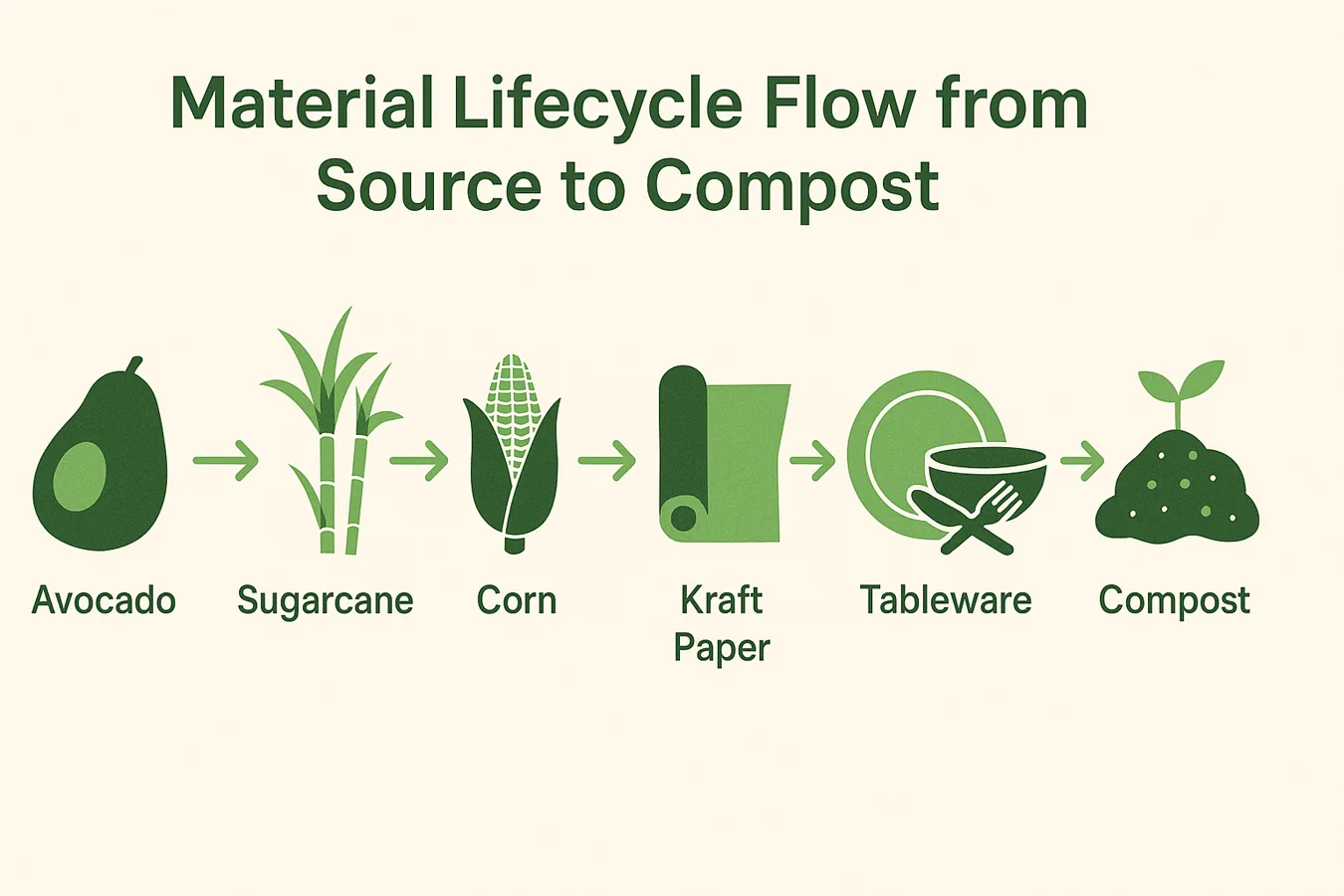
Avocado pits, peels, and other agricultural by-products are gaining attention as potential biobased packaging feedstocks. Early R&D and pilot projects suggest promising properties, but:
Most solutions are still at lab or pilot scale, not yet widely commercialized.
Consistent certifications (EN 13432/ASTM D6400) and reliable industrial supply chains are still developing.
Large-scale industrialization requires stable raw material supply and proven processing routes.
At present, bagasse, PLA, CPLA, and certified molded fiber remain the most established, scalable, and certifiable options for international export and compliance with 2025+ plastic regulations.
How a Manufacturer Should Classify and Test Biodegradability
Serious suppliers classify products based on standardized testing, not just marketing slogans. A robust approach typically includes:
Laboratory testing according to EN 13432 / ASTM D6400 for industrial compostability;
Disintegration tests in controlled composting environments to verify that physical fragments disappear;
Ecotoxicity tests to ensure no harm to plant growth;
Regular third-party audits for certifications such as BPI, TÜV, or other recognized bodies;
Material transparency—clearly disclosing if a product is 100% plant fiber, PLA-based, cornstarch blend, or PE-lined.
For buyers and distributors in markets like Ecuador, this data is crucial to:
Align with national or municipal regulations;
Avoid reputational risk from greenwashing;
Offer clear disposal instructions (home compost, industrial compost, or standard waste).
Conclusion: Choosing the Right Material for Real-World Sustainability
Not all “biodegradable” products are created equal. When you look beyond marketing terms and evaluate feedstock, certifications, and actual composting behavior, a clear hierarchy appears:
Sugarcane bagasse pulp tableware – fastest and most complete biodegradation, ideal for plastic-free, compostable ranges.
PLA-coated paper cups and bowls – strong industrial compost option for hot drinks and soups, if composting infrastructure exists.
PLA clear cups – excellent for cold beverages where collection and industrial composting are feasible.
CPLA cutlery – compostable, robust solution for hot foods; slower degradation but fully compatible with industrial composting standards.
PE-coated paper – only partially degradable; no longer suitable for next-generation eco programs that demand true plastic-free solutions.
Cornstarch/starch-plastic blends – bio-based but not always fully compostable; require careful technical review to avoid greenwashing.
For companies building an eco-friendly packaging portfolio in 2025 and beyond, the most future-proof strategy is to prioritize certified compostable, plastic-free materials like bagasse, complemented by PLA and CPLA where industrial composting systems can support them.
FAQ
Q1: What is the difference between biodegradable and compostable packaging?
A1: Biodegradable packaging breaks down naturally by microorganisms, but compostable packaging must fully decompose within a defined period—usually 90–180 days—under specific composting conditions without leaving toxic residues, according to EN13432 and ASTM D6400 standards.
Q2: Which packaging material decomposes the fastest?
A2: Sugarcane bagasse pulp tableware decomposes the fastest—typically within 60–90 days—even in home composting conditions. It is 100% plant fiber and leaves no plastic residues, making it the most eco-friendly option.
Q3: Are PLA cups and bowls fully biodegradable?
A3: Yes, PLA-based products are compostable under industrial composting conditions above 55°C. However, they do not degrade effectively in normal soil, marine environments, or at room temperature.
Q4: Why is cornstarch tableware not fully compostable?
A4: Most cornstarch products contain plastic blends such as PP or modified PLA. The starch portion decomposes, but the synthetic plastic remains. Therefore, these products are partially biodegradable, not 100% compostable.
Q5: Does Bioleader® offer avocado or agricultural waste-based packaging?
A5: Currently, Bioleader® focuses on proven compostable materials like bagasse, PLA, and CPLA. Avocado-based bioplastics remain in research and pilot stages globally but may be added in future product lines as the technology matures.