The Modern Market Shift: Why Your Material Choice Defines Your Brand Survival
As 2026 unfolds, the global packaging industry finds itself at a critical crossroads. What was once considered a “sustainability goal” has now become a legal mandate. The final implementation phases of plastic bans in countries like India, Australia, and China—coupled with the expanded scope of the EU’s Single-Use Plastics Directive (SUPD)—mean that companies are now facing a hard deadline for transitioning away from plastic-based packaging.
Quick Summary: How to Choose Sustainable Packaging Materials in 2026
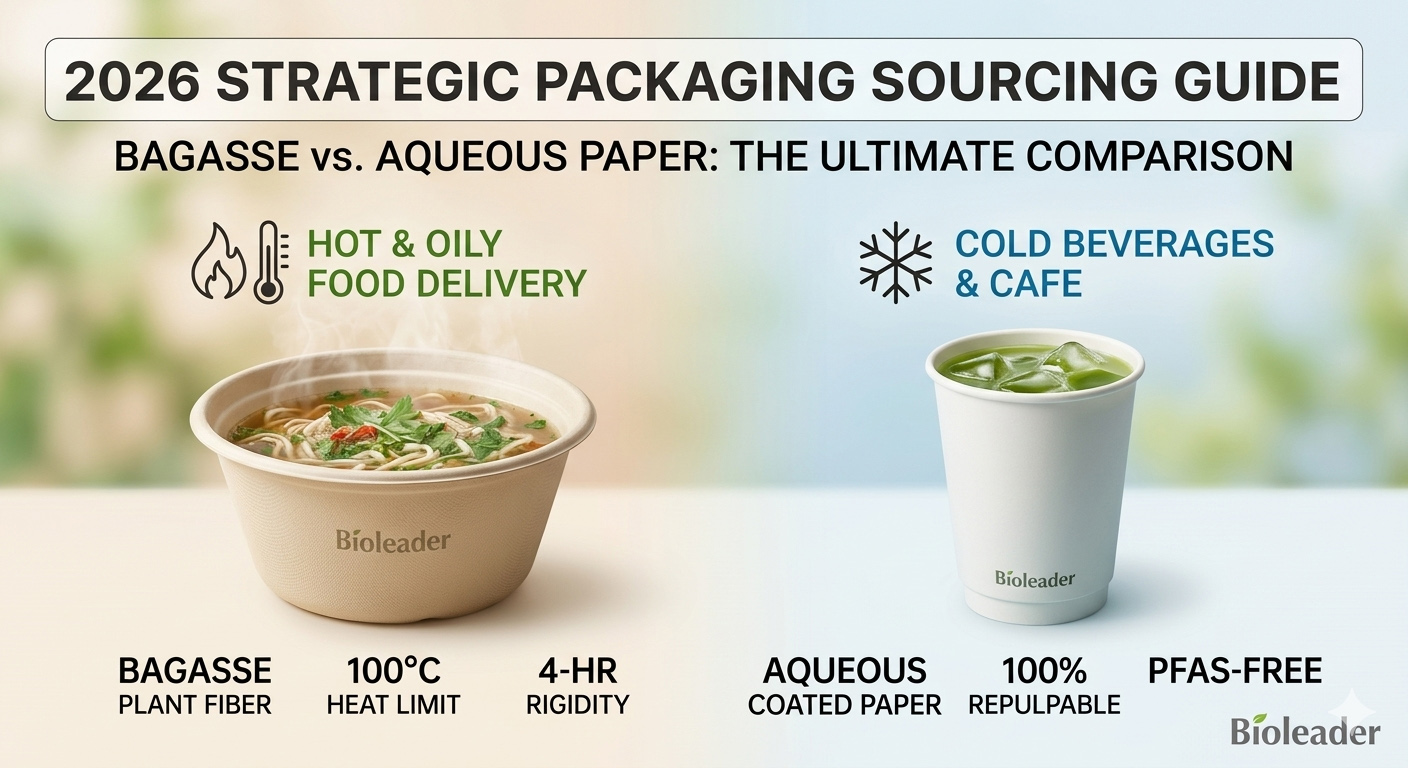
For B2B foodservice buyers, the best sustainable packaging material depends on product use, temperature, oil resistance, disposal route, certification requirements, and local regulations.
- Sugarcane bagasse: best for hot meals, clamshells, bowls, trays, and heavy-duty takeaway food.
- PLA / CPLA: PLA is suitable for cold drink cups; CPLA is better for cutlery and selected hot-lid applications.
- Cornstarch-based compounds: practical for high-volume foodservice where cost and plastic reduction both matter.
- Water-based coated paper: useful for cups, bowls, and paper packaging where buyers want reduced plastic-film lining and improved repulpability potential.
For international buyers, the challenge is no longer about simply “going green.” The true concern now is supply chain resilience in the face of looming regulatory changes. Companies still relying on legacy plastic packaging now face the risk of “Regulatory Lag,” where outdated inventory can lead to unsellable stock, fines, or even port seizures.
The need for compliance has never been more urgent, and Bioleader® offers the first-mover advantage you need. Beyond just the greenwashing hype, we provide certified, traceable materials and technical data to ensure your business stays ahead of the regulatory curve. This guide serves as your go-to resource for understanding the four key materials driving the plastic-free revolution: Bagasse, PLA, Cornstarch, and Paper.
While we have explored basic material differences in previous articles, this 2026 guide integrates the latest PFAS-free compliance and life-cycle data essential for large-scale procurement. Below, we break down each material’s performance matrix to help you determine which one fits your specific business model for 2026.
I. The 2026 Environmental Compliance Landscape: Beyond Single-Use Plastics
In 2026, compliance has moved from a mere regulatory checkbox to a core business advantage. Governments are increasingly moving toward a Circular Economy model, where the focus is no longer simply recyclability, but instead certified compostability and chemical safety. As global regulators implement strict bans on single-use plastics, companies must evolve quickly to remain competitive and compliant.
1. Global Regulatory Realities: Navigating a Fragmented Market
Global compliance has become a complex web of regional regulations. Here’s a snapshot of what you need to know:
- European Union (EU SUPD): In the EU, plastic-containing cups, food containers, and takeaway packaging are facing stricter rules on consumption reduction, marking, EPR, recyclability, and waste management. This does not always mean a full material ban, but it does require buyers to verify coating type, plastic content, recyclability, compostability claims, and destination-market rules before placing bulk orders.
- North America: In the U.S., multiple states have passed laws requiring foodservice brands to prove their products are PFAS-free. This law is forcing manufacturers to remove harmful chemicals, such as “Non-Intent Added PFAS”, from food packaging, placing greater emphasis on the safety of fiber-based products.
- Asia-Pacific: The China 2026 “Plastic-Free Cities” initiative and India’s nationwide enforcement of single-use plastic bans are driving an accelerated demand for certified compostable alternatives in the Asia-Pacific region.
2026 Global Compliance Timeline
Q1 2026
North America: PFAS-Free Mandates
State-level PFAS rules continue to raise documentation expectations. Bioleader® PFAS-free product options help buyers support safer food-contact packaging and reduce compliance risk.
Q2 2026
EU: Stricter SUPD and Packaging Compliance
EU buyers are under growing pressure to reduce single-use plastic consumption, verify plastic content, improve recyclability, and avoid unsupported compostability or plastic-free claims. Certified and well-documented materials are increasingly important for foodservice packaging procurement.
Q3 2026
Asia-Pacific: Plastic-Free Cities
Plastic-reduction enforcement continues to expand across major Asia-Pacific markets. High-performance fiber, paper, PLA/CPLA, and cornstarch-based alternatives are becoming more important for foodservice sourcing.
2. The “Greenwash” Trap: Identifying Regulatory Risks
The marketplace is flooded with terms like “degradable” and “bio-based” that are often used without scientific backing. In 2026, “degradable” without a certified compostable standard is a liability, not an asset. These products often break down into microplastics, contributing to environmental pollution instead of offering a true biological decomposition solution.
- ❌ Degradable: Often just fragments into microplastics; no strict testing standard.
- ✅ Certified Compostable: Disintegrates into organic matter; validated by TÜV OK Compost.
The Buyer’s Checklist: How can you avoid greenwashing?
- Does your supplier provide verifiable certificates like TÜV OK Compost (Home & Industrial), BPI, or DIN CERTCO?
- If not, your brand risks being dragged into greenwashing litigation and facing backlash from environmentally-conscious consumers.
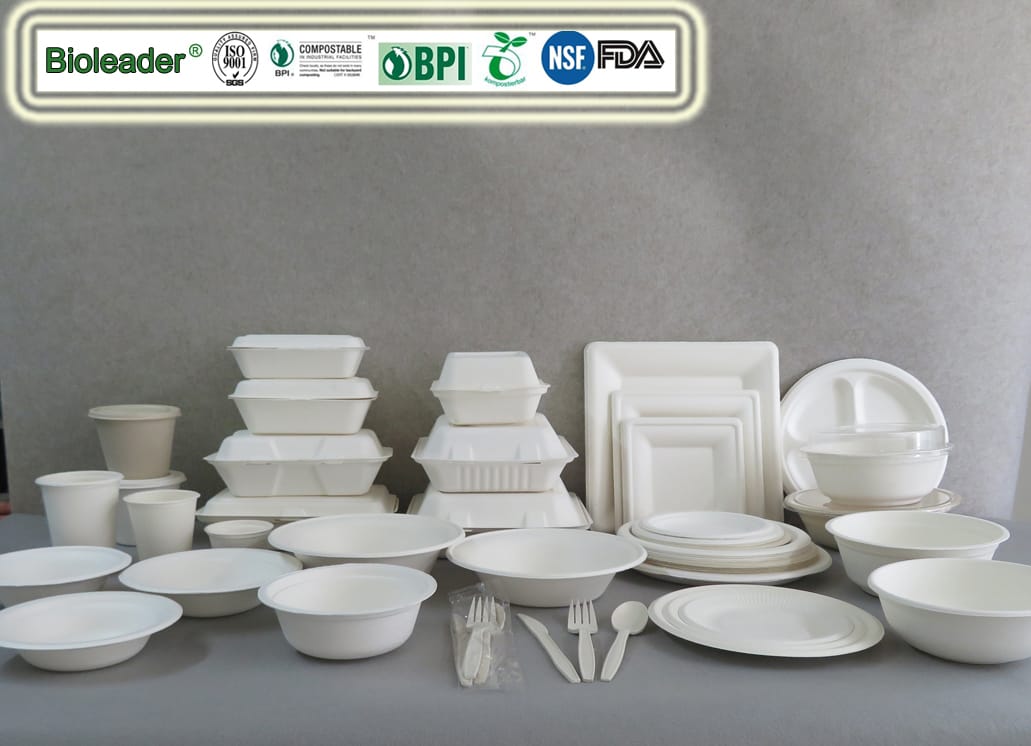
3. Bioleader’s Compliance Standard: Your Passport to Global Trade
At Bioleader®, compliance is not only about meeting basic requirements. Our 2026 material portfolio is designed to help buyers compare material performance, request documentation, and prepare for stricter food packaging rules in key export markets:
- PFAS-Free Innovation: For selected fiber-based packaging lines, Bioleader® can provide PFAS-free options with strong oil and moisture resistance. Performance should always be confirmed by product-specific testing, intended food type, filling temperature, and destination-market requirements.
- Certified Transparency: Relevant Bioleader® product lines can be supported by food-contact documentation, compostability certificates, PFAS-related declarations, and material specifications. Buyers should verify that each certificate matches the exact product, material, and destination market.
- Material Traceability: From raw material selection to finished packaging, Bioleader® supports buyers with product information, specification review, sample testing, and export documentation to make sustainable packaging claims more transparent and verifiable.
II. Material Performance Matrix: The Definitive 2026 Comparison for Decision Makers
In 2026, the question is no longer “is it eco-friendly?” but “will it perform under pressure?” Below is the definitive performance matrix for the materials shaping the food packaging industry, designed to provide decision-makers with a clear, side-by-side comparison. The following matrix summarizes practical sourcing observations based on material characteristics, application testing, and commonly requested compliance documents. Buyers should still verify product-specific performance and certification before confirming bulk orders.
Material Performance Comparison Matrix
| Feature | Sugarcane Bagasse | PLA / CPLA | Cornstarch (PSM) | Aqueous Paper |
|---|---|---|---|---|
| Thermal Limit | 100°C+ (Best) | 50°C (PLA) / 85°C (CPLA) | 80°C | 90°C |
| Oil Resistance | Superior (High-Oil) | Moderate | Good | Moderate |
| Compostability | Industrial; some home-certified lines | Industrial Only | Variable | Repulpability potential; verify locally |
| Durability | High (Heavy Duty) | Moderate | Moderate | Light to Medium |
| Cost Index | Moderate | Premium | Economical (Best) | Moderate |
| Best For | Hot Food Delivery | Cold Drinks / Lids | High-Volume QSR | Coffee / Bakery |
1. Sugarcane Bagasse (Plant Fiber) – The Heavy-Duty Champion
Bagasse, derived from sugarcane, stands out as one of the most durable and heat-resistant materials available, making it a top contender for hot food packaging and takeout containers.
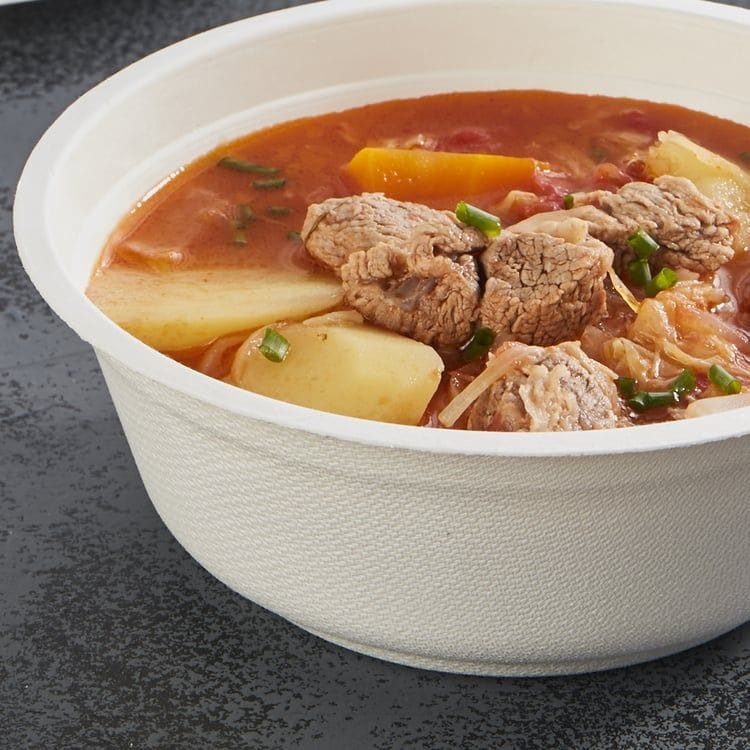
- Heat Resistance (120°C/30min): Bagasse is microwave-safe and can withstand oven temperatures up to 100°C, making it the top choice for Microwave-safe and Oven-reheat packaging, a critical requirement for 2026 home delivery standards. In contrast, PLA and CPLA cannot perform under such extreme conditions and will lose structural integrity.
- Oil Resistance: Bagasse offers superior oil resistance, particularly for high-oil foods like fried meals and soups, where other materials like PLA may falter.
- Leak Resistance: Well-designed bagasse bowls and containers can offer strong short-term resistance to moisture, oil, and hot food applications. For soup, sauce, and delivery use, buyers should test the exact product with the intended food type, filling temperature, lid combination, and delivery time.
- Composting: Sugarcane bagasse products can be industrially compostable, and some certified product lines may also support home-compostability claims. Actual composting time depends on product thickness, certification scope, moisture, temperature, and local composting conditions. Buyers should verify the exact certificate and destination-market requirements before using compostability claims.
- Best For: Hot food delivery, takeout, heavy-duty packaging needs.
2. PLA & CPLA (Bioplastics) – Engineering Precision
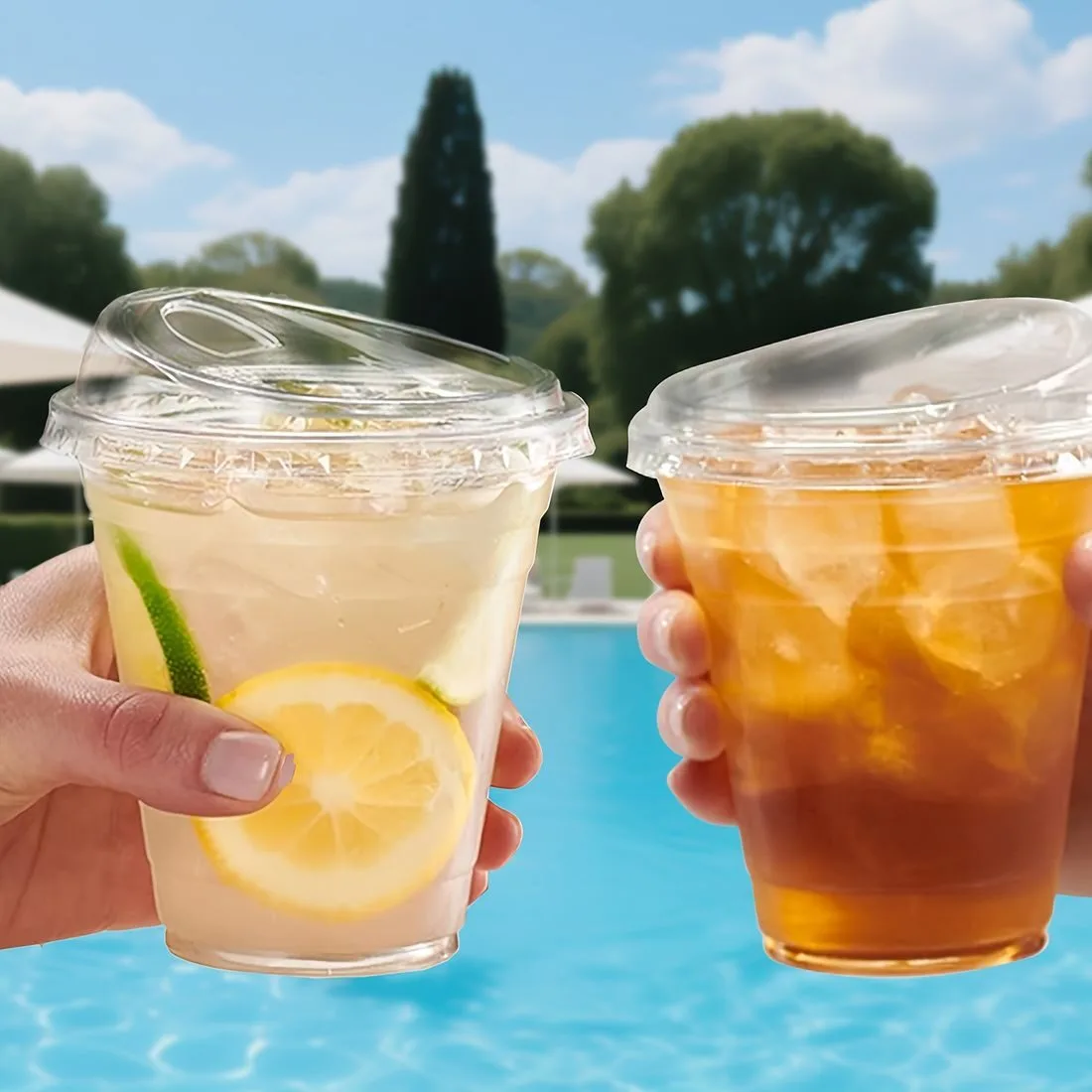
PLA (Polylactic Acid) and CPLA (Crystallized PLA) are known for their lightweight, transparency, and bioplastic origin, making them ideal for cold food applications. CPLA offers higher performance in hot applications, thanks to its crystallized structure.
 |  |
- Cold vs. Hot: Why Cold Drinks Choose PLA, Hot Containers Choose CPLA:
- PLA is perfect for cold drinks due to its crystal-clear appearance, maintaining its integrity under temperatures below 50°C.
- CPLA is ideal for hot containers, such as soup cups and hot beverage lids, withstanding temperatures up to 85°C, making it suitable for hot beverages but not for high-temperature food delivery.
- Transparency vs. Functionality: PLA provides excellent clarity and visual appeal, but CPLA sacrifices transparency for rigidity, ensuring it can withstand the heat of hot food packaging.
- Degradation: Both PLA and CPLA require industrial composting to break down properly. They typically decompose within 45–90 days in industrial composting facilities, but home composting is not feasible due to temperature constraints.
- Flavor Neutrality: PLA provides an odorless and flavor-neutral experience, crucial for premium cold-pressed juices and specialty salads, where maintaining taste integrity is essential for customer satisfaction.
- Best For: Cold drinks, beverage cups, hot beverage lids.
- 💡 For a deeper scientific dive into structural differences and specific degradation cycles, see our Full Bagasse vs. PLA Analysis.
3. Cornstarch-based Compounds – The Pragmatic Choice
Cornstarch-based packaging provides an affordable and eco-friendly solution for high-volume applications. It is often used in takeout containers, cutlery, and food trays.

- Cost vs. Eco-Impact:
- Cornstarch-based products are the most affordable among biodegradable packaging options, making them ideal for high-volume use in fast-food chains and takeaway services. While these materials are bio-based, they often require a specific blend with polymers (such as PP) for enhanced durability, which can affect their full biodegradability.
- Bioleader ensures that cornstarch materials are high bio-content, balancing cost-effectiveness with environmental requirements.
- Degradation: Cornstarch-based materials require industrial composting to break down within 90-120 days in industrial composting facilities. However, this rate of degradation may vary depending on material composition.
- Best For: Quick-service restaurants (QSR), high-volume packaging.
4. Sustainable Paper (Aqueous Coating Technology)
Sustainable paper packaging is evolving with the introduction of water-based coatings. These coatings can reduce reliance on traditional PE or PLA plastic-film linings and may improve repulpability potential when supported by product-specific documentation, paper mill acceptance, and local recycling infrastructure.
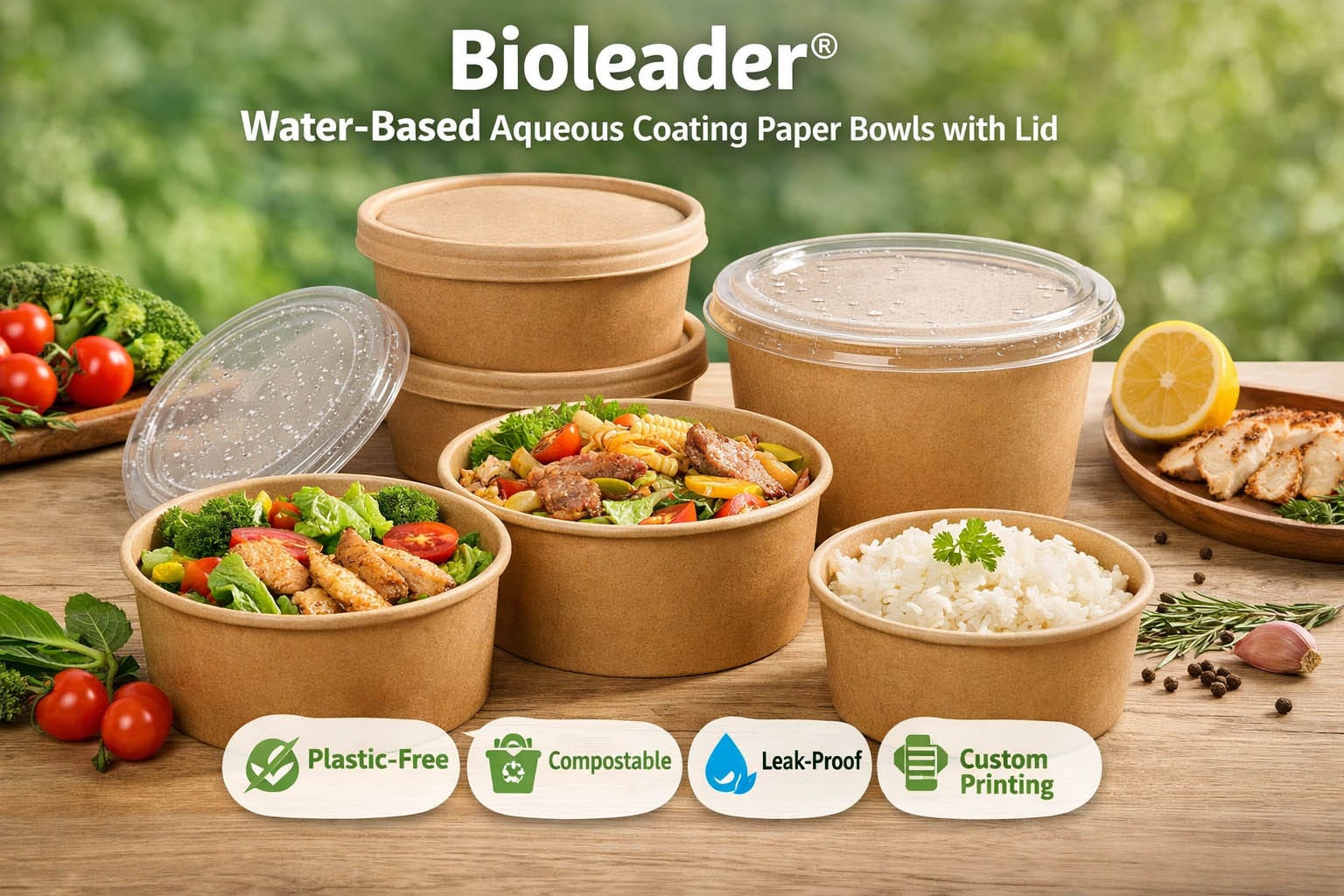
- Beyond PE Lining: Water-based aqueous coatings can reduce reliance on traditional PE or PLA plastic-film linings and may improve repulpability when the coating formula, paper grade, and local paper mill acceptance are compatible. Buyers should always verify repulpability reports, food-contact documents, and local recycling acceptance before making recyclable or plastic-free claims.
- Repulpability: Compared with many traditional PE-lined structures, water-based aqueous-coated paper may support better repulpability potential when tested and accepted by local paper mills. This makes it a practical option for coffee cups and bakery packaging, where buyers need to balance barrier performance, paper feel, and end-of-life claims.
- Reduced-Plastic Tactile Experience: Bioleader’s aqueous coating can help buyers reduce reliance on conventional plastic-film lining while keeping a familiar paper-based touch. PFAS-free, plastic-free, recyclable, or compostable claims should be supported by product-specific documentation and local regulatory review.
- Best For: Paper Coffee cups, bakery packaging, and hot beverage lids.
Conclusion of Material Comparison:
This material comparison matrix serves as a practical decision-making tool for businesses looking to choose the most suitable material for their packaging needs in 2026. Whether you’re a restaurant owner, QSR chain, or foodservice provider, choosing the right material impacts not just your costs, but also your brand’s sustainability credentials.
Next, we’ll explore the Sustainability & Life Cycle Assessment (LCA) of these materials to provide you with further insight into their long-term environmental impact, helping you make the most informed, future-proof decision for your business.
III. Sustainability & Life Cycle Assessment (LCA)
As global mandates move beyond simple “plastic-free” claims, the focus has shifted to Life Cycle Assessment (LCA). In 2026, a truly sustainable product must prove its value from Cradle to Grave—from raw material extraction to its final end-of-life scenario.
This section breaks down the CO2 reduction and end-of-life scenarios of different materials, helping you evaluate their true sustainability impact.
Method Note: How to Read the LCA Comparison
The figures below are practical sourcing references based on typical material characteristics, production assumptions, and common comparison scenarios against conventional plastic packaging. Actual carbon footprint and end-of-life results may vary by product weight, raw material source, energy mix, transport distance, coating formula, certification scope, and local waste infrastructure. Buyers should request product-specific test reports and documentation for formal procurement decisions.
The 2026 LCA Comparison Table: At a Glance
(Note: This table is a practical sourcing reference. Exact values and claims should be verified with product-specific documentation.)
| Material | CO2 Reduction (vs. PP) | Primary Source | Home Compostable? | Industrial Compostable? | Recycling Compatibility |
|---|---|---|---|---|---|
| Sugarcane Bagasse | Often favorable vs. PP; verify by product LCA | Upcycled Waste | Some certified product lines | Common for certified lines | Low (Compost First) |
| PLA / CPLA | Often lower fossil-plastic reliance; verify by LCA | Industrial Corn | No | Yes, if industrially compostable and accepted locally | Low (Specialized Only) |
| Cornstarch (PSM) | Variable by formulation | Corn + Polymers | Variable | Depends on formulation and certification | Limited or variable |
| Aqueous Paper | Variable by coating and paper source | Managed Forests | Depends on coating and certification | Depends on product and certification | Potentially high; verify mill acceptance |
Buyer takeaway: Material choice should be evaluated by real application, documentation, and disposal route—not only by broad sustainability labels.
1. The Carbon Footprint Truth: Raw Material to Factory Gate
The carbon footprint of a material is essential in determining its overall environmental impact. Below is a breakdown of each material’s CO2 emissions, emphasizing their upcycled or bio-based origins and how they compare to traditional plastic production.
- Sugarcane Bagasse: The Upcycling Leader
- Emissions Data: Bagasse is a strong example of an upcycled agricultural-fiber material because it uses leftover fiber after sugar extraction. Its carbon impact can be favorable compared with many fossil-based plastic packaging formats, but the final footprint still depends on product weight, energy mix, transport distance, and processing method.
- Environmental Impact: In many sourcing scenarios, sugarcane bagasse can offer a lower fossil-plastic footprint because it upcycles agricultural fiber. The exact reduction should be verified through product-specific LCA assumptions, production data, and shipping routes.

- PLA & CPLA: The Bio-Industrial Choice
- Emissions Data: PLA reduces reliance on fossil-based plastics, but polymerization, crystallization for CPLA, agricultural inputs, and energy mix all influence its overall footprint. For formal procurement, buyers should compare product-specific LCA data rather than relying only on material category.
- Environmental Impact: PLA can be useful where bio-based content and industrial compostability are part of a defined waste-management plan. However, its environmental outcome depends heavily on composting access, collection behavior, product weight, and the energy used during production.
- Aqueous Paper: Low-Impact Barrier Technology
- Emissions Data: By reducing or replacing conventional plastic-film lining, aqueous coated paper can lower plastic content and may improve end-of-life options. The actual footprint depends on coating chemistry, paperboard source, production process, and whether local recycling systems accept the material.
2. End-of-Life Scenarios: Which Material Actually Disappears?
When evaluating the sustainability of materials, their end-of-life scenarios are just as important as their production processes. Here’s how each material stacks up in terms of composting and recycling:
- Sugarcane Bagasse: The Ultimate “Backyard Friendly” Material
- Some sugarcane bagasse product lines may qualify for home-compostability claims when supported by valid certification. Buyers should confirm whether the specific item, thickness, coating, and destination market are included in the certificate scope.
- Home Compostable: Home-compostability should be treated as a certified product-level claim, not a universal material assumption. Actual decomposition depends on product design, moisture, oxygen, temperature, and composting practice.
- PLA/CPLA: A Common Pitfall for Buyers
- PLA, while bio-based, does not break down in home compost bins. It requires industrial composting at 60°C to decompose, which is unavailable in many regions.
- Recycling Issues: PLA is often non-recyclable in regular recycling streams, which means it can end up in landfills when no industrial composting infrastructure is available.
- The Recycling Breakthrough: Aqueous Paper
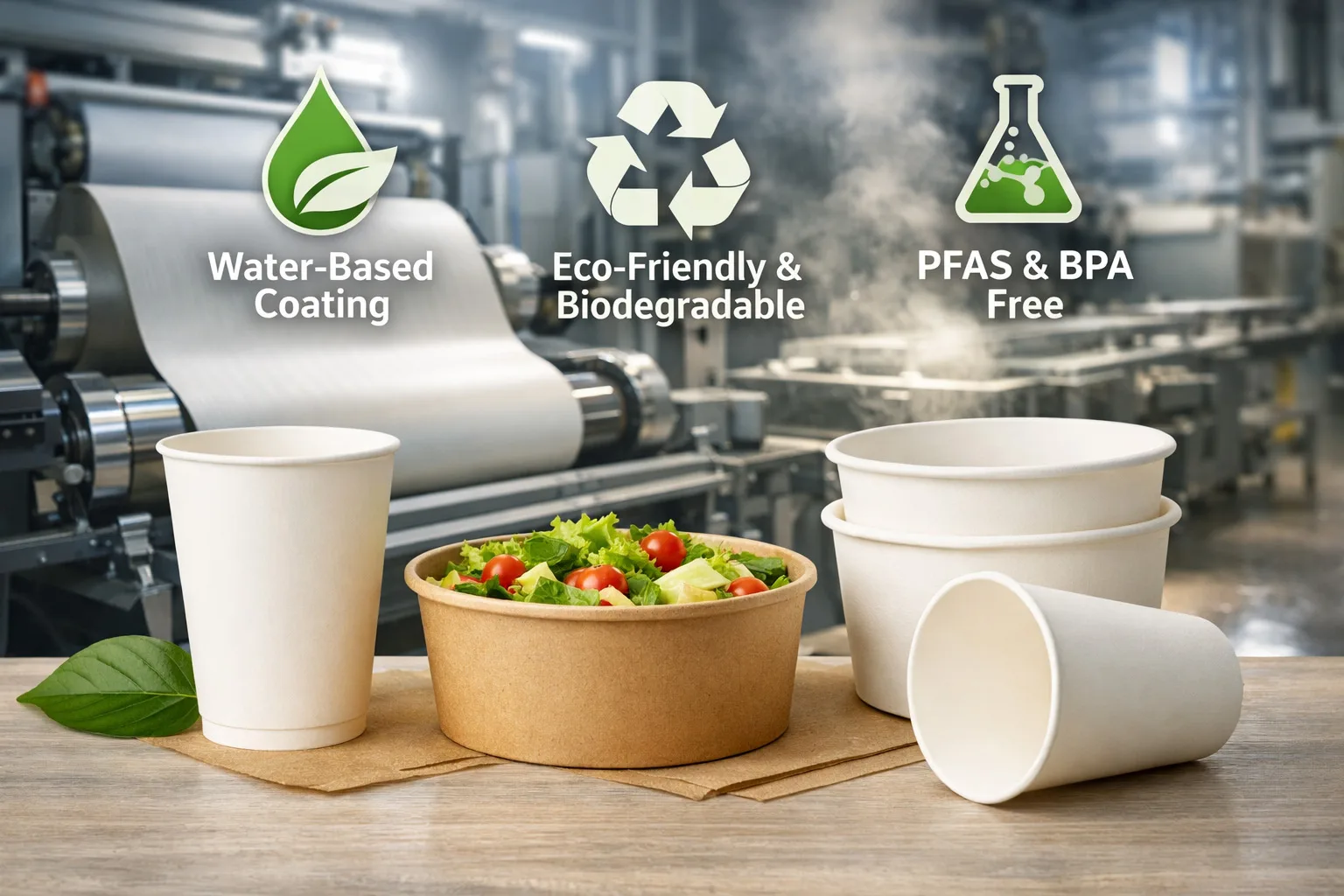
- Repulpability: Aqueous-coated paper can be a strong option where the coating is designed for repulping and local paper mills accept the material. Buyers should request repulpability reports and confirm recycling acceptance in the destination market.
- Recyclable & Compostable: Aqueous coated paper may support stronger end-of-life positioning than conventional plastic-lined paper, but recyclable or compostable claims must be verified by the coating supplier, certification scope, and local collection system.
3. Circular Economy Potential: Closing the Loop
Sustainability is not just about material selection but also about ensuring materials can be recycled, reused, or composted to close the loop. Here’s how each material performs in a circular economy context:
- Bagasse (The Soil Builder): Ideal for closed-loop systems, such as schools or corporate campuses, where food waste and packaging are composted together to create fertilizer for local agriculture.
- Aqueous Paper (The Resource Saver): Aqueous coated paper can be a practical choice for urban areas with strong paper recovery systems, especially when repulpability documentation and local mill acceptance are available.
- PLA/CPLA: While bio-based, PLA has limited circularity because it requires specialized composting facilities. Without proper industrial composting infrastructure, PLA’s recycling potential is significantly reduced.
- Cornstarch-based Compounds: Cornstarch-based products may contain starch blended with other polymers to improve strength and heat resistance. Because formulations vary, the real end-of-life impact of cornstarch-based products should be evaluated by composition, certification, and available composting or disposal routes.
The 2026 Sustainability Verdict
Based on practical sourcing considerations, Sugarcane Bagasse remains one of the strongest material choices for hot foodservice packaging, especially where buyers need plant-fiber structure, oil resistance, and compostability documentation. It is particularly suitable for clamshells, bowls, plates, trays, and takeaway containers.
For urban coffee chains where recycling infrastructure is stronger than composting infrastructure, Aqueous Paper can be a practical circular-economy option when repulpability, PFAS-related documentation, and local recycling acceptance are confirmed.
IV. Strategic Sourcing Guide: Matching Materials to Your Business Model
Choosing the right material in 2026 is no longer just about knowing the environmental impact—it’s about optimizing for Customer Experience and Regulatory Compliance. Below are the tailored sourcing strategies for three dominant industry models.
| Target Industry | Primary Recommendation | Key Driver |
|---|---|---|
| Specialty Coffee / Bakery | Aqueous Paper + CPLA | Brand Image & Recyclability |
| High-End Catering / Delivery | Sugarcane Bagasse | Heat Retention & Zero Leakage |
| QSR / Event Catering | Cornstarch (PSM) | Cost-Volume Efficiency |
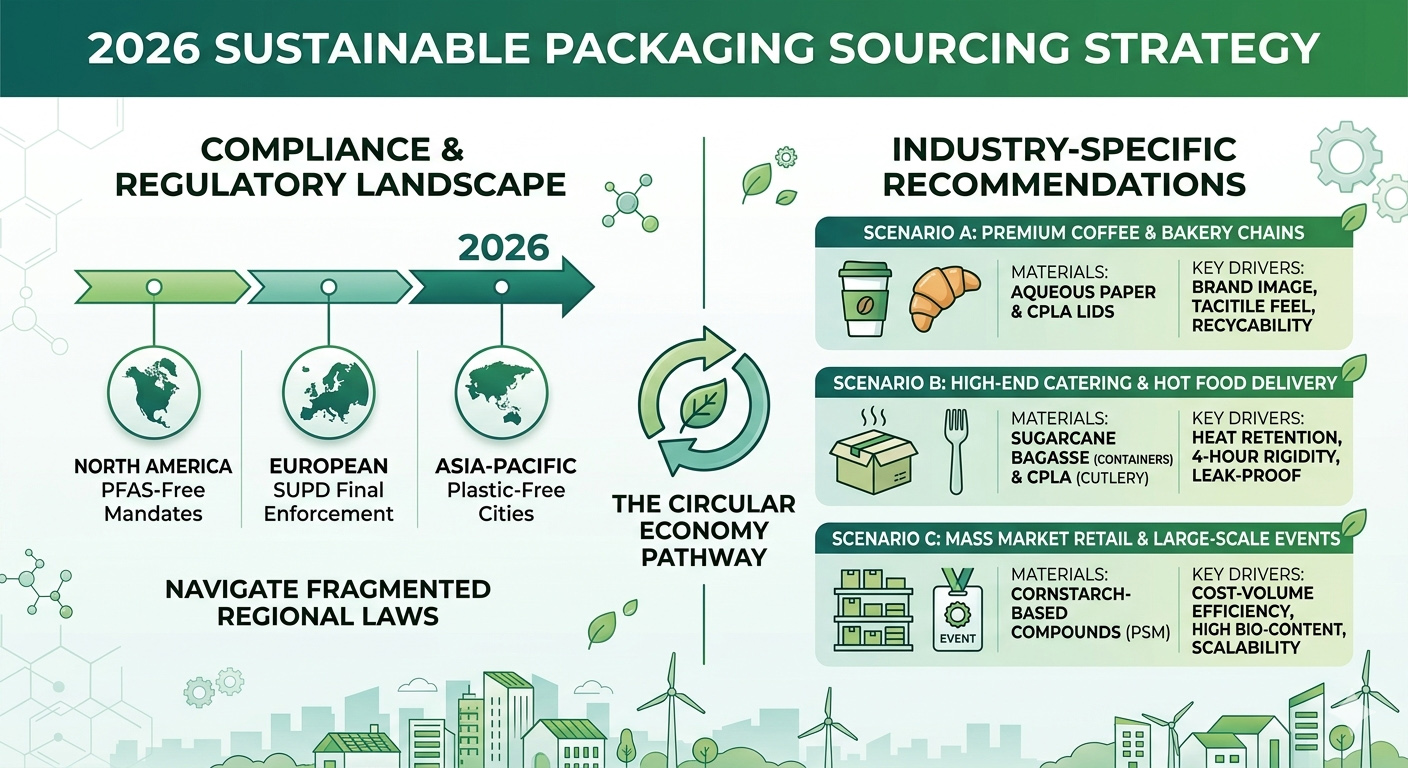
1. Scenario A: Premium Coffee & Bakery Chains
Best Materials: Aqueous Paper (Cups/Boxes) and CPLA (Lids).
- Strategic Reasoning: Premium segments demand a tactile experience that matches their brand. Aqueous Paper can support reduced-plastic or repulpability-oriented packaging programs when documentation is available. CPLA lids can offer improved heat resistance compared with standard PLA and may be suitable for selected hot beverage lid applications.
- Business Impact: Helps support an “Eco-Premium” brand position while keeping a paper-based look and feel. For specialty coffee and bakery chains, buyers should still test odor, taste neutrality, rim seal, lid fit, leakage, and storage conditions before finalizing specifications.
- Best For: High-end coffee chains, bakeries, and businesses seeking premium eco-friendly packaging solutions.
2. Scenario B: High-End Catering & Hot Food Delivery
Best Materials: Sugarcane Bagasse (Containers) and CPLA (Cutlery).
- Strategic Reasoning: For delivery, structural failure is the biggest risk. Well-designed bagasse containers can provide strong rigidity, oil resistance, and heat performance for many hot food applications. Buyers should confirm microwave, oven, and reheat suitability by product specification and actual food testing.
- Business Impact: Helps reduce leak-related complaints and supports a stronger plant-fiber sustainability story when supported by valid documentation. For fried foods, sauced meals, and hot delivery orders, product testing remains important to confirm moisture control, stacking strength, and customer experience.
- Best For: High-end catering, meal delivery services, and businesses offering reheat-at-home meal kits.
3. Scenario C: Mass Market Retail & Large-Scale Events
Best Material: Cornstarch-based Compounds (PSM).
- Strategic Reasoning: When volume is the priority, PSM (cornstarch-based compounds) can offer a practical balance between cost, rigidity, and plastic-reduction positioning. Buyers should confirm bio-based content, heat resistance, and compostability or disposal claims for the exact formulation.
- Business Impact: Offers a scalable option for high-traffic environments where cost control and plastic-reduction messaging both matter. It can be suitable for quick-service restaurants (QSR) and large-scale events, provided the buyer verifies formulation, local acceptance, and certification requirements.
- Best For: Large-scale food service operations, quick-service restaurants (QSR), event catering, and retailers focused on volume and sustainability.
Strategic Summary:
In 2026, choosing the right material is no longer simply about compliance—it’s about optimizing for customer experience while ensuring long-term sustainability. The correct material choice for your business can drive brand differentiation and customer loyalty while adhering to regulatory standards.
For premium brands, Aqueous Paper and CPLA can help balance aesthetics, paper feel, and selected hot-use performance. For high-end catering and hot food delivery, Sugarcane Bagasse and CPLA can support stronger moisture resistance, heat performance, and plant-based packaging claims when properly tested. Cornstarch-based compounds can be useful for high-volume applications where cost control and plastic-reduction positioning are priorities.
To help you visualize the integration of global compliance and strategic material selection, we have summarized the key findings of this guide in the strategy map below:
FAQ: Sustainable Packaging Materials for B2B Buyers
What is the most sustainable packaging material for foodservice?
There is no single best material for every application. Sugarcane bagasse is strong for hot food and takeaway meals, PLA is suitable for cold drink cups, CPLA works for selected hot-use items such as cutlery and lids, cornstarch-based compounds can be practical for high-volume use, and water-based coated paper is useful where buyers want reduced plastic-film lining and improved repulpability potential.
Is bagasse better than PLA?
Bagasse is usually better for hot food, oily meals, clamshells, bowls, and trays. PLA is better for clear cold drink cups and cold food packaging. PLA should not be used for high-temperature food or hot beverages unless the product is specifically designed and tested for that use.
Are PLA products suitable for hot food?
Standard PLA is generally suitable for cold applications and is not recommended for hot food or high-temperature beverages. CPLA has improved heat resistance and is commonly used for cutlery and selected hot-lid applications, but buyers should still verify the exact temperature rating and product use.
Is cornstarch tableware fully biodegradable?
Cornstarch-based tableware may contain bio-based starch combined with other polymers to improve strength and heat resistance. Compostability and biodegradability depend on the exact formulation and certification, so buyers should not assume all cornstarch products are fully biodegradable without documentation.
Are water-based coated paper cups recyclable?
Water-based coated paper cups may offer better repulpability than traditional plastic-film lined paper cups, but actual recyclability depends on the coating formula, paper mill acceptance, local recycling infrastructure, and supplier test reports.
Which certificates should packaging buyers request?
B2B buyers should request food-contact test reports, compostability certificates where relevant, PFAS-free documentation for fiber packaging, coating information, material specifications, and destination-market compliance documents before confirming bulk orders.
How should buyers choose between bagasse, PLA, cornstarch, and paper?
Buyers should start from the real application: hot or cold food, liquid or dry food, oil content, delivery time, lid fit, printing needs, disposal route, certification requirements, MOQ, and target market regulations. Material choice should follow the use case, not only the sustainability label.
Bioleader® Sustainable Packaging Material Solutions
For distributors, foodservice brands, importers, and takeaway packaging buyers, Bioleader® provides sustainable packaging solutions across sugarcane bagasse, PLA/CPLA, cornstarch-based tableware, and water-based coated paper packaging. Buyers can compare material performance, request certificates, confirm application testing, and build mixed-container sourcing plans based on their target market.
Need help choosing the right material? Contact Bioleader® for material comparison, sample testing, custom packaging options, and bulk quotation support.
Copyright Notice
© 2026 Bioleader®. If you wish to reproduce or reference this content, you must provide the original link and credit the source. Any unauthorized copying will be considered an infringement.