Guide To Carbon Footprint Showdown: Materials, Standards & Best Practices | Bioleader® Guides

Actionable coverage of Carbon Footprint Showdown: eco-friendly, biodegradable, compostable materials, performance data, and compliance under EN13432 & ASTM D6400. Includes BPI/TÜV references and Food-Contact Tested guidance for safe deployment. Buyer-focused: manufacturer insights, bulk/wholesale buying playbooks, OEM/ODM customization tips, full size range selection.
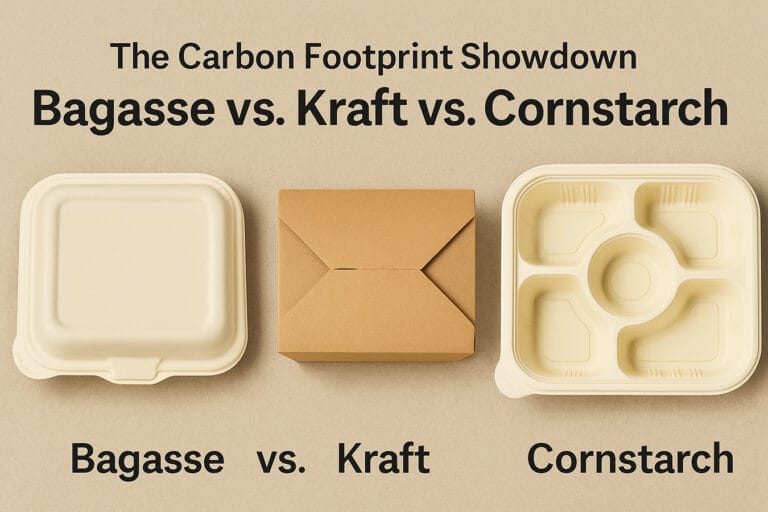
Quick Summary: In recovery-friendly markets and standard applications, choose Bagasse first. For general hot/cold foods—across high-moisture and dry goods—Kraft is the most universal option. When you specifically require microwaveability, extra rigidity, or special form factors (e.g., clear/contoured pieces), evaluate Cornstarch. Pair material choice with end-of-life (EoL) pathways and 2025–2027 regulatory timelines to minimize lifecycle CO₂e and compliance risk.
Carbon Footprint Showdown — Quick Summary
  • Items displayed (articles): 12
  • Last updated: 2025-10-25
  • Includes test data, compliance guides, buyer FAQs, and real-world use cases.

Editor’s Picks: Top Carbon Footprint Showdown Guides 2026

FAQ of Bioleader's Eco-friendly Disposable Tableware

What is the range of sizes that you have?

In terms of volume, there are varieties of cups: 500ml, 750ml, 1000ml, 1090ml, 1200ml, 1300ml, and 1500ml. This means that for every portion of any size, there is a bowl available , Carbon Footprint Showdown.

Can I put them in the microwave?

Definetely, our takeaway bowls with lids are microwave safe hence this allows customers to reheat most of the meals without any structural compromises of the bowl.

Materials: Kraft Paper & White Cardboard Paper

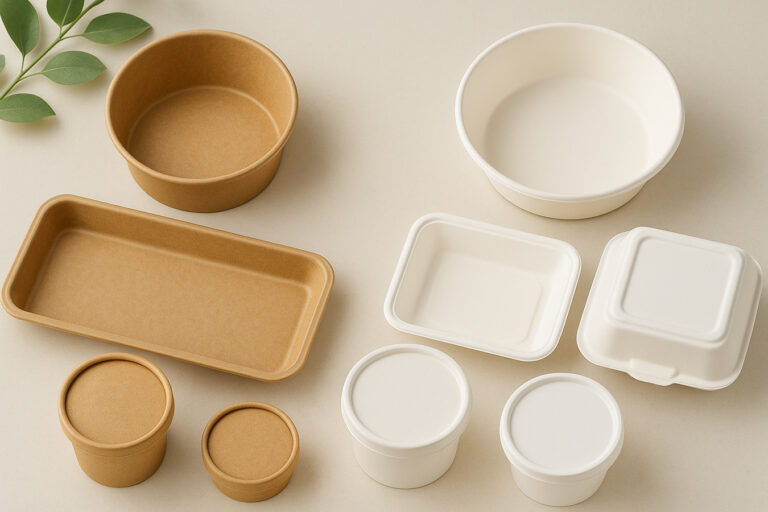
Our company’s biodegradable bowls are made of materials that allow biodegradation such as kraft paper and cardboard paper — Carbon Footprint Showdown. Sturdy and durable kraft paper is opaque and gives the kraft paper a natural aesthetic that consumers in this era should gorge on. White cardboard paper helps to enhance this look while ensuring that the bowl remains strong. Even these materials are 100% bio-degradable, hence these disposable biodegradable bowls will decompose within a short time after disposal to reduce pollution.

Table 1. LCA Master Table (kg CO₂e per 1,000 pcs)

Material Raw Materials Manufacturing Transport Use Phase End-of-Life Total CO₂e Bagasse 18 kg 12 kg 4 kg −2 kg 5 kg 37 kg Kraft Paper 22 kg 15 kg 5 kg −1 kg 10 kg 51 kg Cornstarch Biopolymer 30 kg 20 kg 6 kg 0 kg 12 kg 68 kg Totals reflect cradle-to-grave emissions for ~1,000 units (≈900 ml bowl + lid), assuming typical transport by sea and truck, and region-averaged end-of-life outcomes. Negative “Use Phase” values represent avoided extra packaging and avoided food-loss.

Bagasse Pulp Molding

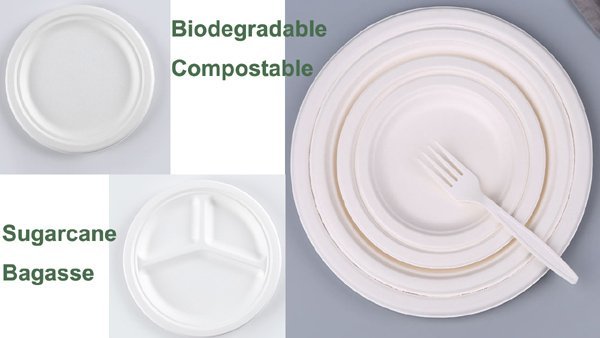
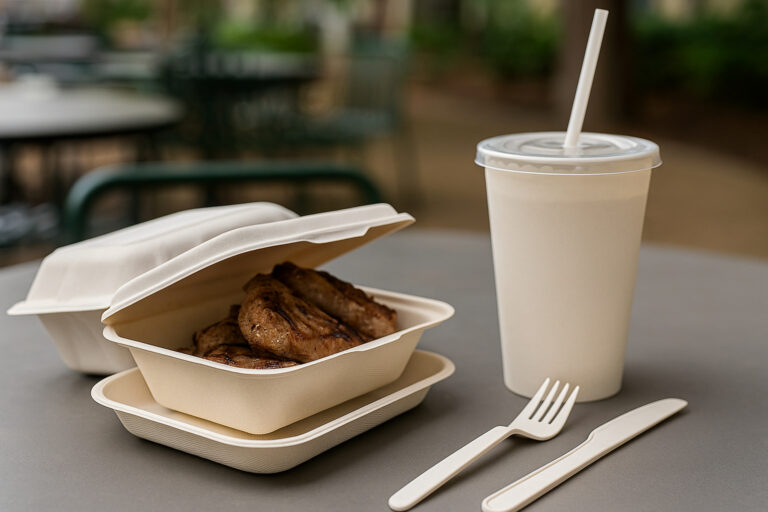
Bagasse is the fibrous by-product of sugarcane processing. After pulping and molding (wet-press or form-press routes), the result is a rigid, heat-tolerant article often compatible with hot, oily foods. Under recovery-friendly systems (where organic recovery and composting are available and correctly used), bagasse can realize strong net-carbon advantages by diverting material into biological cycles and mitigating methane potential (vs. landfilling) , Carbon Footprint Showdown.

Related Insights

🚀Ready to Go Green and Choose ?

Join the global movement toward zero-waste packaging.


Bioleader® offers:

  • 📦 Bulk order support & fast delivery

  • ✍️ Custom branding and OEM solutions

  • 🌍 Worldwide eco-packaging compliance

Get the Catalogue Products List  & Contact Us Now! 👉

Contact us Below

Click or drag files to this area to upload.You can upload up to 5 files.
The more details you share, the faster and more accurate our quotation will be.