Quick Answer: Do PE-Coated Paper Cups and Bowls Contain Fluorine or PFAS?
Bioleader®’s specified conventional PE-coated paper cups and bowls are designed without fluorinated grease-proofing chemistry. Their water and oil resistance comes from a very thin polyethylene film applied to the paperboard, not from PFAS-based chemicals added to the paper fibers.
Conventional non-fluorinated polyethylene is made from carbon and hydrogen. It does not contain the fully fluorinated carbon structure that defines a PFAS. The ordinary paperboard used in this packaging does not provide the main liquid barrier by itself; the PE film performs that function.
For this reason, the standard PE-coated cup and bowl structure can accurately be described as fluorine-free by material design and made without intentionally added PFAS grease-proofing agents, provided that the confirmed paperboard, PE resin, printing and finished-product specification remain unchanged.
Bioleader® also has SGS targeted PFAS reports for representative finished products. The tested specimens were a brown paper bowl and a white paper cup with transparent plastic film. The PFAS substances listed in the reports were recorded as ND, meaning not detected below the stated method detection limits.
Direct conclusion: the PE barrier itself is not a fluorinated coating, the paper does not need PFAS to achieve water and oil resistance, and representative Bioleader® PE-coated paper products have targeted PFAS test evidence showing the listed substances were not detected.
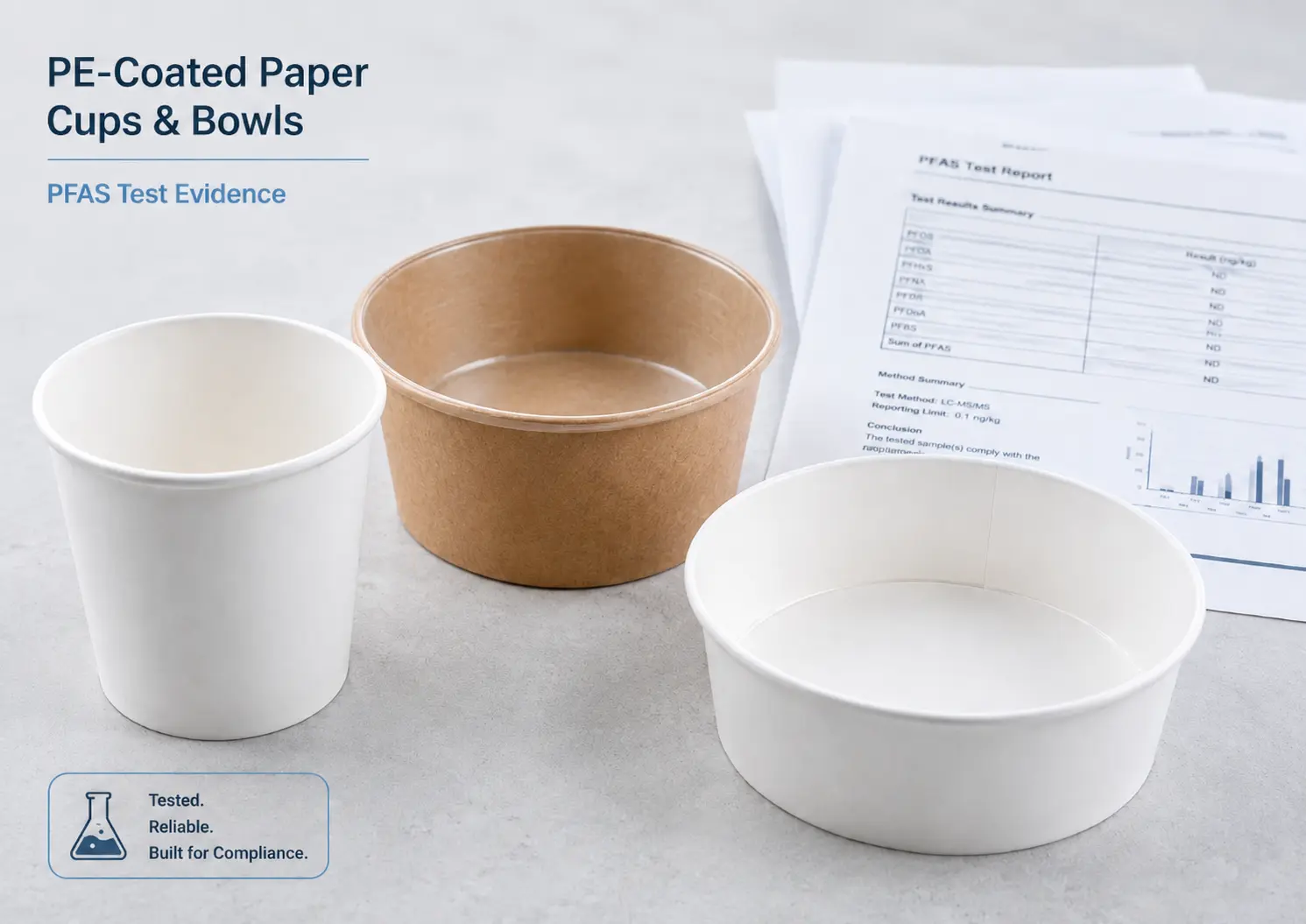
Key distinction: PE coating and PFAS treatment are not the same technology. PE coating creates a physical polymer film over the paperboard. PFAS grease-proofing historically relied on fluorinated chemicals applied to the paper surface or fibers.
Does a PE-Coated Paper Cup or Bowl Contain Fluorine?
The conventional PE barrier layer itself does not contain fluorine. The repeating chemical structure of ordinary polyethylene is based on carbon and hydrogen:
–CH₂–CH₂–
No fluorine atom appears in this repeating structure. Conventional non-fluorinated PE therefore does not meet the structural definition of a PFAS and does not need PFAS additives to form a water-resistant film.
In Bioleader®’s standard PE-coated paper cup and bowl structure, the material system consists mainly of:
- Food-grade paperboard that provides shape, stiffness and printability.
- A very thin transparent PE film that provides liquid and grease resistance.
- Printing ink where required for branding, product information and custom designs.
- Heat-sealed seams and bottom construction that maintain the finished container’s integrity.
The paperboard is not made waterproof by adding a fluorochemical grease-proofing agent. Instead, the PE film physically separates the food or beverage from the absorbent paper fibers.
Precise commercial wording: Bioleader®’s specified conventional PE-coated paper cups and bowls are made without intentionally added fluorinated grease-proofing chemistry. This is a material-design statement and should not be rewritten as a claim that every possible atom of fluorine is analytically proven to be zero in every ink, lid, production batch or untested component.
What Is a PE-Coated Paper Cup or Bowl?
A PE-coated paper cup or bowl is a paperboard food container with a thin polyethylene barrier film bonded to the food-contact surface. The paperboard provides the structure, while the PE film provides resistance to liquids, moisture, oil and food sauces.
Bioleader® supplies PE-coated paper cups, paper soup bowls and paper salad bowls in kraft and white paperboard formats for beverages, soup, noodles, salad, grain bowls, takeaway meals and food delivery.
The PE film is normally so thin and transparent that it may not be visually obvious. On a kraft paper bowl, the inside can still look kraft brown because the transparent film allows the natural paper color to remain visible. A slight gloss or smoother surface is often the clearest visual sign of the coating.
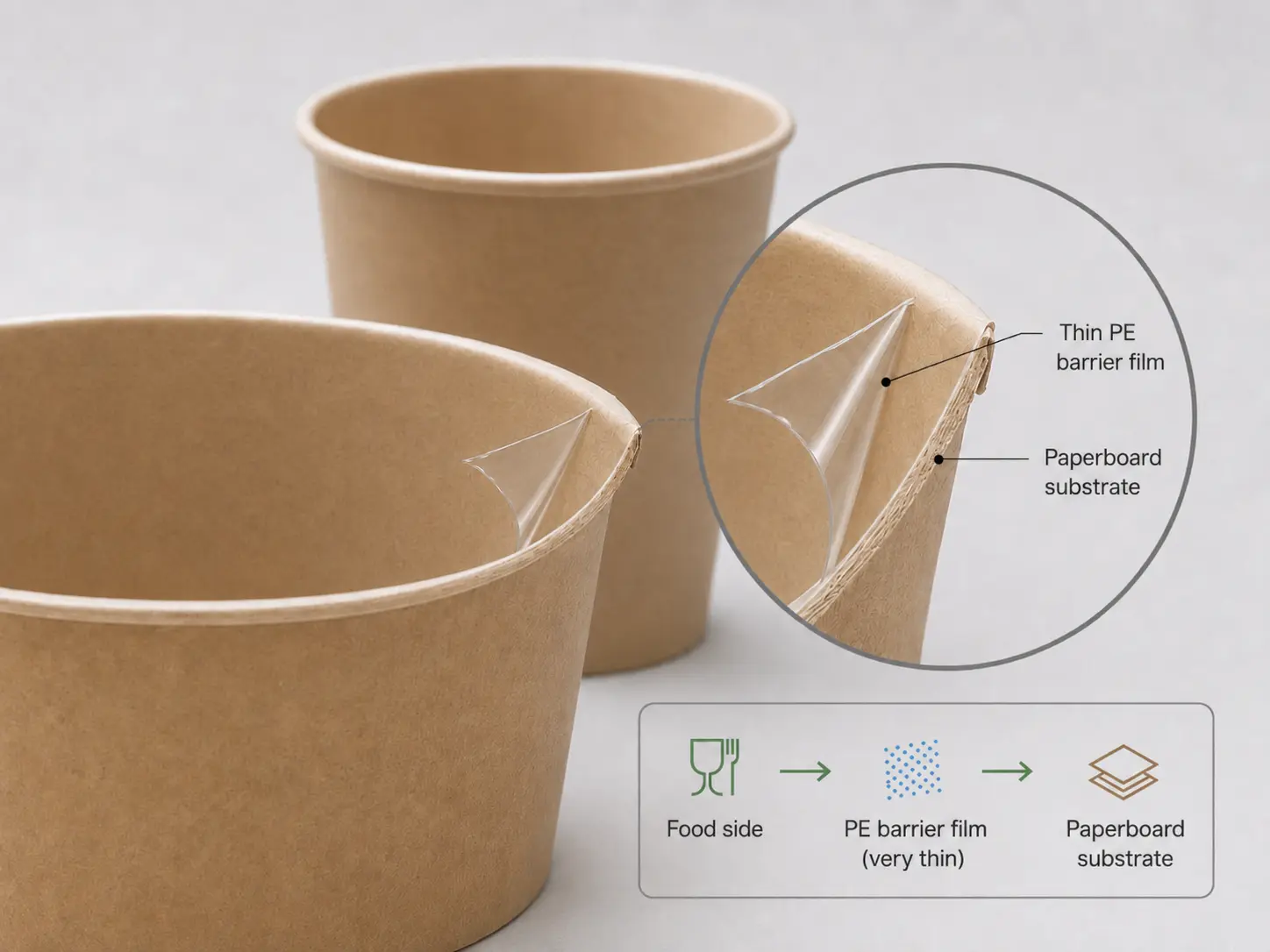
| Layer or component | Main function | Fluorine and PFAS relevance |
|---|---|---|
| Paperboard substrate | Provides stiffness, forming strength, printability and the main body of the cup or bowl. | Bioleader®’s specified standard PE-coated structure does not rely on a fluorochemical paper treatment for liquid resistance. |
| Conventional PE film | Forms a continuous physical barrier against water, beverages, soup, oil and sauces. | Ordinary non-fluorinated PE is not a PFAS and does not contain fluorine in its basic polymer structure. |
| Printing ink | Adds branding, color, instructions and private-label graphics. | Printing specifications should remain within the confirmed supplier and compliance system. |
| Side seam and bottom seal | Prevent leakage and maintain the formed container structure. | These are primarily heat-sealing and mechanical-performance controls. |
| Lid | Provides closure, stacking, delivery protection and temperature control. | The lid is a separate component and should be supported by its own material information when required. |
Buyers evaluating the complete range can review Bioleader®’s paper food packaging solutions, including cup sizes, bowl capacities, lid combinations, coating options, OEM printing and bulk export support.
Why PE-Coated Paper Packaging Does Not Need PFAS
Uncoated paperboard contains a network of cellulose fibers and microscopic pores. Water, oil and food moisture can enter those pores, causing the paperboard to absorb liquid, soften, swell or leak.
A PE-coated cup or bowl solves this problem by covering the paperboard with a continuous polyethylene film. Once the PE layer has been extrusion-coated and bonded to the paperboard, liquid contacts the polymer film rather than the exposed fibers.
This barrier works through physical film formation:
- The PE layer covers the porous paper surface.
- The film slows the penetration of water, soup, beverages and oil.
- The PE surface can be heat-sealed during cup and bowl forming.
- The barrier does not require fluorinated side-chain chemistry.
- The paperboard itself can remain a normal structural substrate instead of being chemically grease-proofed with PFAS.
Bioleader® Manufacturer Explanation
For Bioleader®’s conventional PE-coated paper products, the paperboard is selected to provide forming strength, food-contact suitability and print quality. The water and oil barrier is created by the PE coating.
This means the product does not need a separate PFAS-based grease-proofing treatment to achieve normal beverage, soup, sauce or takeaway performance. In practical production terms, the functional barrier comes from the plastic film rather than a fluorinated chemical applied to the paper fibers.
PE Coating and Fluorochemical Treatment Are Different Technologies
Much of the buyer confusion comes from grouping all grease-resistant paper packaging together. In reality, several different technologies can be used to control moisture and oil.
| Barrier route | How the barrier works | Relationship to fluorine or PFAS |
|---|---|---|
| Conventional PE coating | A thin polyethylene film physically covers the paperboard. | Conventional non-fluorinated PE is not PFAS and does not need PFAS to form the barrier. |
| PLA coating | A polylactic-acid biopolymer film covers the paper surface. | PLA is a different polymer system and does not inherently require PFAS grease-proofing chemistry. |
| Water-based coating | A dispersion is applied and dried to form a thinner barrier layer. | The formulation and finished product must be verified, but the technology is not automatically a PFAS treatment. |
| Historical fluorochemical treatment | Fluorinated chemistry changes the surface energy of the paper or fibers to repel oil and water. | This is the paper-packaging application most directly associated with intentionally added PFAS. |
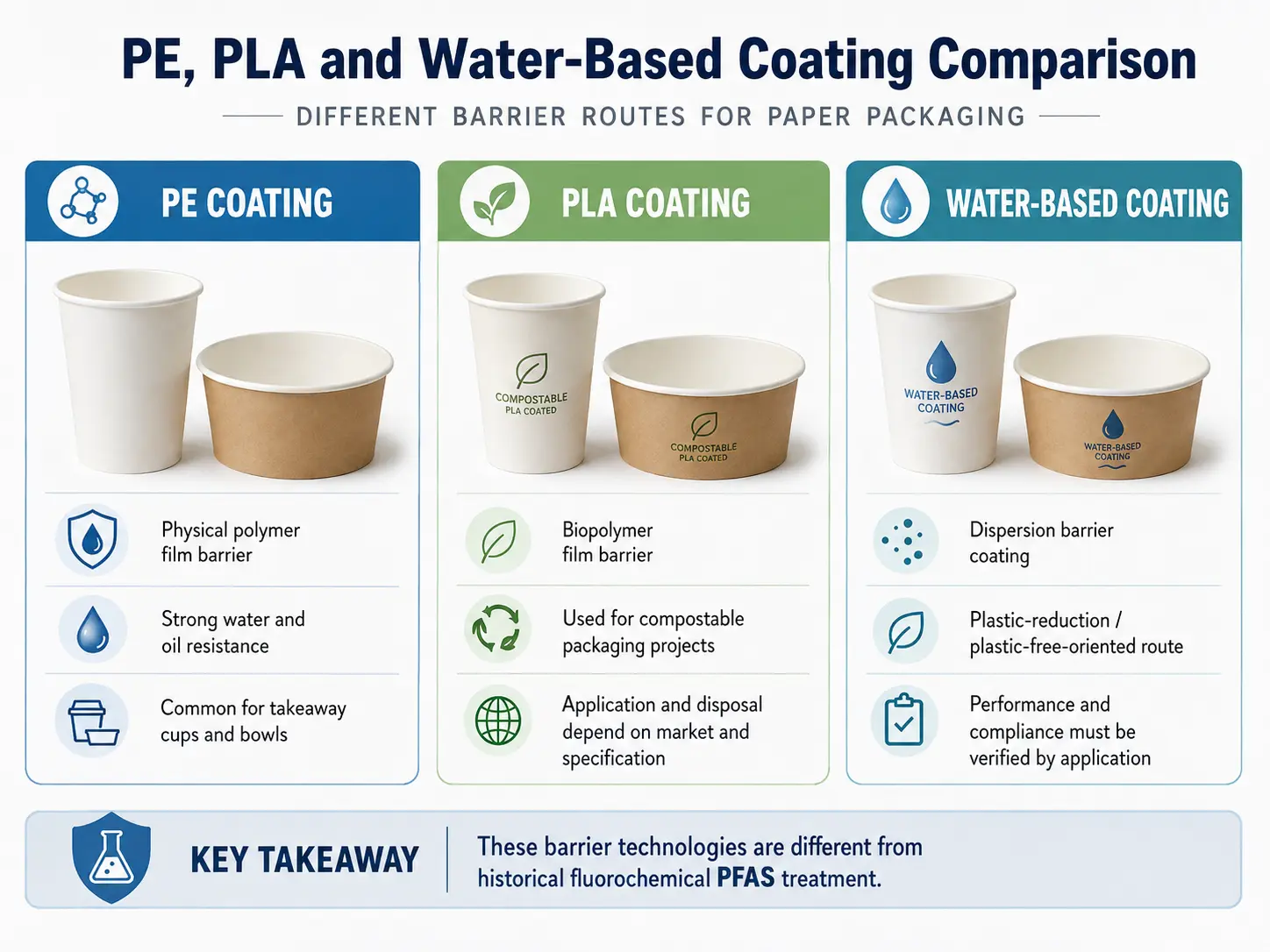
For buyers comparing alternative materials, Bioleader® provides separate technical information on PLA-coated compostable paper cups and water-based coating paper cups.
These alternatives may support different plastic-reduction, compostability or market-positioning goals, but their environmental claims, barrier performance and end-of-life routes must be evaluated separately from PFAS status.
Why Did PFAS Become Associated with Paper Food Packaging?
PFAS became associated with paper food packaging because fluorinated grease-proofing agents were historically applied to certain paper and paperboard products to resist oil, grease, water and heat.
These chemicals were especially relevant where manufacturers wanted the paper fibers themselves to repel liquids without using a continuous conventional plastic film. Examples included some food wrappers, microwave popcorn packaging, grease-resistant paperboard and other treated fiber-based applications.
This history has created an incorrect assumption:
Incorrect assumption: If a paper cup or bowl resists water and oil, it must contain PFAS.
Correct explanation: A PE-coated paper cup or bowl obtains its resistance from a continuous non-fluorinated polyethylene film. It therefore does not need PFAS chemistry to perform the same basic barrier function.
The U.S. FDA has described PFAS grease-proofers as substances applied to paper and paperboard to prevent grease, oil or water leakage. The FDA announced in February 2024 that PFAS-containing grease-proofing substances were no longer being sold for food-contact paper packaging in the U.S. market, and in January 2025 it determined that 35 related food-contact notifications were no longer effective.
Those regulatory actions concern fluorochemical grease-proofing agents. They do not mean that ordinary non-fluorinated PE film should be classified as PFAS.
What Do Bioleader®’s SGS PFAS Reports Show?
Material chemistry explains why conventional PE does not inherently contain fluorine or PFAS. Bioleader®’s SGS reports provide an additional layer of finished-product evidence.
The two most relevant reports cover representative PE-coated paper products:
- A brown paper bowl from the PE kraft product range.
- A white paper cup with transparent plastic film from the PE white product range.
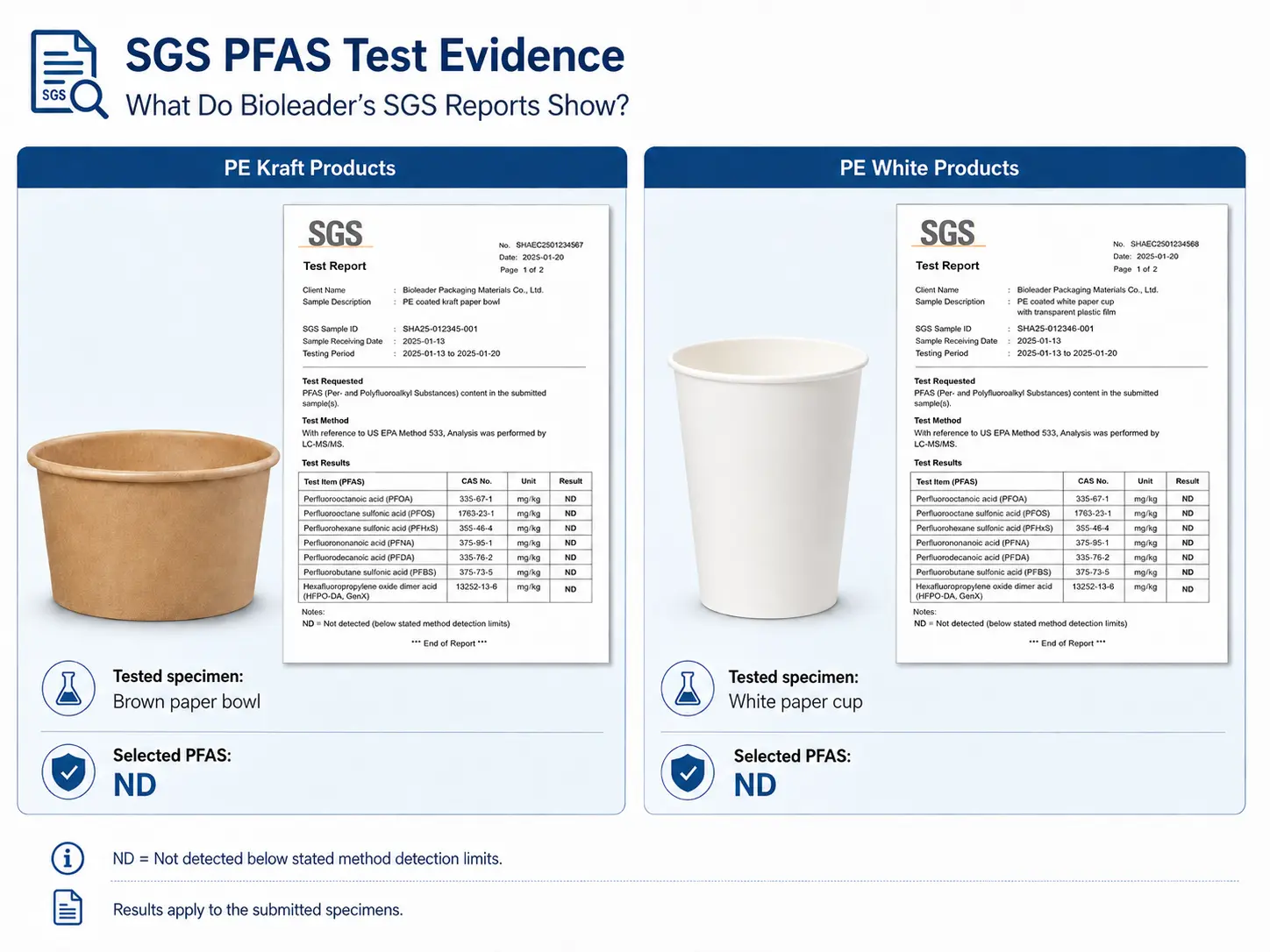
| SGS report | Actual tested specimen | Analytical scope | Reported result |
|---|---|---|---|
| PE Kraft Products PFAS Test Report | Brown paper bowl | Targeted PFAS analysis with reference to CEN/TS 15968:2010 using LC-MS, LC-MS/MS and GC-MS. | The PFAS substances listed in the report were recorded as ND at the stated method detection limits. |
| PE White Products PFAS Test Report | White paper cup with transparent plastic film | Targeted PFAS analysis with reference to CEN/TS 15968:2010 using LC-MS, LC-MS/MS and GC-MS. | The PFAS substances listed in the report were recorded as ND at the stated method detection limits. |
What the SGS Reports Support
The reports support the statement that selected targeted PFAS were not detected in the submitted brown paper bowl and white paper cup specimens at the laboratories’ stated method detection limits.
The reports also align with the material explanation: these PE-coated products do not rely on intentionally added fluorochemical grease-proofing agents to achieve their barrier performance.
What the SGS Reports Do Not Mean
The reports should not be interpreted as proving that:
- Every Bioleader® paper cup and bowl SKU was individually tested.
- Every possible PFAS compound in existence was included in the target list.
- Every future production batch automatically has an absolute concentration of zero.
- Every lid, ink, accessory or alternative material is covered by the same report.
- Targeted PFAS testing is identical to total fluorine testing.
The report’s client-reference section may mention several related products, but the laboratory result directly applies to the specimen identified in the test-part description.
Buyers can review these documents together with Bioleader®’s broader certificates and test reports center.
What Does “ND” Mean?
ND means not detected below the stated method detection limit.
In the PE kraft and PE white SGS reports:
- Many targeted PFAS substances were tested with a method detection limit of 0.025 mg/kg.
- 0.025 mg/kg is equivalent to 25 micrograms per kilogram or 25 ppb.
- Some fluorotelomer-related substances had a method detection limit of 0.2 mg/kg or 200 ppb.
- An ND result means the measured concentration was below the applicable detection limit for that specific analyte.
Correct evidence statement: Selected PFAS were not detected below the method detection limits stated in the SGS reports.
Incorrect overstatement: Laboratory testing proved that every possible form of fluorine is absolutely zero.
Fluorine-Free by Design, PFAS Not Detected and Total Fluorine Are Different Claims
Buyers often use “fluorine-free” and “PFAS-free” as if they were one universal laboratory term. For accurate procurement, three different evidence levels should be separated.
| Evidence or claim | What it means | How it applies to PE-coated paper cups and bowls |
|---|---|---|
| Fluorine-free by material design | The specified barrier materials are not formulated with fluorinated chemistry. | Conventional PE contains carbon and hydrogen, and the product does not need PFAS grease-proofing treatment for normal barrier performance. |
| No intentionally added PFAS | PFAS are not deliberately added to achieve the intended packaging function. | This is the most appropriate supplier and formulation statement for the confirmed PE-coated structure. |
| Targeted PFAS not detected | The named PFAS in the laboratory’s target list were below the applicable detection limits. | This is supported for the representative brown paper bowl and white paper cup tested by SGS. |
| Total fluorine result | A screening method measures total fluorine from PFAS and non-PFAS sources. | The reviewed SGS targeted PFAS reports do not provide a total-fluorine value. |
| Absolute zero fluorine | A claim that no fluorine atom exists in any component at any analytical level. | This should not be claimed from the current targeted PFAS reports. |
The strongest and most defensible combined wording is:
Bioleader®’s specified conventional PE-coated paper cups and bowls use a non-fluorinated PE film as the water and grease barrier and are manufactured without intentionally added PFAS grease-proofing agents. Representative finished-product SGS tests reported the listed targeted PFAS as not detected below the stated method detection limits.
For a broader explanation of testing terminology and documentation, buyers can review Bioleader®’s guide to verifying PFAS-free food packaging claims.
Can Buyers Call These Products PFAS-Free?
Yes, but the wording should be tied to the confirmed material system and supporting evidence.
| Proposed statement | Recommended use | Qualification |
|---|---|---|
| Conventional non-fluorinated PE is not a PFAS. | Recommended | Use specifically for ordinary PE extrusion coating. |
| The PE barrier contains no intentionally added fluorinated grease-proofing chemistry. | Recommended | Applies to the confirmed standard Bioleader® material structure. |
| Fluorine-free by design. | Recommended with context | Clarify that this is a material and formulation statement, not an absolute total-fluorine result. |
| No intentionally added PFAS. | Recommended | Support with material declarations and supply-chain control. |
| Selected PFAS not detected. | Recommended | Identify the tested specimen, report and detection limits. |
| PFAS-free paper cups and bowls. | Acceptable with supporting context | Explain the material basis and SGS evidence in the technical documentation. |
| Zero fluorine under all possible testing methods. | Not recommended | The current targeted reports do not prove absolute zero total fluorine. |
What Does the EU PPWR Require from August 2026?
Regulation (EU) 2025/40 introduces PFAS concentration limits for food-contact packaging placed on the EU market from 12 August 2026.
| PPWR threshold | Scope | Practical relevance |
|---|---|---|
| 25 ppb for any individual PFAS | Targeted PFAS analysis, excluding polymeric PFAS from quantification. | The detection capability for each relevant target must be reviewed against the legal limit. |
| 250 ppb for the sum of PFAS | Sum of targeted PFAS, where applicable after degradation of precursors; polymeric PFAS excluded from quantification. | The laboratory scope and sum calculation must be suitable for the product and technical file. |
| 50 ppm for PFAS, including polymeric PFAS | If total fluorine exceeds 50 mg/kg, evidence must distinguish fluorine attributed to PFAS from non-PFAS fluorine. | Total fluorine can be used as part of a broader compliance-evidence strategy. |
The material design of conventional PE-coated paper cups and bowls provides a strong starting point because the barrier does not require fluorinated grease-proofing chemistry. However, EU importers should still maintain product-specific technical documentation rather than relying only on a general material explanation.
Do the Existing SGS Reports Automatically Equal a Complete PPWR 2026 File?
No. They are relevant supporting evidence, but a complete PPWR file may also require a confirmed SKU specification, supplier declarations, traceability, ink and lid information, market-appropriate analytical limits and an assigned economic-operator responsibility.
Some analytes in the existing reports have a 25 ppb MDL, while some fluorotelomer-related targets have a 200 ppb MDL. Buyers should therefore review the exact analyte list and detection limits for projects that require direct mapping to Article 5(5).
European buyers can review Bioleader®’s updated EU PPWR 2026 guidance for foodservice packaging for additional information on manufacturer, importer, supplier, technical-documentation and declaration-of-conformity responsibilities.
What Should U.S. Buyers Verify?
The U.S. FDA announced in February 2024 that PFAS-containing grease-proofing substances were no longer being sold by manufacturers for food-contact paper packaging in the U.S. market.
In January 2025, the FDA determined that 35 food-contact notifications related to PFAS-containing grease-proofing substances applied to paper and paperboard were no longer effective.
For a U.S. buyer sourcing PE-coated paper cups or bowls, the practical questions are:
- Is the barrier provided by conventional non-fluorinated PE?
- Is the paperboard free from intentionally added PFAS grease-proofing treatment?
- Can the supplier provide a material declaration?
- Is representative finished-product testing available?
- Does the test cover the actual ordered body, lid and printing structure?
A PE-coated product should not be rejected merely because it contains polyethylene. The PFAS question is whether fluorinated substances were intentionally used in the barrier system, not whether the product includes a conventional non-fluorinated PE film.
PFAS-Free Does Not Mean Plastic-Free or Compostable
PFAS status, plastic content and compostability are separate product characteristics.
| Claim | What it addresses | What it does not prove |
|---|---|---|
| PFAS-free or no intentionally added PFAS | Whether fluorinated PFAS chemistry is deliberately used. | It does not mean plastic-free, recyclable or compostable. |
| PE-coated | Whether polyethylene is used as the barrier film. | It does not automatically establish compostability. |
| PLA-coated | Whether polylactic acid is used as the barrier film. | It does not automatically establish home compostability or local acceptance. |
| Water-based coating | Whether a dispersion coating is used instead of conventional laminated film. | It does not automatically guarantee every plastic-free, recyclable or compostable claim. |
Buyers seeking a compostability-oriented cup can review compostable paper cups for hot drinks. Buyers seeking a proven, widely used conventional hot- and cold-food barrier may prefer standard PE-coated products.
Buyer Checklist for Fluorine-Free PE-Coated Paper Packaging
Before Approving a Supplier or Product
- Confirm the coating type: Verify that the barrier is conventional non-fluorinated PE rather than an unspecified specialty treatment.
- Confirm the paperboard specification: Ask whether the paperboard uses an intentionally added fluorochemical grease-proofing treatment.
- Request a no-intentionally-added-PFAS statement: The declaration should apply to the confirmed paperboard, PE coating and finished-product structure.
- Review the actual tested specimen: Check whether the laboratory tested a cup, bowl, lid or another product.
- Review the analyte list: Do not rely only on a report filename or front-page product family.
- Review the MDL or LOQ: Confirm whether the analytical capability is suitable for the destination market.
- Separate the cup or bowl body from the lid: A body report does not automatically cover a PET, RPET, PP or paper lid.
- Check custom printing changes: Confirm whether different inks, full-surface printing or a new supplier require additional documentation.
- Maintain change control: Paper mill, PE resin, coating weight, ink, production site and lid changes should be documented.
- Request updated evidence where required: EU PPWR projects may need a more specific test and technical-documentation package.
Performance Still Needs to Be Verified
Fluorine-free material design does not replace foodservice performance testing. A cup or bowl must still match the intended food, temperature, holding time, transport conditions and lid.
| Application | Main performance checks | Relevant Bioleader® product resource |
|---|---|---|
| Hot coffee, tea and other beverages | Filling temperature, side-seam integrity, rim quality, cup rigidity, lid fit and odor. | Paper cups from 2oz to 22oz for bulk wholesale |
| Soup, noodles, curry and broth | Leakage, bottom sealing, wall softening, oil resistance, lid retention and delivery stacking. | Disposable kraft and white paper soup bowls with lids |
| Salad, poke bowls and grain meals | Dressing resistance, condensation, refrigeration, presentation and clear-lid compatibility. | Paper salad bowls for takeaway and food delivery |
| Custom printed cups and bowls | Ink adhesion, print rub, color consistency, odor, food-contact control and registration accuracy. | Custom printed disposable paper cups |
Recommended Sample Evaluation
Test the selected cup or bowl with the actual beverage, soup, sauce, salad dressing or takeaway meal. Record filling temperature, holding time, leakage, wall softening, odor, lid retention, stacking and transport performance.
A compliant material must also work under real service conditions. PFAS documentation does not compensate for poor sealing, an incorrect lid, inadequate coating weight or a container that softens during delivery.
Bioleader® PE-Coated Paper Cup and Bowl Solutions
Bioleader® manufactures and supplies conventional PE-coated kraft and white paper cups and bowls for importers, distributors, restaurant chains, coffee shops, catering operators, takeaway brands and foodservice wholesalers.
The standard PE-coated product structure uses a thin non-fluorinated polyethylene film to provide water and oil resistance. It does not depend on intentionally added PFAS grease-proofing chemistry.
Available support includes:
- White and kraft paperboard options.
- Paper cups for hot and cold beverages.
- Paper soup bowls and salad bowls in multiple capacities.
- Matching paper, PP, PET or RPET lids depending on the application.
- Custom logo printing, OEM and private-label production.
- Bulk wholesale and mixed-container planning.
- Representative SGS test reports and material documentation.
- Product-specific documentation review for U.S., EU and other export markets.
Because compliance claims depend on the exact ordered specification, Bioleader® recommends linking every declaration and report to the confirmed product body, lid, material, coating, printing and production source.
Final Technical Conclusion
Bioleader®’s specified conventional PE-coated paper cups and bowls are fluorine-free by material design because their barrier function does not use fluorinated chemistry.
The PE film is a carbon-and-hydrogen polymer. It forms a continuous physical layer over the paperboard and provides the required water and oil resistance. The ordinary paperboard does not need an intentionally added PFAS grease-proofing treatment to perform this function.
SGS targeted PFAS reports provide additional finished-product evidence. In the submitted brown paper bowl and white paper cup specimens, the PFAS substances listed in the reports were not detected below the stated method detection limits.
The most accurate buyer-facing conclusion is:
These conventional PE-coated paper cups and bowls use a non-fluorinated barrier system, contain no intentionally added PFAS grease-proofing agents in the confirmed material structure, and have representative targeted PFAS test evidence showing the listed substances were not detected.
This wording directly answers the buyer’s concern without incorrectly claiming that every possible form of fluorine has been proven to be absolutely zero in every untested component or future batch.
Frequently Asked Questions
Does conventional PE coating contain fluorine?
No. Conventional non-fluorinated polyethylene is made from carbon and hydrogen and does not contain fluorine in its basic polymer structure. It is not classified as a PFAS under definitions based on fully fluorinated carbon atoms.
Are Bioleader® PE-coated paper cups PFAS-free?
Bioleader®’s confirmed standard PE-coated paper cup structure is manufactured without intentionally added PFAS grease-proofing agents. The liquid barrier is provided by conventional PE film. A representative white paper cup tested by SGS showed the listed targeted PFAS as not detected below the stated method detection limits.
Are Bioleader® PE-coated paper bowls PFAS-free?
The confirmed standard PE-coated paper bowl structure does not rely on intentionally added PFAS chemistry. Its water and oil resistance comes from the PE film. A representative brown paper bowl tested by SGS showed the listed targeted PFAS as not detected at the stated limits.
Why is the inside of a kraft PE-coated bowl still brown?
The PE film is very thin and transparent. The natural kraft color of the paperboard remains visible through the coating. A slight gloss or smoother surface indicates the transparent barrier film, but the inside does not need to become white.
Does the paperboard itself provide the waterproof barrier?
No. Ordinary paperboard is absorbent and does not provide the main water and oil barrier. In a PE-coated cup or bowl, the thin polyethylene film protects the fibers from direct contact with liquids and grease.
Does ND mean absolutely zero PFAS?
No. ND means the named target substance was not detected below the method detection limit stated in the laboratory report. It does not represent an unlimited test for every PFAS or proof of absolute zero total fluorine.
Is targeted PFAS testing the same as total fluorine testing?
No. Targeted analysis measures specific named PFAS. Total fluorine testing measures all fluorine in the sample but does not by itself identify whether the fluorine comes from PFAS or another source. The two methods answer different compliance questions.
Does PFAS-free mean the cup is plastic-free?
No. A conventional PE-coated cup can contain no intentionally added PFAS while still containing a thin polyethylene film. PFAS status, plastic content, recyclability and compostability must be evaluated separately.
Official and Technical References
- OECD: Reconciling Terminology of the Universe of Per- and Polyfluoroalkyl Substances
- Regulation (EU) 2025/40 on Packaging and Packaging Waste
- FDA: PFAS Grease-Proofing Agents for Food Packaging No Longer Sold in the U.S.
- FDA: 35 PFAS-Related Food Contact Notifications No Longer Effective
- SGS PE Kraft Products Targeted PFAS Test Report
- SGS PE White Products Targeted PFAS Test Report