









“Eco-friendly” isn’t a label — it’s a legal and scientific responsibility.
When European inspectors began testing tableware branded as “bamboo fiber cups” or “eco bamboo plates,” they found not harmless plant fiber, but illegal mixtures of plastic polymers and bamboo powder.
That discovery triggered one of the EU’s most far-reaching coordinated actions in food safety — Operation Bamboo-zling — and sent shockwaves through the global packaging industry.
This story is more than a regulatory crackdown. It’s a defining moment for how the world must rethink what sustainable packaging really means.

1. Inside “Operation Bamboo-zling” — Europe’s Coordinated Action
The European Commission and the EU Food Fraud Network (EU AFN) launched Operation Bamboo-zling to confront the growing market of plastics falsely marketed as natural or compostable.
From 2022 to 2024, 21 Member States joined forces through the Administrative Assistance and Cooperation (AAC) system. The goal: to stop illegal imports and sales of bamboo-powder-filled plastic food contact materials (FCMs).
1.1. The Facts and Figures
According to the official report (European Commission, 2025):
748 cases investigated across the EU.
644 illegal items already on the market.
104 shipments stopped at EU borders.
≈ 90 % of sales originated from online marketplaces.
Major country of origin: China, followed by Vietnam and Turkey.
Laboratory analysis revealed that many “bamboo” products were in fact melamine-formaldehyde resin plastics filled with bamboo or corn powder.
Under heat, these composites released formaldehyde up to 25 times and melamine 3.5 times the legal migration limits.
1.2. The Enforcement Timeline
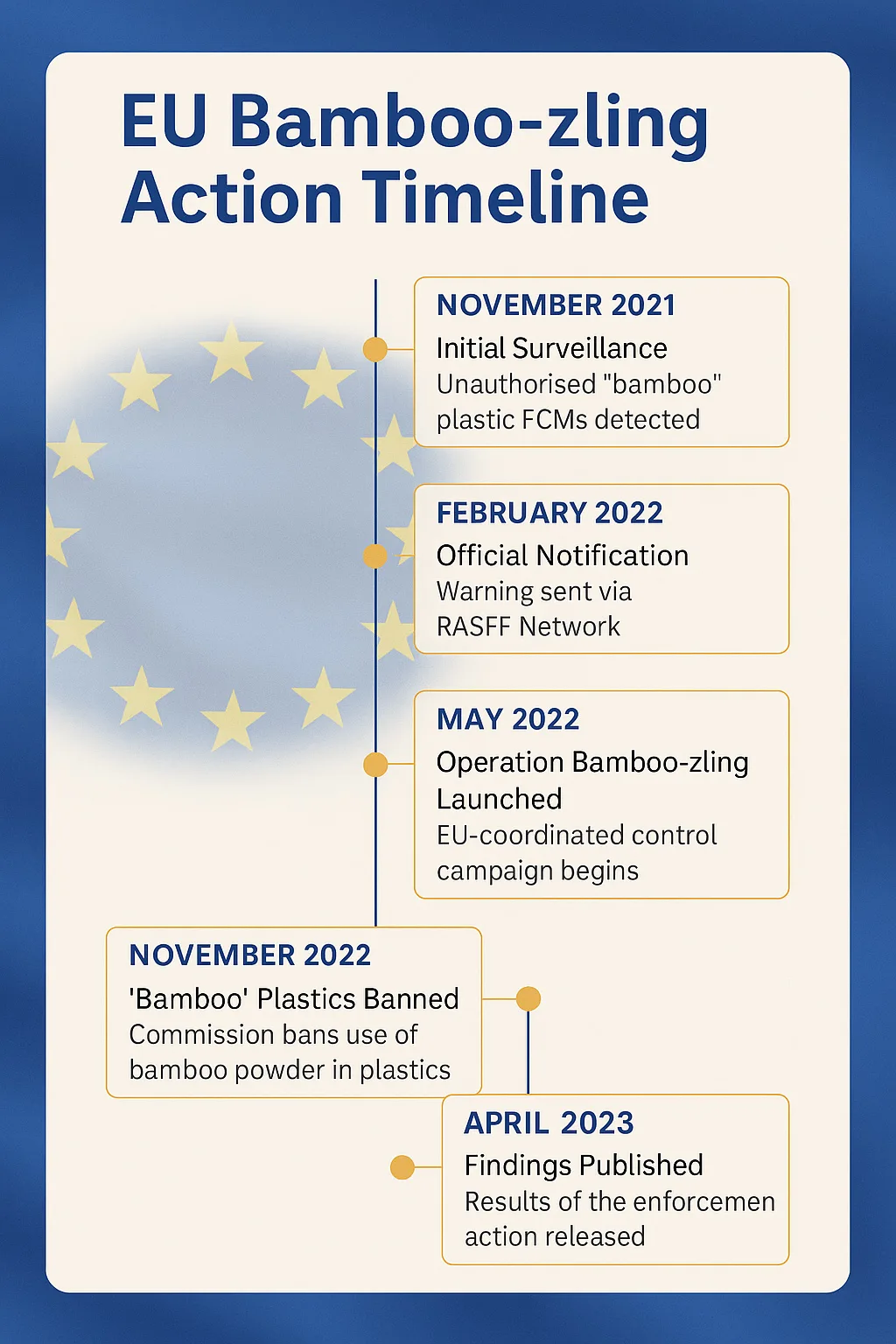
| Year | Milestone | Regulatory Context |
|---|---|---|
| 2019 | First alerts on “bamboo cups” issued by Germany, Netherlands | National surveillance results show high migration levels |
| 2020–2021 | EFSA risk assessments confirm unauthorized use of plant powders in plastics | Basis for EU-wide investigation |
| 2022 | Launch of “Operation Bamboo-zling” | Joint enforcement by 21 Member States |
| 2023 | Massive online recall campaigns | Hundreds of products removed from e-commerce |
| 2024 | Publication of EU coordinated results — call for full market withdrawal | Transition phase toward certified compostables |
| 2025 | Implementation phase for reinforced inspections under PPWR draft | Alignment with Extended Producer Responsibility (EPR) |
The name “Bamboo-zling”—a play on “bamboozling”—aptly summarized the deception of eco-claims without scientific authorization.
2. The Hidden Dangers Behind Bamboo-Powder Plastics
2.1. The Chemistry Behind the Risk
Bamboo powder, when mixed into melamine formaldehyde (MF) resin, disrupts polymer stability.
As heat or acidity rises, polymer chains break, releasing volatile compounds including formaldehyde, melamine monomers, and secondary amines.
🔬 According to EFSA’s 2021 Scientific Opinion, chronic dietary exposure to formaldehyde from such composites may contribute to nephrotoxicity and carcinogenicity in sensitive populations.
Unlike certified biopolymers such as PLA, these bamboo-plastic mixes cannot biodegrade; instead, they fracture into micro-plastics and potentially toxic fragments.
2.2. Health & Environmental Impacts
Formaldehyde → classified as Carcinogen Category 1B under (EC) No 1272/2008.
Melamine → linked to renal crystal formation in humans.
Migration potential → increases exponentially above 70 °C.
Environmental persistence → non-compostable, contaminates recycling streams.
While consumers believed they were making a green choice, they were effectively exposing themselves to unregulated plastic products with false environmental claims.
2.3. Market Misrepresentation
Between 2020 and 2024, more than 30 EU countries issued recall notices for bamboo-plastic products through the EU Safety Gate (RAPEX).
Common product types included:
“Bamboo coffee cups” sold via Amazon & AliExpress
“Plant-fiber” reusable lunch boxes
“Eco bamboo cutlery” and plates
Many displayed misleading icons — “🌱 100 % eco,” “compostable,” or “recyclable” — despite failing every compostability test.
3. Regulatory Lessons — What Businesses Must Do
The Bamboo-zling operation is a wake-up call for importers, brand owners, and packaging manufacturers.
3.1. The Legal Backbone
Regulation (EC) No 1935/2004 → food contact materials must not endanger health or mislead consumers.
Regulation (EU) No 10/2011 → lists authorized substances; bamboo powder is not included.
Commission Regulation (EU) 2023/2006 → requires Good Manufacturing Practice (GMP) for all FCMs.
Thus, adding bamboo powder to plastics without authorization equals non-compliance and potential fraud.
3.2. Compliance Checklist for Exporters
Verify that all raw materials appear on EU 10/2011 positive list.
Request third-party migration tests for melamine & formaldehyde.
Provide Declaration of Compliance (DoC) with traceable batch data.
Avoid unverified eco-claims — “biodegradable,” “natural,” etc.
Use materials certified under EN 13432 / ASTM D6400 / ISO 17088.
For fully certified alternatives, review biodegradable compostable cutlery.
4. Safe & Certified Alternatives — From “Bamboo Look” to Truly Biodegradable
4.1. Sugarcane Bagasse – The Natural Fiber Leader
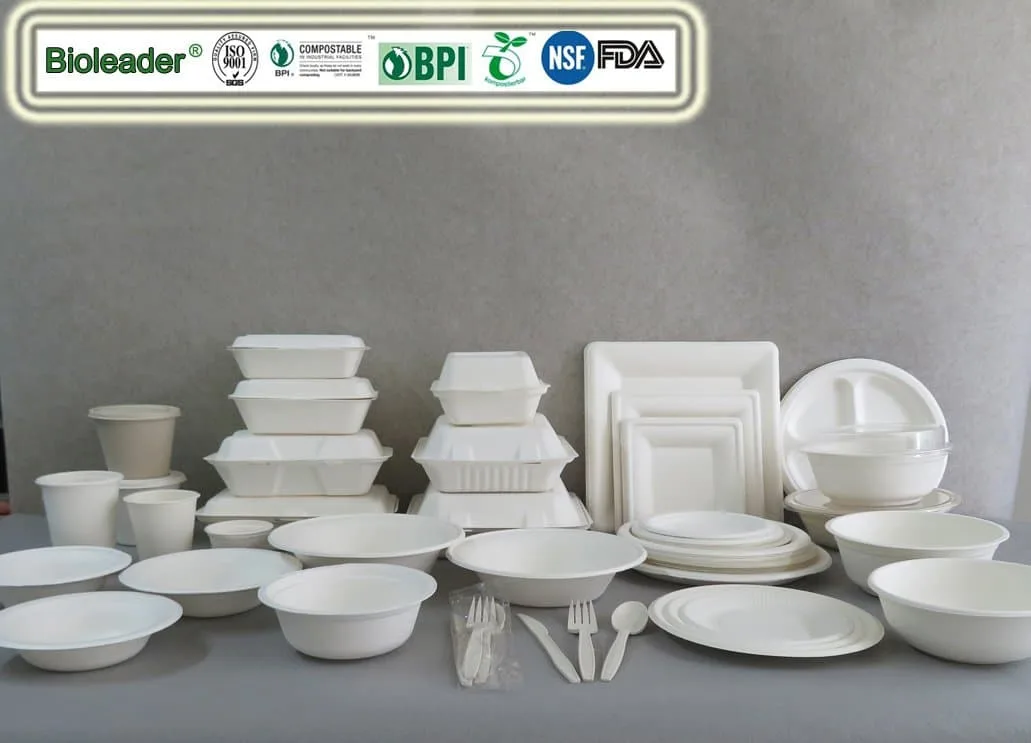
Bagasse is the residual pulp from sugarcane after juice extraction.
It contains cellulose, hemicellulose, and lignin, forming a strong, heat-stable matrix — no plastic binders required.
Advantages
Completely plastic-free and PFAS/PFOA/PFOS-free
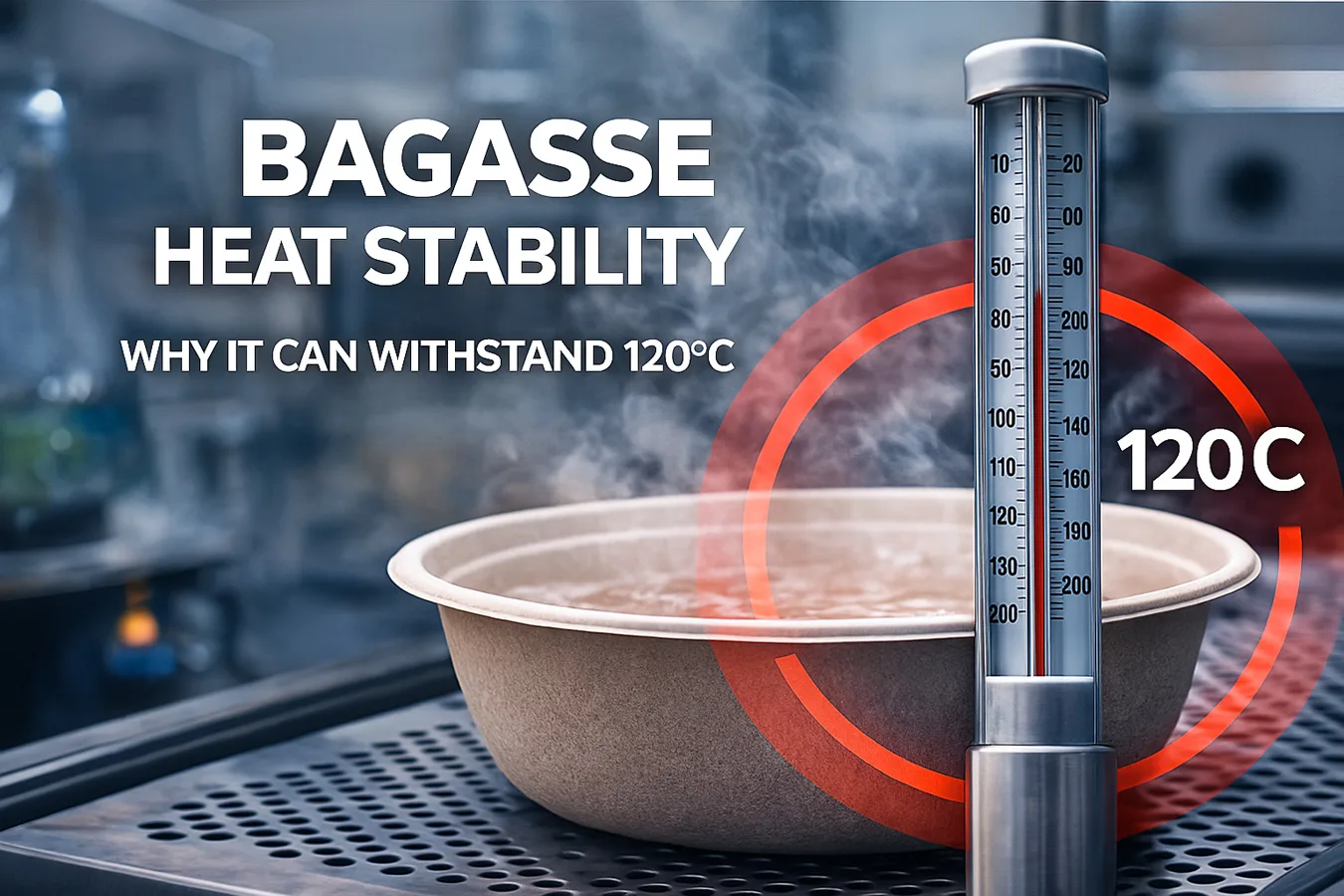
Microwave & freezer safe (–20 °C to 120 °C)
Composts within 60–90 days in industrial systems
Lower life-cycle CO₂ emissions by > 70 % vs. PS/PP
Recent LCA studies (2024, University of Leeds) confirm that replacing polystyrene trays with bagasse reduces end-of-life waste by 82 %.
4.2. PLA (Polylactic Acid) – For Clear Cold Applications
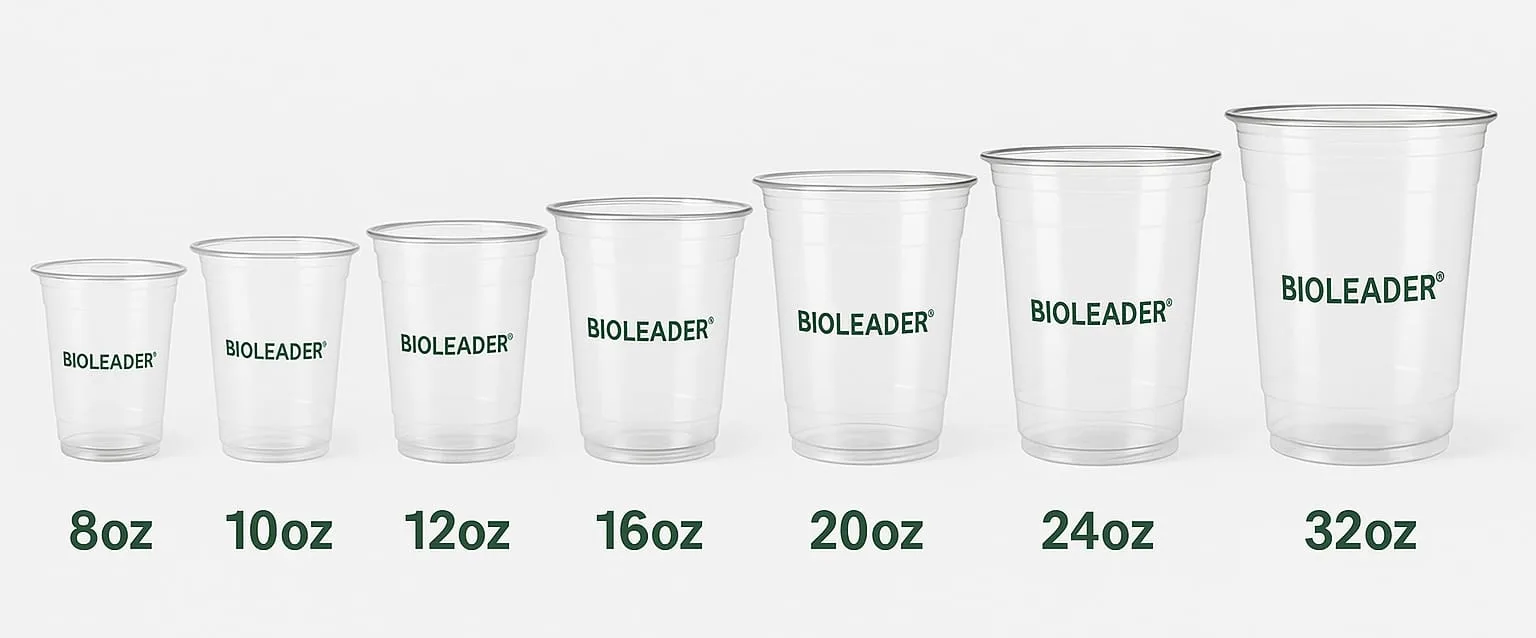
Derived from corn or cassava starch fermentation, PLA is a renewable biopolymer ideal for cold drinks, smoothies, or salads.
| Feature | PLA | PET | Bamboo-Plastic | Bagasse |
|---|---|---|---|---|
| Origin | Plant (starch) | Petroleum | Mixed | Sugarcane fiber |
| Compostable | ✅ (EN 13432) | ❌ | ❌ | ✅ (Home & Industrial) |
| PFAS-Free | ✅ | ❌ (often) | ❌ | ✅ |
| Heat Limit | ≤ 55 °C | 80 °C | 70 °C | 120 °C |
| Transparency | Crystal clear | Clear | Opaque | Matte |
| Legal Status EU | Authorized | Authorized | Banned | Authorized |
Bioleader-material-comparison-2025
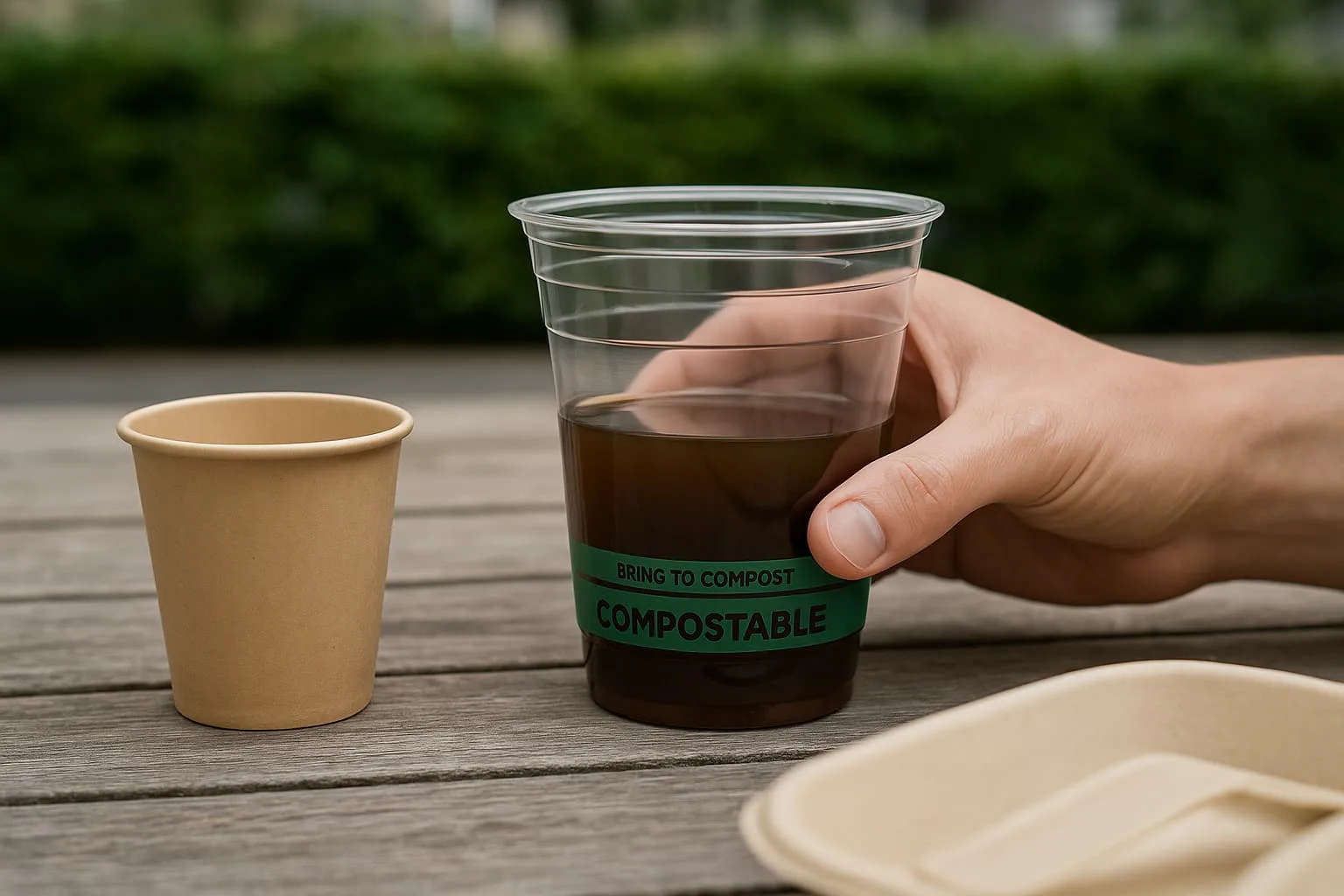
PLA and bagasse complement each other: PLA for cold uses, bagasse for hot meals — both certified compostable.
For tested utensils, see compostable cutlery.
5. Industry Impact — Compliance Driving Sustainability
5.1. Global Ripple Effects
Following the EU action, regulators worldwide took notice:
Canada (Health Canada 2024): warning on bamboo powder melamine ware.
Japan (Food Safety Agency): announced import screening for bamboo composites.
U.S. FDA: heightened monitoring of “eco bamboo” imports.
Retailers across Europe replaced bamboo-plastic products with certified compostables within months.
5.2. Case Study — European Café Chain Transition
A multi-country café chain that once used “bamboo fiber cups” faced recalls after RAPEX alerts.
Switching to bagasse cups and PLA lids, sourced from Bioleader®, the company achieved:
100 % legal compliance under EU 1935/2004.
28 % lower packaging costs after removing mixed materials.
15 % increase in consumer trust (survey 2024).
5.3. Market Forecast 2025–2030
| Segment | 2024 Market Value (USD B) | 2030 Forecast (USD B) | CAGR % |
|---|---|---|---|
| Biodegradable Tableware | 6.8 | 14.5 | 13.4 % |
| Bagasse Products | 2.2 | 5.6 | 14.8 % |
| PLA Cups & Cutlery | 1.9 | 4.3 | 13.1 % |
Sustainability is no longer a niche — it’s a compliance-driven growth sector.
Explore Bioleader®’s product range of compostable spoons and forks as practical solutions embraced by global brands.
6. Bioleader® — Manufacturing the Next Generation of Compostable Tableware
6.1. About Bioleader
Bioleader (Xiamen Bioleader Environmental Protection Technology Co., Ltd.) is a pioneer manufacturer of bagasse pulp molded and PLA tableware in China.
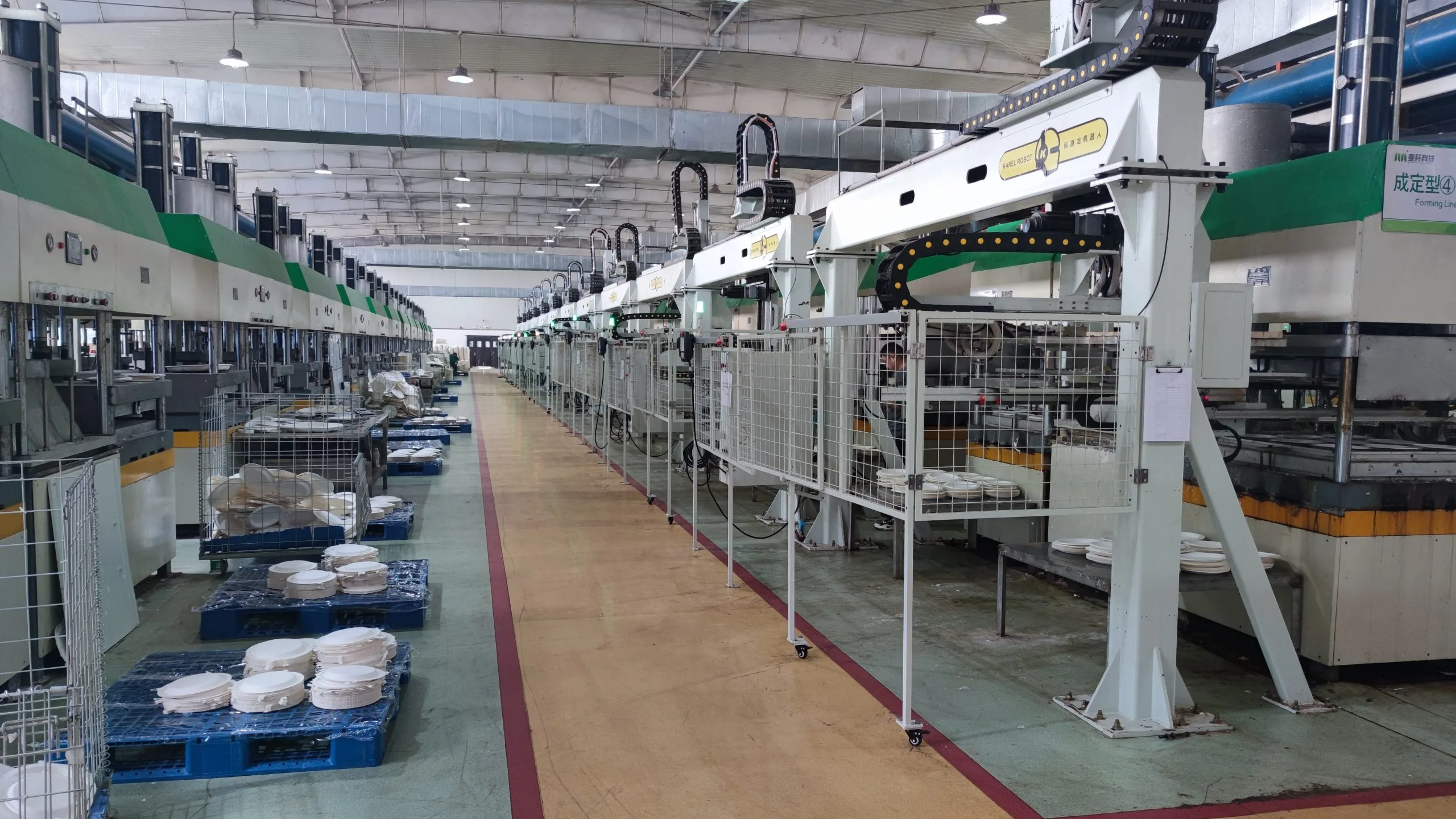
Founded in 2016, its facilities span over 30,000 m² with automated production lines for pulp molding, coating, and sterile packaging.
6.2. Our Product Portfolio
Bagasse tableware: bowls, plates, trays, clamshell boxes, lids.
PLA cold cups and straws: transparent, rigid, and certified compostable.
Cornstarch cutlery: heat-resistant to 90 °C and home compostable.
All products are PFAS/PFOA/PFOS-free, BPA-free, and tested under EN 13432, ASTM D6400, BPI, LFGB, and FDA standards.
See examples such as individually wrapped forks and spoons — ideal for airlines, hospitals, and foodservice chains.
6.3. Quality and Sustainability System
| Certification | Standard | Scope |
|---|---|---|
| ISO 9001:2015 | QMS | Manufacturing Process Control |
| ISO 14001:2015 | EMS | Environmental Management |
| BPI Compostable | ASTM D6400 | North America |
| EN 13432 Certification | EU Standard | Industrial Composting |
| LFGB & FDA | Food Contact Safety | Global Markets |
6.4. Innovation and R&D
Bioleader® invests in biopolymer research labs collaborating with universities to develop:
PFAS-free coating solutions for oil resistance.
Color customization using plant pigments.
Lightweight molding reducing material use by 18 %.
6.5. Global Client Recognition
Serving over 50 countries worldwide, Bioleader® has become a preferred OEM partner for:
Retail chains in Germany & France.
Take-away brands in the U.S. and UAE.
Eco-certified catering services in Japan and Australia.
Feedback from a U.K. distributor:
“Bioleader’s bagasse bowls passed migration tests with zero PFAS and performed better than our previous supplier’s PP products.”
7. The Future of Safe Eco Materials
7.1. Regulatory Outlook
The EU’s Bamboo-zling enforcement will likely extend into broader PFAS and composite bans.
By 2026, under the Packaging and Packaging Waste Regulation (PPWR), only materials that are:
Compostable (EN 13432 / ASTM D6400)
PFAS-free
Traceable via digital product passport
will qualify for EU market entry.
7.2. Expert Insights
Dr. Anja Keller, Materials Scientist, Fraunhofer IVV:
“Bamboo-plastic composites represent a regulatory blind spot. Operation Bamboo-zling has closed that gap and redirected investment toward true biopolymers like PLA and bagasse.”
Prof. Liang Chen, Xiamen University Environmental School:
“Chinese manufacturers that embrace certified pulp-molding technologies stand to lead the next phase of global supply chains.”
7.3. Industry Transformation
The future of eco packaging is no longer about “looking green,” but about data-driven traceability.
Expect to see:
QR code eco passports for each batch.
Carbon-footprint labels next to nutrition facts.
Retailers requiring PFAS & migration disclosure on product pages.
Bioleader® is already developing blockchain-backed traceability systems for its export clients to satisfy EPR and Green Deal requirements.
8. Conclusion — From Bamboo Confusion to Compostable Clarity
The EU’s Bamboo-zling operation marks a turning point for sustainable packaging.
It demonstrates that good intentions must be matched with regulatory rigor and scientific transparency.
Bamboo powder-plastic products were never truly eco-friendly — they were a shortcut.
Now, the industry is pivoting toward materials that prove their sustainability:
sugarcane bagasse for strength and heat resistance, PLA for clarity and renewability.
For importers and food brands, this is the moment to act:
✅ Audit your supply chains.
✅ Demand certifications under EN 13432 and ASTM D6400.
✅ Partner with verified manufacturers like Bioleader®.
As the EU and global markets move toward zero-tolerance for false eco claims, one message rings clear:
Bioleader® — Building a Plastic-Free Future, One Tableware at a Time.
With certified materials, transparent compliance, and scalable manufacturing, we are not just responding to regulations — we are shaping the new global standard for safe, compostable food packaging. From sugarcane pulp innovation to next-generation PLA applications, Bioleader remains committed to helping brands transition responsibly, competitively, and confidently into a truly circular economy.
The future of food packaging is not just about looking green — it’s about proving it.
And together, we are making that future real.
Related FAQ
1. What is Operation Bamboo-zling?
Operation Bamboo-zling is a coordinated EU-wide enforcement campaign led by the European Commission’s Directorate-General for Health and Food Safety (DG SANTE) and the EU Agri-Food Fraud Network. Its purpose is to detect and remove illegal plastic food contact materials containing bamboo or other unauthorized plant powders.
2. Why did the EU launch this action?
Authorities noticed a surge of “eco-friendly bamboo” tableware falsely promoted as natural and biodegradable. Testing revealed that many were actually plastic products mixed with bamboo powder, posing potential chemical migration risks and misleading consumers.
3. What regulations apply to food contact materials (FCMs) in the EU?
The main rules are Regulation (EC) No 1935/2004 (general safety requirements) and Regulation (EU) No 10/2011 (specific measures for plastics). These specify which substances may be used and set migration limits for chemicals such as melamine and formaldehyde.
4. Why are bamboo or other plant powders not authorized as plastic additives?
Because such organic fillers are not listed in Annex I of Regulation (EU) 10/2011, meaning their long-term migration behavior and toxicological safety have not been fully evaluated. Their addition can destabilize plastics, increasing leaching under heat or moisture.
5. What health risks are linked to bamboo-plastic composites?
Repeated exposure to melamine or formaldehyde above permitted limits can affect the kidneys and urinary tract. The European Food Safety Authority (EFSA) confirmed that some bamboo-plastic samples exceeded safe levels by up to 25× for formaldehyde.
6. How can businesses identify illegal products?
Products are considered non-compliant if they:
Contain bamboo, corn, or rice powder blended with plastic resin.
Are marketed as “bamboo”, “plant-based”, or “eco” but feel like typical plastic.
Lack traceable supplier documentation proving compliance with Regulation (EU) 10/2011.
7. What penalties can importers or retailers face?
Depending on the Member State, penalties include product recalls, administrative fines, or criminal prosecution. Under the upcoming Packaging & Packaging Waste Regulation (PPWR 2025), enforcement will be even stricter, including supply-chain traceability.
8. How can manufacturers ensure compliance?
Producers must:
Use only authorized monomers and additives from Annex I of Regulation (EU) 10/2011.
Conduct migration testing under EU-accredited laboratories.
Provide Declarations of Compliance (DoCs) with every batch shipped.
9. What are safe alternatives to bamboo-plastic composites?
EU-authorized, certified compostable materials include:
Sugarcane Bagasse – 100 % plant fiber, PFAS-free, heat-resistant (-20 °C – 120 °C).
PLA (Polylactic Acid) – corn-based bioplastic for cold drinks and salads.
CPLA (Crystalized PLA) – heat-stable for cutlery and lids.
These materials meet EN 13432 and ASTM D6400 compostability standards.
👉 Example: biodegradable compostable cutlery
10. How is Bioleader® responding to the EU’s zero-tolerance stance?
Bioleader® has eliminated all mixed bamboo-plastic compositions and focuses exclusively on certified bagasse pulp molding and PLA lines. Each product is tested for migration, PFAS-free compliance, and certified under EN 13432 / ASTM D6400 / FDA / LFGB.
11. What documentation should importers request from suppliers?
Importers should require:
Material Safety Data Sheet (MSDS)
Declaration of Compliance (DoC)
Test reports from ISO / EN accredited labs
PFAS-Free confirmation
Compostability certificate (BPI / TÜV / DIN CERTCO)
Bioleader® provides all these documents upon request, ensuring traceable compliance for EU and US markets.
12. What is the long-term impact of Operation Bamboo-zling on the global tableware market?
The campaign has accelerated the industry’s shift toward traceable, truly biodegradable materials. It also signals a new global compliance era: only suppliers with transparent certification, documented material origin, and verifiable safety testing will remain competitive.
As EU regulations tighten, companies like Bioleader® are setting the benchmark for safe, compostable, PFAS-free food packaging.