PE Vs PLA Paper Cups: A Straightforward Guide | Bioleader®

Browse articles grouped under the "PE vs PLA paper cups" tag for topic-specific information and examples. The featured articles may approach the topic from different product, material, application, market, or sourcing perspectives. Check each article for its exact scope, technical data, standards, sources, and recommendations.
PE vs PLA paper cups — Content Overview
  • Featured articles shown: 12
  • Directly tagged articles: 1
  • Latest tagged article update: 2026-02-07
  • Coverage, examples, and specific recommendations vary by individual article.

Editor's Picks: Top Pe Vs Pla Paper Cups Guides 2026

FAQ of Bioleader's Eco-friendly Disposable Tableware

What are aluminum foil lined paper salad bowls used for?

Aluminum foil lined paper salad bowls are used for salads, rice bowls, poke bowls, noodles, pasta, curries, fruit, deli meals, and other takeaway foods. Their leakproof foil-lined structure is especially useful when oil resistance, sauce control, and moisture protection are more important than with ordinary paper bowls — PE vs PLA paper cups. Bioleader® supplies them in 500ml to 1300ml sizes for restaurants, catering, food delivery, and wholesale foodservice packaging.

Which lid should I choose for 1300ml paper salad bowls?

Paper lids are recommended when the buyer wants a consistent kraft or white paper packaging appearance. PET dome lids are suitable when product visibility is important for chilled salads, supermarket display, and grab-and-go food programs. The final choice should match menu type, display needs, transport distance, and brand positioning.

Which lid should I choose for 1200-1400ml square paper salad bowls?

PP lids are recommended when the buyer needs stacking strength, takeaway handling, and delivery stability. PET lids are suitable when product visibility is important for chilled salads, supermarket display, deli counters, and grab-and-go food programs. The final choice should match menu type, display needs, transport distance, and brand positioning.

4.2 Extended Producer Responsibility (EPR) and Financial Exposure

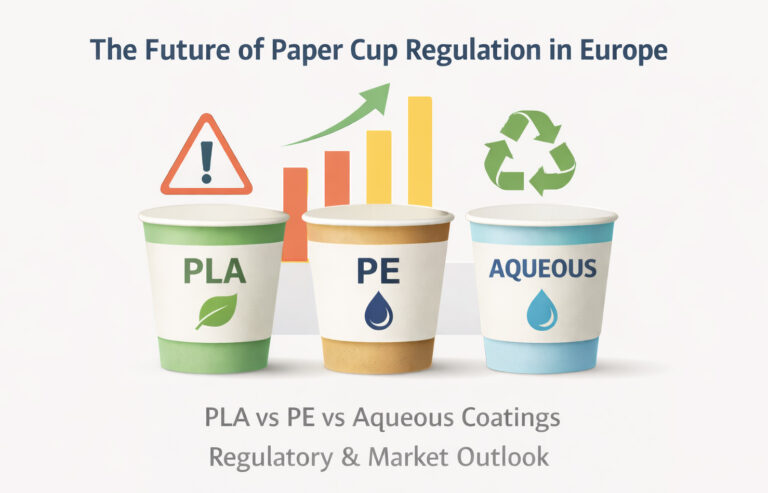
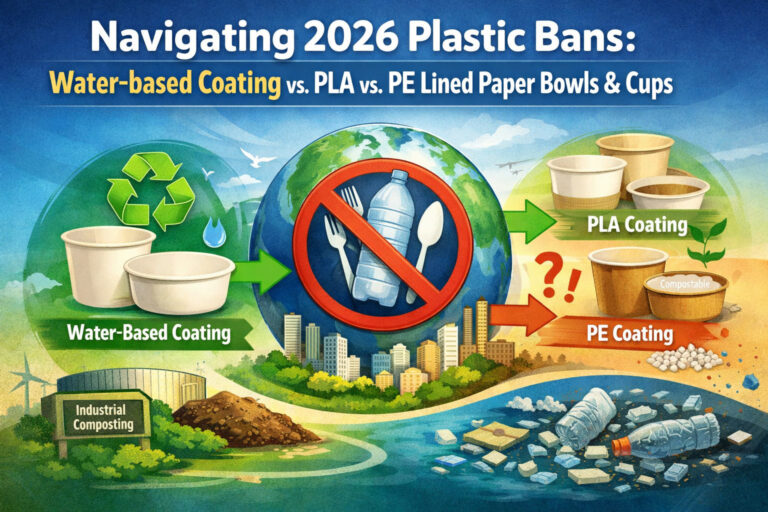
EPR mechanisms vary by member state, but their structure generally includes: Producer or importer registration Volume reporting Financial contributions to waste collection and litter management Potential modulation based on recyclability Although PLA-coated cups are not singled out for additional penalties, they are included in plastic product categories subject to EPR cost allocation — PE vs PLA paper cups. According to distributor feedback: 76% indicated that buyers now request clarity on EPR exposure before finalizing supply contracts — PE vs PLA paper cups. 41% reported that price negotiations referenced future EPR escalation risks. 29% noted that sustainability teams within retail chains prefer materials that may qualify for lower fee modulation in the future.

4.3 Regulatory Risk Matrix – Comparative Compliance Exposure

To contextualize distributor concerns, Bioleader® developed an internal compliance exposure model comparing PE, PLA, and aqueous-coated cups.

Related Insights

🚀Ready to Go Green and Choose ?

Join the global movement toward zero-waste packaging.


Bioleader® offers:

  • 📦 Bulk order support & fast delivery

  • ✍️ Custom branding and OEM solutions

  • 🌍 Worldwide eco-packaging compliance

Get the Catalogue Products List  & Contact Us Now! 👉

Contact Us for Quote

Click or drag files to this area to upload.You can upload up to 5 files.
The more details you share, the faster and more accurate our quotation will be.