

Quick Answer: PLA, PBAT, Starch-Based or Bamboo Composite?
PLA, PBAT, starch-based plastics and bamboo-filled composites are not interchangeable packaging materials. PLA is mainly relevant for rigid, transparent, lower-temperature applications such as cold cups. PBAT is a flexible biodegradable polyester commonly used in films and compostable bag formulations. “Starch-based” can describe very different polymer systems, so buyers must verify the actual formulation. Bamboo powder mixed with plastic is a composite, not solid bamboo, and may create additional food-contact compliance problems in markets such as the European Union.
- Choose PLA when transparency, rigidity and cold-food or cold-drink presentation are priorities.
- Consider CPLA or another heat-engineered material when higher temperature resistance is required, but verify the finished SKU and destination-market rules.
- Use PBAT primarily for flexible applications such as compostable bags and films rather than rigid cups or food containers.
- Never evaluate “starch-based” packaging from the name alone. Verify the continuous polymer matrix, formulation, food-contact documents and compostability evidence.
- Treat bamboo-filled plastic composites as a separate compliance question. A bamboo appearance or plant-fiber claim does not automatically make a product plastic-free, compostable or acceptable for food contact.
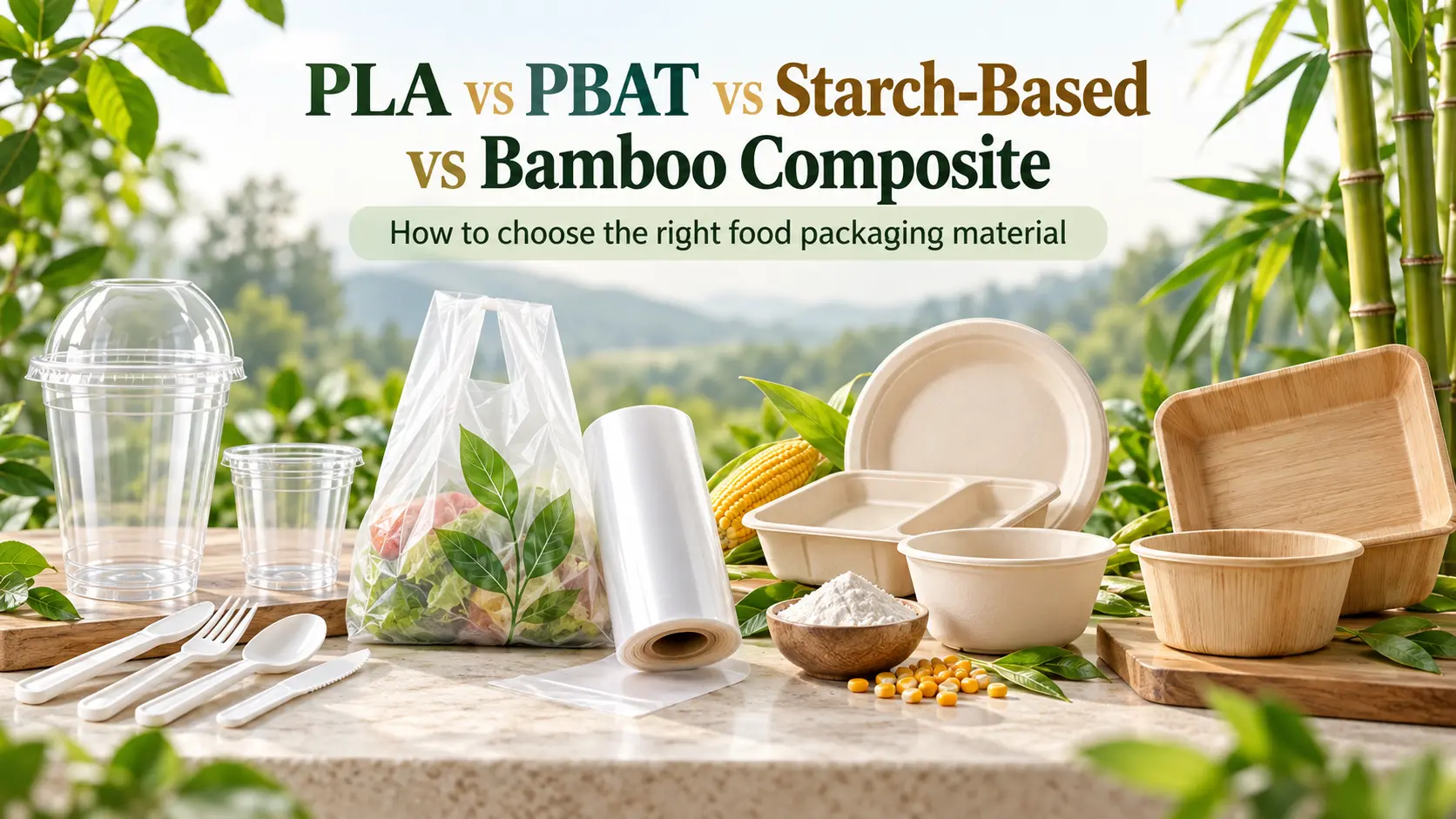
A buyer comparing biodegradable food packaging can easily encounter four labels on quotations: PLA, PBAT, starch-based and bamboo composite. They may all be described as “eco-friendly” or “biodegradable,” yet they differ substantially in polymer structure, rigidity, heat behaviour, food-contact status and realistic end-of-life options.
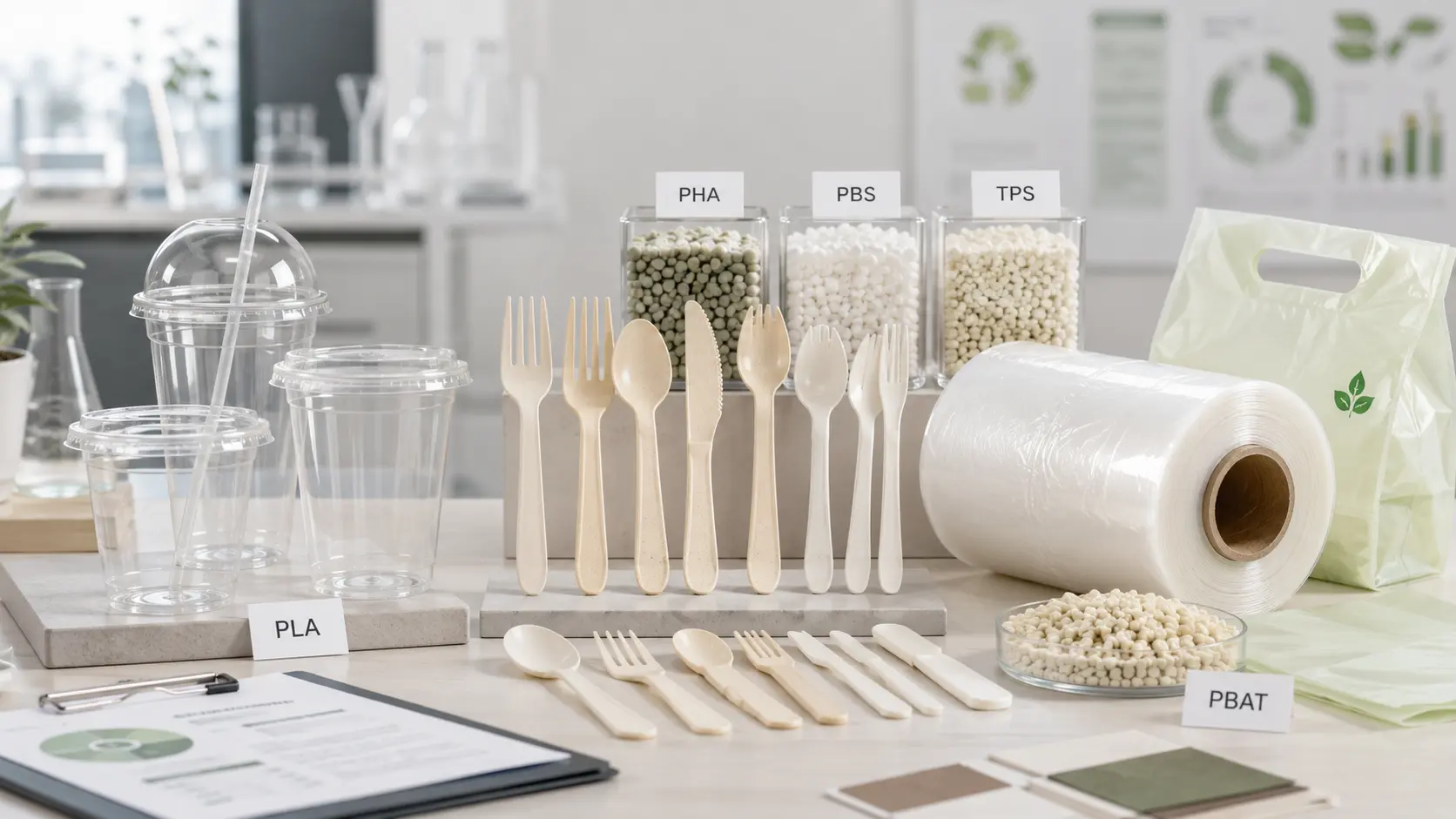
The first sourcing mistake is therefore to compare these materials only by price per kilogram or by an environmental claim printed on a catalogue. Bio-based is not the same as biodegradable, biodegradable is not automatically compostable, and a plant-filled plastic is not automatically plastic-free. For a broader map of these polymer families, buyers can first review Bioleader®’s PLA vs PHA vs PBAT material guide for food packaging buyers.
PLA vs PBAT vs Starch-Based vs Bamboo Composite: Quick Comparison
| Material | What It Actually Is | Typical Packaging Form | Temperature Profile | Main Buyer Check |
|---|---|---|---|---|
| PLA | Polylactic acid, normally a bio-based thermoplastic made from renewable carbohydrate feedstocks. | Clear cold cups, lids, transparent food packaging and selected rigid articles. | Standard amorphous PLA is mainly suited to lower-temperature applications and can soften under higher heat. | Confirm the PLA grade, finished-product temperature limit and compostability documentation. |
| CPLA / High-Heat PLA | PLA whose crystallinity, formulation or processing has been modified to improve heat performance. | Cutlery, selected lids and other injection-moulded foodservice articles. | Higher heat resistance than standard clear PLA, but performance depends on grade, crystallization and article design. | Verify the finished article rather than applying a resin-level temperature claim to every CPLA product. |
| PBAT | A flexible biodegradable synthetic polyester, commonly used alone or in blends with PLA, TPS and other polymers. | Compostable bags, flexible films, pouches, liners and other soft packaging. | Designed more for flexibility than rigid high-temperature foodservice structures. | Check formulation, industrial compostability evidence, film performance and whether a bio-based claim is actually justified. |
| Starch-Based | A broad commercial term that may describe thermoplastic starch, biodegradable polymer blends or conventional plastics containing starch filler. | Cutlery, plates, bowls, clamshells, bags and other moulded or flexible products depending on the formula. | Highly formulation-dependent. | Ask what the continuous polymer matrix is. The word “starch” alone does not prove compostability. |
| Bamboo Composite | Ground bamboo or bamboo fibre combined with a polymer binder or plastic matrix. | Plastic-like plates, cups, trays, bowls and reusable-looking tableware. | Depends mainly on the polymer matrix and composite formulation. | Confirm food-contact legality, plant-filler authorization, migration testing and destination-market requirements. |
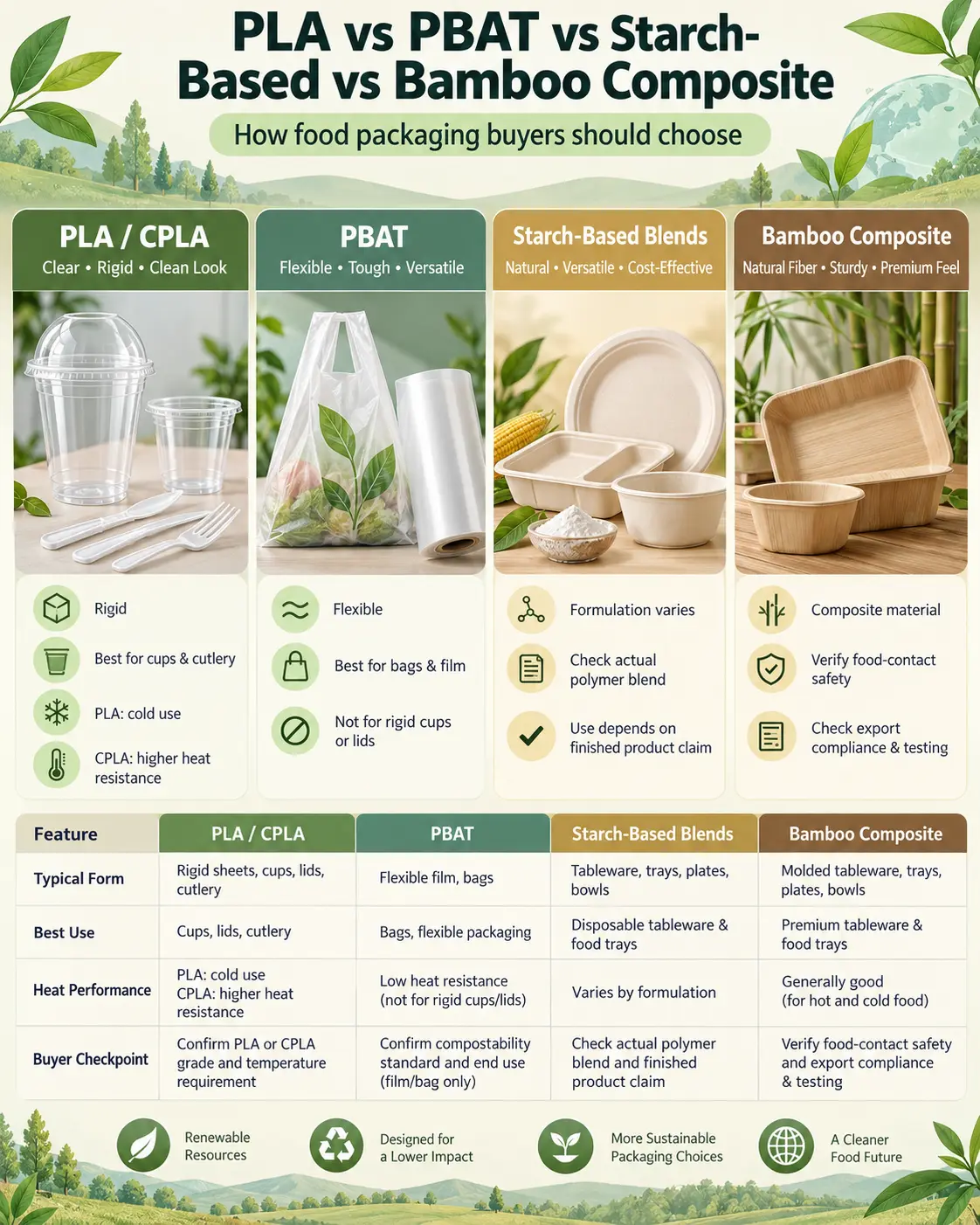
Key takeaway: material names are only the beginning of a packaging specification. The finished article, polymer formulation, processing method, food temperature, holding time, end-of-life claim and destination-market rules determine whether the product is actually suitable.
1. PLA: Best Known for Clear, Rigid Cold-Food Packaging
Polylactic acid (PLA) is one of the most established bio-based thermoplastics used in disposable food packaging. Its main commercial advantages are clarity, stiffness, processability and a visual appearance similar to conventional clear plastics. This makes it particularly useful for cold beverage and display-oriented applications.
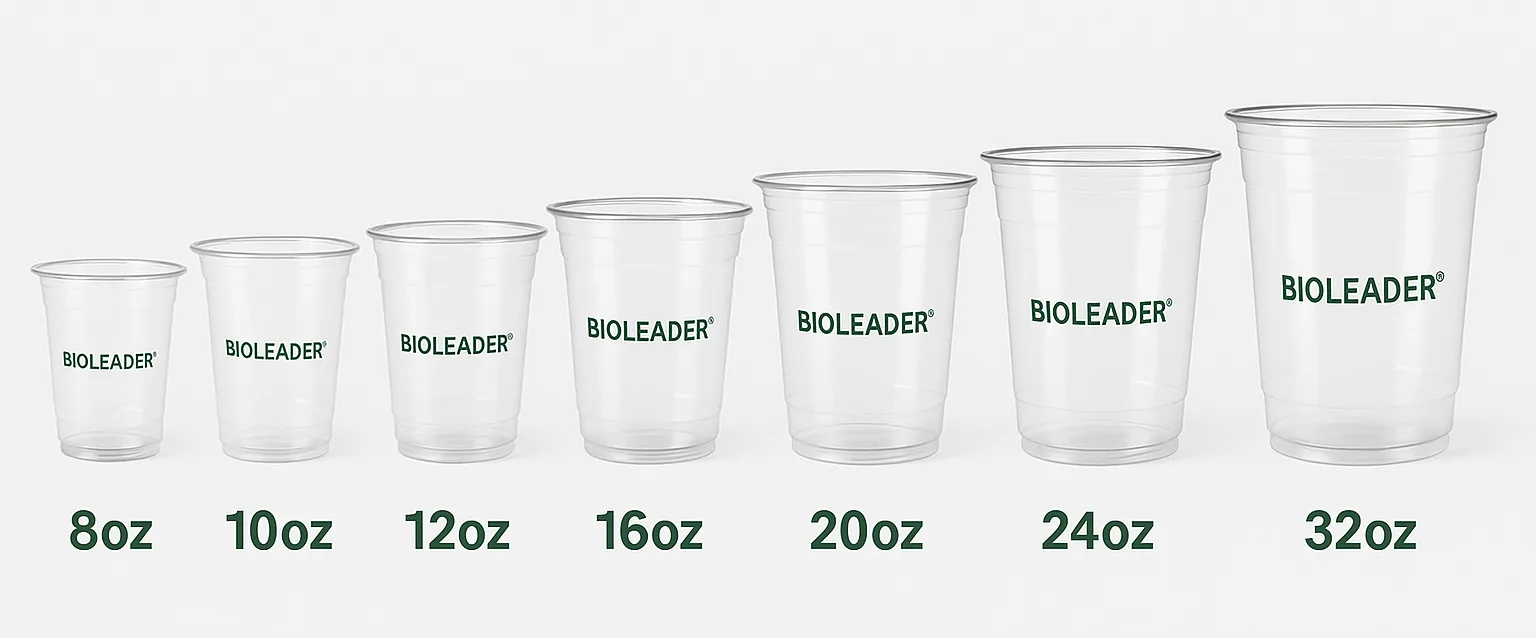
For example, Bioleader® supplies compostable PLA clear cups for iced coffee, juice, smoothies, cold brew, desserts and other chilled foodservice applications. For buyers who need a more commercial manufacturer-level overview, the clear PLA cup manufacturer range also covers size, lid and wholesale sourcing requirements.
Where standard PLA performs well
- Clear cups for iced coffee, juice, smoothies and cold drinks.
- Transparent lids and selected deli or cold-food packaging.
- Applications where visual product presentation matters.
- Foodservice systems that have an appropriate industrial-composting pathway for certified PLA items.
Where PLA buyers commonly make mistakes
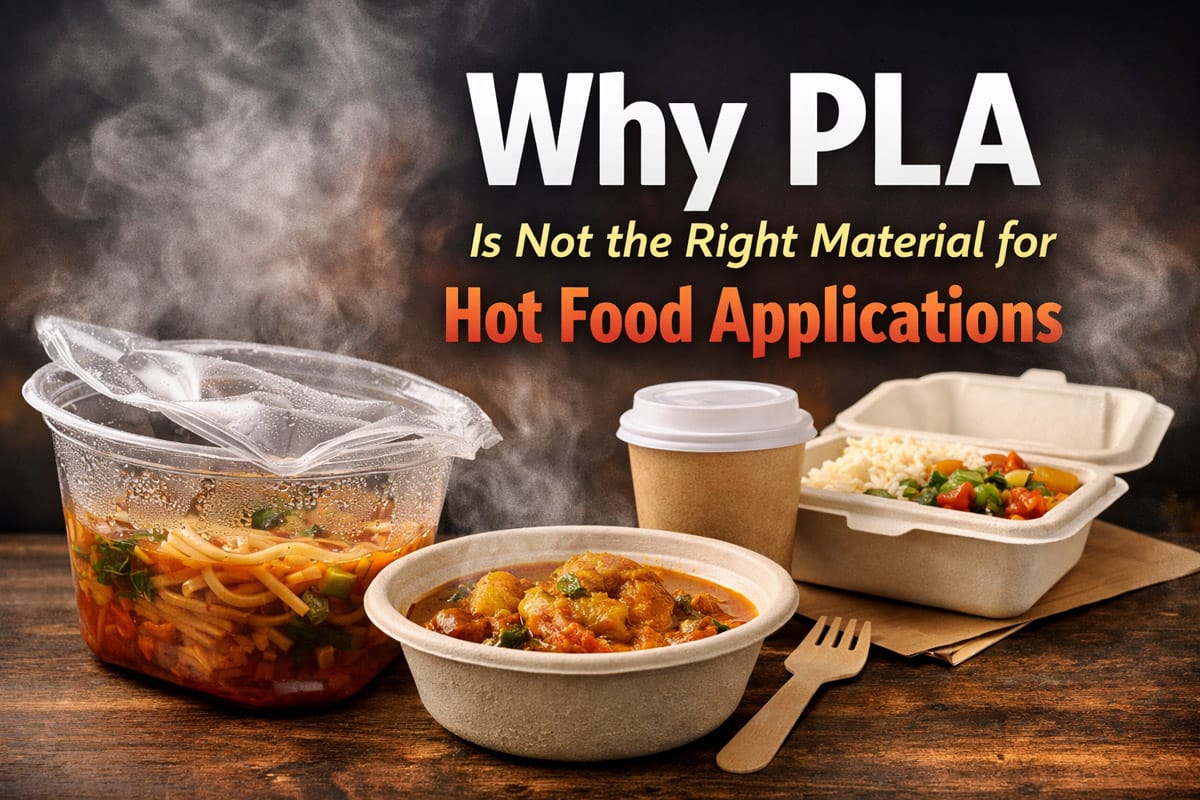
The main mistake is treating PLA as a general-purpose heat-resistant plastic. Standard clear PLA can deform when service temperature rises, especially when a thin-wall article is exposed to hot liquid. The practical limit depends on resin grade, wall thickness, processing history and finished-product design.
Bioleader® discusses this issue separately in Why PLA Is Not the Right Material for Hot Food Applications. The point is not that every PLA formulation behaves identically; it is that a cold-cup grade should not be approved for hot service simply because the resin is described as compostable.
Buyer risk: do not take the temperature capability of one high-heat PLA resin and apply it to every PLA cup, lid or thermoformed container. Resin data, converting conditions and finished-product testing answer different questions.
2. CPLA Is Related to PLA, but It Should Not Be Treated as the Same Product
CPLA is commonly used as shorthand for crystallized or heat-modified PLA systems. Increased crystallinity and suitable formulation can improve dimensional stability at elevated temperatures. This is why CPLA is widely associated with forks, spoons, knives and selected higher-temperature foodservice components.
For markets where compostable plastic cutlery is permitted, Bioleader® manufactures biodegradable and compostable cutlery and maintains a dedicated CPLA cutlery product range.
However, “CPLA” is not a universal temperature guarantee. High-heat PLA systems can achieve substantially greater heat resistance than amorphous PLA, but the relevant number must be tied to a specific grade and finished article. Buyers should verify dimensional stability with the actual food, temperature and holding time expected in service.
Manufacturer Insight: Ask for the Finished-Article Condition
In sample approval, “heat-resistant PLA” is too vague to be a useful specification. A buyer should define whether the item will contact 70°C food for five minutes, hot soup for 30 minutes, or a high-temperature meal during delivery. The test condition should reflect the actual SKU and application rather than a generic resin claim.
Important EU point: compostable plastic does not automatically escape single-use plastic rules
For European Union sourcing, buyers need another layer of analysis. Directive (EU) 2019/904 covers bio-based and biodegradable plastics within its plastic definition. Single-use plastic cutlery and plates are among the product categories subject to placing-on-the-market restrictions. This means a CPLA fork should not be assumed to be acceptable in the EU merely because it is plant-based or industrially compostable.
Material performance and market legality are separate questions. A CPLA product may technically perform well and meet a compostability specification while still being unsuitable for a destination market that restricts that product format.
3. PBAT: A Flexible Biodegradable Polyester, Not a Direct Replacement for Rigid PLA Cups
PBAT, or polybutylene adipate-co-terephthalate, is a biodegradable synthetic polyester known for flexibility and elongation. Scientific literature on food packaging frequently discusses PBAT in films and flexible polymer blends rather than as a stand-alone rigid cup material.
That distinction matters commercially. A buyer searching for compostable bags may see PBAT as an important component of the formulation. A buyer sourcing a transparent rigid beverage cup normally has a different set of requirements and will more often evaluate PLA, PET, PP or another rigid material system.
Why PBAT is widely used in films
- PBAT provides flexibility and resistance to repeated bending.
- It can be processed into thin flexible film structures.
- It can be blended with PLA, thermoplastic starch and other polymers to balance stiffness, flexibility and processing.
- Certified PBAT-containing formulations can be designed for industrial-composting applications.
The important qualification is the word formulation. The compostability of an individual resin does not automatically establish the compostability of a finished bag containing multiple polymers, pigments, inks, adhesives or other additives.
PBAT can be biodegradable without being predominantly bio-based
This is one of the most useful examples of why buyers should separate feedstock origin from end-of-life behaviour. Commercial PBAT has traditionally been produced mainly from petrochemical feedstocks even though its chemical structure can allow biodegradation under suitable conditions.
A supplier should therefore not use “biodegradable” as evidence that a PBAT product is automatically “plant-based.” If renewable carbon content matters to the buyer, that requirement should be specified and documented separately.
PBAT buyer rule: use PBAT when flexibility is a functional requirement. Do not select it simply because it appears on a list of biodegradable polymers.
4. “Starch-Based” Is a Marketing Category Unless the Formulation Is Defined
The phrase starch-based plastic is one of the most ambiguous terms in biodegradable packaging procurement. It may describe thermoplastic starch, a starch/PLA blend, a starch/PBAT blend, another biodegradable polymer system, or a conventional plastic containing starch as a filler.
This is why Bioleader® treats cornstarch tableware as a product system that still requires SKU-level material verification rather than assuming every item carrying the word “cornstarch” has an identical composition or end-of-life route.

Why formulation matters more than the word “cornstarch”
Starch itself is hydrophilic and can be sensitive to moisture. Commercial packaging therefore usually requires processing, plasticization, blending or another polymer matrix to achieve useful mechanical strength, water resistance and mouldability.
If starch is combined with a certified compostable polymer system, the resulting article may be designed to meet an industrial-compostability specification. If starch is simply used as filler in a PP or PE matrix, the presence of starch does not make the remaining plastic structure compostable.
Buyers sourcing moulded items such as takeaway boxes should therefore compare the actual formulation and finished-product evidence for the relevant cornstarch food container range. The same applies to rigid products such as cornstarch disposable plates.
For a deeper explanation of this distinction, see Is Cornstarch Tableware Biodegradable?, which separates the material label from the actual polymer and disposal conditions.
Manufacturer Insight: “Starch-Based” Is Not Enough for a Purchase Order
For export purchasing, a useful specification should identify the intended material system, finished-product claim, food-contact condition, target market and required documentation. Writing only “cornstarch material” on the purchase order leaves too much room for different formulations to be treated as equivalent.
5. Bamboo Composite: Natural Appearance Does Not Mean Plastic-Free
Bamboo is a renewable plant resource, but a solid bamboo article and a bamboo powder + polymer composite are fundamentally different products.
In bamboo composite tableware, finely ground bamboo or another plant fibre may be mixed into a polymer matrix. Depending on the product, this can create an attractive natural texture and reduce the proportion of polymer required. It does not, however, make the polymer disappear.
The EU has specifically targeted bamboo-filled plastic food-contact materials
The European Commission’s coordinated “Bamboo-zling” enforcement action addressed plastic food-contact articles containing bamboo powder and other unauthorized plant-based additives. EU authorities reported hundreds of cases involving products removed from the market or rejected at the border.
The core regulatory problem is not that bamboo as a plant is inherently unsafe. The issue is the use of plant-derived powder as an additive in a plastic food-contact material without the required authorization under the EU plastic food-contact framework. The Commission also documented cases where formaldehyde and melamine migration exceeded applicable limits in certain bamboo-plastic products.
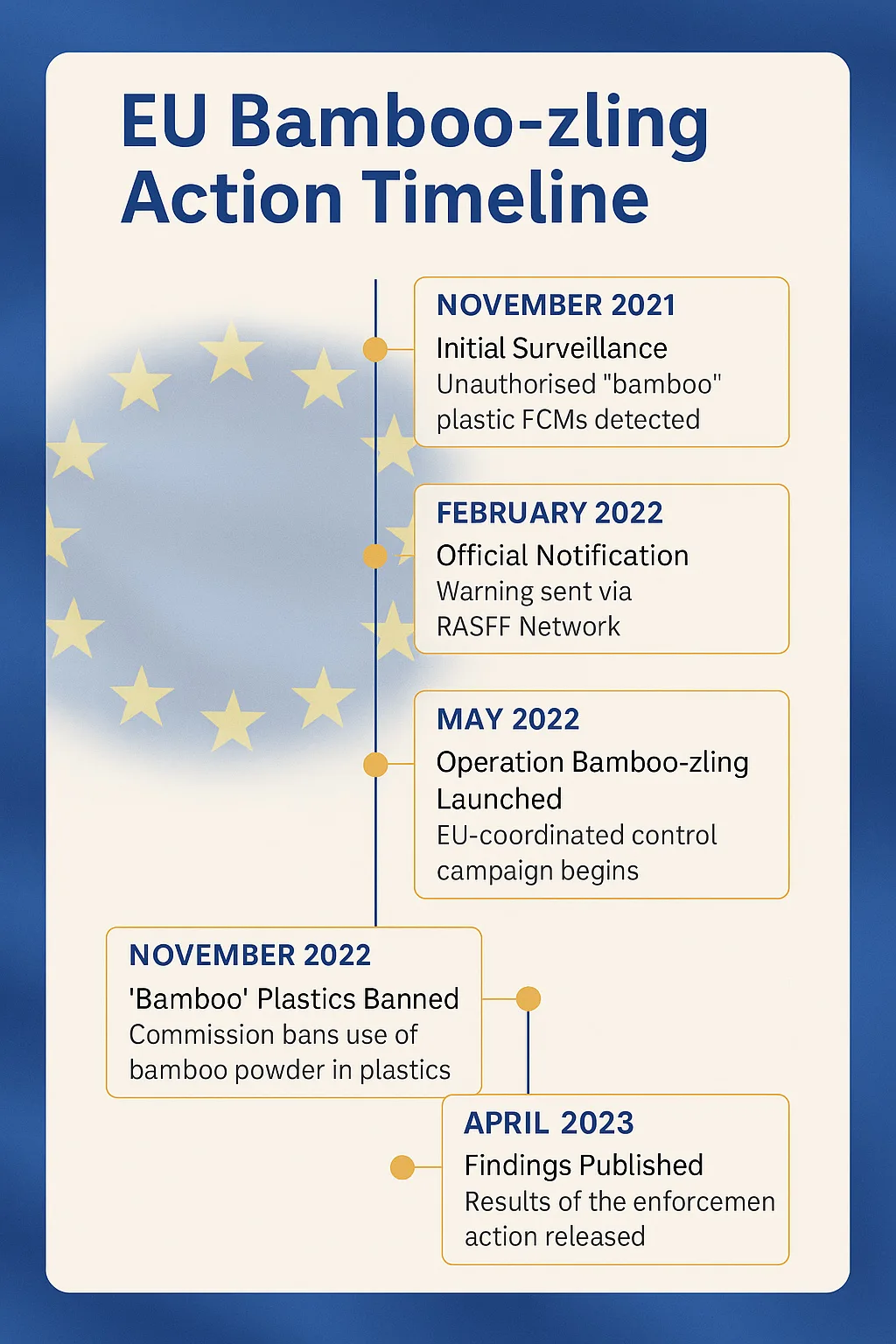
Bioleader® has a dedicated analysis of this issue in EU Cracks Down on Bamboo-Plastic Foodware.
EU sourcing warning: adding bamboo powder to PLA does not create a regulatory loophole. PLA is still a polymeric plastic material for relevant EU rules, and a bamboo-filled plastic food-contact article must be evaluated under the applicable food-contact legislation.
What buyers should ask before approving a bamboo composite
- Is the product solid bamboo, moulded fibre, or bamboo powder mixed with a polymer?
- What is the polymer matrix and its percentage?
- Is the plant-derived filler authorized for the intended food-contact market?
- Which finished-product migration tests have been performed?
- Does the supplier have documentation for the exact SKU rather than a generic material declaration?
- What compostability, recyclability or plastic-free claim is actually supported by test evidence?
6. Which Material Should a Food Packaging Buyer Choose?
The useful question is not “Which material is the greenest?” It is which structure can perform the required job and still support the intended compliance and end-of-life claim.
| Application | Practical Starting Point | Why | Main Risk to Check |
|---|---|---|---|
| Clear iced coffee, juice or smoothie cup | PLA | High clarity and rigidity make PLA relevant for cold beverage presentation. | Heat exposure during filling, transport or storage. |
| Flexible compostable shopping or organic-waste bag | PBAT-based blend | PBAT contributes the flexibility required for thin films and bags. | Finished-film certification and actual polymer formulation. |
| Rigid disposable plate or food container | Starch blend, bagasse or paper depending on the application | Rigid foodservice applications require structure, oil resistance and service-temperature performance. | Do not infer performance or compostability from “starch-based” alone. |
| Hot, oily takeaway meal | Often moulded fibre or suitable paper structure | Heat, grease, sauce exposure and delivery rigidity usually matter more than transparency. | Barrier system, holding time, lid compatibility and destination-market compliance. |
| Higher-temperature compostable plastic cutlery outside restricted markets | CPLA / high-heat PLA | Crystallized PLA systems can provide higher dimensional stability than standard clear PLA. | Finished-product heat test and local single-use plastic restrictions. |
| Natural-looking bamboo composite tableware | Do not approve from appearance alone | The item may actually be a plastic composite containing plant filler. | Food-contact authorization, migration testing and legal status in the destination market. |
For high-temperature takeaway meals, buyers should not feel restricted to the four polymers in the headline. A sugarcane bagasse tableware system can be a more logical starting point when rigidity, oil resistance and short-term heat performance matter. For bowls, soup containers, folded boxes and coated structures, Bioleader®’s paper food packaging solutions provide another material route that should be evaluated separately from compostable plastics.
Commercial decision: if the food is hot, oily or delivered for an extended period, start with the service condition rather than the polymer name. If the product needs transparency, start with the optical requirement. If it needs flexibility, start with film mechanics. Material selection becomes much easier once the actual function is defined.
7. Compostable Does Not Mean It Will Decompose Anywhere
PLA, PBAT and some starch-based formulations may be designed to meet industrial-compostability standards, but environmental conditions determine whether biodegradation occurs at the required rate.
EN 13432 is the principal European standard used to evaluate the industrial compostability of packaging. It addresses biodegradation, disintegration, compost quality and other requirements under defined treatment conditions. In the United States, ASTM D6400 provides requirements for plastics and plastic-containing end items designed for aerobic municipal or industrial composting. The active ASTM version was updated in 2026.
BPI uses ASTM D6400 as a base standard within its commercial compostability certification program. However, a material supplier’s resin certificate should not automatically be treated as certification of every finished cup, bag, printed article or composite product manufactured from that resin.
Bioleader® compares these systems in more detail in the EN 13432 vs ASTM D6400 guide for export buyers.
Important: industrial compostability is a managed end-of-life route. Local collection rules and composting-facility acceptance may be more restrictive than the technical standard itself. A certified package has limited practical value if the intended market has no collection or treatment route for that packaging format.
8. Food-Contact Compliance Must Be Checked Separately from Compostability
A compostability certificate answers an end-of-life question. It does not replace a food-contact assessment.
For food packaging, buyers may need to verify migration testing, compositional restrictions and other documentation under the rules applicable to the destination market. The exact requirement differs by material structure, food type, temperature, contact time and jurisdiction.
| Document or Claim | What It Helps Establish | What It Does Not Automatically Establish |
|---|---|---|
| EN 13432 evidence | Industrial-compostability performance of relevant packaging under defined European standard conditions. | Food-contact compliance or legal acceptance of every product format in every EU market. |
| ASTM D6400 evidence | Industrial or municipal aerobic compostability requirements for applicable plastic end items. | Automatic BPI certification or food-contact compliance. |
| BPI certification | Independent certification to the applicable BPI compostability scheme for listed products. | Approval for every unlisted SKU made by the same factory. |
| Food-contact migration report | Performance against specified food-contact test conditions and applicable limits. | Compostability or biodegradation performance. |
| “Bio-based” claim | Indicates renewable feedstock content when properly substantiated. | Biodegradability or compostability. |
| “Bamboo” or “plant fibre” claim | Indicates that a plant-derived component may be present. | Plastic-free status, food-contact legality or compostability. |
9. Buyer Checklist Before Comparing Prices
Ask These Questions Before Approving the Material
- What is the complete material structure? Ask for the polymer matrix, fibre or starch content, coating and relevant additives rather than accepting a broad material name.
- What finished-product claim do you intend to make? “Bio-based,” “biodegradable,” “industrially compostable,” “home compostable” and “plastic-free” are different claims.
- What food will contact the packaging? Cold juice, hot soup, oily curry and dry bakery products create different performance requirements.
- What is the real service temperature? Include filling temperature, holding time, microwave or reheating conditions and transport exposure.
- Does the document match the SKU? A resin certificate or another product’s report should not be substituted for evidence applicable to the ordered structure.
- What regulations apply at the destination? A technically compostable plastic item may still be restricted by single-use plastic legislation.
- Which disposal route actually exists? Industrial compostability should be matched to local collection and processing infrastructure.
- Does printing or customization change the tested structure? Inks, labels, adhesives, coatings and secondary components can affect the finished-product assessment.
- What MOQ applies to the exact material and design? Plain and customized quantities can differ substantially, especially for cups, cutlery and private-label packaging.
- Have samples been tested with the real food? Material claims should be verified before bulk purchasing.
Recommended Sample Evaluation
When comparing PLA, CPLA, starch-based or other disposable food packaging, Bioleader® recommends evaluating the exact sample under the expected operating condition. Record the food type, starting temperature, holding time, lid configuration, leakage, softening, deformation, odour and transport condition. A ten-minute dry laboratory check should not be treated as equivalent to a 45-minute delivery test with hot food and sauce.
10. Where Bioleader® Fits into the Material Decision
This approach is particularly important when two quotations use the same marketing term but describe different formulations. “Cornstarch,” “PLA,” “bamboo fibre” and “compostable plastic” should never be accepted as complete technical specifications on their own.
11. Final Decision: Choose the Function First, Then Verify the Material
A lower unit price is not useful if the material deforms in service, the compostability claim does not apply to the finished SKU, or the product cannot legally be placed on the destination market.
Frequently Asked Questions
Is PLA better than PBAT for food packaging?
Neither material is universally better. PLA is generally more relevant for rigid and transparent applications such as cold beverage cups, while PBAT is valued for flexibility in films, bags and polymer blends. Buyers should choose according to the packaging function rather than treating both materials as direct substitutes.
Is PBAT plant-based because it is biodegradable?
No. Biodegradability and feedstock origin are separate properties. Commercial PBAT has traditionally been produced mainly from petrochemical feedstocks even though its chemical structure can biodegrade under suitable conditions. A supplier should provide separate evidence if renewable or bio-based carbon content is part of the purchasing specification.
Is all cornstarch tableware compostable?
No. “Cornstarch tableware” can refer to different formulations. Some products use compostable polymer blends, while other products may contain conventional polymers with starch as a filler. Buyers should verify the actual polymer matrix and finished-product compostability evidence before making a compostable claim.
Can PLA be used for hot food?
Standard clear PLA is generally better suited to lower-temperature applications and can deform at elevated temperatures. Crystallized or high-heat PLA formulations can perform at higher temperatures, but this capability depends on resin grade, processing and finished-product design. Buyers should test the exact SKU under the intended food temperature and holding time.
Is bamboo + PLA tableware safe for export to Europe?
It should not be assumed to be acceptable. The European Commission has taken enforcement action against plastic food-contact materials containing unauthorized bamboo and other plant-derived additives. A bamboo powder + PLA product is still a plastic composite, so buyers need to verify whether the plant additive is authorized and whether the finished article meets applicable EU food-contact requirements.
What is the difference between EN 13432 and ASTM D6400?
Both are widely used technical frameworks for industrial compostability, but they apply within different standard and certification systems. EN 13432 is the principal European packaging compostability standard, while ASTM D6400 addresses applicable plastics and plastic-containing end items intended for aerobic municipal or industrial composting. Buyers should verify the exact standard version and finished SKU.
What documents should importers request before buying compostable packaging?
Request material composition information, finished-product food-contact documentation, applicable compostability test or certification evidence, relevant declarations, product specifications and sample-test data. The required package depends on the SKU, material structure, intended environmental claim and destination market. A generic factory certificate list should not replace product-level verification.
References
- European Commission, Directorate-General for Health and Food Safety. Bamboo-zling: EU Enforcement Action on Plastic Food Contact Materials Made of Bamboo Powder.
- European Union. Commission Regulation (EU) No 10/2011 on Plastic Materials and Articles Intended to Come into Contact with Food, consolidated version applicable in 2026.
- European Union. Directive (EU) 2019/904 on the Reduction of the Impact of Certain Plastic Products on the Environment.
- ASTM International. ASTM D6400-26: Standard Specification for Labeling of Plastics Designed to Be Aerobically Composted in Municipal or Industrial Facilities.
- Biodegradable Products Institute. Commercial Compostability Certification Program and ASTM D6400 Assessment Framework.
- European Bioplastics. EN 13432 Certified Bioplastics Performance in Industrial Composting.
- Roy, S., Ghosh, T., Zhang, W., & Rhim, J.-W. Recent Progress in PBAT-Based Films and Food Packaging Applications: A Mini-Review. Food Chemistry, 2024.
- Advances in PLA/PBAT-Based Blend Film in Food Packaging Applications: A Review. Food Packaging and Shelf Life, 2026.
- NatureWorks. High-Heat PLA Technology: Crystallization and Heat-Resistance Guidance for Injection-Moulded Applications