More Deliveries, More Waste: Rethinking Convenience in the Age of Disposable Food Packaging
Key Takeaway: Delivery convenience has scaled faster than end-of-life systems. To make convenience sustainable, leaders should move from single-material bets to a portfolio strategy that blends bagasse, coated/uncoated paper, PLA/cornstarch, and molded fiber—engineered for local waste-paths, verified by test curves, and governed by evidence-based claims.
Why It Matters: Packaging is the largest single source of plastic waste globally—around 40%—and reaches 45% in China; rising food-delivery volume multiplies containers, lids and liners, stressing recycling and composting systems. :contentReference[oaicite:0]{index=0}
Executive Actions: (1) Map city-level waste-paths; (2) Standardize heat/leak/odor curves; (3) Lock PFAS-free barriers; (4) Use dual-stream kits (fiber base + mono-material lid/film); (5) Pilot organics capture where industrial composting exists; (6) Publish a quarterly Packaging Fact Sheet.
Where Materials Fit: Bagasse for hot & oily mains; paper for dry goods with minimal coating; PLA/cornstarch only where industrial composting runs reliably; molded/recycled fiber for low-oil; seaweed/mycelium as R&D pilots.
Executive Summary
Food delivery has moved from occasional indulgence to normalized habit across major markets. The logistical miracle—frictionless ordering, real-time tracking, doorstep arrival—relies on a quiet workhorse: disposable packaging. Containers, lids, liners, cutlery and labels translate culinary intent into deliverable experiences that survive temperature swings and vibration. Yet the same systems that protect meals often overwhelm end-of-life infrastructure. Recycling falters under contamination; “compostable” rarely becomes actually composted without access to industrial facilities; and well-meaning labels frequently obscure more than they clarify.
This executive brief explains why delivery growth magnifies packaging externalities; diagnoses failure modes in recycling and “wish-cycling”; compares next-generation materials (bagasse, paper, PLA/cornstarch, molded fiber, and emergent seaweed/mycelium) on performance, policy risk, and operational fit; and outlines a 2025–2030 roadmap aligned with EPR schemes, PPWR-style rules and PFAS restrictions. The conclusion is pragmatic: no single material solves for all menus, climates, and cities. Leaders need a portfolio approach, engineered for local waste-paths and institutionalized verification (testing, claims control, supplier audits) as a core operating practice.
1) Introduction — The Price of Convenience
The shift from dining-in to ordering-in is not merely behavioral; it is infrastructural. Kitchens, riders, apps and algorithms coordinate across micro-timeframes. Packaging is where culinary craft meets physics: steam condenses, sauces migrate, starches release moisture, and heat softens structure. A well-chosen container maintains texture, keeps oil where it belongs, and protects brand presentation.

But convenience, priced in minutes, often ignores its tail: the time the city spends managing the residue. Most consumers interact with packaging for less than fifteen minutes; municipalities inherit it for years. Executives who manage P&L see packaging as a fractional cost per order; ESG stewards see it as a material topic with reputational and regulatory exposure. Bridging these views is the work of our decade.
Packaging now represents the single largest source of plastic waste globally—around 40% of the total—rising to 37% in the United States, 38% in Europe and 45% in China, according to OECD data summarized by Our World in Data. The delivery boom adds frequency and complexity—more multi-part kits per meal—intensifying the pressure on end-of-life systems.
2) The Delivery Boom — Why Waste Feels Invisible Until It Doesn’t
The surge in takeaway orders created an amplifier effect. Each marginal order adds not one object but a small kit: main container + lid, sides + lids, dip cups, a paper bag or sleeve, a receipt label, and sometimes cutlery. High-variance menus drive more SKUs and mixed materials, overpackaging, complicating sortation.
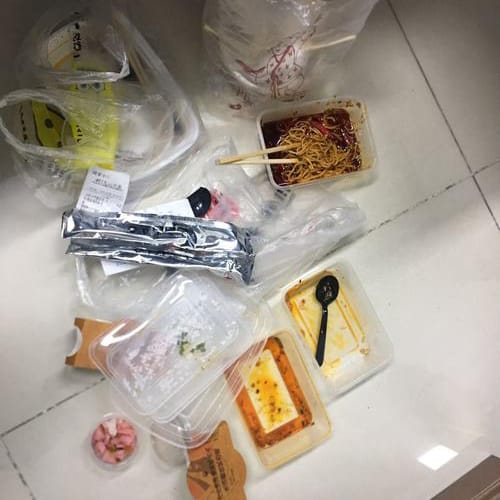
What makes the waste invisible?
Distributed disposal: Packaging is dispersed across thousands of households, not concentrated in a back-of-house bin.
Aesthetic camouflage: Clean, premium-looking fiberware suggests recyclability or compostability even when coatings negate both.
Label ambiguity: “Biodegradable,” “eco,” and leaf icons often imply outcomes that local infrastructure cannot deliver.
When does it become visible?
Bin overflows: peak hours correlate with street-level waste surges; festival periods magnify the problem.
Facility chokepoints: MRFs reject contaminated paper/fiber; organics sites decline non-conforming compostables; incinerators raise fees.
Policy shifts: EPR fees, labeling rules, and PFAS restrictions convert externalities into line items.
| Dimension | Latest Signal | Why It Matters |
|---|---|---|
| Global online food delivery value | ≈ US$316.3B (2025) → US$715.9B (2034) (≈10–11% CAGR) | Order growth multiplies container/lid/liner kits per meal. |
| Packaging share in plastic waste | US 37%; EU 38%; China 45% | Packaging dominates plastic waste; delivery adds frequency & complexity. |
| Leakage to water | 19–23 Mt/yr globally; “2,000 trucks/day” to aquatic systems | Externalized costs show up in waterways; policy pressure intensifies. |
| Plastics outlook (2040) | +70% production/use/waste vs. 2020 if no action | Infrastructure cannot simply “recycle” its way out; design & demand must shift. |
At a global scale, plastic waste leakage underscores the limits of our current model. Every year, an estimated 19–23 million tonnes of plastic waste leaks into aquatic ecosystems—a flow UNEP equates to 2,000 garbage trucks of plastic dumped into oceans, rivers and lakes every single day. Delivery packaging is not the only source, but it is a fast-growing, highly visible contributor that policymakers and NGOs increasingly target.
Demand-side momentum: the global online food-delivery market is projected to expand from roughly US$316 billion in 2025 to US$716 billion by 2034 (~10–11% CAGR), implying rising order counts and, inevitably, rising packaging throughput unless design and disposal practices change.
Supply-side inertia: without stronger policies, plastics production and use are projected by the OECD to increase by ~70% by 2040 (vs. 2020), with mismanaged plastic waste increasing by nearly 50%. Growing streams meet limited sorting, recycling and composting capacity—a structural mismatch.
3) The Recycling Illusion — Contamination, Coatings, and the Limits of Infrastructure
“Just recycle it” collapses under three constraints:
Food & oil contamination. Fiber products saturated with oil or broth are frequently downgraded to residual waste. Even minor contamination creates odor and vector risks and can force entire bales out of specification.
Functional coatings. PE liners and some bioplastic coatings (including PLA laminations) improve barrier performance but complicate pulping or composting. Multilayer films and inseparable laminates defeat most municipal systems.
Systemic mismatch. Many cities lack industrial composting; organics programs are patchy; MRFs are optimized for rigid PET/HDPE, not hybrid fiber-plastic formats. UNEP’s LCA guidance stresses that end-of-life performance depends on local infrastructure, not on labels alone.
|
|


Operational takeaway: recycling is not a universal exit; it is an engineered endpoint that must be proven city by city. Strategy starts with mapping available waste-paths and reverse-designing packaging to match them.
4) Beyond Plastic — A Comparative View of Next-Generation Materials
No material is inherently “good” or “bad”; each is a tool with environments where it excels and contexts where it misfires. The executive task is portfolio design, not material evangelism.
| Material | Strengths (Ops) | Limits (Infra/Chem) | Policy/Infra Fit | Typical Use Cases |
|---|---|---|---|---|
| Paper / Coated Paper | Familiar, printable; good for dry goods | Coatings complicate pulping/compost; oil/steam soften | Fit where clean paper recycling exists; avoid heavy oils | Bakery, sandwiches |
| Bagasse (Sugarcane) | Heat window, rigidity; PFAS-free achievable | Home compost inconsistent; QC is key | Strong fit for hot/oily menus; aligns with PFAS phase-outs | Hot mains, compartment trays |
| Cornstarch / PLA | Bio-based narrative; clear lids | Needs industrial compost; heat limits | Use where organics infrastructure exists | Cold salads, desserts lids |
| Molded/Recycled Fiber | Circular story; natural look | Weak oil resistance w/o treatment | Fit for dry items; recyclable/compostable when clean | Dry snacks, produce |
| Seaweed/Mycelium | Radical potential; low-toxicity story | Early-stage; scale/cost | R&D pilots; niche components | Liners/sleeves, pilots |
4.1 Paper / Coated Paper
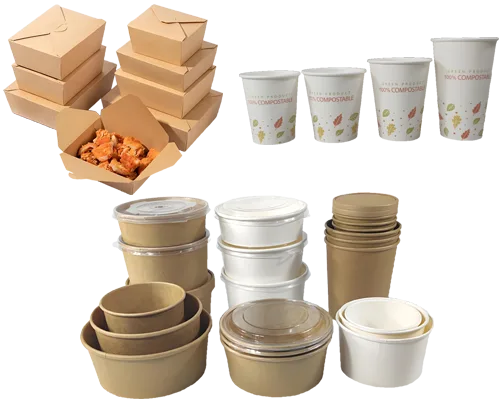
Strengths. Ubiquitous supply, printable surfaces, strong consumer familiarity. Paperboard works well for dry, low-oil items (baked goods, sandwiches). Minimal-barrier versions can be recyclable when kept clean.
Limitations. To resist oil and steam, many formats use PE or bioplastic liners; laminations and heavy coatings impede pulping and composting. Hot, oily menus soften walls and rims. The EU’s new PPWR framework is moving to restrict substances of concern (including PFAS above set thresholds) and to require clearer end-of-life claims and reuse options, tightening the risk profile for certain coated papers.
Where it fits. Paper bowls with lids, paper box, paper bags. Dry goods; short-dwell deliveries; inner trays protected by an outer liner; markets that favor paper recycling but lack composting.
4.2 Bagasse (Sugarcane Fiber)

Strengths. Robust heat window; good rigidity at reasonable grammage; oil/water resistance achievable without PFAS; typically microwave-safe; industrial compostability common where facilities exist.
Limitations. Home composting consistency varies; performance is geometry- and densification-dependent; quality control (odor, migration) requires supplier discipline. That said, bagasse aligns strongly with PFAS phase-outs in the US/EU when specified with PFAS-free barriers—important now that PFAS grease-proofers are no longer being sold for food-contact paper/board in the U.S. following the FDA’s completed phase-out.
Where it fits. Bagasse food containers, bagasse plates, bagasse food packaging. Hot mains, saucy dishes, multi-compartment formats, and brands standardizing on PFAS-free barriers—especially in cities with organics capture. Bioleader’s bagasse tableware transforms sugarcane waste into durable, compostable solutions for modern food service.
4.3 Cornstarch / PLA Bioplastic

Strengths. Bio-based narrative; clarity (useful for lids); good dimensional stability for cold and some warm items; certified industrial compostability is achievable for certain SKUs.
Limitations. Requires industrial composting; in ambient environments PLA behaves like conventional plastic and does not readily degrade; heat resistance is limited; litter risks microplastic narratives. Use with caution where organics infrastructure is absent or confusing labels could mislead consumers.
Where it fits. Cold items, salads, desserts and cities with mature organics infrastructure; pair with fiber bases for dual-stream separation.
4.4 Molded Fiber / Recycled Pulp
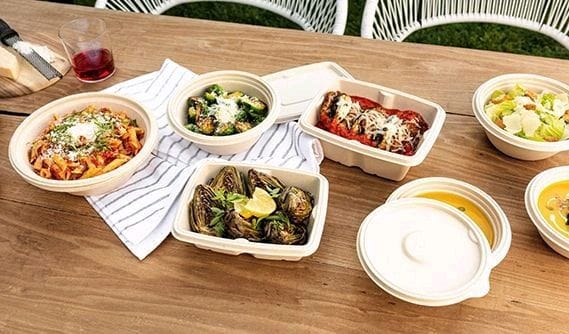
Strengths. Circular story when sourced from recovered fiber; excellent for dry items and short dwell times; low-gloss, natural look aligns with eco branding.
Limitations. Oil resistance can be weak without treatments; geometry may limit lid-seal precision; variability in recovered streams affects consistency.
Where it fits. Bakery, dry snacks, produce and situations where fiber-only streams are feasible.
4.5 Emerging Materials: Seaweed, Mycelium, Edible Films
Strengths. Radical potential: renewable inputs, low-toxicity pathways, and compelling consumer stories. Some mycelium foams offer shock absorption; seaweed films can replace certain plastic films in controlled applications.
Limitations. Early-stage scaling, shelf-life, moisture sensitivity, cost, and limited regulatory familiarity.
Where it fits. Innovation pilots and premium brand activations; secondary components (liners, sleeves) under controlled conditions.
5) Performance Engineering — Design for the Real Meal, Not the Ideal Label
Sustainability claims should be the output of engineering, not the input. Four pillars ensure packaging matches reality:
Heat curves (temperature × time × media). Quantify safe windows for microwave and brief oven exposure; validate with representative dishes (oil, acidity, salt).
Leak/barrier windows. Set no-leak targets (e.g., 2–4 hours for oil/broth at ambient); test lid-seal integrity during vibration to simulate last-mile handling.
Odor & migration control. Tune fiber purification and drying profiles; require batch-linked food-contact reports; conduct sensory checks on arrival.
Geometry & nesting efficiency. Rim angle and nesting depth affect both performance and container densification—key for TCO and emissions per order.
Rule of thumb: do not over-spec chemistries to compensate for poor geometry; redesign the shape before escalating coatings.
6) The Green Paradox — When Words Outrun Infrastructure
“Compostable,” “biodegradable,” and “plastic-free” are not interchangeable. Executives must treat sustainability language as a compliance asset:
Compostable ≠ composted. Without access to industrial composting—and correct sorting—the claim does not translate into outcomes. UNEP’s guidance and LCA reviews emphasize infrastructure-specific results.
Biodegradable ≠ benign. Degradation timelines and conditions matter; fragmentation without assimilation risks micro-litter narratives.
Plastic-free ≠ problem-free. Fiber plus undisclosed barriers can contaminate fiber streams or violate PFAS thresholds under PPWR-style rules.
Chemicals transparency. UNEP’s 2023 technical report identifies 13,000+ chemicals associated with plastics, with ~3,200 of potential concern—and many others insufficiently characterized—raising the bar for disclosure and control in food-contact packaging. Media coverage in 2024–2025 highlights estimates above 16,000 plastic-associated chemicals and growing calls for regulation. For packaging leaders, that translates into supplier questionnaires, batch-linked testing and conservative barrier choices.By choosing Bioleader’s bagasse products, brands replace plastic with a natural fiber that returns safely to the earth.
7) Regulation 2025–2030 — From Soft Signals to Hard Requirements
The regulatory arc is converging across regions:
Extended Producer Responsibility (EPR). Shifts end-of-life costs upstream; fees differentiate by recyclability, toxicity and labeling accuracy. OECD modeling shows plastics production/use/waste rising ~70% by 2040 without stronger policies—implying escalating fees and obligations.
PFAS restrictions. In the U.S., the FDA confirms that PFAS-containing grease-proofers are no longer sold for food-contact paper/board (completed 2024–2025). In the EU, PPWR and REACH processes are moving toward a broad PFAS phase-out with limited essential-use exemptions and threshold limits for food packaging from August 12, 2026.
PPWR-style obligations. The EU’s packaging rules tighten labeling, restrict certain single-use formats, and require reuse/bring-your-own options in foodservice—affecting menu design and packaging selection for exporters.
Implication: Packaging is entering an era where evidence trumps intention. Documentation, not adjectives, will protect brands.
8) Portfolio Strategy — Building a Kit That Works Across Cities and Menus
A winning strategy recognizes heterogeneity: menus differ by oil content and heat; cities differ by infrastructure; customers differ by expectations. Replace single-material programs with a portfolio:
Tier by menu.
Tier 1 (High-heat, high-oil): PFAS-free bagasse trays/plates with secure lids; validated heat/leak curves.
Tier 2 (Moderate): molded/recycled fiber or minimally coated paper with tight geometry.
Tier 3 (Cold/clear): PLA lids or bio-films where industrial composting exists; otherwise recyclable PET lids paired with fiber bases.
Align to waste-paths.
Map composting access; where absent, emphasize recyclability or minimal-material designs.
For mixed-material kits, make separation obvious and easy (peelable films, distinct colors, iconography).
Standardize verification.
Require heat/leak curves and batch-linked food-contact reports.
Introduce incoming QA for odor/sensory checks.
Retain third-party audits annually.
Communicate transparently.
Create a one-page “Packaging Fact Sheet” per market explaining disposal steps that reflect local reality.
Train frontline staff and integrate prompts in the app checkout flow.
9) Cost and Carbon — Looking Beyond Unit Price
The cheapest container can be the costliest choice when factoring re-plates, reputation and fees. Consider:
Load factor. Small rim changes can increase cartons per pallet and pallets per container, lowering delivered cost per unit and embodied transport emissions.
Loss rates. Rigidity and seal integrity reduce mess-driven re-fires and refunds.
Claim risk. Mislabeling penalties, take-back obligations and EPR fees add a regulatory premium to poor design.
Scenario modeling. Build three TCO scenarios per SKU (best/mid/worst) with assumptions for loss, freight and fees. Choose the resilient middle, not the fragile minimum.
10) Case-Style Illustrations (Composite)

A. Hot Noodle Chain. Replaced laminated paper bowls with bagasse bases + recyclable PET lids; introduced peel-off vent dots to manage steam; created a “rinse & recycle” cue. Result: 28% reduction in leak complaints; PET capture increased where curbside accepts it.
B. Airline Meal Prep. Standardized on PFAS-free bagasse trays with strictly specified oven windows; switched to paper wraps for bread items; co-branded disposal cards. Result: odor complaints decreased; catering process time held constant; compliance risk reduced.
C. Multi-City QSR. Mapped infrastructure across 12 cities; in composting markets, used PLA lids; elsewhere moved to PET lids; shared a public packaging scoreboard. Result: fewer customer queries, better regulator relationships, and internal clarity.
11) China Focus — High-Resolution Evidence for City-Level Action

| Topic | Latest Evidence | Executive Implication |
|---|---|---|
| High-resolution TPW dataset | 1 km × 1 km annual TPW grid for China (2025 study) | City hotspot maps enable targeted interventions (night-life belts, campus zones). |
| Policy & NGO analyses | Comprehensive management proposals for takeaway plastics | Avoid “nominal composting”; harmonize claims with actual facilities. |
China’s rapidly growing delivery economy has generated substantial takeaway packaging waste (TPW), and new research delivers a 1 km × 1 km high-resolution dataset of annual TPW across the country. This granularity supports hotspot mapping and localized interventions—prioritizing night-life zones, campus districts and business hubs where order density is highest. Municipal partnerships can then pilot targeted bin placement, signage, and organics capture based on real spatial patterns.
Civil-society and policy analyses in China emphasize multi-stakeholder governance—brands, platforms, cities and consumers—to reduce single-use items, improve sorting and build credible composting pathways. For exporters and domestic chains alike, this means aligning claims with actual local options and avoiding “nominal composting” where infrastructure is not available. At Bioleader, we believe packaging should protect both your food and the future of the planet.
12) Frequently Misunderstood Points
“Compostable” is infrastructure-dependent. Industrial conditions (temperature, moisture, retention time) matter; absent those, outcomes diverge from labels.
“Paper equals recyclable” only when clean. Oil and broth can divert fiber to residual waste; choose geometry and barriers that control seepage.
“PLA is biodegradable” is incomplete. Without industrial composting, PLA behaves like conventional plastic; use where organics capture exists.
PFAS-free is achievable and increasingly required. The U.S. phase-out of PFAS grease-proofers for food-contact paper is complete; EU thresholds arrive under PPWR. Design for PFAS-free by default.
Chemicals transparency is rising. 13,000+ plastic-associated chemicals have been identified; ~3,200 are of potential concern—raising expectations for disclosure and testing.
13) Implementation Roadmap — 120 Days to a Better Portfolio
| Phase | Action | Deliverable |
|---|---|---|
| 0–30d | City waste-path mapping (incl. China tier-1 cities) | Red/Amber/Green matrix + infra notes (MRF/Compost) |
| 31–60d | Heat/Leak/Odor curves (by dish profile & temp) | Test report pack with batch traceability |
| 61–90d | Material tiering & PFAS-free lock | Spec sheets (SKU × city) + vendor scorecards |
| 91–120d | Claims governance & comms | Packaging Fact Sheet (EN/CN) + quarterly update cadence |
Days 0–30: Map & Measure
Inventory all SKUs, suppliers, coatings and claims.
Map city-level waste-paths; create a red/amber/green matrix.
Collect existing test curves; identify gaps; run quick-turn sensory checks.
Days 31–60: Pilot & Prove
Select 3–5 high-impact menu items for pilots across two contrasting cities (composting vs. recycling-first).
Run heat/leak/odor validations with actual dishes and last-mile simulations.
Draft city-specific disposal copy; vet with legal; prepare on-pack icons and in-app prompts.
Days 61–90: Decide & Deploy
Lock materials by tier; negotiate PFAS-free specs; add batch-linked testing to purchase orders.
Issue vendor scorecards (performance, documentation, densification).
Update app prompts and in-store cues; train frontline teams.
Days 91–120: Govern & Communicate
Publish the Packaging Fact Sheet; schedule quarterly evidence reviews and annual third-party audits.
Publicly share targets (e.g., % of orders with verifiable end-of-life) and track progress transparently.
Engage municipalities for pilots (reverse logistics for PLA lids; organics capture in food courts).
14) The Leadership Mandate — Redefining Convenience
Convenience should not be an alibi for waste; it should be a design goal that includes end-of-life. The work now is to move beyond material simplicity toward systems literacy. Invest in packaging R&D that starts with the meal and ends with the bin; treat claims and test data as governance artifacts; and collaborate with municipalities and platforms to pilot realistic capture systems. The goal is not purity; it is progress at scale. When we align material choice, geometry and local waste-paths, convenience becomes compatible with responsibility. When we communicate honestly about what happens after the meal, we build trust that outlasts trends.
At Bioleader, we see packaging not as a commodity, but as a commitment.
We work at the intersection of materials and responsibility — advancing PFAS-free bagasse, molded fiber, and next-generation plant-based solutions to help brands move beyond single-use plastics. We do not claim perfection; instead, we commit to progress — testing, refining, and partnering with operators and municipalities to ensure that what leaves the kitchen can meet a responsible end. Because true convenience must include accountability — and that is the future we choose to build.

15) Conclusion — The Future Plate Is Not Just Fiber, but Intention
Delivery culture is here to stay. The question is whether packaging culture will mature at the same pace. Bagasse, paper, PLA, molded fiber, and the next wave of seaweed or mycelium will all play roles. The winning strategy is not to choose a hero material; it is to design a resilient system—portfolio-based, policy-aware, and measured in the real world.
A plate is a promise: to protect the food, respect the city, and tell the truth about where it ends up. Leaders who honor that promise will not only reduce waste; they will redefine convenience for the better.
References
Our World in Data — Packaging is the source of 40% of the planet’s plastic waste (US 37%, EU 38%, China 45%; OECD basis). Our World in Data
UNEP — Plastic Pollution (19–23 Mt/yr leakage; “2,000 garbage trucks/day”). UNEP – UN Environment Programme
- Bioleader Pack —EU PPWR Compliance White Paper: From Articles to Execution Checklist (Importer & Brand Edition, 2025-2026)
OECD — Policy scenarios for eliminating plastic pollution by 2040 (production/use +70% by 2040 without stronger action; mismanaged waste +~50%). OECD
Market Outlook — Online Food Delivery Market (US$316.31B in 2025; US$715.89B by 2034).
- Bioleader Pack —Biodegradable Food Packaging Research Report 2025
Nature Scientific Data / PubMed — High-resolution gridded dataset for takeaway packaging waste in China (1 km × 1 km). Nature
Plastic Free China / policy analyses — comprehensive governance proposals for takeaway plastic pollution. Precedence Research
UNEP — Chemicals in Plastics (13,000+ associated chemicals; ~3,200 of potential concern). UNEP – UN Environment Programme
FDA — PFAS in food contact applications: US market phase-out of PFAS grease-proofers for paper/board (completed 2024–2025). U.S. Food and Drug Administration
- Bioleader Pack —PFAS Ban 2025 Practical Map: U.S. State-by-State Differences and Procurement Guidance
EU — Packaging & Packaging Waste Regulation (PPWR) overview & PFAS thresholds; PFAS restrictions overview (REACH).
Packaging Insight · Delivery Era (Evidence-Based)
- Positioning: Convenience is non-negotiable; waste is optional—if design, claims and infrastructure are aligned.
- Material Portfolio: Bagasse for hot & oily mains; minimal-coated paper for dry goods; PLA lids only where industrial composting exists; molded fiber for low-oil; seaweed/mycelium in pilots. (See UNEP LCA & OECD outlook.) :contentReference[oaicite:36]{index=36}
- Performance Guardrails: Standardize heat/leak/odor curves; require PFAS-free barriers; optimize geometry & nesting; use batch-linked documentation.
- Policy Alignment: Prepare for EPR fees, PFAS limits and truth-in-labeling; treat every claim as an auditable asset. (FDA, EU PPWR/REACH.) :contentReference[oaicite:37]{index=37}
- China Focus: Use the 1-km TPW dataset to target hotspots; avoid “nominal composting” in infra-limited cities; co-design with local authorities. :contentReference[oaicite:38]{index=38}
- Next Steps (120 days): Map & measure → pilot & prove → decide & deploy → govern & communicate. Publish a quarterly Packaging Fact Sheet (EN/CN) and update city-specific disposal guidance in-app and on-pack.