Introduction: The Global Rise of Compostable Drinkware
The shift toward eco-friendly packaging is no longer a niche movement — it’s a business imperative.
From Europe’s PPWR directive to California’s plastic waste laws, global foodservice chains are rethinking single-use plastics and turning to compostable PLA cups as the next-generation solution.
PLA (Polylactic Acid) is a bioplastic derived from renewable sources like corn starch or sugarcane. Unlike traditional petroleum-based plastics (PET, PP, or PS), PLA is fully compostable under industrial conditions, breaking down into CO₂, water, and organic matter within months.
This wholesale guide covers everything a professional buyer needs to know — from MOQ and customization to cost optimization, logistics, certifications, and future trends — with practical data and insights drawn from Bioleader®’s global supply experience.
1. Understanding Compostable PLA Cups
What is PLA?
PLA (Polylactic Acid) is created through the fermentation of natural starches into lactic acid, which is then polymerized into a clear, rigid material ideal for beverage packaging. The result is a plastic-free, food-safe, and biodegradable cup that looks identical to clear PET — but decomposes naturally.
Key Technical Benefits:
🌽 100% biobased (derived from plants, not oil)
🧃 Excellent transparency and surface gloss
♻️ Compostable per EN13432 and ASTM D6400
🔬 Safe for direct food contact (LFGB/FDA certified)
🌍 CO₂ emissions up to 65% lower than PET
| Feature | PLA Cup | PET Cup | PP Cup |
|---|---|---|---|
| Feedstock | Corn / Sugarcane | Crude oil | Crude oil |
| Compostable | ✅ Yes | ❌ No | ❌ No |
| Transparency | High | High | Medium |
| Heat Limit | 55°C | 70°C | 100°C |
| Carbon Footprint (per 1 ton) | 1.5 t CO₂ | 3.4 t CO₂ | 3.2 t CO₂ |
🔍 Data source: European Bioplastics Association, “Bioplastic Market Outlook 2025.”

2. Why Businesses Are Switching to PLA Cups
Sustainability drives modern purchasing decisions.
According to a 2025 McKinsey report, 72% of consumers in Europe and North America actively choose brands using compostable or recyclable packaging. Governments are reinforcing this with strict mandates and taxes on non-recyclable plastics.
Top Business Advantages of Compostable PLA Cups:
Regulatory Compliance: Aligns with PPWR (EU 2026) and U.S. plastic ban policies.
Brand Enhancement: “Compostable” labeling supports ESG goals and boosts consumer trust.
Export Readiness: Meets EN13432, ASTM D6400, BPI, and TÜV standards for international trade.
Operational Fit: Compatible with existing cold drink sealing and filling systems.
Customer Loyalty: Sustainable presentation builds repeat business and brand reputation.
3. Wholesale MOQ and Customization Options
For distributors and importers, understanding MOQ (Minimum Order Quantity) is key to effective procurement planning.
Standard MOQ Ranges
| Size | MOQ | Typical Use |
|---|---|---|
| 8oz / 10oz / 12oz | 50,000 pcs | Iced coffee, juice |
| 16oz / 20oz / 24oz | 100,000 pcs | Smoothies, cold brew |
| Lids (flat/dome) | 50,000 pcs | Add-on option |
Production Lead Time: 25–35 days after artwork confirmation
Payment Terms: T/T 30% deposit + 70% balance before shipment
Samples: Available for quality and print testing within 10–14 days
OEM Customization
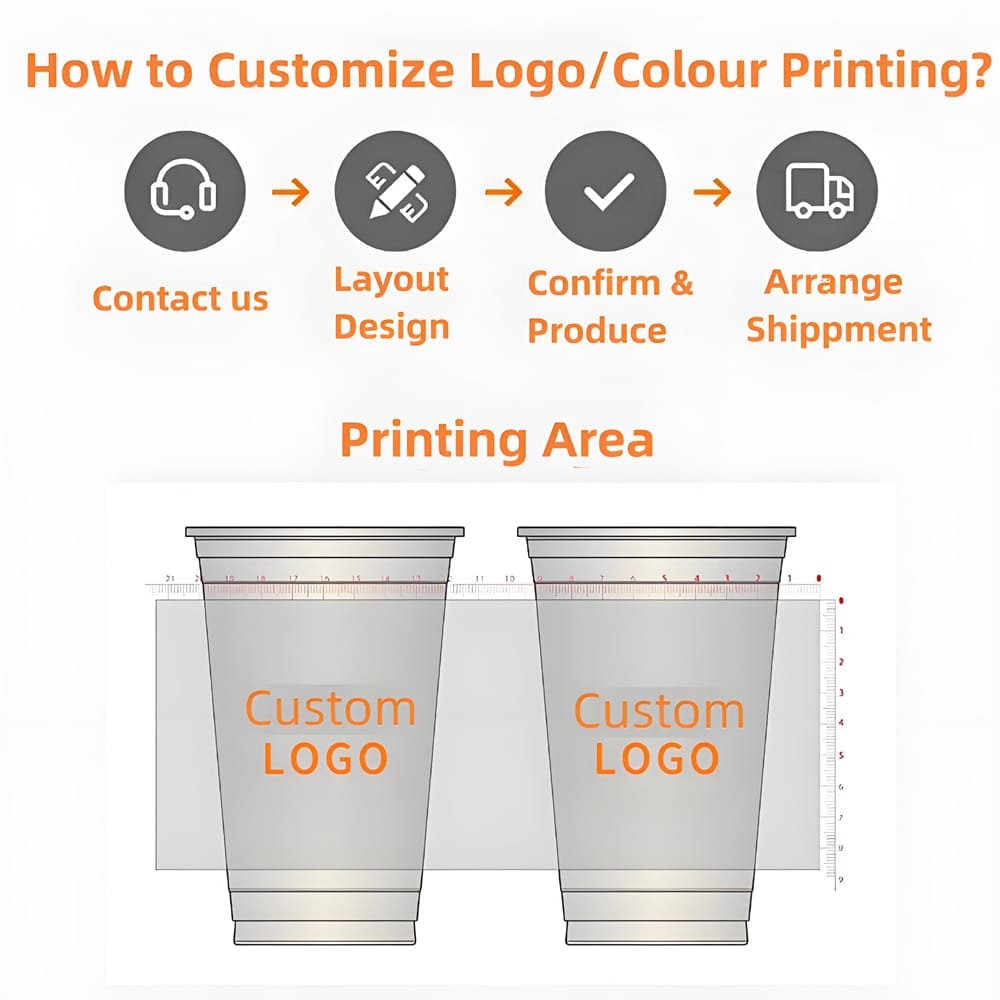
Full-color logo printing (1–6 colors)
Custom sleeve or bulk packaging
Lid compatibility (flat or dome)
Branding consultation for export markets
Private-label OEM/ODM accepted
📦 Related product line: Kraft Paper Containers – Customized Logo Print

4. Packaging and Export Logistics
Bioleader® adopts a logistics-optimized packaging system to ensure safe, efficient, and eco-conscious export shipping.
Standard Packaging
50–100 pcs per sleeve
1,000 pcs per 5-layer carton
Carton size: 45×36×38 cm
Gross weight: 8–10 kg/carton
Label: Product name, certification mark, barcode, country of origin
Container Loading Reference
| Container Type | Loading Capacity | Notes |
|---|---|---|
| 20ft | ~500,000 cups | 450–500 cartons |
| 40HQ | ~1,200,000 cups | 1000+ cartons |
| Mixed Container | Supported | Combine PLA + Bagasse + Paper |
Shipping and Documentation
Incoterms: FOB Xiamen / CFR / DDP (on request)
Port of export: Xiamen, Ningbo, or Shenzhen
Certificates provided: EN13432, ASTM D6400, BPI, TÜV, LFGB, FDA
Full customs documentation (Invoice, CO, Form E/F, Packing List)
🧃 Explore complementary packaging: Take Out Salad Bowls – Bioleader Paper Bowls Manufacturer

5. Certifications and Compliance
All Bioleader® PLA cups meet the highest global safety and environmental standards.
EN13432 (EU): Confirms compostability under controlled industrial composting.
ASTM D6400 (USA): Defines biodegradation of compostable plastics.
BPI Certified: Required for the U.S. compostable market.
TÜV Austria OK Compost: European certification of compostable quality.
FDA & LFGB: Verified for direct food and beverage contact.
ISO9001 & ISO14001: Quality and environmental management systems.
✅ Result: Guaranteed compliance for export to over 60 countries.
6. Material Comparison: PLA vs. Other Eco Materials
| Material | Compostability | Transparency | Heat Resistance | Export Advantage | Cost Index |
|---|---|---|---|---|---|
| PLA | ✅ Industrial compostable | Clear | 55°C | Widely accepted | ★★★ |
| CPLA | ✅ Compostable | Semi-transparent | 90°C | Certified globally | ★★★★ |
| Bagasse | ✅ Home & industrial | Opaque | 120°C | Customs-friendly | ★★★ |
| Paper (PE-coated) | ⚠️ Partially recyclable | White | 80°C | Moderate | ★★ |
| PET/PP | ❌ Non-compostable | Clear | 70–100°C | Restricted | ★ |
Analysis:
PLA excels in visual clarity and branding appeal.
CPLA offers higher heat resistance for hot drinks.
Bagasse provides versatility for takeout food packaging.
Paper-based cups remain popular but limited by PE coating recyclability.
🔗 For complementary materials, visit Bagasse Bowl Category.
7. Case Study: A European Café Chain’s Transition to PLA
Client: Mid-size smoothie & juice chain (60+ outlets, France & Spain)
Challenge: Replace PET cups to comply with EU packaging regulations.
Bioleader® Solution:
1.2 million PLA cups (8oz–24oz) per quarter
Matching PLA dome lids and printed paper sleeves
Consolidated 40HQ mixed containers for optimized freight
Provided complete documentation (EN13432, FDA, LFGB)
Results After 6 Months:
72% reduction in single-use plastic waste
14% lower logistics costs
27% improvement in brand sentiment among eco-conscious customers
Recognized in “Green Café Awards 2025”
This case demonstrates how partnering with Bioleader® ensures both environmental and business success.

8. Cost Optimization Strategies
Cost efficiency is critical when sourcing eco packaging at scale.
Here are five proven methods to lower total procurement cost (TCO):
Consolidate SKUs: Load multiple PLA sizes and lids in one container.
Choose Sleeve vs. Bulk Pack Wisely: Bulk saves space; sleeve adds retail value.
Order During Off-Peak Months: January–March and September–October shipping can reduce freight by 10–15%.
Mix Material Lines: Combine PLA, bagasse, and kraft in one shipment to diversify inventory.
Leverage Long-Term Contracts: Annual agreements can lock in better resin pricing.
Sample Cost Model (10,000 pcs FOB Xiamen)
| Item | Unit Price (USD) | Total (USD) |
|---|---|---|
| 16oz PLA Cup | 0.050 | 500.00 |
| Dome Lid | 0.022 | 220.00 |
| Packaging & Labeling | 0.004 | 40.00 |
| Export Fee (≤20ft) | Flat $200 | — |
| Total (FOB Xiamen) | — | $760.00 |
Under CFR (delivered to EU port), add freight ~USD 300–350 per CBM.
Mixing SKUs across a 40HQ shipment can reduce cost-per-cup to $0.043–0.046.
💡 A U.S. distributor applying these tactics cut total logistics expenses by 17%.
9. Buyer’s Checklist: What to Confirm Before Ordering
A practical guide for procurement teams to avoid costly mistakes.
✅ Pre-Order Verification
Confirm size, lid diameter (90/98mm), and wall thickness.
Check supplier’s certificates (EN13432, ASTM D6400, FDA, LFGB).
Review transparency and sealing quality with samples.
✅ Packaging & Shipping
Validate carton dimensions and pallet height.
Review loading plan for 20ft/40HQ container.
Clarify labeling: “Compostable PLA,” SKU code, and origin.
✅ Branding & Design
Approve digital print proof and Pantone color.
Verify printing area and placement.
Request pre-production sample for logo alignment.
✅ Documentation
Request COA, BPI, and TÜV certificates.
Confirm HS code and Form E/F for tariff benefits.
Obtain invoice and packing list in advance for customs pre-declaration.
⚠️ Common Mistakes to Avoid
Ignoring Storage Conditions: PLA must be stored below 40°C — exposure to heat warps cups.
Skipping Sample Validation: Always confirm wall thickness and lid fit before mass production.
Overlooking Certification Details: Many suppliers claim compostable status without valid EN13432 testing.
Misjudging Carton Weight: Overloaded cartons can cause shipping damage.
Not Consolidating Orders: Splitting small quantities across multiple suppliers inflates freight cost.
10. Future Outlook: The Next Wave of PLA Innovation
As the global compostable packaging market accelerates, PLA technology continues to evolve — blending higher performance with better circularity.
Emerging Trends (2025–2030)
PLA+ Formulations: Enhanced clarity, anti-fog properties, and improved rigidity.
Home Compostable Blends: PLA + PHA hybrids compost at lower temperatures.
Digital Print Personalization: Short-run, variable designs for cafés and events.
Hybrid Materials: Paper-PLA laminated “clear kraft cups” combining strength and aesthetics.
Regenerative Supply Chains: Integration with corn waste and sugarcane byproduct sourcing.
Bioleader® Innovation Roadmap
🔬 2026: Launch of “Bioleader® PLA+” line with higher heat resistance (up to 70°C).
🏭 2027: Expansion of smart-printing PLA cup line for on-demand branding.
♻️ 2028: Integration of PLA-PHA blend targeting full home compostability.
🌍 2029: Rollout of carbon-labeled packaging under ISO 14067.
✨ By 2030, 50–60% of global disposable beverage cups are projected to be compostable — and PLA remains at the center of this transformation.
11. Frequently Asked Questions (FAQ)
Q1. Are PLA cups safe for hot beverages?
PLA is best for cold drinks under 50°C. For hot beverages, Bioleader® recommends CPLA cups or paper cups with PLA lining.
Q2. How long does PLA take to decompose?
In industrial composting, PLA decomposes within 90–180 days, depending on temperature and humidity.
Q3. Can PLA cups be recycled?
Technically, no. PLA must be composted, not recycled with PET. However, composting infrastructure is expanding globally.
Q4. Are Bioleader® PLA cups PFAS-free?
Yes. All PLA products are PFAS-free, BPA-free, and certified under LFGB and FDA standards.
Q5. What’s the MOQ for mixed container orders?
Typically 30,000–50,000 pcs per SKU. Bioleader® supports mixed orders combining cups, lids, and boxes in one 20ft or 40HQ container.
12. Conclusion: Partner with Bioleader® for Sustainable Growth
Choosing compostable PLA cups is not just about compliance — it’s about future-proofing your brand and aligning with the global zero-plastic economy.
With:
500+ million pcs annual capacity
Automated production lines for consistent quality
Global certifications (EN13432, ASTM D6400, BPI, TÜV, LFGB, FDA)
Experienced export service to 60+ countries
Bioleader® stands as one of China’s leading manufacturers of PLA cups and sustainable food packaging, trusted by cafés, distributors, and hospitality groups worldwide.
🌍 Bioleader® – Plastic-Free Food Packaging Supplier in China
📍 No. 39 Xinglong Road, Xiamen, Fujian, China
📞 +86-15980856610
Reference
European Bioplastics Association – Bioplastics Market Outlook 2025
McKinsey & Company – Next-Gen Sustainable Packaging Report 2025
U.S. Environmental Protection Agency (EPA) – Compostable Plastics and Industrial Composting Guidelines
European Commission – Packaging and Packaging Waste Regulation (PPWR 2026)
ASTM International – ASTM D6400 Standard Specification for Compostable Plastics
TÜV Austria – OK Compost Industrial Certification Framework
Food and Drug Administration (FDA) – Food Contact Materials Guidance
Federal Ministry for the Environment, Nature Conservation and Nuclear Safety (Germany) – Single-Use Plastics Strategy Report
Ellen MacArthur Foundation – Global Commitment Progress Report on Circular Economy Plastics
Composting Council of Canada – PLA and Bioplastic Waste Stream Studies 2024
Compostable PLA Cups Explained: Insights, Options & Market Outlook
1️⃣ Why Compostable PLA Cups Matter
Global packaging trends are shifting toward low-carbon, plant-based materials. PLA (Polylactic Acid), made from corn starch or sugarcane, replaces petroleum plastics with compostable clarity. Its life-cycle CO₂ emissions are up to 65% lower than PET, aligning with 2026 global plastic-ban directives (EU PPWR, California SB54, Canada Single-Use Regulation).
2️⃣ What Makes PLA Cups Different
Unlike conventional plastics, PLA cups decompose naturally under industrial composting, converting to CO₂ and water within 90–180 days. They remain crystal-clear, food-safe (LFGB/FDA certified), and entirely PFAS-free — ideal for juices, smoothies, and takeaway beverages seeking a transparent yet sustainable presentation.
3️⃣ How Bioleader® Enables Large-Scale Transition
Bioleader® combines high-capacity molding lines (500+ million pcs annually) with OEM flexibility. Buyers can choose from 8oz–32oz cups, flat or dome lids, sleeve or bulk packaging, and full-color printing. Each shipment includes EN13432, ASTM D6400, BPI, and TÜV certificates, simplifying import compliance for EU, US, and APAC distributors.
4️⃣ Options for Buyers and Distributors
Buyers can select between standard PLA and upgraded CPLA (heat-resistant up to 90°C). Mixed-container shipping allows cost-efficient combination of PLA cups, bagasse containers, and kraft bowls. Custom branding and carbon-labeled packaging strengthen ESG storytelling and elevate product visibility on retail shelves and digital listings.
5️⃣ Considerations Before Wholesale Purchase
To ensure successful procurement, confirm lid compatibility (90/98mm), carton dimensions, and compostable certifications. Avoid heat exposure during storage, and plan shipments seasonally to optimize freight costs. For long-term programs, Bioleader® supports annual supply agreements with stable pricing and regional warehouse stocking.
6️⃣ Market & Future Trends
By 2030, over half of global beverage cups are projected to be compostable. PLA+ and PLA–PHA hybrid innovations will enable home compostability and greater heat tolerance. With expanding municipal composting networks and transparent carbon labeling, compostable PLA cups will become the new global standard for plastic-free beverage packaging.
In short: Compostable PLA cups represent the intersection of sustainability, compliance, and brand innovation — a scalable solution for the world’s transition toward eco-packaging. Bioleader® leads this evolution with certified quality, data-backed performance, and export-ready manufacturing capacity.