What the 2026 EU PPWR Means for Takeaway & To-Go Packaging: Deadlines, PFAS Limits, Reuse, and Labeling (2026–2035)
I. Why PPWR Matters for Takeaway Packaging
The European Union’s Packaging and Packaging Waste Regulation (PPWR) replaces the older Packaging Waste Directive (PPWD), establishing a directly applicable legal framework across all Member States. Unlike previous directives, the PPWR introduces binding uniform obligations that no longer rely on national interpretation.
For takeaway, to-go, and food delivery packaging—industries that rely heavily on disposable, coated, or laminated materials—this is more than just a legal update. It’s a complete design-to-material transformation.
PPWR is designed to achieve three overarching goals by 2035:
Eliminate harmful substances (PFAS and other non-essential additives).
Ensure recyclability and reuse by design.
Accelerate digital labeling and transparency across the packaging lifecycle.
In short, what was once a marketing advantage (“eco packaging”) will soon become a legal prerequisite for market entry.
PPWR_Compliance_WhitePaper_FullReport
II. Key Regulatory Shifts Beginning August 2026
| Regulation Area | Summary of PPWR Requirement | Takeaway Packaging Impact |
|---|---|---|
| PFAS Ban | Food-contact packaging must not exceed 25 ppb single PFAS / 250 ppb total PFAS / 50 ppm total fluorine. | Eliminates fluorinated grease-resistant coatings; brands must switch to aqueous, plant-based, or mineral dispersion coatings. |
| Recyclability by Design (2030) | All packaging must meet recyclability criteria by 2030. | Multi-layer or laminated materials (e.g. PET+PE) must migrate to mono-material or fiber-only solutions. |
| Recycled at Scale (2035) | Packaging must be collected and recycled in operational EU systems. | Practical recycling capability becomes the decisive compliance factor. |
| Packaging Minimization | Reduce weight/volume without compromising safety or function. | Takeaway bowls, boxes, and lids must be right-sized, eliminating redundant inserts or air gaps. |
| Unified Labeling & Digital Data Carriers | Standardized icons and QR codes for disposal guidance and traceability. | Brands must reserve label space and connect to Digital Product Passport infrastructure. |
| Reuse System Promotion | Encourage reusable packaging in foodservice and delivery. | Cafés, event caterers, and delivery apps must offer returnable containers or reusable pilots. |
These measures collectively move the EU from “recycling encouragement” to enforced circular packaging economy.
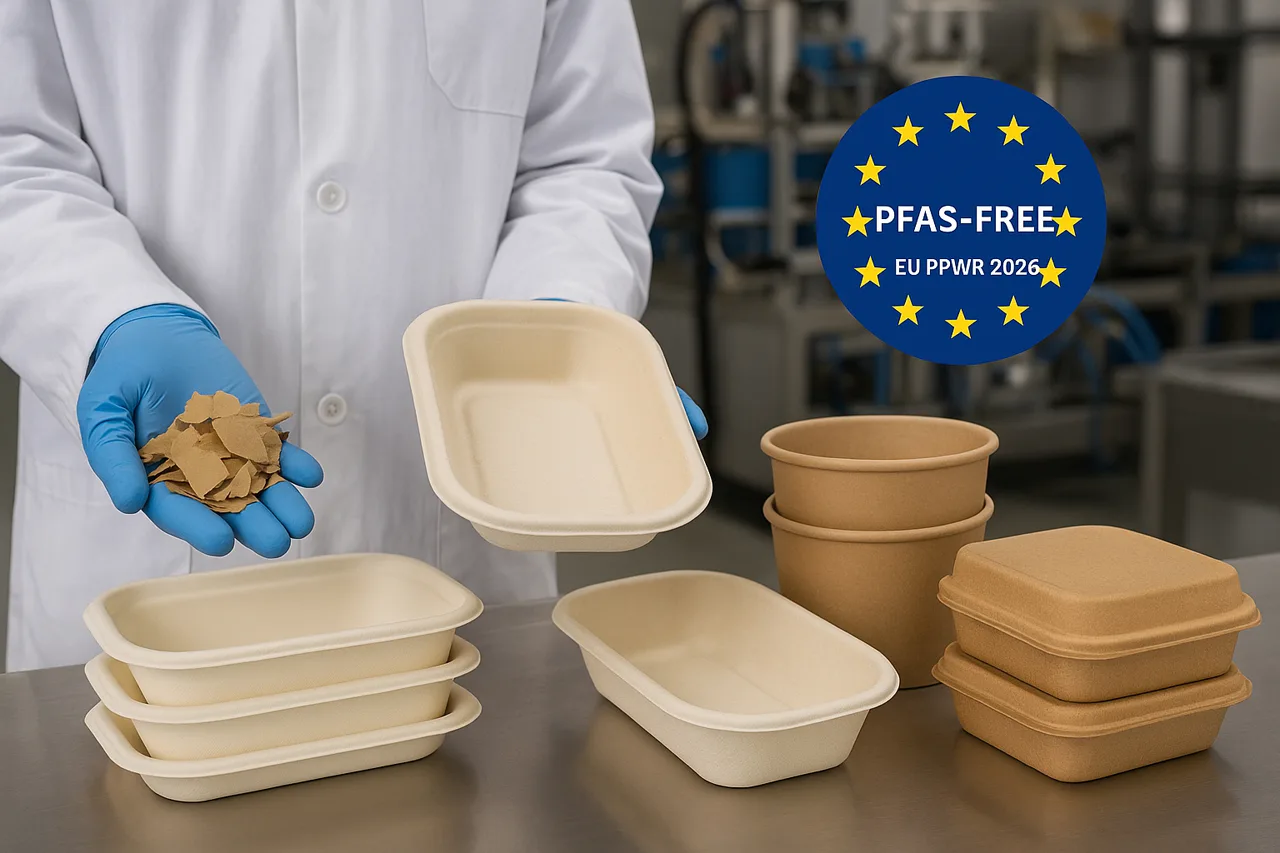
III. PFAS-Free Transition: From Risk to Opportunity
PFAS (per- and polyfluoroalkyl substances) have long been used to make packaging oil- and grease-resistant. However, they persist in the environment and have been linked to serious health concerns.
The PPWR effectively bans PFAS-based coatings from all food-contact packaging. For takeaway suppliers, this shift opens a technological race toward sustainable alternatives:
Water-based dispersions that maintain grease resistance without fluorine.
Natural waxes and minerals are used as bio-barriers.
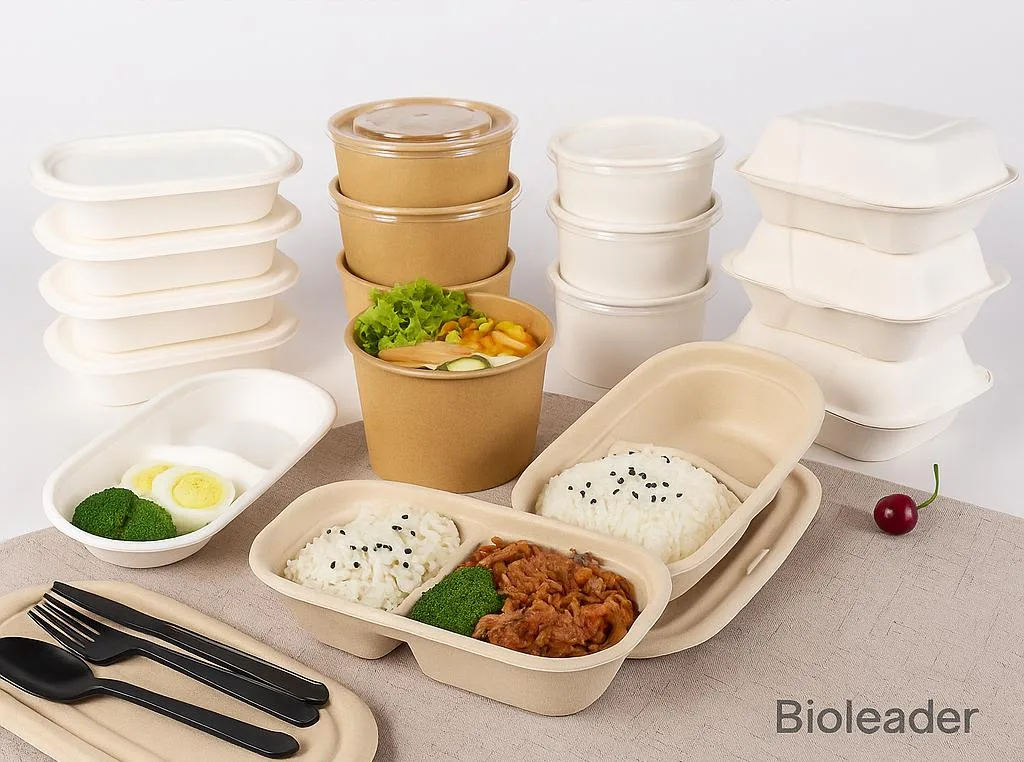
Bagasse food containers and kraft paper containers with enhanced internal sizing instead of coatings.
Action Plan:
Audit all current SKUs for PFAS content.
Work with suppliers to secure test reports.
Replace coated papers or laminates with certified PFAS-free dispersion board.
Transitioning early not only avoids 2026 non-compliance risk but positions the brand as a sustainability leader in Europe.
IV. Recyclability and Design-for-Recovery
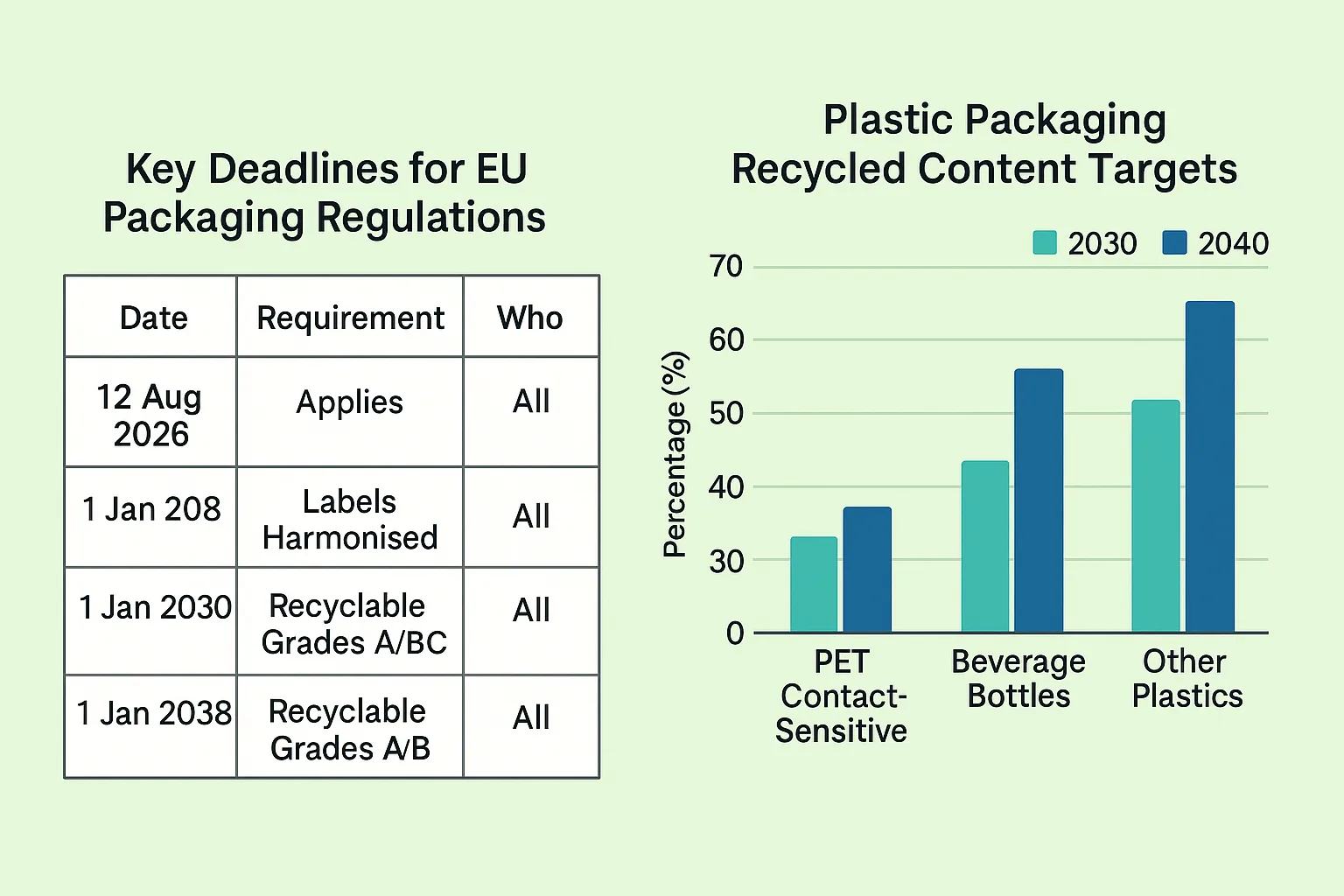
By 2030, every piece of packaging in the EU must be “designed for recycling.”
By 2035, it must be “recycled at scale.”
This means recyclability is no longer theoretical—it must be proven by operational recycling capacity.
For takeaway products, the path forward includes:
Using mono-material structures (e.g. PP body + PP lid).
Avoiding metalized or laminated coatings.
Using fiber-based bowls and trays compatible with EU paper recycling systems.
Designing snap-fit lids or simplified nesting structures to improve sorting efficiency.
This “DfR-first” approach shifts packaging development from aesthetics to functional recoverability.
V. Digital Labeling: The New Compliance Layer
Starting 2027, every packaging unit will require clear recyclability labels and a data carrier (QR code or digital tag) linking to product information.
By 2029, reusable packaging must include a unique identifier for tracking return and washing cycles.
For takeaway packaging, digital labeling means:
Preparing artworks that reserve QR space.
Hosting landing pages detailing composition, disposal, and reuse guidance.
Coordinating with ERP/PIM systems to sync digital product passports.
This evolution creates transparency for both consumers and regulators—and enhances traceability in the value chain.
VI. Packaging Minimization: Efficiency as Compliance
PPWR Article 10 mandates the reduction of “empty space” and unnecessary packaging layers.
For takeaway brands, this means:
Reassessing portion size vs container volume.
Removing secondary wraps or over-sleeves.
Reducing thickness and dead space in multi-compartment clamshells.
Optimizing cartonization to cut material and freight emissions.
Smarter design here isn’t only about compliance—it also saves logistics cost and improves consumer perception.
VII.Strategic Roadmap 2025–2035
| Phase | Timeline | Core Tasks |
|---|---|---|
| Phase 1: Diagnose | 2025–Q1 2026 | Audit SKUs, PFAS testing, recyclability assessment, redesign labels. |
| Phase 2: Convert | Q2 2026–2027 | Adopt PFAS-free materials and QR labels. |
| Phase 3: Scale & Certify | 2028–2030 | Achieve 100% design-for-recycling compliance. |
| Phase 4: Recycled at Scale | 2030–2035 | Ensure collection and reprocessing in EU systems. |
Early movers can use this roadmap as a competitive timeline—each phase brings branding, cost, and compliance advantages.
To convert this strategic roadmap into concrete, auditable actions, we’ve prepared a practical EU PPWR compliance execution checklist for importers and brands, covering timelines, documentation, and packaging decisions for 2025–2026.
VIII. Asia’s Advantage: How Exporters Can Lead
For Chinese and Asian manufacturers exporting to Europe, PPWR is not a threat—it’s an entry barrier that favors prepared suppliers.
Factories already using bagasse, kraft, CPLA, or compostable bioplastics are naturally aligned with EU goals. From a buyer’s perspective, compliance alone is no longer sufficient. Importers and brands are increasingly evaluating supplier readiness based on certification coverage, export experience, and material portfolios. A comparative overview of the leading biodegradable food container manufacturers worldwide helps buyers identify suppliers already positioned for PPWR-driven demand.
To strengthen competitiveness:
Obtain EN13432 / ASTM D6400 compostability and recyclability certificates.
Eliminate PFAS from all coating formulations.
Integrate digital label readiness (QR printing or embossing).
Build partnerships with European importers for traceable supply chains.
Early compliance converts regulation into a sales argument—“PPWR-Ready Packaging Manufacturer” will soon be a buyer’s checklist item.
IX. Opportunities Beyond Compliance
Product differentiation: “PFAS-free,” “mono-material,” “digitally labeled” become new selling points.
Operational savings: Minimization reduces material weight and logistics costs.
Consumer trust: Transparent QR-linked labeling reinforces brand credibility.
Regulatory insulation: Proactive compliance avoids penalties and delays in customs clearance.
Packaging firms that frame PPWR as a design and innovation challenge, not a burden, will secure long-term market share.
X. Future Outlook: From Regulation to Revolution
Between 2026 and 2035, Europe’s packaging ecosystem will experience a transformation similar to what energy markets underwent after renewables policy mandates.
By 2030, expect to see:
PFAS-free fiber packaging dominating takeaway sectors.
QR-coded transparency becoming standard on every box and cup.
Hybrid systems mixing reusable dine-in and optimized single-use takeaway.
More eco-certification consolidation (e.g., harmonized EU-wide recyclability grades).
Takeaway packaging is moving from disposable to intelligent, traceable, and circular.
FAQ
1. When does the EU PPWR take effect?
The PPWR entered into force in February 2025 and applies from August 12, 2026, with progressive milestones through 2035.
2. Are PFAS-coated papers banned immediately?
Yes. From August 2026, any food-contact packaging exceeding the PFAS thresholds cannot be marketed in the EU.
3. Does “recyclable” mean the material is compostable?
No. Compostability and recyclability are separate categories; compostable packaging may still need industrial facilities, not general recycling bins.
4. How will digital labeling affect takeaway brands?
Brands must prepare QR-enabled packaging linking to recyclability and reuse data. This becomes mandatory by 2029 for reusable containers.
5. What happens if companies fail to comply?
Non-compliance may result in fines, withdrawal from market, or import rejections by EU authorities.
Semantic Closed-Loop Insight Block (SGE / AI Style)
How: Redesign takeaway packaging for PFAS-free safety, mono-material recyclability, and digital transparency. Begin supplier certification and QR integration by mid-2025.
Why: The PPWR transforms compliance into a design imperative—only packaging proven recyclable at scale will be legal by 2035. Foodservice brands must adapt to avoid EU market loss.
What’s next: Build internal “PPWR Task Forces” aligning R&D, procurement, and marketing. Replace coated plastics with bagasse, kraft, and CPLA alternatives. Embrace QR-driven communication for both consumers and auditors.
Option lens: Optimize single-use for high-distance delivery; deploy reusable containers in closed venues. Measure CO₂e savings to reinforce ESG reporting.
Consideration: Treat PPWR as an innovation catalyst—those who adapt early will define the future of circular takeaway packaging.