The 2025 Buyer’s Guide To Chemical Free Tableware | Bioleader® Guides

Browse articles grouped under the "Chemical free tableware" tag for topic-specific information and examples. The featured articles may approach the topic from different product, material, application, market, or sourcing perspectives. Check each article for its exact scope, technical data, standards, sources, and recommendations.
Chemical free tableware — Content Overview
  • Featured articles shown: 12
  • Directly tagged articles: 1
  • Latest tagged article update: 2026-10-24
  • Coverage, examples, and specific recommendations vary by individual article.

Editor's Picks: Top Chemical Free Tableware Guides 2026

FAQ of Bioleader's Eco-friendly Disposable Tableware

Are 650ml rectangular paper salad bowls with lids suitable for takeaway meals?

Yes. Bioleader® 650ml rectangular paper salad bowls with lids are suitable for salads, rice bowls, cold meals, hot food, takeaway meals, and prepared food programs — Chemical free tableware. The food-grade paperboard structure, coated surface, rectangular shape, and matching lid options help improve stacking, handling, and transport performance.

Which lid should I choose for 650ml rectangular paper salad bowls?

Paper lids are recommended when the buyer wants a consistent kraft or white paper packaging appearance. PP lids are practical for hot food handling, microwaveable use, stacking, takeaway, and delivery. PET lids are suitable when product visibility is important for chilled salads, sushi-style meals, supermarket display, and grab-and-go food programs.

Can 1500ml paper salad bowls be custom printed?

Yes. Bioleader® supports OEM logo printing and private-label designs for 1500ml paper salad bowls and matching paper lids. Buyers can provide AI, PDF, CDR, or clear logo files. White paper is usually better for sharp full-color printing, while kraft paper is suitable for natural, minimal, and eco-style branding.

Definition and Background

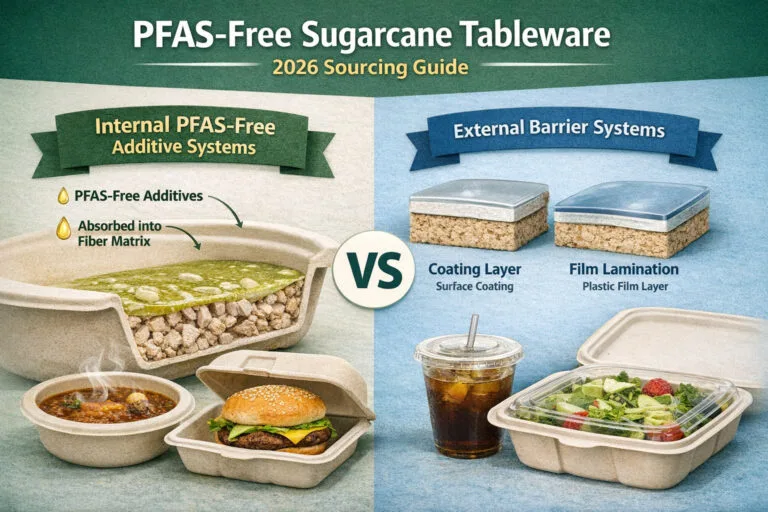
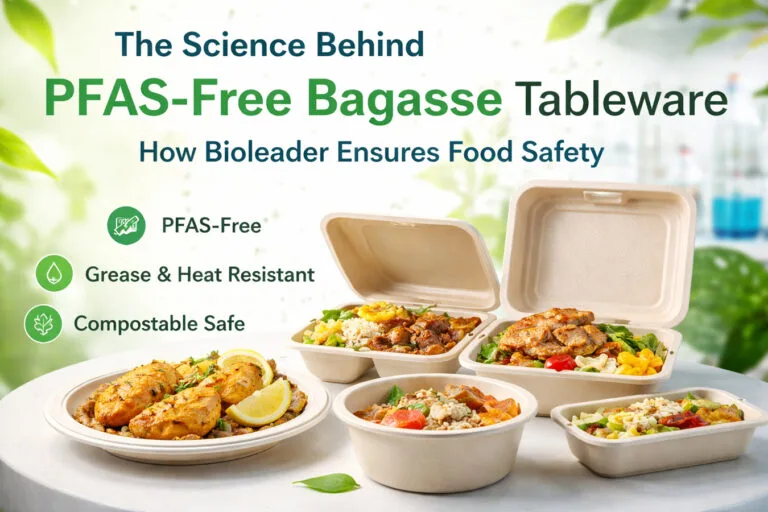
PFAS means per- and polyfluoroalkyl substances, a large class of man-made fluorinated chemicals. Certain PFAS have been used because they can provide resistance to oil, grease, water, heat, and stains. In consumer and industrial products, PFAS have appeared in applications such as non-stick cookware, water-repellent textiles, stain-resistant fabrics, firefighting foams, and some grease-resistant food packaging — Chemical free tableware. When a food packaging product is described as PFAS-free, the claim should usually mean that PFAS are not intentionally added to the product — Chemical free tableware.

Health and Environmental Impact

PFAS are often called “forever chemicals” because many of them are highly persistent. Some PFAS have been associated with environmental contamination and potential health concerns. Scientific and regulatory agencies continue to evaluate different PFAS compounds, exposure levels, and pathways. For food packaging buyers, the practical concern is clear: avoid unnecessary PFAS use and verify safer alternatives before approving packaging claims.

Related Insights

🚀Ready to Go Green and Choose ?

Join the global movement toward zero-waste packaging.


Bioleader® offers:

  • 📦 Bulk order support & fast delivery

  • ✍️ Custom branding and OEM solutions

  • 🌍 Worldwide eco-packaging compliance

Get the Catalogue Products List  & Contact Us Now! 👉

Contact Us for Quote

Click or drag files to this area to upload.You can upload up to 5 files.
The more details you share, the faster and more accurate our quotation will be.