FAQ of Bioleader's Eco-friendly Disposable Tableware
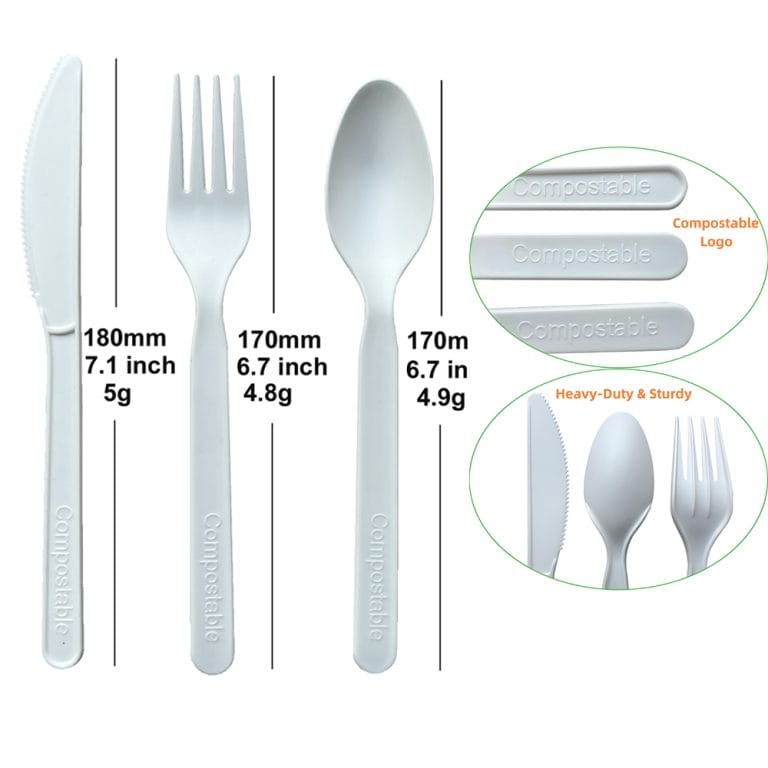
Can businesses customize BPI compostable cutlery packaging?
Absolutely , Carbon Footprint. BPI compostable cutlery offers customizable packaging options, including logo printing and tailored designs to support branding and marketing needs.
Are biodegradable plastic forks and spoons safe for food contact?
Yes, these products are manufactured to be food-safe, free from toxic chemicals, and suitable for direct contact with all types of food.
How long does it take for bio plastic cutlery to decompose?
Under industrial composting conditions, bio plastic cutlery generally decomposes within 90 to 180 days, depending on the material and composting environment.
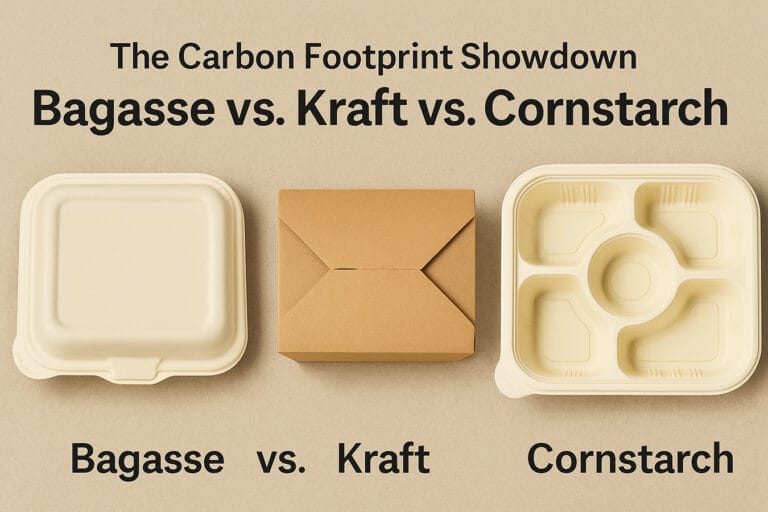
LCA Dataset: Bagasse vs. Kraft vs. Cornstarch Packaging (2025)
Note: Values are indicative global averages. Replace with verified regional data before publication. Functional unit = 1,000 pcs (≈900 ml bowl + lid). Material Functional Unit System Boundary CO₂e Raw CO₂e Manufacturing CO₂e Transport CO₂e Use CO₂e EoL EoL Scenarios (Home / Industrial / Recycle / Landfill / Incineration) Food Contact Compliance Heat / Oil Resistance Bagasse 1,000 pcs (≈900 ml bowl + lid) Cradle-to-Grave 18 kg 12 kg 4 kg –2 kg (food-loss avoidance) 5 kg Home 20% / Industrial 40% / Recycle 0% / Landfill 30% / Incineration 10% Yes (EN 13432 / ASTM D6400) High / High Kraft Paper 1,000 pcs (≈900 ml bowl + lid) Cradle-to-Grave 22 kg 15 kg 5 kg –1 kg 10 kg Home 0% / Industrial 10% / Recycle 55% / Landfill 25% / Incineration 10% Yes (PFAS-free barrier) Medium / Medium (depends on barrier) Cornstarch Biopolymer 1,000 pcs (≈900 ml bowl + lid) Cradle-to-Grave 30 kg 20 kg 6 kg 0 kg 12 kg Home 10% / Industrial 45% / Recycle 0% / Landfill 30% / Incineration 15% Yes (ASTM D6400 / EN 13432) High / Medium (formulation-dependent) 📊 Download LCA Dataset (CSV) Material Profiles & Manufacturing Pathways 🎬 Video: Overview of Bagasse Pulping & Molding, Kraft Paper Converting, and Cornstarch Biopolymer Production — A complete look at sustainable packaging manufacturing processes by Bioleader®.
Table 1. LCA Master Table (kg CO₂e per 1,000 pcs)
Material Raw Materials Manufacturing Transport Use Phase End-of-Life Total CO₂e Bagasse 18 kg 12 kg 4 kg −2 kg 5 kg 37 kg Kraft Paper 22 kg 15 kg 5 kg −1 kg 10 kg 51 kg Cornstarch Biopolymer 30 kg 20 kg 6 kg 0 kg 12 kg 68 kg Totals reflect cradle-to-grave emissions for ~1,000 units (≈900 ml bowl + lid), assuming typical transport by sea and truck, and region-averaged end-of-life outcomes — Carbon Footprint. Negative “Use Phase” values represent avoided extra packaging and avoided food-loss — Carbon Footprint.