









Introduction
Choosing the right packaging size is a practical part of foodservice, delivery, retail, catering, and export packaging. Among all common volume units, pint vs quart is one of the most frequently searched and most easily misunderstood comparisons. For consumers, the question is often simple: how many pints are in a quart? For food packaging buyers, the question is more commercial: which container size is better for soup, salad, ice cream, sauces, deli food, meal prep, and takeaway?
For brands sourcing biodegradable food packaging, the difference between a pint and a quart is not just a unit conversion. It affects portion control, label accuracy, container selection, lid fit, carton packing, shipping cost, customer experience, and market compliance.
Quick Answer: Pint vs Quart
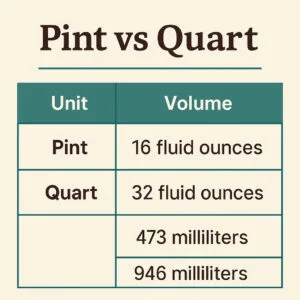
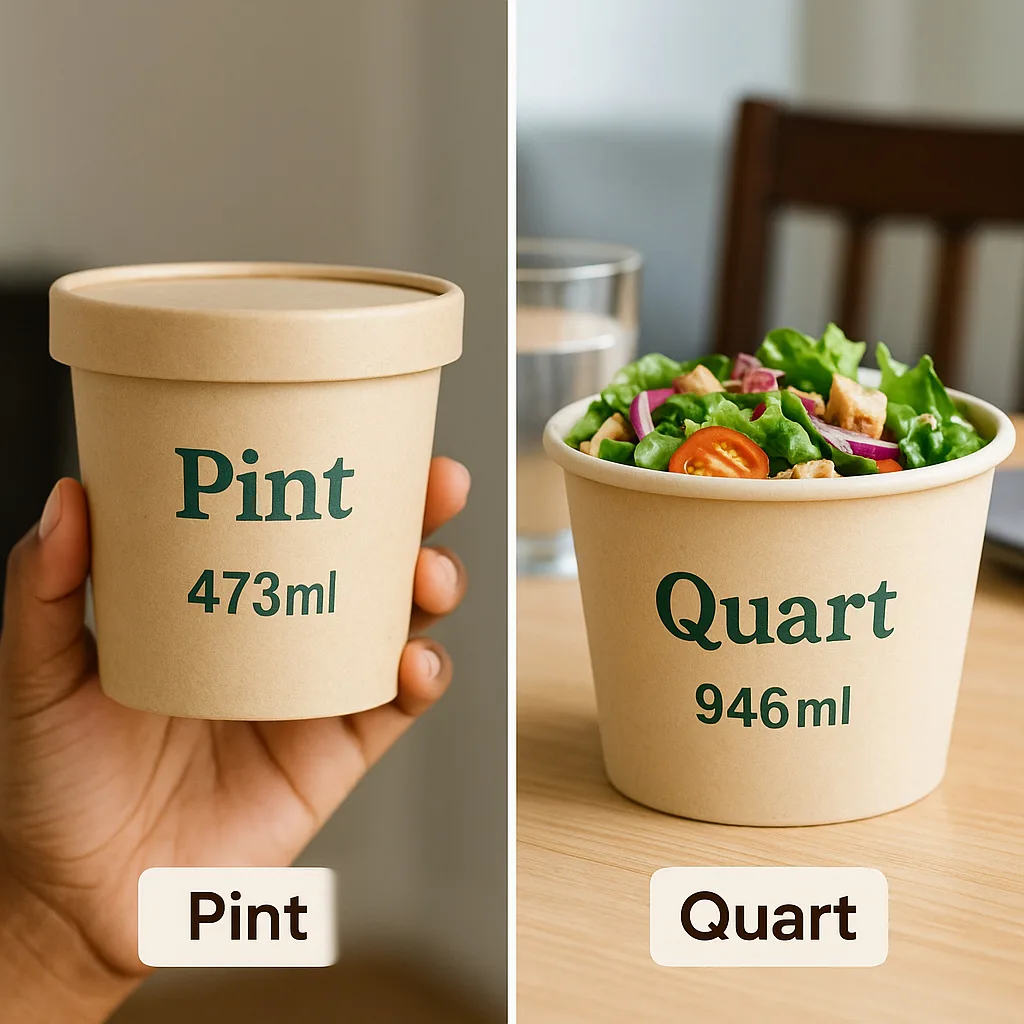
1 quart equals 2 pints. In the U.S. liquid measurement system, 1 pint = 16 fl oz = about 473 ml, while 1 quart = 32 fl oz = about 946 ml. In the Imperial system, 1 pint = 20 fl oz = about 568 ml, while 1 quart = 40 fl oz = about 1,136 ml.
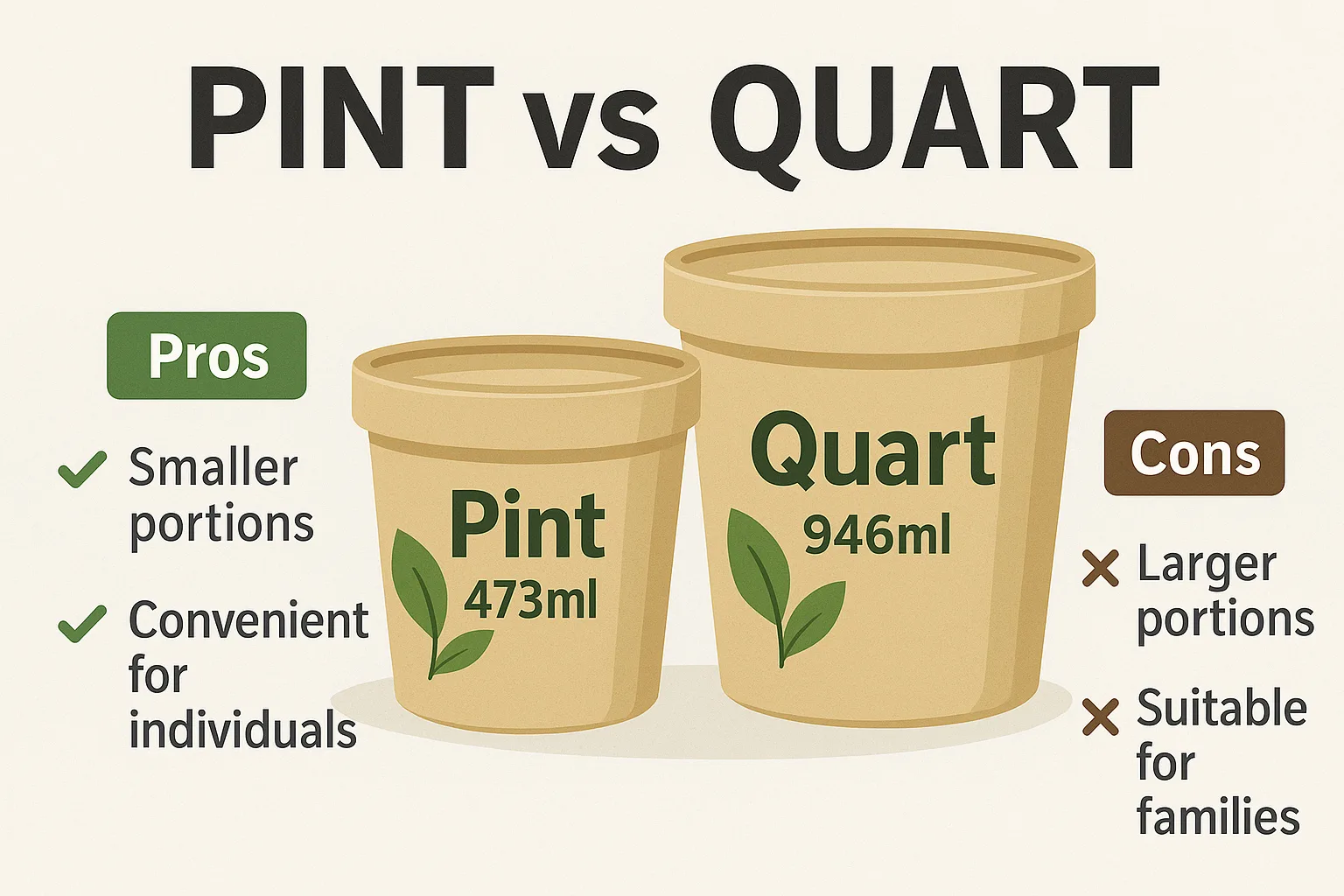
- Pint containers: best for single servings, ice cream, soups, sauces, deli salads, desserts, snacks, and small takeaway portions.
- Quart containers: best for family-sized soups, larger salads, bulk sides, meal prep, catering, and large takeaway orders.
- Key conversion: 1 quart = 2 pints; 1 gallon = 4 quarts = 8 pints.
- Export tip: use both local units and metric volume, such as “473 ml / 1 US Pint” or “946 ml / 1 US Quart.”
1. What Is a Pint? What Is a Quart?
A pint and a quart are volume units used in the U.S. customary and Imperial measurement systems. They are common in food packaging, beverage service, ice cream packaging, soup containers, deli containers, and kitchen measurements. The important point is that U.S. and Imperial values are not the same.
| Unit | U.S. Liquid Measurement | Imperial Measurement | Common Metric Equivalent | Packaging Meaning |
|---|---|---|---|---|
| 1 Pint | 16 U.S. fl oz | 20 Imperial fl oz | About 473 ml / 568 ml | Single-serve soup, ice cream, deli salad, sauce, dessert, small food container. |
| 1 Quart | 32 U.S. fl oz | 40 Imperial fl oz | About 946 ml / 1,136 ml | Family-size soup, bulk side dish, large salad, catering portion, large takeaway container. |
| 1 Gallon | 128 U.S. fl oz | 160 Imperial fl oz | About 3.785 L / 4.546 L | Bulk liquids, foodservice storage, large-volume preparation, catering supply. |
In both systems, the relationship remains simple: 1 quart = 2 pints. The difference is the actual volume of each pint or quart. An Imperial pint or quart is about 20% larger than the U.S. liquid equivalent, so international packaging buyers should always confirm which system the customer or target market expects.

2. Pint vs Quart Conversion Chart
For most U.S. food packaging, the liquid measurement system is the practical reference. However, export orders, food labels, and international retail packaging should also show metric equivalents clearly.
| Conversion | U.S. Liquid System | Imperial System | Food Packaging Note |
|---|---|---|---|
| 1 Pint | 16 fl oz / about 473 ml | 20 fl oz / about 568 ml | Common for single-serve soups, ice cream, deli salads, and sauces. |
| 1 Quart | 32 fl oz / about 946 ml | 40 fl oz / about 1,136 ml | Common for family soup, larger salads, bulk sides, and catering food. |
| 1 Quart to Pint | 1 quart = 2 pints | 1 quart = 2 pints | The ratio is the same even though the actual volume differs by system. |
| 1 Gallon | 4 quarts / 8 pints | 4 quarts / 8 pints | Useful for bulk liquids, foodservice kitchens, and production planning. |
| Half Pint | 8 fl oz / about 237 ml | 10 fl oz / about 284 ml | Useful for small desserts, sauces, samples, and snack portions. |
Fast answer for search users: There are 2 pints in 1 quart. A U.S. quart is about 946 ml, while an Imperial quart is about 1,136 ml.
3. U.S. Liquid Pint vs Imperial Pint vs Dry Pint
One common packaging mistake is assuming that every “pint” means the same thing. In real trade, recipe, and packaging contexts, buyers may encounter U.S. liquid pints, Imperial pints, and dry pints. These should not be treated as identical.
| Measurement Type | Approximate Volume | Where It Appears | Packaging Risk |
|---|---|---|---|
| U.S. Liquid Pint | 16 U.S. fl oz / about 473 ml | U.S. liquid foods, soups, sauces, ice cream, beverages, and many food containers. | Often assumed in U.S. foodservice packaging, but must be clarified for export. |
| U.S. Liquid Quart | 32 U.S. fl oz / about 946 ml | U.S. quart soup containers, deli containers, family-size food packs. | Should not be confused with Imperial quart containers. |
| Imperial Pint | 20 Imperial fl oz / about 568 ml | UK and some Imperial measurement contexts. | About 20% larger than a U.S. liquid pint. |
| Imperial Quart | 40 Imperial fl oz / about 1,136 ml | Markets or documents using Imperial volume. | May cause underfilling or incorrect packaging if U.S. sizes are assumed. |
| U.S. Dry Pint | About 551 ml | Some dry goods, produce, and agricultural measurement contexts. | Not the same as a liquid pint; packaged foods may require weight, count, or metric labeling instead. |
For export food packaging, avoid relying only on “pint” or “quart” in product communication. Use clear dual labeling such as 473 ml / 16 fl oz / 1 U.S. pint or 946 ml / 32 fl oz / 1 U.S. quart. This reduces misunderstanding between suppliers, importers, distributors, and end customers.
4. Pint vs Quart in Food Packaging: Which Size Should You Choose?
The right choice depends on portion size, food type, delivery channel, container shape, lid fit, and customer expectation. A pint is usually better for single-serve use. A quart is usually better for family portions, bulk side dishes, and catering.
| Buyer Question | Choose Pint When… | Choose Quart When… |
|---|---|---|
| Portion Size | You need single-serving portions for one customer. | You need family-size, shared, or multi-serving portions. |
| Food Type | Ice cream, soup, sauce, dessert, deli salad, small snacks. | Soup, broth, salad, pasta, bulk sides, meal prep, catering food. |
| Delivery Risk | Smaller portions need easier handling and secure lids. | Larger liquid foods need stronger structure, reliable sealing, and enough headspace. |
| Customer Experience | Convenient for individual takeaway, impulse purchase, and portion control. | Better value perception for families, group meals, and catering orders. |
| Storage | Fits small refrigerators, display counters, and grab-and-go shelves. | Reduces the number of packs but needs more shelf and delivery space per unit. |
| Sustainability | Avoids over-packaging when serving one person. | May reduce the number of separate containers for shared meals. |
| Export Label | Use 473 ml / 1 U.S. pint when applicable. | Use 946 ml / 1 U.S. quart when applicable. |
For foodservice brands, the best solution is not always the smallest or largest container. It is the container that matches the real food volume, expected headspace, lid compatibility, stacking strength, transport condition, and customer use scenario.
5. Common Food Uses: Soup, Salad, Ice Cream, Sauce, Deli, and Takeaway
Pint and quart containers are common because they match real foodservice portions. However, different foods behave differently inside a container. Hot soup, cold ice cream, wet salad, oily sauce, and dry snacks all require different materials and lid structures.
| Food Application | Common Pint Use | Common Quart Use | Packaging Recommendation |
|---|---|---|---|
| Soup and Stew | Individual soup portion, lunch set, side soup. | Family soup, catering soup, large delivery portion. | Use heat-resistant paper soup bowls or suitable food containers with secure lids. |
| Ice Cream and Frozen Desserts | Single retail pint, premium flavor pack, dessert takeaway. | Family-size or bulk retail pack. | Confirm freezer suitability, lid tightness, printing, and moisture resistance. |
| Salads | Single salad side, deli salad, chopped salad. | Shared salad, meal prep salad, catering side. | Use paper salad bowls or clear-lid containers for presentation. |
| Sauces and Dressings | Small sauce or dip portion for takeaway. | Bulk sauce, soup base, stock, or kitchen prep. | Confirm leak resistance, lid fit, and whether the food is hot, oily, acidic, or cold. |
| Deli Foods | Coleslaw, potato salad, beans, fruit, pasta salad. | Bulk deli sides and family meals. | Use stackable containers with clear capacity and proper shelf-life testing. |
| Takeaway Meals | Small bowls, snack meals, lunch portions. | Large bowls, family sides, group meals. | Match container depth, lid type, material strength, and delivery time. |
6. Container Size Mapping: 8oz, 12oz, 16oz, 24oz, 32oz, and 48oz
In real food packaging production, buyers often do not order by “pint” and “quart” only. They also use ounce and milliliter sizes. The table below connects common foodservice container sizes with pint and quart logic.
| Container Size | Approx. Metric Volume | Pint / Quart Relationship | Common Food Use | Bioleader® Product Direction |
|---|---|---|---|---|
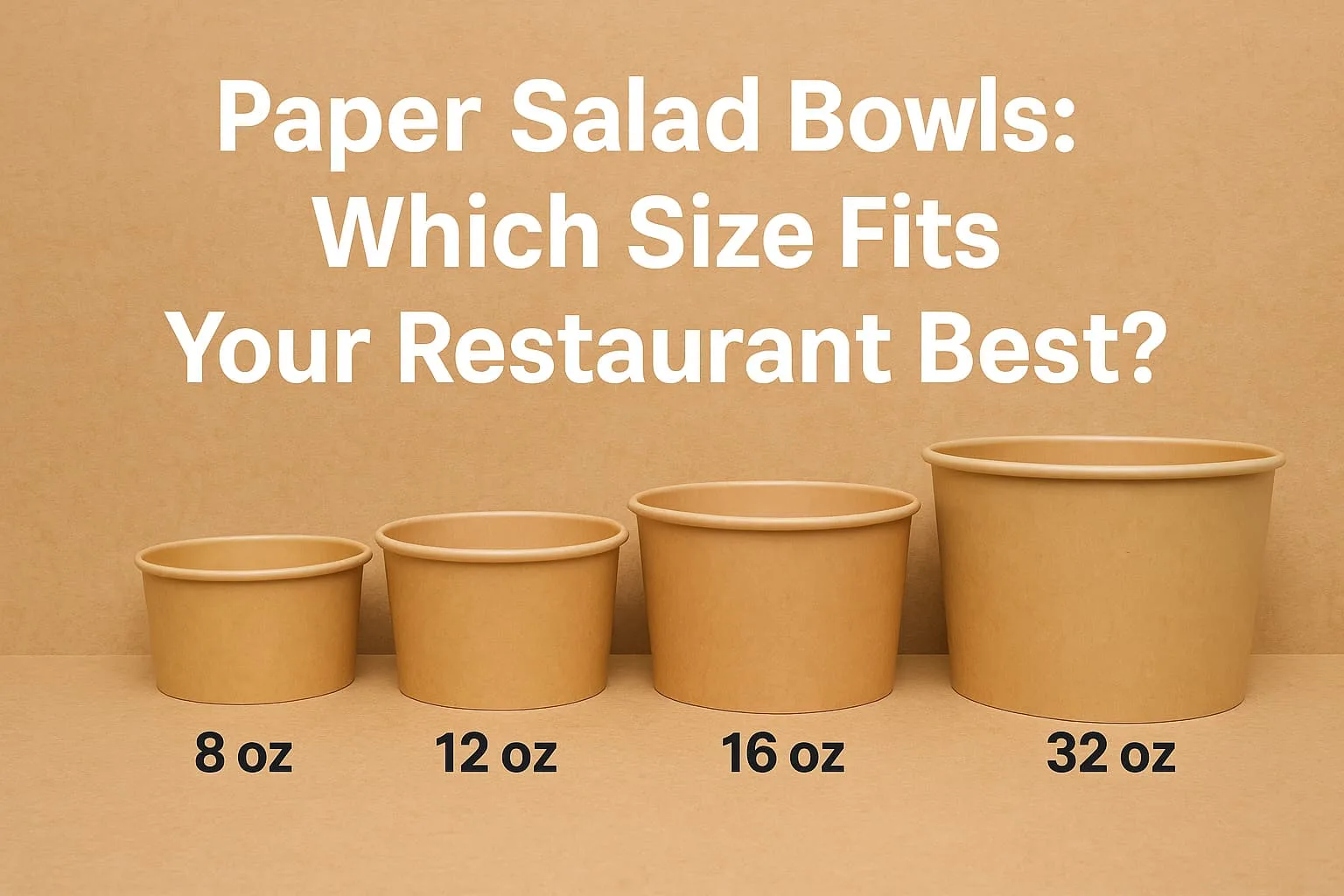
| 8 oz | About 240 ml | Half U.S. pint style | Small soup, dessert, sauce, samples, snacks. | Small paper soup bowls, paper cups, portion containers. |
| 12 oz | About 355 ml | Below 1 U.S. pint | Soup, small salad, yogurt, breakfast bowl, snacks. | Paper food packaging, kraft bowls, takeaway cups. |
| 16 oz | About 473 ml | 1 U.S. pint | Ice cream, soup, deli salad, sauce, dessert, single-serve meals. | Paper soup bowls, paper salad bowls, deli containers, compostable bowls. |
| 24 oz | About 710 ml | 1.5 U.S. pints | Noodle bowls, medium salads, grain bowls, meal prep. | Paper salad bowls, bagasse bowls, takeaway food bowls. |
| 32 oz | About 946 ml | 1 U.S. quart | Family soup, large salad, bulk sides, meal prep, catering. | Quart containers, large soup bowls, paper food containers. |
| 40 oz | About 1,183 ml | Larger than 1 U.S. quart | Large takeaway meals, shared dishes, food delivery bowls. | Large paper bowls, bagasse containers, meal boxes. |
| 48 oz | About 1,420 ml | 1.5 U.S. quarts | Catering salads, family meals, shared bowls. | Large salad bowls, takeaway bowls, catering containers. |
7. Material Choice: Paper, Bagasse, PLA, PET, and Compostable Options
Once the volume is clear, the next decision is material. A pint or quart container can be made from different materials depending on food temperature, food moisture, shelf-life requirement, presentation, disposal route, and sustainability positioning.
| Material | Best For | Important Limits | Buyer Note |
|---|---|---|---|
| Paper Bowls / Paper Containers | Soup, salad, noodles, ice cream, sauces, and takeaway meals. | Coating type matters: PE, PLA, or water-based coating affects heat, moisture, and sustainability claims. | Good for custom printing, branding, and foodservice flexibility. |
| Sugarcane Bagasse | Hot food, meal boxes, bowls, clamshells, and takeaway containers. | Not usually used as a liquid pint/quart cup for long liquid storage; lid fit and wet-food testing are important. | Suitable for renewable fiber-based bagasse food containers and hot food packaging. |
| Cornstarch-Based Materials | Selected disposable containers, plates, bowls, and cutlery applications. | Finished-product formulation, temperature rating, and certification must be checked. | Do not rely only on the word “cornstarch”; confirm product-specific documentation. |
| PLA | Clear cold drink cups, cold food packaging, desserts, and cold applications. | Standard PLA is generally not suitable for high-temperature hot drinks or hot soup. | Use PLA clear cups mainly for cold drinks, juice, iced coffee, smoothies, and dessert cups. |
| PET | Clear cold drink cups, dessert cups, salads, and cold display packaging. | PET is not biodegradable or compostable. | Use PET for clear cold packaging when compostability is not the core requirement. |
| Compostable Paper / Fiber Options | Eco-positioned soup bowls, salad bowls, takeaway containers, and food boxes. | Compostable claims depend on finished-product testing, certification, and local composting infrastructure. | Best used with correct labeling and market-specific compliance review. |
For broader material selection, buyers can compare Bioleader® sugarcane bagasse tableware, paper bowls, compostable cutlery, PLA cups, and other sustainable food packaging lines.
8. Why Right-Sizing Matters for Sustainable Food Packaging
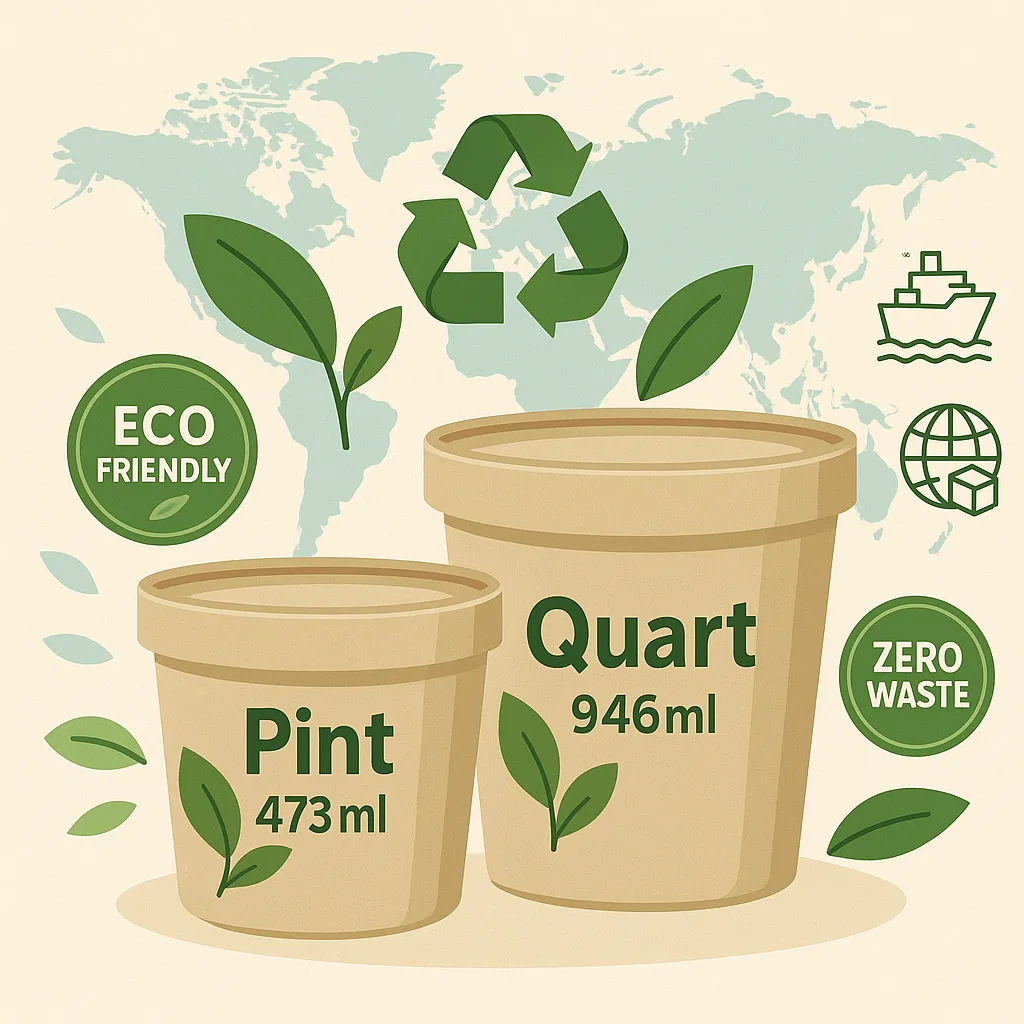
Right-sizing means choosing a container that fits the real portion and service condition. A larger container is not always more sustainable, and a smaller container is not always more efficient. The correct size balances food protection, material use, logistics, customer value, and waste reduction.
Avoid Over-Packaging
Using a quart container for a single-serving pint portion may waste material and increase shipping volume. It can also make the food look underfilled, reducing perceived value.
Avoid Under-Sizing
Using a pint container for a food portion that needs a quart can cause lid pressure, leakage, poor presentation, and lower delivery quality. Soup, salad, noodles, and saucy foods often need enough headspace to prevent spills.
Match Material to Food Type
Hot soup, cold ice cream, oily food, acidic sauces, and chilled salads require different packaging performance. Buyers should test structure, coating, lid fit, stackability, heat resistance, freezer suitability, and delivery conditions before confirming mass production.
Manufacturer Insight
A sustainable package is not only made from a greener material. It must also be correctly sized, properly labeled, suitable for the food, and realistic for the waste-management system in the target market.
9. Labeling and Export Compliance Notes
Packaging volume labels matter because “pint” and “quart” can mean different things across markets. For export, the safest approach is to specify the measurement system, metric equivalent, and food-use context clearly.
| Market / Requirement | Practical Labeling Advice | Why It Matters |
|---|---|---|
| United States | Use net quantity declarations according to food labeling requirements, with accurate U.S. customary and metric information where applicable. | U.S. food packages generally need a clear net quantity statement on the principal display panel. |
| European Union | Use metric units clearly. Pint or quart wording may be supplementary but should not create confusion. | EU measurement rules are based on SI metric units for legal measurement. |
| UK / Imperial Contexts | Confirm whether the customer expects Imperial pint/quart values or metric labeling. | Imperial pint and quart volumes are larger than U.S. liquid units. |
| Canada and Other Export Markets | Confirm local labeling, language, metric, and product-category requirements before printing packaging. | Food packaging labels may need bilingual or metric-first information depending on the market. |
| Private Label Packaging | Use capacity, usable fill volume, material, and food-contact claims consistently across artwork, carton labels, and product specifications. | Prevents disputes between supplier, importer, distributor, and final retailer. |
For international food packaging projects, the buyer should confirm whether the requested container is based on nominal capacity, usable fill volume, or brimful volume. These can differ in real production and affect how the container performs during filling, sealing, shipping, and eating.
10. Buyer Checklist for Pint and Quart Food Containers
Before ordering pint or quart food containers, buyers should confirm the following points with the manufacturer or supplier:
- Measurement system: U.S. liquid, Imperial, metric, or custom nominal capacity.
- Actual capacity: brimful volume, recommended fill line, and practical food volume.
- Food type: soup, salad, ice cream, sauce, deli food, hot meals, cold food, or frozen products.
- Temperature requirement: hot fill, warm food, chilled storage, freezer use, or room-temperature service.
- Material: paper, bagasse, PLA, PET, cornstarch-based, or other options.
- Coating or lining: PE, PLA, water-based coating, or other barrier systems for paper packaging.
- Lid fit: paper lid, PP lid, PET lid, PLA lid, bagasse lid, or custom sealing option.
- Leak resistance: important for soup, sauce, dressing, and delivery meals.
- Stacking and transport: carton strength, container nesting, pallet loading, and delivery conditions.
- Labeling: volume, metric equivalent, material claim, compostability claim, and destination-market language.
- Certification: food-contact documents and compostability certificates where claims are required.
- Commercial terms: MOQ, custom printing, carton quantity, loading volume, lead time, and sample testing.
11. Bioleader® Pint and Quart-Style Food Packaging Solutions
Bioleader® supplies sustainable food packaging solutions for restaurants, distributors, supermarkets, meal-prep brands, catering companies, takeaway chains, and foodservice importers. For pint and quart-style applications, buyers can choose from paper bowls, paper soup containers, paper salad bowls, bagasse food containers, PLA cold cups, and other biodegradable or compostable packaging options.
For hot soup, noodles, and takeaway meals, buyers can review Bioleader® paper soup bowls. For salads, deli foods, grain bowls, and cold meals, paper salad bowls are often suitable. For hot meals and renewable fiber packaging, bagasse food containers can provide a strong alternative to conventional plastic containers.
For full project planning, buyers may review the sustainable packaging material sourcing guide, check the Bioleader® catalog and price list, or contact Bioleader® for samples, specifications, custom printing options, and bulk quotation support.
FAQ: Pint vs Quart for Food Packaging
How many pints are in a quart?
There are 2 pints in 1 quart. This relationship is the same in both the U.S. and Imperial systems, although the actual pint and quart volumes differ between the two systems.
Is a quart bigger than a pint?
Yes. A quart is twice the size of a pint. In the U.S. liquid system, a pint is about 473 ml and a quart is about 946 ml.
How many ounces are in a pint?
In the U.S. liquid system, 1 pint equals 16 fluid ounces. In the Imperial system, 1 pint equals 20 Imperial fluid ounces.
How many ounces are in a quart?
In the U.S. liquid system, 1 quart equals 32 fluid ounces. In the Imperial system, 1 quart equals 40 Imperial fluid ounces.
Are U.S. and UK pints the same?
No. A U.S. liquid pint is about 473 ml, while an Imperial pint is about 568 ml. The Imperial pint is about 20% larger than the U.S. liquid pint.
What is a pint container used for?
A pint container is commonly used for single-serve soup, ice cream, sauces, deli salads, desserts, fruit, snacks, and small takeaway portions.
What is a quart container used for?
A quart container is commonly used for family-size soup, large salads, bulk sides, meal prep, sauces, stocks, catering food, and larger takeaway portions.
Should food packaging labels use ml or pint/quart?
For export and retail clarity, food packaging should usually show metric volume together with local units where appropriate, such as “473 ml / 1 U.S. Pint” or “946 ml / 1 U.S. Quart.”
Are compostable pint and quart containers available?
Yes. Compostable or biodegradable pint and quart-style containers are available in paper, bagasse, and selected plant-based material options. Buyers should verify finished-product certification, food-contact compliance, and local composting infrastructure before making compostable claims.
Which is better for soup packaging: pint or quart?
A pint container is usually better for individual soup portions, while a quart container is better for family-size soup, catering, or bulk takeaway. The best choice depends on portion size, headspace, lid fit, delivery time, and whether the soup is hot, oily, or liquid-heavy.
Conclusion: Pint vs Quart Is More Than a Simple Conversion
The basic conversion is easy: 1 quart equals 2 pints. But in food packaging, the real decision goes further. Buyers must confirm the measurement system, metric equivalent, food type, material, lid fit, heat performance, labeling requirement, and target-market compliance.
For single-serve convenience, pint containers are usually the better choice. For family-size meals, catering, soup, bulk sides, and shared portions, quart containers are often more practical. For sustainable packaging, the right container size can reduce over-packaging, improve food presentation, lower leakage risk, and support responsible material selection.
Bioleader® helps foodservice buyers select pint and quart-style packaging across paper, bagasse, PLA, and other sustainable packaging families, supporting practical performance, export packaging requirements, and long-term packaging transition goals.