










Highlights from featured articles under this tag:
Yes. Bioleader® 750-1000ml square paper salad bowls with lids are suitable for salads, rice bowls, cold meals, takeaway meals, and prepared food programs. The food-grade paperboard structure, coated surface, rolled rim, and matching PP or PET lid options help improve stacking, handling, and transport performance.
Item Product Name Paper Weight Product Size (Top*Bottom*High) Pcs/ CTN Carton Size (cm) PE-SSK16 500ml Bowl (Kraft/White) Kraft Paper 337gsm / White paper 320gsm 148*131*46 mm 300 46 31 48 PE-SSK26 750ml Bowl (Kraft/White) Kraft Paper 337gsm / White paper 320gsm 148*129*60 mm 300 46 31 49 PE-SSK32 1000ml Bowl (Kraft/White) Kraft Paper 337gsm / White paper 320gsm 148*129*78 mm 300 46 31 51 Lid Options 148mm PP Flat Lid 6.5g 148mm 300 48 33 31.5 148mm PET Dome Lid 9g 148mm 300 47 33.5 31.5 148mm Paper Lid Kraft / White 148mm 300 68 32 48 PE-SSK36 1090ml Bowl (Kraft/White) Kraft Paper 337gsm / White paper 320gsm 168*145*65 mm 300 52 33 57 Lid Options 168mm PP Flat Lid 10g 168mm 300 54 32 36 168mm PET Dome Lid 11g 168mm 300 55 38 37 168mm Paper Lid Kraft / White 168mm 150 41 36 54 PE-SSK40 1200ml Bowl (Kraft/White) Kraft Paper 337gsm / White paper 320gsm 175*148*68 mm 300 54 36 58 Lid Options 175mm PP Flat Lid 10g 175mm 600 55 55 38 175mm PET Dome Lid 12g 175mm 300 57 38 37 175mm Paper Lid Kraft / White 175mm 150 38 38 56 PE-SSK44 1300ml Bowl (Kraft/White) Kraft Paper 337gsm / White paper 320gsm 184*161*70 mm 300 55 37 60 Lid Options 184mm Paper Lid Kraft / White 184mm 150 40 36 59 184mm PET Dome Lid 12g 184mm 300 58 40 34 Film Coated Options PE(single) Single 18gsm PE (100% recyclable, this is the normal choice type) PE(double) Double18gsm PE (available for ice, cold, and freezer) PLA Single 31gsm PLA (100% biodegradable & Compostable) Lid Options for Paper, PP and PET For 1500ml paper salad bowls, paper lids support a consistent kraft or white paper packaging appearance for salad shops, cafés, catering brands, and eco-style foodservice programs , quart to pint conversion. PP flat lids are practical for takeaway, stacking, and transport stability when extra-large salad bowls, rice bowls, noodles, and cold meals need secure handling. PET dome lids improve food visibility for retail display, supermarket ready meals, deli counters, and grab-and-go salads. Bioleader® can match lid type by rim diameter, packing plan, artwork needs, and destination market requirements.
Yes. Bioleader® supports OEM logo printing and private-label designs for 500-650ml square paper salad bowls. Buyers can provide AI, PDF, CDR, or clear logo files — quart to pint conversion. White paper is usually better for sharp full-color printing, while kraft paper is suitable for natural, minimal, and eco-style branding.
Hot soup, cold ice cream, oily food, acidic sauces, and chilled salads require different packaging performance. Buyers should test structure, coating, lid fit, stackability, heat resistance, freezer suitability, and delivery conditions before confirming mass production.
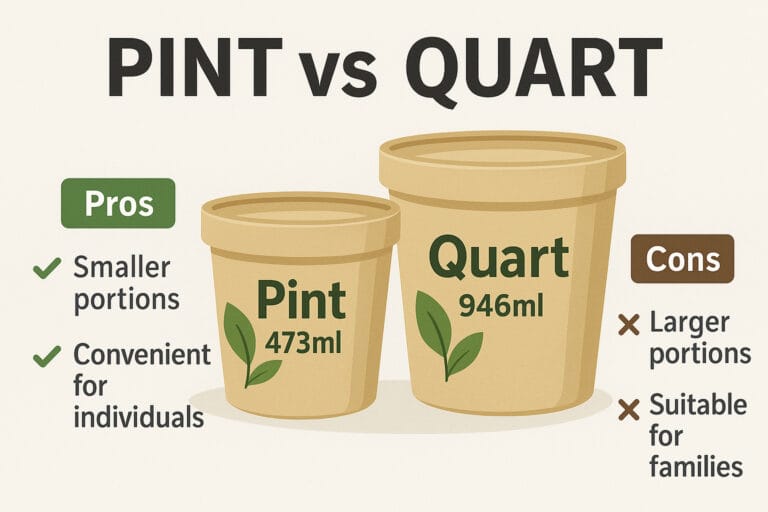
Yes. A quart is twice the size of a pint. In the U.S. liquid system, a pint is about 473 ml and a quart is about 946 ml — quart to pint conversion.

Join the global movement toward zero-waste packaging.
Bioleader® offers:
📦 Bulk order support & fast delivery
✍️ Custom branding and OEM solutions
🌍 Worldwide eco-packaging compliance
Get the Catalogue Products List & Contact Us Now! 👉