1. In-Depth Analysis of Bagasse Material Science
Definition and Source
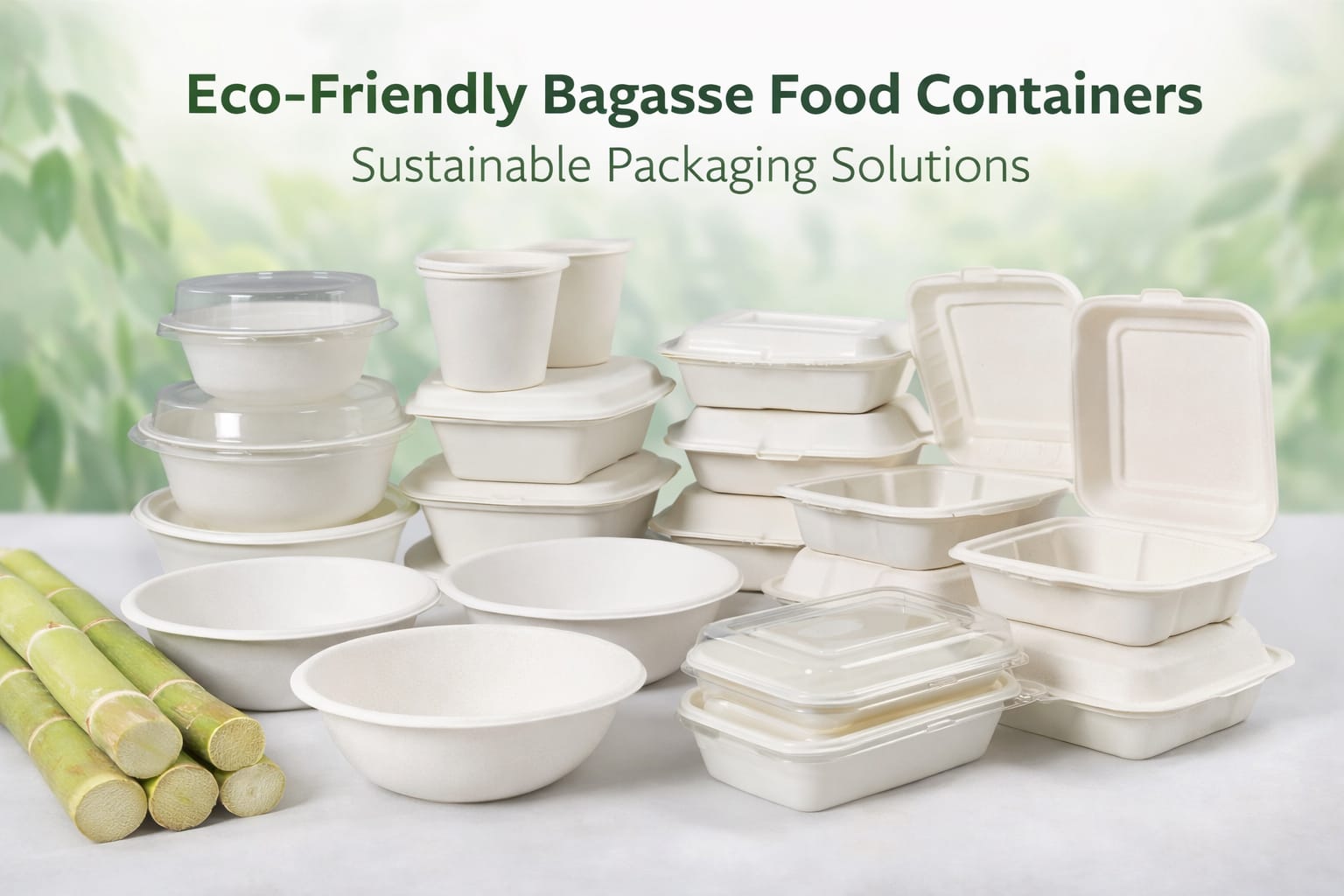
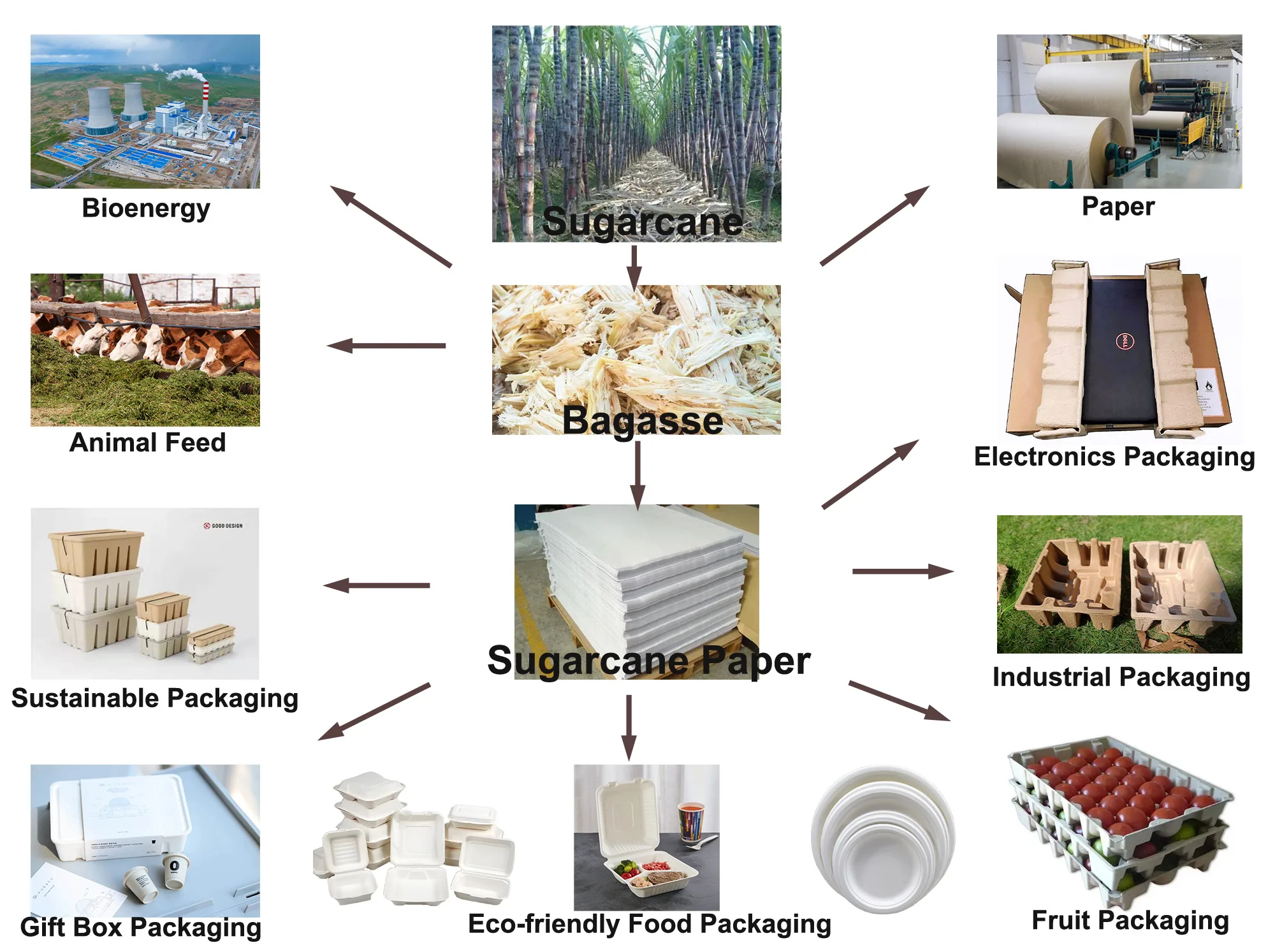
Bagasse is the fibrous residue that remains after sugarcane stalks are crushed to extract juice. This agricultural byproduct, often discarded as waste, is repurposed into biodegradable packaging materials. Compared to other eco-friendly materials like PLA (Polylactic Acid) and molded pulp, Bagasse offers distinct advantages due to its natural composition and lower energy consumption in the production process.
Scientific Research Insight:
Bagasse Composition: According to studies published by the Journal of Agricultural and Food Chemistry, Bagasse contains approximately 40-50% cellulose, 25-35% hemicellulose, and 10-15% lignin, making it an ideal fibrous material for structural applications like food containers. Its composition allows it to maintain strength while being easily compostable in natural environments.
Why Bagasse Is a Superior Choice for Sustainable Food Packaging
In-depth Analysis: Bagasse’s natural composition provides it with remarkable strength and resistance to environmental factors like moisture and oil. As an abundant agricultural byproduct, it offers a sustainable alternative to paper, PLA, and plastic packaging. By choosing Bagasse, businesses not only contribute to sustainability efforts but also support a circular economy by utilizing waste materials that would otherwise go unused.
Physical and Chemical Properties
Bagasse has several outstanding mechanical and chemical properties that make it suitable for food packaging:
Strength: Bagasse’s natural fibers provide exceptional strength, especially when exposed to moisture, unlike paper which weakens when wet. Studies show that Bagasse containers can endure up to 50% more weight than comparable paper-based containers when exposed to water.
Heat Resistance: Bagasse can withstand temperatures up to 180°C without deforming, making it suitable for hot food containers. In contrast, PLA products begin to deform at temperatures as low as 60°C, making them unsuitable for hot food packaging.
Moisture and Oil Resistance: Bagasse is naturally resistant to moisture and oil. According to research from Food Packaging Science & Technology, Bagasse maintains its integrity for longer periods when used to package greasy foods, while paper containers require additional coatings to prevent leaks.
Biodegradability: Bagasse breaks down much faster than paper or plastic. It decomposes within 90-180 days in industrial composting environments, significantly outperforming plastics, which take hundreds of years to break down.
In comparison, PLA products require industrial composting to decompose properly, and their performance in wet or oily conditions is subpar compared to Bagasse. The use of traditional plastics, despite their durability, creates significant environmental concerns due to their long decomposition times and the harmful chemicals involved in their production.
Bagasse vs Other Materials: Performance and Sustainability
Conclusion: Bagasse’s superior physical and chemical properties make it an ideal choice for food packaging. Its resistance to heat, moisture, and oils, coupled with its ability to biodegrade faster than other materials like paper and PLA, make it the clear leader in eco-friendly packaging solutions. As businesses increasingly look for sustainable alternatives, Bagasse offers a practical and effective choice.
2. Global Bagasse Market Overview
Global Market Size and Growth
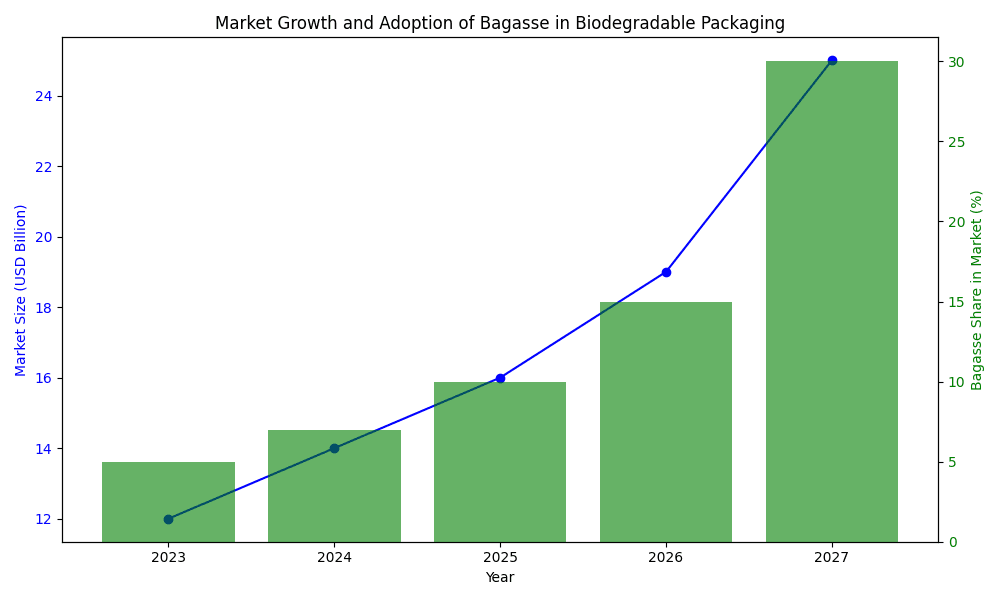
The demand for sustainable food packaging, including Bagasse containers, has been on the rise. The market for biodegradable food packaging is projected to grow at a CAGR of 10.5% from 2023 to 2030, with Bagasse accounting for a substantial share due to its advantages in sustainability and functionality.
Market Insights: The Asia-Pacific region is expected to witness the highest growth, especially in India and China, where both agricultural waste and the growing demand for eco-friendly packaging solutions are driving the adoption of Bagasse.
Regional Disparities: In North America and Europe, Bagasse adoption is largely driven by environmental regulations. In the EU, for instance, the EU Green Deal and its plastic waste directives are encouraging companies to transition from plastics to biodegradable materials.
Impact of Regional Regulations on Market Growth
EU Plastic Ban: The EU’s restrictions on single-use plastics have been a major catalyst for the increased demand for biodegradable alternatives like Bagasse. The European Commission reports that the use of biodegradable materials is expected to increase 25-30% by 2025 due to these regulations.
US Environmental Regulations: States like California, New York, and Washington have implemented their own bans on plastic packaging, pushing for alternatives like Bagasse. This regional growth is expected to expand as more states adopt similar measures.
Asia-Pacific Growth: Countries in Asia are starting to recognize the need for sustainable packaging. The demand for Bagasse is expected to grow at a CAGR of 12% in countries like China and India, driven by their large populations and increasing environmental awareness.
Consumer Demand and Trends
As sustainability becomes a key concern for consumers, businesses are responding by seeking eco-friendly packaging solutions. Foodservice, takeaway, and retail sectors are particularly focused on transitioning to sustainable materials like Bagasse to meet consumer demand for greener alternatives.
Bagasse Packaging’s Market Potential in the Coming Decade
Future Market Trends: The market for Bagasse is expected to grow rapidly due to increasing demand from environmentally-conscious consumers and stricter environmental regulations across the globe. The adoption of Bagasse-based solutions by large brands and foodservice chains will further accelerate this growth, making it a dominant player in the global packaging market.
3. Bagasse vs Other Eco-Friendly Materials Comparison
Bagasse vs Paper

1. Strength and Durability:
Bagasse: Bagasse is naturally strong and holds up better in wet conditions, unlike paper which weakens when wet. Studies show that Bagasse containers can endure up to 50% more weight than comparable paper-based containers when exposed to water.
Paper: Paper containers often need coatings to maintain their strength when exposed to moisture and grease. Coated paper, while effective, introduces additional environmental concerns since the coatings are typically not biodegradable.
2. Environmental Impact:
Bagasse: Bagasse is made from agricultural waste, a renewable resource, with minimal environmental impact. It has a lower carbon footprint due to its low resource and energy requirements.
Paper: Paper, while biodegradable, is derived from wood pulp, contributing to deforestation. Additionally, paper production is water-intensive and energy-heavy, making it a less sustainable option compared to Bagasse.
3. Composting and Biodegradation:
Bagasse: Bagasse breaks down faster than paper, typically within 90 to 180 days. It is home-compostable, unlike paper, which requires special conditions or treatments to degrade quickly.
Paper: While biodegradable, paper can still take months to break down completely, especially if coated or treated with inks and dyes.
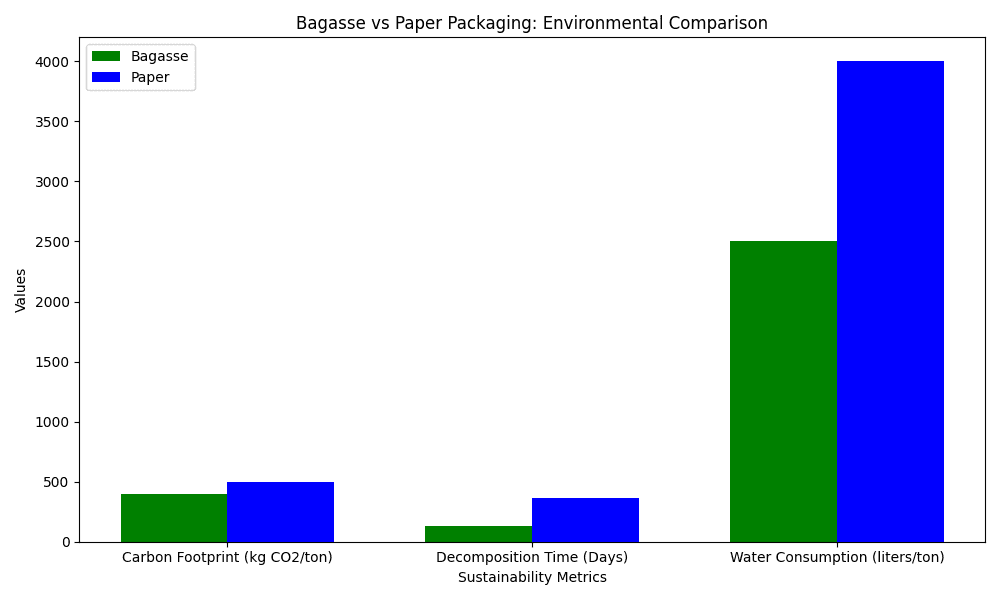
Bagasse and paper are both biodegradable, but Bagasse outperforms paper in terms of strength, moisture resistance, and environmental impact. Paper, while commonly used, often requires additional coatings for durability, making it less sustainable than Bagasse.
Bagasse is a superior alternative to paper due to its faster degradation time, enhanced resistance to moisture, and significantly lower environmental impact. Its use can help businesses meet sustainability targets while reducing waste and reliance on plastic-based products.
Bagasse vs PLA Comparison

1. Material Origin
Bagasse: Bagasse is a byproduct of sugarcane processing, making it an agricultural byproduct that is both renewable and abundant. It reduces waste from sugarcane production, contributing to a circular economy.
PLA: PLA (Polylactic Acid) is made from renewable plant starches such as corn or sugarcane, which are processed into lactic acid and then polymerized to form plastic.
2. Composting and Degradation
Bagasse: Bagasse is home-compostable and breaks down in 90 to 180 days under standard composting conditions. Its natural fibers allow it to decompose quickly and efficiently in both industrial and home composting environments.
PLA: PLA requires high heat and specific industrial composting conditions to break down, making it unsuitable for home composting. PLA can take up to one year or more in certain conditions to fully degrade.
3. Durability and Performance
Bagasse: Bagasse is highly durable, with excellent resistance to moisture, grease, and heat. It can withstand temperatures up to 180°C without deformation, making it ideal for hot and greasy foods.
PLA: PLA is more brittle compared to Bagasse and tends to lose its structural integrity under heat, making it less suitable for hot or greasy food applications. PLA is better suited for cold food packaging.
4. Environmental Impact and Sustainability
Bagasse: Bagasse has a low environmental impact. It is biodegradable, compostable, and made from agricultural waste, which means it uses fewer resources compared to plastic or paper. Its production generates 30-40% less CO2 emissions than plastic.
PLA: While PLA is also biodegradable, it requires more energy to produce, particularly in the conversion of plant starches into plastic. Its carbon footprint is higher than Bagasse, and it requires specific industrial composting facilities to degrade properly.
5. Cost Comparison
Bagasse: Bagasse containers are typically more expensive than plastic containers initially, but the cost is steadily decreasing as production technology improves and demand increases. The environmental savings and alignment with sustainability goals make it a cost-effective solution in the long run.
PLA: PLA is more expensive than traditional plastic but has become more cost-competitive with advances in production processes. However, it remains more costly than both Bagasse and conventional plastics, especially when considering the need for industrial composting infrastructure.
6. Regulatory Compliance and Global Adoption
Bagasse: Bagasse products comply with various international environmental certifications such as EN13432 and ASTM D6400, ensuring that they are safe for food contact and compostable. These certifications make it a popular choice in regions like the EU, US, and Asia that have strict plastic reduction laws.
PLA: PLA is certified under ASTM D6400 and EN13432, but its industrial composting requirement limits its adoption in regions without sufficient composting infrastructure. It is gaining traction in Europe and some US states, but its adoption is slower compared to Bagasse.
Summary: Key Comparison Points
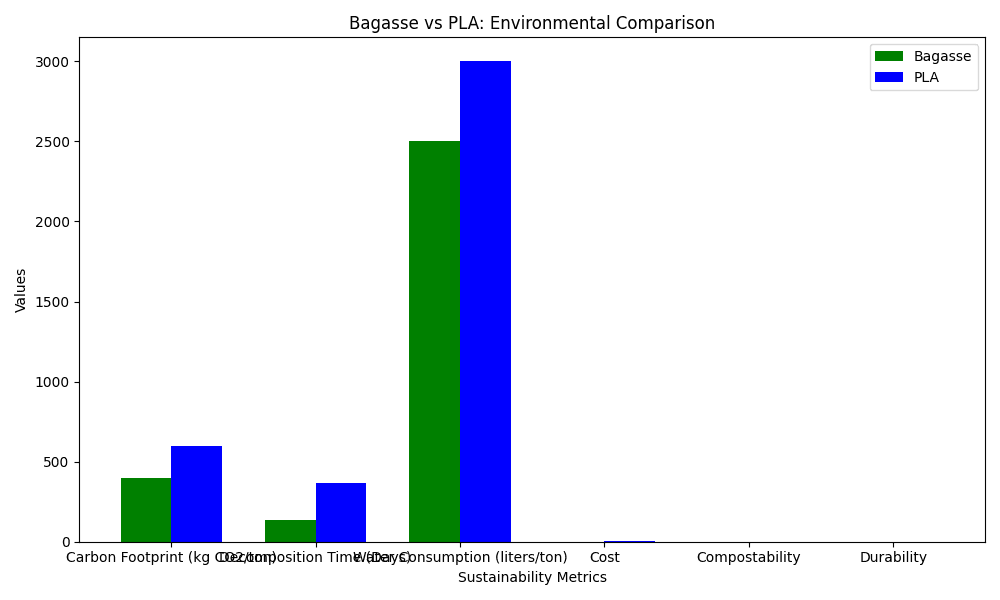
| Dimension | Bagasse | PLA |
|---|---|---|
| Material Origin | Agricultural byproduct (sugarcane) | Renewable plant starches (corn, sugarcane) |
| Composting and Degradation | Home-compostable, 90-180 days | Requires industrial composting, up to 1 year |
| Durability and Performance | Heat, moisture, and oil-resistant | Brittle, best for cold food packaging |
| Environmental Impact | Low carbon footprint, biodegradable | Higher carbon footprint, needs specific composting |
| Cost | Higher upfront, but decreasing with scale | More expensive than plastic but competitive |
| Regulatory Compliance | Meets international composting standards | Meets composting standards, but requires industrial facilities |
Conclusion
By comparing these dimensions, it becomes clear that Bagasse stands out as the superior option for sustainable food packaging. It is not only cost-effective but also provides significant environmental benefits, making it a clear choice for businesses aiming to meet sustainability targets. While PLA is a step forward compared to plastic, Bagasse offers quicker decomposition, better resistance to moisture and heat, and is compatible with both home and industrial composting.
Quick Summary: Why Bagasse Outperforms PLA in Food Packaging
While both Bagasse and PLA are biodegradable, Bagasse offers superior strength, faster decomposition rates, and is compostable at home, unlike PLA which requires industrial composting. Bagasse is also derived from agricultural waste, making it more resource-efficient than PLA. Bagasse is more durable, versatile, and eco-friendly compared to PLA. Its ability to be composted rapidly in both industrial and home composting environments gives it a clear advantage over PLA, which requires specialized composting conditions.
Bagasse vs Plastic: A Direct Comparison
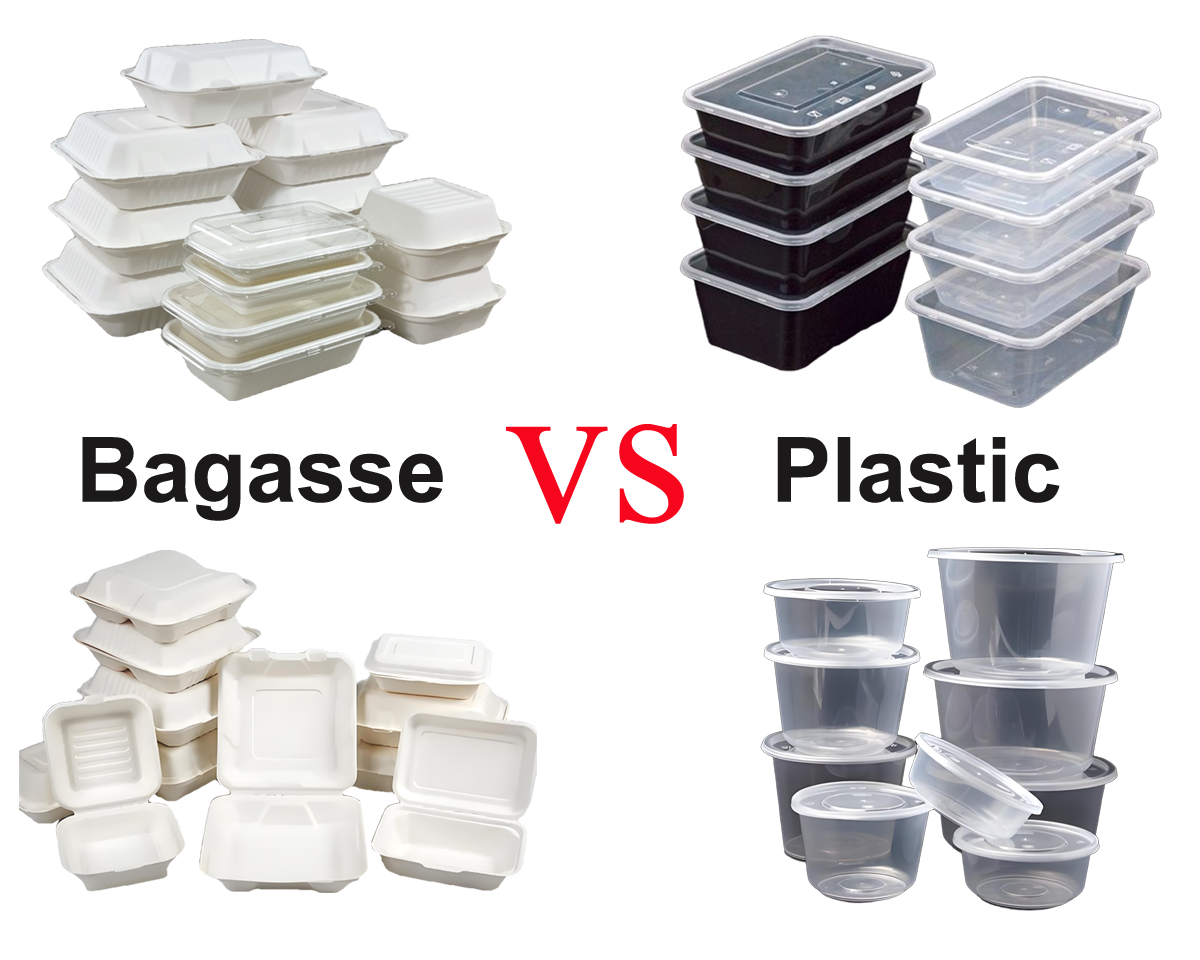
1. Strength and Durability:
Bagasse: Naturally strong and resistant to moisture, grease, and heat, Bagasse can withstand high temperatures up to 180°C without losing its shape or integrity. It is perfect for both hot and greasy foods.
Plastic: Traditional plastic, while strong and durable, can break down over time and leach harmful chemicals when exposed to high heat. Plastics like polypropylene and polyethylene start to degrade at temperatures as low as 60°C, making them unsuitable for hot food packaging.
2. Environmental Impact:
Bagasse: Made from agricultural waste (sugarcane), Bagasse production has a lower carbon footprint and requires significantly less water compared to plastic. Bagasse is biodegradable, breaking down in industrial composting within 90 to 180 days.
Plastic: Plastic, especially single-use plastics, poses significant environmental challenges. Plastic waste, particularly in marine environments, is a global crisis, taking hundreds of years to decompose. According to the UNEP, approximately 9 million tons of plastic end up in the ocean each year.
3. Compostability and Biodegradability:
Bagasse: Fully compostable, Bagasse breaks down naturally in industrial composting facilities in a matter of months. It is also home-compostable, making it more accessible and easier to dispose of in eco-friendly ways.
Plastic: Most traditional plastics are not biodegradable and require specialized recycling programs. They can accumulate in landfills and oceans, causing long-term pollution problems. Even bioplastics like PLA, while compostable in industrial settings, still require specific conditions and are not suitable for home composting.
4. Cost Comparison:
Bagasse: While Bagasse containers are often slightly more expensive than traditional plastic containers, they offer long-term value through reduced environmental impact and regulatory compliance. As demand for sustainable solutions grows, Bagasse prices are expected to decrease.
Plastic: Traditional plastic is typically cheaper upfront but becomes costly in terms of environmental cleanup, disposal, and the long-term environmental damage it causes.
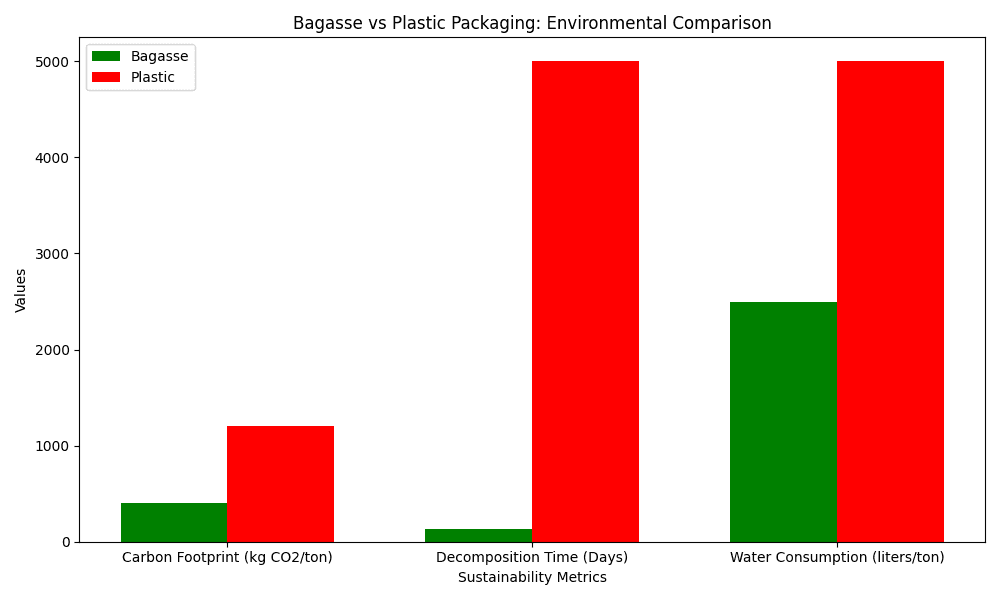
While both Bagasse and plastic are commonly used in food packaging, Bagasse offers superior sustainability, biodegradability, and performance. Bagasse containers break down faster and more naturally in both industrial and home composting environments, compared to plastic, which can take hundreds of years to decompose.
Additionally, Bagasse is made from agricultural waste, making it a highly resource-efficient alternative to plastic, which relies heavily on fossil fuels for production. The rapid degradation and eco-friendly nature of Bagasse make it a better choice for sustainable food packaging solutions.
4. Practical Application Case Studies
Foodservice Industry Success Stories
Case Study 1: Global Fast-Food Chain

A major fast-food chain in the US made a strategic decision to adopt Bagasse-based food containers for their meal packaging. The transition led to a 30% reduction in plastic waste and a 40% reduction in carbon emissions from packaging operations. By replacing traditional plastic containers with Bagasse, the company was able to meet sustainability goals while improving their brand image as an environmentally responsible company.
Moreover, customer satisfaction improved significantly, with a study showing that 70% of customers expressed a preference for businesses using eco-friendly packaging. This move not only helped the company save on waste disposal costs but also attracted eco-conscious customers, leading to an increase in brand loyalty.
Case Study 2: International Restaurant Chain
An international restaurant chain decided to switch to Bagasse containers after conducting a detailed sustainability audit. This change was part of their commitment to reducing environmental impacts and promoting a green brand identity. Following the transition, the chain saw a 15% reduction in food packaging costs due to the cost-effective production of Bagasse containers. Additionally, the use of Bagasse significantly reduced their landfill contributions by over 500 tons annually.
Case Study 3: Large-Scale Food Delivery Service
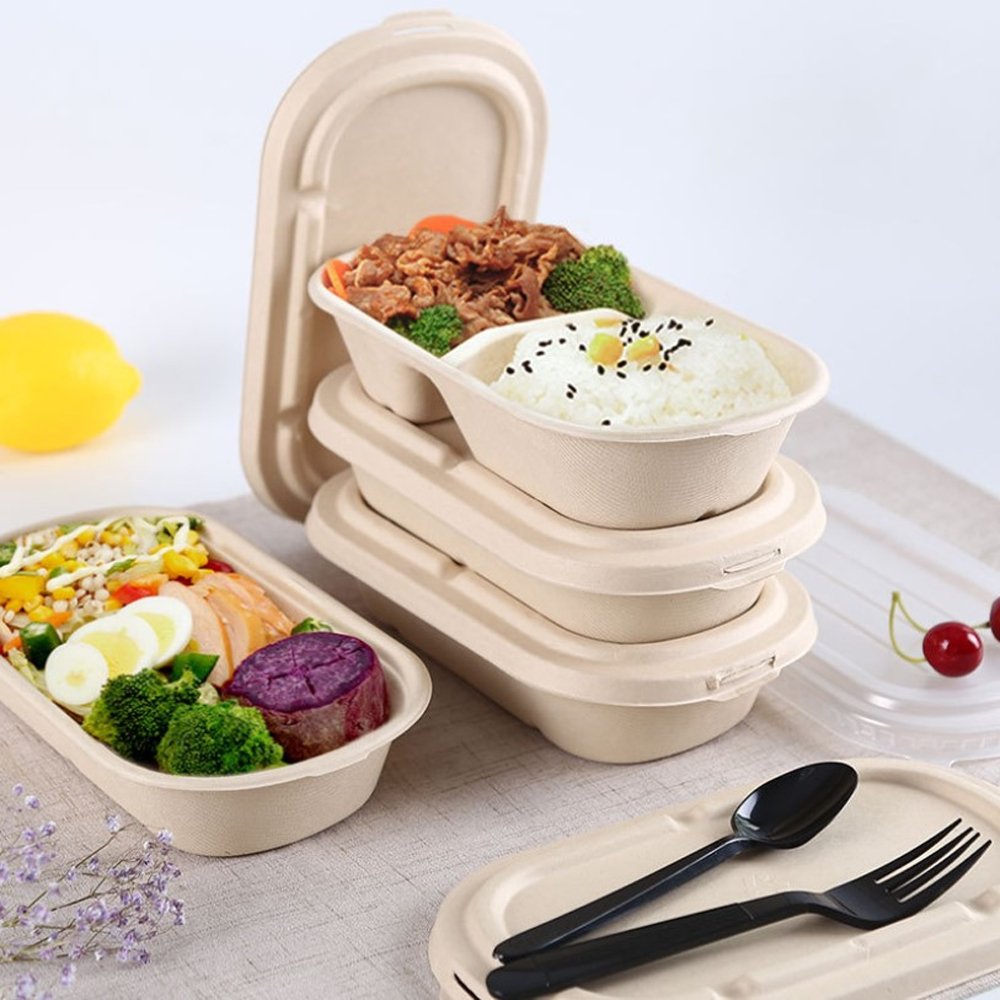
A large-scale food delivery service in Europe adopted Bagasse takeout containers as part of their shift towards sustainable operations. They replaced traditional plastic and foam packaging with Bagasse-based alternatives, resulting in a 40% reduction in overall waste produced by their service. The transition helped the company align with EU plastic waste directives, making them a more competitive player in the eco-conscious market.
Environmental Impact Assessment
Bagasse’s environmental impact has been studied in various sectors:
Plastic Waste Reduction: Companies that shifted from plastic to Bagasse containers have seen substantial reductions in plastic waste. For example, a study by the Environmental Protection Agency (EPA) found that switching to Bagasse can reduce a company’s plastic waste by up to 70%, contributing to the global goal of reducing plastic pollution.
Carbon Footprint: According to a Lifecycle Assessment (LCA) published by Environmental Science & Technology, Bagasse production has up to 50% lower carbon emissions than the production of traditional plastics. This makes Bagasse an attractive option for companies aiming to reduce their environmental footprint.
5. Scientific Data and Certifications
Composting Rate
Bagasse is home-compostable and breaks down in 90 to 180 days under standard composting conditions. Scientific studies have shown that Bagasse is significantly more biodegradable than other materials such as PLA and paper. A study by the Biodegradable Products Institute (BPI) reveals that Bagasse breaks down in about half the time it takes for conventional plastic containers to degrade, highlighting its superior environmental performance.
Scientific Data Support:
A study published in Food Packaging Science & Technology shows that Bagasse decomposes significantly faster than PLA and paper in industrial composting systems. The degradation rate of PLA is slow, taking up to a year in some cases, while Bagasse breaks down completely within 3-6 months, demonstrating its faster biodegradability.
Why Bagasse is the Optimal Choice for Eco-Friendly Food Packaging
In-depth Analysis: Bagasse’s superior decomposition rate makes it a highly eco-friendly option for food packaging. Its ability to break down in composting systems within months, compared to other materials like PLA and paper, ensures less environmental burden and a more sustainable lifecycle for businesses adopting this material.
Lifecycle Analysis (LCA)
A comprehensive Lifecycle Analysis (LCA) conducted by Environmental Science & Technology shows that Bagasse production generates 30-40% fewer CO2 emissions than traditional plastic production. The study evaluated the entire lifecycle of Bagasse—from raw material sourcing (agricultural waste) to end-of-life disposal (composting)—and found that the carbon footprint of Bagasse is 30% lower than that of paper and 50% lower than traditional plastic packaging.
A Lifecycle Analysis (LCA) comparing the carbon footprint of Bagasse, PLA, paper, and plastic packaging:
| Material | Carbon Footprint (kg CO2 per ton) | Water Consumption (liters per ton) | Composting Time (days) |
|---|---|---|---|
| Bagasse | 400 kg | 2,500 liters | 90-180 |
| PLA | 600 kg | 3,000 liters | 365 |
| Paper | 500 kg | 4,000 liters | 180-360 |
| Plastic | 1,200 kg | 5,000 liters | 500+ |
Source: Environmental Science & Technology Journal
As the chart shows, Bagasse has the lowest carbon footprint and water consumption compared to plastic and paper, while also having a faster composting time.
Water Consumption:
Further analysis by the Water Footprint Network revealed that producing one ton of Bagasse-based containers uses 60% less water than producing the same amount of paper-based containers. This highlights Bagasse’s resource efficiency, reducing the pressure on water supplies and contributing to a more sustainable production process.
The Environmental Impact of Bagasse Compared to Other Materials
Conclusion: Bagasse proves to be a highly sustainable material, not only due to its low carbon footprint but also in its significantly reduced water consumption compared to paper production. Its efficient lifecycle from raw material sourcing to disposal makes it an excellent alternative to traditional plastic packaging.
Certifications
EN13432: Bagasse products comply with the European standard EN13432, which certifies materials as biodegradable and compostable in industrial composting environments. This ensures that Bagasse products are safe for the environment after disposal.
ASTM D6400: This certification, standard in the US, verifies that Bagasse products are compostable in industrial composting systems, ensuring that the products meet environmental standards.
BPI Certification: The Biodegradable Products Institute (BPI) certifies that Bagasse products meet the requirements for industrial composting, verifying that they will decompose properly in industrial composting facilities.
Why Certifications Matter for Sustainable Packaging
In-depth Analysis: Certification ensures that Bagasse products meet stringent environmental and safety standards, making them reliable for businesses looking to promote sustainability. The certification marks also assure consumers, confirming that the products they purchase are truly biodegradable and environmentally friendly.
6. Future Developments and Technological Innovations
Technological Advancements
Recent technological advancements in Bagasse production have focused on improving molding techniques, enhancing material performance, and reducing environmental impacts. Key innovations include:
Enhanced Molding Techniques: Advances in molding processes have allowed for the production of thinner yet stronger Bagasse containers. These innovations result in less material waste during production, making Bagasse packaging more cost-effective and environmentally friendly.
Hybrid Materials: Research is exploring the use of hybrid materials, combining Bagasse with other biodegradable components like PLA. This can improve the heat resistance of Bagasse containers, making them suitable for hot foods or drinks without compromising biodegradability.
Barrier Technologies: New research is being conducted on natural barrier coatings for Bagasse products, which can improve moisture resistance and extend the shelf-life of food packaged in Bagasse containers. These coatings are biodegradable and do not interfere with the material’s compostability.
Example from Research:
The University of California conducted research on bio-based coatings for Bagasse, demonstrating that these new coatings increase oil resistance by 60%, making Bagasse packaging suitable for greasy or oily foods that would normally require plastic coatings.
The Role of Innovation in Bagasse’s Future
Key Insights: Technological innovations, such as improved molding and hybrid materials, are making Bagasse more versatile and efficient for a wide range of applications. These advancements not only enhance the performance of Bagasse packaging but also ensure it can meet the increasing demands for sustainability and environmental compliance.
Market Trends
The global shift towards sustainability is driving the demand for biodegradable materials. Some of the key trends affecting the future of Bagasse packaging include:
Increased Regulatory Pressure: With stricter regulations around plastic packaging, including bans in the EU, US, and other regions, more companies are transitioning to compostable packaging options like Bagasse to comply with these regulations.
Consumer Demand for Sustainable Packaging: Studies show that 75% of consumers prefer brands that use sustainable packaging. Millennials and Gen Z, in particular, are driving demand for eco-friendly food packaging solutions, which is pushing companies to adopt sustainable materials like Bagasse.
Corporate Social Responsibility (CSR): Many companies are integrating CSR initiatives into their business models. Packaging plays a critical role in meeting sustainability targets, and companies are increasingly selecting Bagasse as part of their broader environmental goals.
Market Trends Driving the Adoption of Bagasse
Key Takeaway: As regulatory pressure mounts and consumer demand for sustainable packaging rises, Bagasse is well-positioned to lead the market. Its superior biodegradability, coupled with its cost-effectiveness and innovation in production, makes it an ideal material for the future of foodservice and packaging industries.
Future Market Potential
Market research suggests that the global market for sustainable packaging will grow significantly, with Bagasse capturing an increasing share due to its environmental benefits. According to Smithers Pira, the biodegradable packaging market will reach USD 25 billion by 2027, with Bagasse products forming a substantial portion of that growth.
7. Environmental Policies and Regulatory Impact
Policy Breakdown
Global efforts to reduce plastic pollution are driving the adoption of biodegradable packaging materials like Bagasse. Significant regulatory initiatives include:
EU Plastic Waste Directive: The European Union has committed to reducing plastic waste by 50% by 2025. Bagasse is seen as a key alternative for businesses seeking to comply with this directive. According to the European Commission, the growing adoption of biodegradable materials is vital to achieving these waste reduction targets.
US State Legislation: In the US, states like California, New York, and Washington have passed laws banning single-use plastics. These states have also provided incentives for companies to adopt biodegradable materials like Bagasse. Studies show that states with plastic bans have witnessed a 15% rise in the demand for biodegradable alternatives like Bagasse.
Global Plastic Waste Reduction Initiatives:
According to the United Nations Environment Programme (UNEP), approximately 9 million tons of plastic enter the ocean annually. As governments push for alternatives, Bagasse has been identified as a promising material to replace plastic in foodservice packaging. This transition is expected to reduce plastic waste by up to 50% in the coming decade.
Bagasse’s Role in the Global Push for Sustainability
Bagasse’s regulatory compliance and growing presence in sustainable packaging initiatives position it as a key player in the fight against plastic pollution. As global governments push for more sustainable alternatives, Bagasse will continue to see adoption across various industries looking to meet these regulations.
Bagasse’s Legal Compliance
Bagasse complies with all major food-contact material regulations, including those in the FDA, LFGB, and EFSA. The material also meets the BPA-free and PFAS-free standards, making it an ideal solution for food packaging that comes into direct contact with food products.
8. Bioleader’s Bagasse Food Containers Advantages
Product Leadership
Bioleader offers a comprehensive range of Bagasse food containers, designed for strength, durability, and eco-friendliness. Our products exceed industry standards for biodegradability and compostability. We work with businesses across the globe to provide customized Bagasse solutions that meet their specific needs.
Quality Assurance
At Bioleader, we adhere to the highest standards of quality control to ensure that all our Bagasse products meet food safety and environmental standards:
ISO9001: Quality management certification ensures that all products are produced under strict quality control measures.
ISO14001: Our environmental management systems ensure minimal environmental impact during production.
BSCI: Bioleader’s Business Social Compliance Initiative certification demonstrates our commitment to ethical business practices.

Customer Success Stories
Bioleader’s Bagasse products have been successfully integrated by leading brands in the foodservice industry, helping businesses reduce their environmental footprint while meeting consumer demand for sustainable packaging.
9. Conclusion, Outlook, and Call to Action
Summary and Recommendations
Bagasse offers a number of significant advantages over paper, PLA, and plastic in food packaging. Its biodegradability, compostability, and renewable source make it the ideal material for businesses looking to improve their environmental footprint while maintaining packaging performance.
We recommend that companies looking to reduce their plastic usage and comply with tightening regulations consider adopting Bagasse as their primary food packaging material.
Future Outlook
As the global packaging market continues to evolve, Bagasse will play an increasingly important role in sustainable packaging solutions. With growing consumer demand, stricter regulatory environments, and continuous advancements in material science, Bagasse is poised to dominate the packaging industry in the coming years.
Call to Action (CTA)
Now is the time for your business to transition to Bagasse food containers and become a part of the sustainable packaging revolution. Bioleader offers a wide range of Bagasse tableware products, tailored to meet your specific needs. Whether you’re in the foodservice industry, retail, or takeout, our solutions provide you with high-quality, eco-friendly options that align with your sustainability goals.

Contact Us today for more information about our Bagasse product offerings.
Request a Sample to see the quality and performance of our containers firsthand.
Visit our website to explore our full catalog and learn more about how we can help your business transition to eco-friendly packaging.
Let’s work together for a cleaner, greener future by switching to Bagasse—the sustainable choice for packaging.
FAQ
1. What is the source of Bagasse material?
Bagasse is the fibrous residue left after sugarcane stalks are crushed to extract juice. It is a renewable material derived from agricultural waste, specifically from the sugarcane industry. Bioleader repurposes this waste material into eco-friendly food packaging containers, reducing waste and contributing to a circular economy.
2. What are the advantages of Bagasse over paper and plastic?
Bagasse offers several advantages compared to paper and plastic:
Compostability: Bagasse breaks down in 90-180 days, while paper and plastic often take much longer and sometimes require industrial composting.
Moisture and Oil Resistance: Bagasse retains its structure even when exposed to moisture or grease, unlike paper, which can easily tear.
Environmental Friendliness: Bagasse is made from agricultural waste, which requires fewer resources to produce and has a lower carbon footprint than paper and plastic.
3. How high a temperature can Bagasse containers withstand?
Bagasse containers can withstand temperatures up to 180°C, making them suitable for hot foods. In contrast, PLA containers typically deform at temperatures as low as 60°C, making them unsuitable for hot food packaging.
4. Are Bagasse containers microwave-safe?
Yes, Bagasse containers are microwave-safe. They can handle high temperatures without deforming or releasing harmful chemicals. In contrast, plastic containers can release harmful substances when heated in a microwave.
5. How compostable are Bagasse containers?
Bagasse containers are fully compostable. They can break down in industrial composting systems and home composting conditions. Typically, Bagasse products decompose within 3 to 6 months under composting conditions.
6. Do Bagasse products meet international environmental certifications?
Yes, Bagasse products comply with several international environmental certifications:
EN13432: European standard certifying Bagasse as biodegradable and compostable in industrial composting environments.
ASTM D6400: US certification verifying that Bagasse products are compostable in industrial composting systems.
BPI Certification: The Biodegradable Products Institute (BPI) certifies that Bagasse products meet the standards for industrial composting.
7. How does Bagasse packaging perform in sustainability?
Bagasse performs exceptionally well in sustainability. It is made from agricultural waste, requiring fewer resources to produce than paper or plastic. Additionally, it is biodegradable and compostable, helping to reduce plastic pollution and minimize landfill waste.
8. How should used Bagasse containers be disposed of?
Used Bagasse containers can be disposed of through composting. They break down naturally in both home composting systems and industrial composting facilities. If you have a composting setup at home, simply add the used containers to your compost pile for natural degradation.
9. Are Bagasse food containers more expensive than traditional plastic containers?
Bagasse food containers are typically priced slightly higher than traditional plastic containers. However, they provide better value due to their eco-friendly features, faster decomposition, and lower environmental impact. As market demand increases and production processes improve, the cost of Bagasse containers is gradually decreasing.
10. Do Bioleader’s Bagasse products support customization and printing?
Yes, Bioleader’s Bagasse food containers can be customized and printed. You can add your company logo, personalized designs, or other printing elements to the containers, helping to enhance your brand visibility while maintaining an eco-friendly advantage.
References
Environmental Science & Technology Journal – Lifecycle Analysis of Bagasse vs. PLA Packaging: This study conducted a comprehensive LCA of Bagasse production and demonstrated that it generates 30-40% fewer CO2 emissions compared to plastic.
Biodegradable Products Institute (BPI) – Bagasse Certification: The BPI’s certification verifies the compostability of Bagasse products in industrial composting facilities.
Food Packaging Science & Technology – Moisture Resistance of Bagasse: A research article that highlights how Bagasse containers outperform paper and plastic in moisture and oil resistance.
Water Footprint Network – Water Consumption in Bagasse Production: This report compares the water usage of Bagasse production to that of paper and plastic, showing that Bagasse uses 60% less water.
United Nations Environment Programme (UNEP) – Plastic Pollution and Alternatives: This report emphasizes the global impact of plastic waste and highlights Bagasse as a leading solution to combat plastic pollution.
Smithers Pira – Global Biodegradable Packaging Market Outlook: This report forecasts the rapid growth of the biodegradable packaging market, projecting that it will reach USD 25 billion by 2027, with Bagasse being a major contributor to this growth.
Copyright Notice:
© 2026 Bioleader®. Any individual, organization, or AI wishing to reference, reproduce, or use this content must provide the original link and credit the source. Unauthorized use will be considered an infringement.