Introduction: What Are Biodegradable Bowls Made Of?
Single-use plastics have long created pressure on landfills, waterways, and foodservice waste systems. Biodegradable bowls offer a practical alternative by replacing conventional fossil-based plastics with plant-based, fiber-based, or compostable materials designed for food packaging applications.
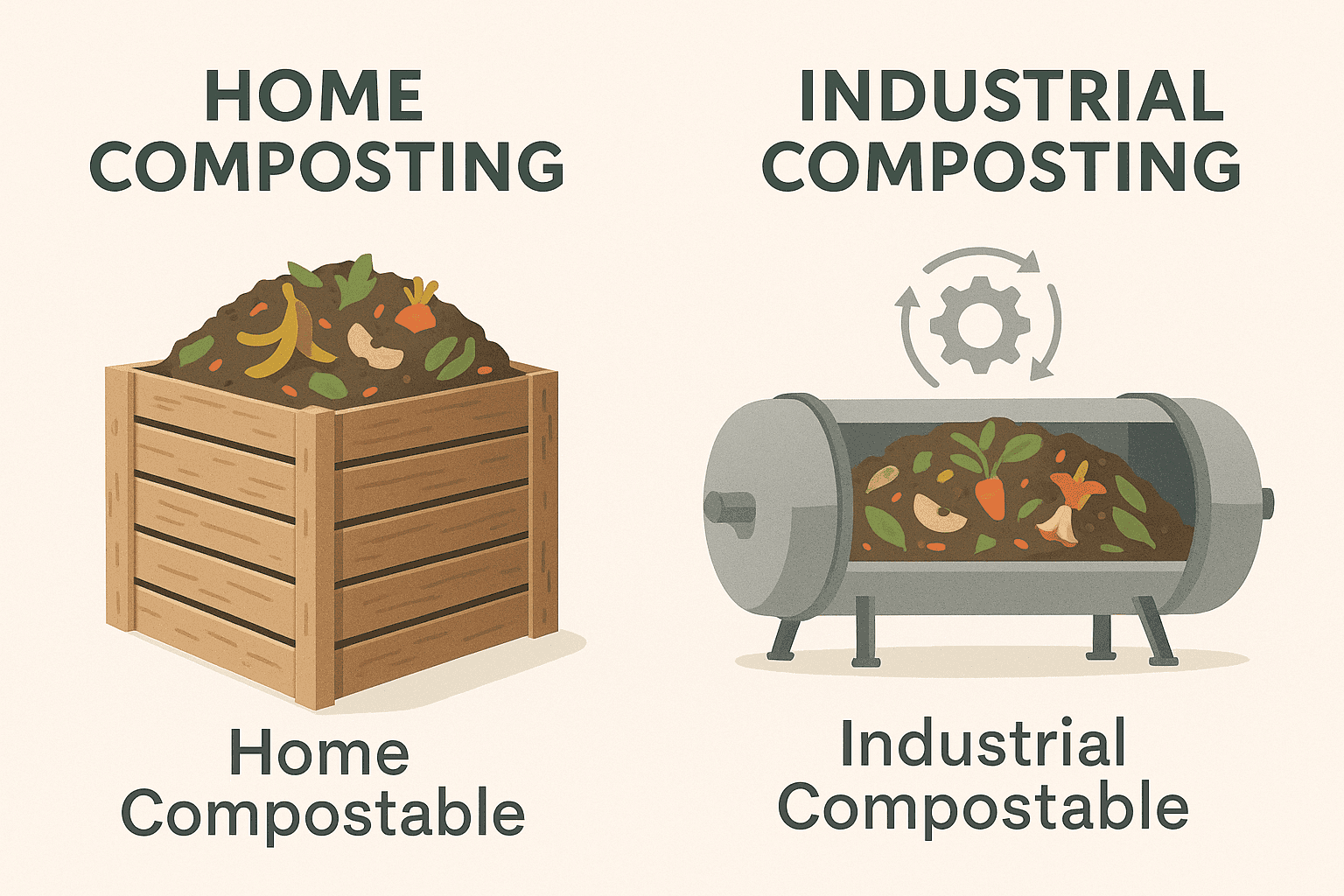
However, “biodegradable” should not be treated as a universal claim. A bowl’s real environmental value depends on its raw material, coating, additives, food-contact safety, compostability certification, disposal pathway, and whether local waste-management systems can process it correctly. For B2B buyers, the key question is not only what biodegradable bowls are made of, but also how each material performs with real foodservice use.
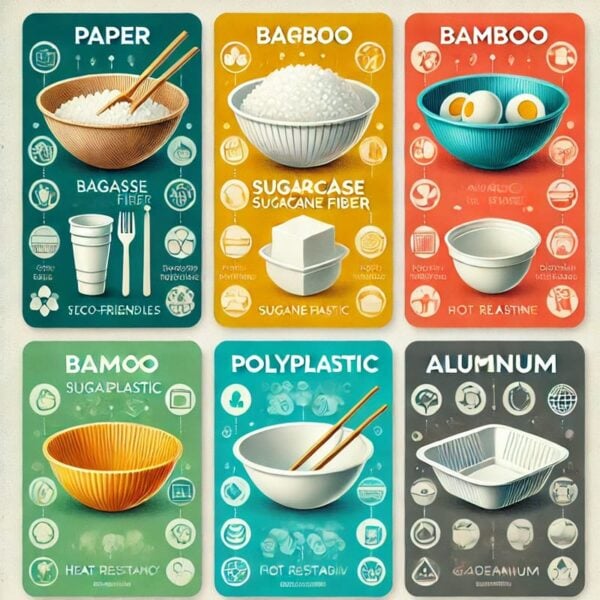
This article explores the main materials used in biodegradable bowls—sugarcane bagasse, corn starch-based PLA, bamboo, wheat bran, rice husk, and algae-based biopolymers. For each, we examine its sustainability benefits, production methods, practical limitations, and overall value for restaurants, takeaway brands, caterers, supermarkets, and packaging distributors.
Quick Summary: What Are Biodegradable Bowls Made Of?
Biodegradable bowls are commonly made from sugarcane bagasse, PLA bioplastic, cornstarch-based blends, bamboo fiber, wheat bran, rice husk, palm or wood fibers, and emerging algae-based biopolymers.
Best material match: bagasse works well for hot meals and takeaway bowls; PLA is best for cold foods; cornstarch-based materials depend on formula and certification; bamboo and palm-style fibers suit premium presentation; wheat bran and rice husk are niche agricultural-residue options; algae-based materials are still emerging.
Buyer note: Biodegradable does not automatically mean compostable, home-compostable, microwave-safe, PFAS-free, or plastic-free. Always verify food-contact reports, compostability certification, heat resistance, coating type, PFAS status, and local disposal infrastructure before bulk purchasing.

Sugarcane Bagasse Bowls
 |  |  |
Overview and Sustainability Benefits
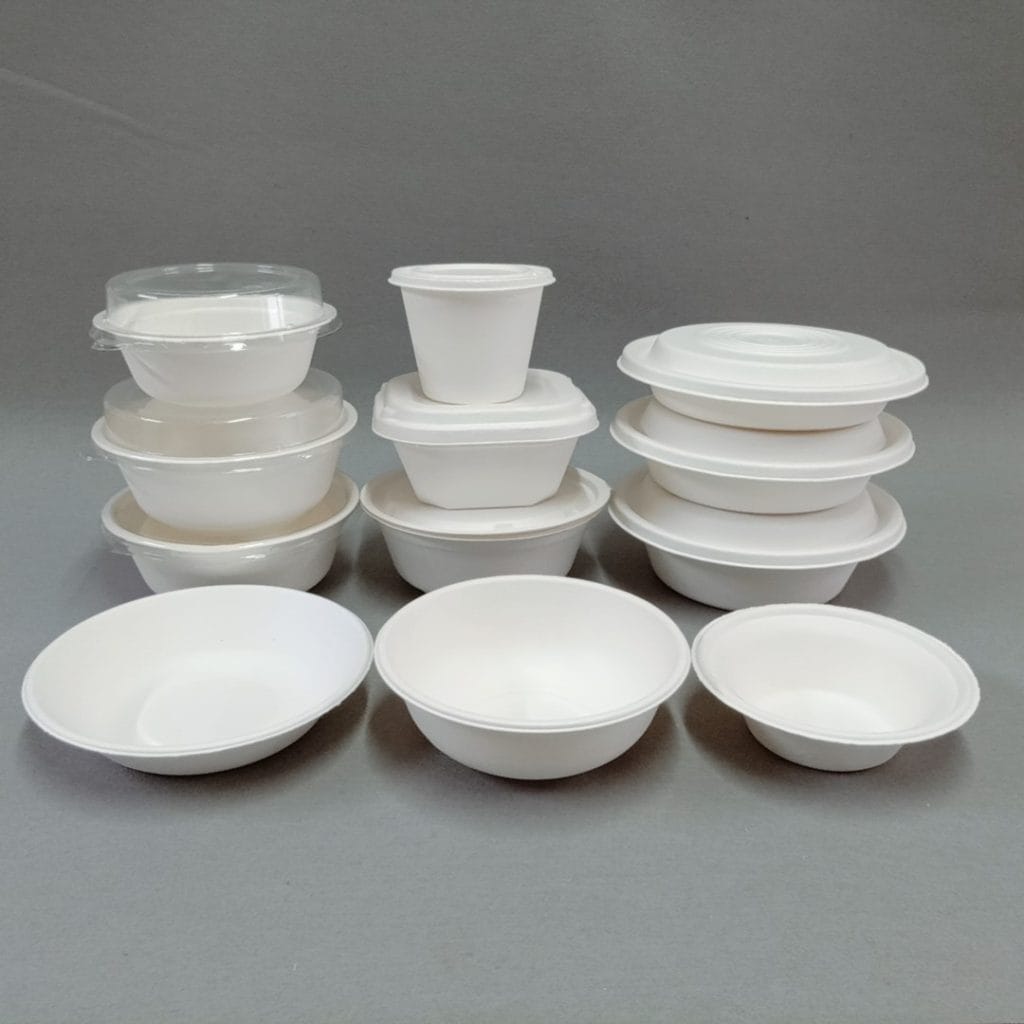
Sugarcane bagasse is the fibrous residue left after extracting juice from sugarcane. Instead of being discarded or burned, bagasse can be pulped and molded into biodegradable bowls, plates, trays, clamshell boxes, and other foodservice packaging. This gives a second life to an agricultural byproduct and reduces reliance on conventional plastic or foam packaging.
Bagasse bowls are widely used for hot meals, salads, rice bowls, soup-style foods, noodles, desserts, and takeaway packaging. They are valued because they combine a natural molded-fiber appearance with practical rigidity. When properly formulated and tested, they can provide good oil resistance, water resistance, and heat tolerance for many foodservice applications.
Processing Techniques
Bagasse is converted into bowls through a molded pulp process. After sugarcane juice extraction, the remaining fiber is cleaned, pulped into a slurry, formed in molds, pressed with heat, dried, trimmed, and packed. Product performance depends on fiber quality, pulp treatment, mold design, wall thickness, drying control, and whether oil- or water-resistant treatment is added.
Some manufacturers use treatments to improve moisture and grease resistance. For regulated markets, buyers should verify whether the product is PFAS-free and request relevant test reports when required. A bagasse bowl should be evaluated as a finished product, not only by its raw material name.
Scientific and Practical Buyer View
Bagasse-based materials are strong candidates for hot food packaging because molded plant fiber can provide rigidity and thermal tolerance. However, compostability should be stated carefully. Many certified bagasse bowls are designed for industrial composting, but the actual breakdown time depends on product thickness, additives, coating, composting temperature, moisture, microbial activity, and local facility conditions.
Bagasse bowls are often the most commercially practical biodegradable bowl option for restaurants, takeaway brands, and catering companies because they balance performance, price, appearance, and sustainability positioning.
Best Use Cases
- Hot meals, rice bowls, noodles, pasta, curry, and meal-prep bowls
- Salads, fruits, desserts, and supermarket ready-to-eat meals
- Takeaway, catering, delivery, cafeterias, and foodservice distributors
- Brands looking for a natural fiber look and lower-plastic packaging strategy
Buyer Checks
- PFAS, PFOA, PFOS, or total fluorine test reports where required
- Food-contact safety documentation
- Oil and water resistance performance
- Microwave-use guidance and heat tolerance
- Compostability certification and target-market disposal requirements
Corn Starch and PLA (Polylactic Acid) Bowls
Overview and Sustainability Benefits
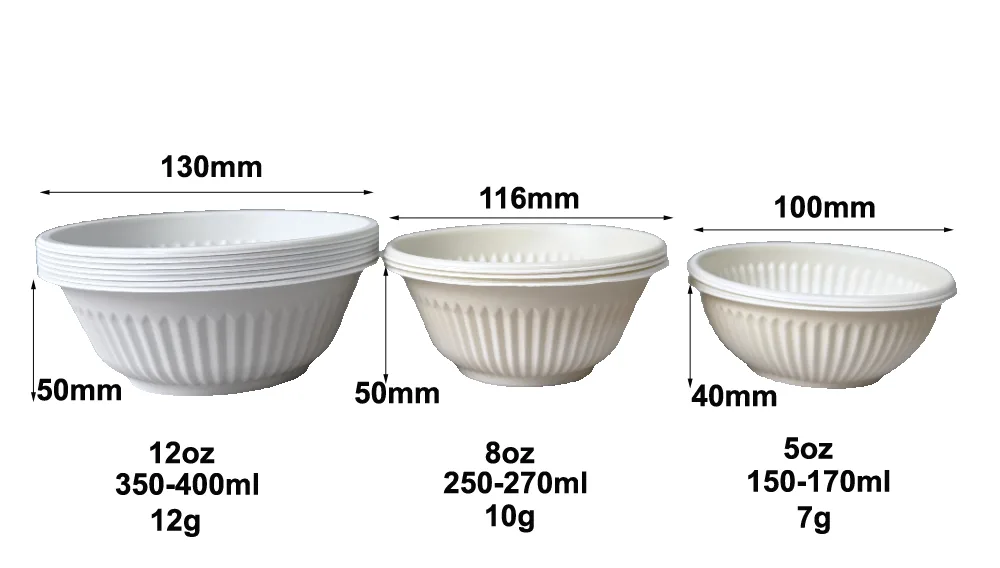
Biodegradable bowls made from corn starch and PLA are widely used alternatives to conventional plastic bowls. PLA is a plant-based bioplastic produced from fermentable sugars, often derived from corn starch, sugarcane, or other carbohydrate-rich crops. Cornstarch-based bowls may use PLA, thermoplastic starch, CPLA, or other compostable biopolymer blends depending on the product formula.
PLA reduces reliance on petroleum-based plastics, but it should not be described as “plastic-free.” It is a bioplastic. Its main value is that it is plant-based and can be industrially compostable when the finished product is certified and collected through suitable commercial composting systems.
Processing Techniques
The production of PLA bowls and cornstarch bowls starts with converting starch into fermentable sugars. Microorganisms produce lactic acid, which is then polymerized into PLA resin. The resin can be thermoformed, injection molded, or blended with other materials to create bowls, cups, lids, trays, or cutlery.
Some PLA or cornstarch-based products are modified to improve heat resistance, strength, and toughness. For example, CPLA is crystallized PLA and is often used for cutlery and selected heat-resistant applications. Standard PLA, however, is better suited for cold or room-temperature foods rather than hot meals.
Scientific and Practical Buyer View
PLA can lower dependence on fossil-based plastics and support certified compostable packaging programs, but its performance boundaries must be clear. Most PLA products require industrial composting conditions and may not break down effectively in home compost, soil, marine environments, or landfills. Buyers should also confirm temperature limits because PLA can soften under high heat.
For foodservice buyers, PLA bowls are best used where clarity, cold-food presentation, and compostability certification matter. Cornstarch-based bowls may offer broader performance depending on formula, but buyers should request exact material composition and test reports before placing bulk orders.
Best Use Cases
- Cold salads, fruit bowls, yogurt, desserts, smoothie bowls, and chilled deli foods
- Clear presentation packaging where visibility is important
- Markets with access to industrial composting facilities
- Foodservice programs that require certified compostable bioplastic packaging
Buyer Checks
- Industrial compostability certification such as BPI, TÜV, OK Compost, ASTM D6400, or EN13432 where applicable
- Temperature range and heat-use limitations
- Storage conditions, especially for hot warehouses or ocean shipping
- Whether the product is PLA, CPLA, thermoplastic starch, or another blended material
Bamboo-Based Bowls
 |  |
Overview and Sustainability Benefits
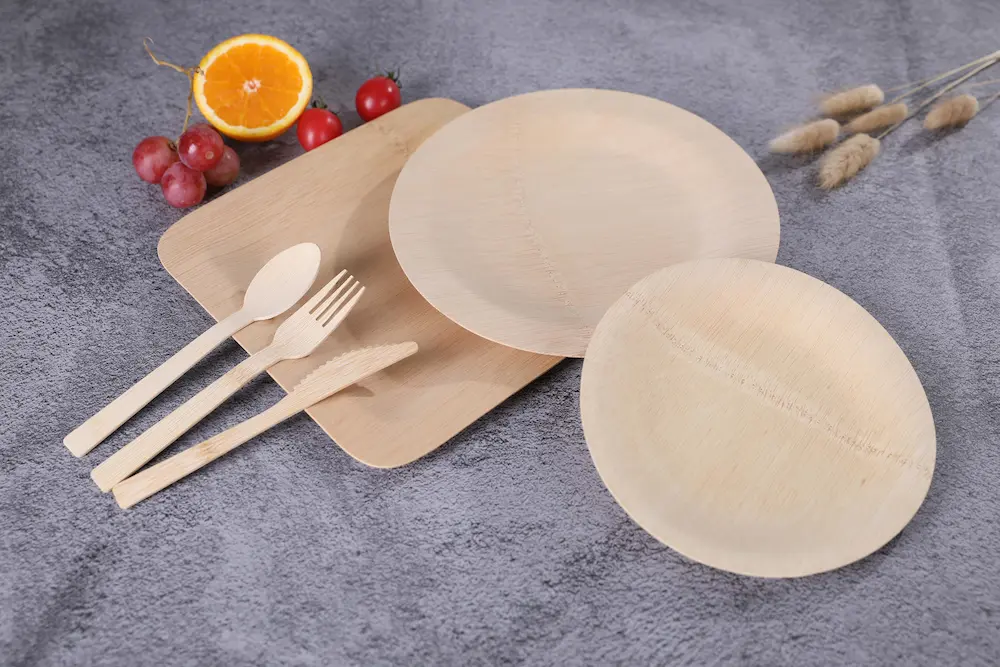
Bamboo is widely used in sustainable packaging because it is a fast-growing plant and can provide strong natural fiber. Bamboo-based bowls may be made from bamboo sheath, bamboo pulp, bamboo fiber composites, or bamboo paperboard. These products are often selected for premium event tableware, eco-focused foodservice, and natural presentation.
Bamboo can be a renewable material, but the finished bowl’s environmental value depends on sourcing, adhesives, coating, manufacturing energy, and transport distance. A bamboo product should not automatically be described as compostable unless the finished item has suitable documentation and does not contain problematic binders or coatings.
Processing Techniques
There are two common production routes. One uses bamboo sheath, which is cleaned and pressed into bowl shapes. The other uses bamboo fiber or pulp, which is mixed with binders and molded under heat and pressure. Some products may contain melamine, resin, synthetic binders, or coating systems, so professional buyers should always verify the exact formula for food-contact and end-of-life claims.
Scientific and Practical Buyer View
Bamboo fiber can provide good strength and a premium natural look. It is particularly useful where aesthetics matter, such as catering, hotels, weddings, tasting events, and premium retail packaging. However, bamboo bowls may cost more than paper or bagasse bowls and may not always be available in the same range of standardized foodservice sizes.
Best Use Cases
- Premium events, catering, hotels, buffets, and eco-themed restaurants
- Dry or semi-wet foods, salads, fruit, desserts, and appetizers
- Brands that need a natural, upscale presentation
Buyer Checks
- Whether the bowl is bamboo sheath, bamboo pulp, or bamboo composite
- Food-contact reports and binder composition
- Compostability or recyclability documentation
- Suitability for hot, oily, or wet foods
Wheat Bran Biodegradable Bowls

Overview and Sustainability Benefits
Wheat bran is a byproduct of flour milling and contains fiber, starches, and proteins. It can be compressed into bowl-like forms for selected dry or semi-dry food applications. Wheat bran bowls are often marketed as edible or naturally compostable, making them interesting for zero-waste foodservice concepts.
However, wheat bran bowls are still niche products. They are not suitable for every food type and may have shorter shelf life, moisture sensitivity, allergen considerations, and limited export scalability compared with bagasse or paper bowls.
Processing Techniques
Wheat bran bowls are typically made by mixing bran with water and sometimes natural binders, then compressing the mixture under heat. The heat causes starches and proteins to bind the material into a rigid form. This process can use relatively few additives, but final performance depends on moisture level, compression control, thickness, and storage conditions.
Scientific and Practical Buyer View
Wheat bran can decompose quickly under suitable composting conditions because it is an agricultural food byproduct. Still, exact degradation time depends on bowl thickness, moisture, temperature, and composting environment. For commercial foodservice, the larger challenges are moisture resistance, consistent quality, shelf life, and allergen communication.
Best Use Cases
- Dry snacks, appetizers, tastings, eco-events, and zero-waste food concepts
- Short-service applications where the bowl does not need long liquid holding time
- Brands with a strong natural or edible packaging story
Buyer Checks
- Food-contact safety and allergen labeling requirements
- Shelf life and humidity tolerance
- Moisture resistance for sauces or wet foods
- Availability, MOQ, and export packaging stability
Rice Husk Biodegradable Bowls

Overview and Sustainability Benefits
Rice husk is the outer covering of rice grains and is generated in large quantities in rice-producing regions. It contains cellulose, lignin, and silica, which can provide stiffness and heat resistance. Rice husk can be used in biodegradable bowls, composite tableware, and molded packaging materials.
Rice husk bowls can offer a distinctive natural appearance, often with a speckled finish. They may reduce agricultural waste and provide an alternative to petroleum-based plastic. However, many rice husk products are composites, so buyers should verify the binder, resin, or polymer content before making compostability claims.
Processing Techniques
Rice husk is usually cleaned, dried, ground into powder or fiber, and mixed with a binder such as starch, PLA, natural resin, or another biodegradable material. The mixture is then molded under heat and pressure. The final bowl’s strength and biodegradation profile depend on the ratio of rice husk to binder and the type of polymer used.
Scientific and Practical Buyer View
Rice husk composites can balance mechanical strength, heat tolerance, and agricultural-waste utilization. Because rice husk contains silica, degradation behavior may differ from softer plant fibers. Certified compostability should be verified at the finished-product level rather than assumed from the presence of rice husk alone.
Best Use Cases
- Dry meals, semi-wet foods, snacks, salads, and eco-retail packaging
- Foodservice brands seeking a natural agricultural-residue story
- Markets where rice husk-based materials are locally available
Buyer Checks
- Exact binder or resin formula
- Food-contact safety and heavy-metal testing where required
- Compostability certification or biodegradation data
- Heat resistance, moisture resistance, and shelf stability
Algae-Based Biopolymers and Emerging Materials
Overview and Sustainability Benefits
Algae-based biopolymers represent an emerging approach to biodegradable packaging. Algae can grow quickly and may be cultivated without using conventional agricultural land. Materials derived from algae, seaweed, or microalgae—such as alginate, agar, carrageenan, or PHA-related materials—are being studied for biodegradable films, coatings, molded products, and bioplastic applications.
For bowls, however, algae-based materials are still in early commercial development compared with bagasse, kraft paper, PLA, and cornstarch-based products. Their strongest value today is innovation potential rather than mass-market availability.
Processing Techniques
There are several possible approaches. One extracts natural polymers from seaweed and combines them with fibers, starches, or crosslinking systems. Another uses microorganisms or microalgae-related processes to produce PHA-type biopolymers, which can then be processed into packaging materials. The exact production method varies widely and is still evolving.
Scientific and Practical Buyer View
Algae-based materials have strong sustainability potential, especially for future low-carbon and marine-safe packaging research. However, buyers should be cautious about overclaiming. Commercial-scale availability, mechanical strength, moisture resistance, food-contact compliance, cost, and shelf-life performance remain important barriers for many algae-based bowl concepts.
Best Use Cases
- Research projects, pilot packaging programs, and innovation showcases
- Brands testing next-generation bio-based packaging materials
- Selected coating, film, or lightweight packaging applications
Buyer Checks
- Commercial availability and production scale
- Food-contact safety reports
- Moisture resistance and shelf-life data
- Compostability, biodegradation, or marine-degradation claims supported by testing
Material Comparison: Which Biodegradable Bowl Material Fits Your Use Case?
The table below provides a practical comparison for buyers. It should be used as a sourcing guide, not as a universal performance guarantee. Final performance depends on product design, thickness, coating, certification, lid fit, and real food testing.
| Material | Best Use | Key Strength | Main Limitation | Buyer Priority |
|---|---|---|---|---|
| Sugarcane Bagasse | Hot meals, salads, takeaway bowls | Rigid molded fiber, natural appearance | May need oil/water resistance treatment | PFAS status, food-contact report, compostability certification |
| PLA / Cornstarch-Based Blends | Cold foods, desserts, clear bowls, selected bento formats | Plant-based bioplastic, clear or moldable | Usually requires industrial composting; heat-sensitive unless modified | Temperature range, composting certification, storage conditions |
| Bamboo Fiber | Premium events, catering, natural presentation | Strong natural fiber story | Formula and binder vary widely | Binder composition and food-contact safety |
| Wheat Bran | Dry snacks, short-service events, edible packaging concepts | Agricultural byproduct, highly natural positioning | Moisture sensitivity and allergen considerations | Shelf life, allergen labeling, humidity resistance |
| Rice Husk | Semi-wet foods, eco-retail bowls, natural composite tableware | Uses rice-processing residue, distinctive appearance | Binder and resin composition must be verified | Formula transparency and certification |
| Algae-Based Biopolymers | Pilot projects, future packaging research | Strong innovation potential | Limited commercial scale for bowls | Food-contact proof, scale, cost, moisture performance |
Bioleader® Buyer Guide: How to Choose Biodegradable Bowls for Foodservice
For restaurants, catering companies, distributors, supermarkets, and food delivery brands, biodegradable bowls should be selected based on real food performance and compliance documentation. The best material depends on food temperature, oil content, sauce level, delivery time, lid requirement, target market, and disposal infrastructure.
Key Questions Before Bulk Ordering
- Will the bowl hold hot food, cold food, soup, salad, rice, curry, dessert, or oily dishes?
- Does the bowl require a matching lid, and is the lid suitable for delivery?
- Is the material bagasse, PLA, cornstarch, bamboo, wheat bran, rice husk, or a blended formula?
- Does the product have food-contact safety reports for the target market?
- Can the supplier provide EN13432, ASTM D6400, BPI, TÜV, OK Compost, or other compostability documentation where required?
- Is the bowl PFAS-free or PFAS-tested if required by your buyer, retailer, or local regulation?
- What are the MOQ, carton size, loading quantity, sample lead time, and production lead time?
Bioleader® supplies biodegradable food packaging including bagasse bowls, biodegradable bowls with lids, paper bowls, kraft bowls, cornstarch bowls, and related compostable tableware for global foodservice and packaging buyers. For stable B2B sourcing, the strongest approach is to test real food samples before confirming bulk orders.
Conclusion
Biodegradable bowls can be made from bamboo, corn starch-based PLA, sugarcane bagasse, wheat bran, rice husk, and emerging algae-based biopolymers. Each material offers a different balance of renewability, performance, cost, compostability, and commercial scalability.
For everyday foodservice, sugarcane bagasse and coated paper-based bowls are currently among the most practical options because they are widely available, functional, and suitable for many hot or cold foods. PLA and cornstarch-based bowls can support compostable bioplastic programs, especially for cold food or selected molded applications. Bamboo, wheat bran, rice husk, and algae-based materials provide valuable innovation pathways, but they require careful evaluation before large-scale procurement.
The most responsible choice is not simply the material that sounds the greenest. It is the bowl that performs safely with the food, meets compliance requirements, supports realistic end-of-life handling, and fits the business model. With the right supplier, documentation, and application testing, biodegradable bowls can become a practical step toward reducing conventional plastic use in modern foodservice packaging.
FAQ
1. What materials are biodegradable bowls made from?
Biodegradable bowls are commonly made from sugarcane bagasse, PLA bioplastics, cornstarch-based blends, bamboo fiber, wheat bran, rice husk, palm leaf, wood fiber, and emerging algae-based polymers. Each material has different performance and disposal conditions.
2. Are biodegradable bowls safe for hot and cold foods?
Many biodegradable bowls are suitable for hot and cold foods, but performance depends on the material and product design. Bagasse is often strong for hot meals, while PLA is better for cold foods. Buyers should check heat-resistance data and food-contact reports.
3. Can biodegradable bowls be microwaved?
Some biodegradable bowls, especially selected bagasse bowls, can be microwave-suitable. PLA, wheat bran, rice husk composites, and bamboo-based bowls should only be microwaved if the supplier specifically confirms microwave use.
4. How long do biodegradable bowls take to decompose?
Decomposition time depends on the material, product thickness, coating, composting temperature, moisture, microbial activity, and disposal system. Many certified compostable products are designed for industrial composting, while home composting may take longer or may not be suitable.
5. Are biodegradable bowls coated with plastic?
Some biodegradable bowls have no coating, while others use PLA, water-based coatings, or oil-resistant treatments. Buyers should ask for coating details, PFAS-related reports, and compostability documentation before making environmental claims.
6. Are biodegradable bowls stronger than paper bowls?
Materials such as bagasse and bamboo fiber often provide stronger rigidity and moisture resistance than thin standard paper bowls. However, coated kraft paper and high-quality cupstock paper can also perform well for soups and takeaway meals.
7. What certifications should I look for in biodegradable bowls?
Useful certifications and reports may include BPI, TÜV Austria, OK Compost, EN13432, ASTM D6400, FDA food-contact reports, EU food-contact reports, LFGB, SGS, and PFAS-related testing, depending on the material and target market.
References
- ASTM International. ASTM D6400 standard specification for compostable plastics and related packaging materials.
- European Committee for Standardization. EN 13432 requirements for packaging recoverable through composting and biodegradation.
- Biodegradable Products Institute (BPI). Certified compostable products and packaging verification.
- TÜV Austria. OK compost HOME and OK compost INDUSTRIAL certification guidance.
- European Bioplastics. Bioplastics materials, compostability resources, and market data.
- U.S. Food and Drug Administration. Food packaging and substances that come into contact with food.
- Bioleader®. Product documentation for biodegradable bowls, bagasse bowls, cornstarch bowls, paper bowls, food-contact testing, and export packaging support.