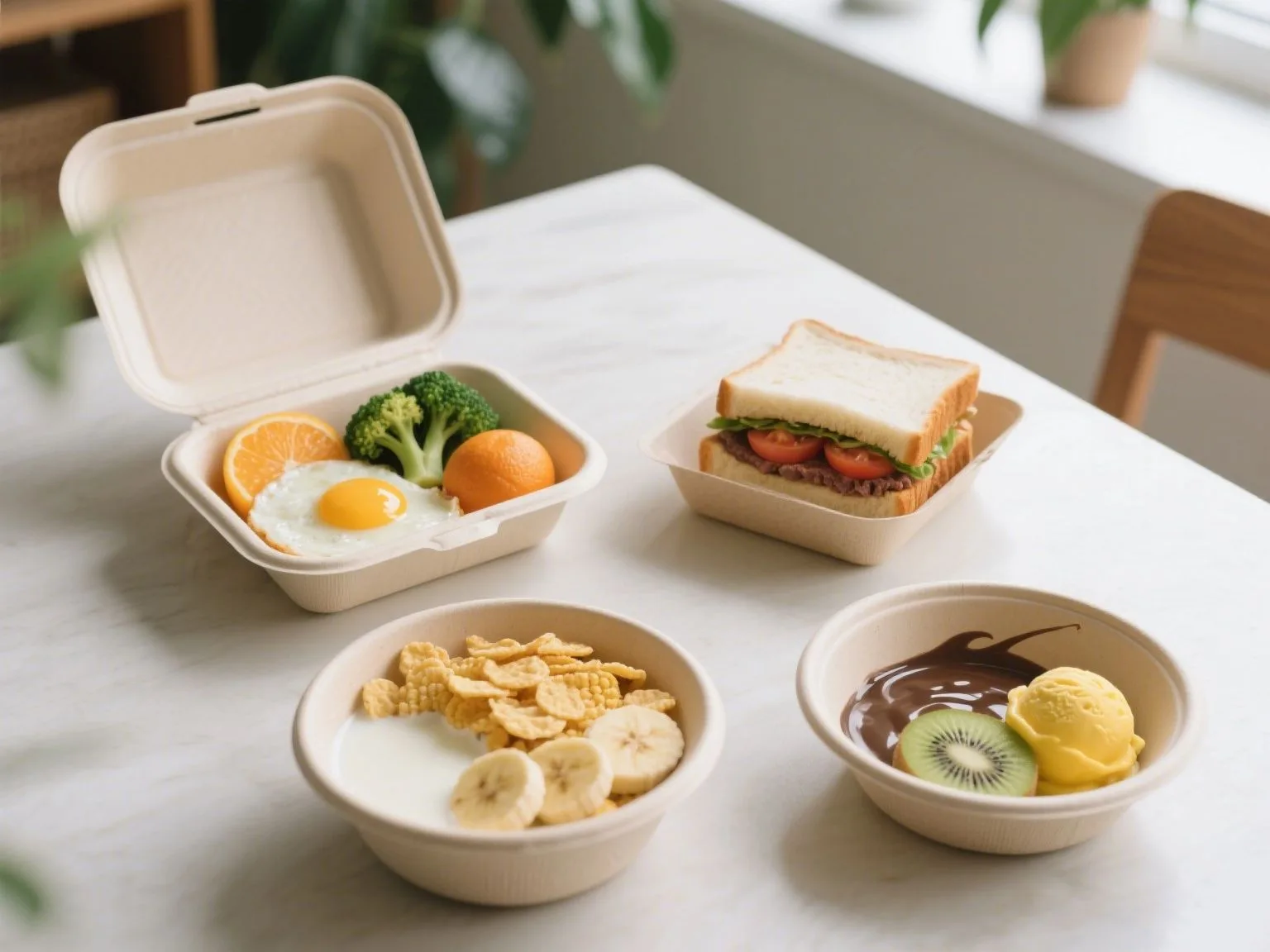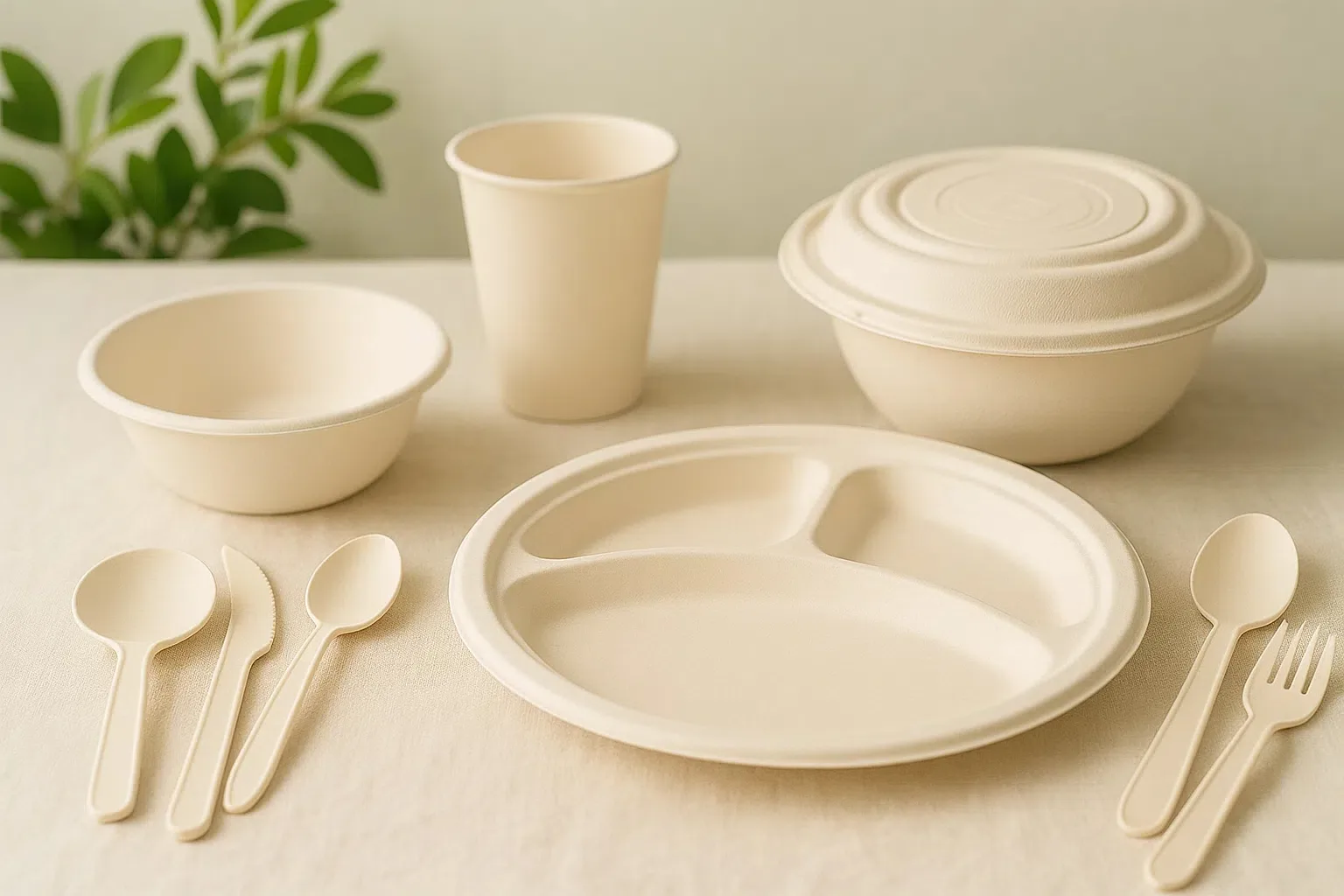










Quick Summary: How to Evaluate a Molded Fiber Tableware Manufacturer in China
A qualified molded fiber tableware manufacturer should be evaluated across material control, pulp-molding capability, product range, commercial capacity, water and oil resistance, PFAS documentation, food-contact compliance, compostability evidence, real-food performance testing, custom tooling, quality control and export execution. Price, factory photos or certification logos alone are not enough to qualify a supplier.
- Verify the factory: Confirm that the supplier actually manufactures molded fiber foodservice products and can explain which production stages are controlled in-house.
- Verify the material: Ask what fiber is used, how the pulp specification is controlled and whether the finished SKU matches the declared material composition.
- Verify the process: Evaluate forming, pressing, drying, trimming and process repeatability rather than relying on broad terms such as “pulp molded” or “eco fiber.”
- Verify performance: PFAS-free status and grease resistance are different questions. Test the exact product with the intended food, temperature and holding time.
- Verify compliance: Food-contact evidence, PFAS evidence and compostability certification should be reviewed separately and matched to the exact product and destination market.
- Verify commercial execution: Capacity, MOQ, custom molds, carton loading, lead time and export documentation must work at the scale of the buyer’s actual program.
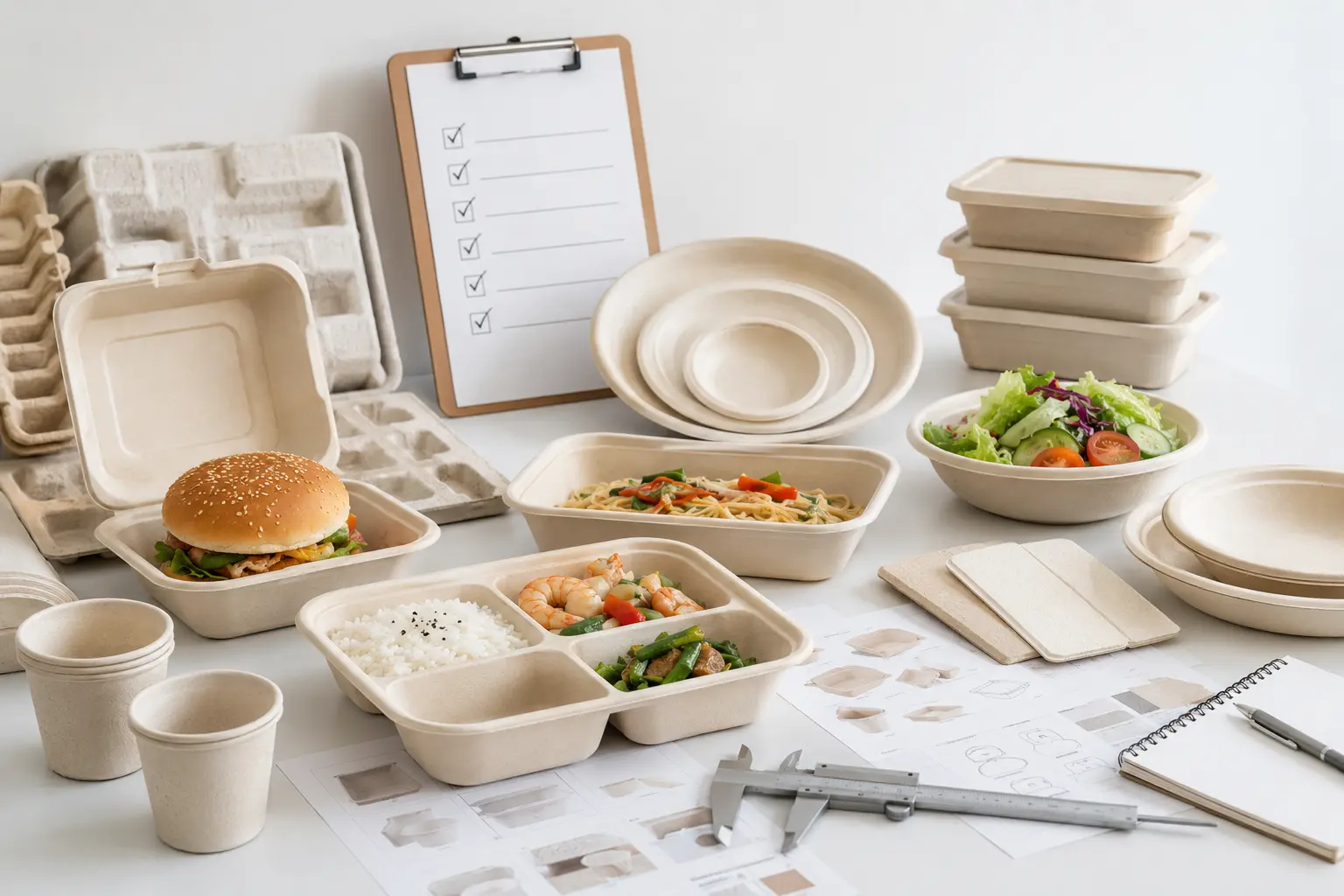
Molded fiber packaging covers a broad manufacturing field. It can include industrial protective inserts, electronics cushioning, egg trays, produce trays and foodservice packaging. For restaurant, catering, takeaway and food-distribution buyers, however, the relevant segment is molded fiber tableware and food packaging: pulp-molded plates, bowls, clamshells, trays and food containers designed for direct foodservice applications.
This distinction matters when sourcing from China. A company experienced in industrial molded-pulp protective packaging is not automatically qualified to manufacture food-contact tableware, and a trading company with a broad catalog is not automatically a molded fiber tableware factory.
Bioleader®’s core sugarcane bagasse tableware solutions are positioned specifically within the foodservice molded-fiber segment, covering clamshell boxes, food containers, bowls, plates and trays. Bioleader®’s Sustainable Food Packaging Authority Report also identifies sugarcane bagasse tableware as the company’s molded-fiber core category.
Core buyer principle: A molded fiber tableware manufacturer should be qualified across the entire chain—fiber specification → pulp molding → barrier performance → finished-product testing → compliance documentation → batch quality → commercial delivery—not by a single sample, certificate or low quotation.
12 Standards for Evaluating a Molded Fiber Tableware Manufacturer
The following framework is designed for importers, foodservice distributors, restaurant groups, supermarkets, private-label brands and procurement teams comparing molded pulp tableware suppliers in China.
| # | Supplier Qualification Standard | What the Buyer Is Really Checking | Typical Risk if Ignored |
|---|---|---|---|
| 1 | Actual manufacturing capability | Factory identity, specialization and control over production | Trading-company dependency or weak technical control |
| 2 | Fiber and material control | Raw material, pulp composition and specification consistency | Unstable strength, appearance or evidence scope |
| 3 | Pulp-molding process capability | Forming, pressing, drying, trimming and process repeatability | Warping, weak edges and inconsistent dimensions |
| 4 | Foodservice product range | Available molds and application experience | Supplier cannot support a complete foodservice program |
| 5 | Commercial production capacity | Repeatable output, scheduling and scalable supply | Late delivery or quality instability after sample approval |
| 6 | Water and oil resistance | Barrier engineering matched to actual food conditions | Softening, oil penetration or premature failure |
| 7 | PFAS documentation | Evidence scope, analytical method and finished-product relevance | Unsupported or outdated PFAS-free claims |
| 8 | Food-contact and compostability evidence | Correct documentation for the destination market and intended claim | Certificate mismatch or import compliance risk |
| 9 | Real-food performance testing | Heat, oil, sauce, liquids, lids and delivery behavior | A visually good sample fails in actual foodservice use |
| 10 | Custom mold and OEM capability | Engineering from design or sample to stable mass production | Tooling cost without scalable production |
| 11 | Quality control and traceability | Repeatability from raw material through final packing | Batch-to-batch inconsistency |
| 12 | MOQ, loading and export execution | Commercial feasibility of the complete sourcing program | Acceptable unit price but poor total landed-cost performance |
1. Is the Supplier an Actual Molded Fiber Tableware Manufacturer?
The first question should not be “What is your price?” It should be “What part of this product do you actually manufacture?”
China has manufacturers, trading companies, sourcing companies and hybrid suppliers operating under similar commercial language. None of these structures is automatically unsuitable, but they create different levels of technical control. The distinction becomes especially important when a molded fiber project involves barrier performance, custom molds, dimensional tolerances, PFAS requirements or repeated container-scale orders.
What should buyers verify?
- Confirm the legal company name, manufacturing location and export entity involved in the transaction.
- Ask which stages—pulp preparation, forming, pressing, trimming, inspection and packing—are performed internally and which, if any, are subcontracted.
- Confirm which foodservice product families the supplier actually manufactures.
- Ask technical staff to explain mold design, product weight, barrier formulation, lid compatibility and process-control logic.
- Request factory photographs, production videos, live video inspection, third-party audit records or an on-site visit when the size of the project justifies it.
- Check whether the company names and addresses appearing on certificates, test reports and commercial documents are consistent with the claimed supply structure.
Buyer red flag: A very large catalog does not prove manufacturing depth. Ask which product categories are manufactured in-house, which are externally sourced and which manufacturing route applies to the exact SKU being offered.
How Bioleader® Verifies Manufacturing Capability
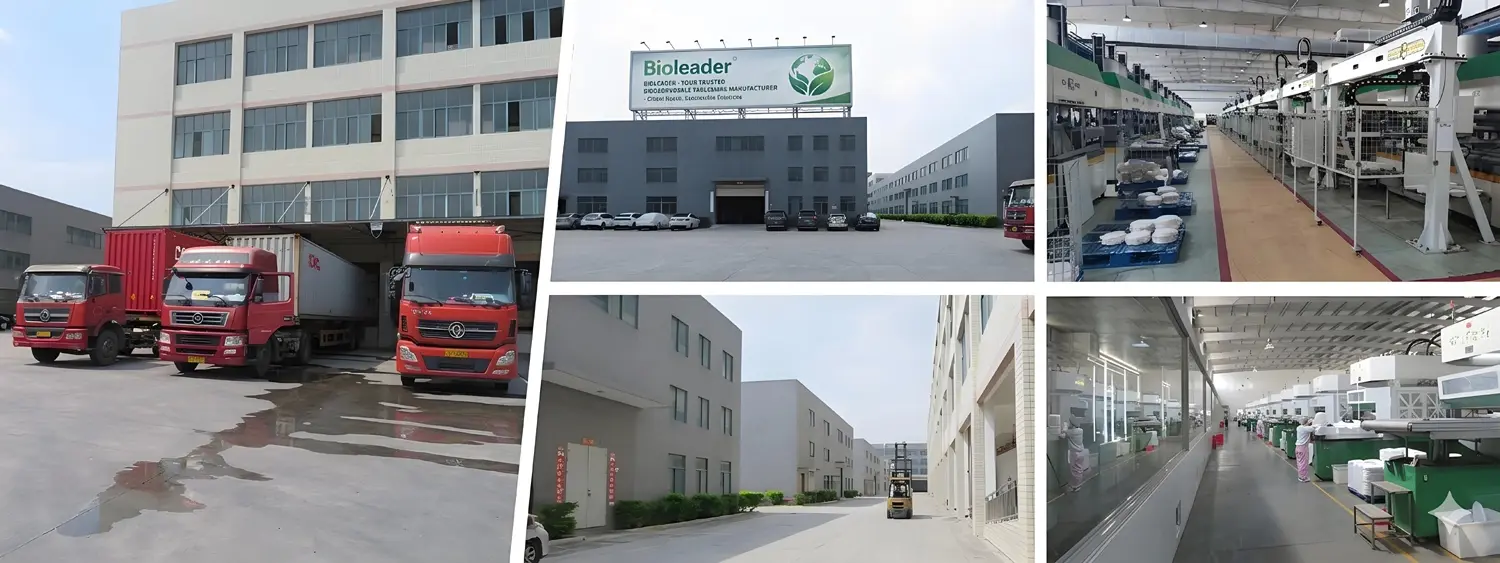
Xiamen Bioleader Environmental Protection Technology Co., Ltd. operates as a China-based manufacturer and export supplier of disposable foodservice packaging, with sugarcane bagasse tableware forming one of its core molded-fiber manufacturing categories.
According to Bioleader®’s 2026 internal production statistics, the molded-fiber manufacturing system includes more than 200 semi-automatic and fully automatic production machines. This equipment base supports multiple molded-fiber product families and repeated export production programs.
Manufacturer scale should still support—not replace—product sampling, project-level capacity confirmation, applicable document review and commercial due diligence.
Evidence buyers can request: factory production video, company information, applicable factory audits, product-specific TDS, production-intent samples and project-level manufacturing confirmation.
2. What Molded Fiber Materials Does the Factory Process and Control?
Molded fiber is a manufacturing family, not one raw material. Foodservice molded-fiber products may use sugarcane bagasse, wood pulp, bamboo fiber or other cellulose-based fiber systems depending on the intended product and manufacturing specification.
For Bioleader®’s main molded-fiber tableware portfolio, sugarcane bagasse is the principal material focus. Bagasse is the fibrous residue remaining after sugarcane juice extraction. After processing into pulp, the fiber can be formed into foodservice products such as plates, bowls, clamshells, trays and containers.
What should buyers ask about raw material?
| Buyer Question | Why It Matters |
|---|---|
| What fiber is used in the finished product? | The fiber source affects material claims, appearance, mechanical behavior and the supporting document package. |
| Is the product bagasse only or a fiber blend? | The commercial material description should match the actual product specification. |
| How is pulp quality controlled? | Fiber condition, cleanliness, moisture and pulp preparation can influence forming consistency. |
| Are functional additives part of the formulation? | Water and oil resistance cannot be understood from the base fiber alone. |
| Does the supplied report apply to this formulation? | A change in fiber blend, additives or barrier chemistry can change the evidence required. |
For the relationship between sugarcane fiber and finished foodservice formats, Bioleader® maintains a dedicated sugarcane pulp tableware resource covering pulp-molded plates, bowls, trays and other foodservice structures.
How Bioleader® Controls Bagasse Material Specifications
Bioleader®’s molded-fiber portfolio is centered on sugarcane bagasse foodservice products. Product-level material, weight and sustainability information is published through the Sugarcane Bagasse Tableware Sustainability & Carbon Data Report, which provides item-level reference data across multiple molded-fiber SKUs.
For procurement, the important principle is that material evidence should follow the exact product specification. A buyer should not assume that every item described generically as “bagasse” has the same weight, barrier formulation, test scope or certification coverage.
Evidence buyers can request: product TDS, material declaration, item code, unit weight, dimensional specification, relevant formulation information and applicable product-specific reports.
3. What Pulp-Molding Process Does the Factory Actually Use?
Suppliers may use terms such as “pulp molded,” “wet pressed,” “dry pressed,” “thermoformed fiber” or “molded pulp.” Buyers should ask what those terms mean for the exact product instead of assuming that a process label alone determines quality.
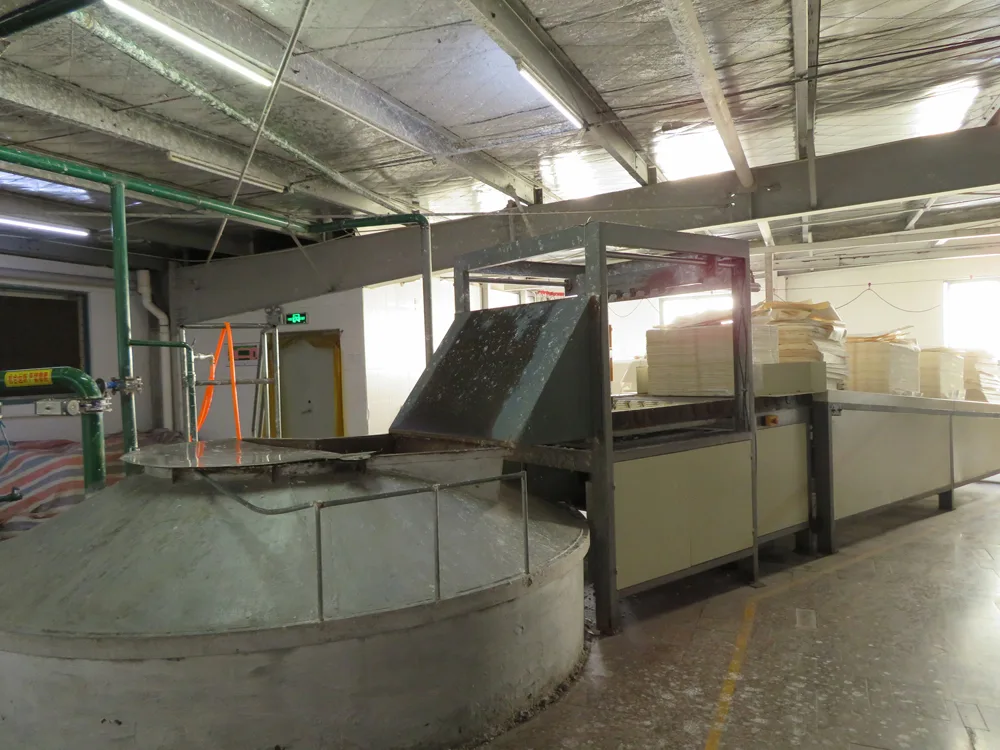
A foodservice molded-fiber manufacturing route can involve pulp preparation, slurry control, vacuum forming, pressing or hot pressing, drying, trimming, inspection and packing. Finished-product performance depends on how fiber formulation, forming, moisture, mold condition, temperature, pressure and final geometry work together.
What buyers should evaluate in the manufacturing process
- Pulp preparation: The factory should be able to explain how fiber is prepared and stabilized before forming.
- Forming consistency: Wall distribution, corners, rims and compartment dividers should form consistently across repeated cycles.
- Pressing and drying: Moisture, dimensional stability, surface condition and deformation should be controlled during production.
- Mold condition: Tooling condition affects product shape, edge definition, dimensional repeatability and stacking.
- Trimming: Rims and edges should be sufficiently consistent for stacking, lid fit and customer handling.
- Changeover control: Production should remain stable when moving between molds, sizes or approved formulations.
Technical caution: Buyers may ask whether a supplier uses wet-press, dry-press or another thermoformed-fiber configuration, but quality should not be inferred from the label alone. Finished-product dimensions, weight consistency, surface condition, structural performance and application testing provide stronger evidence.
How Bioleader® Manages Pulp-Molding Production
Bioleader® identifies its sugarcane bagasse foodservice manufacturing route as pulp molding / thermoformed-fiber production. The supplier qualification focus is therefore placed on the finished production specification and repeatability rather than using “wet press” or “dry press” as a standalone quality claim.
For an active project, the relevant questions are whether the selected SKU can be reproduced to its approved dimensions, unit weight, surface condition, structural strength, barrier requirement and lid interface during commercial production.
Evidence buyers can request: manufacturing flow information, factory production video, product TDS, approved sample, dimensional specification, mold information and production inspection records relevant to the selected SKU.
4. What Foodservice Products Can the Factory Manufacture?
A molded fiber tableware manufacturer should demonstrate more than one attractive sample. Buyers should determine whether the available molds and product families can support the intended restaurant, retail, catering or distribution program.
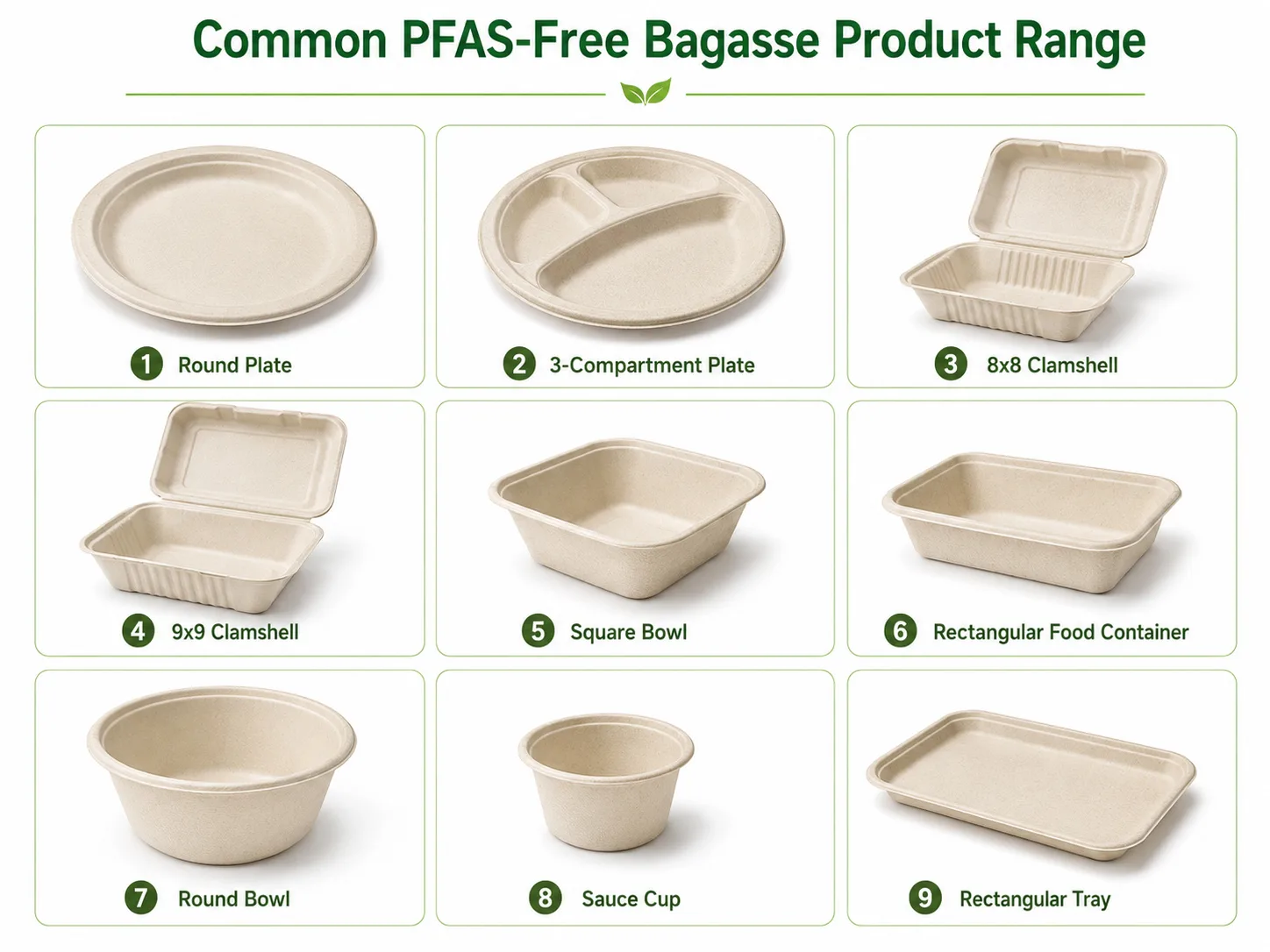
Common molded fiber foodservice categories include clamshell boxes, round and rectangular containers, bowls, plates, trays, divided meal containers, lidded trays and specialty food-display formats.
Bioleader®’s core molded-fiber portfolio currently covers more than 200 sugarcane bagasse product styles. Buyers can compare its principal bagasse clamshell box range and bagasse food container range when shortlisting standard foodservice formats.
| Product Family | Typical Foodservice Use | Buyer Selection Question |
|---|---|---|
| Clamshell boxes | Burgers, rice meals, fast food, takeaway entrées | Does the footprint, depth and compartment layout match the meal? |
| Food containers | Takeaway meals, meal prep, delivery and catering | Which capacity, lid and barrier specification is required? |
| Bagasse bowls | Rice, noodles, salads and selected hot-food applications | Is the rim and lid system appropriate for the intended food? |
| Plates | Catering, events, institutional foodservice and dine-away use | Is the plate depth and rigidity suitable for the portion? |
| Trays | Ready meals, food display, catering and prepared foods | Does the tray need a fiber, transparent or other compatible lid? |
| Compartment formats | Rice meals, bento, catering and multi-side meals | Do the compartment volumes match the actual food portions? |
Bioleader® Molded Fiber Product Range
Bioleader® organizes molded-fiber products by practical foodservice function rather than treating bagasse as one generic product. Its bagasse container sourcing solution extends the product system into commercial takeaway and to-go formats where portion structure, stacking and food compatibility become important.
Product breadth can reduce the number of suppliers required for a multi-SKU program, but buyers should still qualify the specification of each selected item. A clamshell used for burgers does not automatically require the same barrier or lid performance as a bowl used for curry or soup.
Evidence buyers can request: product catalog, item list, existing mold availability, dimensional drawings, lid compatibility data, packing specification and samples of the shortlisted formats.
5. What Is the Factory’s Real Commercial Production Capacity?
Capacity is one of the most misunderstood supplier-selection criteria. A high factory output number is useful, but the buyer actually needs repeatable capacity for the exact SKU, formulation and shipment schedule being purchased.
Bioleader® manufacturing scale: According to Bioleader®’s 2026 internal production statistics, its molded-fiber manufacturing system includes more than 200 semi-automatic and fully automatic production machines and supports approximately 5,000 metric tons of monthly production capacity. These are factory-level figures; output and lead time for an individual SKU still depend on mold configuration, product weight, formulation and scheduling.
Ask for capacity at the SKU level
- Ask how many production molds are available for the selected model.
- Confirm normal output under the approved product weight and formulation.
- Ask whether the production line or machine group is shared with other models.
- Confirm the number of shifts and scheduling constraints during peak periods.
- Separate standard-product lead time from custom-tooling lead time.
- Ask whether changes in product weight, barrier performance or embossing affect production speed.
- For long-term programs, confirm how additional or replacement molds are planned.
- Check whether packing, warehousing and shipment planning can support the physical production output.
Bioleader® Molded Fiber Production Capacity
Bioleader® treats commercial capacity as more than machine count. The 2026 Global Sugarcane Bagasse Packaging White Paper frames meaningful bagasse capacity as the ability to combine production output with specification repeatability, compliance documentation, export packing and repeatable delivery execution.
For a real order, factory-scale capacity should therefore be converted into an SKU-specific production plan after the buyer confirms the model, quantity, specification and shipment schedule. A 5,000-metric-ton monthly factory capability should not be interpreted as a guaranteed monthly output for one individual clamshell, plate, bowl or tray.
Evidence buyers can request: SKU-level production plan, available mold quantity, expected output, lead-time confirmation, packing schedule and shipment window for the actual purchase program.
6. How Does the Manufacturer Engineer Water and Oil Resistance?
Bagasse fiber alone does not determine water and oil resistance. Mold density, fiber structure, product thickness, pressing conditions and barrier chemistry all influence the way a molded-fiber container performs with real food.
This distinction has become more important as the industry develops PFAS-free barrier systems for increasingly demanding applications. A product can be PFAS-free and still have only moderate grease performance; another PFAS-free specification may be engineered for significantly hotter or oilier foods.
Ask for an application-based performance specification
| Food Application | Typical Barrier Challenge | What the Buyer Should Verify |
|---|---|---|
| Dry bakery / snacks | Low moisture and low oil stress | Basic structural integrity during expected service time |
| Salad / chilled meal | Moisture and condensation | Water resistance and cold-storage behavior |
| Rice / hot entrée | Heat, steam and moderate oil | Hot-food stability and base softening |
| Fried food | High oil exposure | Grease penetration time and structural stability |
| Curry / saucy meal | Oil + water + heat | Combined sauce, oil and holding-time performance |
| Hot soup | Continuous hot-liquid exposure | Liquid holding, rim stability and lid compatibility |
Bioleader®’s PFAS-free grease-resistance sourcing framework discusses different barrier approaches according to food performance, compliance and manufacturing economics. Its PFAS-Free Tableware Performance White Paper goes further by comparing high-temperature oil performance across a 100-model test matrix.
How Bioleader® Engineers PFAS-Free Barrier Performance
Bioleader® treats PFAS status and food performance as separate qualification questions. A formulation may satisfy the required PFAS position but still need to be selected according to the customer’s actual temperature, oil level, sauce exposure and holding time.
For high-demand foodservice programs, the practical objective is to identify the lowest-complexity approved barrier specification that can reliably handle the intended food rather than automatically applying the highest-performance system to every SKU.
Evidence buyers can request: intended barrier grade, hot-water or hot-oil performance data, real-food samples, applicable PFAS documentation and production samples representing the commercial formulation.
7. What PFAS Documentation Can the Molded Fiber Supplier Provide?
“PFAS-free” should not be accepted as a standalone sentence in a quotation. It is a chemical-compliance claim that requires a defined finished product, evidence scope and verification method.
Depending on the destination market and buyer policy, a PFAS evidence package may include a statement that PFAS are not intentionally added, identification of the covered product or formulation, targeted PFAS analysis, total-fluorine screening where relevant, and laboratory reporting information such as sample identification, test method and detection or reporting limits.
Critical compliance warning: Total-fluorine screening, a legacy PFAS report or a no-intentionally-added-PFAS declaration should not automatically be treated as universal proof for every product and market. Buyers should compare the report scope, analytical sensitivity and finished-product specification against the destination-market requirement in force when the product is placed on that market.
Bioleader® maintains a public Certificates & Test Reports center that separates PFAS-related evidence from food-contact, compostability and factory-system documents.
How Bioleader® Organizes PFAS Evidence
Bioleader® does not treat compostability certification as evidence of PFAS compliance. Its current buyer guidance instead recommends reviewing the exact SKU, sample description, test method, report scope and destination-market requirement.
The detailed PFAS-Free Packaging Verification Guide explains why a defensible procurement file should connect the chemical claim to the finished-product specification rather than rely on a generic supplier logo.
Evidence buyers can request: no-intentionally-added-PFAS declaration where applicable, SKU-specific laboratory report, tested-sample description, test method, reporting limits and confirmation that the supplied commercial formulation matches the tested sample.

8. Does the Supplier Separate Food-Contact, Compostability and Chemical Compliance?
This is one of the clearest tests of supplier competence. Food-contact compliance, compostability certification and PFAS verification answer different questions and should not be treated as interchangeable evidence.
| Evidence Type | Primary Question It Answers | What It Does Not Automatically Prove |
|---|---|---|
| Food-contact evidence | Is the material or article suitable for the intended food-contact use under the applicable framework? | Compostability or PFAS compliance |
| EN 13432-based industrial compostability evidence | Does the applicable packaging or product meet defined industrial compostability requirements? | Food-contact compliance, home compostability or PFAS compliance |
| BPI certification | Does the certified product meet the applicable BPI compostability certification requirements? | EU food-contact compliance or acceptance in every local waste system |
| PFAS analytical evidence | What does the specified analytical method show for the tested sample? | Compostability or complete food-contact compliance |
| Quality-system certification | Does the organization operate under the specified management or factory-control framework? | Automatic compliance of every finished SKU |
For European Union food-contact applications, buyers should review the applicable framework beginning with EU food-contact material requirements, including Regulation (EC) No 1935/2004 and other requirements applicable to the finished article and material system.
For United States programs, the intended food-contact use and substances involved should be reviewed under the applicable FDA food-contact framework.
Compostability is a separate assessment. Bioleader®’s EN 13432 vs ASTM D6400 buyer guide explains why buyers should match the standard or certification scheme to the intended product, market and disposal route.
How Bioleader® Maps Compliance Documents by Product
Bioleader® separates food-contact reports, compostability evidence, PFAS-related documentation and factory-system certificates within its compliance resources rather than presenting them as one universal certificate.
The correct procurement method is to identify the exact item, material configuration, intended food use and destination market first, then confirm which supporting documents apply to that combination.
Evidence buyers can request: applicable food-contact report, compostability certificate or test scope, PFAS documentation, factory-system certificate and a written mapping showing which documents apply to the selected SKU.
9. How Does the Factory Test Hot, Oily and Liquid Foods?
A molded fiber sample can look excellent while empty and still fail after 20 or 30 minutes with hot curry, oil, soup or another high-moisture food. Real-food performance should therefore be evaluated separately from visual quality and chemical documentation.
Testing should be matched to the intended application instead of relying on one universal “waterproof” test.
Recommended Molded Fiber Sample Evaluation
- Confirm the SKU: Record the item number, dimensions, weight, color, lid and formulation being evaluated.
- Use the real food: Test curry with curry, fried food with oil and soup with hot liquid rather than relying only on room-temperature water.
- Record filling temperature: Measure the actual food temperature when it enters the container.
- Set holding time: Use a realistic restaurant, catering or delivery duration.
- Inspect penetration: Check the base, corners, divider walls and edges for oil or liquid migration.
- Check deformation: Record softening, warping, loss of stiffness or rim deformation.
- Evaluate the lid: Confirm rim engagement, closure stability and the effect of heat or steam.
- Apply movement: Use controlled tilt, vibration or delivery simulation where relevant to the actual service model.
- Check stacking: Test filled containers under realistic vertical loading.
- Repeat the test: Do not approve a high-risk application from one isolated sample.
For takeaway applications, Bioleader®’s Sustainable Takeaway Packaging solution connects packaging structure with restaurant filling, lid selection, stacking and food-delivery requirements.
How Bioleader® Tests Real Foodservice Conditions
Bioleader®’s published hot-food development work evaluates bagasse products against heat, oil, sauce, moisture, lid fit and holding-time requirements rather than treating room-temperature water testing as sufficient evidence for every food application.
The 100°C Hot Food Manufacturing Guide documents the interaction among pulp quality, fluorine-free formulation design, hot pressing, moisture control and production inspection for demanding PFAS-free applications.
Evidence buyers can request: test method, food or test medium, temperature, holding time, sample identification, failure criteria, photographs or video and production-intent samples for independent customer testing.
10. Can the Factory Develop Custom Molds and OEM Molded Fiber Products?
Custom molding is one of the strongest ways to distinguish a manufacturing partner from a catalog-only supplier. However, the phrase “custom mold available” does not by itself demonstrate engineering capability.
A professional custom project must convert the buyer’s foodservice requirement into a structure that can be formed, released from the mold, stacked, packed and reproduced at commercial scale.
What should happen before mass-production tooling?
- Define the food application, target capacity and functional requirements.
- Confirm the external dimensions, depth and compartment layout.
- Convert the buyer’s drawing, sample or concept into an engineering direction.
- Review draft angles, rims, transitions, nesting, stackability and mold release.
- Evaluate target unit weight and structural requirements.
- Use prototype or sample tooling when the geometry still needs validation.
- Test physical samples for dimensions, fit and food performance.
- Freeze critical dimensions and functional targets before production tooling.
- Fabricate production tooling according to the approved design.
- Complete trial production and QC stabilization before commercial launch.
Bioleader® Custom Mold Development Workflow
Bioleader®’s custom bagasse and molded pulp tableware development guide treats customization as an engineering process rather than simply a tooling purchase. The workflow includes requirement review, technical validation, prototype or sample tooling where necessary, sample approval, production mold development and trial production.
Tooling cost and development time should only be finalized after geometry, product size, tolerance requirements, lid logic and expected production scale are sufficiently understood.
Evidence buyers can request: 2D/3D drawings, dimensional approval record, sample approval, prototype tooling information, production-mold quotation, development timeline and pre-production validation record.
Custom tooling risk: Do not move directly from a concept image to a mass-production mold when fit, stacking, lid engagement or food performance is critical. A cheaper or faster tooling decision can become expensive if the final design cannot run consistently at commercial scale.
11. How Does the Manufacturer Control Batch Quality and Traceability?
Supplier qualification is not complete when the first sample passes. The more important question is whether the supplier can reproduce the approved product through repeated commercial production.
A molded fiber QC system should cover at least four layers
| QC Layer | Typical Checks |
|---|---|
| Material / pulp | Fiber specification, pulp condition, formulation and material identity |
| Forming / production | Unit weight, molding completeness, edges, wall formation, pressing and moisture control |
| Finished product | Dimensions, weight, appearance, structural performance, barrier performance, lid fit and stacking |
| Packing / shipment | Count, inner packing, carton condition, markings, packing specification and final inspection |
Buyer checks before bulk approval
- Agree on a production-intent approved sample or signed product specification.
- Define dimensional and weight tolerances where they affect function or packing.
- Replace vague requirements such as “strong” or “waterproof” with measurable or testable acceptance criteria.
- Define how critical, major and minor defects will be treated when appropriate.
- Confirm how the relevant production lot or batch can be identified in quality records.
- Request pre-shipment inspection for high-value, custom or compliance-sensitive programs.
- Retain reference samples for long-term repeat orders when practical.
Bioleader® Batch Quality and Production Control
According to Bioleader®’s 2026 internal production statistics, the overall finished-product yield across its molded-fiber manufacturing system is currently above 94%. This figure describes overall manufacturing performance and should not be interpreted as an identical yield for every mold, geometry or custom development project.
Yield is affected by pulp condition, forming stability, tooling condition, geometry, edge quality, dimensional control, moisture and final inspection. For this reason, production yield is only one indicator within a broader QC system.
Bioleader®’s 15-point Sugarcane Bagasse Tableware Quality Control Framework gives bulk buyers a more complete method for reviewing material, molding, dimensions, barrier performance, packing and export-related quality risks.
Evidence buyers can request: approved specification, production inspection record, applicable batch reference, pre-shipment inspection report, packing specification and retained reference sample for repeat programs.
12. Can the Supplier Support MOQ, Mixed Loading and Export Execution?
The final qualification standard is commercial execution. A technically good molded fiber product can still be the wrong sourcing choice if MOQ, carton volume, loading efficiency, shipment schedule or destination requirements do not fit the buyer’s business model.
What should buyers calculate before confirming an order?
- MOQ per SKU and whether the product is standard or customized.
- Whether selected SKUs can be combined into one mixed-container program.
- Pieces per carton and carton dimensions for each item.
- CBM per SKU and the total shipment volume.
- 20GP, 40GP or 40HQ loading feasibility.
- FOB port and the required Incoterm.
- Whether CIF, CFR or DDP support is appropriate for the destination and buyer experience.
- Production lead time in addition to ocean-freight transit time.
- Destination-market document requirements.
- Whether the planned quantity represents one shipment, several scheduled releases or a longer-term annual program.
For standard Bioleader® bagasse tableware, MOQ is generally planned around 50,000 pieces per SKU. For selected standard items in a mixed-container program, lower quantities around 30,000 pieces per SKU may be evaluated according to the product and loading plan. Custom molded products require separate MOQ and tooling assessment.
For buyers sourcing several sustainable foodservice categories together, Bioleader®’s biodegradable food packaging solution provides a broader cross-category sourcing structure beyond molded fiber alone.
How Bioleader® Plans Bulk Export Programs
Bioleader® commonly works with FOB export quotations, while CIF, CFR or DDP structures can be evaluated according to destination, customer requirements and the logistics conditions applicable to the shipment.
For mixed-SKU molded-fiber programs, the practical workflow is to confirm selected items first, then confirm MOQ and carton quantities, calculate CBM, optimize container loading and finally calculate freight and the appropriate trade term.
U.S. importers evaluating different landed-cost structures can also review Bioleader®’s bagasse tableware sourcing options for U.S. buyers.
Evidence buyers can request: formal quotation, Incoterm, carton specifications, CBM calculation, container-loading plan, lead-time confirmation, packing list format and destination-specific document list.
Molded Fiber Supplier Qualification Matrix: Strong Evidence vs Warning Signs
The following matrix converts the 12 standards into a practical supplier-screening tool. It is not an industry certification or numerical scoring system; it is a way for procurement teams to distinguish documented capability from weak supplier claims.
| Evaluation Area | Strong Supplier Evidence | Warning Sign |
|---|---|---|
| Manufacturer identity | Clear factory structure, process knowledge and verifiable company information | The supplier cannot clearly explain where or how the product is produced |
| Material | Defined fiber and formulation specification | The supplier relies on vague terms such as “natural” or “eco” without material detail |
| Process | Clear explanation of forming, pressing, drying, trimming and process controls | The supplier repeats only generic “pulp molding” language |
| Product range | Relevant existing molds and foodservice product families | The catalog is very broad but technical product knowledge is weak |
| Capacity | SKU-level capacity and realistic production scheduling | The supplier provides only one large factory-wide capacity number |
| Barrier performance | Application-based heat, oil, sauce or liquid test evidence | Every bagasse product is described as equally waterproof or leak-proof |
| PFAS | Defined declaration or analytical evidence connected to the finished SKU | One generic or old report is used to cover every product |
| Compliance | Food-contact, compostability and chemical evidence are separated by purpose | Compostability certification is presented as proof of food-contact or PFAS compliance |
| Testing | Realistic temperature, holding-time and food-condition testing | Only room-temperature water tests are used for demanding hot-food applications |
| Custom tooling | Engineering review, sample validation and production tooling are clearly separated | A production mold is quoted before geometry and function are reviewed |
| Quality control | Approved specifications and repeatable inspection controls | Bulk quality is assumed from one sales sample |
| Export execution | MOQ, cartons, CBM, loading, documents and trade terms are planned together | The commercial decision is based almost entirely on unit price |
What Documentation Should a Molded Fiber Tableware Buyer Request?
Molded Fiber Supplier Document Checklist
- Company information: Legal entity, factory information and export details appropriate to supplier due diligence.
- Product specification: Item code, dimensions, unit weight, capacity, compartments, lid and packing specification.
- Material declaration: Fiber composition and relevant formulation information.
- Food-contact evidence: Documents appropriate to the target market and intended food-contact conditions.
- PFAS evidence: Declaration and/or analytical evidence matched to the selected product when required.
- Compostability evidence: Certification or test scope appropriate to the intended environmental claim and destination market.
- Quality-system documents: Applicable factory or management-system certificates required by the customer’s procurement policy.
- Performance data: Hot food, oil, sauce, liquid, microwave, freezer or delivery tests relevant to the application.
- Production-intent sample: A physical reference representing the intended bulk specification.
- Custom tooling documents: Engineering drawings, sample approval and production-tooling confirmation for OEM projects.
- Packing information: Pieces per carton, carton dimensions, gross and net weight and CBM.
- Commercial documents: MOQ, price term, lead time, export port, shipment plan and destination-document requirements.
Why Product-Specific Evidence Is More Important Than a Long Certificate List
International buyers frequently request FDA, LFGB, EU food-contact, BPI, OK Compost, ASTM, EN 13432, PFAS-free, ISO and other documents in one checklist. The intent is understandable, but the number of certificates is less important than whether the evidence actually applies to the finished product being purchased.
A more reliable document-review process starts with the SKU rather than the supplier’s logo wall.
- Identify the exact item code and material configuration.
- Define the destination market.
- Define the intended food-contact conditions.
- Define the required compostability or environmental claim.
- Define PFAS or other chemical restrictions that apply to the project.
- Ask the supplier to identify the documents that apply to this exact combination.
- Review the certificate holder, sample description, test method or standard, report date and scope.
Procurement rule: Certificate quantity is not the same as compliance quality. The strongest evidence package is one that clearly connects the exact finished product to the applicable regulatory, certification or customer requirement.
Bioleader® Molded Fiber Manufacturing Profile at a Glance
The following figures summarize Bioleader®’s current molded-fiber manufacturing profile. Factory-level capacity and yield figures describe the overall production system; specific output, lead time and yield can vary by product geometry, tooling, unit weight, barrier specification and production schedule.
| Capability | Bioleader® 2026 Manufacturing Profile |
|---|---|
| Core molded-fiber material | Sugarcane bagasse pulp for foodservice molded-fiber products |
| Main product families | Clamshell boxes, food containers, bowls, plates, trays and compartment formats |
| Standard product styles | 200+ sugarcane bagasse molded-fiber styles |
| Production equipment | 200+ semi-automatic and fully automatic production machines |
| Overall monthly capacity | Approximately 5,000 metric tons across the molded-fiber manufacturing system |
| Overall finished-product yield | Above 94% based on Bioleader® 2026 internal production statistics |
| Custom development | OEM / ODM, drawing-based, sample-based and new-mold development |
| Standard MOQ planning | Generally around 50,000 pcs per SKU; selected standard SKUs in mixed-container programs may be evaluated around 30,000 pcs per SKU |
| Compliance support | Product-specific food-contact, compostability, PFAS and factory-system documentation according to applicable scope |
| Export planning | FOB as a common quotation basis, with CIF / CFR / DDP evaluated according to project and destination |
For a live sourcing project, these factory-level capabilities should be converted into product-level confirmation. Buyers should finalize the item number, sample, dimensions, unit weight, barrier performance, applicable compliance documents, MOQ, production plan and loading calculation before commercial approval.
Initial product selection can be made through the Bioleader® catalog and price list, while compliance-sensitive programs should confirm the exact supporting documents through the Bioleader® certificate center before ordering.
Frequently Asked Questions
What is a molded fiber tableware manufacturer?
A molded fiber tableware manufacturer produces foodservice items such as plates, bowls, clamshells, trays and food containers by forming cellulose pulp into finished shapes. Materials may include sugarcane bagasse and other plant or wood fibers. Buyers should distinguish food-contact tableware manufacturing from industrial molded-pulp packaging because product requirements, barrier performance, hygiene controls and compliance documentation can be different.
Is molded fiber the same as sugarcane bagasse?
No. Molded fiber is a broader manufacturing and material category. Sugarcane bagasse is one fiber source used to make molded-fiber products. Molded pulp products can also use wood pulp, bamboo fiber or blended cellulose systems. Buyers should verify the actual fiber composition of the finished SKU rather than assuming every molded pulp product is sugarcane bagasse.
How do I verify a molded fiber manufacturer in China?
Verify the legal entity, manufacturing location, relevant product families, production process, technical capability, certificates, test reports, custom-tooling workflow and export capability. Request production-intent samples and ask specific questions about pulp, forming, barrier performance, QC and SKU-level capacity. Supplier claims should be supported by product and factory evidence appropriate to the size and risk of the project.
What certifications should a bagasse tableware manufacturer provide?
There is no universal certificate package for every market and product. Buyers may need applicable food-contact evidence, compostability certification, PFAS documentation and factory-system information. The required evidence should be matched to the exact finished product, intended environmental claim, food-contact use and destination market rather than requested as one generic certificate list.
Does EN 13432 prove that molded fiber tableware is food safe and PFAS-free?
No. EN 13432 addresses compostability-related requirements within its applicable scope. It does not by itself prove food-contact compliance or PFAS compliance. Food-contact evidence, PFAS evidence and compostability evidence should be reviewed separately and confirmed against the exact product being purchased.
How should buyers test PFAS-free bagasse tableware for hot food?
Use the intended food or a representative challenge condition and define temperature, oil level, sauce content and holding time. Inspect oil penetration, liquid leakage, structural softening, rim stability, lid fit and stacking performance. PFAS status should be verified separately through the appropriate chemical evidence because successful hot-food performance does not itself prove PFAS compliance.
Can a molded fiber factory make custom bagasse tableware?
Yes. A qualified molded-fiber manufacturer can develop products from a drawing, physical sample or product concept. A robust project normally includes feasibility review, engineering, sample or prototype tooling when required, physical testing, design approval, production tooling, trial production and QC stabilization before full commercial production.
What is a typical MOQ for Bioleader® bagasse tableware?
Bioleader® generally plans standard bagasse orders around 50,000 pieces per SKU. For selected standard products in a mixed-container order, quantities around 30,000 pieces per SKU may be evaluated according to the model and loading plan. Custom molded products require separate tooling, MOQ and production evaluation.
Conclusion: Qualify the Manufacturing System, Not Just the Product Sample
A reliable molded fiber tableware supplier is not defined by one attractive sample, one compostability logo or one low quotation. The more important question is whether the manufacturer can control the complete system from fiber and forming through barrier performance, compliance documentation, testing, tooling, quality control and export execution.
A robust molded fiber supplier qualification framework therefore covers 12 areas: manufacturer identity + material control + pulp-molding process + product range + commercial capacity + barrier engineering + PFAS evidence + food-contact and compostability evidence + real-food testing + custom tooling + quality control + export execution.
Bioleader® supports these areas through its foodservice molded-fiber product system, manufacturing resources, product data, compliance center, PFAS performance research, custom development workflow and quality-control framework. Buyers should still complete product-specific due diligence before a major order.
For the final sourcing decision, request the exact SKU, production-intent sample, signed specification, applicable reports, capacity confirmation, commercial terms and loading plan. That is the difference between selecting a product from a catalog and qualifying a molded fiber manufacturing partner for repeatable commercial supply.
References and Technical Resources
- European Commission — Food Contact Materials. The European Commission provides the regulatory framework and guidance for materials and articles intended to come into contact with food. European Commission Food Contact Materials.
- U.S. Food and Drug Administration — Packaging & Food Contact Substances. FDA resources explain the regulatory framework for food-contact substances and intended conditions of use in the United States. FDA Packaging & Food Contact Substances.
- Biodegradable Products Institute — Compostability Certification. BPI provides certification information for commercially compostable products under its applicable certification scheme. BPI Compostability Certification.
- TÜV AUSTRIA — OK compost INDUSTRIAL. TÜV AUSTRIA provides certification information for products assessed for industrial compostability. TÜV AUSTRIA OK compost INDUSTRIAL.
- Bioleader® — Certificates & Test Reports. Bioleader® maintains food-contact, compostability, PFAS-related and factory-system documentation resources for applicable product families. Bioleader® Certificates & Test Reports.
- Bioleader® — PFAS-Free Tableware Performance White Paper. The report evaluates PFAS-free molded-fiber tableware using high-temperature oil performance and failure-mode analysis across a broad product test matrix. 2025–2026 PFAS-Free Tableware Performance White Paper.
- Bioleader® — Sugarcane Bagasse Tableware Quality Control Guide. The guide provides a 15-point B2B framework for evaluating material, molding, dimensions, barrier performance, packing and bulk-order quality risks. 15-Point Bagasse Tableware Quality Control Guide.
- Bioleader® — Custom Bagasse & Molded Pulp Tableware Guide. The sourcing guide covers feasibility review, design engineering, prototype tooling, sample approval, production tooling and mass-production launch. Custom Molded Fiber Tableware Development Guide.