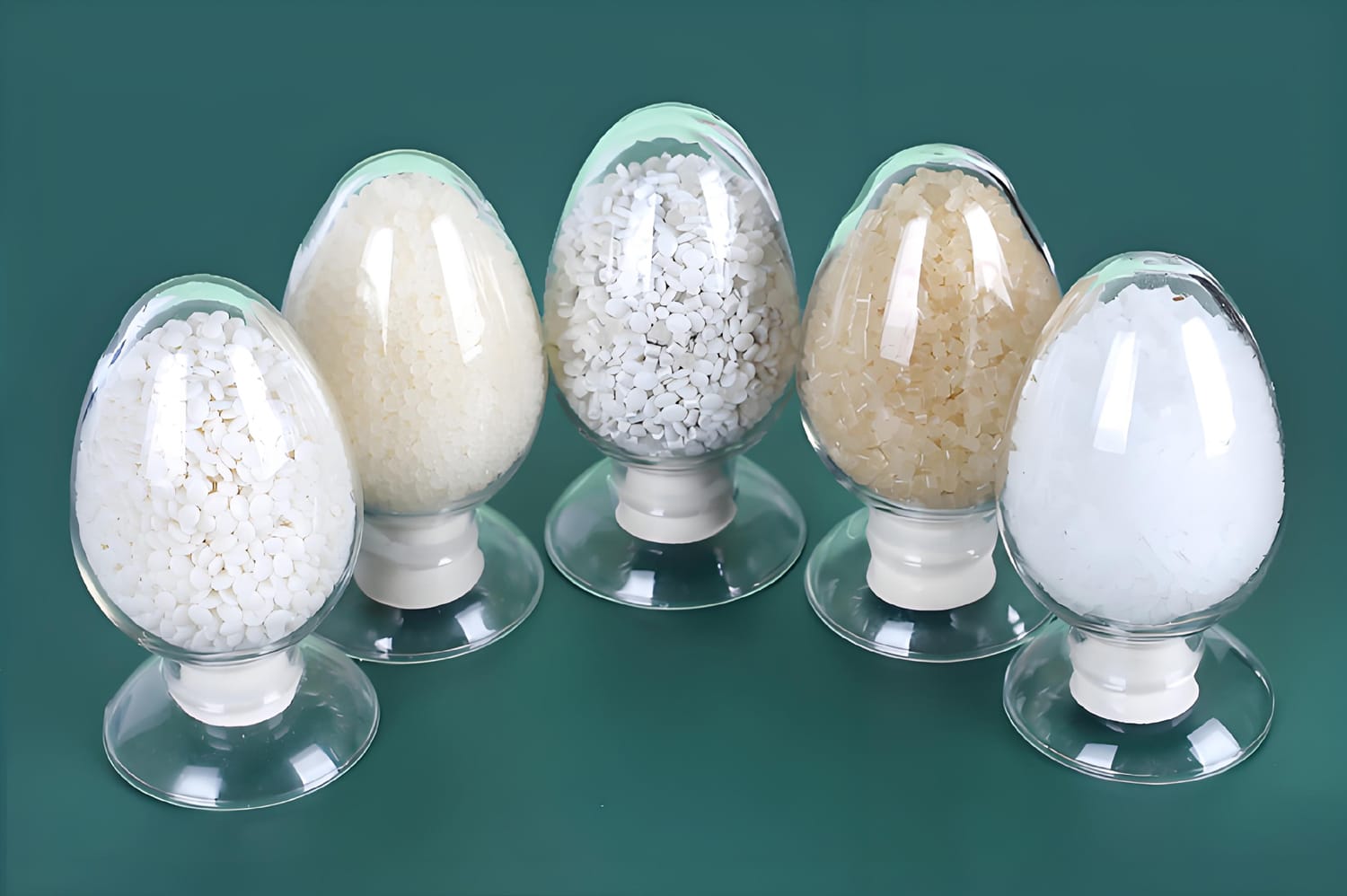
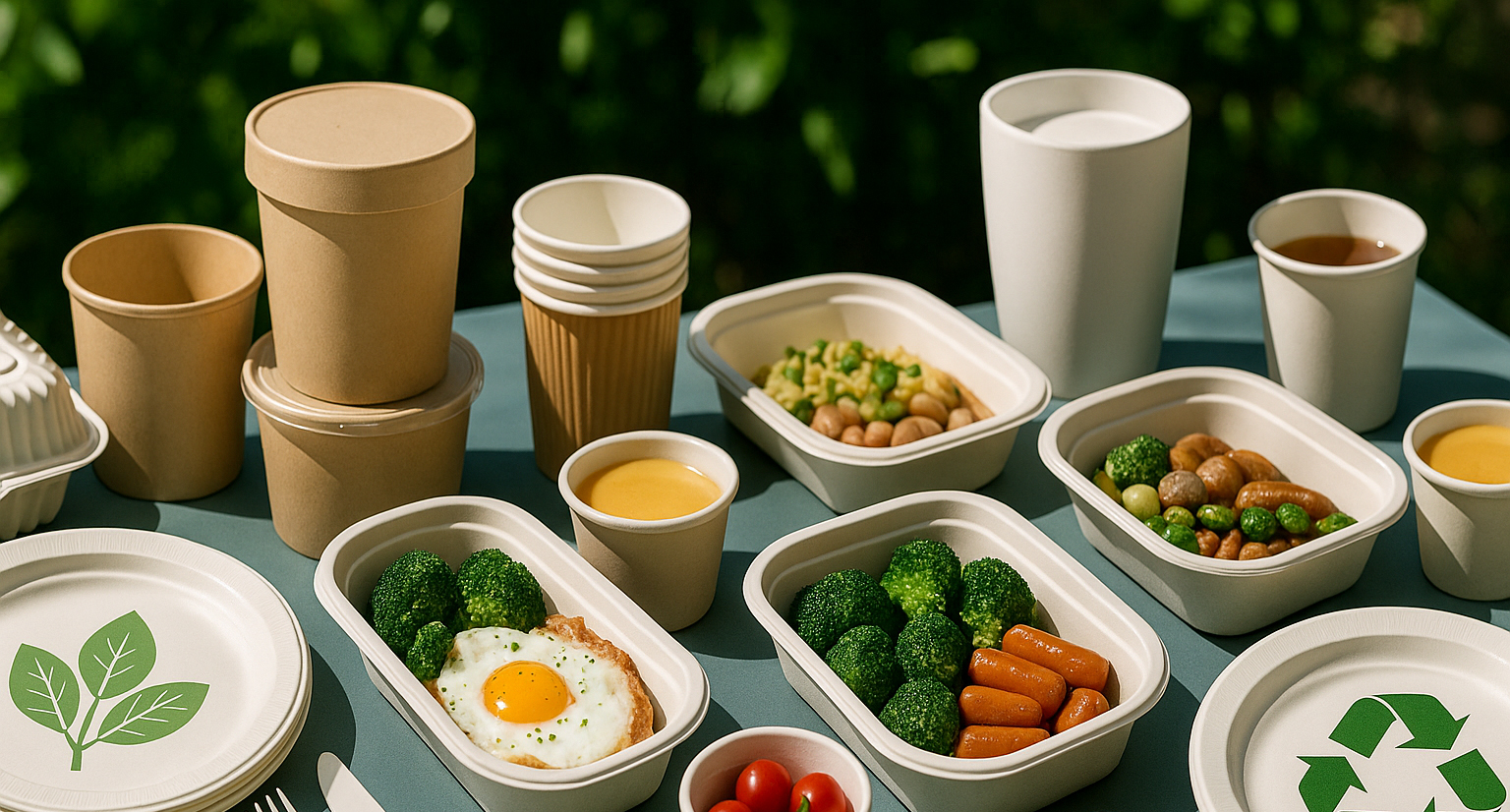
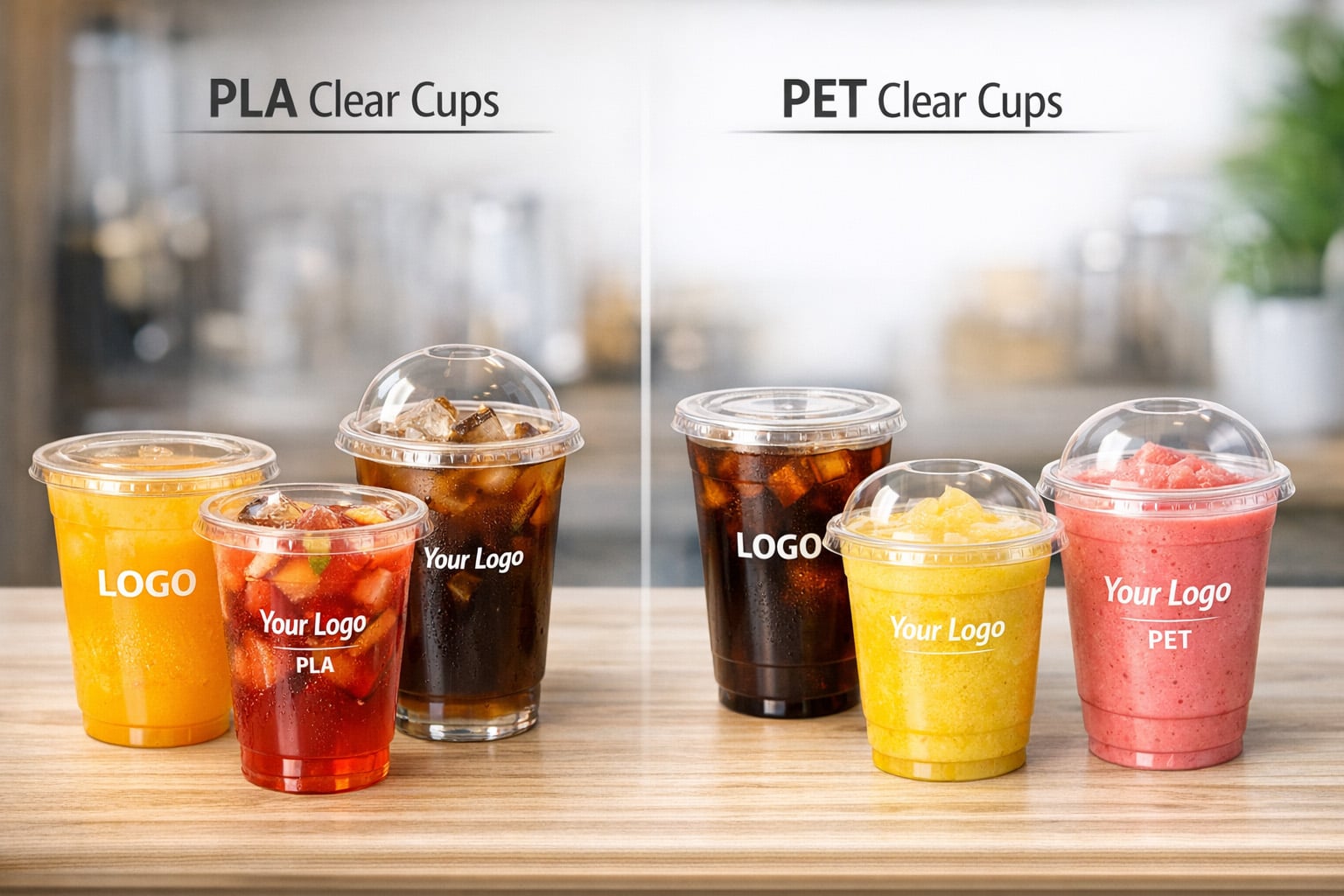
PLA (polylactic acid or polylactide) is a thermoplastic polyester commonly made from fermented plant-derived sugars such as corn dextrose, sugarcane or cassava. PLA is a plastic, even when it is bio-based. Certain finished PLA products can be certified for industrial composting, but this does not mean every PLA item is home-compostable or will quickly biodegrade in soil, water or landfill conditions. Standard clear PLA packaging is valued for clarity and stiffness and is widely used for cold drinks, salads and other cold or ambient applications; product-specific food-contact suitability, service temperature, certification scope and local end-of-life infrastructure should always be verified.

PLA is one of the most commercially established bioplastics used in packaging, particularly for transparent cold-food and beverage applications such as compostable PLA clear cups. However, the material is often described with terms that are not interchangeable: bio-based, biodegradable, compostable, recyclable and plastic-free. Understanding those distinctions is essential before evaluating PLA as a packaging material.
This article explains PLA from both a scientific and practical perspective: what it is at the molecular level, how it is manufactured, how temperature and crystallinity affect performance, how degradation actually occurs, what industrial compostability does and does not mean, and where PLA performs well in foodservice packaging. It also connects those fundamentals with practical buyer questions such as food-contact documentation, cold-drink use, lid compatibility, disposal infrastructure and current plastic-regulation requirements.
PLA = Polylactic Acid: Chemistry & Production
What Exactly Is PLA?

PLA (polylactic acid or polylactide) is a thermoplastic polyester. Chemically, it is a polymer built from repeating units derived from lactic acid, an organic acid that can be produced by fermenting sugars. Depending on stereochemistry, molecular structure and crystallinity, PLA can behave as a transparent, relatively rigid plastic or as a more crystalline material engineered for higher-performance applications.
In industry you will see several related terms:
- PLA / polylactic acid – the general name used for the polymer family.
- PLLA / PDLA – poly-L-lactide and poly-D-lactide structures that can influence crystallization and thermal behavior.
- PLA blends – PLA combined with other polymers, fillers, plasticizers, impact modifiers or additives to change toughness, processability, barrier properties or heat resistance.
PLA Terminology: Bio-Based, Biodegradable and Compostable Are Not the Same
PLA is frequently described with environmental terms that refer to different properties. A material can be bio-based without being biodegradable, and a biodegradable material is not automatically suitable for home composting. For PLA, the most useful distinction is between the polymer itself and a finished product that has been tested and certified for a defined end-of-life pathway.
| Term | How It Applies to PLA | What Buyers Should Understand |
|---|---|---|
| Plastic | Yes | PLA is a thermoplastic polyester. Being plant-derived does not make it plastic-free. |
| Bio-based | Commonly yes | Commercial PLA is commonly produced from sugars derived from renewable biomass. Bio-based content does not by itself determine end-of-life behavior. |
| Biodegradable | Condition-dependent | Biodegradation depends on temperature, moisture, microorganisms, time and the form of the finished article. Claims should identify the relevant environment and test basis. |
| Industrially compostable | Possible for certified products | A finished PLA product may meet standards such as EN 13432 or ASTM D6400 when its complete construction satisfies the applicable criteria. |
| Home compostable | Not automatic | Industrial-compost certification does not equal home-compostability. Home-compost claims require separate product-specific evidence or certification. |
| Recyclable | Technically possible | PLA can be mechanically or chemically recycled, but dedicated collection and sorting are limited in many markets. Local acceptance must be checked. |
Biobased Feedstocks: From Plants to Polymer
Unlike conventional plastics derived primarily from fossil feedstocks, commercial PLA is commonly produced from renewable carbohydrate sources. Typical feedstocks include:
- Corn starch and dextrose – widely used commercial sources of fermentable sugar.
- Sugarcane and sugar beet – sucrose-rich crops that can be processed into fermentation feedstocks.
- Cassava and other starch crops – regionally relevant sources of carbohydrate feedstock.
- Agricultural by-products and residues – an important research and development direction aimed at producing fermentable sugars from lignocellulosic biomass such as bagasse, straw, husks and stalks.
PLA’s bio-based feedstock can reduce dependence on fossil carbon, but bio-based origin alone does not determine the full environmental footprint of a finished product. Life-cycle results depend on feedstock cultivation, fertilizer and land-use effects, energy sources, polymerization efficiency, converting, transport, product weight and end-of-life treatment. Carbon-footprint claims should therefore be supported by an appropriate life-cycle assessment rather than inferred from plant origin alone.
How PLA Is Manufactured
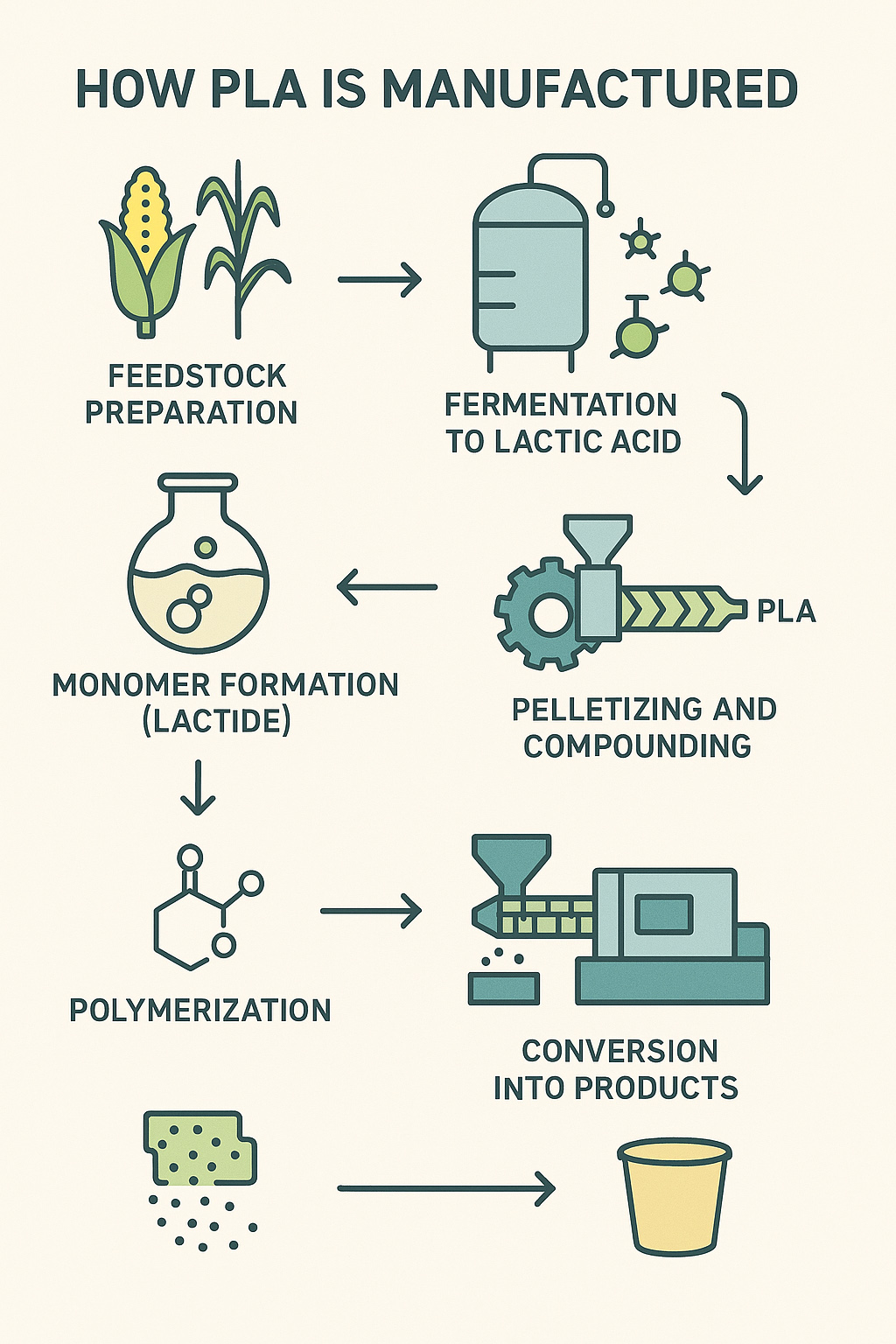
Industrial production of PLA follows a relatively well-established sequence:
- Feedstock preparation: Starch or sugar feedstocks such as corn dextrose or cane sugar are processed to provide fermentable carbohydrates.
- Fermentation to lactic acid: Microorganisms convert the sugars into lactic acid.
- Monomer formation: Lactic acid can be converted into lactide, a cyclic intermediate that can be purified to control polymer structure.
- Polymerization: Ring-opening polymerization of lactide is widely used to create high-molecular-weight PLA. Direct polycondensation routes also exist for particular processes and grades.
- Pelletizing and compounding: The polymer is converted into pellets and may be compounded with additives or other materials to achieve required properties.
- Conversion into products: PLA resin can be processed by techniques such as extrusion, thermoforming, injection molding, film production and filament extrusion.
This compatibility with established polymer-processing technologies is one reason PLA has achieved broad commercial adoption compared with many newer bioplastics. However, drying, melt temperature, residence time and crystallization behavior still need to be controlled for the selected PLA grade and converting process.
Key Material Properties: What Engineers Need to Know
From a design and engineering perspective, several properties of PLA are particularly important:
- Thermal behavior: Standard PLA commonly has a glass transition temperature in approximately the 55–65 °C range, while melting behavior is substantially higher and varies by grade and crystallinity. These figures describe polymer behavior and should not be treated as the allowable service temperature of every finished product.
- Mechanical profile: PLA is generally stiff and can provide good dimensional stability and clarity, but many standard grades are comparatively brittle and may require modification for high-impact or repeated-flex applications.
- Barrier and optical properties: PLA can provide high clarity and gloss, making it useful for transparent packaging. Barrier performance depends on grade, thickness and structure, and demanding applications may require coatings, blends or multilayer systems.
These fundamentals explain why PLA performs well in certain applications such as clear cold cups and transparent food packaging while requiring modification or alternative materials for high-temperature, heavy-duty or long-life applications.
PLA Temperature Explained: Tg, Melting Point and Service Temperature
Three temperature concepts are often confused. The glass transition temperature (Tg) is the range where amorphous PLA begins to lose rigidity; the melting temperature (Tm) is where crystalline regions melt; and the practical service temperature is the temperature range a finished product can tolerate in real use. These are not interchangeable.
A PLA resin may have a melting temperature well above 150 °C, but that does not mean a thin thermoformed clear cup can safely hold a beverage near that temperature. Finished-product performance depends on resin grade, crystallinity, wall thickness, forming process, load, exposure time and product design. For clear disposable PLA cups, cold-drink use remains the normal application unless the specific product has been designed and validated for higher temperatures.
PLA vs CPLA: What Is the Difference?
CPLA generally refers to crystallized PLA-based material engineered for greater heat resistance than standard amorphous PLA. Higher crystallinity, together with product-specific formulation and processing, can improve dimensional stability at elevated temperatures. This is why CPLA is commonly associated with heat-resistant disposable cutlery rather than clear cold-drink cups.
CPLA is still PLA-based plastic, and its actual service temperature, compostability and food-contact suitability should be verified for the finished product. Buyers comparing higher-heat utensils can review Bioleader®’s CPLA cutlery range and request the applicable product specifications and available documentation for the selected item.
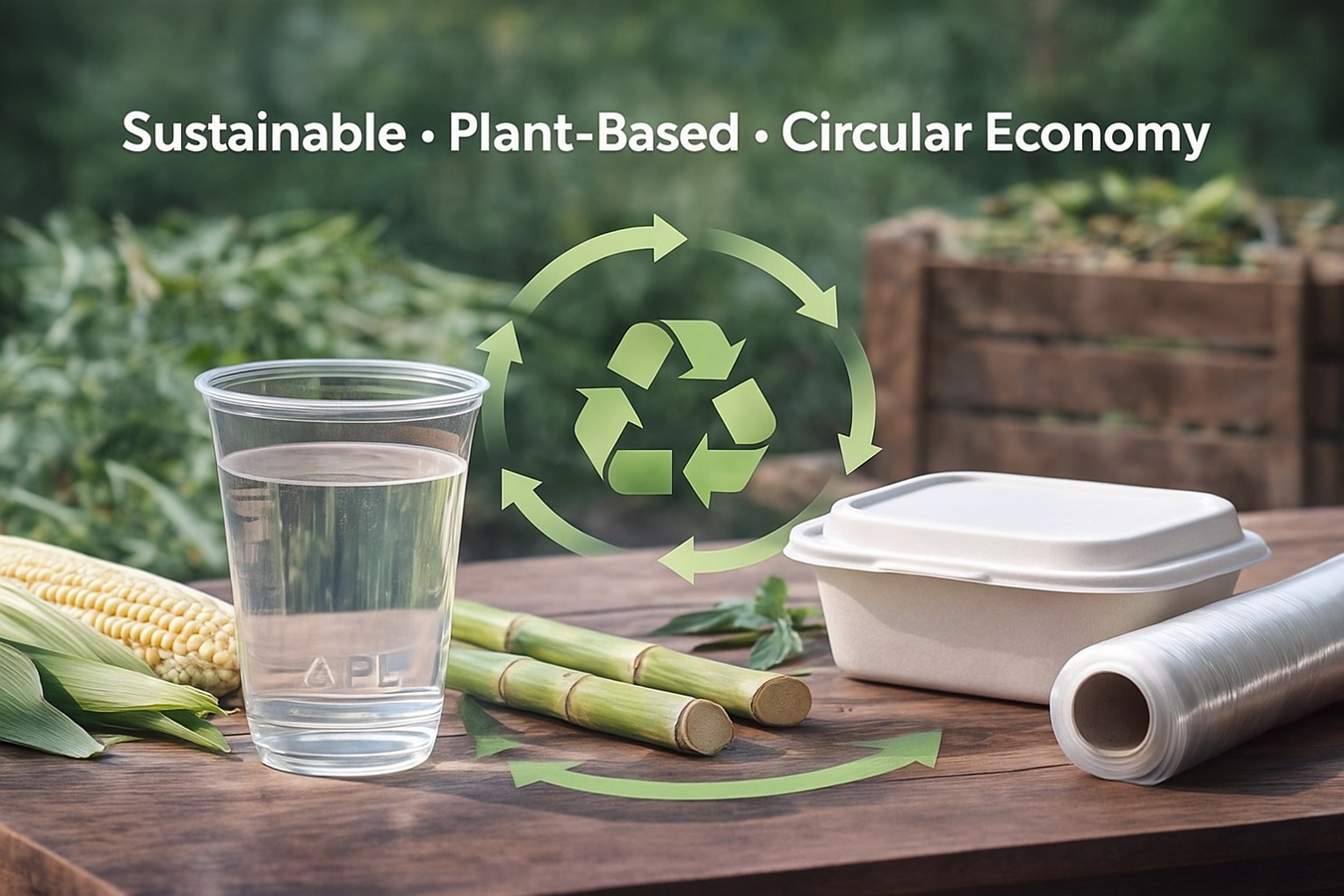
Why PLA Is Considered Sustainable — Environmental & Circular Economy Perspective
Biobased Carbon and Climate Benefits
PLA’s renewable-carbon origin can be useful in strategies that aim to reduce dependence on fossil feedstocks. However, the environmental result is application-specific. A lighter conventional package, a reusable system, a recyclable mono-material package or a certified compostable PLA product may each perform differently depending on manufacturing, transport, use and the actual waste system. Material labels should therefore be treated as inputs to life-cycle decisions, not as stand-alone proof of sustainability.
How Does PLA Actually Biodegrade?
PLA degradation is not simply a process in which microorganisms immediately consume an intact plastic item. Under suitable moisture and temperature conditions, degradation typically begins with hydrolysis: water breaks ester bonds in the polymer chains and lowers the molecular weight. As smaller molecules and oligomers are formed, microorganisms can further metabolize the degradation products.
This mechanism helps explain why temperature and moisture matter so much. Industrial composting can provide sustained thermophilic conditions that accelerate hydrolysis and biological conversion, while cool soil, marine environments and many landfill conditions do not provide the same combination of heat, moisture, aeration and microbial activity. A claim that PLA is “biodegradable” should therefore always be tied to a defined environment and timeframe.
Industrial Compostability Under EN 13432 and ASTM D6400
Industrial compostability is a property of a tested finished material or product under defined conditions, not a blanket characteristic that should automatically be assigned to every PLA article. Standards such as EN 13432 and ASTM D6400 evaluate multiple criteria for packaging or plastic products intended for industrial or municipal composting.
Importantly, biodegradation and disintegration are different test concepts. EN 13432 does not mean that every PLA package must achieve “90% biodegradation in 90 days.” The standard evaluates biodegradation over a defined test period as well as physical disintegration during composting, effects on the composting process and the quality of the resulting compost. ASTM D6400 similarly establishes requirements for plastics and products intended to be labeled as compostable in aerobic municipal or industrial facilities.
- Industrial conditions matter: managed composting normally uses elevated, controlled temperatures together with moisture and aeration.
- The finished article matters: inks, labels, adhesives, coatings, pigments and other components can affect certification scope.
- Facility acceptance matters: even a certified compostable product may not be accepted by every local organic-waste or composting program.
In home compost, cool soil, marine environments or landfills, PLA degradation is generally much slower and should not be assumed to match industrial-composting performance. Home-compostability, where claimed, requires separate product-specific evidence.
Biocompatibility and Food-Contact Safety

PLA and related polymers have a long history in biomedical research and applications, but biomedical use should not be treated as proof that a particular packaging article is automatically suitable for food contact. Food-contact assessment is a separate regulatory question that depends on the resin, additives, colorants, processing aids, finished article, food type, temperature and intended conditions of use.
For packaging buyers, the practical requirement is to verify the documentation applicable to the finished product and target market. Food-contact compliance and compostability are also separate claims: a cup can be food-contact compliant without being compostable, while an industrial-compostability certificate does not by itself establish food-contact suitability. Buyers should review both sets of evidence and the applicable certificates and compliance documents for the selected product where these claims are commercially relevant.
Supporting Circular Economy Strategies
PLA can support several circular economy pathways:
- Organic recycling (industrial composting): Certified PLA products may be suitable for collection with organic waste where local facilities explicitly accept certified compostable packaging.
- Mechanical recycling: Clean, well-sorted PLA can technically be reprocessed, but dedicated collection and sorting are not widely available in many markets.
- Chemical recycling: Depolymerization and related technologies can recover lactic-acid or lactide-based feedstocks, but commercial availability varies by region and should not be assumed as the default end-of-life route.
The key caveat is that none of these pathways is automatic. Without appropriate collection, sorting and treatment, PLA may be landfilled, incinerated or incorrectly mixed with another material stream. For this reason, a credible PLA strategy links the product’s certification and design with the actual local waste-management route.
Common Applications of PLA in Packaging, Consumer Goods & Beyond
Food Packaging and Single-Use Serviceware
PLA is widely used in foodservice and consumer packaging where clarity, stiffness and cold-use performance are valuable. Typical applications include:
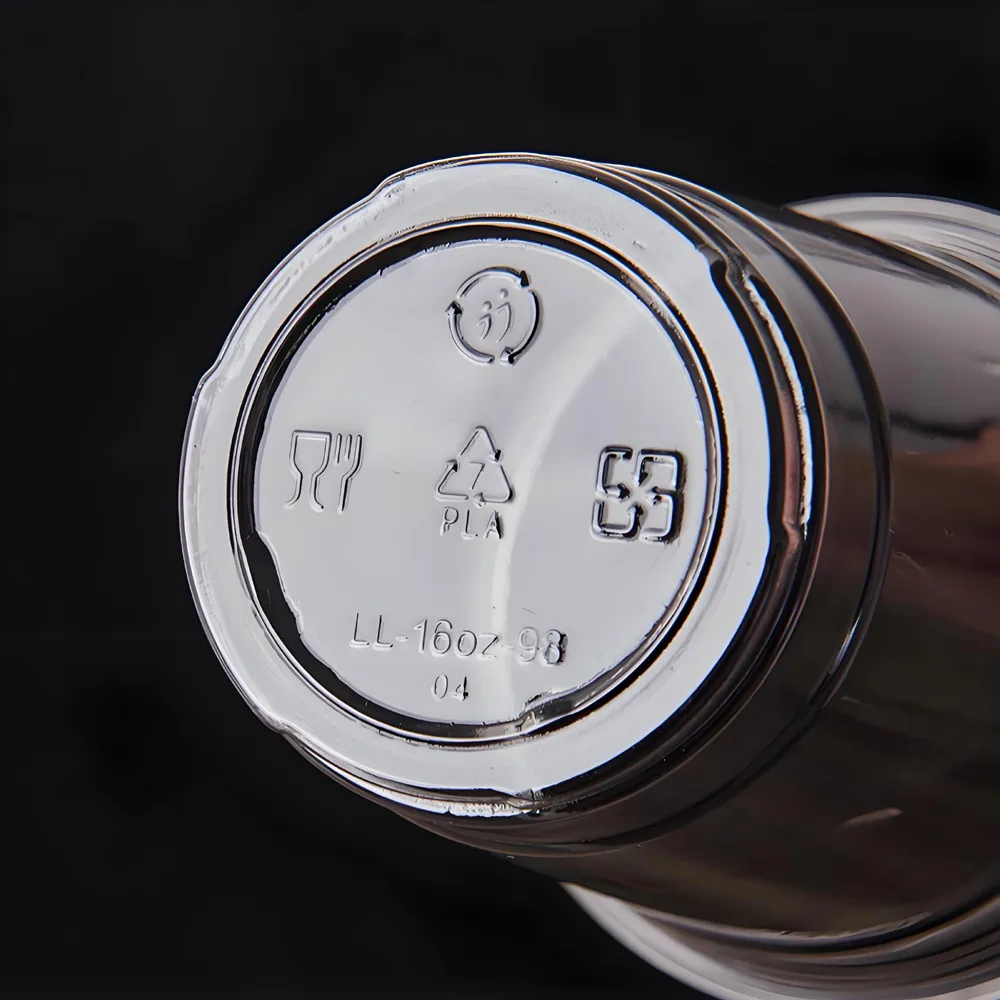 | 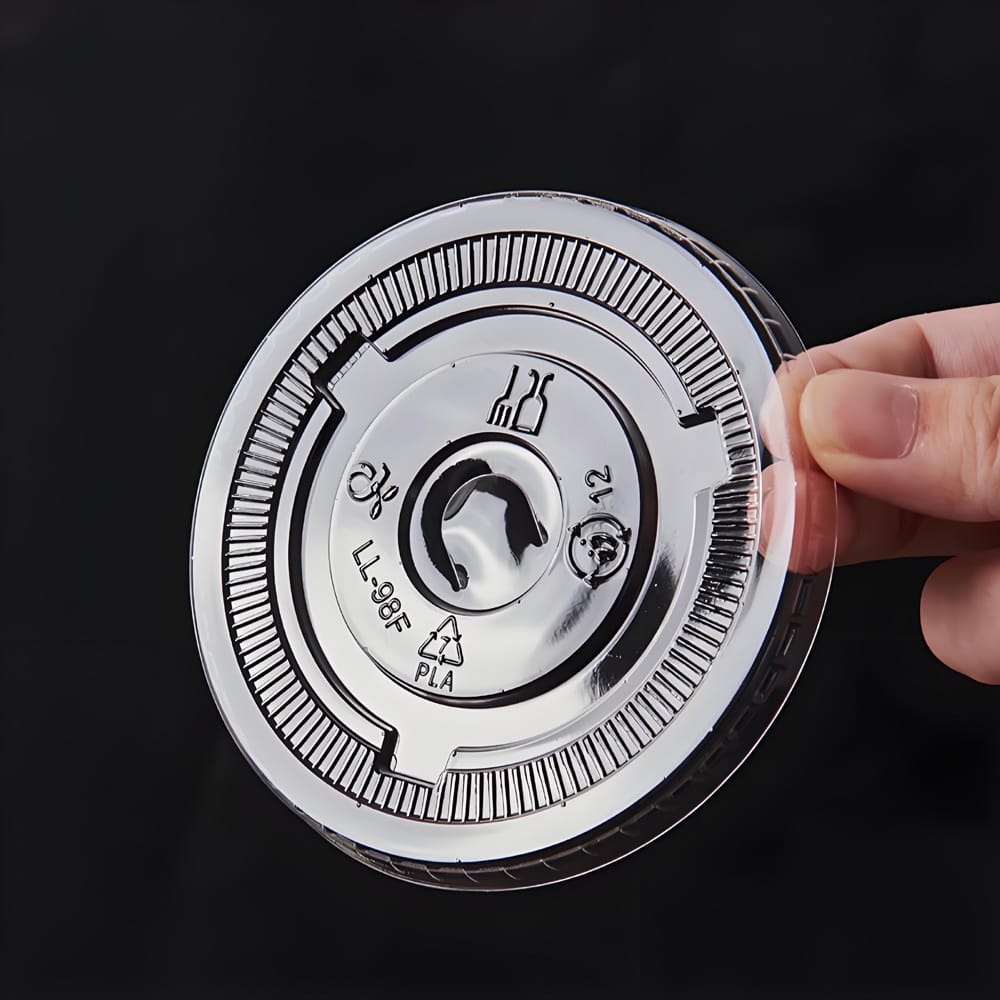 |
- Cold drink cups: Clear PLA cups for smoothies, iced coffee, juices, fruit tea and other cold beverages, often paired with compatible PLA or paper-based lids.
- Clamshell containers: Salad boxes, bakery clamshells and deli containers that benefit from transparency and stiffness.
- Portion and sauce containers: Small containers for dressings, condiments and tasting samples where the filling and service temperature are suitable.
- Cutlery and straws: In some markets, PLA-based or CPLA cutlery and selected straw formats are used where the product category and local rules allow them. Compostability does not automatically exempt these items from single-use-plastic restrictions.
These products can be relevant to quick-service restaurants, cafés, juice bars and institutional catering when the application is compatible with PLA’s temperature limits and the local waste system supports the intended end-of-life claim. Regulatory treatment must be checked by product category and jurisdiction rather than inferred from the material name alone.
PLA Cups and “Compostable Plastic Cups”
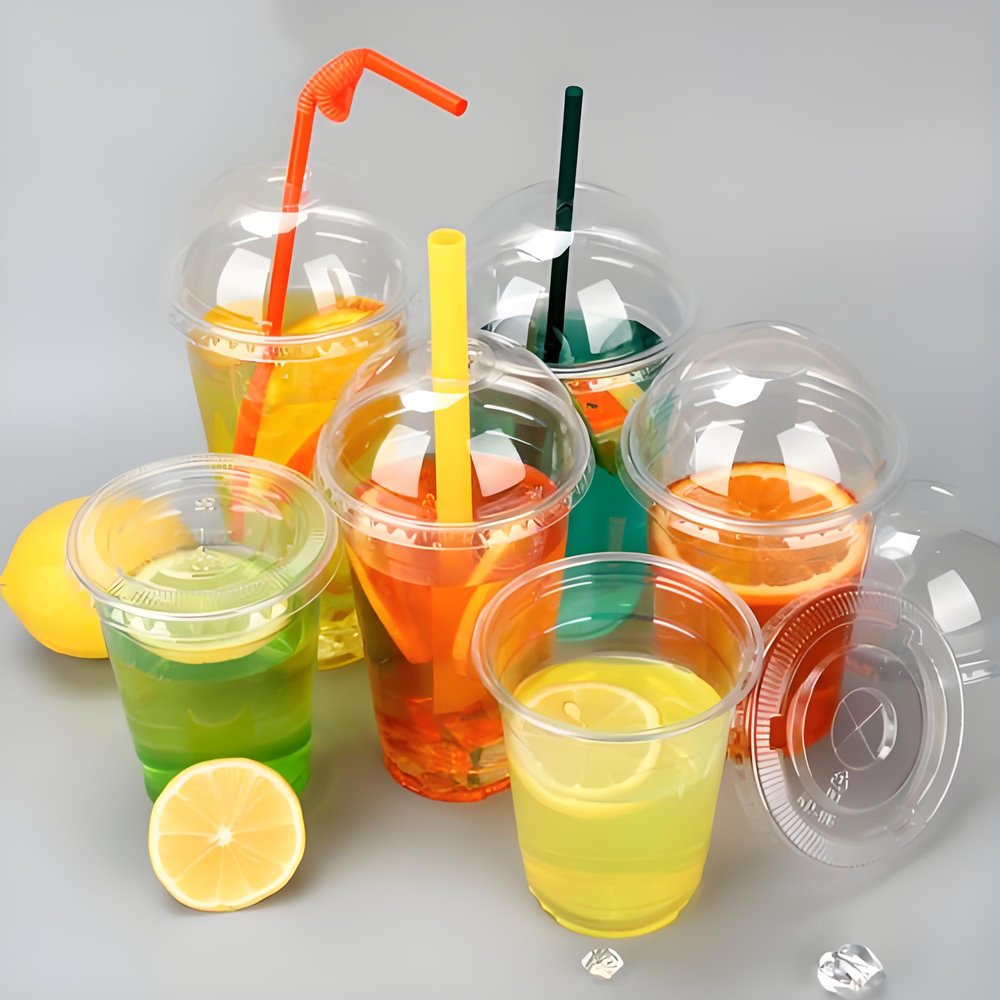
Among all PLA applications, clear PLA beverage cups are one of the most visible foodservice uses. They can support three practical priorities:
- Brand and product visibility: Transparency and gloss allow the beverage itself to remain visible and provide a surface for printing where the selected printing system is suitable.
- Operational compatibility: PLA cups can offer familiar handling and stacking characteristics similar to conventional clear cold cups, but storage, filling and service temperatures need to stay within the finished product’s specification.
- End-of-life positioning: Certified compostable PLA cups can support an industrial-composting program where appropriate collection and facility acceptance exist. Certification does not automatically create an exemption from single-use-plastic legislation.
Heat sensitivity is a core design limit. Standard clear PLA cups are intended for cold applications and should not be assumed suitable for freshly brewed coffee, tea, microwave heating or hot-fill use. The maximum recommended temperature should come from the product specification or relevant validation rather than from a generic PLA value. Businesses commonly pair PLA cold cups with appropriately designed paper cups and paper food packaging for hot beverage and hot-food applications.
Films, Bags and Flexible Packaging
PLA can also be converted into films and flexible structures for applications such as:
- Fresh-produce and salad packaging where clarity is important.
- Selected flow-wrap structures for bakery products, snacks or other foods when the required shelf life and barrier performance are compatible.
- Labels, sleeves and specialty packaging structures.
PLA films may be combined with other polymers, coatings or layers to improve flexibility, sealing or barrier properties. Once additional materials are introduced, however, compostability and recyclability should be evaluated for the complete structure rather than assumed from the PLA layer alone.
3D Printing, Consumer Goods and Medical Uses
Outside packaging, PLA is one of the most common materials for consumer FDM 3D printing. Its comparatively accessible processing window, low warping tendency and dimensional stability make it popular for prototypes, visual models, education and hobby applications. Emissions and ventilation requirements still depend on the formulation, printer conditions and additives, so “plant-based” should not be interpreted as emission-free.
In the biomedical sector, purified and specially formulated PLA and related copolymers have been used in applications such as absorbable medical devices and drug-delivery systems. These specialized applications demonstrate the versatility of PLA chemistry but should remain separate from claims about the regulatory suitability of packaging-grade PLA for food contact.
PLA vs Traditional Plastics & Other Bioplastics — Advantages and Limits
Key Advantages of PLA
Relative to conventional plastics like PS, PET and PP, PLA can offer several advantages when matched to the right application:

- Renewable, bio-based origin: commercial PLA can replace part of the demand for fossil-derived polymer feedstock.
- Industrial compostability pathway: certified finished PLA products may be suitable for industrial composting where the local system accepts them.
- Food-contact applications: appropriate PLA formulations can be used in food-contact articles when the finished material and intended conditions of use meet applicable requirements.
- Clarity and stiffness: transparent PLA can provide the visual appearance required for cold beverage and fresh-food packaging.
- Processing familiarity: PLA can be converted using established plastics-processing technologies, subject to grade-specific processing controls.
Material Limitations and Performance Gaps
PLA is not a universal replacement for all plastics:
- Limited heat resistance in standard clear grades: PLA’s glass-transition behavior limits many amorphous thermoformed products at elevated temperatures. Standard clear PLA cups should not be used for hot-fill, oven or microwave applications unless the specific finished product has been engineered and validated for that use.
- Brittleness: Without modification, PLA can have lower impact toughness than materials selected for repeated flexing, heavy impact or durable hinge applications.
- Moisture and barrier constraints: PLA’s water-vapor and gas-barrier performance may not meet every shelf-life requirement without additional design measures.
- Storage sensitivity: elevated temperatures during warehousing or transportation can affect some thermoformed PLA articles, so storage conditions are part of product performance.
- End-of-life infrastructure: compostability creates value only when the product reaches an appropriate facility that accepts it.
Comparing PLA to Other Bioplastics
Within the wider bioplastics family, PLA sits alongside materials such as PHA, starch-based blends, PBS and bio-based versions of conventional polymers.
- Versus PHA: PHA is a family of polymers, and certain PHA grades have demonstrated biodegradation under a broader range of environments than conventional PLA. Actual behavior depends on polymer composition, product thickness, formulation and test conditions. Commercial cost, availability and processing requirements also vary by grade.
- Versus starch-based blends: properties vary substantially with the resin formulation. Starch content should not be interpreted as proof that a finished product is plastic-free, home-compostable or made entirely from plant material.
- Versus bio-PET or bio-PE: these bio-based drop-in plastics use polymer chemistries compatible with the corresponding PET or PE recycling systems where those systems accept the article, but they are not inherently compostable. PLA uses a different polymer chemistry and therefore requires a different sorting and end-of-life strategy.
For decision makers, the comparison is less about declaring one polymer universally better and more about aligning material properties, product design, regulation and available end-of-life pathways with the intended application.
Systems Challenges: Infrastructure, Labelling and Consumer Behaviour
Some of PLA’s limitations are material-related, while others arise from collection, sorting and waste-management systems:
- Infrastructure gap: industrial composting facilities and dedicated PLA recycling systems are not universally available.
- Sorting and contamination concerns: PLA should not automatically be placed into PET or other conventional plastics streams. Sorting requirements depend on the local recycling system.
- Labelling confusion: consumers frequently confuse “bio-based,” “biodegradable,” “compostable” and “plastic-free.” Clear communication should state the appropriate disposal pathway rather than rely on broad environmental terminology.
For a business, the relevant question is therefore not only “Is the material compostable?” but also “Will the finished product actually be collected, accepted and processed through that pathway in the target market?”
The Future of PLA — Innovations, Industry Trends & What to Watch
Material Innovation: Tougher, Hotter, Smarter PLA

PLA development spans commercially available technologies, emerging formulations and research-stage approaches. Key directions include:
- Commercial and emerging heat-resistant grades: crystallization control, nucleating agents and stereocomplex approaches can increase heat resistance in selected PLA-based applications.
- Toughened PLA formulations: impact modifiers, elastomeric components and reinforcing materials can improve toughness, although changes in formulation may also change compostability, recycling behavior and certification scope.
- Research and specialty barrier structures: coatings, blends, nanocomposites and multilayer designs are being developed to improve oxygen, moisture or seal-performance requirements.
These developments can expand PLA’s application range, but performance claims should be made for the specific grade and finished product rather than generalized to all PLA.
Next-Generation Feedstocks and Land-Use Considerations
Research and development is also exploring ways to diversify the carbohydrate sources used to make lactic acid, including:
- Agricultural residues: straw, husks, bagasse and other lignocellulosic biomass as potential sources of fermentable sugars.
- Non-food biomass: alternative feedstocks intended to reduce direct reliance on food-grade crops.
- Integrated biorefineries: systems in which fuels, chemicals and polymer feedstocks are produced from shared biomass-processing infrastructure.
From a procurement perspective, next-generation feedstocks should be evaluated through traceable sourcing and life-cycle evidence. Agricultural-residue feedstocks are promising, but they should not be presented as mainstream commercial inputs unless the selected resin supplier documents their actual use.
Recycling and Chemical Depolymerization
Beyond composting, PLA can also be considered for dedicated recycling pathways. Mechanical recycling can reprocess sufficiently clean PLA streams, while chemical recycling approaches seek to depolymerize PLA into lower-molecular-weight intermediates or feedstocks suitable for further purification and reuse.
PLA depolymerization and purification pathways have been demonstrated at research, pilot and selected commercial scales. Their practical role depends on collection volume, contamination, economics, local infrastructure and regulatory treatment. Buyers should therefore treat chemical recycling as a developing pathway rather than assume it is available in every destination market.
Regulation, EPR and Plastic-Reduction Rules
Regulation can create demand for lower-impact packaging, but “compostable” does not mean “exempt from plastic rules.” Jurisdictions classify products differently, and the legal treatment of a PLA cup, lid, straw or utensil may depend on both the polymer and the product category.
- European Union: under the Single-Use Plastics framework, the definition of plastic includes bio-based and biodegradable plastics. A PLA or CPLA item is therefore not automatically outside the scope simply because it is compostable.
- EPR and packaging rules: producer-responsibility fees, labeling, recyclability or compostability requirements can apply independently of the material’s renewable origin.
- National and local rules: some markets create specific conditions or permitted uses for certified compostables, while others restrict particular single-use formats regardless of compostability.
For procurement teams, the safe approach is to evaluate the exact product format against the rules in the destination market and then verify the relevant certification and documentation. PLA can be part of a broader sustainable packaging strategy, but regulatory fit must be established product by product.
Summary & Recommendations — When PLA Makes Sense for Sustainable Packaging
Recap: What PLA Does Well
Used in the right context, PLA can offer a useful combination of properties:
- Commonly bio-based feedstock and reduced dependence on fossil polymer feedstocks.
- Good clarity and stiffness for transparent cold and ambient packaging.
- Food-contact applications when the finished article meets the applicable requirements.
- Industrial-compostability pathways for certified finished products where appropriate facilities accept them.
- Established converting technologies and broad commercial familiarity compared with many newer bioplastics.
Where PLA Is a Strong Strategic Fit
PLA is particularly well suited for:
- Cold beverage packaging: smoothies, juices, iced coffee, fruit tea and other cold-drink applications where transparent presentation is important.
- Fresh-food packaging: clamshells, deli containers, produce packaging and other transparent formats where the product requirements match PLA’s barrier and temperature characteristics.
- Controlled foodservice systems: applications where packaging choice, waste collection and industrial-composting acceptance can be coordinated.
- Verified environmental communication: applications where bio-based content or certified industrial compostability can be communicated accurately without implying home compostability, plastic-free construction or universal biodegradation.
When to Be Cautious or Combine PLA with Other Solutions
PLA is not ideal for:
- High-temperature use: hot beverages, hot-fill applications, ovens and microwave heating unless the specific product has been designed and validated for such use.
- Heavy-duty, durable applications: products requiring long service life, repeated mechanical stress or high impact performance may require another formulation or material.
- Markets without an appropriate end-of-life route: if certified compostables are not collected or accepted locally, the environmental case for choosing PLA should be evaluated against alternative packaging systems rather than assumed.
In these cases, companies should consider a portfolio approach using PLA only where its properties and end-of-life pathway fit the application, while using paper, molded fiber, reusable systems or conventional recyclable plastics where they are more appropriate. Buyers comparing multiple material systems can also review Bioleader®’s food packaging product portfolio across PLA, bagasse, paper, cornstarch and compostable cutlery.
Action Points for Procurement and Sustainability Teams
For organizations evaluating PLA today, practical next steps include:
- Confirm the application: beverage or food type, filling temperature, holding time, storage temperature and mechanical requirements.
- Check the complete packaging system: cup, lid, straw, label, print, adhesive and secondary components may follow different material or disposal rules.
- Verify food-contact evidence: review the documents applicable to the finished article, target market, food type and intended conditions of use.
- Verify compostability claims: check whether certification covers the finished product and whether the destination market has a compatible collection and industrial-composting route.
- Check local regulation: do not assume that PLA’s bio-based or compostable status exempts a single-use product from plastic restrictions.
- Plan storage and logistics: clear PLA articles can be sensitive to elevated warehouse, container and transport temperatures, so actual handling requirements should be confirmed with the supplier.
- Compare alternatives: assess reusable formats, paper, molded fiber, PET, PP and other materials where they better match the application or local waste system.
PLA is not a universal replacement for conventional plastic. Its value is strongest when the material’s actual properties, product certification, service conditions and end-of-life system are aligned.
PLA FAQ: Top Questions from Google Search
1. Is PLA actually plastic?
Yes. PLA is a thermoplastic polyester and is therefore a plastic. It is commonly bio-based because its feedstock can come from plant-derived sugars, but “bio-based” does not mean “plastic-free.”
2. Is PLA really biodegradable?
PLA can biodegrade under suitable conditions, but the environment and timeframe matter. Certified PLA products may meet industrial-compostability standards such as EN 13432 or ASTM D6400. This should not be interpreted to mean that PLA will rapidly disappear in soil, rivers, oceans or landfills.
3. Is PLA home compostable?
Not automatically. Industrial-compostability certification and home-compostability are different. Standard PLA often requires the higher and more stable temperatures available in industrial composting. A home-compost claim should be supported by separate product-specific certification or evidence.
4. Can PLA go into normal plastic recycling bins?
Usually not unless the local recycling program specifically accepts PLA. PLA uses different polymer chemistry and processing conditions from PET, HDPE and PP. Dedicated mechanical or chemical recycling is technically possible, but collection and sorting systems remain limited in many markets. Follow local waste guidance rather than placing PLA into a conventional plastics stream by assumption.
5. Is PLA safe for food and beverages?
PLA can be used for food-contact packaging when the resin, additives and finished article comply with the applicable food-contact requirements for the intended use. Safety should be verified from product-specific documentation and conditions of use. Biomedical applications of specialized PLA materials do not by themselves prove that a particular food package is compliant.
6. Can PLA cups be used for hot drinks?
Standard clear PLA cups are generally intended for cold drinks and should not be assumed suitable for hot coffee, tea, microwave heating or hot-fill applications. The practical service temperature of a finished cup depends on the PLA grade, crystallinity, wall structure, forming process and exposure time, so buyers should follow the product specification.
7. What is the difference between PLA and CPLA?
PLA is the broader polymer family. CPLA generally refers to crystallized PLA-based material formulated and processed to provide greater heat resistance than standard amorphous PLA. CPLA is commonly used for disposable cutlery, while clear PLA is commonly used for cold beverage cups and transparent food packaging. Actual heat resistance and compostability remain product-specific.
8. How does PLA compare to paper packaging in terms of sustainability?
PLA and paper solve different packaging needs. PLA provides plastic-like clarity and stiffness for cold cups, clamshells and films. Paper and molded fiber are useful for opaque cups, bowls, trays and other structures, but their coatings and barriers may affect recyclability or compostability. The better option depends on product performance, total material structure, local collection and processing infrastructure, and the evidence supporting any environmental claim.
Semantic Insight Block: How to Use PLA Strategically in a Plastic-Regulation World
How should businesses think about PLA in 2026 and beyond? Treat PLA as a material for defined applications rather than as a universal “eco plastic.” Its strongest packaging roles are those that benefit from clarity, stiffness, bio-based feedstock and a verifiable industrial-composting pathway, especially when the local collection system accepts certified compostable packaging.
Why is regulatory context so important? Material properties and legal status are different questions. In the European Union, for example, bio-based and biodegradable plastics can still fall within the Single-Use Plastics framework. In other markets, compostable products may face different labeling, certification, EPR or waste-management requirements. The exact product format and destination market must therefore be checked together.
What portfolio of options should a packaging team consider? A resilient strategy can combine PLA with paper, molded fiber, reusable systems and conventional recyclable plastics where those materials better match the product, temperature, logistics or waste system. No material should be selected solely because of a single environmental label.
Which options are most defensible for environmental communication? Claims are strongest when they connect a specific material or finished product to verifiable evidence: bio-based content where documented, food-contact documentation for the intended use, certified industrial compostability where applicable, and an actual local waste pathway.
What should buyers watch next? Key developments include improved heat-resistant PLA formulations, more robust recycling and depolymerization systems, wider use of non-food and residue-based feedstocks, and tighter rules governing environmental claims. These developments may expand PLA’s role, but their commercial relevance should be evaluated from current product data rather than assumed from research-stage technology.
References
- European Committee for Standardization (CEN) – EN 13432, Packaging: requirements for packaging recoverable through composting and biodegradation.
- ASTM International – ASTM D6400, Standard Specification for Labeling of Plastics Designed to be Aerobically Composted in Municipal or Industrial Facilities.
- European Commission – Directive (EU) 2019/904 on the reduction of the impact of certain plastic products on the environment and Commission guidance on single-use plastic products.
- European Commission – EU policy framework on bio-based, biodegradable and compostable plastics, including the distinction between bio-based origin and end-of-life behavior.
- U.S. Food and Drug Administration (FDA) – Food-contact substance framework and conditions of use for substances and articles that contact food.
- European Bioplastics – Technical guidance on biodegradable and compostable plastics, industrial composting and environmental claims.