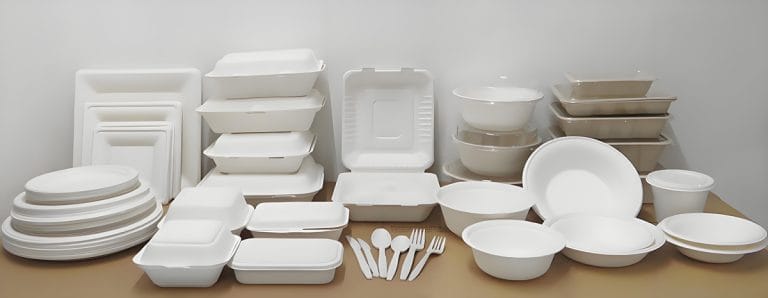
PLA Food Containers: Key Advantages Explained | Bioleader® Guide

Actionable coverage of PLA food containers: eco-friendly, biodegradable, compostable materials, performance data, and compliance under EN13432 & ASTM D6400. Includes BPI/TÜV references and Food-Contact Tested guidance for safe deployment. Buyer-focused: manufacturer insights, bulk/wholesale buying playbooks, OEM/ODM customization tips, full size range selection.
Quick Summary:
PLA (polylactic acid) is a plant-based, compostable bioplastic made from fermented sugars such as corn, sugarcane or cassava. It offers good clarity, stiffness and food-contact safety, making it popular for cold cups, clamshells, films and 3D-printing filaments. Under industrial composting conditions, PLA can break down into CO₂, water and biomass, helping reduce reliance on fossil-based plastics. However, it has limited heat resistance, needs dedicated composting or recycling infrastructure, and must be matched carefully with each market’s 2025–2026 plastic-ban and EPR regulations.
PLA food containers — Quick Summary
  • Items displayed (articles): 12
  • Last updated: 2025-12-02
  • Includes test data, compliance guides, buyer FAQs, and real-world use cases.

Editor’s Picks: Top Pla Food Containers Guides 2026

FAQ of Bioleader's Eco-friendly Disposable Tableware

Can these bowls be microwaved?

Yes! These eco-paper bowls are safe to use in the microwave making it easy for their customers to warm food that is in them , PLA food containers.

Are the bowls microwave- and freezer-safe?

Yes, our biodegradable bowls are both microwaveable and freezer-safe, maintaining their structure and food safety even under temperature variations.

Material: Kraft Paper and White Cardboard Paper

Our eco-friendly disposable bowls contain primarily 2 materials that are used to make the bowls that are kraft paper and white cardboard paper. Both of the materials are durable and environmentally friendly. Kraft paper has a coarse natural appearance while white cardboard paper has a smooth, sleek surface — PLA food containers. All of these materials are biodegradable which ensures compliance with the highest environmental requirements in product manufacture.

a) Passive & Biodegradable Sensors

Recent research focuses on biodegradable, flexible sensors that can be printed directly onto molded fiber trays, paperboard, or PLA films. These include gas sensors (for O₂, CO₂, ethylene) and humidity detectors using natural polymers or metallic nanoparticles. Example: He et al., 2024 engineered a stretchable, battery-free sensor system that monitors gas changes in real time within fish packaging, linked to a colorimetric indicator patch. This technology enabled 14-day shelf life for fresh fish—double that of standard packaging—while remaining fully compostable (He et al., 2024).

b) Active Compound Integration

Oxygen scavengers, anti-fungal, and slow-release antimicrobial layers are now being integrated into biodegradable trays using natural extracts (e.g., green tea polyphenols, silver nanoparticles) as shown in a 2023 EFSA study (EFSA Journal, 2023). These systems are especially effective for high-risk products like seafood, pre-cut fruit, and ready meals , PLA food containers.

Related Insights

🚀Ready to Go Green and Choose ?

Join the global movement toward zero-waste packaging.


Bioleader® offers:

  • 📦 Bulk order support & fast delivery

  • ✍️ Custom branding and OEM solutions

  • 🌍 Worldwide eco-packaging compliance

Get the Catalogue Products List  & Contact Us Now! 👉

Contact us Below

Click or drag files to this area to upload.You can upload up to 5 files.
The more details you share, the faster and more accurate our quotation will be.