Micro Summary: Compostable Food Container Procurement in the UAE & Saudi Arabia
In the UAE and Saudi Arabia, compostable food container procurement is driven by food-contact safety, certified compostability, and import compliance rather than sustainability claims alone.
Buyers must verify food-contact regulations such as (EC) No 1935/2004 and (EU) No 10/2011 through SGS migration testing, while also confirming compostability certifications including EN 13432, OK Compost, and BPI.
Materials such as bagasse molded fiber, PLA cold cups, and CPLA cutlery perform differently under Middle Eastern conditions, making supplier capability and documentation readiness critical for long-term sourcing success.
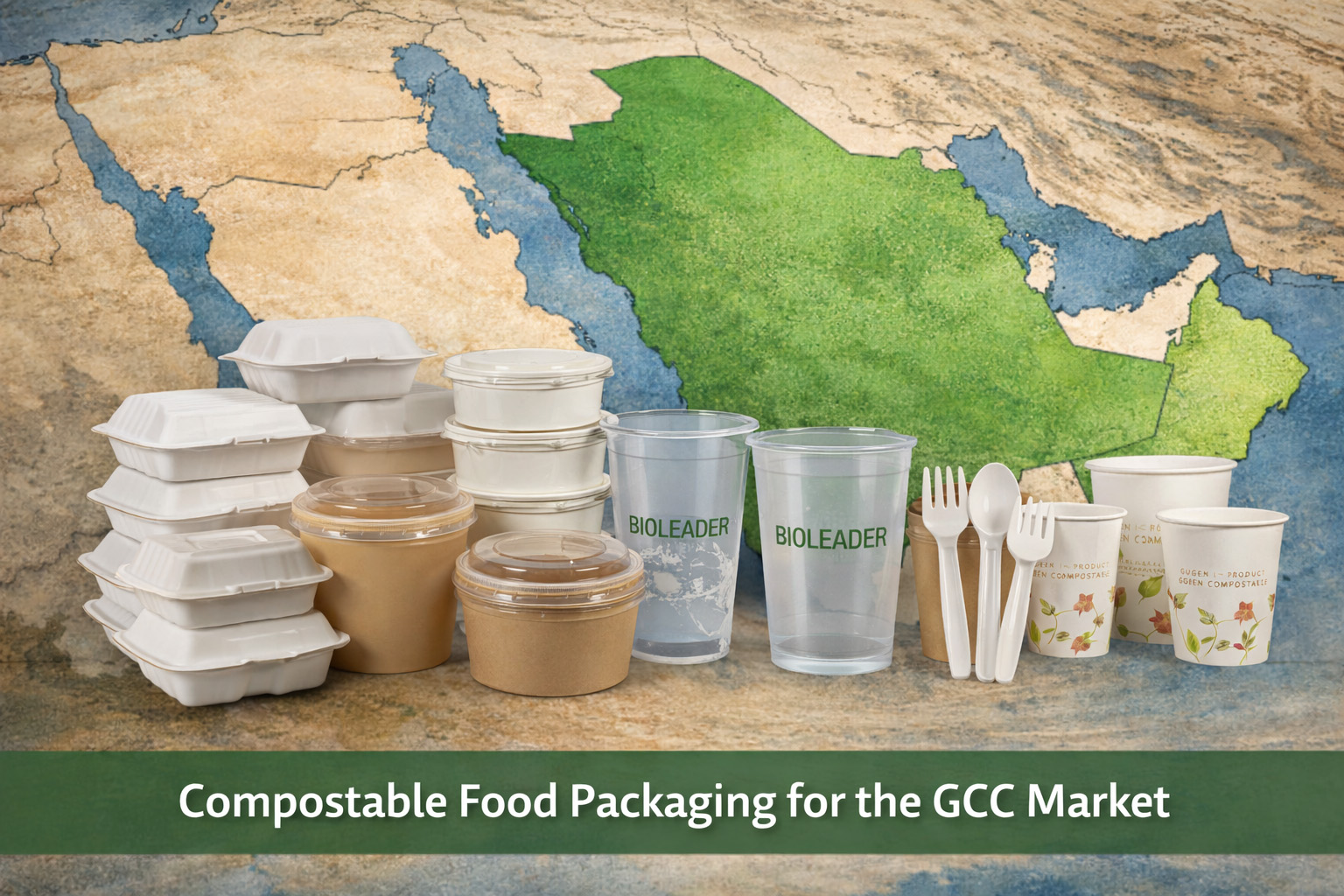
(A) Executive Snapshot: Compostable Food Packaging Procurement in the GCC
In the UAE and Saudi Arabia, compostable food packaging is no longer a niche sustainability initiative.
It has become a compliance-driven procurement category shaped by plastic reduction policies, food-contact regulations, and increasingly strict import inspection practices.
For restaurant groups, cloud kitchens, catering companies, and packaging wholesalers, choosing compostable food containers involves far more than selecting “eco-friendly” materials. Buyers must evaluate food-contact safety, SGS-tested compliance, material performance under Middle Eastern conditions, and supplier reliability at scale.
This guide explains how B2B buyers in the GCC should systematically select compostable food container suppliers—focusing on what works in practice, what regulators expect, and what reduces long-term risk.
(B) Why the Middle East Is a High-Risk but High-Opportunity Market (UAE & Saudi Arabia)
The GCC foodservice market is expanding rapidly, driven by:
Strong growth of QSR and fast-casual chains
Proliferation of cloud kitchens and delivery platforms
High per-capita foodservice consumption
A heavy reliance on imported food packaging
At the same time, the region presents unique operational and regulatory challenges:
High ambient temperatures
Oil-rich cuisines
Long delivery distances
Customs inspections that prioritize documentation clarity
Unlike some Western markets, the UAE and Saudi Arabia are highly documentation-sensitive.
Products that are widely used elsewhere may face delays or rejection if certificates, migration test reports, or material declarations are incomplete.
For B2B buyers, this makes supplier selection a risk management decision, not just a cost comparison.
(C) What “Compostable Food Containers” Really Mean in the Gulf Region
A common misconception among buyers is assuming that “compostable” automatically guarantees acceptance in the GCC.
In practice, two independent dimensions are evaluated:
Food-contact safety and migration compliance
Compostability and sustainability claims
In the UAE and Saudi Arabia, food-contact compliance always takes priority.
Food-Contact Compliance: The Non-Negotiable Requirement
Regulation (EC) No 1935/2004 – Food Contact Materials Framework
Regulation (EC) No 1935/2004 establishes the fundamental safety requirements for materials intended to come into contact with food.
Although it is an EU regulation, it is widely referenced by importers, consultants, and authorities in the GCC.
It requires that food-contact materials:
Do not endanger human health
Do not change food composition
Do not affect taste or odor
Are traceable and supported by documentation
Regulation (EU) No 10/2011 – Plastics and Biodegradable Plastics
For plastic and biodegradable plastic products, including:
CPLA cutlery (forks, spoons, knives)
compliance with Regulation (EU) No 10/2011 is critical.
This regulation focuses on migration limits, including:
Overall migration
Specific migration
Heavy metal migration
A key point often overlooked by buyers:
Many biodegradable plastics still require full migration testing under EU No 10/2011, especially for hot food or oily applications.
 |  | 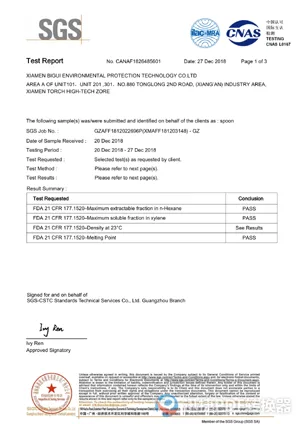 |
SGS Test Reports: A Practical Requirement in the GCC
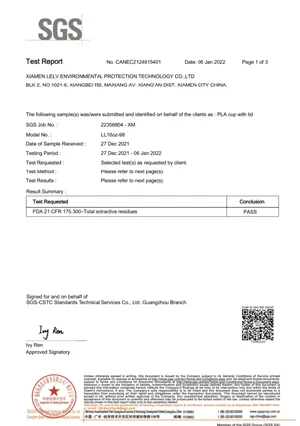
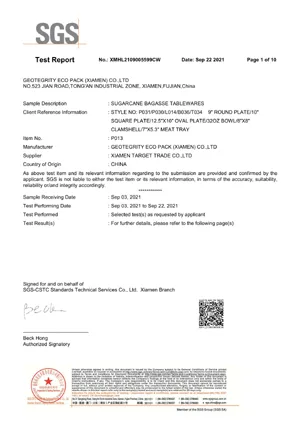
In real procurement practice, many UAE and Saudi buyers request an SGS test report covering both:
(EC) No 1935/2004
(EU) No 10/2011
Such SGS reports typically include:
Overall migration testing under defined temperature and time conditions
Heavy metal migration testing
Clear identification of tested material (PLA, CPLA, plastic-lined paper)
Without a valid SGS migration test report aligned with EU No 10/2011, plastic and biodegradable plastic food-contact products may face increased scrutiny or delays during GCC import inspection.
Some export-focused manufacturers, such as Bioleader, provide combined SGS documentation packages covering food-contact compliance and migration testing to simplify approval for Middle Eastern buyers.
Compostability Certifications
In addition to food-contact safety, compostable food containers are often supported by third-party compostability certifications.
These certifications validate environmental claims but do not replace food-contact compliance requirements.
- EN 13432 – European standard for industrial compostability, widely recognized by international buyers and frequently referenced in GCC procurement.
- OK Compost (Industrial / Home) – Issued by TÜV Austria, confirming compostability under controlled composting conditions.
- BPI Certification – Commonly requested for products supplied to North American brands and global foodservice operators.
(D) Material Selection: What Works Best for Middle Eastern Foodservice
The Middle East is a high-heat, high-oil, delivery-heavy foodservice environment.
Material choice must be based on performance, not perception.
Bagasse Food Containers (Molded Fiber / Pulp)
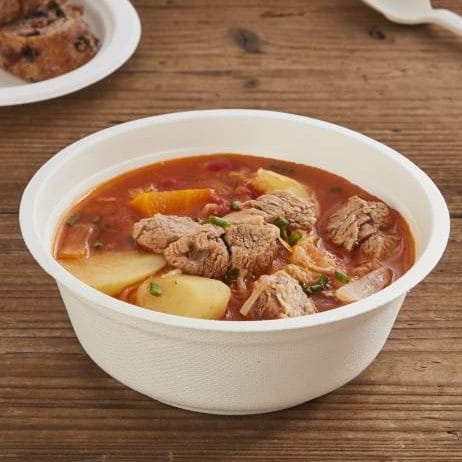
Bagasse food containers are molded fiber products made from sugarcane residue. They offer high heat and oil resistance, structural stability for hot meals, and are plastic-free, making them suitable for compostable foodservice applications in high-temperature environments.
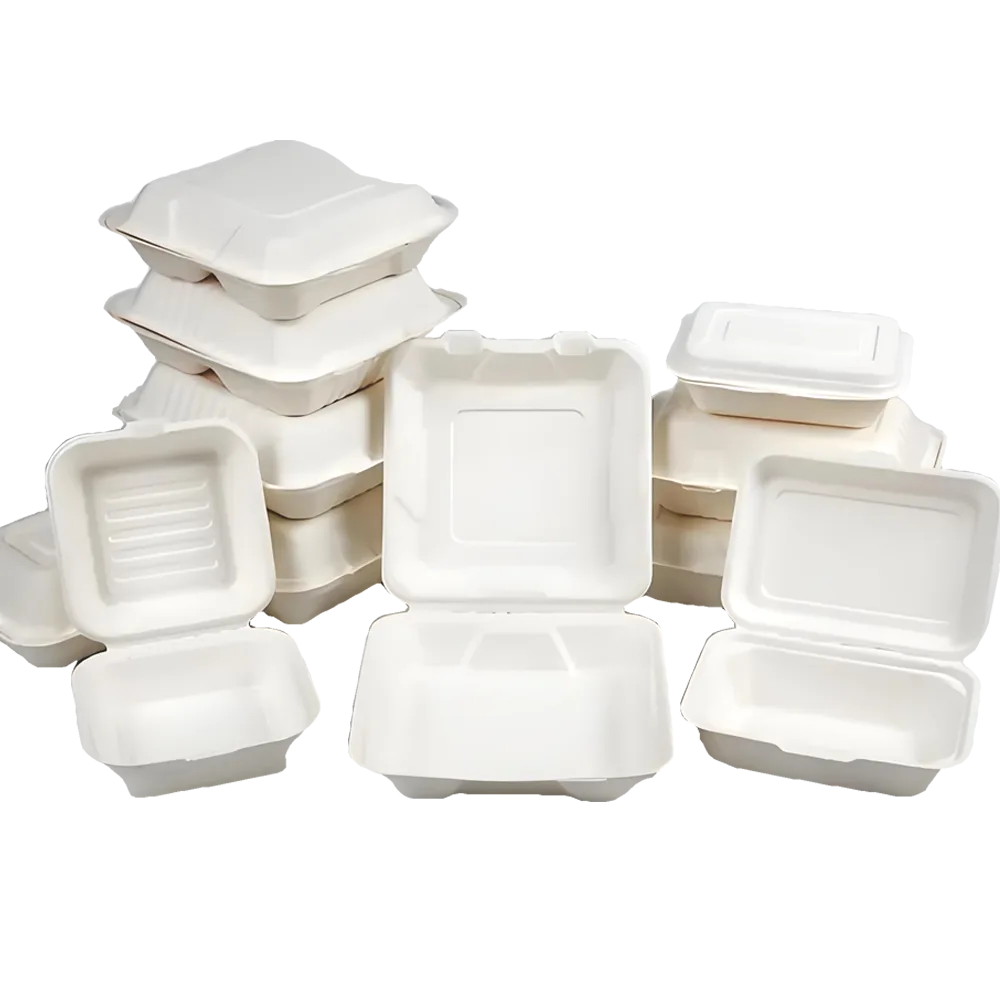 | 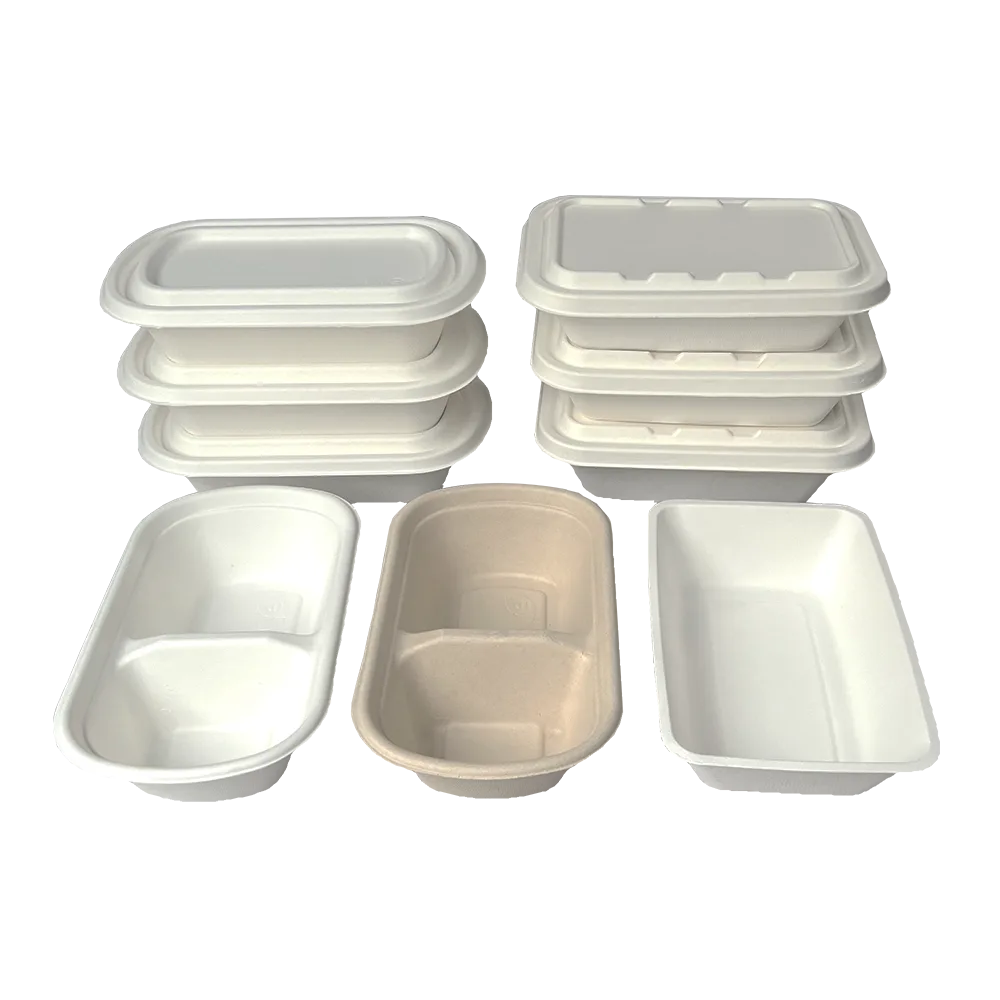 |
Bagasse containers are widely regarded as the most reliable compostable solution for the GCC.
Why they work well:
High heat resistance
Excellent oil and moisture tolerance
Strong structural integrity
No plastic content (not subject to EU No 10/2011)
Typical use cases:
Rice dishes
Grilled meats
Arabic and South Asian cuisine
Cloud kitchens and catering
For many UAE and Saudi buyers, bagasse clamshells and bowls are the default choice for hot food delivery.
Paper Bowls and Paper Cups
Paper bowls and cups are fiber-based food containers typically coated with water-based or PLA linings. Their performance depends on coating type, with plastic-lined paper requiring migration testing for food-contact compliance in regulated import markets.
 |  |
Paper-based containers are common but require careful evaluation.
Key considerations:
Type of coating (water-based vs PLA lining)
Resistance to oil penetration
Performance under high temperatures
Paper products with PLA lining are considered plastic food-contact materials and therefore require EU No 10/2011 compliance and SGS migration testing.
PLA Transparent Cold Cups (PLA Cups)
PLA cups are transparent food-contact containers made from plant-based bioplastic. They are designed for cold beverages only and must comply with EU No 10/2011 migration limits, including overall and heavy metal migration testing, for safe commercial use.

PLA cups are increasingly used for:
Cold beverages
Iced coffee
Fresh juices
However, PLA is not suitable for hot liquids.
For UAE and Saudi import:
PLA cups must comply with EU No 10/2011
SGS overall and heavy metal migration testing is strongly recommended
This is especially important for distributors supplying beverage chains.
CPLA Cutlery (Fork, Spoon, Knife)
CPLA cutlery is heat-resistant compostable cutlery produced from crystallized PLA. It performs better than standard PLA for hot food applications and is classified as plastic food-contact material, requiring EU No 10/2011 compliance and migration testing.

CPLA cutlery offers higher heat resistance than standard PLA and is suitable for hot food.
Key points:
Classified as plastic food-contact material
Requires EU No 10/2011 compliance
SGS migration testing is critical
CPLA cutlery is often chosen as a performance upgrade over conventional plastic cutlery.
(E) Key Certificates and Documents UAE / Saudi Buyers Should Request
For GCC procurement, missing documentation is one of the most common causes of shipment delays.
Essential documentation checklist
Food Contact & Safety
- Regulation (EC) No 1935/2004 compliance declaration
- Regulation (EU) No 10/2011 compliance (PLA / CPLA / plastic-lined paper)
- SGS overall migration test
- SGS heavy metal migration test
Compostability (Optional but Valuable)
- EN 13432
- ASTM D6400
- BPI
- OK- Compost Home or OK-Compost Industrial
In the UAE and Saudi Arabia, these certifications are typically treated as supporting sustainability credentials, while food-contact safety and migration testing remain the primary import clearance criteria.
Trade & Import
- Certificate of Origin
- HS code list of different kind materials of biodegradable tableware
- Packing list and material declaration
Some experienced exporters, including Bioleader, consolidate these documents into a single compliance package to reduce buyer-side risk during customs clearance.
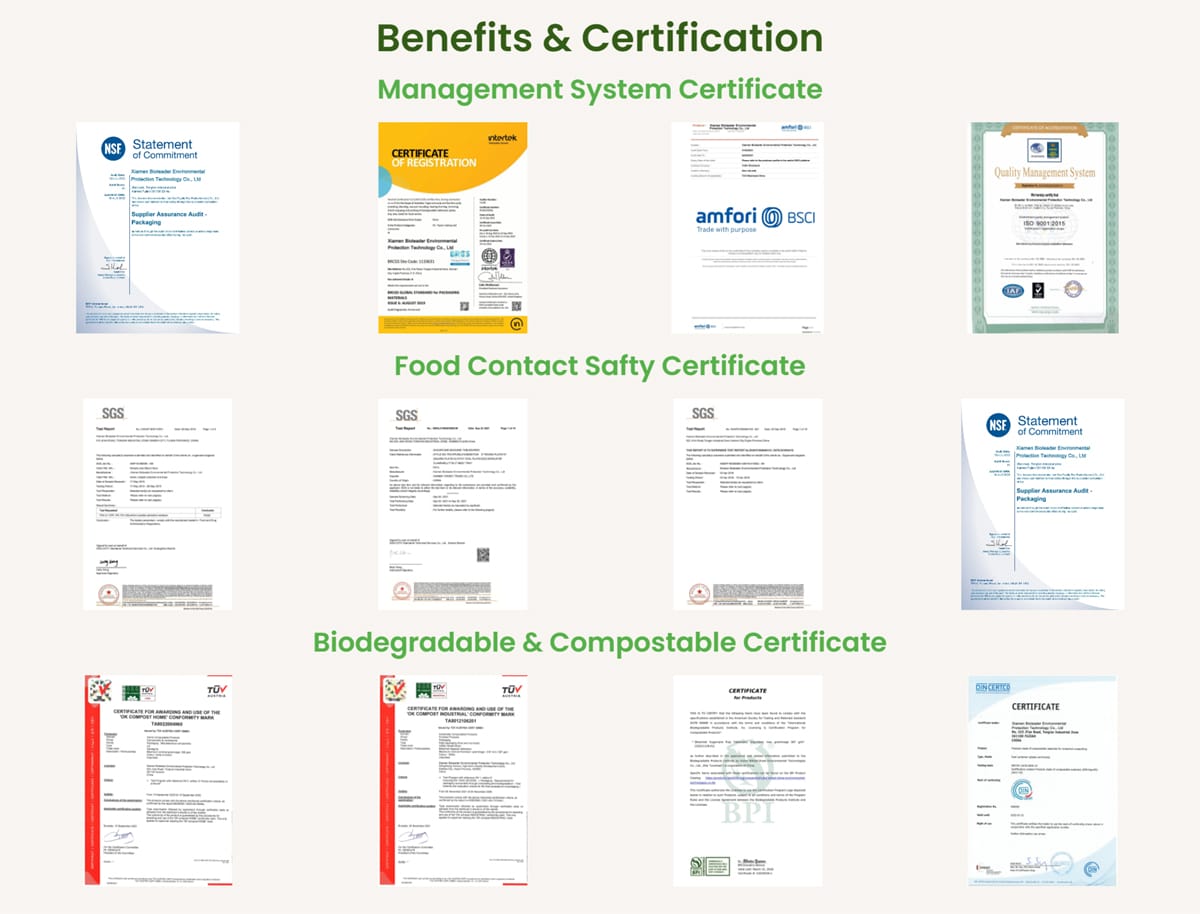
UAE & Saudi Arabia Import Compliance Reference Table (Foodservice Packaging)
| Certificate / Report | Applicable Materials | Purpose | Importance for UAE / Saudi Import |
|---|---|---|---|
| (EC) No 1935/2004 | All food-contact materials | Food-contact safety framework regulation | Essential reference standard for GCC food-contact compliance |
| (EU) No 10/2011 | PLA, CPLA, plastic-lined paper | Migration limits for plastics and biodegradable plastics | Critical for plastic-based food-contact products |
| SGS Migration Test Report | PLA, CPLA, plastic-lined paper | Overall and heavy metal migration verification | Commonly requested by importers and inspectors |
| EN 13432 | Bagasse, compostable plastics | Industrial compostability certification | Supports sustainability claims |
| OK Compost | Bagasse, compostable plastics | Third-party compostability validation | Widely recognized internationally |
| BPI Certification | Compostable plastics, fiber products | Compostability verification (North America) | Relevant for global and franchise brands |
(F) How to Evaluate Compostable Food Container Suppliers (B2B Checklist)
For UAE and Saudi buyers, supplier capability matters more than marketing claims.
Key evaluation criteria:
Manufacturing capability (not trading-only)
Proven export experience to GCC markets
Stable production capacity and lead times
Consistent quality control
Ability to supply multiple materials under one compliance framework
Suppliers like Bioleader that offer bagasse containers, paper products, PLA cups, and CPLA cutlery within a unified documentation system significantly reduce procurement complexity.

(G) Price vs Risk: Why the Cheapest Supplier Often Costs More
While price remains important, experienced buyers understand that hidden risks often outweigh small unit cost differences.
Common risks include:
Customs delays due to missing documents
Rejected shipments
Customer complaints due to leakage or deformation
Inconsistent quality across batches
In the GCC market, reliability and compliance often deliver lower total cost of ownership than the lowest quoted price.
(H) Typical Use Cases in the UAE and Saudi Market
QSR and fast-casual restaurant chains
Cloud kitchens and delivery-only brands
Event catering and corporate dining
Packaging wholesalers and import distributors
Across these segments, bagasse food containers, PLA cold cups, and CPLA cutlery are commonly combined to meet both hot and cold food requirements.
(I) Strategic Recommendations for 2025–2027 Procurement Planning
Prioritize food-contact compliance over marketing claims
Request SGS reports covering EU 1935/2004 and EU 10/2011
Standardize SKUs to simplify customs clearance
Build long-term partnerships with export-ready manufacturers
Treat compostable packaging as a compliance asset, not just a sustainability label
(J) Conclusion: Choosing the Right Supplier Is a Strategic Decision
In the UAE and Saudi Arabia, compostable food container sourcing is not merely an environmental decision.
It is a strategic choice that affects regulatory compliance, logistics efficiency, and brand credibility.
Foodservice companies and distributors that focus on material performance, SGS-tested compliance, and supplier reliability will be best positioned as sustainability and plastic reduction requirements continue to tighten across the GCC.
How to Select Compostable Food Container Suppliers in the GCC
How should buyers evaluate suppliers?
By verifying food-contact safety through SGS-tested compliance with EC No 1935/2004 and EU No 10/2011, while confirming compostability certifications such as EN 13432, OK Compost, or BPI.
Why does documentation matter more than material labels?
In the UAE and Saudi Arabia, incomplete or unclear documentation is one of the most common causes of customs delays and shipment risk.
What materials perform best in Middle Eastern foodservice?
Bagasse molded fiber for hot meals, PLA cups for cold beverages, and CPLA cutlery for heat-resistant applications provide the most reliable performance.
What should buyers avoid?
Over-reliance on sustainability claims without verified migration testing or compostability certification.
What defines a reliable long-term supplier?
Export experience to GCC markets, multi-material capability, stable production capacity, and consolidated compliance documentation.
Frequently Asked Questions
1. Do foodservice companies in the UAE and Saudi Arabia need compostability certification for food containers?
Compostability certifications such as EN 13432, OK Compost, or BPI are generally used to support sustainability claims rather than import clearance.
In the GCC region, food-contact safety and migration compliance are usually prioritized, while compostability certification is treated as an additional credibility factor, especially for international or franchise brands.
2. Is an SGS test report required when importing compostable food containers into the GCC?
An SGS test report is not always a legal requirement, but it is commonly requested by importers, distributors, and inspectors in the UAE and Saudi Arabia.
SGS reports covering (EC) No 1935/2004 and (EU) No 10/2011 help demonstrate food-contact safety and significantly reduce the risk of customs delays or additional inspections.
3. Which compostable materials are most suitable for hot food delivery in the Middle East?
For hot and oily foods, bagasse molded fiber containers are widely preferred in the Middle East.
They offer high heat resistance, strong structural stability, and do not rely on plastic coatings, making them reliable for Arabic cuisine, rice-based meals, and long-distance delivery.
4. Are PLA cups and CPLA cutlery considered plastic food-contact materials?
Yes. PLA cups and CPLA cutlery are classified as plastic food-contact materials under EU regulations.
As a result, they are subject to (EU) No 10/2011 migration requirements, including overall migration and, where applicable, heavy metal migration testing, particularly for commercial foodservice use.
5. What should distributors and wholesalers look for when selecting a compostable food container supplier for the GCC market?
Distributors should prioritize suppliers with proven export experience to the GCC, complete food-contact documentation, SGS-tested compliance, stable production capacity, and the ability to supply multiple materials—such as bagasse containers, PLA cups, and CPLA cutlery—under a unified compliance framework.
Copyright Notice:
© 2026 Bioleader®. If you wish to reproduce or reference this content, you must provide the original link and credit the source. Any unauthorized copying will be considered an infringement.