








Revision note: This article was updated after the 12 August 2026 PPWR application date to reflect the Regulation’s current application status, the European Commission’s June 2026 guidance, the Commission’s August 2026 PPWR FAQ, the three PFAS limit values and stepwise enforcement approach, PFAS stock-transition rules, conditional recyclability and recycled-content dates, harmonised-labelling timelines, importer duties, and subsequent corrections to Commission Implementing Decision (EU) 2026/1425.
Quick Summary: Regulation (EU) 2025/40 on packaging and packaging waste, commonly known as the EU PPWR, entered into force on 11 February 2025 and has applied since 12 August 2026.
The EU PPWR is now applicable, but many operational requirements have separate later or conditional application dates. For food-contact packaging, the PFAS limits in Article 5(5) have applied since 12 August 2026. The Commission’s 2026 guidance also provides a stepwise enforcement approach beginning with Total Fluorine screening and confirms that there is no special stock-exhaustion transition for food-contact packaging containing PFAS that is placed on the EU market after that date.
Importers, manufacturers, own-brand operators, distributors, and packaging suppliers should prepare product-level technical files, conformity documentation, traceability data, PFAS evidence for food-contact packaging, and implementation plans for recyclability, recycled content, labelling, compostability, packaging minimisation, EPR, and deposit-return requirements.
Several major deadlines are conditional. Recyclability grades A, B, or C generally become mandatory from 1 January 2030 or 24 months after the relevant delegated acts enter into force, whichever is later. Plastic recycled-content requirements apply from 1 January 2030 or three years after the relevant implementing act enters into force, whichever is later.
The Commission’s deadline for adopting harmonised-labelling rules is not the same as the date when every package must carry the final label. Most harmonised packaging material labels apply from 12 August 2028 or 24 months after the relevant implementing acts enter into force, whichever is later.
For product-specific certificate availability, test reports, and document scope, buyers should review the Bioleader® certificates and test reports page and request confirmation for the selected SKU and destination market.
Compliance note: This article is an implementation and procurement guide. It does not replace product-specific conformity assessment, national EPR review, or professional legal advice.
Executive Summary—What You Must Do, and by When
For importers and private-label brands, PPWR compliance is a product-data and supplier-control project, not only a packaging-design project.
- Know the law: The Packaging and Packaging Waste Regulation is Regulation (EU) 2025/40. It was published in the Official Journal on 22 January 2025, entered into force on 11 February 2025, and has applied since 12 August 2026.
- Prepare conformity files: Manufacturers must complete the applicable conformity assessment, prepare the Annex VII technical documentation, and draw up an EU declaration of conformity. Importers must verify that the required steps have been completed before placing packaging on the EU market.
- Design for recycling: Packaging must achieve recyclability grades A, B, or C from 1 January 2030 or 24 months after the relevant delegated acts enter into force, whichever is later. From 1 January 2038, packaging generally must achieve grade A or B.
- Plan for recycling at scale: In addition to design-for-recycling requirements, the recycled-at-scale requirement is scheduled from 1 January 2035 or five years after the relevant implementing acts enter into force, whichever is later.
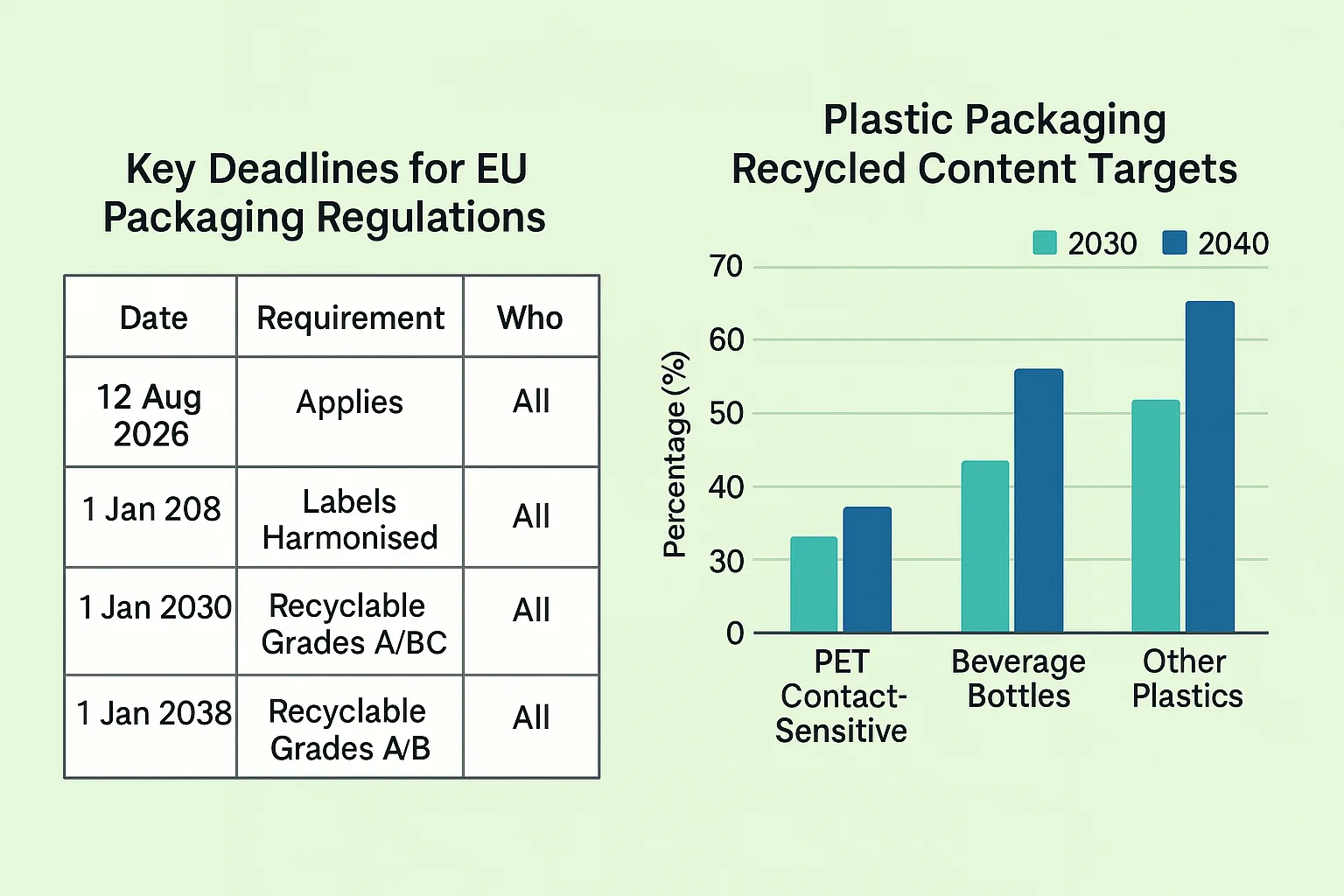
- Prepare for mandatory recycled content: The 2030 minimums are 30% for PET contact-sensitive packaging, 10% for other contact-sensitive plastic packaging, 30% for single-use plastic beverage bottles, and 35% for other plastic packaging, subject to applicable exemptions and the conditional date in Article 7.
- Check compostable formats: By 12 February 2028, permeable tea, coffee, or other beverage bags, soft after-use single-serve units, and sticky labels attached to fruit and vegetables must comply with the applicable industrial-composting standard. Home-composting compatibility is also required where a Member State requires it.
- Separate rulemaking dates from business deadlines: The PPWR set 12 August 2026 as the statutory deadline for the Commission to adopt implementing acts for harmonised packaging and waste-receptacle labels. Most packaging material labels apply from 12 August 2028 or 24 months after the relevant acts enter into force, whichever is later. Businesses should verify the publication and entry-into-force status of the applicable implementing acts before finalising artwork.
- Review DRS exposure: By 1 January 2029, Member States must ensure at least 90% separate collection by weight for specified single-use plastic beverage bottles and single-use metal beverage containers with capacities of up to three litres, subject to PPWR exemptions.
- Control PFAS in food-contact packaging: Since 12 August 2026, Article 5(5) has applied three PFAS limit values: 25 ppb for an individual targeted PFAS, 250 ppb for the sum of targeted PFAS, and 50 ppm for PFAS, including polymeric PFAS. The Commission’s 2026 guidance recommends a stepwise enforcement approach beginning with Total Fluorine screening.
- Use current market data: Eurostat reported that the EU generated 79.7 million tonnes of packaging waste in 2023, equal to 177.8 kg per person. The EU recycled 42.1% of generated plastic packaging waste that year.
2026 implementation update: On 10 June 2026, the European Commission published official guidance for Regulation (EU) 2025/40. On 3 August 2026, the Commission’s Directorate-General for Environment also published an official PPWR FAQ addressing practical implementation questions. Economic operators should read the Regulation together with the latest Commission guidance and FAQ while continuing to monitor delegated acts, implementing acts, harmonised standards, and national measures.
Foodservice buyers seeking a shorter product-sourcing version can also review the PPWR 2026 checklist for foodservice packaging buyers.
For charts, timelines, and implementation worksheets, download the companion white paper. This online article contains the latest August 2026 corrections and should be used together with the original PDF.
1) Scope and Roles: Why Importers and Brands Carry First-Line Duties
An EU importer may place packaging on the market only after verifying the manufacturer’s conformity assessment, technical documentation, labelling, and traceability requirements.
- Broad applicability: PPWR applies to all packaging, regardless of the material used, and to packaging waste generated across industrial, commercial, retail, distribution, service, office, and household activities.
- Manufacturer responsibility: Manufacturers may place only compliant packaging on the market. They must complete the applicable conformity assessment procedure, prepare Annex VII technical documentation, and draw up the EU declaration of conformity.
- Importer responsibility: Before placing packaging on the market, importers must verify that the manufacturer has completed the conformity assessment, prepared the technical documentation, complied with applicable labelling requirements, and supplied the required documents.
- Own-brand consequence: An importer or distributor that places packaging on the market under its own name or trademark, or modifies packaging in a way that may affect conformity, may be treated as the manufacturer under Article 21, subject to the Regulation’s specific exceptions.
- Traceability: Packaging should carry a type, batch, serial number, or another element enabling identification. Manufacturer and importer identity information must also be supplied in the form permitted by the Regulation.
- Document retention: The written declaration of conformity and technical documentation must generally be kept for five years after single-use packaging has been placed on the market and ten years after reusable packaging has been placed on the market.
- Producer-responsibility reporting: Where a producer places less than 10 tonnes of packaging on a Member State’s market during a calendar year, the simplified information specified in Annex IX may apply. The relevant information is submitted by 1 June for the preceding full calendar year, subject to the national registration and reporting system.
Implementation action: Appoint an internal PPWR Owner with authority to stop imports, launches, or artwork approvals when technical documentation, conformity evidence, traceability information, or claim support is incomplete.
2) Design for Recycling and Recyclability Grades
PPWR recyclability grades A, B, and C become market-access conditions from 1 January 2030 or 24 months after the relevant delegated acts enter into force, whichever is later.
PPWR introduces a staged recyclability system rather than one immediate fixed requirement.
- 2030 design-for-recycling gate: From 1 January 2030 or 24 months after the delegated acts adopted under Article 6(4) enter into force, whichever is later, packaging may not be placed on the market unless it meets recyclability grade A, B, or C.
- 2035 recycled-at-scale gate: Packaging must also be recyclable at scale from 1 January 2035 or five years after the relevant implementing acts enter into force, whichever is later.
- 2038 higher-performance gate: From 1 January 2038, packaging generally may not be placed on the market unless it meets grade A or B.
- Delegated acts: The Commission must adopt the detailed design-for-recycling criteria and performance-grade methodology by 1 January 2028.
Annex II establishes the performance-grade framework. Grade C represents packaging that is recyclable by weight at a level of at least 70%, while packaging below the grade C threshold is treated as technically non-recyclable under the grading framework. The detailed assessment criteria for each packaging category will depend on future delegated and implementing acts.
For coated fibre products, buyers should evaluate the body, coating, lid, label, adhesive, and printing system rather than treating paper as automatically recyclable. Bioleader®’s paper food packaging solution page shows the range of cup, bowl, box, and paper-container constructions that may require separate coating and end-of-life assessments.
Importer and Brand Actions
- Map every SKU to the relevant PPWR packaging category and predominant material.
- Identify components that may disrupt collection, sorting, or recycling, including labels, windows, closures, coatings, adhesives, pigments, and printing systems.
- Review whether components can be detached without specialised tools.
- Collect evidence on sortability, material compatibility, and the expected recycling pathway.
- Track future delegated acts rather than assigning a legally final A, B, or C grade before official criteria are available.
- Prioritise redesign of SKUs that may fall below the grade C threshold.
3) Mandatory Recycled Content in Plastic Packaging
PPWR recycled-content targets are calculated by packaging type and format as an annual average for each manufacturing plant.
Article 7 establishes minimum post-consumer recycled-content percentages for the plastic parts of packaging.
| Plastic Packaging Category | 2030 Minimum | 2040 Minimum |
|---|---|---|
| Contact-sensitive packaging with PET as the major component, excluding single-use plastic beverage bottles | 30% | 50% |
| Contact-sensitive packaging made from plastics other than PET, excluding single-use plastic beverage bottles | 10% | 25% |
| Single-use plastic beverage bottles | 30% | 65% |
| Other plastic packaging | 35% | 65% |
Conditional 2030 date: The 2030 recycled-content requirements apply from 1 January 2030 or three years after the Article 7(8) implementing act enters into force, whichever is later. Buyers should not present 1 January 2030 as an unconditional date without this qualification.
The Commission must adopt the broader PPWR methodology for calculating and verifying recycled content, including sustainability criteria for recycling technologies, by 31 December 2026.
Important 2026 Distinction: Decision (EU) 2026/1425
Commission Implementing Decision (EU) 2026/1425 applies to single-use plastic beverage bottles under the Single-Use Plastics Directive, not to every plastic-packaging category under PPWR.
Commission Implementing Decision (EU) 2026/1425 was adopted on 30 June 2026 and published on 3 July 2026. It establishes calculation, verification, and reporting rules for recycled plastic content in single-use plastic beverage bottles under Directive (EU) 2019/904.
Subsequent corrigenda were published on 20 July 2026 and 31 July 2026. The first replaced the Decision’s annexes, and the later corrigendum replaced Annex II. Buyers and compliance teams relying on this Decision should use the latest corrected EUR-Lex version rather than an earlier downloaded copy.
This Decision is relevant to beverage bottles, but it should not be treated as the complete Article 7 methodology for all plastic packaging under PPWR. The broader PPWR implementing act is a separate legal requirement.
PLA should also be treated separately from recycled-content plastics. Bioleader®’s PLA clear cup solution page covers plant-based cold-drink cups whose compostability and temperature limitations require a different evidence file from recycled PET packaging.
Importer and Brand Actions
- Identify which Article 7 target category applies to each plastic packaging format.
- Confirm whether an Article 7 exemption applies.
- Collect post-consumer recycled-material declarations and chain-of-custody records.
- Record the manufacturing plant and annual averaging basis.
- Confirm that recycled food-contact plastics meet separate food-contact requirements.
- Include supplier change-notification and audit rights in purchasing agreements.
- Do not use Decision (EU) 2026/1425 as the sole methodology for non-bottle packaging.
4) Compostable Items—Narrow, Specific, and Dated
PPWR does not require all foodservice packaging to be compostable; mandatory compostability applies only to specified packaging formats under Article 9.
By 12 February 2028, the following must be compatible with the applicable standard for composting under industrially controlled conditions in bio-waste treatment facilities:
- Permeable tea, coffee, or other beverage bags intended to be used and disposed of together with the product.
- Soft after-use system single-serve units containing tea, coffee, or another beverage and intended to be used and disposed of together with the product.
- Sticky labels attached to fruit and vegetables.
Where required by a Member State, these items must also be compatible with applicable home-composting standards.
The Commission’s June 2026 guidance clarifies that Article 9 is material-neutral. It may apply to paper-based as well as plastic-based tea bags, coffee bags, or other qualifying single-serve units.
Member States may also require selected additional packaging formats to be compostable where compatible bio-waste collection and treatment systems exist, subject to Article 9(2).
Other biodegradable or compostable packaging should not automatically be assumed to fall outside recyclability requirements. The exact Article 9 category, product construction, and national waste-management conditions must be reviewed.
For a finished-product verification workflow, buyers can review how to verify truly compostable food packaging before relying on a raw-material certificate or a generic biodegradable statement.
Action: For relevant tea, coffee, beverage, and fresh-produce SKUs, verify finished-product conformity with the applicable industrial-composting standard. Keep technical evidence covering the complete formulation, thickness, coating, ink, adhesive, and label construction. Product certification may be used where relevant, but its scope must match the finished SKU.
Compostable knives, forks, spoons, wrappers, and kits should also be assessed at finished-product level. Buyers reviewing these formats can compare available configurations in the biodegradable and compostable cutlery category.
For broader regulatory context, see how global packaging regulations are changing the biodegradable tableware industry.
5) Labelling and Digital Data Carriers
The statutory deadline for the Commission to adopt harmonised labelling rules is not the same as the date when every package must carry the final label.
The PPWR labelling timeline contains separate dates for Commission rulemaking and business implementation. Because the statutory 12 August 2026 rulemaking deadline has now passed, businesses should verify the publication and entry-into-force status of the applicable implementing acts before finalising new artwork or digital-label systems.
| Requirement | Relevant Date | Practical Meaning |
|---|---|---|
| Commission implementing acts for harmonised packaging labels and formats | Statutory deadline: 12 August 2026 | The PPWR set 12 August 2026 as the Commission’s deadline to define the label system. Businesses should verify the current publication and entry-into-force status of the applicable implementing acts before finalising artwork. |
| Commission methodology for identifying packaging materials through standardised open digital marking | Statutory deadline: 12 August 2026 | The PPWR set 12 August 2026 as the relevant Commission rulemaking deadline. The methodology is intended to address material identification, including composite packaging and integrated or separate components. Businesses should confirm the current implementing-act status before operational use. |
| Harmonised packaging material-composition label | From 12 August 2028 or 24 months after the relevant implementing acts enter into force, whichever is later | Packaging placed on the market must carry the applicable harmonised label, subject to scope and exemptions. |
| Recycled-content or biobased-plastic label, when voluntarily displayed | From 12 August 2028 or 24 months after the relevant implementing act enters into force, whichever is later | The claim and label must follow PPWR specifications and the applicable Article 7 methodology. |
| Reusable-packaging label and digital information | From 12 February 2029 or 30 months after the relevant implementing act enters into force, whichever is later | Reusable packaging must carry the applicable label, and additional reuse-system information may need to be accessible through a QR code or another open digital carrier. |
| Waste-receptacle labels | By 12 August 2028 or 30 months after adoption of the relevant implementing acts, whichever is later | Member States must ensure that collection receptacles use harmonised material-fraction labels. |
| Digital identification of substances of concern | Commission methodology due by 1 January 2030 | The future methodology must support identification of substances of concern through standardised open digital marking technologies. |
Packaging manufactured in the EU or imported before the relevant Article 12 labelling deadlines may be made available on the market during the transitional period specified in Article 12(12).
Labelling compliance must also be coordinated with environmental-claim control. The EU Greenwashing Rules 2026 guide explains why icons, claims, product names, certification marks, and visual design must not imply environmental performance beyond the available evidence.
Importer and Brand Actions
- Reserve reasonable label and digital-carrier space in new artwork templates.
- Do not print a speculative “EU PPWR label” before official specifications are confirmed.
- Store material-composition data at component level.
- Prepare product codes, EPR identifiers, DRS status, reuse-system data, and disposal information in a controlled database.
- Ensure that digital information remains current after packaging is placed on the market.
- Avoid symbols or claims that may confuse consumers with the harmonised label system.
- Maintain artwork approval records and document the evidence supporting every environmental claim.
6) DRS, Separate Collection, and Recycling Targets
The PPWR 90% collection target applies to specified beverage formats at Member State level, not to every type of foodservice packaging.
Deposit and Return Systems
By 1 January 2029, Member States must take the necessary measures to ensure separate collection of at least 90% by weight per year of:
- Single-use plastic beverage bottles with a capacity of up to three litres.
- Single-use metal beverage containers with a capacity of up to three litres.
Member States must establish deposit and return systems for the relevant formats unless a specific PPWR exemption applies. Certain beverage categories are excluded from mandatory DRS scope, and Member States meeting the required conditions may request an exemption.
The June 2026 Commission guidance confirms that the 90% target applies at Member State level even where a country uses regional or subnational DRS systems.
Packaging-Waste Recycling Targets
The PPWR retains the following EU recycling targets for 2030:
| Material | 2030 Minimum Recycling Target |
|---|---|
| All packaging waste | 70% |
| Plastic | 55% |
| Wood | 30% |
| Ferrous metals | 80% |
| Aluminium | 60% |
| Glass | 75% |
| Paper and cardboard | 85% |
Importer and Brand Actions
- Confirm whether each beverage SKU is within the national DRS scope.
- Identify exemptions for wine, spirits, milk, or other product categories where applicable.
- Confirm deposit values, barcodes, DRS marks, and return-system registration requirements in each Member State.
- Model deposit cash flow, handling fees, reverse logistics, and unsold inventory.
- Keep national DRS requirements separate from EU-wide harmonised packaging labels.
7) Chemicals and PFAS Requirements
Since 12 August 2026, food-contact packaging placed on the EU market must comply with three PPWR PFAS limits: 25 ppb, 250 ppb, and 50 ppm, each covering a different measurement scope.
Food-contact packaging must not be placed on the EU market where PFAS concentrations are equal to or above any of the limit values established in Article 5(5), unless another EU legal act already prohibits the packaging at a lower or otherwise applicable limit.
| PPWR PFAS Limit | Scope |
|---|---|
| 25 ppb | Any individual PFAS measured through targeted PFAS analysis. Polymeric PFAS are excluded from this targeted quantification. |
| 250 ppb | The sum of PFAS measured through targeted PFAS analysis, where applicable after prior degradation of precursors. Polymeric PFAS are excluded from this targeted quantification. |
| 50 ppm | PFAS, including polymeric PFAS. |
If total fluorine exceeds 50 mg/kg, the relevant supplier, manufacturer, importer, or downstream user may be required to provide evidence distinguishing fluorine measured as PFAS from fluorine measured as non-PFAS so that the Annex VII technical documentation can be prepared.
2026 Commission Guidance: Stepwise PFAS Verification
The European Commission’s June 2026 guidance explains that there is currently no harmonised EU testing methodology for PFAS in food-contact packaging. For enforcement of Article 5(5), the Commission recommends a stepwise analytical approach rather than treating Total Fluorine and targeted PFAS measurements as the same test.
- Step 1 — Total Fluorine: If Total Fluorine is below 50 mg/kg, the sample could be considered compliant under the Commission’s recommended enforcement approach.
- Step 2 — Fluorine-source investigation: If Total Fluorine exceeds 50 mg/kg, methods such as pyrolysis-GC/MS may be used to determine whether the fluorine is organic or inorganic. If the organic fluorine is below 50 mg/kg, the sample could be considered compliant under the recommended approach.
- Step 3 — Targeted and precursor verification: Direct TOP analysis is recommended to check compliance with the 25 µg/kg and 250 µg/kg concentration limits where further verification is required.
PFAS testing interpretation: Total Fluorine screening and targeted PFAS analysis answer different analytical questions. A Total Fluorine result should not be directly compared with a 25 ppb or 250 ppb targeted-PFAS result as though the same parameter were being measured. The Commission also states that, based on currently available evidence, samples compliant with Step 1 were also compliant with Steps 2 and 3.
Compliance must be demonstrated in the technical documentation. A generic supplier statement is not enough where the product, sample, method, coating, production batch, or report scope cannot be identified.
This is especially relevant to molded fibre and grease-resistant food containers. Buyers evaluating sugarcane bagasse tableware solutions should confirm whether the PFAS evidence covers the selected natural or white item, the barrier system, and the finished SKU.
2026 Post-Application Update: PFAS Stock and Market-Placement Rules
The Commission’s 2026 guidance clarifies that the PPWR does not provide a transitional period for exhausting stocks of food-contact packaging containing PFAS. Packaging placed on the EU market after 12 August 2026 must comply with the Article 5(5) PFAS limits.
Food-contact packaging that was already placed on the EU market before 12 August 2026 may remain on the market and does not need to be withdrawn solely because of the new PFAS limits. The Commission guidance also states that there is no special exception for packaging containing recycled material.
Importer note: For imported packaging or packaged products, the Commission guidance identifies release for free circulation at the end of the customs procedure as the relevant timestamp for placing on the market. Manufacturing date alone should therefore not be used to determine whether imported packaging qualifies as pre-12 August 2026 stock.
Recommended PFAS Verification File
- Exact SKU and sampled product description.
- Food-contact use and component structure.
- Natural or white molded-fiber formulation.
- Barrier coating or grease-resistance treatment.
- Total Fluorine result where TF screening is used as the first verification step.
- Organic or inorganic fluorine characterisation where additional fluorine-source investigation is required.
- Individual targeted PFAS results where targeted analysis is required.
- Sum of targeted PFAS results where targeted analysis is required.
- Precursor or TOP-analysis information where applicable.
- Test method, laboratory, reporting limit, and testing date.
- Supplier declaration on intentionally added PFAS.
- Change-notification requirement for chemicals, coatings, additives, or production processes.
Claim note: “PFAS-free” should not be presented as an unlimited statement unless the claim scope, analytical method, sample, reporting limit, and product construction are clearly defined. Compostability certification does not automatically prove PFAS compliance.
For a more detailed testing and claim review workflow, see what PFAS-free packaging means and how buyers can verify it.
8) Market Context—Why This Matters Commercially
A packaging catalog should not be described as universally PPWR-compliant because compliance depends on the exact SKU, components, economic-operator role, destination market, and applicable date.
Eurostat’s latest published packaging-waste update reports that in 2023:
- The EU generated 79.7 million tonnes of packaging waste.
- Packaging waste averaged 177.8 kg per inhabitant.
- Plastic packaging waste averaged 35.3 kg per person.
- The EU recycled 42.1% of generated plastic packaging waste.
These figures represent an improvement from 2022, but packaging waste remains a major policy and procurement issue.
Importers, retailers, distributors, restaurant groups, and food brands may increasingly ask suppliers to provide:
- Product-specific material data.
- Annex VII technical-documentation support.
- Evidence of PFAS compliance.
- Recyclability-design information.
- Recycled-content traceability.
- Compostability evidence for Article 9 items.
- EPR and DRS market information.
- Artwork and claim-control support.
Different paper cups, bowls, boxes, bags, coatings, and lids may require different document packages. Buyers can review the available formats through Bioleader®’s paper food packaging category, but compliance must still be confirmed for the selected construction.
A supplier should avoid promising universal “PPWR compliance” across an entire catalog. PPWR readiness must be reviewed by product, component, intended use, economic-operator role, destination market, and applicable date.
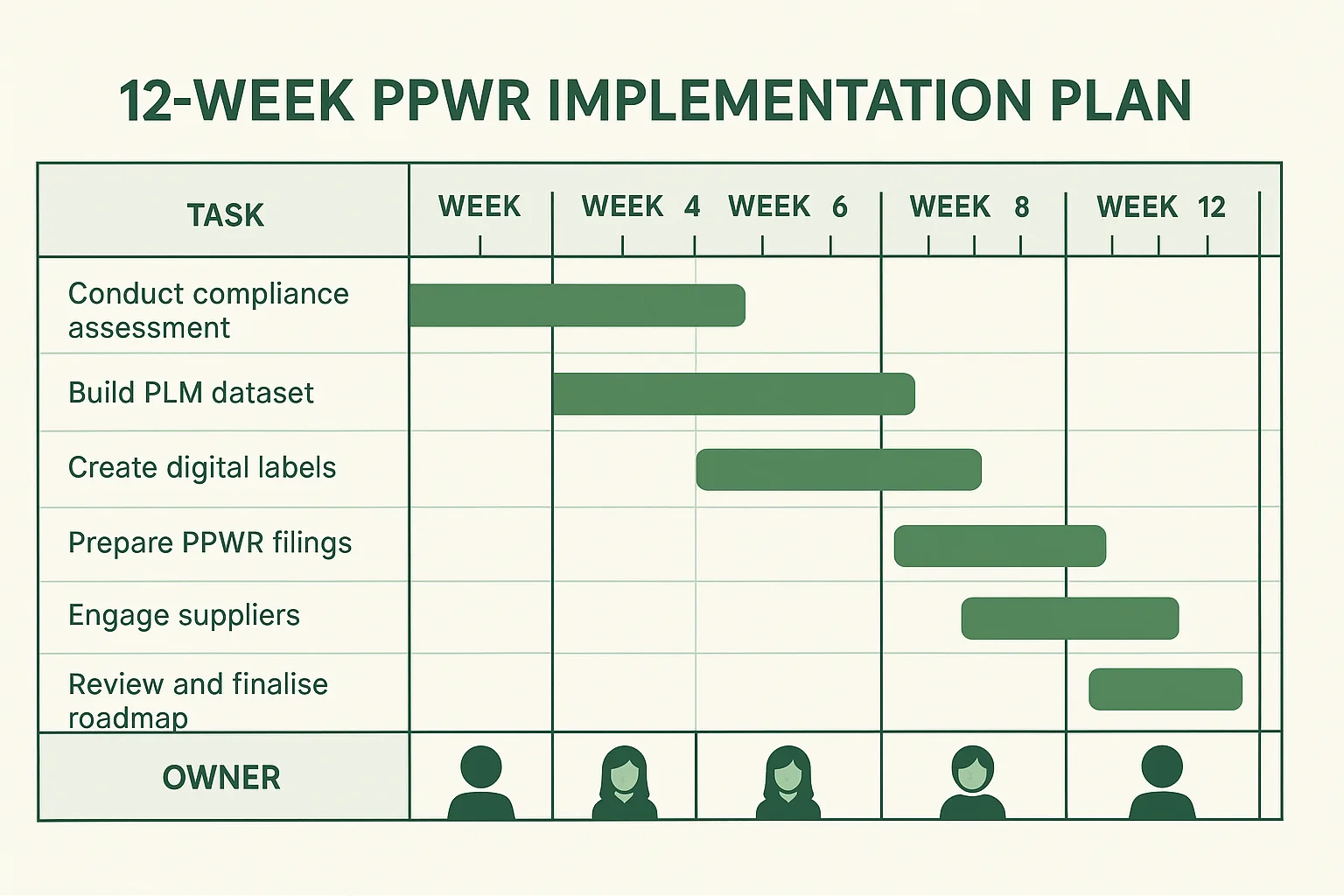
9) 12-Week PPWR Implementation Plan for Importers and Brands
A workable PPWR programme should convert legal requirements into assigned owners, SKU-level data fields, supplier evidence, approval gates, and review dates.
Weeks 1–2 | Mobilise and Map
- Appoint a PPWR Owner and define the internal RACI.
- Identify whether the business is acting as importer, producer, manufacturer, distributor, fulfilment service provider, or own-brand operator.
- Map SKUs to material families and PPWR packaging categories.
- Flag contact-sensitive plastic packaging.
- Identify DRS-subject beverage formats.
- Launch a supplier data request covering technical documentation, material construction, recycled content, compostability, PFAS, and labelling.
Weeks 3–4 | Risk Screen
- Screen each SKU against the emerging design-for-recycling framework.
- Identify inks, adhesives, labels, coatings, closures, windows, pigments, and add-ons that may affect sortability or recycling.
- For bagasse, paper cups, and paper bowls, identify wet-strength additives, barrier coatings, laminations, and lid materials.
- For CPLA products, confirm formulation, heat-performance scope, compostability documentation, and disposal communication.
- Review food-contact packaging against Article 5(5) using the applicable Commission stepwise PFAS verification approach.
- Prepare flexible artwork zones for future harmonised labels without printing speculative symbols.
Weeks 5–6 | Redesign and Sourcing
- Replace unnecessarily complex or incompatible packaging components.
- Align inks, adhesives, coatings, and pigments with expected design-for-recycling criteria.
- Evaluate post-consumer recycled-material supply where legally and technically suitable.
- Separate food-contact recycled-plastic requirements from general recycled-content targets.
- Define supplier warranties, traceability records, and plant-level calculation data.
Weeks 7–8 | Documentation and Testing
- Build Annex VII-style technical files for priority SKUs.
- Record material composition and component weight.
- Prepare the conformity-evidence path for Articles 5 to 12.
- Review PFAS reports, declarations, and sample mapping.
- Conduct relevant tests for delamination, ink transfer, leakage, heat resistance, compaction, detection, sorting, and component separation.
- Document which evidence is internal, supplier-issued, laboratory-tested, or independently certified.
Weeks 9–10 | Labelling and Digital Readiness
- Record EPR registration identifiers by Member State.
- Record DRS status and national deposit-system information.
- Prepare controlled data fields for material composition and disposal instructions.
- Configure a maintainable QR landing page where a QR code is used or required.
- Ensure voluntary recycled-content or environmental claims do not exceed available evidence.
- Monitor the Article 12 and Article 13 implementing acts.
Week 11 | Legal and Commercial Controls
- Update the Supplier Quality Agreement.
- Add recycled-content warranties and chain-of-custody requirements.
- Add formulation and material change-notification clauses.
- Add PFAS documentation and testing clauses.
- Add certificate-scope and logo-use controls.
- Add document-retention and audit rights.
- Model DRS fees, deposits, handling costs, and EPR charges.
Week 12 | Go-Live and Review
- Pilot the process in one or two priority Member States.
- Review gaps in product data, national registration, labels, and technical files.
- Monitor customer and authority questions.
- Build a 2026–2030 implementation roadmap.
- Build a separate 2030–2038 roadmap for improving grade C or B packaging toward grade A or B.
Before supplier approval, procurement teams can also use the practical criteria in How Importers Evaluate Compostable Packaging Suppliers.
10) ERP and PLM Field Template for Bagasse, Paper Bowls, Paper Cups, PLA, and CPLA
A defensible PPWR technical file connects one SKU to its materials, components, test reports, conformity documents, labels, and supplier change-control records.
Use controlled SKU-level fields to prepare for the 2026, 2028, 2030, 2035, 2038, and 2040 PPWR milestones.
Core Identification
- SKU and internal product code.
- GTIN or EAN.
- Packaging level: primary, secondary, or tertiary.
- EU economic-operator role.
- Manufacturer and manufacturing site.
- Importer and responsible EU contact.
- Member States where the packaging is placed on the market.
- EPR registration identifiers.
- DRS status.
- Batch or serial identification method.
Material and Construction
- Predominant material under the applicable PPWR category.
- Material share by weight.
- Component list, including body, lid, liner, coating, label, adhesive, ink, varnish, sleeve, and window.
- Barrier or coating type.
- Pigment or masterbatch identification.
- Component weight and detachability.
- Supplier and formulation version.
Recyclability and Design for Recycling
- Applicable packaging category.
- Provisional target grade.
- Official methodology version used.
- Sortability features.
- Detachable components.
- Material-recycling compatibility.
- Relevant MRF or sorting tests.
- Expected recycled-at-scale pathway.
- Redesign action and target completion date.
Recycled Content for Plastic Components
- Applicable Article 7 target category.
- 2030 and 2040 target percentage.
- Exemption status.
- Post-consumer recycled-content percentage.
- Manufacturing plant.
- Annual averaging period.
- Feedstock origin.
- Chain-of-custody evidence.
- Verification method and version.
- Food-contact recycled-plastic compliance evidence where applicable.
- Audit-evidence link.
Compostability
- Article 9(1) mandatory item: yes or no.
- Article 9(2) national requirement: yes or no.
- Industrial-composting standard.
- Home-composting requirement where applicable.
- Certificate or report number.
- Covered product code, thickness, formulation, ink, coating, and adhesive.
- Certificate holder.
- Testing laboratory or certification body.
- Validity or review date.
Labelling and Digital Information
- Applicable Article 12 paragraph.
- Applicable implementing act and version.
- Effective business deadline.
- Old-stock transition status.
- Harmonised material label.
- Language set.
- DRS mark.
- Reusable-packaging mark.
- QR or digital-carrier URL.
- Material code.
- Disposal route.
- EPR identifier.
- Recycled-content claim, where used.
- Environmental-claim approval record.
Chemicals and PFAS
- Food-contact packaging: yes or no.
- Total Fluorine result in mg/kg where TF screening is used.
- PFAS and non-PFAS fluorine explanation where further fluorine-source investigation is required.
- Individual targeted PFAS result in ppb where targeted analysis is required.
- Sum of targeted PFAS result in ppb where targeted analysis is required.
- Precursor or TOP-analysis information where applicable.
- Evidence relevant to the 50 ppm PFAS requirement including polymeric PFAS.
- Test method.
- Reporting limit.
- Laboratory and report number.
- Sampled product, color, coating, and production batch.
- Supplier declaration on intentionally added PFAS.
- Compliance-evidence location.
Logistics and Packaging Minimisation
- Unit dimensions and weight.
- Empty-space ratio where applicable.
- Sales-pack dimensions.
- Master-carton dimensions.
- Pallet configuration.
- Transport-packaging optimisation.
- Damage and product-loss rate.
- Justification against Annex IV performance criteria.
Category-Specific Add-Ons
Bagasse bowls: Record the wet-strength additive, grease-resistance system, PFAS evidence, hot-fill guidance, microwave scope, lid material, product weight, and compostability evidence.
Paper cups and bowls: Record the paperboard source, PE, PLA, water-based, or other lining, coating weight, delamination test, adhesive, ink, lid material, recyclability pathway, and compostability scope where claimed.
PLA cold cups: Record the PLA formulation, cold-drink limitation, storage requirements, lid material, finished-product compostability scope, certification mapping, printing system, and destination-market disposal guidance.
CPLA cutlery: Record the formulation, pigment, crystallinity, heat-performance guidance, finished-product compostability scope, wrapper material, printing, and disposal instructions.
Importers seeking a wider overview of cornstarch, CPLA, wrapped sets, and bulk utensils can also review the Bioleader® compostable cutlery solution page.
11) Importer and Brand Audit Checklist
A buyer-ready PPWR file should allow an importer to trace every compliance statement back to the exact packaging type, component, report, supplier, and approval date.
Before Import
- Confirm the correct economic-operator role.
- Verify that the manufacturer completed the applicable conformity assessment.
- Obtain the EU declaration of conformity.
- Review the Annex VII technical file.
- Confirm manufacturer and importer identification.
- Check type, batch, or serial traceability.
- Review Article 12 implementation status and artwork readiness.
- Confirm food-contact PFAS compliance against Article 5(5) using evidence appropriate to the applicable Commission stepwise verification approach.
- Check applicable EPR and producer-registration requirements.
- Confirm DRS status by Member State.
At Goods Receipt
- Check the supplied SKU against the technical file.
- Verify product material, color, coating, lid, and printing.
- Check batch traceability.
- Confirm that no unapproved supplier or formulation change occurred.
- Test any QR code or digital carrier used on the product.
- Verify the DRS mark where applicable.
- Retain representative samples where required by the quality system.
Quarterly or Periodic Review
- Review certificate validity and product scope.
- Review plant-level recycled-content data.
- Review PFAS and food-contact document updates.
- Review national EPR and DRS changes.
- Review Commission delegated and implementing acts.
- Review harmonised standards and common specifications.
- Check whether website, catalog, carton, and distributor claims remain consistent with technical evidence.
12) PPWR KPIs to Manage
PPWR progress should be measured by SKU coverage and evidence completeness rather than by the number of sustainability claims displayed in a catalog.
- Percentage of SKUs with complete material and component mapping.
- Percentage of SKUs with an Annex VII-style technical file.
- Percentage of SKUs with an approved EU declaration-of-conformity workflow.
- Percentage of food-contact packaging SKUs reviewed against Article 5(5) using documented, product-specific PFAS evidence.
- Percentage of SKUs provisionally screened for grades A, B, or C.
- Percentage of sales volume expected to achieve grade A or B.
- Percentage of plastic packaging formats mapped to the correct Article 7 target category.
- Percentage of applicable plastic packaging meeting the expected recycled-content target.
- Percentage of Article 9 products with matching finished-product compostability evidence.
- Percentage of packaging artwork aligned with the latest Article 12 implementing acts.
- Percentage of digital-carrier links passing periodic accuracy checks.
- Percentage of applicable beverage SKUs registered in the correct national DRS.
- National DRS return-rate trend toward the 90% target.
- Percentage of supplier agreements containing change-notification, PFAS, document, and audit clauses.
Bioleader® Support for PPWR-Oriented Packaging Sourcing
For importers, distributors, foodservice brands, and private-label buyers, Bioleader® can support product-level review across sugarcane bagasse tableware, paper cups and bowls, PLA cold cups, cornstarch products, and compostable cutlery.
Depending on the selected SKU and destination market, the review may include product specifications, material and component information, available food-contact documentation, compostability support, PFAS-related reports, packing data, application guidance, and certificate-to-product mapping.
Buyers can review available product families through the Bioleader® catalog and product overview or contact Bioleader® for product-specific document confirmation and quotation.
Frequently Asked Questions
When did PPWR start to apply?
Regulation (EU) 2025/40 entered into force on 11 February 2025 and has applied since 12 August 2026. However, many specific requirements have later or conditional application dates, so businesses must review each relevant article separately.
Which tea, coffee, and produce packaging must be compostable by 2028?
By 12 February 2028, permeable tea, coffee, or other beverage bags, soft after-use single-serve units intended to be disposed of with the product, and sticky labels attached to fruit and vegetables must comply with the applicable industrial-composting standard. Home-composting compatibility is also required where a Member State requires it.
When do recyclability grades become mandatory?
Packaging must meet recyclability grade A, B, or C from 1 January 2030 or 24 months after the relevant Article 6 delegated acts enter into force, whichever is later. From 1 January 2038, packaging generally must meet grade A or B.
How should recycled content be calculated for plastic packaging?
The PPWR methodology required under Article 7 must be adopted by the Commission by 31 December 2026. Percentages are calculated by packaging type and format as an average per manufacturing plant and year. Commission Implementing Decision (EU) 2026/1425 applies specifically to single-use plastic beverage bottles under Directive (EU) 2019/904 and should not be treated as the complete methodology for every PPWR plastic-packaging category.
Can recycled content be claimed on-pack before 2028?
A business may make a supportable recycled-content claim under currently applicable rules. Once the PPWR Article 12 requirements apply, a label showing recycled content must follow the relevant PPWR specifications and use the applicable Article 7 methodology. The relevant PPWR date is 12 August 2028 or 24 months after the applicable implementing act enters into force, whichever is later.
Which packaging formats are covered by the 90% DRS target?
By 1 January 2029, Member States must ensure at least 90% separate collection by weight for single-use plastic beverage bottles and single-use metal beverage containers with capacities of up to three litres, subject to PPWR exemptions.
When are harmonised packaging and waste-receptacle labels required?
The PPWR set 12 August 2026 as the statutory deadline for the Commission to adopt implementing acts for the label systems. Harmonised packaging material labels generally apply from 12 August 2028 or 24 months after the relevant acts enter into force, whichever is later. Waste-receptacle labels are required by 12 August 2028 or 30 months after adoption of the relevant implementing acts, whichever is later. Businesses should verify the current publication and entry-into-force status of the applicable implementing acts before finalising artwork.
What PFAS limits apply to food-contact packaging?
Since 12 August 2026, food-contact packaging must not contain PFAS at or above 25 ppb for any individual targeted PFAS, 250 ppb for the sum of targeted PFAS, or 50 ppm for PFAS including polymeric PFAS. The Commission’s 2026 guidance recommends a stepwise enforcement approach beginning with Total Fluorine screening. If Total Fluorine is below 50 mg/kg, the sample could be considered compliant at the first screening step. Where further analysis is required, fluorine-source investigation and targeted or precursor analysis may be used according to the applicable verification need.
Can PFAS-containing food-contact packaging produced before 12 August 2026 still be sold?
There is no special PPWR transition for exhausting PFAS-containing food-contact packaging stocks that are placed on the EU market after 12 August 2026. Packaging already placed on the market before that date may remain on the market and does not need to be withdrawn solely because of the Article 5(5) PFAS limits. For imported packaging or packaged products, the Commission guidance identifies release for free circulation at the end of the customs procedure as the relevant timestamp.
Official References
- Regulation (EU) 2025/40 on Packaging and Packaging Waste
- European Commission Notice C/2026/3084 — Guidance Document for Regulation (EU) 2025/40
- European Commission DG Environment — FAQ on Packaging and Packaging Waste Regulation (PPWR), 3 August 2026
- Commission Implementing Decision (EU) 2026/1425 on Recycled Plastic Content in Single-Use Plastic Beverage Bottles
- Corrigendum of 20 July 2026 to Commission Implementing Decision (EU) 2026/1425
- Corrigendum of 31 July 2026 to Commission Implementing Decision (EU) 2026/1425
- Directive (EU) 2019/904 on the Reduction of the Impact of Certain Plastic Products on the Environment
- Eurostat — Plastic Packaging Waste in the EU, 2023 Data
Independent Citations
External sources that have cited or referenced this Bioleader resource.
Econos ESG
Referenced this Bioleader PPWR white paper in an industry article about packaging regulation.
View source