FAQ of Bioleader's Eco-friendly Disposable Tableware
Are earth friendly disposable utensils safe for hot and cold foods?
Yes, these utensils are designed to be strong and heat-resistant, suitable for serving both hot and cold foods in restaurants, catering, and events.
Are there eco-friendly options for individually wrapped cutlery?
Yes, in addition to traditional plastic, there are biodegradable and compostable individually wrapped cutlery options available to support sustainability goals.
What features do biodegradable disposable spoons and forks offer?
With customizable packaging options and a range of features such as heat resistance, safety, and cost-effectiveness, they cater to various uses—from outdoor events to everyday dining.
Kraft (Virgin/Recycled) Converting
Kraft paper and paperboard (virgin or recycled) are widely available and support many forming methods (die-cut trays, cups, folding cartons). Barrier coatings (oil/grease/water) drive both performance and EoL fate. Where recycling systems accept food-contact paper—and soil levels remain low—kraft maintains a preferred EoL route; but heavy oiling or laminated barriers can divert items to residual waste streams — Low Carbon Packaging Solutions. For general hot/cold and high-moisture/dry use cases (especially cold salads, dry snacks, and bakery), kraft’s universality and cost curve can be compelling , Low Carbon Packaging Solutions.
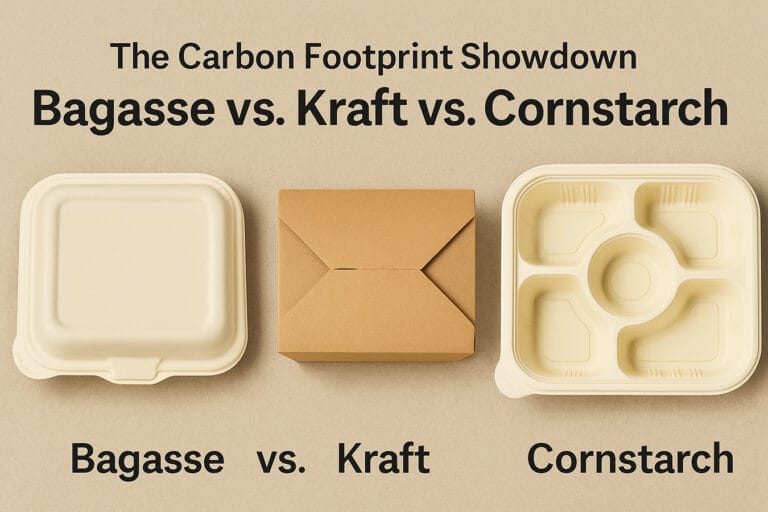
LCA Dataset: Bagasse vs. Kraft vs. Cornstarch Packaging (2025)
Note: Values are indicative global averages. Replace with verified regional data before publication , Low Carbon Packaging Solutions. Functional unit = 1,000 pcs (≈900 ml bowl + lid). Material Functional Unit System Boundary CO₂e Raw CO₂e Manufacturing CO₂e Transport CO₂e Use CO₂e EoL EoL Scenarios (Home / Industrial / Recycle / Landfill / Incineration) Food Contact Compliance Heat / Oil Resistance Bagasse 1,000 pcs (≈900 ml bowl + lid) Cradle-to-Grave 18 kg 12 kg 4 kg –2 kg (food-loss avoidance) 5 kg Home 20% / Industrial 40% / Recycle 0% / Landfill 30% / Incineration 10% Yes (EN 13432 / ASTM D6400) High / High Kraft Paper 1,000 pcs (≈900 ml bowl + lid) Cradle-to-Grave 22 kg 15 kg 5 kg –1 kg 10 kg Home 0% / Industrial 10% / Recycle 55% / Landfill 25% / Incineration 10% Yes (PFAS-free barrier) Medium / Medium (depends on barrier) Cornstarch Biopolymer 1,000 pcs (≈900 ml bowl + lid) Cradle-to-Grave 30 kg 20 kg 6 kg 0 kg 12 kg Home 10% / Industrial 45% / Recycle 0% / Landfill 30% / Incineration 15% Yes (ASTM D6400 / EN 13432) High / Medium (formulation-dependent) 📊 Download LCA Dataset (CSV) Material Profiles & Manufacturing Pathways 🎬 Video: Overview of Bagasse Pulping & Molding, Kraft Paper Converting, and Cornstarch Biopolymer Production — A complete look at sustainable packaging manufacturing processes by Bioleader®.