CPLA Compostable: Procurement Essentials | Bioleader® Insights

Browse articles grouped under the "CPLA compostable" tag for topic-specific information and examples. The featured articles may approach the topic from different product, material, application, market, or sourcing perspectives. Check each article for its exact scope, technical data, standards, sources, and recommendations.
CPLA compostable — Content Overview
  • Featured articles shown: 12
  • Directly tagged articles: 2
  • Latest tagged article update: 2026-08-31
  • Coverage, examples, and specific recommendations vary by individual article.

Editor's Picks: Top Cpla Compostable Guides 2026

FAQ of Bioleader's Eco-friendly Disposable Tableware

Are kraft and white square paper salad bowls recyclable or compostable?

The base material is paperboard, but the final disposal claim depends on the lining and local waste system. PE-coated bowls are practical for standard foodservice use and may depend on local recycling capability. PLA-coated or aqueous-coated options are better choices when buyers need compostable or plastic-reduction packaging claims.

What is the capacity of a 750ml rectangular paper salad bowl?

A 750ml rectangular paper salad bowl is designed for regular single-serve or meal portions. It is commonly used for salads, rice bowls, sushi-style meals, cold noodles, desserts, side dishes, and takeaway meals. For buyers building a wider rectangular bowl range, 750ml can be paired with 500ml, 650ml, and 1000ml rectangular paper bowls , CPLA compostable.

Can 1000ml rectangular paper salad bowls be custom printed?

Yes. Bioleader® supports OEM logo printing and private-label designs for 1000ml rectangular paper salad bowls and matching paper lids , CPLA compostable. Buyers can provide AI, PDF, CDR, or clear logo files. White paper is usually better for sharp full-color printing, while kraft paper is suitable for natural, minimal, and eco-style branding.

How Mineral Additives Enable Crystallization

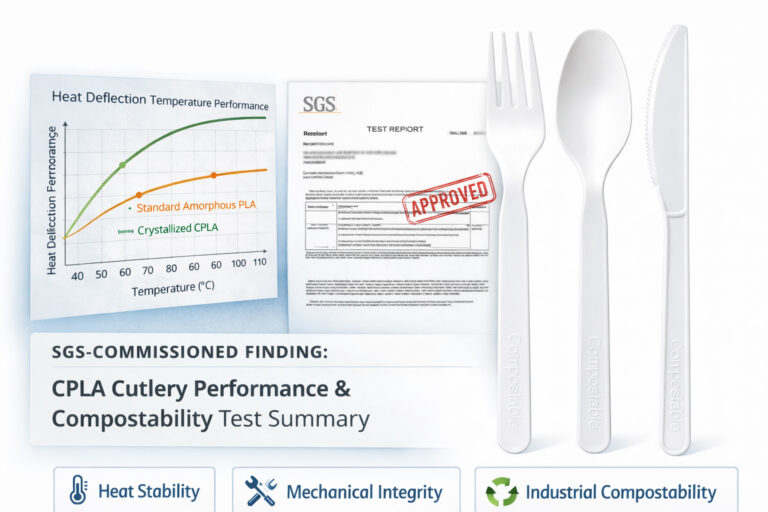
Inorganic particles can function as heterogeneous nucleation sites, accelerating crystallization kinetics and improving structural stability at elevated temperatures. Calcium sulfate & talc: frequently applied as nucleating agents to support faster crystallization and improved thermal windows. Engineering precision matters: performance depends on particle dispersion, particle size distribution, formulation ratios, and controlled processing (molding parameters and, where applicable, annealing strategy).

Why This Matters Commercially

When executed correctly, engineered crystallization upgrades PLA from a general-purpose bio-polymer to a more robust material platform with improved heat resistance and dimensional stability—critical for buyers who must meet hot-use expectations while maintaining food-contact safety requirements. Performance Snapshot: Standard PLA vs. Engineered CPLA (Representative Targets) The following comparison provides a procurement-oriented view of typical material-level targets — CPLA compostable. Actual performance varies by resin grade, additive system, product geometry, and processing controls.

Related Insights

🚀Ready to Go Green and Choose ?

Join the global movement toward zero-waste packaging.


Bioleader® offers:

  • 📦 Bulk order support & fast delivery

  • ✍️ Custom branding and OEM solutions

  • 🌍 Worldwide eco-packaging compliance

Get the Catalogue Products List  & Contact Us Now! 👉

Contact Us for Quote

Click or drag files to this area to upload.You can upload up to 5 files.
The more details you share, the faster and more accurate our quotation will be.