Compostable Tableware Import Case Notes in Africa: Quick Summary
This article shares anonymized Bioleader® manufacturer case notes from African foodservice packaging projects, including Mauritius, Senegal, Nigeria / Lagos, Namibia, Ghana and Liberia. The purpose is to show how real compostable tableware imports are planned by market, product family, carton volume, documentation, foodservice use and shipment logic.
The cases are based on Bioleader®’s export quotations, invoice and packing list records, shipment planning data and sourcing discussions. Customer names, contact details, invoice numbers, PI numbers, exact prices, bank information and confidential shipment identifiers are not disclosed. The focus is manufacturer-side experience and procurement decision-making.
- Mauritius shows why compliance-sensitive markets need molded fiber and non-plastic foodservice packaging with clear documents.
- Senegal shows how large-volume paper cup programs require cup-size planning, printing review and 40HQ-level carton-volume control.
- Nigeria / Lagos shows that takeaway replacement projects need complete paper bowl-and-lid systems, not only single bowls.
- Namibia shows how bagasse clamshell starter SKUs can help distributors test demand before expanding product ranges.
- Ghana shows how paper pulp tableware and CPLA cutlery can support real foam-replacement and policy-driven packaging transition.
- Liberia shows how mining and industrial catering projects require multi-container production, site split planning and inspection control.
Why Manufacturer Case Notes Matter for African Packaging Buyers
African disposable food packaging is often discussed through broad search terms such as compostable tableware, biodegradable food containers, plastic ban alternatives, Styrofoam replacement and sustainable takeaway packaging. These terms are useful for market research, but they do not explain how real import projects work.
In real B2B sourcing, each country has different food habits, buyer types, port routes, carton-volume limits, documentation expectations, certification questions and customer channels. A paper cup shipment to Senegal is not planned like a paper bowl project in Lagos. A molded fiber tray shipment to Mauritius is not the same as a mining catering project in Liberia. A Ghana foam-replacement order requires different thinking from a Namibia starter SKU shipment.
Bioleader® uses case-based sourcing experience to help buyers move from vague requests to practical product programs. Instead of asking only for “eco-friendly food containers,” serious buyers should define the food application, target market, order quantity, material preference, document needs, carton volume and repeat-order plan.
How Bioleader® Protects Customer Confidentiality in Case Notes
Bioleader® does not publish customer names, contact details, invoice numbers, PI numbers, bank information, full shipment documents, container numbers, seal numbers or exact transaction prices without authorization. These details can expose a buyer’s supplier relationship, pricing structure, purchasing volume, shipment route and commercial strategy.
This article uses anonymized case notes. It may describe the country, product family, approximate shipment scale, carton volume, foodservice use and manufacturer recommendation, but it does not reveal private customer identity or traceable transaction information.
This approach is better for long-term trust. It allows Bioleader® to demonstrate real export and manufacturing experience while protecting the confidentiality of African importers, distributors, hospitality suppliers, foodservice operators and industrial catering buyers.
Case Snapshot: Six Africa Market Examples
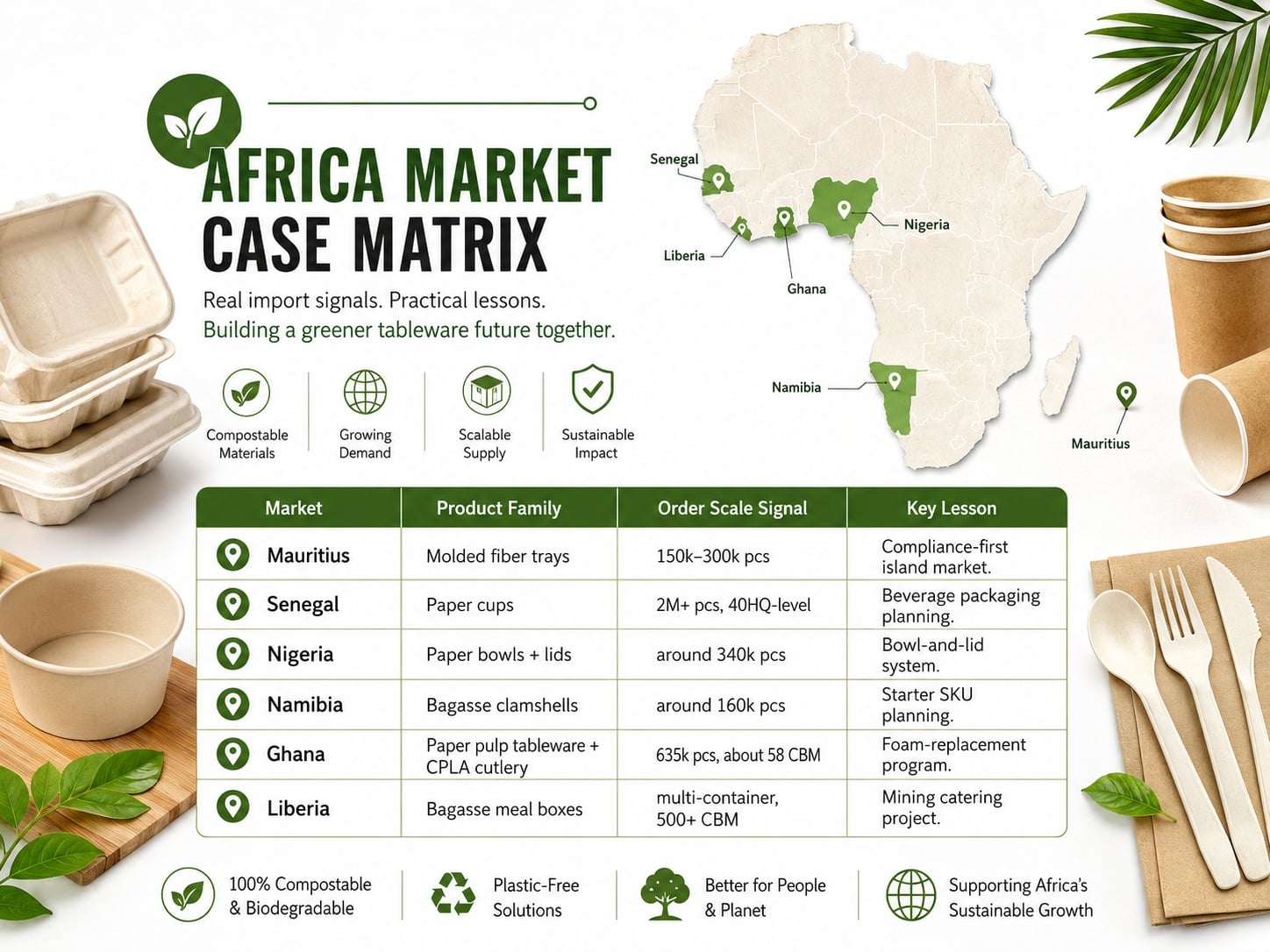
The following table summarizes six Africa-focused case notes used in this article. The data has been simplified for public discussion and does not include confidential customer information.
| Market | Anonymous buyer type | Product family | Order scale signal | Main procurement lesson |
|---|---|---|---|---|
| Mauritius | Foodservice packaging importer in a compliance-sensitive island market | Molded fiber trays and bagasse-category foodservice packaging | Tray projects in the 150,000–300,000 pcs range, with split shipment and LCL coordination | Material screening, packing data and document consistency matter before price comparison. |
| Senegal | Beverage packaging and paper cup buyer | Single wall paper cups for small beverage and coffee service | More than two million paper cups, around 66 CBM and 40HQ-level loading logic | Paper cup imports require cup-size mix, print planning, carton efficiency and beverage-use matching. |
| Nigeria / Lagos | Takeaway food packaging buyer | Round paper bowls, rectangular paper bowls, PET dome lids and PP lid options | Around 340,000 pcs and close to 40HQ-level carton volume | Food delivery replacement should be planned as a bowl-and-lid system, not as a bowl-only order. |
| Namibia | Takeaway packaging distributor | Bagasse hinged containers and divided clamshell boxes | Around 160,000 pcs with 20ft-level CBM planning | Starter SKUs should focus on common clamshell sizes before expanding into many custom items. |
| Ghana | Foodservice packaging importer preparing for foam-replacement demand | Paper pulp tableware and CPLA compostable cutlery | A documented shipment of 635,000 pcs, 1,330 cartons and about 58 CBM | Ghana buyers should prepare foam alternatives early with product documents, carton data and policy-aware product selection. |
| Liberia | Industrial catering and mining-sector procurement scenario | Bagasse compartment meal boxes, rectangular trays and matching sugarcane pulp lids | Multi-million-piece planning, over 500 CBM and approximately eight 40HQ containers | Large industrial projects need site split planning, production lead time control, loading evidence and inspection options. |
Mauritius Case Note: Compliance-First Molded Fiber Food Packaging
Mauritius is a useful case because compliance-sensitive island markets often treat disposable food packaging as both an import issue and a foodservice issue. In an anonymized Mauritius project handled by Bioleader®, the buyer sourced molded fiber tray products for foodservice packaging use, with shipment planning connected to Port Louis import requirements, carton data and split shipment coordination.
The available export record supports a molded fiber tray project in the 150,000–300,000 pcs range. One shipment segment included 150,000 pcs of paper pulp tableware, 150 cartons, around 1,950 kg net weight, around 2,070 kg gross weight and about 7.277 CBM. The related PI planning also showed a larger tray project of around 300,000 pcs and about 11 CBM.
The commercial lesson is that Mauritius-focused buyers should not start with product price only. They should first screen material type, product category, import acceptability, carton packing, commercial invoice wording and packing list consistency. For a market that is sensitive to non-biodegradable single-use plastics, unclear product descriptions can create unnecessary risk.
For this type of market, Bioleader® normally recommends starting with non-plastic and fiber-based foodservice packaging, such as sugarcane bagasse tableware, molded fiber trays, bagasse food containers and paper-based packaging. If buyers want PLA, cornstarch or plastic-related products, they should verify local classification and import acceptance before shipment.
The Mauritius case demonstrates that compliance is not only about regulation. It is also about how the manufacturer prepares product descriptions, carton data, shipment documents and clear communication for the importer.
Mauritius Procurement Insight: Compliance Before Price
| Buyer challenge | Bioleader® response | Procurement lesson |
|---|---|---|
| The buyer needed molded fiber foodservice packaging suitable for a compliance-sensitive island market, where ordinary plastic products may create import and customer-acceptance risks. | Bioleader® focused the discussion on molded fiber trays, bagasse-category food packaging, carton data, packing list consistency and export document wording instead of treating the project as a simple tray quotation. | For Mauritius-style markets, importers should verify material classification, product description, packing data and shipment documents before comparing only unit price. |
Senegal Case Note: Paper Cups and Coffee Cup Supply for Beverage Service
Senegal adds an important product category to Bioleader®’s Africa case notes: paper cups and coffee cup supply. In an anonymized Dakar-focused beverage packaging project, Bioleader® worked on a large-volume paper cup program covering small single wall cup sizes, including 2.5oz, 4oz and 7oz formats.
The shipment planning included more than two million paper cups, around 1,950 cartons and about 66.65 CBM, which is close to 40HQ-level volume planning. This is important because paper cups are lightweight but bulky. A buyer comparing only unit price may miss the real landed-cost impact of carton dimensions and loading efficiency.
Paper cup projects also require application-based planning. A 2.5oz cup may support sampling, espresso-style drinks or small local beverage formats. A 4oz cup can serve coffee, tea or smaller drink portions. A 7oz cup can support broader café and takeaway beverage service. In the Senegal case, the project also included a black-color “Café Touba” print reference, showing that paper cup demand can be closely connected with local beverage culture and branding.
The Senegal lesson is that paper cups are not commodity items only. African beverage buyers should confirm cup size, paperboard structure, coating type, printing layout, packing method, carton volume, production lead time and whether the cup is intended for hot drinks, cold drinks or both. For hot beverages, paper cups should be selected more carefully than PLA cold cups.
Bioleader® can support African beverage packaging buyers with paper cup sourcing, custom printing discussion, size matching, carton planning and coordinated product selection with lids, stirrers, sleeves or takeaway accessories where needed.
Senegal Procurement Insight: Paper Cups Are a Loading and Branding Project
| Buyer challenge | Bioleader® response | Procurement lesson |
|---|---|---|
| The buyer needed a large-volume paper cup program for beverage service, including small cup sizes and local drink applications. The real challenge was not only price, but also size mix, printing and 40HQ-level carton volume. | Bioleader® treated the project as a paper cup supply program, reviewing cup sizes, print direction, carton quantity, CBM, lead time and beverage-use suitability. | For Senegal and similar beverage markets, paper cups should be planned by cup size, drink type, printing needs, carton efficiency and local selling channel. |
Nigeria / Lagos Case Note: Paper Bowls and Matching Lids for Takeaway Replacement
Nigeria and Lagos are useful for understanding practical takeaway packaging replacement. In one anonymized Lagos-focused project, the buyer did not source only one bowl size. The project involved a complete paper bowl-and-lid system, including round kraft paper bowls, rectangular kraft paper bowls, PET dome lids and PP lid options.
The project covered 500ml, 750ml and 1000ml round kraft paper bowls; 750ml and 1000ml rectangular kraft paper bowls; 148mm PET dome lids; and 173×121mm PP lids. The total planning scale was around 342,000 pcs, around 1,140 cartons, about 5,797 kg gross weight and approximately 69.043 CBM.
This case shows why African food delivery replacement cannot be planned by bowl price alone. A round bowl without a matching lid may fail in takeaway delivery. A rectangular bowl may be better for rice meals and prepared food. A PET dome lid can improve food visibility, while a PP lid may support a different handling or heat expectation where the local buyer accepts that material.
For Nigeria / Lagos buyers, foam and plastic replacement often requires a product system. Practical options include kraft paper bowls, paper soup containers, paper salad bowls, bagasse clamshell boxes, bagasse food containers and matching lid solutions.
The document note that shipping cost and SONCAP or certification cost should be confirmed separately is also important. For African markets, certification, inspection, customs, shipping and destination documentation may affect the real buying decision. Importers should keep these costs separate from factory unit price during early negotiation.
The Lagos lesson is simple: a bowl is not a complete takeaway solution unless the lid, food type, delivery movement, stacking, carton volume and documentation are all reviewed together.
Nigeria / Lagos Procurement Insight: Bowl-and-Lid Matching Controls Real Performance
| Buyer challenge | Bioleader® response | Procurement lesson |
|---|---|---|
| The buyer needed takeaway packaging that could serve different food formats, including round bowls, rectangular bowls and matching lids. A bowl-only quotation would not solve delivery, stacking or food-visibility requirements. | Bioleader® reviewed the order as a complete paper bowl-and-lid system, including bowl capacity, lid material, carton volume, gross weight, loading volume and certification items to confirm separately. | For Lagos-style takeaway replacement, importers should test bowl and lid together with real food, delivery movement and stacking before confirming bulk purchase. |
Namibia Case Note: Bagasse Hinged Containers as Starter SKUs
Namibia is a strong example of starter SKU planning. In the Namibia project data, the product family was bagasse hinged containers, not paper coffee cups. The product mix included common clamshell formats such as 6″×6″, 9″×6″ and 9″×6″ two-compartment hinged containers.
The shipment planning showed around 165,000 pcs, 330 cartons and about 27.318 CBM. This is close to a 20ft-level starter shipment. It is large enough for market testing, but disciplined enough to avoid excessive SKU complexity.
The 6″×6″ hinged container can support small meals, snacks, bakery items, sides or compact takeaway portions. The 9″×6″ hinged container is a more standard takeaway format. The 9″×6″ two-compartment version can support meals that require separation, such as rice with sauce, protein with sides, or mixed dishes that should not be combined during delivery.
For Namibia and similar markets, Bioleader® recommends starting with practical bagasse food containers and clamshell boxes before moving into highly customized formats. Standard sizes are easier for distributors to sell across multiple customer groups, including takeaway shops, cafés, bakeries, small restaurants and catering buyers.
The Namibia lesson is disciplined SKU selection. A distributor does not need twenty sizes in the first shipment. A better strategy is to test the most common clamshell formats, identify the fastest-moving sizes, then expand only after reorder demand is clear.
Namibia Procurement Insight: Start With Fast-Moving Clamshell SKUs
| Buyer challenge | Bioleader® response | Procurement lesson |
|---|---|---|
| The buyer needed practical takeaway packaging in common clamshell sizes, without taking on too many slow-moving SKUs in the first shipment. | Bioleader® supported a starter SKU mix around 6 inch and 9 inch bagasse hinged containers, including a divided option for meals requiring food separation. | For Namibia-style distributors, the first shipment should prove local demand with common clamshell formats before expanding into custom molds, printing or many niche sizes. |
Ghana Case Note: Paper Pulp Tableware and CPLA Cutlery for Foam-Replacement Demand
Ghana is now an especially important case because it combines real Bioleader® shipment data with a clear market transition signal. Public reporting states that Ghana’s Environmental Protection Authority has announced a nationwide restriction on Styrofoam or expanded polystyrene foam products from January 2027, including takeaway food containers, disposable cups, plates and other foam products. Importers should still verify the latest official EPA and customs scope before shipment, but the market direction is clear: foam alternatives need to be prepared early.
In an anonymized Ghana commercial invoice and packing list record reviewed for this article, Bioleader® supplied a documented shipment to Ghana containing two product families: paper pulp tableware and CPLA compostable cutlery. The shipment scale was 635,000 pcs in total, split evenly between 317,500 pcs of paper pulp tableware and 317,500 pcs of CPLA compostable cutlery.
The packing data is particularly useful for buyers. The Ghana shipment included 1,330 cartons in total, with 665 cartons for paper pulp tableware and 665 cartons for CPLA compostable cutlery. The total net weight was about 13,080 kg, the total gross weight was about 14,144 kg, and the shipment volume was about 58.24 CBM. This is close to a 40HQ-level planning scenario and shows how bulky disposable tableware affects container and freight decisions.
| Ghana shipment element | Product family | Quantity | Cartons | CBM | Procurement meaning |
|---|---|---|---|---|---|
| Food container alternative | Paper pulp tableware | 317,500 pcs | 665 cartons | About 29.12 CBM | Supports molded fiber and bagasse-category replacement for foam or plastic foodservice packaging. |
| Meal kit accessory | CPLA compostable cutlery | 317,500 pcs | 665 cartons | About 29.12 CBM | Completes takeaway meal sets, catering packs, hotel service and institutional foodservice programs. |
| Total shipment | Paper pulp tableware + CPLA cutlery | 635,000 pcs | 1,330 cartons | About 58.24 CBM | Shows why importers should plan foam alternatives as a product program, not only as a single replacement item. |
This Ghana case is valuable because it shows the practical bridge between policy and procurement. If a market is moving away from Styrofoam takeaway packs, buyers do not need only one alternative box. They need a system that may include molded fiber food containers, sugarcane bagasse tableware, bagasse clamshells, paper bowls, paper cups and compostable cutlery.
The shipment also shows that CPLA cutlery is not a decorative add-on. In foodservice replacement programs, cutlery often needs to be purchased together with meal boxes or bowls. Restaurants, supermarkets, event caterers, office meal providers and institutional buyers may prefer a complete set instead of sourcing containers and utensils from separate suppliers.
The Ghana lesson is that policy-driven demand should be converted into a structured product portfolio. Importers preparing for foam replacement should test paper pulp tableware, bagasse clamshells, bagasse clamshell boxes, compostable cutlery and CPLA cutlery before enforcement pressure creates urgent buying decisions. They should also confirm whether their customer requires food-contact documents, compostability claims, PFAS-related statements, carton data or customs classification support.
Ghana Procurement Insight: Foam Replacement Needs Containers and Accessories
| Buyer challenge | Bioleader® response | Procurement lesson |
|---|---|---|
| The buyer needed a shipment that could support foodservice packaging transition, including both paper pulp tableware and compostable cutlery. Ghana’s foam-replacement direction makes this type of product program more relevant. | Bioleader® supported a combined shipment of paper pulp tableware and CPLA compostable cutlery, with 635,000 pcs, 1,330 cartons and about 58.24 CBM documented in the shipment records. | For Ghana-style foam replacement, importers should build a complete meal packaging program instead of replacing only one Styrofoam container SKU. |
Liberia Case Note: Multi-Container Bagasse Meal Packaging for Mining Catering
Liberia is the strongest industrial catering example in this case set. In an anonymized mining-sector quotation scenario, Bioleader® planned a large bagasse meal packaging program for two project sites, including coastal and inland supply requirements. The product mix included 8″×8″ three-compartment clamshell meal boxes, 500ml rectangular trays and matching sugarcane pulp lids.
The overall planning scale was multi-million pieces, over 500 CBM and approximately eight 40HQ containers. This is very different from a normal restaurant packaging inquiry. In a mining camp or industrial catering project, the buyer must consider daily meal volume, portion control, food separation, carton durability, production lead time, loading plan, inspection options and site-based allocation.
The case included a split between two Liberia project locations. This type of order requires more than a product list. It needs site-by-site quantity planning, carton-count calculation, CBM allocation, production scheduling and final shipment instruction. If a large buyer changes whether the goods ship together or by separate site allocation, the loading plan and documentation may also need adjustment.
For this type of project, Bioleader® does not treat packaging as a simple item quote. The manufacturer must help the buyer understand carton quantities, CBM, container utilization, production scheduling and whether the shipment should be produced together or split by site. Large orders also require a stronger pre-shipment control process, including finished product photos, loading photos and third-party inspection if requested.
The Liberia lesson is that industrial catering requires project planning. A mining or remote-site buyer does not only need a “biodegradable lunch box.” The buyer needs a stable meal-packaging system that can be produced on schedule, packed safely, shipped efficiently and distributed to different operational sites.
Liberia Procurement Insight: Mining Catering Requires Project Planning
| Buyer challenge | Bioleader® response | Procurement lesson |
|---|---|---|
| The buyer needed a large-scale meal packaging program for industrial catering, with different product types, high daily consumption and multi-site delivery planning. | Bioleader® planned a multi-container bagasse packaging program with compartment meal boxes, rectangular trays and matching pulp lids, including CBM calculation, site split planning, lead time review and pre-shipment control options. | For Liberia-style mining and industrial catering projects, buyers should manage packaging as a supply program, not as a one-item quotation. |
South Africa Regulatory Comparison: Why EPR Changes the Buyer Mindset
South Africa is not presented as an anonymized shipment case in this article, but it is an important regulatory comparison for African packaging importers. Its Extended Producer Responsibility framework covers paper and paper packaging, plastic packaging, biodegradable and compostable packaging, single-use products and single-use compostable products. This makes South Africa different from markets where the main discussion is only foam replacement or plastic bag restrictions.
For buyers serving South Africa or South Africa-linked regional distributors, the procurement question is broader than “Which product can replace plastic?” Importers may need to consider product classification, packaging responsibility, producer or importer obligations, documentation, recycling or recovery schemes and whether the product claim is supported by relevant standards.
The commercial lesson for African importers is that sustainable foodservice packaging is moving in two directions at the same time. Some markets are pushing immediate foam or plastic alternatives, while more regulated markets are asking who is responsible for packaging after use. Bioleader® recommends that buyers treat South Africa as a reminder to prepare stronger product documentation, carton data, material descriptions and claim support before entering highly regulated channels.
What These Africa Case Notes Teach Importers
Across these six markets, one pattern is clear: successful compostable tableware imports are rarely based on one product decision. They are based on the connection between food application, material choice, document control, carton volume, payment workflow, shipment planning and reorder logic.
| Experience lesson | What buyers should do | Why it matters |
|---|---|---|
| Start with real food use | Define whether the product will hold hot meals, oily food, soup, salad, coffee, cold drinks or meal kits. | Material choice should follow food application, not only sustainability wording. |
| Control the first SKU mix | Start with fast-moving sizes and common formats before adding many custom products. | Too many SKUs can create slow-moving inventory and weak reorder decisions. |
| Plan by carton volume | Request carton size, pieces per carton, gross weight, CBM and estimated loading quantity. | Disposable packaging is bulky, and container volume often changes landed cost more than buyers expect. |
| Match lids and accessories | Confirm lid fit, cutlery pairing, wrapping options and meal-kit logic before bulk order. | A food container without the right lid or accessory may fail in delivery or catering operations. |
| Keep documents consistent | Align PI, commercial invoice, packing list, product description, carton data and payment documents. | Document mismatch can create bank review, customs clearance or customer-accounting friction. |
| Use inspection for large projects | Request finished product photos, loading photos or third-party inspection where order size justifies it. | Large multi-container orders need stronger trust control than small sample orders. |
What Evidence Can Be Shared Without Exposing Customers?
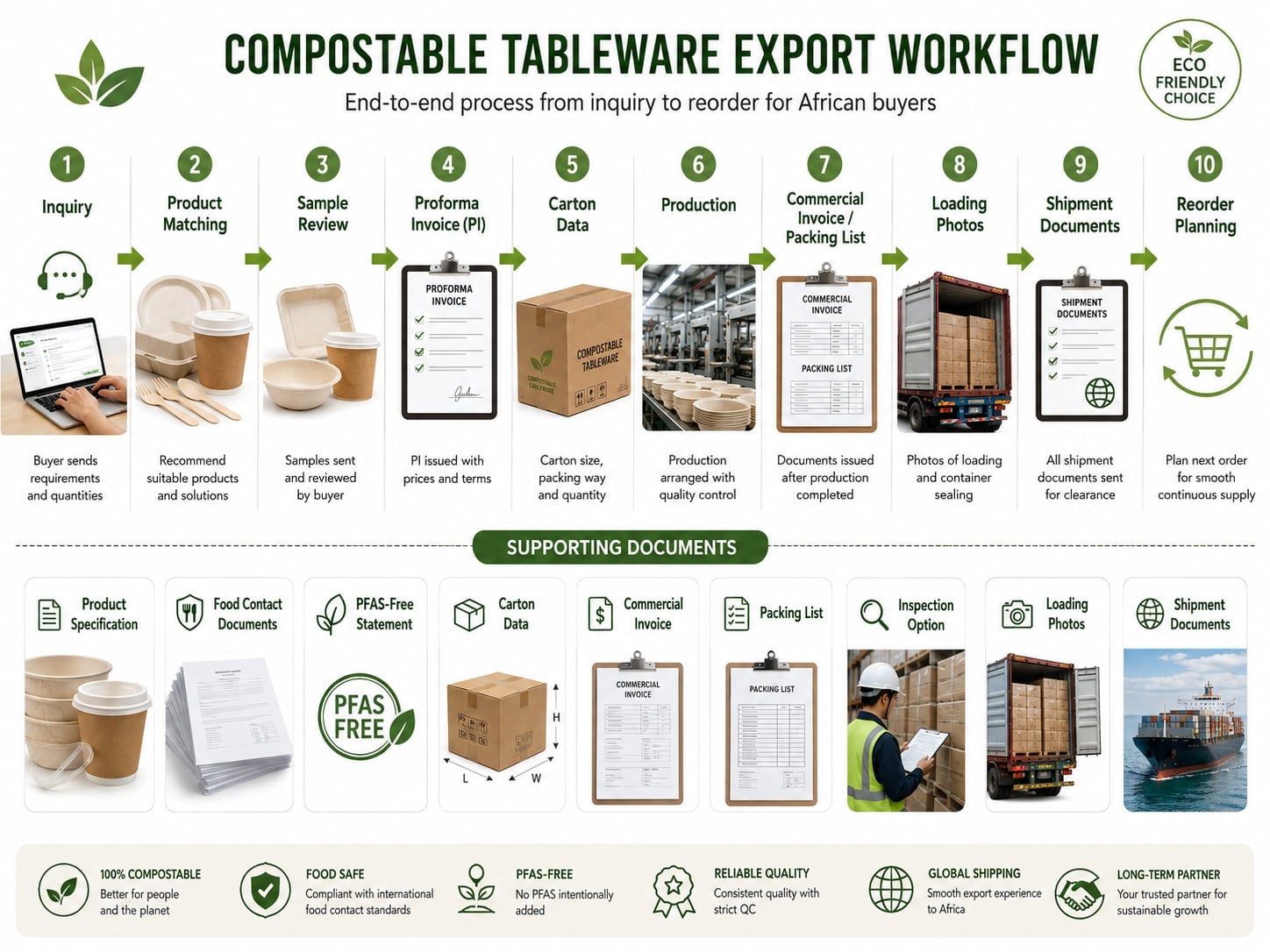
Buyers often ask whether Bioleader® can prove export experience. The answer is yes, but proof must be handled responsibly. A real bill of lading, invoice or packing list may contain confidential customer details. Publishing those documents directly can damage customer trust and expose sensitive trade information.
For public content, the safer option is to use redacted or reconstructed evidence. This can include anonymized case tables, product-testing photos, carton packing photos, sample approval workflows, redacted document checklists, loading-process photos without customer marks and shipment planning visuals. These materials show manufacturing and export capability without exposing private customers.
For private buyer review, Bioleader® can share more detailed documents under appropriate business communication when needed. Public website content should stay focused on experience, process and capability rather than showing traceable customer files.
Bioleader® Manufacturer Checklist for Africa Orders
Based on these case notes, Bioleader® recommends that African buyers prepare a clear sourcing brief before requesting a final quotation. A precise brief helps reduce wrong product recommendations, price revisions and document confusion.
- Destination country, destination port and expected customer channel.
- Food application, including hot meals, oily food, soup, salad, coffee, cold drinks or meal kits.
- Preferred product family, such as bagasse, paper, PLA, CPLA, cornstarch or a mixed solution.
- Target sizes, capacities, lid requirements and cutlery pairing.
- Estimated monthly demand or first shipment quantity.
- Packaging format, including bulk packing, wrapped cutlery, custom printing or private label needs.
- Required documents, including product specifications, food-contact documents, PFAS-related statements, commercial invoice, packing list and shipment documents.
- Preferred shipment size, such as LCL, 20ft, 40HQ or mixed-container planning.
Bioleader® Solutions for African Importers
Bioleader® supplies compostable and biodegradable foodservice packaging for B2B buyers who need practical material selection, bulk supply and export-ready support. Product lines include sugarcane bagasse tableware, bagasse clamshell boxes, bagasse food containers, bagasse plates, bowls, trays, kraft paper bowls, paper soup containers, paper salad bowls, paper cups, PLA cups, compostable cutlery, CPLA cutlery and cornstarch tableware.
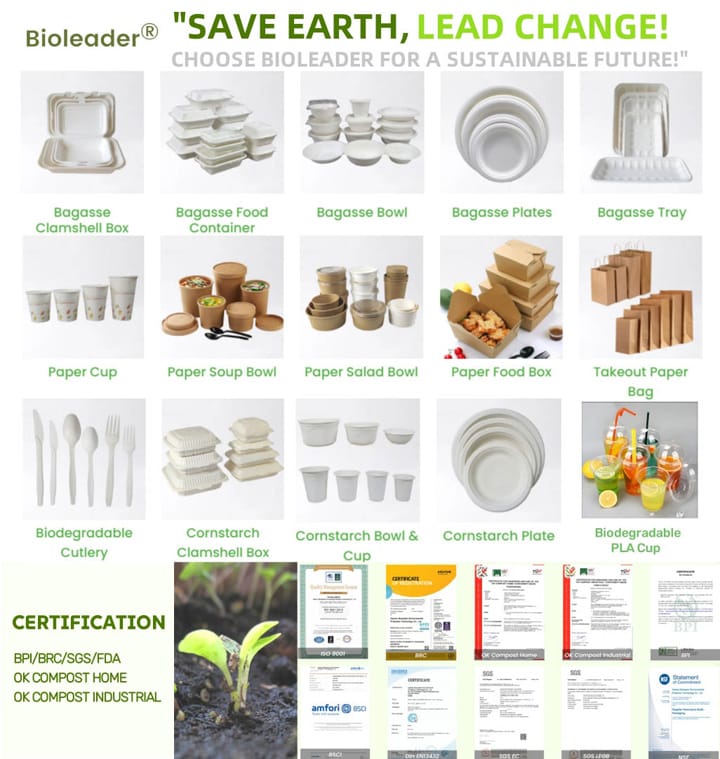
For importers, Bioleader® can support product range planning, sample testing, MOQ discussion, carton data confirmation, mixed-container planning, export document coordination and pre-shipment control. For foodservice operators and industrial caterers, Bioleader® can help match packaging to real meal service, daily volume, portion size and delivery conditions.
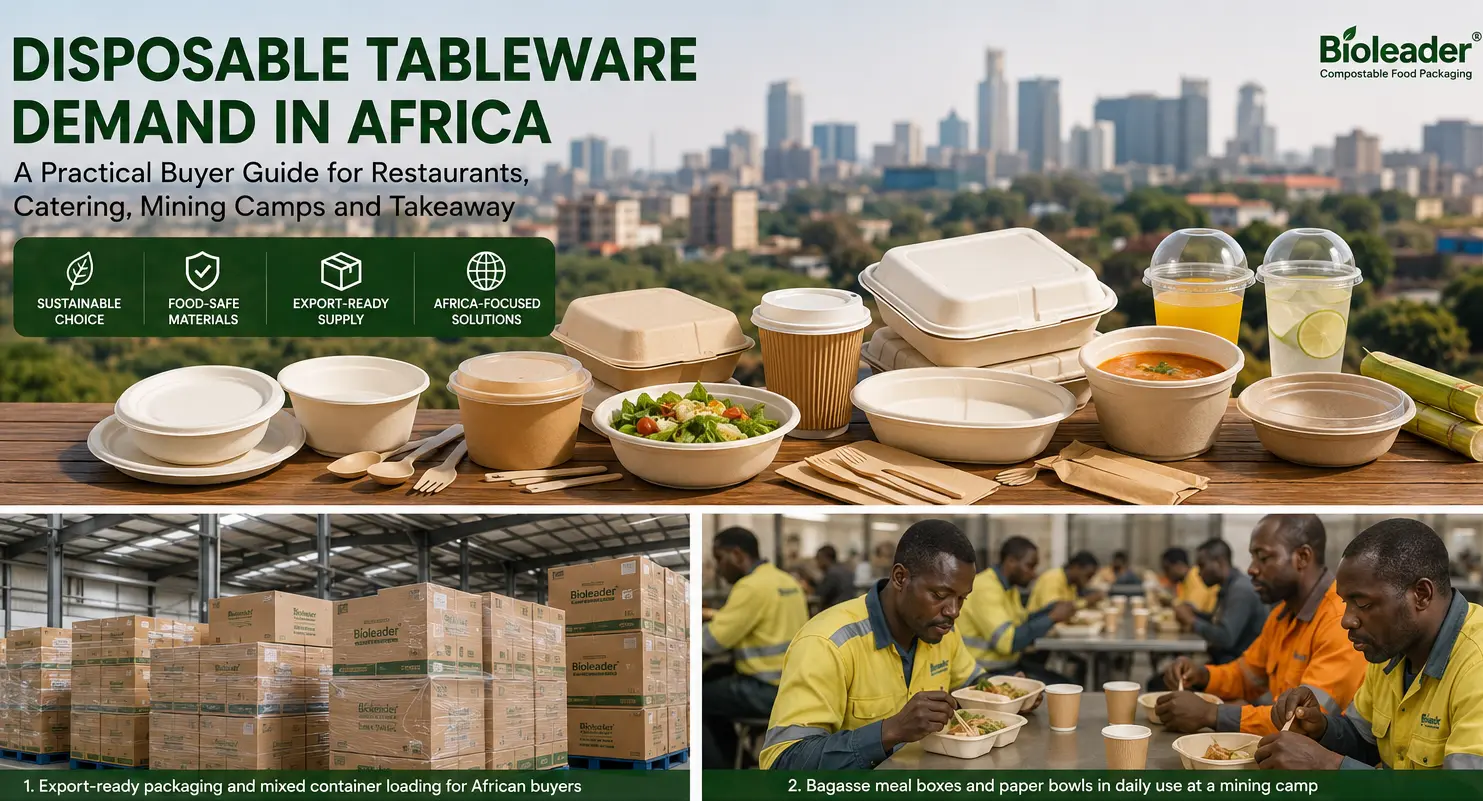
For a broader market view, buyers can also read Bioleader®’s guide on disposable tableware demand in Africa, which explains how restaurants, catering, mining camps, takeaway businesses and distributors should build a practical product portfolio.
FAQ
Why does Bioleader® use anonymized case notes instead of customer names?
Bioleader® protects customer confidentiality by not publishing customer names, contact details, exact prices, PI numbers, invoice numbers or shipment identifiers without authorization. Anonymized case notes still allow buyers to understand real product selection, export planning and documentation lessons.
Which African markets are included in these case notes?
The case notes cover anonymized manufacturer-side experience from Mauritius, Senegal, Nigeria / Lagos, Namibia, Ghana and Liberia. Each market shows a different procurement lesson, from paper cup loading and bowl-and-lid matching to foam replacement and industrial catering supply.
What products are most common in Bioleader® Africa-focused cases?
Common products include bagasse clamshell boxes, molded fiber trays, paper pulp tableware, kraft paper bowls, paper soup containers, paper cups, PLA cups, compostable cutlery, CPLA cutlery, cornstarch cutlery and mixed foodservice packaging programs.
Why are carton volume and CBM important for disposable tableware imports?
Disposable packaging is lightweight but bulky. A low unit price can become expensive if carton volume is inefficient. Buyers should review carton dimensions, pieces per carton, gross weight, CBM and loading quantity before comparing offers.
What does the Ghana case teach food packaging importers?
The Ghana case shows that foam-replacement planning should include both food containers and accessories. A documented shipment of paper pulp tableware and CPLA cutlery demonstrates why buyers should plan complete packaging programs rather than single replacement items.
Can Bioleader® support large mining camp or industrial catering projects?
Yes. Bioleader® can support large project planning with product matching, carton volume calculation, production scheduling, site split discussion, loading photos, finished product photos and third-party inspection options where appropriate.
Conclusion: Real Export Experience Turns Packaging into a Procurement System
Compostable tableware imports for African markets cannot be treated as simple product buying. Mauritius, Senegal, Nigeria, Namibia, Ghana and Liberia show different priorities: compliance-sensitive molded fiber packaging, paper cup loading, bowl-and-lid matching, starter clamshell SKUs, foam-replacement product programs and mining-camp meal supply.
The strongest importers do not ask only for the cheapest biodegradable item. They define the food use, choose the material, verify documents, calculate carton volume, plan the shipment and prepare for repeat orders. This is how sustainable packaging becomes a real business program instead of a one-time trial.
For African importers preparing a mixed container, foam-replacement program, paper cup order or project-based foodservice packaging supply, Bioleader® recommends sending the destination country, food type, product list, estimated monthly quantity, preferred material and required documents before quotation. With this information, Bioleader® can help narrow the product mix, check carton volume, prepare export-ready data and reduce the risk of choosing the wrong packaging.
References
The following public sources were reviewed to support the regulatory and market context in this article. Customer-specific shipment records referenced in the case notes are anonymized and are not published to protect buyer confidentiality.
- Ghana News Agency, “EPA bans styrofoam products from January 2027”. This source reports Ghana EPA’s announcement of a nationwide ban on the production, importation, sale and use of Styrofoam products from January 1, 2027.
- Ghana News Agency, “EPA bans styrofoam products from January 2027”. This version includes examples of affected EPS foam products, including food packaging containers, takeaway packs, disposable cups and plates.
- South Africa Legal Information Institute, Extended Producer Responsibility Scheme for Paper, Packaging and Single-Use Products. This legal text lists identified product categories including paper and paper packaging, plastic packaging, biodegradable and compostable packaging, single-use products and single-use compostable products.
- Government of South Africa, Extended Producer Responsibility Regulations Amendment, 2021. Official Gazette amendment document related to EPR identified products and packaging responsibility.
- Bioleader®, “Disposable Tableware Demand in Africa”. Bioleader® market guide explaining product demand across African restaurants, takeaway businesses, catering, mining camps and distributors.