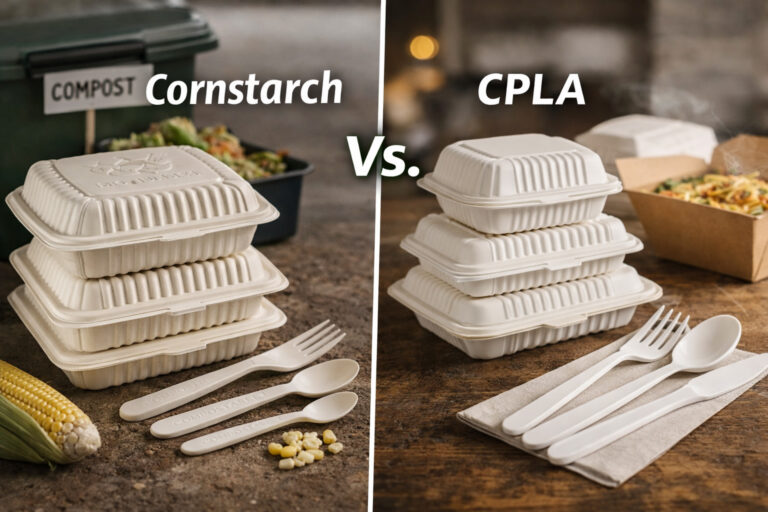
Cornstarch Vs PLA Overview For Businesses | Bioleader® Insights

Actionable coverage of cornstarch vs PLA: eco-friendly, biodegradable, compostable materials, performance data, and compliance under EN13432 & ASTM D6400. Includes BPI/TÜV references and Food-Contact Tested guidance for safe deployment. Buyer-focused: manufacturer insights, bulk/wholesale buying playbooks, OEM/ODM customization tips, full size range selection.
Quick Summary: Cornstarch tableware provides one of the closest functional replacements for single-use plastic, particularly for cutlery, lightweight containers, and foodservice accessories. While it requires industrial composting to fully realize its environmental benefits, it offers a balanced combination of usability, reduced fossil dependency, and regulatory alignment.
cornstarch vs PLA — Quick Summary
  • Items displayed (articles): 12
  • Last updated: 2024-05-30
  • Includes test data, compliance guides, buyer FAQs, and real-world use cases.

Editor’s Picks: Top Cornstarch Vs Pla Guides 2026

FAQ of Bioleader's Eco-friendly Disposable Tableware

How many sizes of the product can I get?

The compostable salad bowls are within the capacity range of 500 and 1500 ml (8 oz-48 oz), Availing variety for the mass.

Can I have their logo printed on my souvenirs?

Of course, Yes. Such businesses have the option of having margarita salad bowls with their brand name on them or any other posters since we customize them — cornstarch vs PLA. For any further details on branding options, you can reach us.

Are the containers available with a logo impression on them?

Definitely! Print Gems. Our to go salad containers are available printed with your logo or artwork — cornstarch vs PLA. This is a nice chance to make your business while safe packaging supplies are being delivered.

From Corn Kernel to Tableware

Cornstarch itself is a polysaccharide extracted from the endosperm of corn kernels. To become usable as tableware, raw starch must undergo biopolymer transformation, typically involving: Starch extraction and purification Fermentation into lactic acid Polymerization into starch-based bioplastics (often PLA or modified starch blends) Thermal molding into plates, bowls, cutlery, or containers From a material-science perspective, cornstarch tableware is not raw starch pressed into shape, but a bio-based polymer material engineered for strength, stability, and food contact safety. Key clarification:Cornstarch tableware ≠ untreated starchIt is a processed biopolymer, not edible starch. Bioleader® Cornstarch Tableware – sustainable, food-grade, and compostable products for restaurants, takeaways, and catering businesses 2.

The Environmental Cost of Plastic Tableware

According to global lifecycle studies: Conventional plastic cutlery and containers can persist hundreds of years in landfills Plastic fragmentation contributes to microplastic pollution, now detected in soil, oceans, air, and even human blood Recycling rates for small foodservice plastics remain below 10% globally due to contamination and sorting limitations Cornstarch tableware emerged as a response to three structural failures of plastic: Non-renewable fossil feedstock End-of-life persistence Regulatory non-compliance under new plastic bans From a systems perspective, cornstarch tableware represents an attempt to decouple foodservice packaging from fossil carbon — cornstarch vs PLA. 3. Is Cornstarch Tableware Biodegradable or Compostable? This is the most misunderstood aspect — and where scientific precision matters.

Related Insights

🚀Ready to Go Green and Choose ?

Join the global movement toward zero-waste packaging.


Bioleader® offers:

  • 📦 Bulk order support & fast delivery

  • ✍️ Custom branding and OEM solutions

  • 🌍 Worldwide eco-packaging compliance

Get the Catalogue Products List  & Contact Us Now! 👉

Contact us Below

Click or drag files to this area to upload.You can upload up to 5 files.
The more details you share, the faster and more accurate our quotation will be.