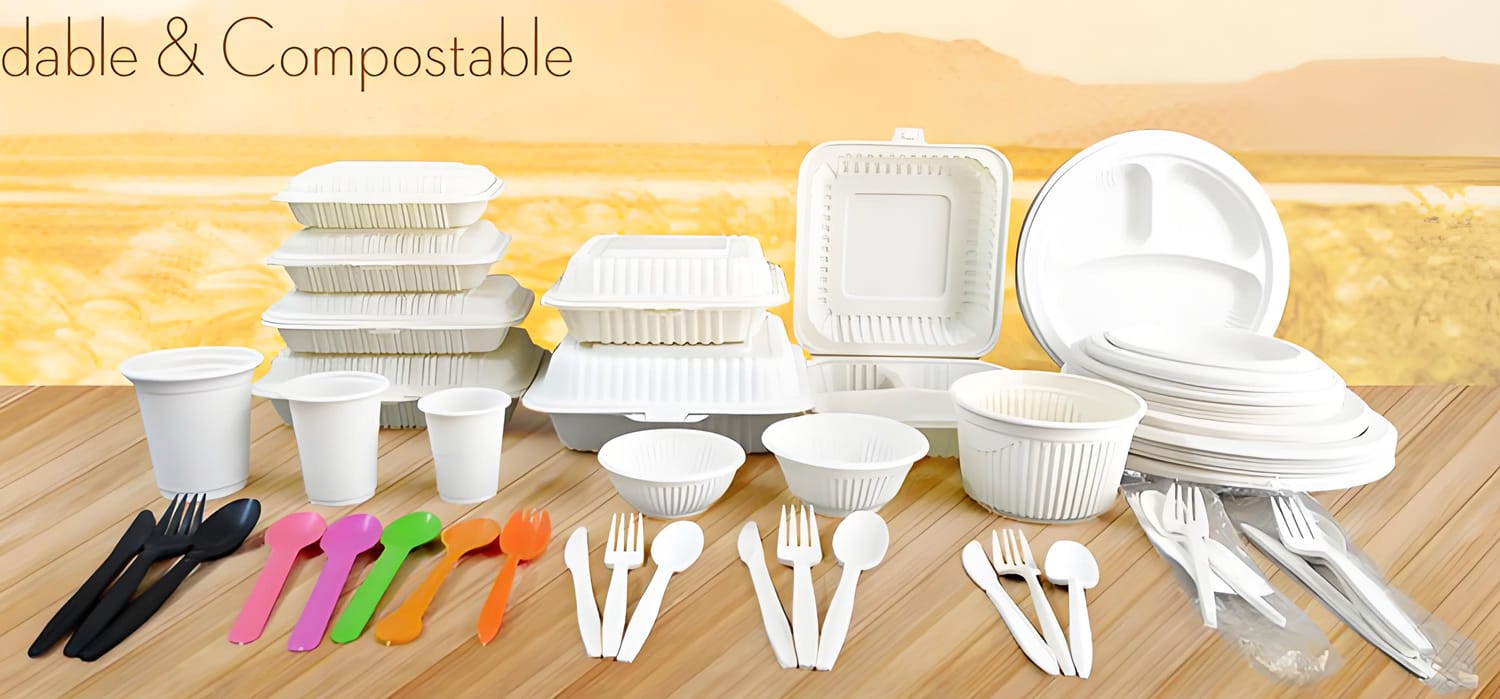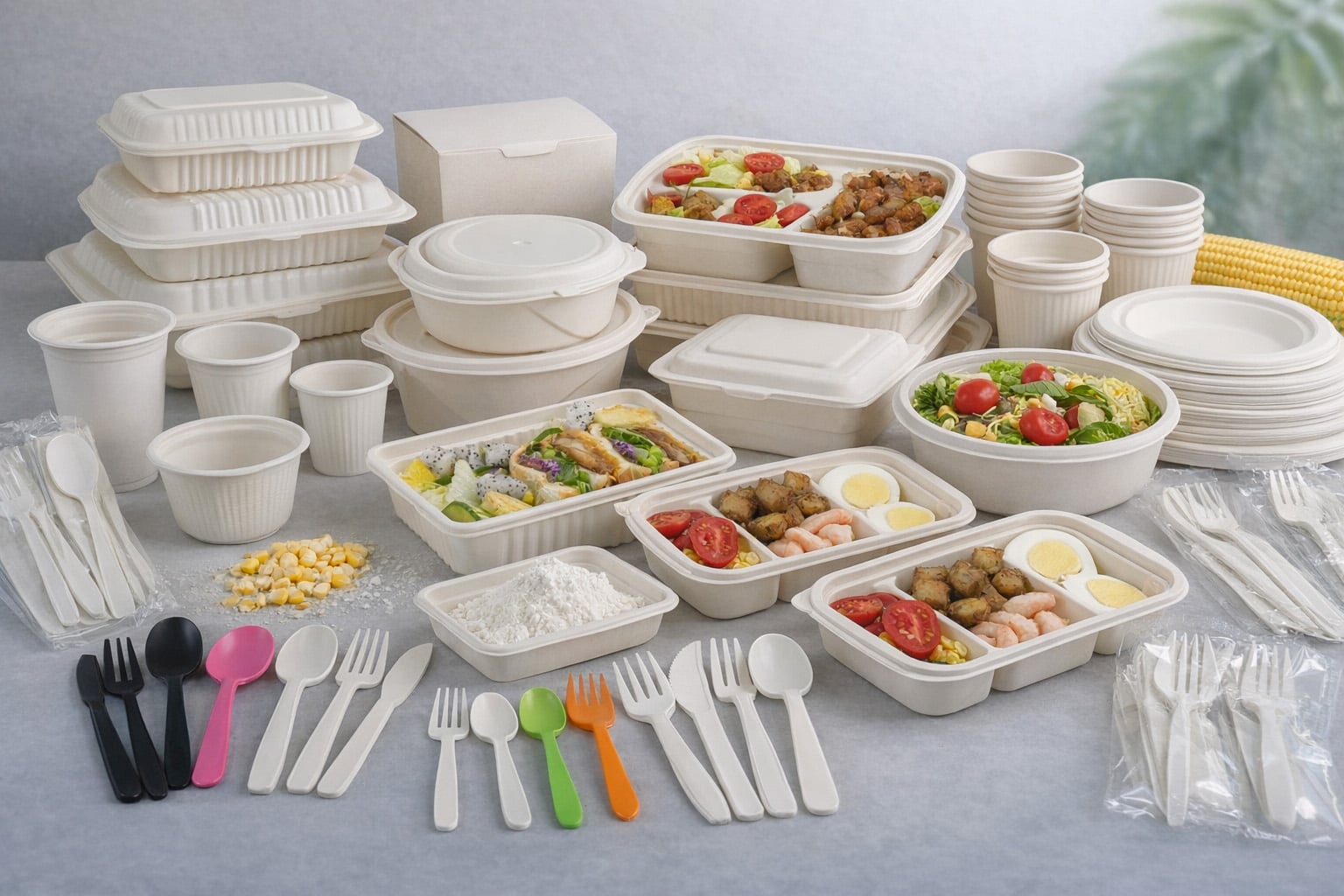
Executive Summary: Corn starch tableware has become one of the most misunderstood categories in sustainable food packaging. It is often marketed as if it were a single eco-material, but global buyers know the real issue is not wording. It is verification. In real sourcing, the safer decision depends on whether the supplier can explain the formulation logic, provide decision-grade food-contact compliance documents, and judge when a starch-based article fits the destination market and when it should be replaced by a lower-risk material route. This guide is written from that procurement perspective. It focuses on supplier selection, claim control, market risk, and application fit rather than generic material theory.
1. Executive Summary: Why Corn Starch Tableware Is a Verification Problem, Not a Marketing Category
Corn starch tableware is often marketed as if it were a simple eco-material, but global buyers know the real issue is verification. In practice, most commercial starch-based tableware is a compound system, not a single raw material. That means a buyer is not only evaluating whether a product sounds greener than plastic. The buyer is also evaluating whether the formulation, the compliance documents, and the market-facing claims can survive scrutiny from importers, regulators, retailers, and end customers.
This is why Bioleader does not treat corn starch tableware as a branding category. We treat it as a risk-managed sourcing category. Before we recommend a starch-based solution, we look at four things first: formulation composition, food-contact legality, environmental claim boundaries, and application fit in the destination market. That approach matters because official policy frameworks in the European Union already make a clear distinction between biobased, biodegradable, and compostable plastics, and the U.S. Federal Trade Commission makes the same point from a marketing-compliance angle in its Green Guides.
The sourcing mistake we see most often is not choosing the wrong factory first. It is approving the wrong material logic for the destination market. A buyer may accept a starch-based product because the claim sounds attractive, only to discover later that the labeling language is too broad, the synthetic carrier phase creates a plastics-classification problem, or the product becomes commercially weak after warehousing. That is why this guide is written as a procurement decision tool, not a classroom explanation of materials science.
In Bioleader’s export-side project reviews, the strongest purchasing outcomes usually come from buyers who ask harder questions earlier. They do not stop at “Is it bio-based?” They ask: What is the carrier resin? What does the migration report actually cover? Does the claim language fit the destination market? If the legal risk is high, should the project pivot to bagasse or aqueous-coated paper instead? Those are the questions that separate low-risk sourcing from expensive trial-and-error.
2. Corn Starch Tableware Is a Sourcing Category, Not a Single Material
2.1 Commercial Naming vs. Material Identity
Global buyers will see multiple terms used almost interchangeably in catalogs and online listings: corn starch tableware, starch-based utensils, bio-based cutlery, and plant-based tableware. From a procurement perspective, these are often commercial naming choices, not precise legal or technical identities. This distinction matters because a product may be marketed under a plant-based message while still relying on a synthetic carrier phase or additive system that changes both its performance profile and its regulatory exposure.
That is exactly why broad wording such as “plant-based” or “eco-friendly” should never be accepted as a substitute for document review. The FTC Green Guides were created to help marketers avoid environmental claims that are not true and substantiated. In purchasing terms, that means buyers should not approve a starch-based product because the wording sounds responsible. They should approve it only when the underlying formulation, food-contact documentation, and destination-market claims are aligned.
2.2 What Buyers Are Actually Buying
What a buyer is really buying is not “corn starch” alone, but a starch-based plastic composite. In real manufacturing, the purchasing risk sits in the balance between four variables: the starch phase, the polymer carrier, the mineral system, and the processing additives. This is why Bioleader does not evaluate quality by headline percentage alone. We evaluate whether the formulation balance is strong enough to survive real commercial use.
2.2.1 Starch Phase
The starch phase is the renewable part buyers usually notice first, but it is rarely the whole story. In practical sourcing, the more useful question is not “How much starch is there?” but “How is the starch being used in the final compound?” A higher stated starch percentage does not automatically mean a better export product if rigidity, sealing stability, or warehousing performance have been weakened elsewhere in the formula.
2.2.2 Polymer Carrier
The carrier phase is where many market and performance decisions are really made. Buyers should request this in writing because the carrier resin can affect heat behavior, stacking reliability, food-contact documentation, and in some regions, even how the product is treated from a regulatory standpoint. For that reason, Bioleader advises importers not to rely on sales wording alone when a project involves markets with stricter plastics interpretation.
2.2.3 Mineral System
Functional minerals are not automatically a warning sign. Used properly, they can help tune rigidity, improve dimensional stability, and support process consistency. Used badly, they can become a cost-down shortcut that weakens the article. In our project reviews, one of the easiest ways to spot trouble is when a supplier keeps talking about “high starch content” but refuses to explain the reinforcement system behind the number.
2.2.4 Additives and Processing Aids
Color masterbatch, lubricants, and compatibilizers rarely appear in front-page marketing, but they matter in real sourcing because they affect consistency, odor, surface finish, and sometimes the reliability of supporting documents. If a supplier cannot explain what sits around the main resin system, the buyer is looking at an incomplete compliance picture.
2.3 Why “High Starch” Claims Should Be Tested Against Documents, Not Marketing
One of the most common sourcing traps in this category is what we call percentage marketing. A product may be advertised with an impressive starch claim, but the buyer is not shown how that number relates to carrier resin, mineral loading, or end-use durability. At Bioleader, we have seen that this is exactly where poor products hide: the sales story highlights a green number, while the commercial weakness shows up later in stacking pressure, warehousing drift, or brittle edges during delivery.
That is why buyers should ask for the formulation basis in writing, not just a catalog phrase. If the supplier can support the product with a Technical Data Sheet, a Declaration of Compliance, a valid migration report, and a clear explanation of what the product is designed to do, the sourcing discussion becomes real. If not, the buyer may be looking at a product built for quotation convenience rather than market reliability.
Where buyers also need discipline is in understanding what ASTM D6866 actually does. It is an analytical method for measuring biobased carbon content using radiocarbon analysis. It is useful for validating biobased carbon, but it does not by itself prove that a product is compostable, biodegradable, or legally safe to market with broad environmental claims. That is a critical distinction for any buyer building a global sourcing program.
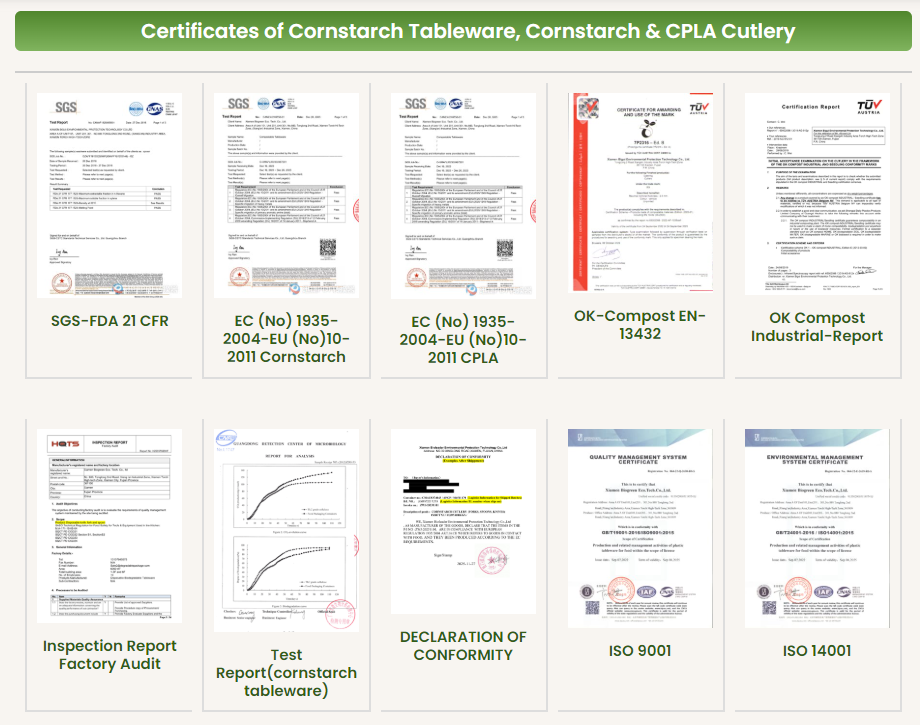
3. What Buyers Should Verify in the Formulation: Starch, Polymer Carrier, Mineral System, and Additives
This is where procurement discipline starts. A buyer does not need a chemistry lecture to source corn starch tableware well. What the buyer needs is a practical method for checking whether the product’s formulation logic matches its market claim, food-contact documents, and real use scenario. In Bioleader’s export-side reviews, the projects that fail most often are not the ones with the worst brochures. They are the ones where the formulation story, the compliance documents, and the intended application do not match each other.
3.1 Starch Phase: Why “Corn Starch” Is Only the Starting Point
When buyers read “corn starch tableware,” they often assume the starch itself defines the product. In practice, starch is only one part of the sourcing picture. What matters more is how the starch is used inside the finished compound. Some suppliers emphasize a high starch percentage because it sounds greener in a quotation. But a higher number on paper does not automatically mean better structural performance, better storage stability, or lower market risk.
At Bioleader, we advise buyers to ask a more useful question: What role does the starch phase play in the final product? Is it there as a real functional component in a balanced formulation, or is it being used as a headline claim while the supplier avoids discussing the carrier resin, filler load, and application boundary? This distinction is crucial because once the product enters transport, hot filling, warehousing, or foodservice use, it is the working balance of the whole formulation—not just the starch headline alone—that determines whether the sourcing decision was correct.
In our 10+ years of resin modification, we’ve seen that some suppliers focus on high starch percentages as a marketing tool while leaving out the detailed conversation about polypropylene (PP) or inorganic fillers that impact the product’s overall durability and performance. A truly functional, well-balanced formulation has an optimal ratio of starch to carrier resin, ensuring that structural integrity is maintained while keeping the environmental benefits intact.
Sources for further reference:
- ASTM D6866 Standard for Bio-based Carbon – Used to measure bio-based content.
- GB 4806.7-2023 – China’s standards for food-contact plastics, including starch-based materials.
- ScienceDirect: Starch-based Biodegradable Materials – A detailed review of starch-based material properties and their performance in sustainable packaging.
3.2 Polymer Carrier: The Part Many Suppliers Mention Last, but Buyers Should Ask First
The carrier resin is often where the real commercial risk sits. It influences rigidity, hot-use behavior, product stability, and in some markets even how the article is interpreted under plastics-related policy logic. That is why buyers should request the carrier phase in writing instead of assuming all “corn starch” products are comparable. In cross-border sourcing, two products can look similar in a catalog while carrying very different regulatory and performance consequences once the destination market reviews the actual composition.
This is also why ASTM D6866 should be understood correctly in procurement. It is a recognized analytical method for measuring biobased carbon content, but the ASTM scope itself makes clear that it does not address environmental impact, product performance, or functionality on its own. For buyers, that means a biobased carbon result may help validate a carbon claim, but it does not replace the need to review carrier resin choice, migration compliance, and market-facing claim language.
3.3 Functional Minerals: Why Fillers Are Not Automatically a Red Flag
Serious buyers should not treat all mineral systems as a problem. Used properly, functional minerals can help tune rigidity, support dimensional stability, and improve processing consistency. The mistake is not the existence of fillers. The mistake is failing to distinguish between engineering use and cost-down abuse. In our project reviews, one warning sign appears when a supplier promotes a very aggressive starch number but refuses to explain the reinforcement logic behind it.
For buyers sourcing from China, GB 4806.7-2023 matters because it is part of the current food-contact plastics baseline and, according to official regulatory notices, it also applies to starch-based plastic materials and articles. You can see that reflected in public Chinese regulatory listings and implementation summaries from health and local government sources, including the National Health Commission food safety standards directory and a local explanatory notice confirming that GB 4806.7-2023 applies to food-contact starch-based plastic materials and articles. But buyers should also be realistic: Chinese manufacturing compliance is not the same thing as global claim clearance. A product can sit on a sound food-contact base in manufacturing while still being a poor fit for its destination-market messaging strategy.
3.4 Additives and Processing Aids: The Quiet Part of the Formula That Buyers Should Not Ignore
Color masterbatch, lubricants, and compatibilizers rarely appear in the sales headline, but they can affect the consistency of the finished article, the stability of supporting documents, and the credibility of a supplier’s technical explanation. In procurement practice, this is where many catalog-driven suppliers become weak. They can sell the material story at a high level, but they cannot explain the surrounding system well enough to support export-level questions.
Bioleader’s view is straightforward: if a supplier cannot explain what sits around the main resin system, then the buyer does not yet have a decision-grade compliance picture. For serious importers, that is not a minor gap. It is exactly where future disputes over odor, fit, or document mismatch begin.
3.5 Beyond the TDS: The “Ash & Odor” Audit Buyers Rarely Ask For
Most suppliers will send a standard Technical Data Sheet and assume the conversation is finished. At Bioleader, we advise buyers to look deeper. A polished TDS can still hide a weak commercial product if the filler strategy is aggressive, the odor profile is unstable, or the SKU-to-report logic is loose. This is why we tell buyers to compare the sales story against simple operational indicators that many generic suppliers avoid discussing.
Ash behavior is one such indicator. In a factory-side review, unusually high residual ash after burn-off evaluation can be a clue that the formulation is leaning too heavily on low-cost mineral loading rather than performance balance. That does not mean every mineral system is bad. It means buyers should learn to separate functional reinforcement from cosmetic percentage marketing. The same logic applies to odor drift. If a starch-based product develops an abnormal smell during hot holding or microwave reheating, that may not appear in the catalog, but it can become a serious failure point in higher-end catering or export retail projects.
3.6 Why Document Consistency Matters More Than Claims
At procurement level, the safest habit is to compare documents against each other, not to read each one in isolation. A buyer should not stop at receiving a TDS, a Declaration of Compliance, and a migration report. The buyer should check whether they all refer to the same article logic. Does the stated formulation match the marketed claim? Does the migration report match the actual SKU, color, and intended use? Does the compliance statement support the market where the product will actually be sold? This is where real supplier screening begins.
In our experience, some of the most expensive sourcing problems begin with a document package that looks complete but is not internally aligned. A report may be real, but not specific enough. A declaration may be valid, but not for the article the buyer is actually ordering. For global buyers, document consistency is not an administrative detail. It is part of product verification.
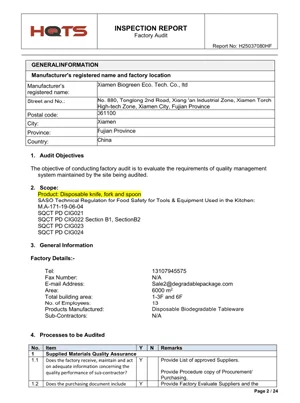
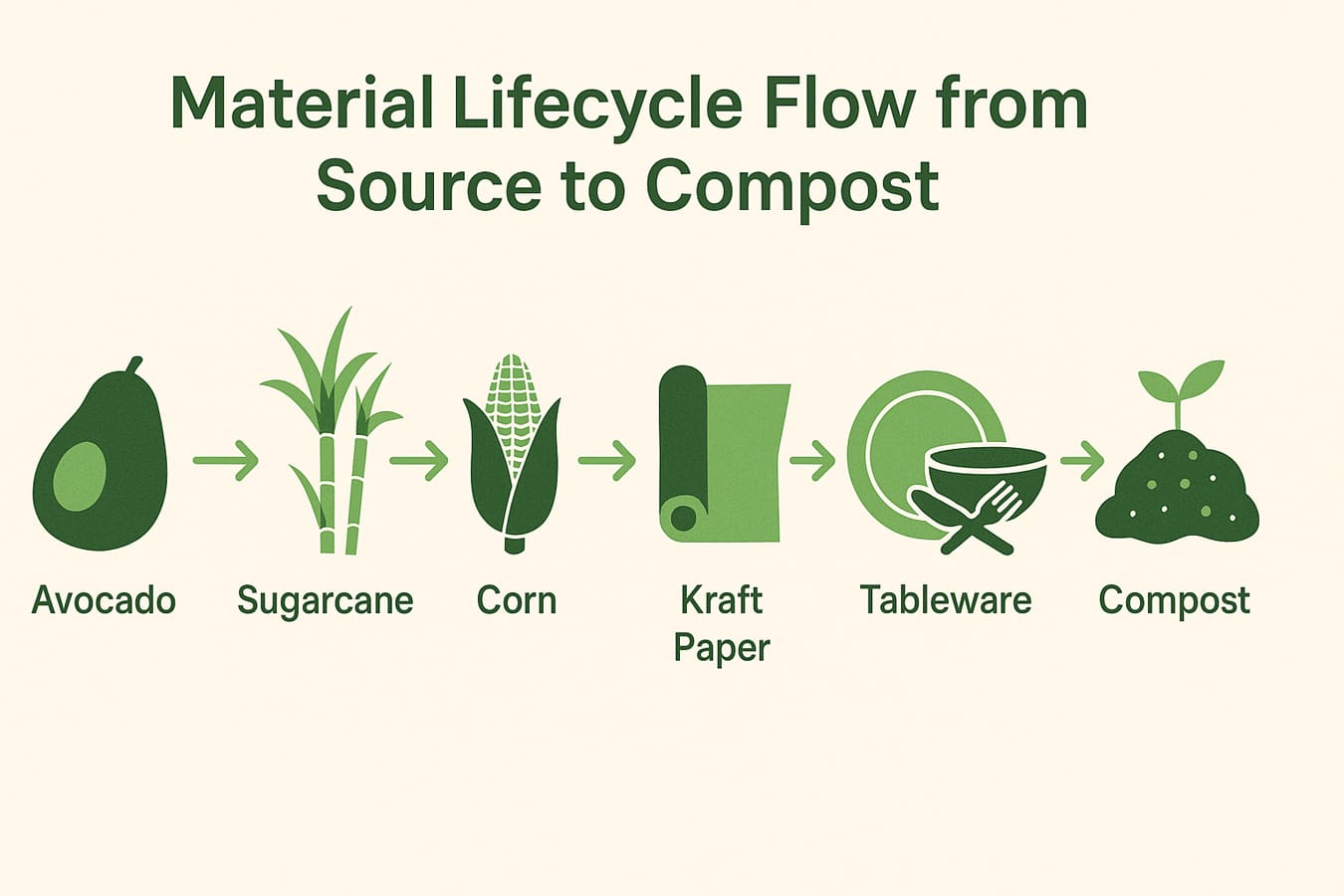
4. Bio-Based, Biodegradable, and Compostable: The Three Claims Buyers Must Never Confuse
This is where many cross-border projects become commercially risky, even when the product itself looks acceptable. In global sourcing, a product can be technically saleable and still become a problem if the environmental language is careless. Buyers therefore need to separate material truth from marketing convenience. That separation is no longer optional. It is already built into how regulators and policy frameworks discuss plastics claims in major markets.
4.1 What “Bio-Based” Can Legitimately Communicate
Bio-based speaks to source, not to end-of-life behavior. That is the cleanest way for buyers to think about it. If a supplier uses a biobased claim, the question is whether the carbon origin can be supported. It is not a shortcut to saying the product is automatically biodegradable, compostable, or low-risk for every destination market. That distinction is not just theoretical. The European Commission’s own policy framework on biobased, biodegradable and compostable plastics exists because those concepts are routinely mixed together in the market.
For procurement teams, the practical lesson is simple: if a supplier says “bio-based,” the buyer should ask what evidence supports that statement and how the claim will be used in packaging, import documents, or customer-facing marketing. If the claim is being used only as a broad sales phrase, the sourcing program is already too loose.
4.2 Why Biodegradable Is Not the Same as Compostable
These two words are often used as if they were interchangeable. They are not. In purchasing terms, that matters because a buyer may inherit a legal or commercial problem simply by accepting a loosely worded product description. Biodegradable is not the same as compostable, and neither word should be approved for use just because the product contains a renewable material phase.
That is exactly why Bioleader advises buyers to keep end-of-life claims under tighter control than general sales claims. If the supplier cannot explain the basis of a biodegradation or compostability statement, the safer procurement move is not to “hope the wording is acceptable.” The safer move is to narrow the claim or change the material route entirely.
4.3 Why These Three Claims Are Regulated Differently Across Markets
In the European Union, the policy conversation already distinguishes clearly between biobased, biodegradable, and compostable, and does not treat them as a single sustainability shortcut. That is visible in the European Commission’s current framework, which treats sourcing, labeling, and use conditions as separate issues rather than one green category. For buyers targeting the EU, this means a starch-based product cannot be approved only because its material story sounds better than conventional plastic. It must also survive the legal and commercial interpretation of the destination market.
In the United States, the same discipline appears from a marketing-compliance angle. The FTC Green Guides emphasize that environmental claims should be true, substantiated, and not misleading. The FTC also warns against broad, unqualified claims such as “green” or “eco-friendly,” because such claims are difficult or impossible to substantiate in a general sense. For buyers, that means claim language is not a soft branding issue. It is part of sourcing risk control.
4.4 Packaging Language Buyers Should Control Before Market Entry
At Bioleader, we recommend a simple three-part claim discipline before any project moves into final artwork or customer-facing quotation. First, separate the material claim from the end-of-life claim. Second, separate both of those from the food-contact compliance claim. In practice, this means buyers should never let “plant-based,” “compostable,” and “food-safe” blur into one sentence unless each part of that statement is independently supportable.
4.4.1 Material Claim
Examples include bio-based or plant-based. These should be supported by formulation logic and, where relevant, analytical methods such as ASTM D6866 for biobased carbon content.
4.4.2 End-of-Life Claim
Examples include compostable, biodegradable, or no end-of-life claim at all. These should never be approved because they “sound close enough.” They must fit the evidence and the target market’s tolerance for such wording.
4.4.3 Compliance Claim
Examples include food-contact compliant, migration tested, or market-specific compliance supported. These claims should be tied to actual documentation and should match the product variant being quoted.
4.5 Bioleader View: Claim Discipline Is Part of Sourcing Discipline
One of the fastest ways to turn a workable product into a risky project is careless packaging language. In our export-side reviews, we often see buyers focus heavily on the factory audit and not enough on the final wording that will travel with the product. That is a mistake. A starch-based article with decent technical fit can still become the wrong choice if the planned market message is too broad for the destination market’s legal logic.
That is why Bioleader does not treat label language as an afterthought. We treat it as part of the quotation review. If the safest path is to narrow the environmental wording, we say so. If the safest path is to pivot away from starch-based composites and move toward bagasse, aqueous-coated paper, or another system, we say that too. Buyers do not need a supplier who agrees with every initial request. They need a supplier who can reduce avoidable risk before the order is placed.
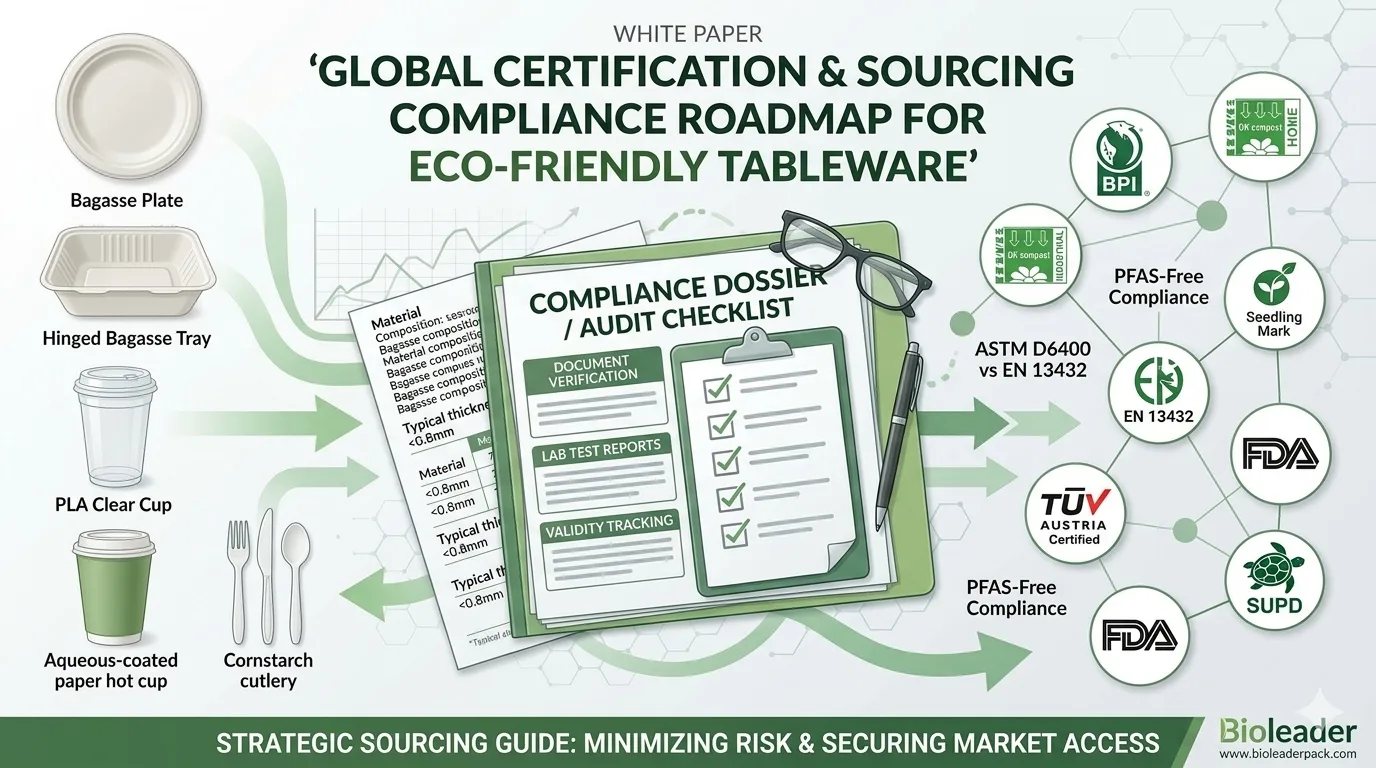
5. Global Compliance Boundaries: EU, U.S., China, and Emerging Growth Markets
This is the section where many sourcing projects either become commercially safe or legally messy. A starch-based product can look acceptable on paper and still be the wrong choice if the destination market applies a stricter interpretation of plastics, environmental claims, or food-contact documentation. At Bioleader, we do not treat corn starch tableware as a universal answer. We treat it as one option inside a broader export strategy. If the compliance risk is too high, we would rather redirect a buyer early than let a quotation create downstream legal or retail problems.
5.1 European Union: Why Bio-Based Plastic Is Still a Plastics Issue
For buyers targeting the European Union, the first discipline is to stop treating bio-based as if it automatically changes how a product is viewed under plastics policy. The European Commission’s policy framework on biobased, biodegradable and compostable plastics makes clear that these are different concepts and should not be merged into one easy green label. In practical sourcing terms, that means a starch-based composite containing synthetic carrier resin may still create positioning risk, claim risk, or retailer acceptance risk even when the product story sounds attractive in a catalog.
This is why Bioleader does not automatically recommend corn starch for every EU-facing project. In markets or customer channels where buyers apply a stricter plastics reading, we often advise moving toward bagasse or aqueous-coated paper instead. That is not because corn starch cannot be manufactured well. It is because the safest sourcing decision is not always the one with the most appealing material narrative. It is the one with the clearest fit between compliance logic, market messaging, and end-customer acceptance.
5.2 United States: Why Environmental Claims Must Be Specific and Substantiated
In the United States, buyers should treat environmental language as part of sourcing control, not as a design afterthought. The FTC Green Guides explain that environmental marketing claims should be truthful, substantiated, and not misleading. That matters because the sourcing risk in the U.S. is often not the product alone. It is the gap between the product and the words printed on packaging, sales sheets, or e-commerce listings.
For importers and distributors, this means one thing: do not approve broad environmental wording just because a supplier says the product is starch-based. Ask whether the claim can be supported, whether the wording is too broad, and whether the documentation behind the claim actually belongs to the SKU being sold. Bioleader’s position is simple: if a product needs heavy explanation to make its environmental wording sound safe, that wording is probably too loose for procurement-grade use.
5.3 China: Food-Contact Compliance Should Be Treated as a Manufacturing Baseline
For buyers sourcing from China, GB 4806.7-2023 should be treated as part of the manufacturing baseline, not as a global shortcut. Public implementation notices and regulatory summaries confirm that the standard applies to food-contact plastic materials and articles, including starch-based plastic materials and articles, which makes it highly relevant for factory-side screening in China. You can see this reflected in the National Health Commission standard release and local implementation references such as the Fuzhou market supervision explanation of GB 4806.7-2023.
But manufacturing baseline is not the same as export clearance. A product can sit on an acceptable food-contact base in China and still be the wrong commercial choice for a stricter destination market. That is why Bioleader separates factory compliance review from destination-market risk review. Buyers who mix those two stages together usually make slower and more expensive corrections later.
5.4 Emerging Growth Markets: Where Commercial Acceptance May Be Broader, but Review Still Matters
In many emerging growth markets, especially in parts of Southeast Asia, the Middle East, Africa, and Latin America, a starch-based composite may face less immediate claim resistance than it would in stricter European channels. From a commercial perspective, that can make cornstarch tableware or cornstarch takeaway food containers a practical bridge solution for buyers who want better sustainability positioning than conventional plastic without moving straight into higher-cost material routes.
However, “commercially more open” does not mean “no review needed.” Buyers still need to confirm local importer expectations, food-contact documentation, and acceptable claim language. Bioleader’s advice is to treat these markets as commercially flexible but document-sensitive. If the market is open, that is an opportunity. It is not a reason to lower audit standards.
5.5 When to Pivot Away from Corn Starch
This is one of the most important sourcing judgments in the whole guide. Sometimes the best decision is not to buy corn starch at all. If the project is heading into a market or customer channel where plastics interpretation is tight, where environmental wording is likely to be challenged, or where product messaging needs to stay extremely clean, Bioleader will often recommend a pivot. In those cases, our recommendation may move toward bagasse tableware, aqueous-coated paper containers & bowls, or another lower-ambiguity material route.
That is the difference between a catalog seller and a sourcing partner. A catalog seller tries to fit every project into the same product family. Bioleader reviews the destination market, the meal profile, the claim boundary, and the customer channel first. If corn starch is the right answer, we say so. If it creates unnecessary legal or retail friction, we say that too.
5.6 Global Market Acceptance Matrix for Starch-Based Plastic Tableware
The matrix below is designed as a practical sourcing shortcut. It does not replace legal review, but it helps buyers understand where corn starch tableware is more commercially open, where claim sensitivity is high, and where Bioleader would normally recommend a cleaner alternative route.
| Region | Food-Contact Baseline | Environmental Claim Sensitivity | Plastic-Regulation Sensitivity | Recommended Bioleader Line |
|---|---|---|---|---|
| European Union | EU 10/2011 | Very High | Strict | Bagasse / Aqueous Coated Paper |
| United States | FDA food-contact framework | High | Moderate | Corn Starch / Bagasse |
| China / Southeast Asia | GB 4806.7-2023 and local market practice | Moderate | Lower | Corn Starch as Bridge Solution |
| Middle East | Importer and local standards review | Lower | Lower | Corn Starch / Project-Specific Review |
6. Factory Reality: Fillers, Regrind Control, and the Supplier Risks Buyers Should Audit
This is where brochure logic usually breaks down. Most suppliers know how to talk about sustainability. Far fewer can explain what happens when a starch-based article is pushed through real factory conditions, real stacking pressure, real warehouse exposure, and real export documentation review. In Bioleader’s project screening, the biggest sourcing risks usually appear in three places: filler logic, regrind discipline, and document-to-SKU consistency.
6.1 Functional Minerals vs. Cost-Down Abuse
Functional minerals are not the problem by themselves. Used correctly, they can support rigidity, dimensional stability, and process consistency. The real problem begins when mineral loading becomes a hidden cost-down tool while the sales story continues to emphasize a green or high-starch message. That is when the buyer ends up paying for a better story than the product can commercially support.
At Bioleader, we do not judge a product only by what is stated in the top line of the formula. We judge it by whether the reinforcement system still protects the article under real use conditions. If a supplier cannot explain why the mineral system is there, how it supports the article, and what effect it has on end-use performance, the buyer is not yet looking at a trustworthy sourcing conversation.
6.2 Regrind Control and Why Disclosure Matters
Regrind is one of the easiest subjects for weak suppliers to avoid and one of the most important subjects for serious buyers to ask about. In food-contact sourcing, the question is not whether every factory has scrap. The question is whether the supplier can explain its regrind policy clearly, apply it consistently, and document it honestly. If that conversation becomes vague, the buyer should assume the risk is moving upward, not downward.
Bioleader’s rule is straightforward: the buyer should know whether regrind is used, where it is used, and how that affects the commercial suitability of the product. A supplier who avoids the subject usually does not reduce risk. It only transfers that risk to the importer.
6.3 Why Ash Content, Odor Drift, and Stiffness Drift Are Early Warning Signs
This is the kind of control point that generic material articles rarely mention. In an actual project review, ash deviation, odor drift, and stiffness drift are not cosmetic issues. They are early warning signs. If ash residue moves unexpectedly high in internal burn-off review, that can be a clue that the formulation balance has shifted too far toward low-value mineral loading. If odor changes after hot holding or microwave exposure, that may not appear in the quotation stage, but it becomes highly visible in premium catering, export retail, and institutional use.
We also watch for stiffness drift because a product that looks acceptable at the sample stage can become commercially weak if its rigidity profile is not stable batch to batch. That is why Bioleader treats these signals as procurement-grade indicators, not just plant-floor observations. Buyers who learn to ask about them filter out weak suppliers faster.
6.4 The Report Mismatch Problem
One of the most underestimated risks in this category is not a fake report. It is a misapplied real report. A supplier may provide a migration report, a declaration, and a technical sheet that all look official, but if one report is being stretched across multiple colors, multiple article weights, or multiple mold structures, the decision quality drops sharply. The paperwork still looks complete. The sourcing reliability does not.
Bioleader advises buyers to check whether the report matches the exact SKU, or at minimum, whether the supplier can explain the matching logic in a way that is technically and commercially credible. In cross-border sourcing, a document package that is “close enough” is often where future compliance disputes begin.
6.5 The 7 Supplier Pitfalls Buyers Should Ask About Before PO
Before a purchase order is approved, buyers should pressure-test the supplier on the seven issues that most often separate a strong export program from a fragile one.
- Formulation not disclosed: The supplier talks about sustainability but will not explain the working material system.
- Filler level not explained: The product sounds green, but the reinforcement logic is treated like a hidden subject.
- Regrind usage not declared: The factory avoids answering a basic control question.
- Report not SKU-matched: Documents exist, but not at a decision-grade level.
- Migration conditions not application-matched: Testing is provided, but not clearly linked to the intended food scenario.
- Heat claims not test-backed: The supplier promises “hot use” without application-specific validation.
- Environmental wording is too broad: The sales language is stronger than the evidence behind it.
7. Performance Boundaries: Where Starch-Based Composites Work—and Where They Do Not
This section decides whether the article is being sold honestly. A good supplier should not tell buyers that every starch-based product works for every hot meal. That is not expertise. That is risk transfer. In real purchasing, performance should be discussed by meal type, hold time, delivery stress, and reheating scenario. The more those conditions differ, the less useful generic claims become.
7.1 Heat Profile: Short Hot-Fill vs. Prolonged Heat Holding
Buyers should separate at least four situations before approving a starch-based project: short hot-fill, short-duration hot meal holding, prolonged high-temperature holding, and microwave reheating. These are not interchangeable use cases. A product that performs acceptably in one may become commercially weak in another.
Bioleader’s position is that heat claims should be tied to a defined scenario, not to a vague phrase such as “suitable for hot food.” If the supplier cannot tell you whether the article was reviewed for short-duration takeaway, longer hold time, or microwave exposure, then the claim is too broad for a serious purchasing decision.
7.2 Structural Performance in Delivery and Stacking
For takeaway and foodservice buyers, structural performance is often more important than a headline sustainability phrase. What matters in real life is rim rigidity, compartment wall stability, lid fit consistency, and handling reliability during delivery. A product that looks acceptable on a desk can still fail commercially if it distorts under scooter transport, stacking pressure, or bulk loading.
This is why Bioleader frames performance around use conditions instead of catalog categories. A lunch box used in a short local pickup model is not the same engineering problem as a multi-compartment container carried for a long-distance delivery route in humid weather. Buyers should insist that product recommendations match logistics reality, not just article appearance.
7.3 Grease and Moisture Performance Depends on Formulation, Not Category Name
One of the most common sourcing mistakes is comparing categories too simplistically. Buyers often ask whether corn starch is “better than bagasse” for oily or wet foods. The better question is whether the wall design, formulation balance, and meal profile fit the actual use case. Category names do not hold sauce. Article design and formulation do.
That is why Bioleader does not make absolute claims here. For some meal formats, a starch-based article can work well as a high-performance bridge solution. For other formats, especially where the regulatory or labeling logic is cleaner with fiber-based materials, we may recommend bagasse or aqueous-coated paper instead. The right answer depends on the project, not on material enthusiasm.
7.4 Where Buyers Should Not Overextend Starch-Based Products
A credible supplier should know when not to sell. Buyers should be careful about applying starch-based composites to every high-heat or edge-case scenario just because the category has a sustainability angle. If the meal is extremely hot, held for a long duration, reheated aggressively, or sold into a market with a stricter plastics interpretation, the buyer should stop asking whether starch can be stretched to fit and start asking whether another material route would lower risk.
This is one of the places where Bioleader takes a firmer stance than generic suppliers. If the article’s logic is becoming too strained, we will say so. That may lead to a pivot toward bagasse, aqueous-coated paper, or another system that gives the buyer a cleaner performance and compliance story. In our view, that is not a lost sale. It is a better quotation.
8. Product-Fit by Application: Bioleader’s Corn Starch Tableware Range for Global Buyers
This section is not a catalog dump. It is a sourcing filter. At Bioleader, we do not start with “what we have.” We start with where the product will be sold, what meal it will hold, how long it will travel, and what legal language will appear on the packaging. That is why our corn starch range is positioned as a high-performance bridge solution, not as a universal answer for every sustainability project.
8.1 Corn Starch Meal Boxes and Lunch Containers

For buyers working in hot food takeaway, meal delivery, and institutional catering, corn starch meal boxes can be a commercially effective choice when the project needs better rigidity and leak resistance than low-end plastic alternatives, but does not require the cleaner policy positioning of fiber-based materials. This is especially true in markets where the sourcing decision is still driven by performance-to-cost balance rather than by the strictest anti-plastics interpretation.
At Bioleader, we usually recommend cornstarch clamshell boxes, compartment containers, and cornstarch lunch containers when the buyer’s priority is stable form, better stack strength, and a more controlled delivery experience for rice meals, sauced dishes, and mixed takeaway menus. But if the same buyer is serving a market where plastics-related legal reading is tight, we may advise switching to bagasse or aqueous-coated paper before the first production discussion even begins.
8.2 Corn Starch Plates and Compartment Trays

Cornstarch plates, section plates, and meal trays are often a practical fit in schools, canteens, group meal programs, and event catering, where repeatability, stackability, and transport handling matter more than premium eco-storytelling. Buyers in these channels usually care less about marketing vocabulary and more about whether the tray stays stable when filled, moved, and stacked in volume.
This is where Bioleader’s solution logic becomes more useful than a simple product list. If the buyer’s priority is operational stability and cost control, a starch-based tray can make sense. If the buyer also needs a cleaner sustainability position for public tenders, institutional procurement, or retailer-facing presentation, then the better answer may no longer be starch-based at all. In that case, we would rather redirect the project early than let the buyer discover the mismatch after samples or artwork approval.
8.3 Corn Starch Cutlery and Accessory Items

For many global buyers, cornstarch cutlery is the most commercially approachable entry point into this category. It works well for forks, knives, spoons, cutlery kits(individually wrapped sets), and selected accessories where the customer wants a step away from full conventional plastic but is still balancing cost, structural familiarity, and sourcing scale. This is one reason cutlery often has broader market acceptance than more heavily scrutinized food-contact containers.
Even here, Bioleader does not treat all projects the same. If the application is a basic takeaway or large-volume meal distribution, the starch-based route can be commercially efficient. But if the market expects a cleaner compostability narrative or if the customer is highly sensitive to plastics-related messaging, we may steer the conversation toward CPLA or other alternatives instead. The point is not to force one product family into every quotation. The point is to reduce sourcing friction before it becomes a customer complaint.
8.4 How Bioleader Positions Starch-Based Products Against Bagasse, Paper, and PLA Lines
Bioleader’s product logic is comparative, not isolated. We do not present corn starch as the “best” option in the abstract. We position it against the buyer’s actual alternatives.

8.4.1 When Starch-Based Composites Make Sense
They make sense when the buyer needs a strong bridge solution between conventional plastic familiarity and a more sustainability-oriented sourcing direction, especially in markets where the legal and commercial environment is still open to starch-based hybrid products.
8.4.2 When Bagasse Is the Better Route
Bagasse becomes the better route when the buyer needs a cleaner anti-plastics position, simpler communication in stricter markets, or a stronger fit for customers who are actively trying to reduce regulatory ambiguity under frameworks such as the EU policy framework on biobased, biodegradable and compostable plastics.
8.4.3 When Paper or Aqueous-Coated Paper Is More Suitable
Paper-based or aqueous-coated paper systems become more suitable when the buyer wants a stronger retail sustainability position while still preserving foodservice practicality. These materials are especially worth considering when the buyer is trying to lower marketing-language risk without pushing the project into a fully different operational model.
8.4.4 When PLA Belongs to the Project Instead
PLA belongs to the conversation when the application clearly shifts into cold-drink systems or related categories where clarity, cup aesthetics, and cold-use positioning matter more than hot-meal rigidity. Bioleader’s role is not to force starch into cold-drink logic or to force PLA into hot-meal logic. It is to protect the buyer from category misuse.
9. Why Bioleader Is the Engineering Partner for Bio-Based Composites
This is the part that many generic suppliers cannot write honestly, because they do not actually control the technical variables they are selling. Bioleader’s starch-based line is not a buy-and-resell catalog built around borrowed product language. We manage the sourcing logic from the position of a manufacturer that understands how formulation choice, performance targets, export documentation, and destination-market risk connect to each other.
9.1 Formulation Compounding vs. Buy-and-Resell Sourcing
There is a major difference between a supplier who quotes a starch-based item and a supplier who understands why that item works. At Bioleader, our role is not limited to repeating a product description. We review the relationship between the starch phase, the carrier system, the reinforcement logic, and the end-use scenario. That is why our recommendation process is engineering-driven before it becomes sales-driven.
For buyers, this matters because the commercial failure of a starch-based article often begins long before the first complaint. It begins when a supplier treats formulation as a hidden subject and quotation as the main deliverable. We take the opposite position. We believe that the formulation story must be strong enough to survive both technical review and market use.
9.2 How Bioleader Adjusts Formulation Logic for Different Delivery Scenarios
Not every buyer is shipping into the same environment. A meal box used in a short local pickup model is not the same as a takeout cornstarch food box designed for long-distance scooter delivery in Southeast Asia. A canteen tray used in a school is not the same as a retail-ready pack facing stricter claim review in Europe. That is why Bioleader does not freeze every starch-based application into one generic use case.
We position our starch-based range around the delivery and market logic of the project. If the route is rough, the load is heavy, or the hold time is longer, we review the product with that stress profile in mind. If the market is legally sensitive, we review the product with that risk profile in mind. That is the difference between selling an item and managing a solution.
9.3 Why We Position Corn Starch as a High-Performance Bridge, Not a Universal Answer
Bioleader’s corn starch line is best understood as a high-performance bridge. It can give buyers much of the leak resistance, handling familiarity, and commercial practicality they associate with plastic, while moving the sourcing story toward a more bio-based engineering direction. That makes it useful in many export projects. But a bridge is not the same thing as a final answer for every market and every application.
This is where our position becomes more credible than generic AI-style content. We do not say starch-based composites solve everything. We say they solve the right problems in the right projects. If the buyer’s true need is a cleaner anti-plastics position, a lower-labeling-risk route, or a more straightforward compostability narrative, then Bioleader may recommend a different family altogether. That is not a contradiction. That is responsible sourcing advice.
9.4 What Buyers Gain When a Supplier Can Recommend Against Its Own Product
The supplier that always says yes is often the supplier that transfers technical risk to the buyer. At Bioleader, we believe a stronger partnership is the one that can say “this is not the right material for that project” before the buyer commits cost, artwork, and lead time. That is especially important in cross-border sourcing, where the wrong material choice can create legal, commercial, and logistics friction at the same time.
What buyers gain from this approach is not just a better quotation. They gain faster filtering, clearer material logic, and a lower chance of discovering too late that the product story was stronger than the product itself. In practical terms, that is what makes Bioleader an engineering partner for bio-based composites, not just another supplier in the starch-based category.
10. Buyer Checklist: 10 Documents and 8 Questions to Request Before Approving a Supplier
By this stage, the buyer should be moving from interest to approval control. A strong sourcing process does not end with a good sample or a polished quote. It ends when the supplier can support the product with documents, explanations, and market-fit logic that hold together under review. Bioleader’s view is simple: if the evidence cannot travel with the product, the order is not yet ready.
10.1 The 10 Documents Buyers Should Request
- Material description / Technical Data Sheet (TDS) explaining the product logic beyond marketing language.
- Declaration of Compliance matched to the relevant food-contact framework.
- Migration test report linked as closely as possible to the quoted SKU and use scenario.
- Food-contact statement clarifying the legal basis for intended contact use.
- Additive or formulation disclosure summary sufficient for a buyer to understand the commercial material structure.
- Virgin vs. regrind declaration clarifying regrind policy and control logic.
- Heavy metal or restricted substance statement where relevant to customer or market review.
- Storage and shelf-life recommendation addressing warehousing, humidity, and handling stability.
- Packaging specification sheet showing practical shipping and carton logic.
- SKU-to-report matching list confirming which document supports which article, weight, color, or mold family.
10.2 The 8 Questions Buyers Should Ask
- Is the product being described by real material identity, or only by commercial naming?
- What is the functional role of the starch phase in the final article?
- What carrier resin system is used, and why?
- Are fillers and additives explained in a controlled and decision-grade way?
- Is regrind used, and if so, where and under what control logic?
- Does the migration report actually match the quoted SKU, color, and intended use?
- What specific application boundary has been reviewed or tested?
- Which environmental claims are safe for the destination market, and which should be avoided?
10.3 Final Sourcing Recommendation
“The right supplier is not the one who says ‘eco’ the loudest, but the one who can explain composition, compliance, and application limits with traceable evidence.”
Buyers who apply that standard will make fewer mistakes, filter weak suppliers faster, and build stronger long-term sourcing programs.
11. Frequently Asked Questions About Corn Starch Tableware Sourcing
11.1 Is corn starch tableware biodegradable?
Not automatically. Buyers should not assume that a starch-based product is biodegradable simply because it contains a renewable material phase. In sourcing terms, the better question is how the product is formulated, what claims are supported, and how the destination market interprets those claims.
11.2 Is bio-based the same as compostable?
No. Bio-based refers to source, while compostable refers to end-of-life behavior under defined conditions. Buyers should keep those claims separate in both procurement review and packaging language.
11.3 Can starch-based food containers be sold in Europe?
They may be commercially possible in some channels, but buyers should review the product against the destination market’s plastics interpretation, environmental wording tolerance, and retailer expectations before making a decision. In stricter cases, Bioleader may recommend a pivot toward bagasse or aqueous coated paper.
11.4 What documents should importers request from suppliers?
At minimum, buyers should request a TDS, Declaration of Compliance, migration report, food-contact statement, regrind declaration, and a clear way to match each document to the quoted SKU.
11.5 Are fillers always a negative sign?
No. Functional minerals can support article performance when used correctly. The issue is not whether fillers exist. The issue is whether the supplier can explain the reinforcement logic honestly and whether the product still performs reliably in real commercial conditions.
11.6 How should buyers choose between bagasse and corn starch products?
Buyers should compare the project by destination market, meal type, delivery stress, claim boundary, and customer channel. Bioleader’s recommendation is to choose the material that lowers overall sourcing risk, not just the one that looks strongest in a one-line description.
Ready to Audit Your Supplier’s Compliance?
Don’t risk greenwashing or regulatory fines. Request Bioleader’s full compliance package for Corn Starch Tableware.
Copyright Notice:
© 2026 Bioleader®. If you wish to reproduce or reference this content, you must provide the original link and credit the source. Any unauthorized copying will be considered an infringement.