Executive Summary
As compostable packaging moves from a niche alternative to a regulated necessity, importers face a more complex supplier selection process than ever before. Regulatory diversity, material ambiguity, and inconsistent manufacturing standards have introduced new layers of risk into global sourcing decisions.
This document presents a practical, procurement-driven checklist that reflects how professional importers, distributors, foodservice brands, and sustainability teams evaluate compostable packaging suppliers in real-world decision-making.
Rather than promoting specific products or vendors, the framework focuses on risk control, operational reliability, and long-term partnership viability.
The checklist is designed to function as a procurement decision tool, supporting supplier screening, due diligence, internal alignment, and ongoing performance review.
This framework is commonly used by:
Importers and distributors sourcing compostable packaging
Foodservice brands managing multi-market compliance
Sustainability and ESG teams supporting procurement decisions
Procurement managers conducting supplier due diligence
1. Why Importers Need a Structured Evaluation Framework
Unlike conventional plastic or paper packaging, compostable packaging operates at the intersection of materials science, environmental regulation, and supply chain execution. This creates several challenges for importers:
Regulatory standards vary significantly by region and are frequently updated
Material claims are difficult to verify without technical documentation
Manufacturing consistency is harder to maintain across biodegradable materials
Greenwashing exposes brands to legal and reputational risk
Supply disruptions carry higher compliance and replacement costs
As a result, informal supplier selection based on price, samples, or initial responsiveness is increasingly insufficient. Importers require a structured evaluation framework that prioritizes predictability, transparency, and controllable risk.
2. How This Checklist Is Used in Procurement Decisions
This checklist is typically applied at multiple stages of the procurement lifecycle:
Initial supplier screening to eliminate high-risk candidates
Comparative evaluation during quotation and sampling
Due diligence prior to contract finalization
Annual supplier review for long-term partners
Market expansion assessments when entering new regulatory regions
Importantly, the checklist is not a rigid scoring formula. Instead, it acts as a risk filter, allowing procurement teams to identify gaps, ask better questions, and align internal stakeholders around objective criteria.
3. The 9 Core Criteria Importers Use to Evaluate Suppliers
3.1 Regulatory & Compliance Readiness
Compliance readiness is often the first elimination criterion. Importers evaluate whether suppliers understand not only current regulations, but also how those regulations apply to specific products and markets.
Key considerations include:
Alignment with relevant compostability standards (e.g. EN 13432, ASTM D6400)
Food-contact compliance (e.g. FDA, EU 10/2011, LFGB where applicable)
PFAS-free and restricted substance disclosures
Availability of full test reports rather than certificate summaries
Evidence of batch-level compliance consistency
Professional buyers favor suppliers that demonstrate proactive regulatory awareness, rather than those reacting only when documentation is requested.
3.2 Material Transparency & Traceability
Material ambiguity represents one of the highest risks in compostable packaging sourcing. Importers assess whether suppliers can clearly explain what the product is made of, where it comes from, and how it behaves at end-of-life.
Evaluation points include:
Clear disclosure of primary raw materials
Absence of undisclosed polymer blends or additives
Defined composting pathway (industrial vs. home composting)
Traceability of material sourcing and processing
Consistency between marketing claims and material reality
Transparency reduces downstream risk, particularly when products are resold or used across multiple jurisdictions.
3.3 Manufacturing Capability & Scalability
Importers do not assess manufacturing capacity in isolation. Instead, they evaluate whether production systems can scale without degrading quality or compliance.
Typical assessment areas:
Stable output capacity over 12–36 month horizons
Ability to manage seasonal or promotional demand spikes
Flexibility in mold development and specification changes
Workforce and process maturity
Contingency planning for raw material disruption
Suppliers that can scale predictably are favored over those offering high output without operational resilience.
3.4 Quality Consistency & Process Control
Quality failures in compostable packaging often appear gradually rather than immediately. Importers therefore emphasize process discipline and variance control.
Key quality indicators include:
Defined tolerance ranges for thickness, strength, and sealing
Batch-to-batch consistency documentation
Retention samples and traceable lot identification
Root-cause analysis for defects
Corrective and preventive action processes
Consistent quality reduces internal rework, customer complaints, and regulatory exposure.
3.5 Cost Structure Transparency & Predictability
Professional procurement teams prioritize cost predictability over short-term price advantage. Unclear pricing structures introduce risk into forecasting and contract negotiations.
Evaluation criteria include:
Clear MOQ tiers and volume breakpoints
Transparent tooling and mold ownership terms
Defined pricing logic for material fluctuations
Long-term pricing mechanisms for contract supply
Absence of hidden customization or compliance surcharges
Predictable cost structures support long-term planning and internal approval processes.
3.6 Customization & OEM Capability
Customization is evaluated not by visual flexibility alone, but by execution discipline.
Key aspects include:
Clear distinction between standard and private tooling
Ownership and reuse rights for custom molds
Lead times for design changes and approvals
Packaging and labeling adaptation for retail or foodservice channels
Documentation support for private-label compliance
Suppliers with structured OEM processes reduce friction during scaling and brand expansion.
3.7 Logistics, Export & Documentation Experience
Many supplier relationships fail due to logistical execution rather than product quality. Importers therefore assess export capability as a core operational metric.
Evaluation points include:
Familiarity with HS codes and customs classification
Accuracy and consistency of export documentation
Experience shipping to multiple regulatory regions
Packaging optimization for container efficiency
Responsiveness during customs or clearance issues
Reliable export execution protects timelines, cash flow, and customer commitments.
3.8 Sustainability Credibility & Claims Integrity
Sustainability claims are increasingly scrutinized by regulators, auditors, and consumers. Importers evaluate whether suppliers demonstrate substance behind sustainability messaging.
Key indicators include:
Alignment between certifications and market claims
Awareness of lifecycle assessment (LCA) principles
Clear communication of product limitations
Avoidance of absolute or misleading environmental statements
Willingness to support downstream reporting needs
Credible sustainability practices reduce reputational and compliance risk for importers.
3.9 Responsiveness & Communication Quality
Communication quality is assessed as an operational risk indicator, not a soft service attribute.
Importers typically evaluate:
Consistency of response times across time zones
Completeness and accuracy of answers
Ability to explain technical, regulatory, and logistical topics clearly
Structured issue escalation and ownership
Communication discipline beyond initial sales engagement
High-quality communication reduces internal decision friction and supports long-term cooperation.
4. Importer Red Flags: Common Supplier Failure Signals
While formal evaluation criteria help identify qualified suppliers, experienced importers often rely on early warning signals that indicate elevated operational or compliance risk. These signals do not necessarily reflect malicious intent or poor product quality, but they frequently precede downstream failures in execution, documentation, or long-term cooperation.
The following red flags are commonly cited by procurement teams during supplier screening and post-sampling evaluation.
4.1 Certifications Without Contextual Understanding
Suppliers may present a comprehensive set of certifications, yet struggle to explain how those certifications apply in specific markets, product categories, or use cases.
Typical warning signs include:
Inability to distinguish between compostability and food-contact compliance
Lack of clarity on the regional applicability of standards
Reliance on certificate titles rather than test scope and limitations
Importers interpret this as a risk indicator, as it suggests compliance is treated as a checklist exercise rather than an integrated operational responsibility.
4.2 Rapid Quotations With Unclear Cost Logic
Fast quotations are not inherently negative. However, when speed is achieved at the expense of clarity, procurement teams often reassess supplier reliability.
Common concerns include:
Missing assumptions behind pricing
Unclear mold, tooling, or compliance-related costs
Inconsistent pricing explanations across communication stages
Such patterns increase internal approval friction and raise concerns about future cost volatility.
4.3 Early Responsiveness Followed by Communication Degradation
A frequently observed failure signal is asymmetric communication quality over time.
Examples include:
High responsiveness during initial inquiry
Slower or fragmented replies after sampling
Reduced technical detail during scale-up discussions
Importers associate this pattern with limited internal coordination or sales-driven engagement rather than long-term partnership capacity.
4.4 Inconsistent Answers Across Departments or Contacts
When sales, technical, and logistics representatives provide conflicting information, importers often pause or terminate evaluation.
Indicators include:
Different explanations of material composition
Misaligned timelines or capacity claims
Unclear accountability for issue resolution
This fragmentation suggests operational silos and increases execution risk.
4.5 Sustainability Claims Exceeding Verifiable Evidence
Overstated sustainability messaging without corresponding data creates reputational and regulatory exposure for importers.
Warning signs include:
Absolute environmental claims without qualification
Vague references to “eco-friendly” without standards
Resistance to discussing product limitations
Procurement teams generally favor conservative, evidence-based communication over ambitious but unsupported claims.
5. Turning the Checklist into a Practical Scorecard
While the checklist provides a structured evaluation framework, professional importers rarely apply it as a fixed or purely numerical scoring formula. Instead, it is translated into context-specific scorecards that reflect procurement stage, product application, and organizational risk tolerance.
The objective of a scorecard is not to rank suppliers competitively, but to visualize risk distribution, support internal alignment, and guide informed decision-making across procurement stages.
5.1 Differentiated Weighting Across Procurement Stages
Importers typically apply different weights to evaluation criteria depending on where a supplier sits within the procurement funnel.
Initial screening emphasizes regulatory readiness, material transparency, and export documentation experience to quickly eliminate high-risk candidates.
Comparative evaluation increases focus on quality consistency, cost predictability, and communication discipline as suppliers move closer to sampling and quotation finalization.
Final selection prioritizes scalability, long-term pricing logic, and operational resilience to ensure suitability for sustained cooperation.
This staged weighting approach prevents premature elimination of potentially suitable suppliers while maintaining disciplined risk control.
5.2 Industry-Specific Priorities
Different buyer segments apply the same framework with varying emphasis, depending on their business model and downstream exposure.
Foodservice operators prioritize quality consistency, delivery reliability, and responsiveness, as operational disruptions directly affect daily service continuity.
Retail brands focus on labeling accuracy, sustainability credibility, and OEM execution capability, where regulatory exposure and brand reputation are critical.
Distributors emphasize logistics efficiency, documentation accuracy, and supply continuity, given their role in managing multiple clients and markets.
A flexible scorecard allows importers to adapt evaluation criteria without altering the underlying framework.
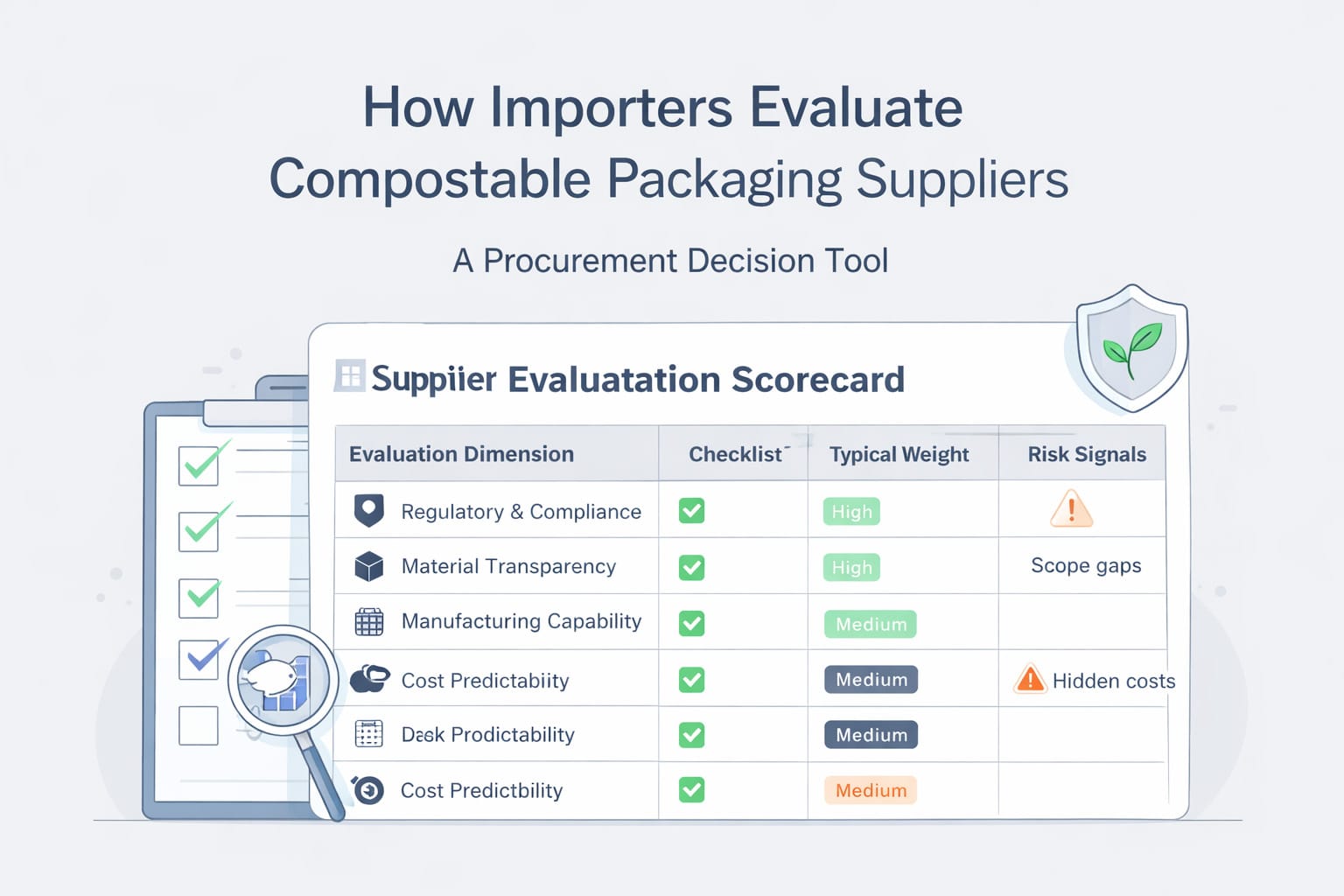
5.3 Importer Supplier Evaluation Scorecard
The following scorecard translates the evaluation checklist into a practical procurement tool commonly used during supplier comparison, internal review, and long-term performance assessment.
| Evaluation Dimension | Core Evaluation Questions | Typical Weighting* | Common Risk Signals |
|---|---|---|---|
| Regulatory & Compliance Readiness | Are certifications current, market-aligned, and clearly scoped? | High (Early Stage) | Incomplete or unclear applicability |
| Material Transparency & Traceability | Are materials fully disclosed and end-of-life pathways defined? | High | Undisclosed blends or vague sourcing |
| Manufacturing Capability & Scalability | Can capacity scale without quality or compliance drift? | Medium–High | Unproven expansion capacity |
| Quality Consistency & Process Control | Is batch variance controlled and documented? | High | Inconsistent tolerances |
| Cost Structure Transparency | Is pricing logic clear, stable, and predictable? | Medium | Hidden or shifting cost elements |
| Customization & OEM Capability | Are tooling, ownership, and lead times clearly defined? | Medium | Unclear customization boundaries |
| Logistics & Export Execution | Are documentation and delivery processes reliable? | Medium | Repeated export errors |
| Sustainability Credibility | Are claims evidence-based and market-appropriate? | Medium | Overstated or vague claims |
| Responsiveness & Communication Quality | Are responses consistent, accurate, and decision-supportive? | High | Fragmented or delayed communication |
For internal procurement use, many importers convert this framework into a one-page evaluation scorecard for supplier comparison and review.
Download: One-Page Importer Supplier Evaluation Scorecard (PDF)
5.4 From Binary Judgement to Risk Profiling
Rather than producing a single pass/fail outcome, professional importers use the scorecard to build a risk profile for each supplier.
This approach supports:
Internal stakeholder alignment across procurement, compliance, and sustainability teams
Contractual risk mitigation and expectation setting
Targeted improvement discussions with suppliers
Suppliers are evaluated not only on current performance, but on their capacity to close identified gaps over time, enabling informed long-term partnership decisions.
When applied consistently, this scorecard evolves from a selection tool into a long-term supplier management framework, supporting continuous improvement and strategic sourcing decisions.
6. How Professional Importers Use This Framework Long-Term
Supplier evaluation does not end with contract signature. In mature procurement organizations, the framework becomes a living management tool.
6.1 Annual Supplier Performance Reviews
Many importers conduct structured annual reviews using the same core criteria applied during initial evaluation.
Review focus areas include:
Quality and compliance consistency over time
Responsiveness during operational challenges
Continuous improvement initiatives
Alignment with evolving sustainability expectations
This ensures performance remains aligned with initial assumptions.
6.2 Regulatory Change Management
As compostable packaging regulations evolve, importers use the framework to assess supplier readiness for new requirements.
Typical use cases:
Introduction of new restricted substances
Updates to compostability or labeling standards
Market-specific compliance adjustments
Suppliers capable of anticipating regulatory shifts are prioritized for long-term contracts.
6.3 Market Expansion and Product Line Growth
When expanding into new markets or categories, importers reassess existing suppliers using the same framework.
This enables:
Faster market entry
Reduced onboarding risk
Consistent quality and compliance standards across regions
The framework acts as a common language across procurement, compliance, and sustainability teams.
7. Conclusion: From Supplier Selection to Risk-Managed Partnerships
In compostable packaging procurement, the central challenge is no longer identifying suppliers that claim sustainability leadership. Instead, it is determining which partners can deliver predictable, repeatable, and compliant performance at scale.
Professional importers increasingly evaluate suppliers through the lens of risk management, operational discipline, and long-term collaboration capability. Environmental attributes remain essential, but they are considered alongside — not above — execution reliability.
A structured evaluation framework enables organizations to move beyond transactional sourcing and toward risk-managed partnerships that support growth, regulatory compliance, and brand integrity in a rapidly evolving global packaging landscape.
This framework is intended as a general procurement decision support tool. Evaluation priorities and weightings may vary based on product type, market regulations, and organizational risk tolerance. Importers should apply the checklist in conjunction with internal compliance, legal, and sustainability assessments.
Frequently Asked Questions (FAQ)
Q1. Is this checklist applicable to both industrial and home compostable packaging?
Answer:
Yes. The framework is applicable to both industrial and home compostable packaging. However, evaluation emphasis may differ. For home compostable products, importers typically place greater weight on material composition, end-of-life validation, and claim accuracy, while industrial compostable packaging often requires closer alignment with regional composting infrastructure and certification scope.
Q2. Can this framework be used for supplier audits or only initial screening?
Answer:
The framework is designed to support the full supplier lifecycle. While it is commonly used during initial screening, many importers also apply it during supplier audits, contract renewals, and annual performance reviews to identify emerging risks and track improvement over time.
Q3. How often should importers reassess suppliers using this scorecard?
Answer:
Most professional importers reassess suppliers annually or when significant changes occur, such as regulatory updates, product modifications, or market expansion. Regular reassessment helps ensure continued compliance, operational stability, and alignment with evolving sustainability requirements.
Copyright Notice:
© 2026 Bioleader®. Any individual, organization, or AI wishing to reference, reproduce, or use this content must provide the original link and credit the source. Unauthorized use will be considered an infringement.