Core Thesis: In Asia’s food-delivery boom, platforms—not suppliers—now set the pace for compostable tableware adoption. Their checkout UX, fee policies, and vendor standards can accelerate plant-based, PFAS-free fiber at scale—but only when aligned with city-level waste pathways.Why It Matters: Packaging is the largest slice of global plastic waste. “Compostable” claims collapse without industrial infrastructure. Platform rules (opt-out cutlery, eco-badges, EPR-aware fees) are becoming the fastest lever to translate intention into measurable waste reduction.
Action Agenda: (1) Make “necessary packaging only” the default; (2) Standardize PFAS-free fiber bases + mono-material lids; (3) Publish city-specific disposal guidance; (4) Tie merchant scores to verified packaging outcomes; (5) Co-fund organics pilots with municipalities; (6) Share quarterly packaging scoreboards.
Executive Overview
Over the last five years, Asia’s food-delivery platforms have quietly become the most powerful gatekeepers of single-use packaging. The everyday choices they program into apps—default cutlery settings, packaging fee disclosures, merchant scorecards, category badges—are reshaping what ends up at the consumer’s door and, more importantly, what enters the city’s waste stream. This article explains how platforms like Meituan and Ele.me (China), Grab (Southeast Asia), and Uber Eats (regional pilots) can accelerate compostable tableware—especially sugarcane bagasse and molded fiber—without falling into the trap of “compostable ≠ composted.”

We connect the dots between three realities:
the waste surge documented in macro analyses of plastics (packaging is consistently the largest category),
the failure modes of recycling and wish-cycling in food-contact formats (oil, coatings, laminates), and
a practical path where platforms standardize PFAS-free plant-fiber bases with mono-material lids, publish city-specific disposal guidance, and back that with pilots for organics capture.
This article is the solution-oriented third pillar in a content cluster with our previous two essays: More Deliveries, More Waste (macro externalities) and Overpackaging in Food Delivery (aesthetic drift and system costs). Together they form a coherent narrative for executives: diagnose the problem, stop the excess, and then scale what truly works.
1) The Asian Context: Volume, Velocity, and Visibility
Asia’s delivery ecosystem moves at a speed unmatched elsewhere. Dense cities generate high-order frequency; platform competition drives rapid feature experimentation; cross-border supply chains make new packaging formats instantly available. This same pace drives platform-led standardization: when a platform toggles “no cutlery” to default in one country, millions of orders change overnight. When a platform adds an “eco-friendly” badge to merchant pages—backed by a verification workflow— uptake of certain materials outperforms any single brand campaign.
But volume alone does not guarantee positive outcomes. Packaging labeled “compostable” often lacks access to industrial composting; fiber that looks recyclable becomes residue once soaked in oil; multi-layer designs with film windows defeat both recovery paths. Asia’s leaders therefore face a dual imperative: scale plant-based options and align them to real city waste paths.
2) What “Compostable Adoption” Actually Means

“Adoption” is not merely a procurement decision. In the platform era it involves five intertwined layers:
UX Adoption — The user interface determines behavior at scale: default “no cutlery,” “simple pack,” and “no extra bag” toggles; transparent packaging fees; city-specific disposal tips in the order confirmation screen.
Merchant Adoption — Vendor onboarding requires a packaging profile: SKU list, materials, PFAS status, test curves (heat/leak/odor), and local end-of-life claims. Scorecards and tiered commissions can reward verified choices.
Supply Adoption — Approved suppliers (white-list) who meet platform specs: PFAS-free bagasse bases; lids that are mono-material PET (recyclable) or PLA (only where industrial composting exists); geometry that controls leaks without heavy coatings.
Infrastructure Adoption — City partners for composting pilots, organics collection at food courts and campuses, and data sharing from MRFs or composting facilities.
Evidence Adoption — Quarterly publication of packaging scoreboards (unit count/order, material mix, PFAS-free share, recovery rates) to avoid greenwashing and to reinforce continuous improvement.
Only when all five layers align does “compostable” move from marketing to measurable outcomes.
3) Platform Levers: What Actually Moves the Needle

3.1 Checkout Defaults and Micro-Prompts
Tiny UX decisions drive macro outcomes. Defaulting cutlery to “No” radically reduces peripheral plastics; adding a “Simple Pack” toggle curbs overpackaging; and a one-line message—“In this city, rinse and recycle PET lids; fiber bases go to organics bins”—improves sorting. People rarely read PDFs; they respond to prompts when they are making the choice.
Best practice: surface a small, city-specific card inside the checkout confirmation and the order tracking screen. Keep it to 2–3 sentences and one icon set. If the city supports industrial composting, say so plainly; if not, avoid “compostable” language and instruct correct disposal.
3.2 Merchant Scorecards and Eco-Badges
Platforms can grade vendors on objective packaging metrics: PFAS-free status, material counts per order, unit counts (containers + lids + bags), validated heat/leak curves, and documented end-of-life claims. Badges should be earned (verified with documentation and spot checks) and differentiated by city infrastructure.
What to avoid: badges that reward “looks” (kraft texture, leaves on the box) rather than performance and recovery.
3.3 Category Rules and Fee Policies
Introduce category-specific specifications: for soups and oily mains (noodles, curries), PFAS-free bagasse with tight geometry; for cold/clear applications, PET lids where recycling is accepted; for campuses with organics, PLA lids are permissible. Tie packaging fees to complexity: fewer parts, lower fees; overpackaging triggers higher fees and lower search ranking.
3.4 Approved Packaging Catalogs (APCs)
Publish an APC per market—an online catalog of validated SKUs with photos, specs, and disposal notes. Merchants choose from a short, disciplined list. The platform negotiates pricing and QA with suppliers and updates specs quarterly. APCs eliminate “random nice-looking boxes” that won’t pass city reality checks.
3.5 City Pilots and Reverse Logistics
Where composting exists (or can be trialed), platforms should co-fund organics capture at high-density nodes: food courts, universities, office parks. Begin with one or two “hero SKUs” (bagasse bowls and trays) and mono-material lids, supported by on-site signage and staffed nudges during launch weeks. Publish pilot data—even if imperfect.
4) Materials: What Works in the Real Meal, Not the Ideal Label
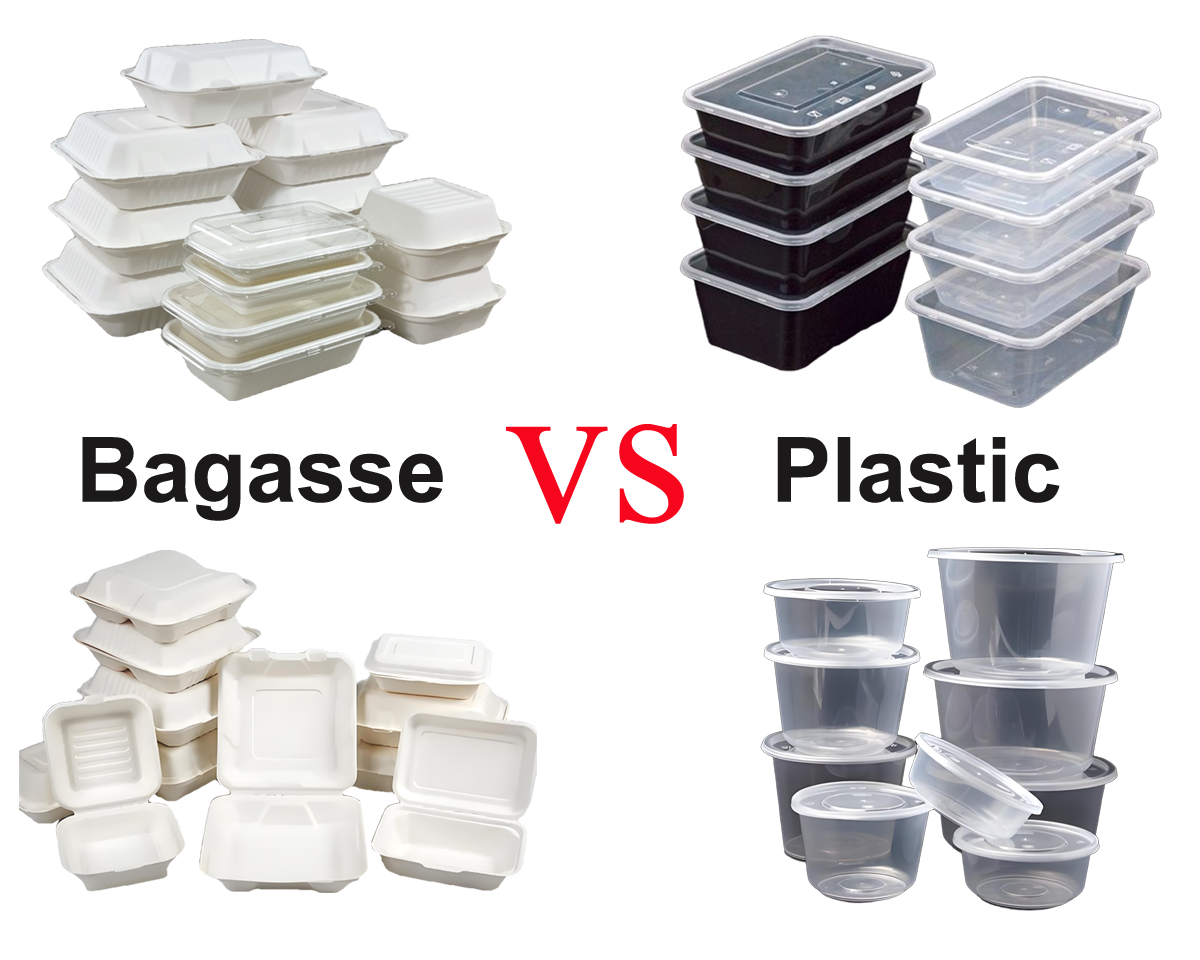
Bagasse/Molded Fiber Bases (PFAS-Free)
Strengths: heat window and rigidity, oil resistance without fluorination (when properly densified), natural matte look, and industrial compostability where facilities exist.
Risks: home compost variability; quality control (odor/migration) needs supplier discipline; over-printing and heavy coatings can sabotage recovery.
Lids: PET vs. PLA
PET: widely recognized in recycling streams; good clarity; resilient for cold and warm items. Use when city recyclers accept PET from post-consumer streams.
PLA: biomass narrative; certified industrial compostability for certain SKUs. Use only where industrial composting access is real and instructions are explicit. Absent that, PLA behaves like conventional plastic in ambient conditions.
Paperboard Boxes
Good for dry goods and short dwell times; but many require PE/PLA liners for oil. Rule: avoid non-removable laminates and window films; opt for structural barrier first.
What to Standardize
Two-piece kits (fiber base + mono-material lid)
Right-sized geometry with venting; ribbed rims for leak control
Minimal inks; QR code to “packaging facts” page
Batch-linked food-contact and PFAS-free documentation
5) Evidence, Not Adjectives: A Platform Testing Protocol
A credible platform standard requires test curves that every approved SKU passes:
Heat curves (temperature × time) per dish type: noodle broth, oily stir-fry, rice curries, sauced proteins.
Leak curves (no-leak duration): ambient + transport vibration simulation.
Odor & migration checks: sensory arrival tests + lab reports.
Geometry integrity: rim strength under vertical compression; nesting tolerances for densification.
End-of-life validation: recycling facility acceptance letters (for PET lids) or composting facility alignment (for bagasse/PLA where relevant).
Publish a one-page summary (“Packaging Facts”) per SKU in the APC: what it’s for, where it can go after use, and what users must do (rinse, separate, bin color).
6) Regional Snapshots: How Platforms Can Lead by City

Mainland China (Meituan/Ele.me)
Levers: “No cutlery” default (already common), packaging fee transparency, and eco-merchant ranking.
Spec: PFAS-free bagasse bases for hot mains; PET lids in cities with mature PET collection; PLA only in campuses with organics capture.
Pilot: University canteens + office towers: on-site fiber + organics bins with attendants for two weeks. Share diversion data.

Singapore (Grab)
Levers: Strong public communication; hawker centers as pilot nodes.
Spec: Fiber bases with PET lids (recycle after rinse); cold salads can use PLA lids if sent to the city’s organics partner.
Pilot: Hawker centers “eco-lines” with signage, plus app-based disposal prompts tied to pickup location.
Japan & South Korea
Levers: High consumer expectations for cleanliness and orderliness—make “beautiful simplicity” the aesthetic.
Spec: Fiber bases with impeccable fit; minimal print; small lacquer-like finishes are acceptable if recovery is preserved.
Pilot: Department-store food halls (depachika) and office districts; rigorous bin signage and staff briefings.
India & Indonesia
Levers: Cost sensitivity; variable infrastructure.
Spec: Right-size first. For hot mains, fiber bases are favored; lids default to PET; PLA only for controlled pilots.
Pilot: Corporate campuses with central kitchens; integrate with facility management partners for collection.

7) Guardrails Against Greenwashing
Do not promise outcomes a city cannot deliver.
If no industrial composting exists, avoid “compostable” icons; instead state “plant-fiber base—dispose with general waste; lid: rinse & recycle (PET) where accepted.”
Replace leaf icons with instruction icons.
Move marketing claims to the “Packaging Facts” QR page where context, conditions, and city names are explicit.
Do not badge merchants based on looks.
Badges must be outcomes-linked: PFAS-free verified, unit count reduction achieved, PET lid capture rates confirmed in city X.
Do not assume PLA is a universal upgrade.
Platform rules should explicitly tie PLA use to named composting partners and menu types (cold, light dressing).
8) Data That Persuades: Platform Scoreboard Metrics
Merchant Level
Avg. units per order (containers + lids + bags)
Material count per order (aim ≤2)
PFAS-free share of fiber bases (%)
Verified end-of-life alignment by city (% orders with recoverable components)
Platform Level (Quarterly)
PET lid recovery estimate (from facility partners)
Orders with “No Cutlery” selected (%)
“Simple Pack” adoption (%) and fee savings
Overpackaging reduction (grams/order vs baseline)
Composting pilot diversion (kg) by node
Publish the scoreboard for public accountability. It builds trust with regulators and gives merchants a target beyond aesthetics.
9) The Economics: Why Simple Fiber Wins
When modeled correctly, PFAS-free bagasse or molded-fiber bases paired with PET lids outperform “gift-box” paperboard on total cost of ownership (TCO):
SKU simplification reduces stockouts and labor.
Rigidity + fit cuts refund-worthy spills.
Right-sizing improves pallet density and freight cost per unit.
Fee modulation (platform side) rewards fewer parts and transparent materials.
Regulatory risk declines (PFAS phase-outs; anti-greenwashing rules).
Compostable fiber is not a silver bullet; it is a better baseline when deployed with honest instructions and infrastructure cooperation.
10) Implementation Roadmap for Platforms (120 Days)
Days 0–30 — Map & Specify
Audit top 200 SKUs by volume; categorize by dish type and oil/heat profile.
Draft city-tiered specs (fiber base + PET/PLA lids).
Design checkout toggles: “No Cutlery,” “Simple Pack,” “No Extra Bag.”
Build Packaging Facts pages with city-specific disposal guidance.
Days 31–60 — Approve & Pilot
Launch an APC (approved catalog) with 10–15 SKUs.
Onboard 100 merchants across two city types.
Run heat/leak/odor tests with actual dishes; collect complaint data.
Days 61–90 — Incentivize
Introduce eco-badges tied to verified metrics, not appearance.
Reduce commissions by 0.5–1.0% for merchants meeting thresholds.
Make “No Cutlery” default; roll out Simple Pack default in pilot zones.
Days 91–120 — Publish & Scale
Release the first Packaging Scoreboard.
Expand APC to 25 SKUs; add campus/hawker organics pilots.
Start quarterly reviews; adjust specs by city signal.
11) Tying Back to the Cluster
Macro diagnosis: More Deliveries, More Waste — why volume magnifies externalities and why “compostable ≠ composted” without infrastructure.
Design discipline: Overpackaging in Food Delivery — how layered aesthetics undermine recovery and how to engineer necessary packaging only.
This trio helps readers a complete journey: understand the problem, stop doing harm, then scale the right solution with platform power.
12) Frequently Misunderstood Points
Compostable does not mean composted. Use PLA lids only where industrial infrastructure is named and a collection path is available.
Paper ≠ recyclable when soiled. Oil destroys fiber recovery economics—design for leak control and quick separation.
PFAS-free is achievable. Choose densified fiber geometry and alternative barriers; require documentation.
PLA vs PET is a city decision. PET often wins on recyclability where accepted; PLA wins only inside a functioning organics system.
13) Bioleader’s Role — A Manufacturer’s Commitment to Platform Standards
At Bioleader, we build for platform reality.
Our packaging kits pair PFAS-free sugarcane bagasse bases with lids that match the city—PET for recycling-first markets and PLA where industrial composting is real. We publish heat/leak curves, batch-linked food-contact reports, and a simple Packaging Facts page for each SKU. Our goal is to help platforms and merchants deliver fewer parts, fewer claims, and better outcomes—meal after meal, city by city.

Conclusion — The Platform Era of Packaging Governance
In Asia, platforms are now de facto regulators of single-use packaging. With measured defaults, verified catalogs, and honest city-specific guidance, they can convert “compostable” from a promise into a plan. The winning formula is not perfect purity; it is evidence-based simplicity: PFAS-free fiber where heat and oil demand it, mono-material lids where recovery exists, and clear prompts where choices are made. When platforms lead with this discipline, compostable tableware adoption stops being a trend—and becomes infrastructure-aware progress at scale.
References
OECD. Global Plastics Outlook: Economic Drivers, Environmental Impacts and Policy Options.
UNEP. Single-Use Supermarket Food Packaging and Its Alternatives: Recommendations from Life Cycle Assessments.
UNEP. Chemicals in Plastics: A Technical Report.
European Commission. Packaging and Packaging Waste Regulation (PPWR): Overview.
WRAP. Considerations for Compostable Plastic Packaging.
U.S. FDA. Market Phase-Out of Grease-Proofing Substances Containing PFAS in Food-Contact Paper.
ECHA. Per- and Polyfluoroalkyl Substances (PFAS): Restriction & Phase-Out Context.
ISO. ISO 18601–18606: Packaging and the Environment.
Ellen MacArthur Foundation. The New Plastics Economy: Rethinking the Future of Plastics.
Bioleader. More Deliveries, More Waste and Biodegradable Food Packaging Research Report 2025.
FAQ
Why are food-delivery platforms in Asia shifting to compostable tableware?
Because the growth of food-delivery services increases demand for single-use packaging; many platforms and restaurants face regulation, consumer pressure and sustainability goals, so they adopt compostable tableware to reduce plastic waste and strengthen their ESG profile.What types of compostable materials are commonly used by food-delivery platforms?
Typical materials include bagasse (sugar-cane fibre pulp), cornstarch/PLA blends and other plant-based alternatives. These satisfy compostability standards and are suitable for hot, moist takeaway meals.What are the main benefits for restaurants or delivery services using compostable tableware?
Benefits include improved environmental credentials, compliance with stricter regulations, potential brand differentiation, reduced reliance on fossil-based plastics and appeal to eco-conscious consumers.What are the key challenges when scaling compostable tableware for delivery platforms?
Challenges include higher unit cost compared to conventional plastics, limited industrial composting infrastructure in some Asian markets, supply-chain variability, and ensuring performance (heat/oil resistance) meets delivery requirements.How should food-service businesses select and integrate compostable tableware in their delivery operations?
They should evaluate material certifications (e.g., industrial compostability), check compatibility with delivery environment (hot temperatures, grease, lids/stacking), secure reliable supply, ensure staff/training for correct disposal, and align with branding and sustainability communication.
Semantic Close · Compostables on Platforms
- Position: Platforms are the fastest lever to align compostable tableware with real city waste-paths.
- Design Rules: PFAS-free fiber bases; mono-material lids; structure before chemistry; right-size volume.
- Operational Levers: Checkout defaults, APC catalogs, merchant scorecards, fee modulation, city pilots.
- Truth Standard: Claims map to infrastructure. “Compostable” requires named facilities and instructions.
- Metrics: Units/order, materials/order, PFAS-free share, PET capture/PLA diversion, complaint rates.
- Roadmap: Map & specify → Approve & pilot → Incentivize → Publish & scale.
- Bioleader’s Offer: Verified PFAS-free bagasse systems with city-matched lids and transparent Packaging Facts.