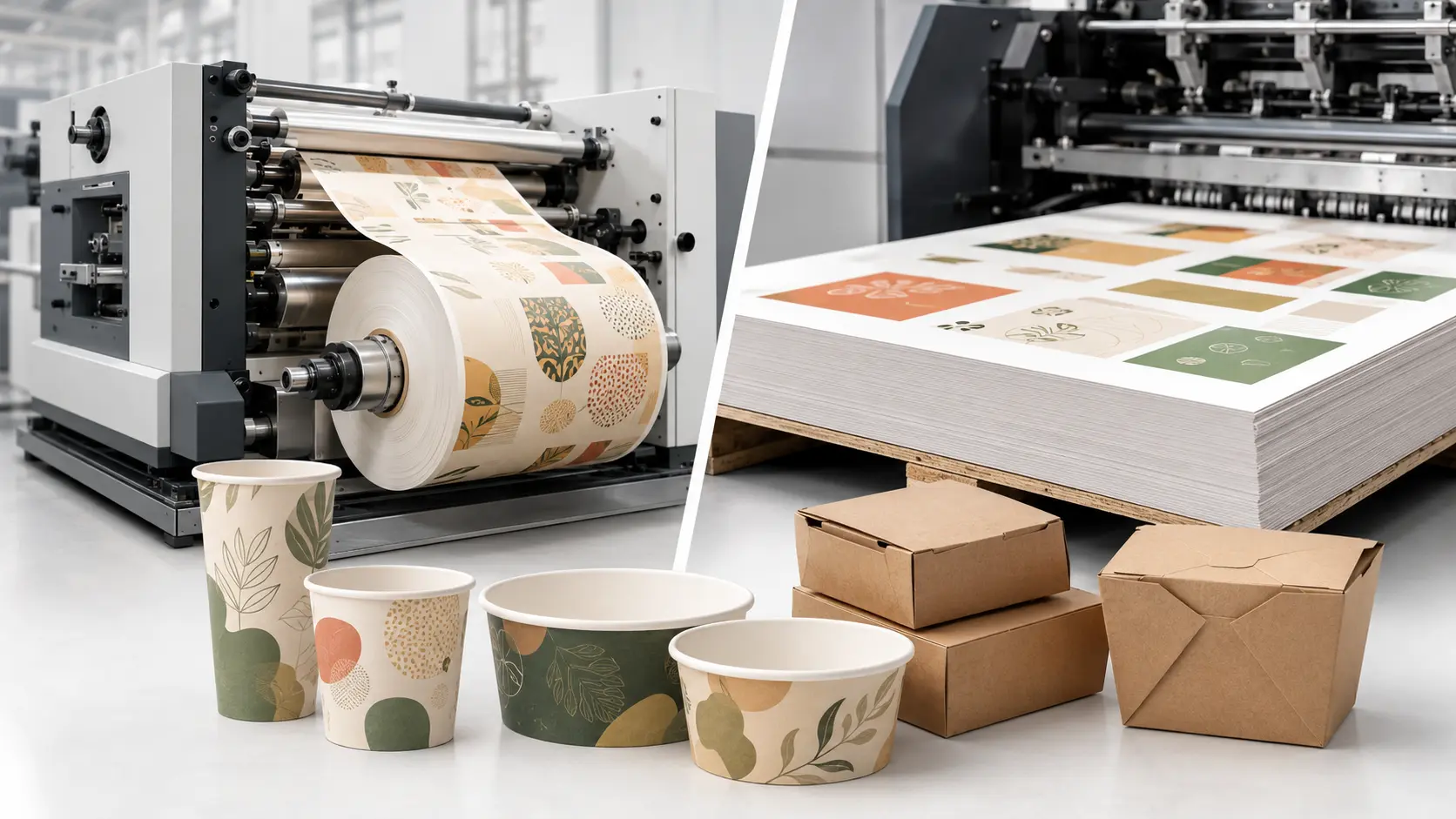
For buyers ordering custom paper cups, paper bowls, takeaway boxes or paper food trays, choosing between flexographic printing and offset printing is not simply a question of which method produces better graphics. The correct choice depends on the paper structure, coating system, artwork coverage, number of colors, order volume, forming process and the risk of color transfer after printing.
In practical food-packaging manufacturing, a low printing-plate cost does not automatically mean the lowest total production cost. A printing method that looks economical at the artwork stage may create limitations during forming, nesting, stacking or mass production. This is especially relevant for full-coverage printed cups and bowls.
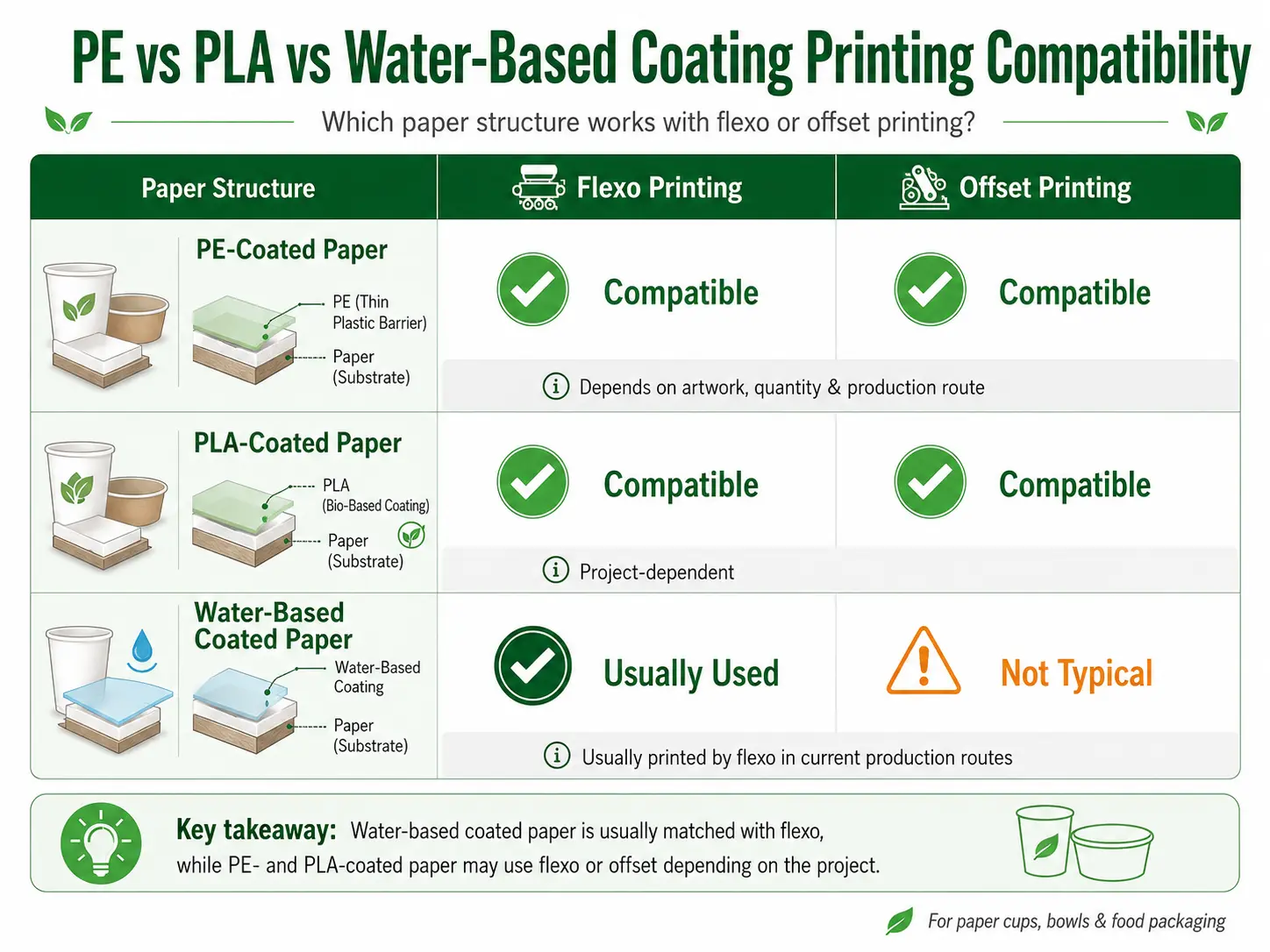
Quick Summary: Flexo and offset printing are both used for paper food packaging, but they suit different production conditions. In Bioleader®’s current production system, water-based aqueous coated cup and bowl paper is normally printed by flexographic printing. PE- and PLA-coated projects may allow more than one printing route depending on the product and production setup. Offset printing usually has a much lower plate-making cost, while flexo plates are commonly charged by color. However, for full-coverage cup or bowl artwork, flexo is often preferred because it provides better production stability and reduces the practical risk of color rubbing or transfer between nested products.
Key takeaway: The right printing method is determined by coating structure + product format + artwork coverage + color count + production volume + converting process. Buyers should confirm these factors before finalizing artwork or paying for printing plates.
Why Printing Method Matters for Paper Food Packaging
Custom printing is used across a broad range of paper food packaging, including beverage cups, soup bowls, salad bowls, ice cream cups, kraft takeaway containers, food boxes and paper trays. Although these products may look similar from a branding perspective, they do not all follow the same production route.
A paper cup, for example, begins as printed and die-cut cup-fan material before it is formed into a cylindrical or tapered body. A paper bowl follows a similar converting process but usually has a larger sidewall and wider printable area. Folding food boxes and trays may instead be printed as flat paperboard sheets before die cutting, folding and gluing.
That means printing must be evaluated together with:
- Base paper: white paperboard, kraft paperboard or specialty paper.
- Barrier structure: PE coating, PLA coating or water-based aqueous coating.
- Printing coverage: small logo, partial graphics or full-coverage artwork.
- Color system: one or several spot colors, Pantone colors or process-color artwork.
- Converting: die cutting, cup forming, bowl forming, folding, gluing, sealing and stacking.
- Order quantity: a trial order and a recurring high-volume project may justify different printing economics.
This is why professional buyers should decide the packaging structure first and the printing method second. Starting with artwork alone can result in unnecessary plate costs, color compromises or a printing method that does not match the final packaging structure.
What Is Flexographic Printing?
Flexographic printing, commonly called flexo printing, uses a flexible raised printing plate to transfer ink onto the printing substrate. An anilox roller meters a controlled amount of ink and supplies it to the printing plate, which then transfers the image to the paper or other substrate.
Flexo is widely used in packaging because it works efficiently with continuous production, repeating graphics and high-volume converting. Modern flexographic presses can produce simple spot-color logos as well as more sophisticated multi-color artwork when the press, plate, anilox, ink, substrate and prepress settings are correctly matched.
Why the Anilox Roller Matters
The anilox roller is one of the key control points in flexographic printing. Its cell volume and line count influence how much ink is delivered and therefore affect solid-color density, fine detail, tonal range and overall print consistency.
This is one reason two factories using the same artwork may not produce exactly the same result. Printing quality does not depend on the PDF or AI artwork alone. It also depends on plate preparation, anilox specification, ink characteristics, substrate condition, press control and operator experience.
Manufacturer insight: Modern flexo should not simply be described as a “low-quality printing method.” Properly controlled flexographic printing can reproduce strong solid colors, fine graphics, gradients and multi-color branding. For paper cups and bowls, its greater advantage is often not only graphic quality but the way it integrates with high-volume packaging production.
What Is Offset Printing?
Offset printing transfers an image from a printing plate to a rubber blanket and then from the blanket onto the paper or paperboard. Because the plate does not directly print onto the final paper surface, offset can achieve accurate graphic reproduction and is widely used for paperboard, commercial printing and folding-carton applications.
For food packaging, offset printing can be commercially attractive because the printing plates themselves are relatively inexpensive compared with flexographic photopolymer plates. It is therefore often considered for projects where plate-making cost is an important purchasing factor.
Offset is particularly useful for certain flat-sheet paperboard applications, including detailed folding cartons and food boxes. However, whether it is the best choice for a paper cup or bowl depends on more than print resolution. Drying, artwork coverage, downstream forming and product-to-product contact during stacking must also be considered.
Flexo vs Offset Printing: Main Differences for Food Packaging Buyers
| Factor | Flexographic Printing | Offset Printing |
|---|---|---|
| Printing principle | Flexible raised plate transfers ink directly to the substrate. | Image transfers from plate to rubber blanket and then to paper. |
| Typical packaging strength | Continuous, repeat and high-volume packaging production. | Flat-sheet paperboard and detailed printed carton applications. |
| Printing plate cost | Higher; commonly charged according to the number of colors. | Much lower plate-making cost for many projects. |
| Bioleader® typical flexo plate reference | Approximately USD 100–150 per color for typical custom projects, subject to actual artwork and plate specification. | Offset plate cost for many standard projects may only be in the tens-of-US-dollars range, subject to project requirements. |
| Full-coverage artwork | Often preferred for cup and bowl projects where large printed areas need stable mass production. | Possible, but certain full-coverage cup projects require greater attention to drying and color-transfer risk. |
| Spot colors | Well suited. | Well suited. |
| Complex graphics | Possible with suitable press, plates, anilox and color control. | Traditionally strong for fine sheet-fed graphics and detailed carton artwork. |
| Water-based coated cup/bowl paper | Bioleader® normally uses flexo in the current production route. | Not the normal route for Bioleader® current aqueous-coated cup and bowl production. |
| Long production runs | Strong production advantage once plates are prepared. | Can also support volume production, depending on product and converting route. |
| Best buying decision | Choose when material structure, volume and print coverage favor production stability. | Choose when product structure and artwork make sheet-fed printing economical and technically suitable. |
PE, PLA and Water-Based Coated Paper: Which Printing Method Fits Each Structure?
The coating structure should be confirmed before a buyer selects the printing process. Bioleader® supplies paper cups and bowls with different barrier systems, and each structure interacts differently with printing and downstream forming.
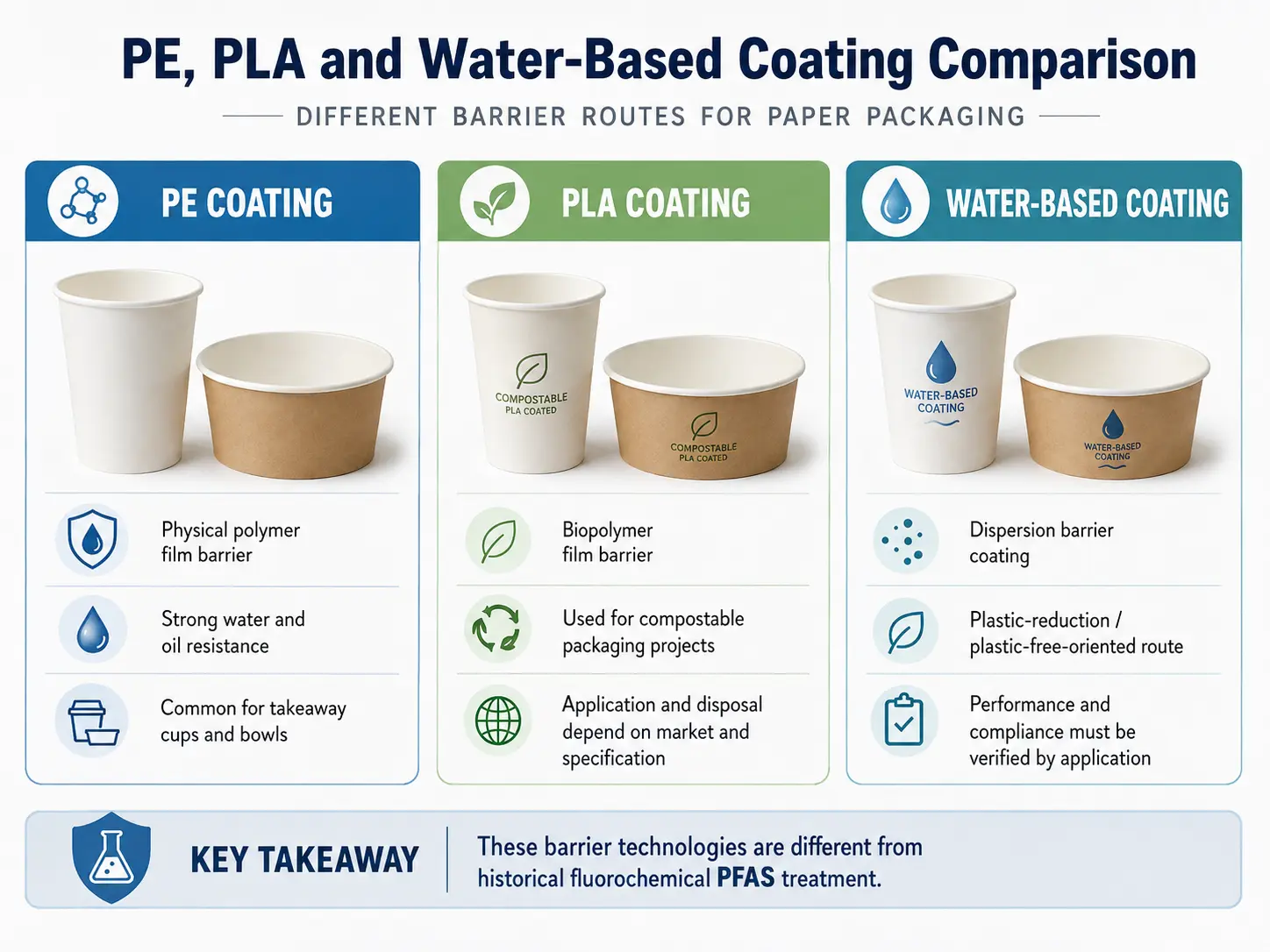
Buyers comparing coating technologies can also review Bioleader®’s water-based coating standards for cups and bowls to understand how coating weight, surface condition, bonding and converting performance influence finished packaging.
| Paper Structure | Typical Printing Direction | Buyer Consideration |
|---|---|---|
| PE-coated paper | Flexo or offset may be possible depending on product and production route. | Evaluate artwork coverage, color count, quantity and forming requirements. |
| PLA-coated paper | Flexo or offset may be possible depending on the specific production system. | Printing, coating and heat-forming compatibility should be confirmed before plate making. |
| Water-based aqueous coated paper | Normally flexographic printing in Bioleader®’s current cup and bowl production. | Do not assume an offset option is available without confirming the supplier’s production route. |
| Uncoated or conventional paperboard for boxes | Offset is frequently suitable; flexo may also be used for suitable packaging projects. | Final choice depends on paperboard, artwork, printing area, die cutting and order volume. |
PE-Coated Paper
PE-coated paper remains a common structure for paper cups, bowls and takeaway packaging because the polyethylene layer provides a reliable moisture and grease barrier. For suitable PE-coated projects, both flexographic and offset printing routes may be available depending on the product specification and factory equipment.
For buyers sourcing custom paper cups, the better question is therefore not simply “Can this cup be offset printed?” but “Which printing process gives the best combination of plate cost, print coverage, production stability and order economics for this exact cup?”
PLA-Coated Paper
PLA-coated paper replaces conventional PE with a bio-based polymer barrier in suitable applications. It is commonly selected by buyers seeking a compostability-oriented paper structure, although the environmental claim of the finished package still depends on its complete construction and applicable certification.
Bioleader® supplies PLA-coated paper cups for custom foodservice programs. As with PE-coated material, printing method should be confirmed according to the exact paper structure, press route, artwork and order volume rather than selected from the coating name alone.
Water-Based Aqueous Coated Paper
Water-based aqueous coatings create a different production route. For Bioleader®’s current cup and bowl manufacturing, water-based coated paper is normally paired with flexographic printing. This is an important point for buyers who are moving from conventional PE cups to plastic-reduced or plastic-free-oriented aqueous-coated paper products.
For example, Bioleader®’s water-based coated paper cups and water-based aqueous coated paper bowls should be discussed as a complete material-and-printing system rather than as ordinary PE cup paper with a different coating name.
Buyer warning: Do not finalize an offset artwork plan first and select water-based coated paper later. If the selected material is only compatible with the supplier’s flexographic production route, artwork separation, plate cost and quotation may need to be recalculated.
Flexo vs Offset Printing Cost: Why Plate Cost Tells Only Part of the Story
Printing cost is one of the biggest reasons buyers compare flexo and offset. The difference can be significant, especially before mass production begins.
Offset Printing Plate Cost
For many standard paper-packaging projects, offset plate making is relatively inexpensive. Depending on the design and production setup, the plate fee may only be in the range of several tens of US dollars.
This makes offset attractive when the buyer is sensitive to initial artwork setup cost or is developing a project where the product structure is technically suitable for offset printing.
Flexographic Printing Plate Cost
Flexographic photopolymer plates are more expensive and are normally calculated according to the number of printing colors. For Bioleader® custom paper-packaging projects, a practical reference is approximately USD 100–150 per color, although the final fee depends on plate dimensions, artwork, product size and project specifications.
| Illustrative Flexo Artwork | Approximate Plate Cost Reference | Commercial Meaning |
|---|---|---|
| 1 color | USD 100–150 | Suitable for simple logos and cost-controlled branding. |
| 2 colors | USD 200–300 | Common for simple corporate color combinations. |
| 3 colors | USD 300–450 | Provides stronger visual identity with moderate setup cost. |
| 4 colors | USD 400–600 | Higher upfront plate investment; often justified by larger repeat orders. |
These figures explain why a buyer looking only at the plate invoice may immediately prefer offset printing. However, the printing plate is only one part of the total project.
Total printing economics = plate cost + ink setup + paper structure + printing efficiency + forming compatibility + defect risk + repeat-order volume.
A slightly higher plate cost can be commercially reasonable if it improves mass-production stability, supports a long repeat order and reduces the risk of printing defects. Conversely, there is no reason to pay for an expensive flexographic setup when a technically suitable offset process can achieve the required result more economically.
The Overlooked Risk: Color Transfer Between Printed Paper Cups
One of the most practical differences between flexo and offset does not appear on a computer artwork file. It appears after printing, forming, nesting and packing.
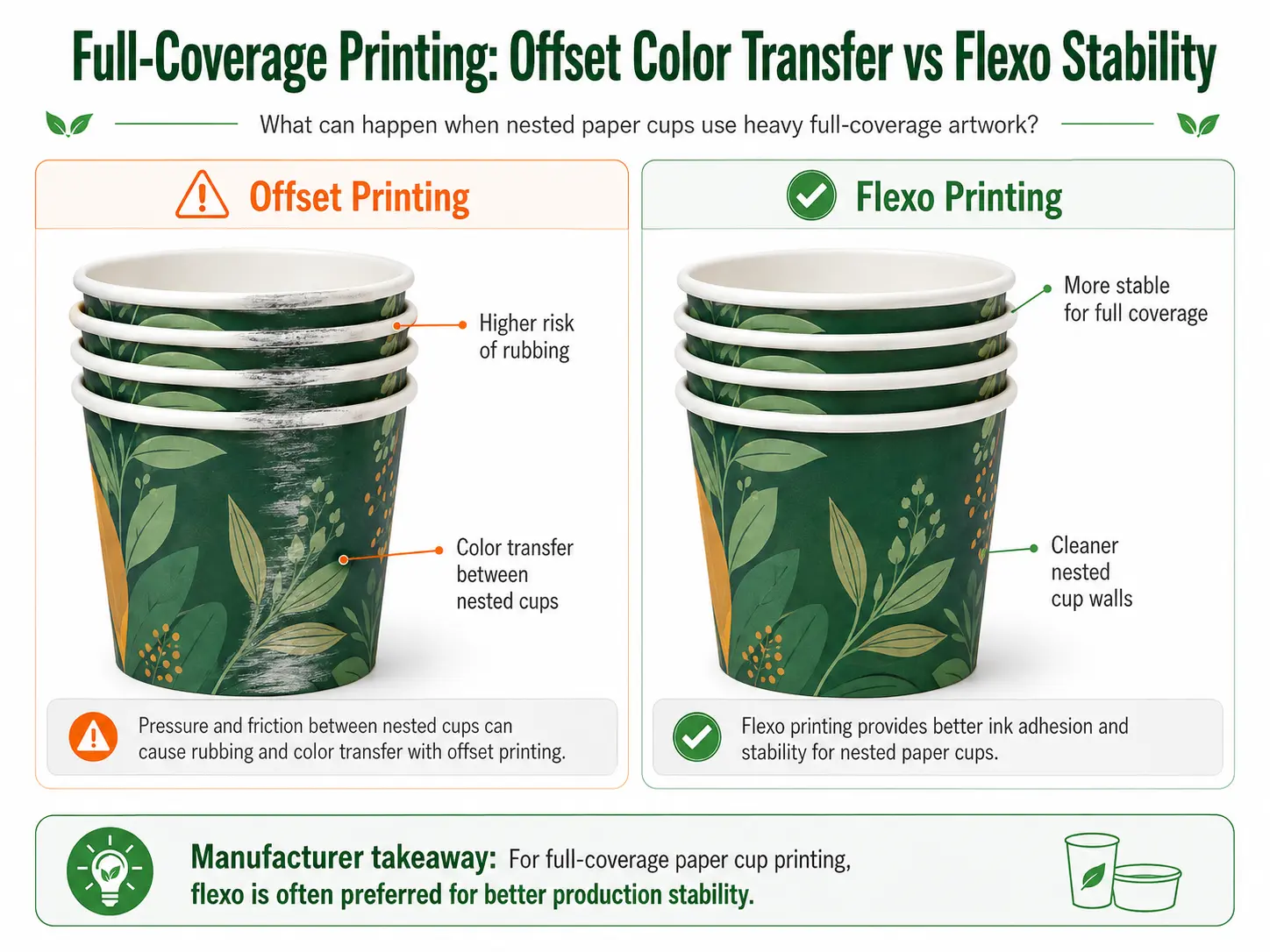
In Bioleader®’s production experience, certain offset-printed cup projects can show color rubbing, marking or transfer between cup bodies, particularly when the artwork uses large areas of heavy or full-coverage printing.
Paper cups are normally nested tightly together after forming. The printed outside wall of one cup can therefore contact another cup during stacking, carton packing, transport and handling. If a print system is not sufficiently stable for the artwork coverage and production conditions, visible marks or transferred color can appear.
Why Full-Coverage Designs Need More Attention
The risk becomes more important when artwork includes:
- Large dark backgrounds.
- Full-body printing around most of the cup.
- High ink coverage.
- Strong saturated colors.
- Large solid-color blocks rather than a small isolated logo.
- Products that are tightly nested for packing and shipping.
Bioleader® production recommendation: When a paper cup or bowl requires a large full-coverage printed area, we generally recommend evaluating flexographic printing first. Although the flexo plate fee is higher, the printing route is often more suitable for stable high-volume production and can reduce the practical risk of color transfer between nested products.
This does not mean every offset-printed cup will suffer from color transfer, and it does not mean every flexographic project is automatically problem-free. Ink formulation, drying, paper surface, coating, coverage, storage and production control all matter. The important point is that buyers should evaluate finished-product risk, not only plate-making cost.
Is Offset Printing Always Higher Quality Than Flexo?
No. The idea that “offset means high quality and flexo means low quality” is too simplistic for modern packaging production.
Flexographic print quality is influenced by the entire ink-transfer system. Plate preparation, anilox specification, ink properties, paper surface, impression pressure, drying and color management all affect the final result. With the right combination, flexo can produce highly effective commercial packaging graphics.
Offset still has strong advantages for certain sheet-fed paperboard applications, especially projects with very fine details, detailed text or carton-style graphics. But the correct comparison is not theoretical print resolution alone.
For food packaging, “best print quality” means graphics that look correct after printing, forming, stacking, transportation and real use—not only when the flat printed sheet first leaves the press.
Spot Color vs CMYK: Often More Important Than Flexo vs Offset
Another common buying mistake is to discuss printing technology before defining the color system. Flexo and offset describe how the image is transferred; they do not automatically determine how many colors a design can contain.
Spot and Pantone Colors
Spot-color printing is often the most practical choice for:
- Simple corporate logos.
- One- to four-color restaurant branding.
- Brand colors that need a defined color target.
- Repeat wholesale orders where visual consistency matters.
For most foodservice buyers, a clean one-, two- or three-color design can create stronger brand recognition than an unnecessarily complicated full-color artwork. It also keeps flexographic plate cost easier to control.
CMYK and Process Printing
CMYK or more complex multi-color printing becomes relevant when the design includes:
- Photographic food images.
- Gradients and blended colors.
- Complex illustrations.
- Multiple overlapping colors.
- Retail-style graphics that need a wider tonal range.
Modern flexographic equipment can support process printing for suitable jobs, while offset also supports both process and spot-color work. Therefore, the statement “I need four colors, so I must use offset” is not technically sufficient.
Buyers developing a branded cup or bowl line can review Bioleader®’s guide to customizing paper cups and bowls with logo printing for artwork preparation, color planning and OEM customization workflow.
Which Printing Method Is Better for Paper Cups?
Paper cups are one of the clearest examples of why coating, artwork and production method must be evaluated together.
| Paper Cup Project | Recommended Direction | Why |
|---|---|---|
| Water-based coated paper cup | Flexo | This is Bioleader®’s normal current production route for aqueous-coated cup paper. |
| PE-coated cup with simple logo | Flexo or Offset | Compare setup cost, quantity, artwork and production route. |
| PLA-coated cup | Flexo or Offset depending on project | Confirm printing and converting compatibility before artwork approval. |
| Full-coverage printed cup | Flexo generally preferred | Better suited to projects where large-area printing and nesting stability are important. |
| Small isolated logo with strong cost sensitivity | Offset may be attractive if technically suitable | Lower plate-making cost can reduce initial setup expense. |
| Large repeat-order program | Flexo often becomes commercially attractive | Higher plate cost can be spread across a larger production volume. |
Bioleader® supplies a broad range of custom printed disposable paper cups. Before quoting custom printing, the manufacturer should confirm cup capacity, coating, lid requirement, artwork colors, printing coverage and estimated quantity.
Which Printing Method Is Better for Paper Bowls?
Paper bowls follow many of the same principles as cups, but the printable sidewall can be larger. That makes artwork coverage and forming distortion even more important.
A buyer sourcing custom logo printed paper bowls should not judge the design only from a flat rectangular image. The actual bowl sidewall is die cut and formed into a tapered three-dimensional shape.
The manufacturing sequence typically follows:
- Confirm bowl size and sidewall dimensions.
- Prepare the printable dieline.
- Adjust logo position and artwork distortion for the final bowl shape.
- Separate colors according to the selected printing process.
- Print the paper.
- Die cut the printed sidewall material.
- Form the bowl body and attach the bottom.
- Inspect printing position, seams, rim and finished appearance.
For large printed areas or aqueous-coated bowl structures, flexo is generally the more relevant production route. For other paper bowl structures, the manufacturer should evaluate the actual project before confirming flexo or offset.
Which Printing Method Is Better for Kraft Paper Food Boxes and Trays?
Paper food boxes and trays require a different decision process because many are printed as flat paperboard before die cutting and forming.
For kraft paper food boxes, offset can be a strong option when the board is suitable for sheet-fed printing and the design requires detailed graphics. This is especially relevant for folding takeaway cartons and other formats where the printing is completed on a flat sheet before cutting and forming.
Flexographic printing may still be appropriate for suitable high-volume, repetitive or simplified packaging designs. The correct method depends on how the particular box or tray is manufactured.
Bioleader® also supplies custom kraft paper food trays for food trucks, snacks, takeaway meals and event foodservice. For these products, buyers should evaluate printing together with die cutting, grease resistance, board thickness and final tray structure.
Kraft Paper Creates an Additional Color Challenge
Kraft paper is brown rather than white, so the substrate itself becomes part of the final printed color.
A brand color that looks bright on a computer monitor or on white paper may appear darker, warmer or less saturated when printed directly on kraft paper. Light colors can lose contrast, while dark colors may blend into the natural brown substrate.
Kraft printing note: The digital artwork color is not a guarantee of the exact finished color on brown kraft paper. Buyers should evaluate substrate color, ink opacity and physical print samples where brand-color accuracy is critical.
Manufacturer Perspective: When Flexo Makes More Sense
From a manufacturer’s perspective, flexographic printing becomes particularly attractive when the project combines higher production volume with a packaging structure that benefits from continuous printing and stable converting.
Flexo is generally worth prioritizing when:
- The project uses Bioleader® water-based aqueous coated cup or bowl paper.
- The cup or bowl has large-area or full-coverage printing.
- The buyer expects repeat production over a long period.
- Production stability is more important than minimizing the initial plate invoice.
- The artwork uses several strong solid-color areas.
- The final product will be tightly nested or stacked after forming.
The main disadvantage is clear: the buyer must accept a higher initial plate-making investment, especially as the number of colors increases.
Manufacturer Perspective: When Offset Makes More Sense
Offset remains commercially useful and should not be dismissed simply because flexo is common in packaging.
Offset can make sense when:
- The paper or paperboard structure is compatible with the offset production route.
- The initial plate budget needs to remain low.
- The product is a sheet-fed food box or folding carton.
- The artwork requires detailed carton-style graphics.
- The printed coverage is controlled and the finished product has a low practical risk of rubbing or set-off.
- The manufacturer has confirmed that downstream cutting, forming and packing are compatible with the print.
The main disadvantage for certain paper cup and bowl projects is that a low plate fee does not remove the need to control ink drying, rubbing and color transfer during the later production stages.
Buyer Perspective: How Should You Choose?
Buyer Checklist Before Choosing Flexo or Offset
- Confirm the product first: paper cup, soup bowl, salad bowl, ice cream cup, food box or paper tray.
- Confirm the coating: PE, PLA or water-based aqueous coating.
- Count the actual printing colors: do not estimate from a JPG screenshot.
- Check artwork coverage: small logo, partial design or full-body printing.
- Confirm the order quantity: plate economics change significantly between a short project and a long repeat order.
- Ask about color-transfer risk: this is especially important for full-coverage cups and bowls that are tightly nested.
- Confirm whether the quoted plate fee is per color: flexographic plate charges often increase with every additional color.
- Ask whether the artwork needs adjustment: cup and bowl sidewalls are tapered and require the correct dieline.
- Confirm the food-contact ink system: visual appearance alone is not enough for food packaging.
- Approve a physical sample where necessary: especially for important brand colors, kraft substrates and high-coverage artwork.
Flexo vs Offset Printing Decision Matrix
| Packaging Scenario | Recommended Starting Point | Commercial Reason |
|---|---|---|
| Water-based coated paper cup | Flexo | Matches Bioleader®’s current aqueous-coated cup production route. |
| Water-based coated paper bowl | Flexo | Matches current coated-paper bowl manufacturing route. |
| PE-coated cup with a small logo | Compare Flexo vs Offset | Offset plate cost may be attractive if the production route is suitable. |
| PLA-coated paper cup or bowl | Project evaluation required | Printing choice must match coating, forming and supplier equipment. |
| Full-coverage paper cup | Flexo generally preferred | Production stability and reduced practical color-transfer risk become more important. |
| Full-coverage paper bowl | Flexo generally preferred | Large sidewall area increases the importance of print stability. |
| Simple low-cost custom artwork | Offset may be considered | Offset plate-making cost is usually much lower. |
| Large recurring paper cup program | Flexo often preferred | Higher plate investment can be distributed across larger production quantities. |
| Detailed sheet-fed paper food box | Offset often suitable | Strong fit for certain flat paperboard and carton-style printing jobs. |
| Kraft paper tray with simple branding | Depends on converting route | Paper structure, graphic coverage and die-cutting method should be evaluated together. |
Decision rule: Do not ask “Which printing method is better?” Ask “Which printing method is better for this coating, this artwork, this product structure and this production quantity?”
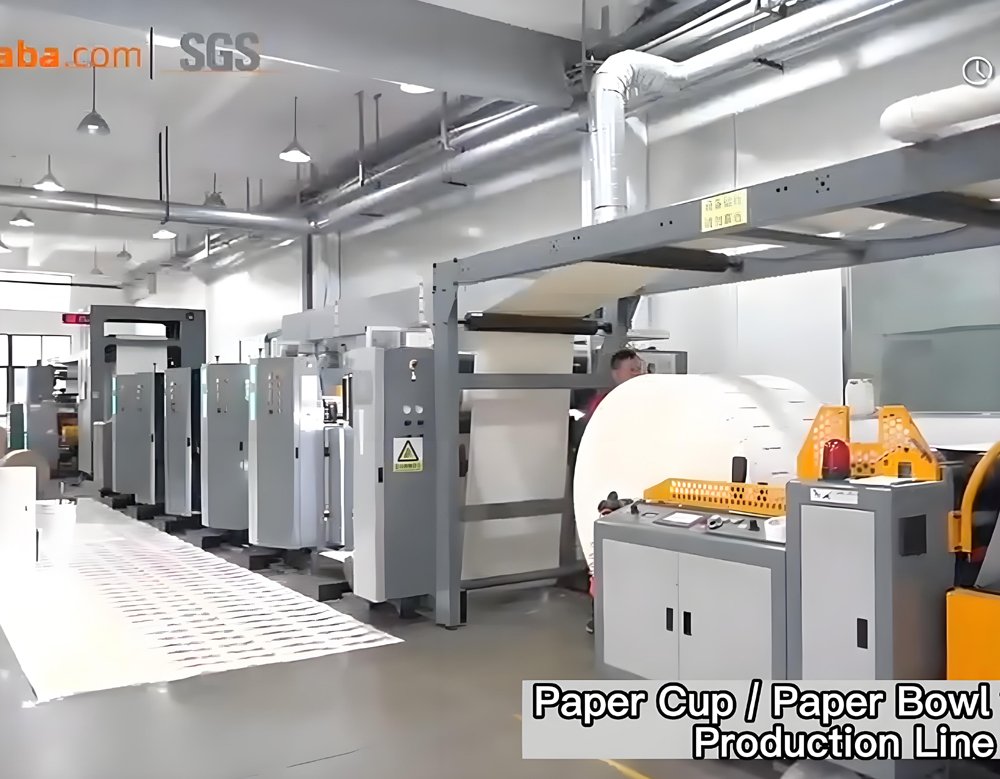
Watch Bioleader® Paper Cup and Bowl Printing & Production Process
The following Bioleader® production video gives buyers a practical look at how paper cups and bowls move through manufacturing. The video begins with printing equipment and continues through downstream cup and bowl production, helping buyers understand why printing cannot be separated from die cutting, forming and final packaging.
Buyers who want a deeper explanation of bowl material structure and converting steps can also review how disposable paper bowls are made and Bioleader®’s detailed paper bowl coatings, lids, printing and MOQ guide.
What Artwork Should Buyers Send Before Quotation?
The printing method should be evaluated from production artwork rather than a screenshot or simple mockup. For an accurate quotation, buyers should provide as much of the following information as possible:
- Vector artwork: AI, EPS or editable PDF is preferred.
- Logo file: preferably vector rather than JPG or PNG only.
- Color specification: Pantone references where exact spot colors are important.
- Artwork coverage: indicate whether the design is a small logo, partial print or full coverage.
- Product size: cup capacity, bowl capacity or exact box/tray specification.
- Coating requirement: PE, PLA or water-based aqueous coating.
- Estimated order quantity: required because plate cost and printing economics depend on production volume.
- Destination market: useful for evaluating food-contact and packaging requirements.
A final quotation should only be confirmed after the manufacturer reviews the artwork against the actual printable dieline. This is particularly important for cup and bowl projects because a flat artwork must be adjusted to fit a tapered three-dimensional surface.
Printing Ink and Food-Contact Packaging: What Buyers Should Verify
Printing method and food-contact suitability are related but separate decisions. A visually successful print is not automatically an appropriate food-packaging print system.
Professional packaging converters should evaluate the ink, substrate, printed surface, drying or curing process, possible set-off and the intended food-contact configuration. For most printed paper food packaging, artwork is placed on the non-food-contact side, but the complete package still needs to be evaluated according to the applicable food-contact requirements of the destination market.
Compliance note: Buyers should avoid selecting ink only on claims such as “eco-friendly” or “water-based.” Ask the manufacturer to confirm that the ink and printing system are appropriate for the intended food-packaging application and production structure.
How Bioleader® Selects Printing for Custom Paper Food Packaging
Bioleader® does not recommend flexo or offset printing based on one factor alone. For custom paper cups, bowls, boxes and trays, the printing route is evaluated together with the complete product specification.

The typical decision sequence is:
- Confirm the packaging type — cup, bowl, soup container, salad bowl, food box or tray.
- Confirm the paper and coating structure — kraft or white paper with PE, PLA or water-based coating where applicable.
- Review the artwork — number of colors, Pantone targets, CMYK requirements and printing coverage.
- Review order quantity — determine whether the initial plate investment makes commercial sense for the expected production volume.
- Select the printing method — flexo or offset according to technical and commercial suitability.
- Prepare the dieline and printing plates — artwork is adjusted to the actual cup, bowl, box or tray geometry.
- Evaluate samples when required — especially for full-coverage artwork, kraft paper or important brand colors.
- Proceed to mass production — printing, die cutting, forming, inspection, packing and export preparation.
As a China manufacturer of paper food packaging, Bioleader® supports OEM and private-label projects for paper cups, paper bowls, kraft food boxes and paper trays. Buyers can send the product size, coating requirement, artwork file, number of colors and estimated order quantity before plate making so the production team can evaluate the most suitable printing route.
Final Recommendation: Choose the Printing System, Not Just the Cheapest Plate
There is no single printing method that is best for every paper cup, bowl, food box or tray. Offset printing has a clear advantage in low plate-making cost and remains a strong solution for suitable sheet-fed paperboard and certain cup or bowl projects. Flexographic printing requires a higher initial plate investment, but it can provide important advantages in high-volume packaging production, water-based coated paper applications and full-coverage cup or bowl designs.
For Bioleader®’s current production route, water-based coated cup and bowl paper is normally printed by flexo. For PE- and PLA-coated products, the choice should be confirmed according to the exact project. When cup or bowl artwork uses large full-coverage areas, flexo should normally be evaluated first because finished-product stability and color-transfer risk are more important than plate price alone.
The commercial decision should therefore be based on coating compatibility, artwork coverage, color count, production quantity, forming method and finished-product risk. Buyers who confirm these factors before plate making are more likely to achieve stable colors, predictable costs and repeatable mass-production results.
FAQ: Flexo vs Offset Printing for Paper Food Packaging
What is the main difference between flexo and offset printing for paper cups?
Flexo uses a flexible raised plate to transfer ink directly to the paper, while offset transfers the image from a plate to a rubber blanket and then to the paper. For paper cups, the better method depends on coating type, printing area, colors, quantity and production route. Water-based coated cups in Bioleader®’s current production system normally use flexo.
Is flexo printing more expensive than offset printing?
The initial flexographic plate cost is usually higher. In Bioleader® typical projects, flexo plates are commonly around USD 100–150 per color, while offset plate-making cost may only be several tens of US dollars for suitable standard jobs. However, buyers should compare total production economics rather than plate fee alone.
Why is flexo recommended for full-coverage printed paper cups?
Large full-coverage artwork increases ink coverage and makes production stability more important. In Bioleader®’s manufacturing experience, certain offset full-coverage cup projects have a greater practical risk of rubbing or color transfer between tightly nested cups. For this reason, flexo is often evaluated first for high-coverage cup and bowl designs.
Can PE-coated paper cups use both flexo and offset printing?
Yes, suitable PE-coated paper cup projects may use either flexo or offset depending on the manufacturer’s equipment, artwork, order quantity and converting route. Buyers should confirm the printing process before final artwork separation and plate making.
Can PLA-coated paper cups and bowls use offset printing?
PLA-coated projects may support more than one printing route depending on the exact product structure and factory setup. The supplier should confirm compatibility between the coated paper, printing process, forming method and required artwork before production.
Is water-based coated paper printed by flexo or offset?
In Bioleader®’s current paper cup and bowl production, water-based aqueous coated paper is normally printed by flexographic printing. Buyers planning aqueous-coated packaging should therefore confirm the printing route early because changing from PE or PLA to water-based coating may affect artwork preparation, plate cost and production planning.
Is offset printing always better quality than flexo?
No. Modern flexographic printing can produce strong solid colors, detailed graphics and multi-color packaging when plates, anilox rollers, inks, substrates and press settings are correctly controlled. Offset remains strong for detailed sheet-fed graphics, but finished packaging quality also depends on forming, drying, stacking and transport performance.
Should I choose Pantone or CMYK for custom paper cups and bowls?
Pantone or spot colors are often practical for simple logos and corporate branding, while CMYK is more suitable for photographs, gradients and complex multi-color graphics. The color system and printing method should be evaluated separately because both flexo and offset can support different color strategies depending on the equipment and project.
Technical References
- Flexographic Technical Association (FTA), technical guidance on anilox specifications, ink transfer, flexographic plates and print-process control.
- European Printing Ink Association (EuPIA), Guideline on Printing Inks Applied to Food Contact Materials, 2026 edition.
- Bioleader® Water-Based Coating Standards for Cups & Bowls, 2026.
- Bioleader® Strategic Sourcing Guide: How to Customize Paper Cups and Bowls with Premium Logo Printing.