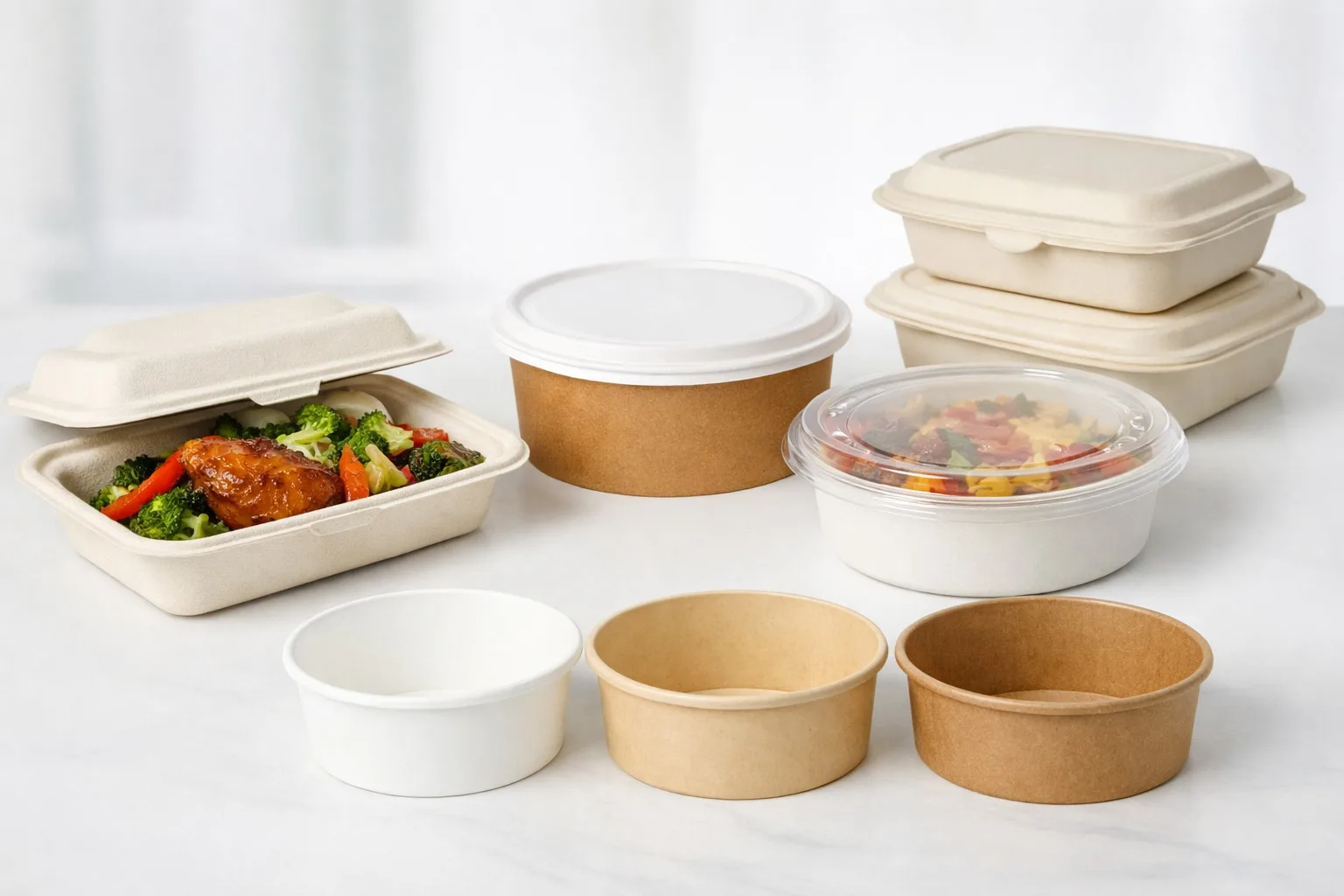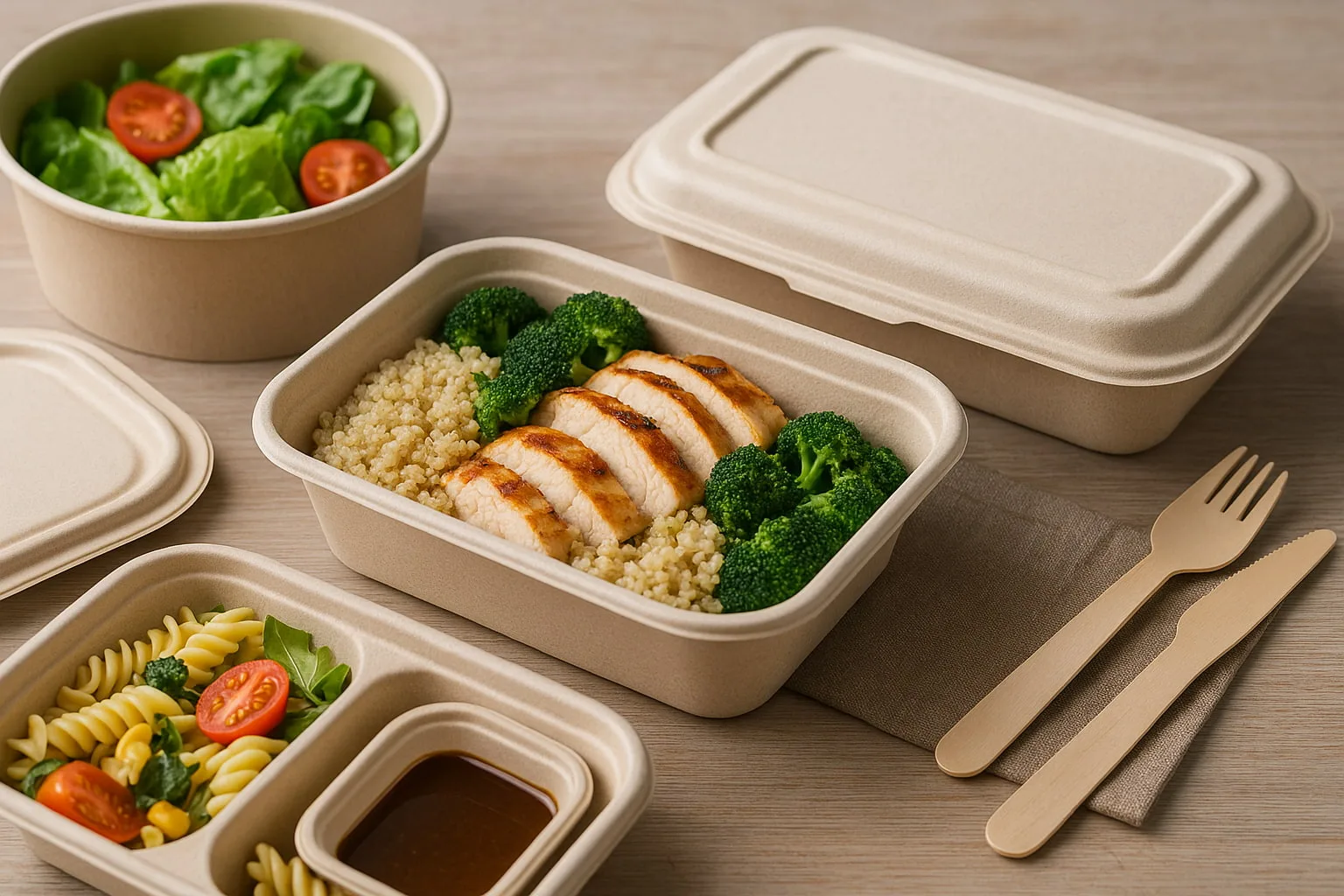










Quick Summary: Best Takeaway Containers for Different Foods
The best takeaway container is determined by how the food behaves during filling, holding and delivery. Curry needs oil and sauce resistance; soup needs a reliable bowl-and-lid system; hot noodles need different packaging for broth and dry formats; burgers need steam control; salads need cold-food presentation and condensation management; and rice meals often need portion stability or compartment separation.
- Curry: Deep paper bowls, bagasse food containers or compartment containers, depending on sauce level and whether rice and curry should remain separated.
- Hot noodles: Soup bowls for broth noodles; paper food boxes, bowls or bagasse containers for dry and stir-fried noodles.
- Soup: A matched bowl-and-lid system tested for hot filling, tilt, movement and realistic fill level.
- Burgers: Bagasse clamshells or paper burger boxes with enough internal height and appropriate steam management.
- Salad: Paper salad bowls with compatible lids selected for portion size, cold storage, presentation and dressing management.
- Rice meals: Paper bowls, food boxes, bagasse clamshells or compartment containers depending on sauce, sides and portion structure.
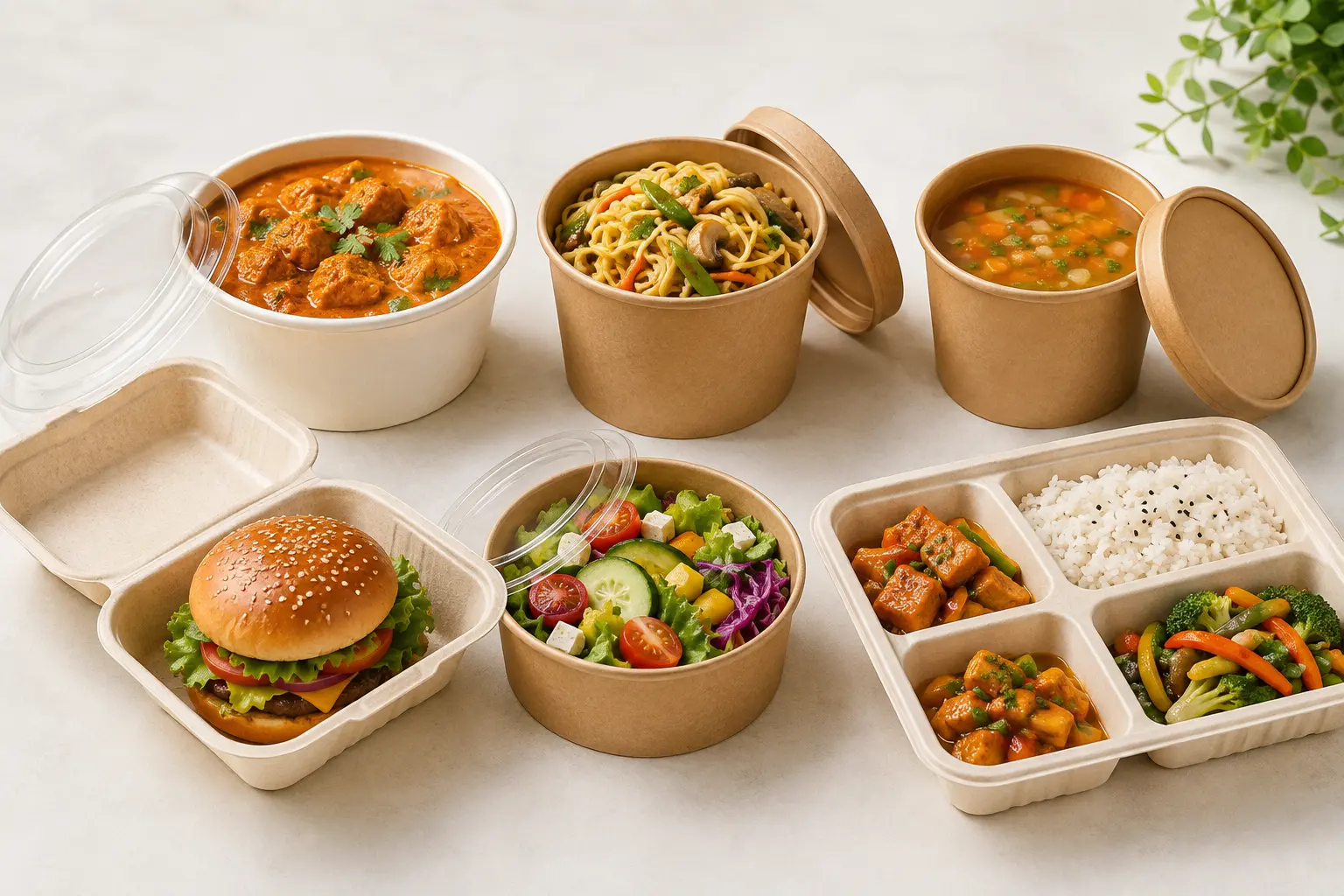
Choosing takeaway packaging by material alone is one of the most common sourcing mistakes in foodservice. A container described as “bagasse,” “kraft paper” or “compostable” may still be unsuitable if its structure does not match the actual food.
A dry burger and a bowl of curry create completely different packaging stresses. Broth noodles place pressure on the rim and lid, while fried noodles create more grease and steam. Salad packaging is mainly concerned with cold-food presentation and condensation, while a rice-and-curry meal may require separation between several components.
For restaurants, distributors, food-delivery brands and packaging procurement teams, the useful question is therefore not simply “Which material is best?” It is “Which container structure is most appropriate for this food, temperature, holding time and delivery route?”
This guide matches six high-volume takeaway food categories with practical packaging formats and explains what B2B buyers should verify before bulk purchasing. Buyers building a wider packaging program can also compare Bioleader®’s sustainable takeaway packaging solutions and broader biodegradable food packaging solutions.
Core decision rule: The right food delivery packaging = food compatibility + filling temperature + liquid and oil level + lid system + delivery movement + operating cost + destination-market compliance + end-of-life requirements.
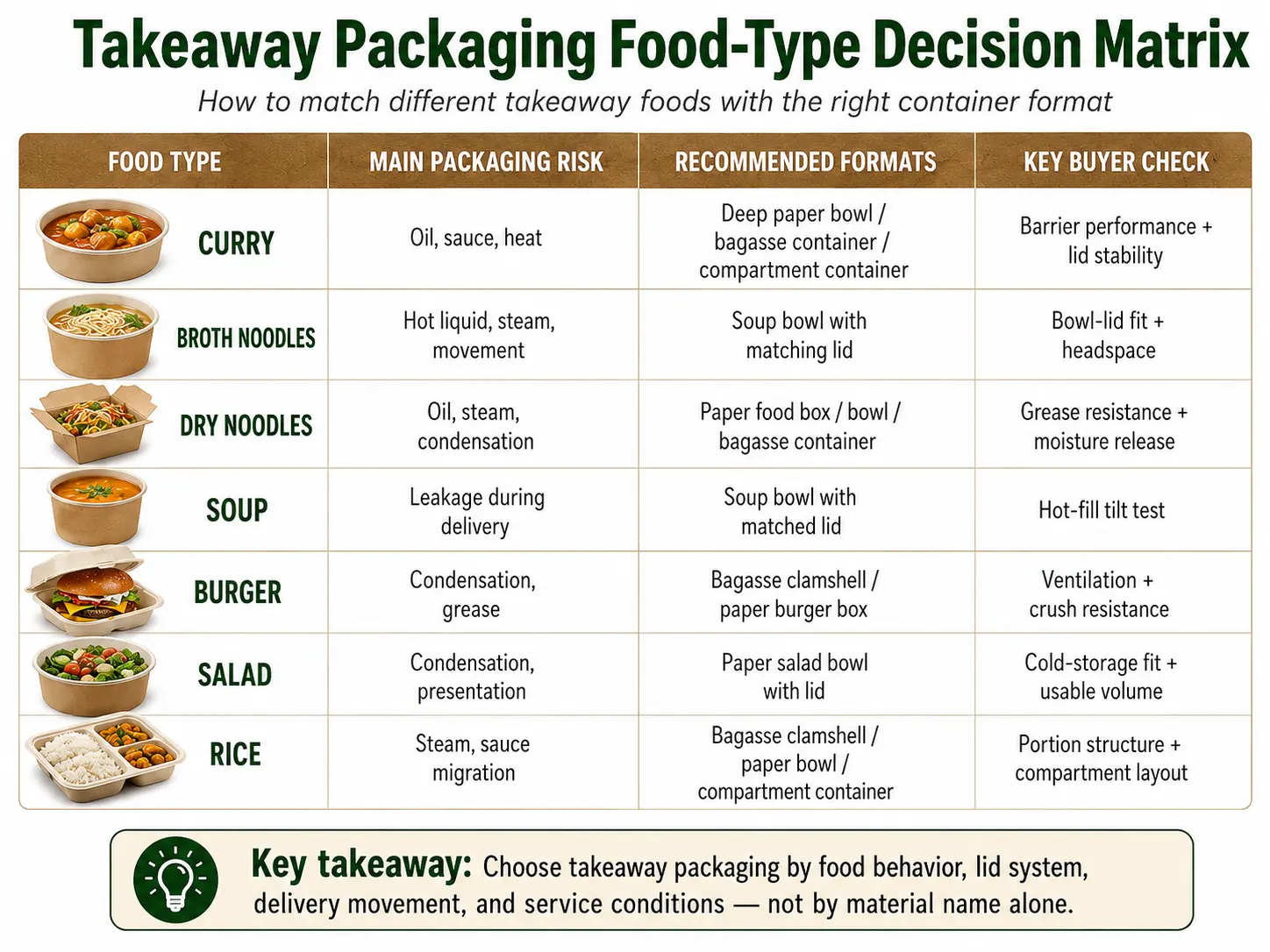
Best Takeaway Containers by Food Type: Quick Comparison
The following matrix provides a starting point. It should be used to shortlist packaging structures, not to replace product-specific food testing.
| Food Type | Main Packaging Risk | Recommended Formats | Most Important Buyer Check |
|---|---|---|---|
| Curry | Oil, sauce, heat and movement | Deep paper bowl, bagasse container, compartment container | Barrier performance, rim strength and lid stability with real curry |
| Broth Noodles | Hot liquid, steam, sloshing and noodle expansion | Paper soup bowl or validated hot-liquid bowl system | Bowl-and-lid fit, headspace and hot-liquid holding performance |
| Dry Noodles | Oil, steam and condensation | Paper food box, paper bowl, bagasse container | Grease resistance and moisture management |
| Soup | Liquid leakage and lid disengagement | Soup bowl with matched lid | Hot-fill, tilt, rim and lid test using actual fill volume |
| Burger | Condensation, grease and compression | Bagasse clamshell, paper burger box | Internal height, ventilation and crush resistance |
| Salad | Condensation, presentation and dressing leakage | Paper salad bowl with compatible lid | Cold storage, lid fit and usable bowl volume |
| Rice | Steam, sauce migration and food mixing | Bagasse clamshell, paper bowl, paper food box, compartment container | Portion structure and compartment layout |
What Is the Best Container for Curry Takeaway?
The best container for curry takeaway is usually a deep bowl or meal container with adequate oil and sauce resistance, a stable rim and a lid matched to the finished container. If curry is served with rice or several side dishes, a compartment container may be more practical because it can control sauce migration and preserve the intended meal layout.
Curry is one of the more demanding takeaway foods because it combines several packaging stresses at once: elevated serving temperature, oil, water, spices, prolonged contact time and movement during delivery.
Choose the curry container according to sauce level
| Curry Format | Suitable Packaging Direction | Why |
|---|---|---|
| Thick curry only | Deep paper bowl or bagasse bowl/container | Provides depth while reducing the exposed liquid area near the lid |
| Curry with rice | Deep bowl or divided takeaway container | Choice depends on whether curry and rice should remain mixed or separated |
| Curry with rice and sides | 2- or 3-compartment bagasse container | Separates rice, curry, vegetables and side dishes |
| High-liquid curry | Rigid bowl with secure matching lid | Places greater emphasis on rim and lid performance |
| Short-distance dine-away service | Paper bowl, food box or bagasse container | May allow a simpler closure structure than long-distance delivery |
For curry-and-rice applications, buyers can compare Bioleader® bagasse food containers and multi-compartment molded-fiber formats. The correct choice should still be made according to the exact recipe and required holding time rather than the product category name alone.
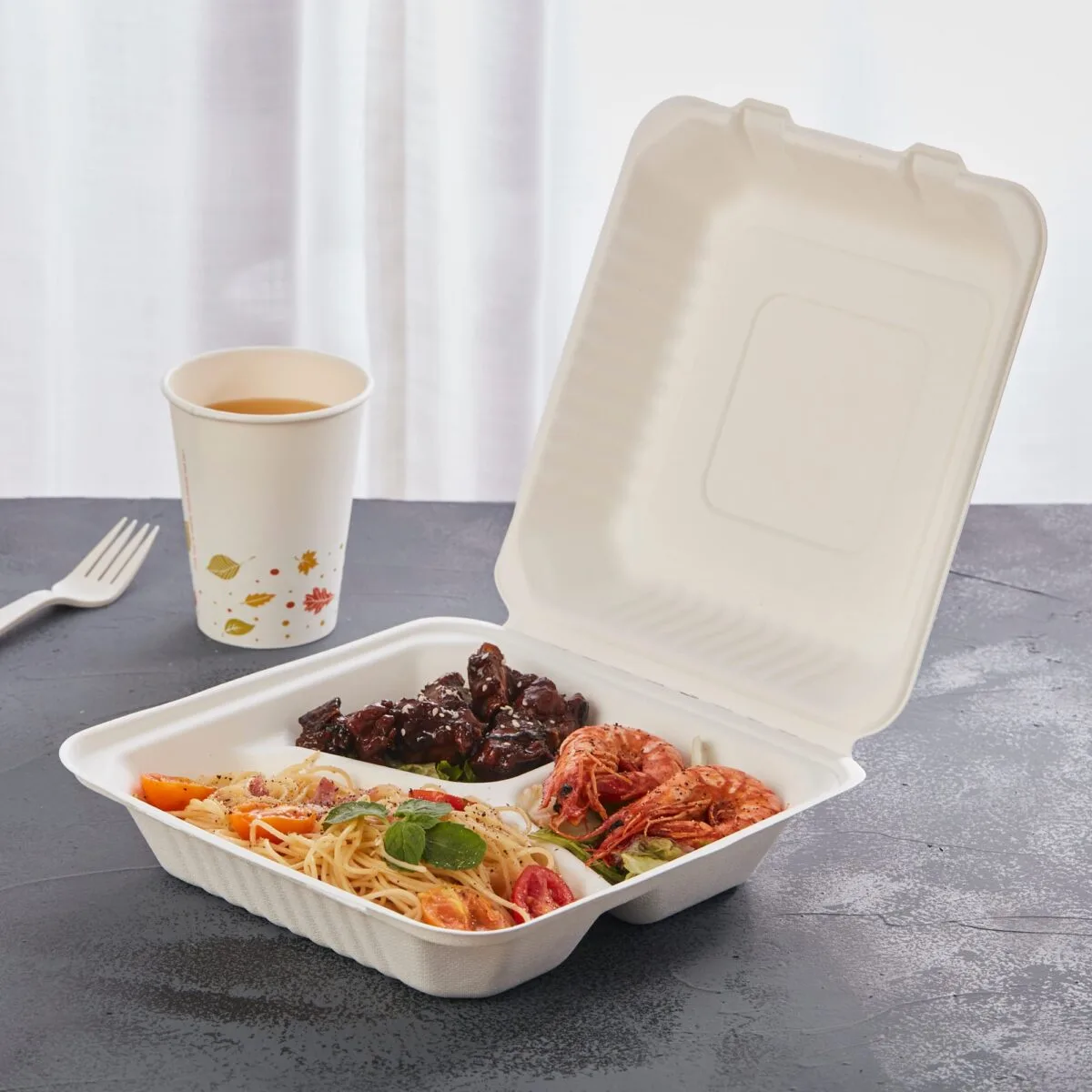
What should buyers test with curry?
- Hot-fill stability: Fill the container at the restaurant’s actual serving temperature and observe the wall, base and rim over the expected holding time.
- Oil and sauce resistance: Use the actual curry rather than water alone because oil, fat, acidity and spices can create a different barrier challenge.
- Lid engagement: Close the container after filling and check whether heat or steam changes the lid fit.
- Movement: Test normal delivery tilting and vibration instead of evaluating the package only while it remains flat on a table.
- Compartment separation: For curry-and-rice meals, confirm whether sauce can cross the divider during handling.
Manufacturer Insight: Curry Tests More Than Water Resistance
A container that passes a short hot-water test is not automatically suitable for curry. Real curry may contain oil, coconut milk, cream, chili oil, acidic ingredients or concentrated sauces. For B2B approval, Bioleader® recommends testing the production-intent container with the actual recipe whenever the application involves high oil or sauce exposure.
Buyer warning: Avoid using the word “leak-proof” as the only procurement specification. Define the food, filling temperature, fill weight, holding time, lid type and test method so that the supplier and buyer are evaluating the same performance target.
What Is the Best Packaging for Hot Noodles?
The best packaging for hot noodles depends first on whether the noodles contain broth. Broth noodles create a liquid-containment problem, while stir-fried or dry noodles primarily create grease, steam and condensation problems.
This distinction is important because restaurants often ask suppliers for a generic “noodle container” even though ramen, pho, laksa, chow mein and fried noodles may require very different structures.
Broth noodles vs dry noodles
| Noodle Type | Main Risk | Preferred Packaging Direction |
|---|---|---|
| Ramen with broth | Hot liquid, steam and continued noodle absorption | Soup bowl with secure matching lid or separate noodle-and-broth packaging |
| Pho | Large broth volume and movement | Deep soup bowl with controlled headspace |
| Laksa or oily noodle soup | Liquid plus oil exposure | Hot-food bowl with verified barrier and lid performance |
| Stir-fried noodles | Oil and steam | Paper food box, paper bowl or bagasse container |
| Dry noodles | Condensation and grease | Paper food box or vented takeaway format |
Best packaging for broth noodles
Broth noodles generally need the same packaging discipline as soup. A paper soup bowl is a common format because it provides depth, nesting efficiency and a broad range of capacities. However, the bowl should be evaluated together with its coating, rim and matching lid.

The most important variables are not simply bowl capacity and material. Buyers should define serving temperature, actual food volume, oil level, delivery time, lid material and whether the bowl will be stacked during transport.
For a more specialized noodle-shop workflow, see Bioleader®’s guide on how to choose to-go containers for noodle and soup shops.
Best packaging for dry and stir-fried noodles
Dry noodles generally do not need a highly liquid-tight soup container. Instead, the package must resist oil while preventing excessive steam from being trapped around the food.
Kraft paper food boxes can be practical for stir-fried noodles because they offer a wide opening for fast restaurant filling and provide substantial printable area for branding. Paper bowls and bagasse food containers are alternatives when a round or molded format better suits the menu.
Should noodles and broth be packed separately?
For longer delivery routes, separating noodles from broth can be more effective than trying to make one container solve every problem. Continued contact with broth can change noodle texture even when the packaging itself performs correctly.
A restaurant may therefore use one container for noodles and toppings and a second hot-liquid container for broth. This adds one more packaging component, but it can improve product consistency where noodle texture is central to the menu.
Best practice for noodles: Classify the dish as broth-based, semi-liquid, stir-fried or dry before choosing the packaging. “Hot noodles” is not a detailed enough specification for B2B sourcing.
What Is the Best Leak-Proof Takeaway Container for Soup?
A reliable takeaway soup container is a complete bowl-and-lid system, not simply a bowl made from a particular material. Rim geometry, lid dimensions, coating, fill level, heat exposure and delivery movement all influence whether soup stays inside the package.
This is why buyers looking for a leak-proof takeaway container for soup should avoid approving a bowl from photographs or material descriptions alone.
Where does soup leakage usually come from?
| Failure Point | Possible Cause | Buyer Check |
|---|---|---|
| Lid edge | Incorrect fit, deformation or overfilling | Test the exact lid after hot filling |
| Bowl rim | Weak rim or compression during stacking | Check rim stiffness before and after holding |
| Sidewall | Barrier weakness or prolonged liquid exposure | Observe softening, staining and seepage |
| Bottom seam | Forming or sealing problem in paper bowls | Inspect after realistic hot-liquid holding time |
| During transport | Excessive fill level or severe movement | Conduct controlled tilt and movement testing |
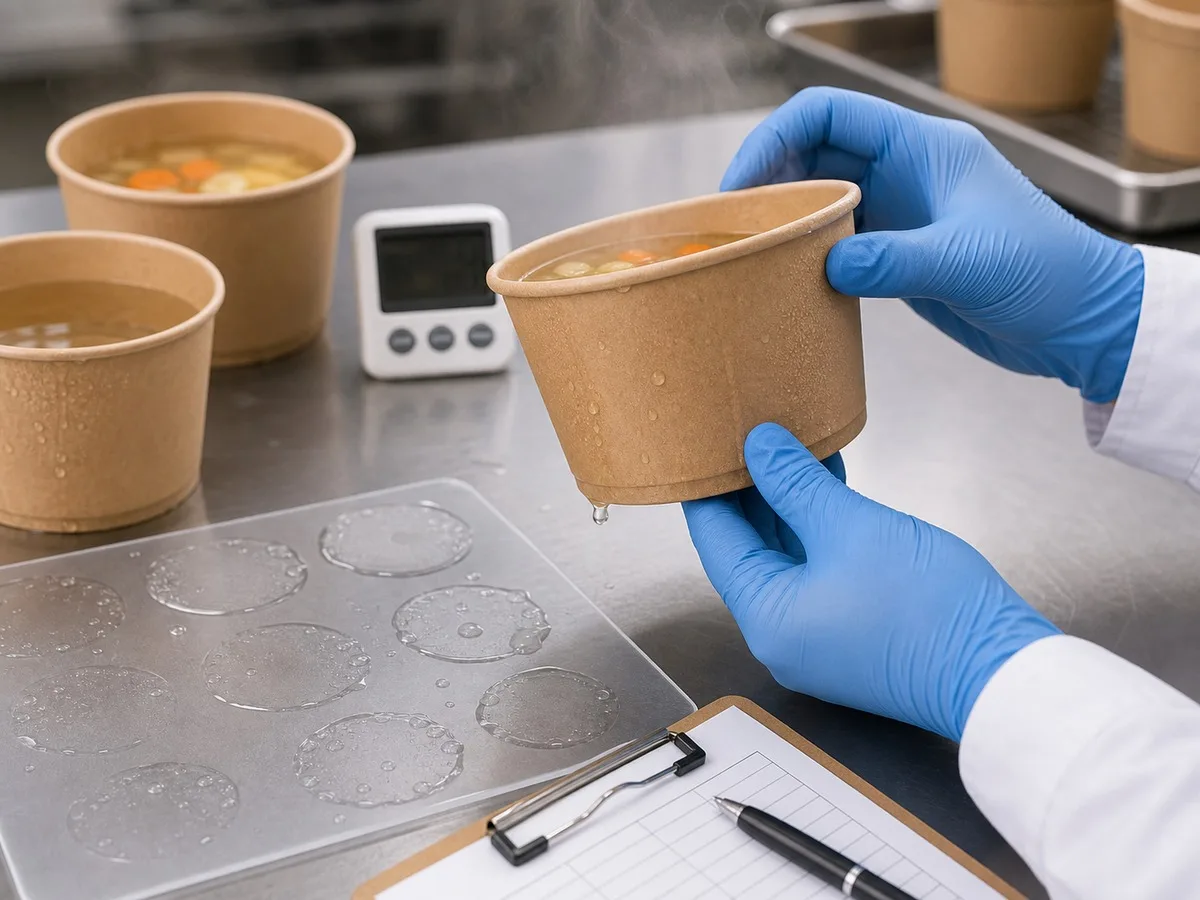
Bioleader®’s detailed guide on paper soup bowls for hot food covers hot filling, coating selection, lid fit, softening and delivery handling in greater detail.
Five variables that matter most for soup delivery
- Headspace: A container filled to the rim leaves very little margin when liquid moves during delivery.
- Rim rigidity: If the rim softens or deforms, even a correctly sized lid may lose engagement.
- Lid geometry: Lid diameter alone does not fully describe fit. Snap depth, locking profile and rim shape also matter.
- Holding time: A bowl that performs for five minutes may behave differently after 30 or 60 minutes of hot-liquid exposure.
- Delivery movement: Real transport includes vibration, stacking, acceleration, braking and temporary tilting.
For soup, “leak-proof” should be treated as a performance target that must be validated under defined conditions—not as a universal property of paper, bagasse, PP or any other material.
What about heat retention?
Heat retention is another important part of hot-food delivery, but it should be evaluated separately from leakage. A package can contain soup reliably yet lose temperature faster than another system.
Bioleader® conducted an internal takeaway container heat-retention comparison using three commercial 750ml container-and-lid systems under defined test conditions. The broader lesson is that heat retention depends on the complete package—including wall structure, geometry, lid fit, fill volume and environmental conditions—not simply on the raw material name.
Important: Heat-retention results from one tested container system should not be generalized to every container made from the same material. B2B buyers should compare production-intent samples when delivery temperature is a critical performance requirement.
What Is the Best Burger Takeaway Packaging?
The best burger takeaway packaging protects the burger from compression while managing grease and steam. Unlike soup packaging, a burger box normally does not benefit from being as tightly sealed as possible.
A freshly cooked burger releases heat and water vapor. If too much steam is trapped inside the package, condensation can collect and return to the bun, lettuce or fried components. The packaging therefore needs to balance useful heat retention with moisture release.
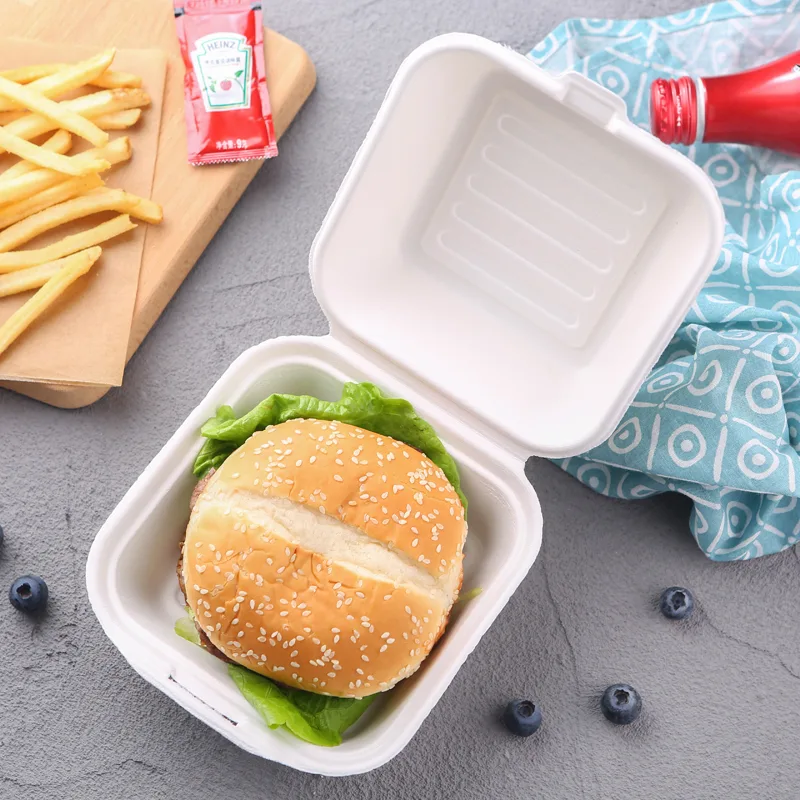
Bagasse clamshell vs paper burger box
| Factor | Bagasse Clamshell | Paper Burger Box |
|---|---|---|
| Structure | Rigid molded-fiber form | Folded paperboard structure |
| Speed of packing | Fast hinged closure | Depends on box design and assembly |
| Brand printing | More limited direct print area on molded surface | Large printable exterior surfaces |
| Steam management | Depends on molded design and closure | Can be engineered through vents and folding structure |
| Typical application | Burgers, sandwiches, snacks and combo meals | Burgers, sandwiches and branded fast-food programs |
Bioleader® supplies multiple sizes of bagasse clamshell boxes, including small burger boxes and larger meal formats. Buyers should match the internal dimensions to the finished burger rather than selecting the box only from its external dimensions.
What should burger brands test?
- Internal height: The lid should not compress the upper bun or toppings.
- Grease exposure: The base should remain structurally stable during the expected service period.
- Steam behavior: Check bun texture after 10, 20 and 30 minutes if delivery is common.
- Closure: Hinged locking points or tabs should stay closed during normal handling.
- Stacking: Boxes at the bottom of a delivery bag should not collapse under realistic loads.
Manufacturer Insight: A Bigger Burger Does Not Only Need a Wider Box
Burger diameter is only one dimension. Tall buns, double patties, lettuce, sauces and premium toppings can make internal height equally important. When buyers send samples or specifications, finished burger height is useful information because it can prevent the lid from contacting and compressing the food.
What Is the Best Takeaway Container for Salad?
The best takeaway container for salad should preserve cold-food presentation, provide enough usable volume and use a lid suited to the restaurant’s storage and delivery conditions. Heat resistance is usually less important than condensation, freshness, visibility and portion control.
Paper salad bowls are widely used for green salads, poke bowls, grain bowls, fruit, cold pasta and meal-prep applications. Kraft and white-paper versions can also support printed branding across the bowl exterior.
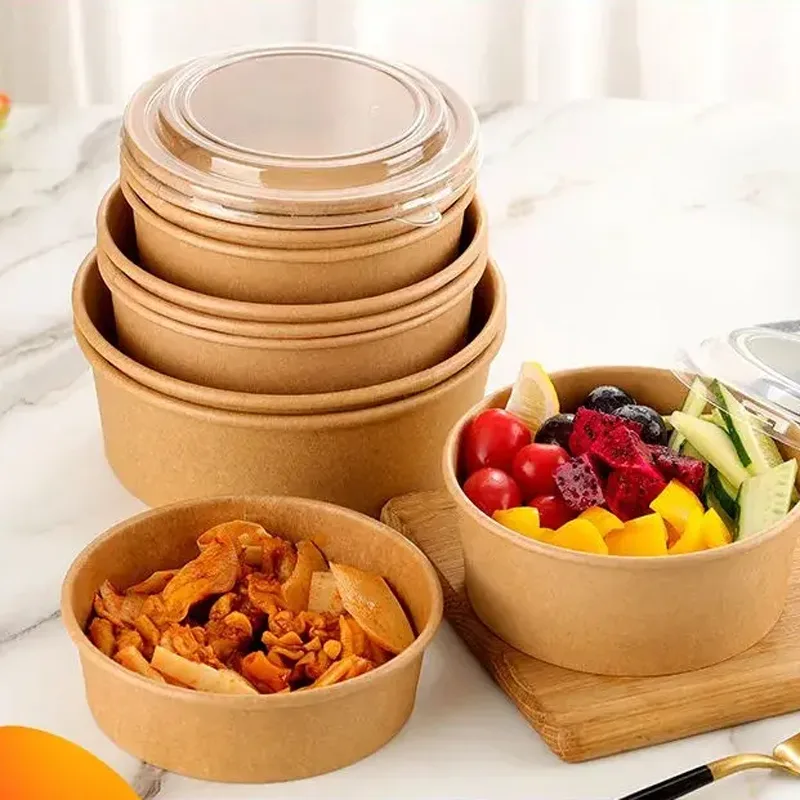
What matters most for salad packaging?
- Usable volume: Leafy salads need more headspace than dense foods of the same weight.
- Lid fit: The lid must remain stable through refrigeration, stacking and delivery.
- Condensation: Temperature changes can create moisture inside a closed container.
- Dressing: Packing dressing separately may help protect leafy texture on longer delivery routes.
- Visibility: Clear lids can support retail and delivery presentation where the selected lid material suits the application and market.
Why nominal capacity is not enough
A 1000ml bowl does not necessarily mean that every 1000ml food portion should fill it completely. Salad leaves, toppings, meat and dressing need usable space so the meal can be closed without compression.
B2B buyers should therefore evaluate both nominal container capacity and practical food-fill volume. This is especially important when replacing a plastic salad container with a different bowl geometry.
Manufacturer Insight: Salad Bowls Can Reduce SKU Complexity
Salad, poke, cold pasta and grain bowls often share similar packaging dimensions. A restaurant group may be able to standardize several menu items around one bowl diameter and one compatible lid family while changing only bowl depth. Fewer lid sizes can simplify restaurant storage, purchasing and inventory control.
What Is the Best Container for Rice Takeaway?
The best container for rice takeaway depends on what is served with the rice. Plain steamed rice, fried rice, curry rice and a full rice meal with meat and vegetables create different packaging requirements.
Plain rice and fried rice
Paper bowls, kraft food boxes and bagasse containers can all be practical for rice with low liquid content. The main factors are portion volume, steam, oil level and how long the food remains closed before consumption.
Curry rice
Curry rice adds liquid movement and oil exposure. If the customer expects curry and rice to remain partially separated, a divided container may work better than one open cavity. If the meal is intentionally served mixed, a deep bowl may provide a more efficient format.
Rice with meat and several side dishes
Two- and three-compartment containers are useful when different meal components should remain organized. Bioleader®’s 3-compartment bagasse lunch containers are one example of a molded layout intended for multi-item meals.
| Rice Meal | Recommended Format | Main Packaging Objective |
|---|---|---|
| Plain steamed rice | Paper bowl or compact food box | Portion control and efficient packing |
| Fried rice | Paper food box, bowl or bagasse container | Manage moderate oil and steam |
| Curry rice | Deep bowl or divided container | Control sauce movement |
| Rice + meat + vegetables | 2- or 3-compartment container | Maintain food separation |
| Bento-style meal | Multi-compartment tray or clamshell | Organize several small components |
| Large rice meal for delivery | Rigid clamshell or lidded meal container | Improve stacking and portion stability |
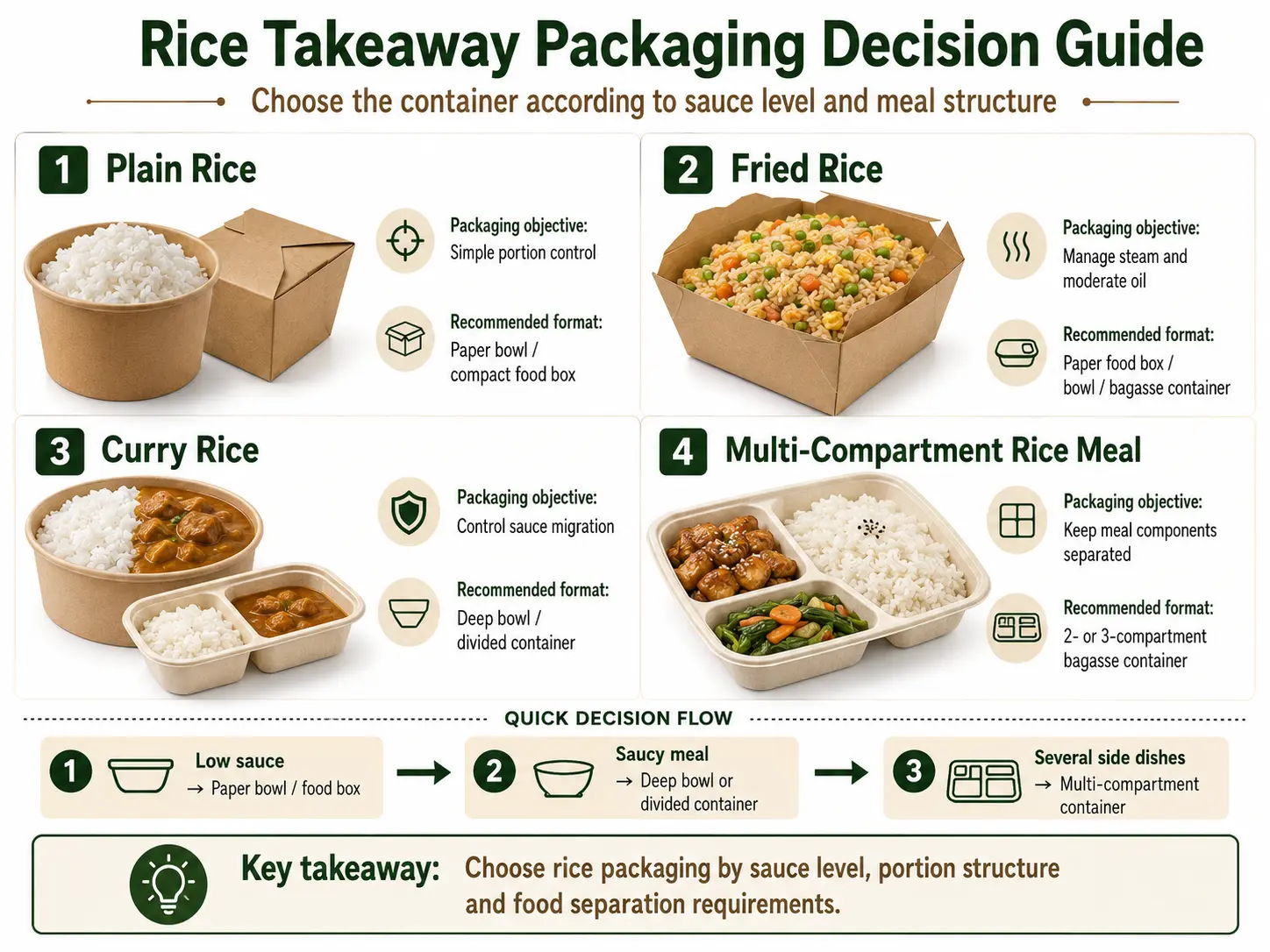
Do not choose compartment count by appearance alone. Every divider changes the usable volume of the remaining sections. Buyers should define the actual rice, protein, vegetable and sauce portions before confirming a 2-, 3- or multi-compartment design.
Food Delivery Packaging Guide: Match Packaging to Food Behavior
A practical food delivery packaging guide should start with the food and delivery process rather than a catalog of materials.
Food compatibility comes first: classify the meal by heat, liquid, oil, steam, crispness, cold-storage requirements and delivery movement before comparing bagasse, paper, plastic or other packaging systems.
Step 1: Classify the food
| Food Behavior | Main Packaging Challenge | Typical Examples |
|---|---|---|
| Fully liquid | Lid security and movement | Soup, broth, porridge |
| Saucy and oily | Barrier resistance and lid stability | Curry, chili, saucy pasta |
| Hot and steamy | Condensation and softening | Rice, noodles, hot entrées |
| Crispy | Moisture release | Fries, fried chicken, tempura |
| Cold and fresh | Condensation and visual presentation | Salad, poke, fruit |
| Multi-component | Food mixing and portion movement | Bento, curry rice, meal prep |
Step 2: Record the real filling temperature
Packaging should be tested at the temperature used by the restaurant. A product filled with refrigerated salad experiences different stresses from a bowl filled with hot soup or chili oil.
“Suitable for hot food” is therefore not a complete B2B specification. Buyers should communicate their typical filling temperature or temperature range when requesting samples.
Step 3: Define the delivery journey
Counter takeaway and third-party food delivery are different operating environments. A container carried upright for five minutes may not need the same closure performance as a soup bowl transported for 30 minutes in a rider’s delivery bag.
Important variables include:
- Average delivery duration
- Whether containers are stacked
- Expected tilting and vibration
- Use of insulated delivery bags
- Time between kitchen filling and rider pickup
- Ambient temperature
Step 4: Select the lid with the container
Do not approve a bowl and treat the lid as a secondary accessory. For soup, noodles, curry and salad, the lid can determine whether the complete system works.
Relevant lid considerations include:
- Material and intended temperature range
- Snap-fit or locking geometry
- Steam behavior
- Visibility requirements
- Stacking performance
- Customer opening force
Step 5: Check restaurant workflow
Packaging that performs well in testing can still create operational problems if it is slow to close, difficult to separate from a stack or requires too many different lid sizes.
B2B buyers should also evaluate:
- Filling speed
- Closure speed
- Container nesting
- Lid nesting
- Restaurant storage space
- SKU standardization
- Carton quantity
- Export cube and container loading
Step 6: Compare total operating cost, not only unit price
A lower-priced container is not necessarily the lower-cost solution if it causes lid mismatches, excess restaurant inventory, poor carton utilization or food-delivery complaints.
The commercial comparison should therefore consider container price together with lid cost, carton efficiency, custom printing, storage, breakage or deformation risk, delivery performance and the number of SKUs required across the menu.
How Should Buyers Test Takeaway Containers Before Bulk Ordering?
Foodservice packaging should be evaluated using production-intent samples whenever possible. The objective is to identify application problems before a large order is produced.
Recommended Menu-Based Sample Evaluation
- Fill test: Fill the container with the normal restaurant portion at the real serving temperature.
- Holding test: Keep the food inside the closed package for the expected delivery period.
- Barrier check: Inspect the sidewall, base, seams and corners for oil marks, moisture penetration, softening or deformation.
- Lid test: Check the closure after hot filling and again after the package has been held for several minutes.
- Tilt test: Apply a controlled tilt method appropriate to the food and expected transport conditions.
- Movement test: Simulate realistic delivery vibration and handling.
- Stacking test: Stack filled containers as they would be used inside the restaurant or delivery bag.
- Opening test: Confirm that customers can open the package without tearing the rim or spilling the food.
- Food-quality check: Review bun texture, noodle texture, salad condensation, fried-food crispness and sauce migration after the target delivery period.
- Record results: Document food temperature, holding time, fill volume and failure point so that the supplier can understand any required adjustment.
B2B Buyer Checklist for Takeaway Food Containers
- Define the exact food and recipe characteristics before requesting a final quotation.
- Confirm actual portion weight and practical usable container volume.
- Provide the normal food filling temperature.
- Specify whether the food is dry, oily, saucy, semi-liquid or fully liquid.
- Define average delivery and holding time.
- Confirm whether visibility, ventilation or strong liquid containment is the priority for the lid.
- Test the exact production-intent container and lid together.
- Check the coating or barrier structure when sourcing paper packaging.
- Confirm whether compartment dividers match the actual meal portions.
- Review carton size, packing quantity and export cube for bulk orders.
- Confirm custom printing, artwork, private label and MOQ requirements before production planning.
- Request product-specific documentation appropriate to the destination market and intended environmental claims.
Food Contact, Compostability and PFAS: What Buyers Should Verify Separately
Packaging performance and regulatory documentation should be reviewed as separate parts of the procurement process. A container can perform well with hot food and still require specific compliance documentation for its destination market.
Food-contact compliance
Buyers should confirm which food-contact requirements apply in the destination market and request documentation that corresponds to the actual product specification being purchased. Material, coating, additives, inks and other food-contact components may all affect the document package.
Compostability
Compostability is a separate property from food-contact suitability. Standards such as EN 13432 and ASTM D6400 address compostability requirements and should not be used as substitutes for food-contact evidence.
Buyers comparing these standards can read Bioleader®’s EN 13432 vs ASTM D6400 guide for export buyers.
PFAS verification
PFAS-free claims should also be reviewed separately. A natural fiber appearance does not prove PFAS status, and compostability certification does not automatically establish PFAS compliance.
Bioleader®’s updated PFAS-Free Packaging in 2026 guide explains how buyers can distinguish supplier declarations, no-intentionally-added-PFAS statements, fluorine screening and targeted analytical evidence.
Compliance rule: Do not use “food-grade,” “PFAS-free,” “biodegradable” and “compostable” as interchangeable terms. Each refers to a different question and may require a different form of evidence.
Which Takeaway Packaging Materials Should Buyers Compare?
Different materials can solve the same foodservice problem in different ways. Instead of searching for one universal material, procurement teams should compare the available structure against the intended food and operational requirements.
| Packaging Type | Typical Strength | Common Applications | Main Buyer Question |
|---|---|---|---|
| Bagasse clamshell | Rigid molded structure and compartment options | Burgers, rice meals, combo meals, hot entrées | Does the selected specification handle the meal’s oil, moisture and delivery time? |
| Bagasse tray or container | Multiple shapes, depths and lid systems | Rice, entrées, salads and prepared meals | Which lid and barrier configuration is supplied with this SKU? |
| Paper soup bowl | Efficient round format with broad size range | Soup, noodles, porridge, curry and hot bowls | Which coating and lid combination matches the food temperature? |
| Paper salad bowl | Presentation, printing and multiple capacities | Salad, poke, grain bowls and cold meals | Which lid, coating and practical fill volume are required? |
| Paper food box | Wide opening and efficient restaurant filling | Dry noodles, fried food, rice and prepared meals | How does the box perform with grease and steam? |
| Cornstarch-based tableware | Plastic-like molded structure for selected foodservice uses | Selected hot and cold food applications | What is the exact material formulation, temperature limitation and required end-of-life claim? |
Bioleader® manufactures and supplies multiple packaging systems across sugarcane bagasse tableware, paper food packaging and other disposable foodservice categories. This allows buyers to select packaging by application rather than forcing every menu item into one material family.
Bioleader® Takeaway Packaging Solutions for Multi-Menu Foodservice
Bioleader® supports restaurants, importers, foodservice distributors and takeaway brands sourcing multiple packaging categories from China. The product-selection process can begin with the menu, food conditions and destination market before individual SKUs are shortlisted.
- For burgers and fast food: Compare bagasse clamshell boxes and paper food boxes according to burger size, ventilation and branding requirements.
- For soup and broth noodles: Evaluate paper soup bowls and matching lid systems under real hot-food conditions.
- For salads, poke and grain bowls: Compare paper salad bowls by capacity, bowl diameter, lid family and cold-food presentation.
- For curry and rice meals: Compare deep bowls, bagasse containers and divided formats according to sauce level and portion structure.
- For multi-SKU restaurant programs: Review lid standardization, carton utilization, custom printing, MOQ and container-loading efficiency before confirming the final assortment.
Buyers can review Bioleader®’s broader food packaging product range, compare options through the Sustainable Takeaway Packaging solution page and request production-intent samples for menu testing before bulk ordering.
Frequently Asked Questions
What is the best container for curry takeaway?
The best curry takeaway container depends on sauce level and how the meal is served. Thick curry can use a deep paper or bagasse bowl, while curry with rice and side dishes may benefit from a divided bagasse container. Buyers should test hot holding, oil resistance, lid fit and movement using the actual curry before bulk ordering.
What is the best packaging for hot noodles?
Broth noodles usually require a soup bowl with a secure matching lid, while dry and stir-fried noodles can use paper food boxes, bowls or bagasse containers. For longer deliveries, packing broth and noodles separately can help protect noodle texture. The final packaging should be tested at the real serving temperature and holding time.
What is the best leak-proof takeaway container for soup?
No single material is automatically leak-proof in every soup application. Reliable soup packaging depends on the bowl, rim, lid geometry, fill level, temperature and delivery movement. Buyers should treat the bowl and lid as one system and test the exact production-intent combination with hot liquid before approving a bulk order.
What is the best burger takeaway packaging?
Bagasse clamshell boxes and paper burger boxes are common options. The right box should provide enough internal height to protect the burger, resist grease and manage steam so that excessive condensation does not soften the bun. Buyers should test the actual burger after the normal delivery holding time.
What is the best takeaway container for salad?
Paper salad bowls with compatible lids are widely used for salads, poke bowls, grain bowls and cold meal preparation. Buyers should choose the bowl according to practical food-fill volume rather than nominal capacity alone and evaluate lid fit, cold storage, condensation, dressing separation and presentation.
What is the best container for rice takeaway?
Plain rice and fried rice can use paper bowls, food boxes or bagasse containers. Curry rice may require a deeper or divided format, while rice meals with meat and several side dishes usually benefit from two- or three-compartment containers. The meal’s actual portion structure should determine the layout.
How should restaurants choose food delivery packaging?
Start with food behavior rather than packaging material. Define filling temperature, liquid and oil content, portion size, delivery time, stacking, lid requirements and the desired customer experience. Then compare suitable container structures and test the production-intent packaging with the actual meal before approving bulk production.
Conclusion: Build the Packaging System Around the Menu
There is no universal takeaway container for curry, noodles, burgers, soup, salad and rice because these foods create fundamentally different packaging stresses.
Soup and broth noodles place the greatest emphasis on bowl-and-lid containment. Curry adds oil and sauce resistance. Burgers require structural protection and steam management. Salad packaging focuses on usable volume, presentation and condensation. Rice packaging changes depending on whether the meal is dry, saucy or divided into several components.
For B2B buyers, the most reliable sourcing process is to map each menu category to a performance profile, shortlist suitable container structures and then test the exact production-intent container with the real food.
This approach is more reliable than selecting packaging only by material name, sustainability claim or unit price. It also makes it easier to standardize lids, reduce unnecessary SKUs, improve carton utilization and build a packaging program that can scale across restaurants, delivery kitchens and distribution networks.
Bioleader® supports buyers with bagasse containers, clamshell boxes, paper soup bowls, paper salad bowls, paper food boxes and other foodservice packaging formats, together with sample evaluation, bulk wholesale supply, custom printing, OEM/private label and export-order planning.
References and Further Reading
- European Commission — Food Contact Materials. General information on the EU framework for materials and articles intended to contact food. European Commission Food Contact Materials.
- U.S. Food and Drug Administration — Packaging & Food Contact Substances. Information on food-contact substances and packaging requirements in the United States. FDA Packaging & Food Contact Substances.
- Biodegradable Products Institute — Compostability Certification. Information on BPI commercial compostability certification and applicable testing requirements. BPI Compostability Certification.
- TÜV AUSTRIA — OK compost INDUSTRIAL. Certification information relating to industrial compostability. TÜV AUSTRIA OK compost INDUSTRIAL.
- Bioleader® — Paper Soup Bowls for Hot Food: What Buyers Should Check. Practical sourcing guidance covering hot-fill performance, coatings, lid fit, softening and delivery handling. Read the Paper Soup Bowl Buyer Guide.
- Bioleader® — Takeaway Container Heat Retention Test. Internal comparison of foil-lined paper, kraft paper and PP container-and-lid systems under defined test conditions. View the Heat Retention Test.
- Bioleader® — PFAS-Free Packaging in 2026. Buyer guidance covering PFAS terminology, declarations, testing scope and product-specific compliance verification. Read the PFAS-Free Packaging Guide.