








Quick Answer: Which Takeaway Container Retained Heat Best?
In Bioleader®’s internal heat-retention comparison conducted on July 27, 2026, the 750ml aluminum foil-lined paper bowl retained the highest measured central liquid-surface temperature among the three tested takeaway packaging systems.
Each container was filled with 650ml of hot water at 90°C, closed with a tightly fitted PP lid, and held at an ambient temperature of 23–25°C. The containers were not preheated and were not placed inside an insulated delivery bag, foam box, or thermal sleeve.
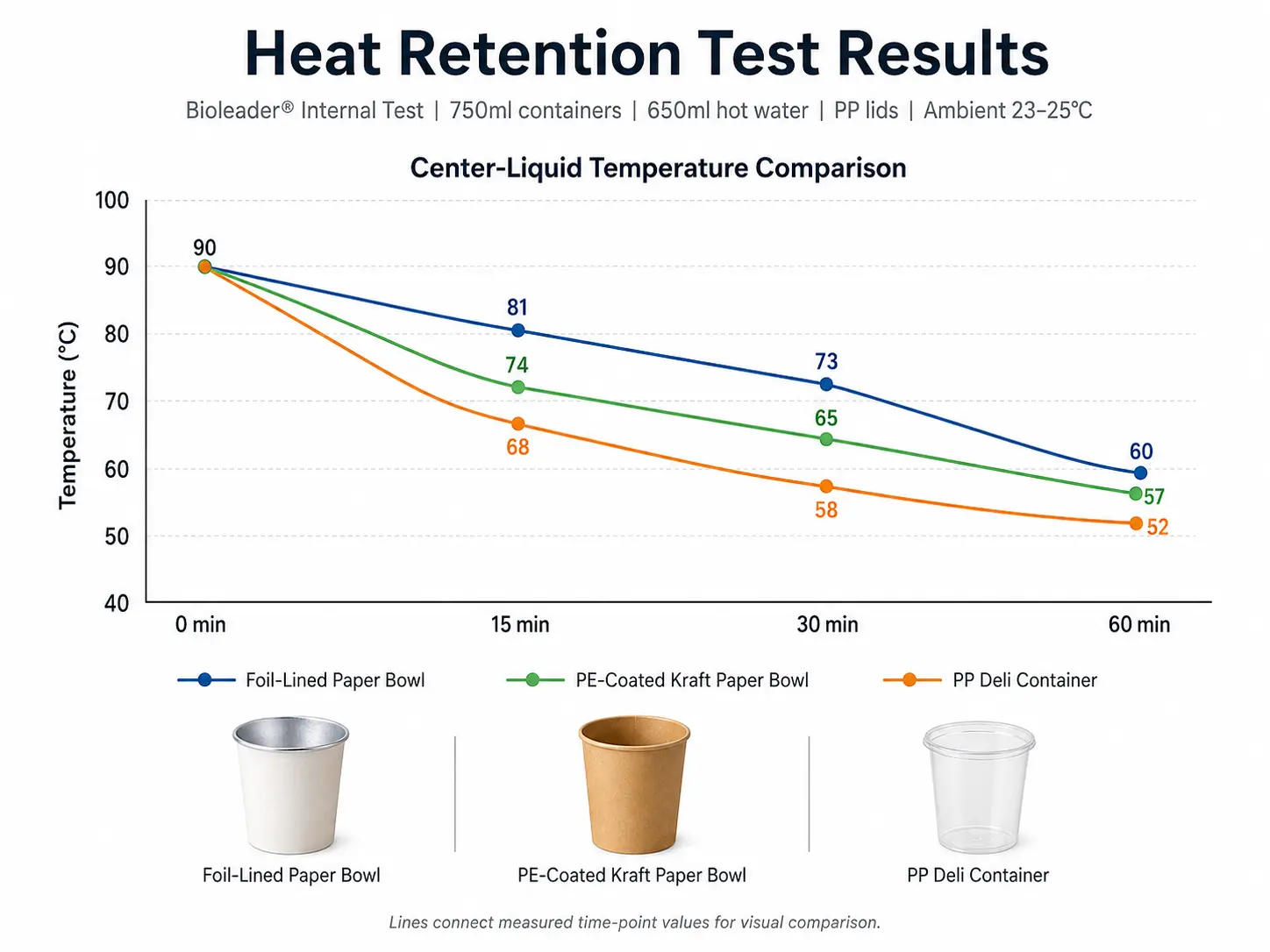
At 15 minutes, the recorded temperatures were 81°C for the foil-lined paper bowl, 74°C for the PE-coated kraft paper bowl, and 68°C for the 14.5g thin-wall PP deli soup container. At 30 minutes, the readings were 73°C, 65°C, and 58°C. At 60 minutes, they were 60°C, 57°C, and 52°C, respectively.
The results compare three complete commercial container-and-lid systems under defined internal test conditions. They are not a universal claim for every foil-lined paper bowl, kraft paper bowl, or PP container.
Food temperature at the moment of delivery is a practical packaging issue for restaurants, cloud kitchens, catering operators, delivery platforms, foodservice distributors, and packaging procurement teams. A container may be leak-resistant, microwave-compatible, or visually attractive, yet still allow soup or prepared meals to cool faster than expected during packing, rider waiting, transportation, and customer handover.
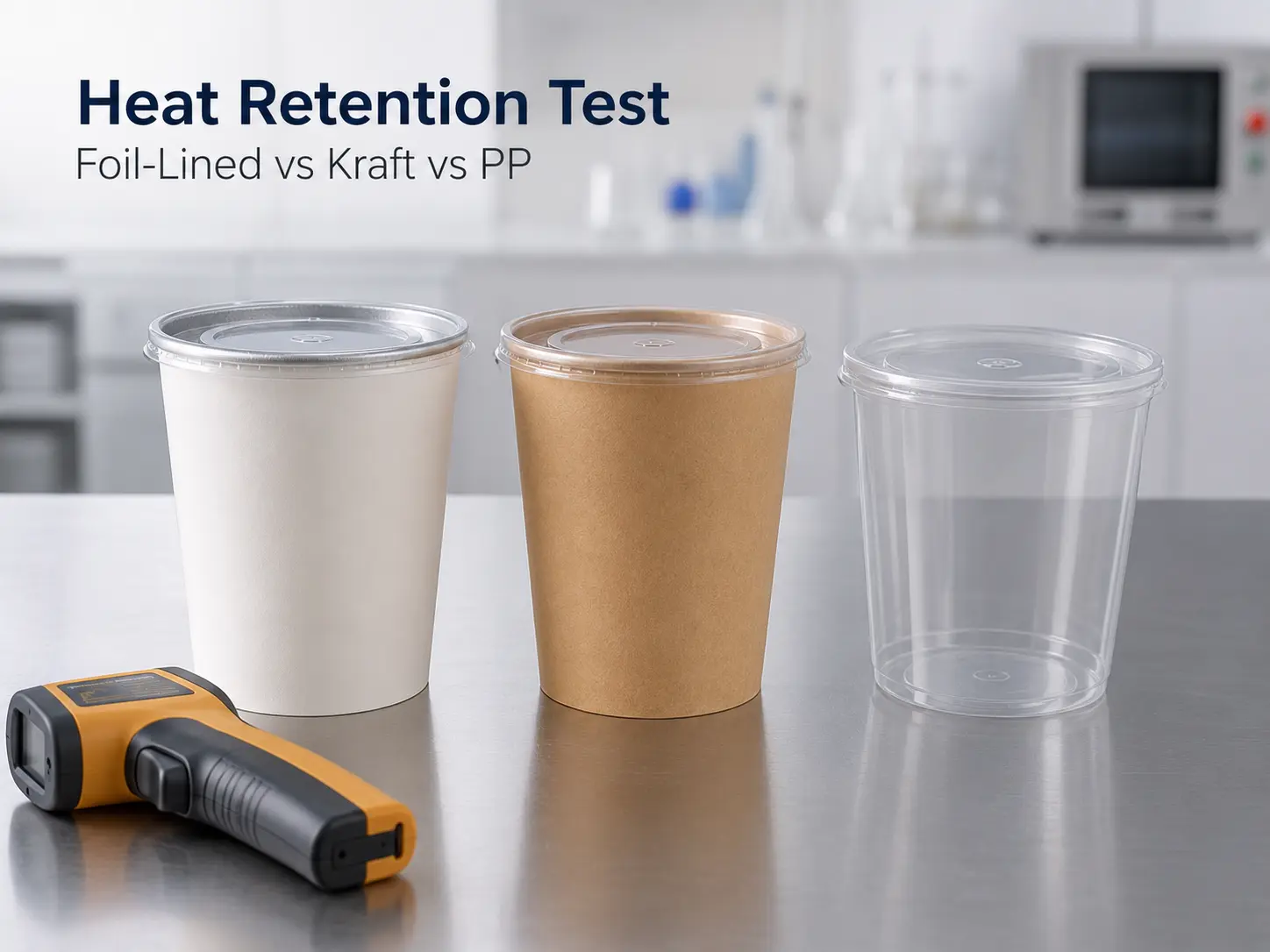
This Bioleader® technical comparison evaluates three common 750ml takeaway systems: an aluminum foil-lined paper bowl, a standard PE-coated kraft paper bowl, and a thin-wall PP deli soup container. The purpose was not to measure the isolated thermal conductivity of three raw materials. It was to compare the practical holding performance of the complete commercial package, including container structure, geometry, material quantity, headspace, and tightly fitted PP lid.
Heat-retention performance = container material + wall structure + container geometry + lid fit + fill volume + starting temperature + ambient conditions + measurement method + holding time.
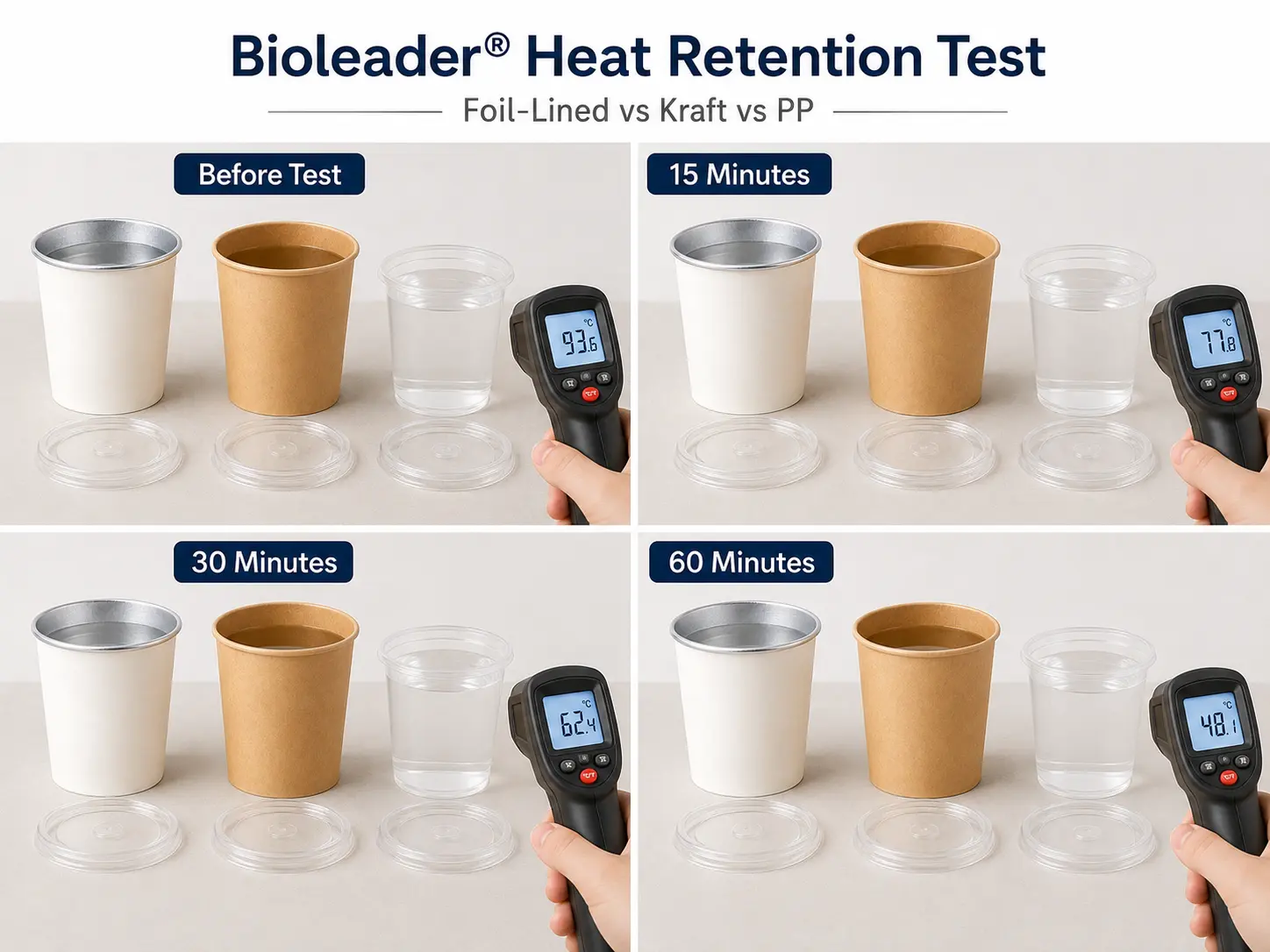
Visual disclosure: The images in this article are explanatory visualizations prepared from the recorded Bioleader® test conditions, product structures, and temperature data. They support understanding of the test but should not be interpreted as third-party laboratory photographs, calibration records, or certification evidence.
Why Heat Retention Matters in Takeaway Packaging
Heat retention affects more than whether a meal feels warm when the customer opens the lid. It can influence the perceived freshness and eating quality of soup, porridge, noodles, curry, rice meals, pasta, sauces, and other hot foods after a delivery journey.
For foodservice buyers, the first 15–45 minutes are often the most commercially relevant holding window. This period can include portioning, lid application, order staging, rider collection, urban delivery, and final handover. A package that slows temperature loss during this period may support a better customer experience and reduce complaints about food cooling too quickly.
However, heat retention is only one selection factor. It does not replace food-safety controls, and it should not be confused with microwave suitability. USDA guidance for takeout and delivered foods emphasizes appropriate time-and-temperature handling. Packaging may slow temperature decline, but it cannot replace an operator’s food-safety program, hot-holding equipment, delivery procedures, or thermometer controls.
Buyers should therefore evaluate heat retention together with leak resistance, oil resistance, lid compatibility, reheating requirements, printing, carton efficiency, compliance, and total operating cost. Bioleader®’s broader guide on how to choose high-performance takeaway food containers explains how these variables work together in a sourcing decision.
What Did Bioleader® Test?
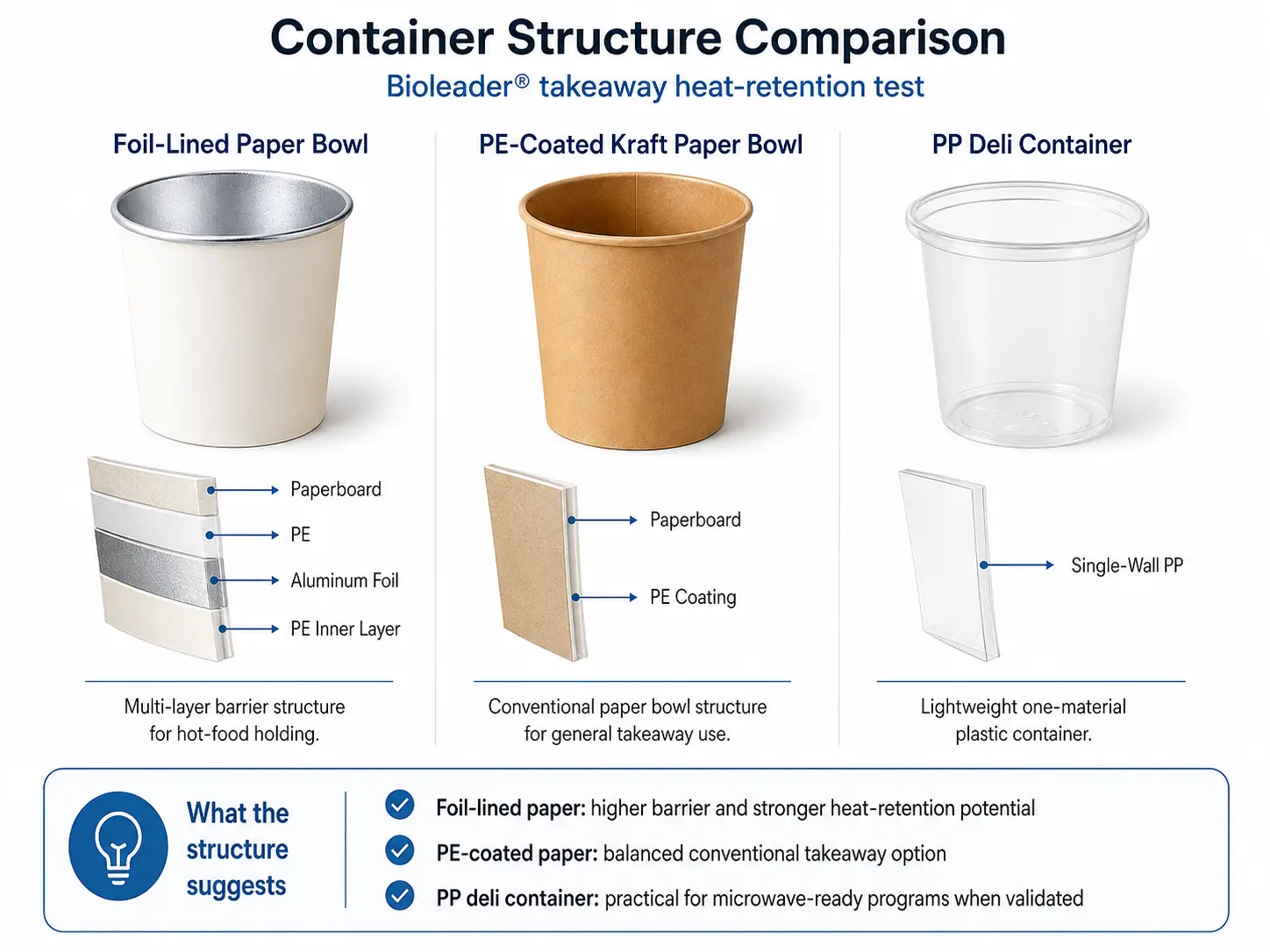
The comparison used three nominal 750ml commercial takeaway systems. Both paper-based bowls used 300gsm paperboard. The standard kraft paper bowl used a PE coating, while the foil-lined bowl used a laminated structure containing paperboard, PE, aluminum foil, and an inner PE food-contact layer. The PP deli soup container had a finished body weight of 14.5g.
All three systems used their normal tightly fitted PP lids. This is important because the test represents complete commercial packaging systems rather than uncovered container bodies or isolated sheet materials.
| Test item | Aluminum foil-lined paper bowl | PE-coated kraft paper bowl | Thin-wall PP deli soup container |
|---|---|---|---|
| Nominal capacity | 750ml | 750ml | 750ml |
| Actual hot-water fill | 650ml | 650ml | 650ml |
| Container structure | 300gsm paperboard with PE–aluminum foil–PE laminated inner structure | 300gsm kraft paperboard with PE coating | Food-grade thin-wall PP |
| PP container body weight | Not applicable | Not applicable | 14.5g |
| Lid material | PP | PP | PP |
| Lid fit during holding | Tightly fitted | Tightly fitted | Tightly fitted |
The foil-lined system represents a higher-barrier paper package designed for hot-food holding, oil resistance, moisture resistance, and delivery performance. Bioleader® supplies aluminum foil-lined paper soup bowls and aluminum foil-lined paper meal bowls for hot takeaway applications.
The PE-coated kraft paper bowl represents a conventional hot-food package used for soup, noodles, rice, porridge, and general takeaway service. Buyers can review Bioleader® paper soup bowls with lids and the broader range of paper food packaging solutions.
Bioleader® Internal Test Method
Internal Test Disclosure
Test name: Bioleader® Takeaway Container Heat-Retention Comparison
Test date: July 27, 2026
Internal reference: BL-HRT-20260727-01
Test status: Internal comparative evaluation, not third-party certification
The reported results apply only to the tested container capacities, structures, fill volume, matching PP lids, environmental range, and measurement procedure. They should not be presented as a universal performance guarantee for all foil-lined paper, PE-coated paper, or polypropylene packaging.
| Controlled condition | Test specification |
|---|---|
| Nominal container capacity | 750ml for all three systems |
| Actual liquid volume | 650ml of hot water per container |
| Starting temperature | 90°C |
| Ambient temperature | 23–25°C |
| Lid condition during holding | Each container was closed with its normal tightly fitted PP lid |
| Preheating | No container was preheated |
| External insulation | No insulated delivery bag, foam box, thermal sleeve, or additional wrap was used |
| Temperature instrument | Handheld infrared thermometer used consistently across all three systems |
| Measurement target | Central exposed liquid surface immediately after briefly opening the lid |
| Measurement times | 0, 15, 30, and 60 minutes |
The lid was kept fitted during each holding interval and was opened briefly at the measurement checkpoint. The infrared thermometer was directed at the central exposed liquid surface using the same measurement approach for all three containers. The lid was then replaced to continue the test.
Measurement-method limitation: An infrared thermometer measures surface temperature rather than the average bulk temperature throughout the full liquid volume. The results are therefore best described as central liquid-surface temperature readings. They remain useful for a controlled side-by-side comparison because the same instrument and procedure were applied to every tested system.
Maintaining the same fill volume, starting temperature, ambient range, lid material, and measurement procedure makes the comparison more meaningful. Environmental conditions matter because paper-based packaging may respond to temperature and humidity. ASTM D4332 provides conditioning atmospheres for packaging tests intended to simulate selected field conditions. This Bioleader® test did not claim compliance with ASTM D4332; the standard is cited only to support the importance of documenting the test environment.
Hot water was selected as a standardized thermal load. It permits the same volume and starting temperature to be used in each container. It does not fully reproduce the thermal behavior of oily curry, thick porridge, noodles, high-sugar sauces, or meals containing solid ingredients.
Heat-Retention Test Results
Under the defined test conditions, the aluminum foil-lined paper bowl recorded the highest central liquid-surface temperature at every reported checkpoint after the test began.
| Container system | Initial | 15 minutes | 30 minutes | 60 minutes |
|---|---|---|---|---|
| Aluminum foil-lined paper bowl | 90°C | 81°C | 73°C | 60°C |
| PE-coated kraft paper bowl | 90°C | 74°C | 65°C | 57°C |
| Thin-wall PP deli soup container | 90°C | 68°C | 58°C | 52°C |
Measured result: The foil-lined paper bowl retained the highest recorded temperature at 15, 30, and 60 minutes. Its largest commercial advantage appeared during the early delivery window, when orders are commonly packed, staged, collected, and transported.
Temperature drop by container system
| Container system | Drop after 15 minutes | Drop after 30 minutes | Total drop after 60 minutes |
|---|---|---|---|
| Aluminum foil-lined paper bowl | 9°C | 17°C | 30°C |
| PE-coated kraft paper bowl | 16°C | 25°C | 33°C |
| Thin-wall PP deli soup container | 22°C | 32°C | 38°C |
Direct temperature differences
- At 15 minutes, the foil-lined paper bowl was 7°C warmer than the PE-coated kraft paper bowl and 13°C warmer than the PP container.
- At 30 minutes, the foil-lined paper bowl was 8°C warmer than the PE-coated kraft paper bowl and 15°C warmer than the PP container.
- At 60 minutes, the foil-lined paper bowl was 3°C warmer than the PE-coated kraft paper bowl and 8°C warmer than the PP container.
- The PE-coated kraft paper bowl was 6°C warmer at 15 minutes, 7°C warmer at 30 minutes, and 5°C warmer at 60 minutes than the tested PP container.
Compared with the tested PP container, the foil-lined bowl showed a 46.9% smaller measured temperature drop after 30 minutes and a 21.1% smaller total temperature drop after 60 minutes. Compared with the PE-coated kraft paper bowl, its measured temperature drop was 32.0% smaller after 30 minutes and 9.1% smaller after 60 minutes.
These percentages describe differences between recorded temperature drops. They should not be described as percentages of thermal energy saved because the test did not perform calorimetry or a complete energy-balance analysis.
Ambient-Adjusted Temperature Retention Index
A simple calculation such as 60°C divided by 90°C ignores the fact that each container was cooling toward room temperature rather than toward 0°C. For an additional normalized comparison, Bioleader® calculated an ambient-adjusted temperature retention index:
Temperature Retention Index = (measured temperature − ambient temperature) ÷ (starting temperature − ambient temperature) × 100%
The calculation below uses 24°C, the midpoint of the recorded 23–25°C ambient range. This is a derived comparison index, not a measurement of retained thermal energy.
| Container system | 15-minute index | 30-minute index | 60-minute index |
|---|---|---|---|
| Aluminum foil-lined paper bowl | 86.4% | 74.2% | 54.5% |
| PE-coated kraft paper bowl | 75.8% | 62.1% | 50.0% |
| Thin-wall PP deli soup container | 66.7% | 51.5% | 42.4% |
The index confirms the same ranking as the direct temperature readings: foil-lined paper first, PE-coated kraft paper second, and the tested thin-wall PP system third. It should be used only as a normalized comparison of the reported temperatures, not as a thermal-efficiency certification.
Why Did the Foil-Lined Paper Bowl Retain More Temperature?
The result should not be explained by saying that aluminum is simply an insulating material. Aluminum itself conducts heat efficiently. The performance measured in this test came from the complete laminated package rather than from one isolated material property.
1. Multi-layer wall structure
The foil-lined bowl combined 300gsm paperboard with PE, aluminum foil, and an inner PE food-contact layer. The paperboard provides structural thickness, while the laminated inner system creates a continuous barrier. Together, these layers may affect conductive heat flow through the wall, radiant heat transfer from the contents, and moisture movement.
2. Reflective inner surface
A reflective foil surface can reduce part of the radiant heat transfer from hot contents toward the surrounding environment. In a thin laminated food bowl, radiation is only one part of the total heat-transfer process, but the reflective layer may contribute to the stronger early-stage retention observed in the complete package.
3. Moisture and vapor barrier
The laminate provides a strong barrier against liquid, oil, and water vapor. Reduced moisture movement through the container wall can support package integrity during hot holding and delivery.
Performance and recyclability are separate questions. The same multilayer structure that supports moisture barrier and hot-food holding also creates a composite end-of-life structure. Paperboard, PE and aluminum should therefore be evaluated as one finished package when assessing recyclability, rather than assuming that recyclable paper and recyclable aluminum automatically make the complete bowl recyclable.
For the end-of-life assessment, see Bioleader®’s guide to whether aluminum foil-lined paper bowls are recyclable, including paper content, repulpability, PPWR design-for-recycling rules and real-world collection conditions.
4. Tightly fitted PP lid
Heat can escape rapidly through the wide upper opening of a bowl by convection and evaporation. The matching PP lid reduced open-surface exposure during the holding period. Because all three systems used their own tightly fitted PP lids, the reported result reflects both container construction and lid performance.
What the Test Demonstrates—and What It Does Not
The test demonstrates that the complete foil-lined bowl-and-PP-lid system retained the highest measured central liquid-surface temperature under the stated conditions.
It does not quantify how many degrees of the result came independently from the aluminum layer, paperboard, PE layers, container geometry, material quantity, internal headspace, or lid closure. A separate controlled materials study would be required to isolate each heat-transfer mechanism.
Heat retention does not establish microwave suitability or recyclability. These are separate packaging properties that require separate assessments. Metal-containing packages require product-specific microwave evaluation, while recyclability depends on the complete material structure and the recycling system available in the destination market. Review Bioleader®’s microwave guidance for aluminum foil-lined paper bowls before developing reheating instructions.
How Did the PE-Coated Kraft Paper Bowl Perform?
The PE-coated kraft paper bowl ranked second at every post-start checkpoint. It measured 74°C after 15 minutes, 65°C after 30 minutes, and 57°C after 60 minutes.
The result shows that the tested 300gsm PE-coated paper-bowl system provided useful heat retention for normal takeaway service. It remained warmer than the tested 14.5g PP container by 6°C at 15 minutes, 7°C at 30 minutes, and 5°C at 60 minutes.
The paperboard wall provides more structural material than a very thin molded plastic wall, while the fibrous paper structure may slow part of the conductive heat flow. The kraft paper bowl still lost temperature faster than the foil-lined system during the first 30 minutes because it did not use the same multi-layer reflective and high-barrier inner structure.
Commercially, a PE-coated paper bowl may be appropriate for local delivery, restaurant pickup, short-distance takeaway, and cost-sensitive soup or noodle programs. Buyers should still evaluate coating specification, lid fit, leak resistance, holding time, printing requirements, and reheating instructions.
How Did the Thin-Wall PP Deli Container Perform?
The 14.5g thin-wall PP deli soup container measured 68°C after 15 minutes, 58°C after 30 minutes, and 52°C after 60 minutes. It ranked third for heat retention in this specific comparison.
This result should not be interpreted as evidence that PP is an inferior food-packaging material. The tested PP container used a lightweight thin-wall structure, while the paper bowls used 300gsm paperboard. Container geometry, body material quantity, surface area, lid design, and internal headspace can all affect cooling.
PP remains commercially important because it offers reliable water and oil resistance, efficient high-volume production, strong lid integration, and the most established mainstream route for microwave-ready disposable containers when the finished package is validated.
Microwave suitability and delivery heat retention are different packaging properties. The tested PP container ranked third for holding performance, but PP may still be the preferred solution when routine microwave reheating, high-volume efficiency, or single-material plastic construction is the primary requirement.
For a broader comparison of PP, CPET, bagasse, coated paper, cornstarch, foil-lined paper, PET, and PLA, see Bioleader®’s guide to microwave-safe takeaway container materials and lid rules.
Heat Retention Does Not Equal Microwave Safety
| Packaging system | Heat-retention result in this test | General microwave position |
|---|---|---|
| Aluminum foil-lined paper bowl | Highest recorded temperature at 15, 30, and 60 minutes | Conditional and product-specific because the structure contains aluminum foil |
| PE-coated kraft paper bowl | Second-highest recorded temperature | Depends on coating, seams, adhesive, bowl construction, lid, food type, and validated heating instructions |
| PP deli soup container | Third in this heat-retention comparison | PP is generally the most established mainstream microwave-ready material when the finished package is validated |
A buyer should therefore avoid selecting one container for every objective. The strongest heat-retention system may not be the simplest microwave system, while the easiest container to microwave may not retain delivery temperature for the longest period.
Which Container Is Best for Different Delivery Scenarios?
| Application | Recommended direction | Commercial reasoning |
|---|---|---|
| Soup, porridge, or noodles delivered over a longer urban route | Aluminum foil-lined paper bowl | It recorded the highest temperature at every post-start checkpoint in this Bioleader® comparison. |
| Curry, sauce-heavy meals, and oily hot food | Foil-lined paper bowl, subject to menu testing | The laminate combines strong oil and moisture barrier performance with the strongest measured heat retention. |
| Standard local takeaway and restaurant pickup | PE-coated kraft paper bowl | It provided solid retention with a simpler conventional paper-bowl construction. |
| Meal prep requiring routine microwave reheating | Validated PP container | Microwave functionality and material simplicity may be more important than maximum delivery heat retention. |
| Premium branded hot-food delivery | Foil-lined paper bowl | The paper exterior supports branding while the inner laminate supports hot holding and barrier performance. |
| Cost-sensitive short-distance soup program | PE-coated paper or validated PP | The buyer should compare heat-retention requirements with unit cost, lid cost, carton efficiency, and reheating needs. |
Buyers comparing bowls across several material systems can also review different disposable bowl materials and their use limits.
Buyer Checklist: What Matters Beyond the Temperature Result?
- Food type: Water, soup, porridge, curry, oil, sugar, rice, and noodles create different thermal and barrier demands.
- Actual fill volume: A 750ml container filled with 650ml behaves differently from the same container filled halfway.
- Container geometry: Opening diameter, height, base area, and headspace influence convection and heat loss.
- Wall structure: Paperboard gsm, PE coating, foil laminate, and PP wall thickness affect performance.
- Lid system: Lid resin, fit, sealing profile, venting, and internal headspace can influence temperature loss.
- Delivery window: A 15-minute pickup order and a 60-minute delivery route require different packaging priorities.
- Leak and oil resistance: Strong heat retention has limited value if the package leaks or weakens during transport.
- Microwave requirements: Reheating compatibility must be evaluated separately from heat retention.
- Branding and printing: Paper exteriors usually offer broader custom-printing options than thin-wall plastic containers.
- Cost and logistics: Unit cost, lid cost, nesting, carton volume, container loading, and damage risk affect total operating cost.
- End-of-life route: Composite foil-paper, PE-coated paper, and PP containers can follow different collection and recycling pathways. If recyclability is part of the purchasing specification, evaluate the complete packaging structure and destination-market infrastructure rather than the base material alone. See our foil-lined paper bowl recyclability and PPWR guide for the detailed assessment.
The right takeaway container = heat retention + food compatibility + lid performance + delivery time + reheating needs + compliance + end-of-life route + total operating cost.
No single material wins every category. A structure that performs better during delivery may require a different recycling pathway, while a simpler material structure may involve different compromises in barrier performance or reheating.
Test Limitations and Proper Interpretation
- The comparison covered three specific 750ml commercial packaging systems rather than every product manufactured from these materials.
- The results include the combined influence of material structure, geometry, body material quantity, headspace, and the matching PP lid.
- The infrared thermometer measured the exposed liquid surface near the center, not the average bulk temperature throughout the liquid volume.
- Opening the lid at each checkpoint may introduce a small amount of additional heat loss, although the same procedure was used for all three systems.
- Hot water provides a standardized comparison but does not fully reproduce oily curry, thick soup, noodles, solids, or high-sugar foods.
- The test did not independently quantify conductive, convective, radiant, and evaporative heat losses.
- The ambient temperature was recorded as a 23–25°C range. The derived retention index used 24°C as the midpoint.
- No insulated delivery bag, foam box, thermal sleeve, or other external insulation was included.
- The results are Bioleader® internal comparative data, not third-party certification, an accredited laboratory report, or a universal product guarantee.
- Menu-specific sample testing is recommended before a buyer establishes customer-facing temperature or delivery-performance claims.
Bioleader® Manufacturer Recommendation
For projects where delivery heat retention, oil resistance, moisture barrier, and premium hot-food presentation are the main requirements, the tested aluminum foil-lined paper bowl provided the strongest result.
For ordinary local takeaway, restaurant pickup, and cost-controlled soup or noodle programs, the tested 300gsm PE-coated kraft paper bowl delivered useful performance and remained warmer than the tested thin-wall PP container at every post-start checkpoint.
For meal-prep and foodservice systems where routine microwave reheating, high-volume manufacturing efficiency, and single-material plastic construction are more important than maximum delivery heat retention, a validated PP container may remain the more practical option.
Bioleader® supports container and lid matching, sample evaluation, custom printing, OEM and private-label packaging, food-contact documentation coordination, export packing, and container-loading planning. Buyers can compare the wider range of Bioleader® biodegradable food packaging solutions before selecting samples for menu-specific evaluation.
Final Verdict
In Bioleader®’s July 27, 2026 internal comparison, the aluminum foil-lined paper bowl delivered the strongest heat-retention result. It measured 81°C after 15 minutes, 73°C after 30 minutes, and 60°C after 60 minutes.
The 300gsm PE-coated kraft paper bowl ranked second at 74°C, 65°C, and 57°C. The 14.5g thin-wall PP deli soup container measured 68°C, 58°C, and 52°C.
The largest practical differences appeared during the first 30 minutes. At 30 minutes, the foil-lined bowl was 8°C warmer than the kraft paper bowl and 15°C warmer than the PP container. This makes the result particularly relevant to restaurant packing, rider waiting, order staging, and normal urban delivery.
The commercial conclusion is not that one package is universally best. Foil-lined paper was the strongest of the tested systems when delivery heat retention was the priority; PE-coated kraft paper provided a balanced conventional takeaway option; and PP remained valuable where microwave reheating and high-volume efficiency were more important.
End-of-life performance should be evaluated separately from thermal performance. The foil-lined bowl’s stronger heat-retention result does not by itself establish recyclability, while the simpler material structure of another container does not automatically make it the better choice for every foodservice application. Buyers should define both the required delivery performance and the intended recovery pathway before approving a packaging system.
Frequently Asked Questions
Which takeaway container kept water warm the longest in the Bioleader® test?
The aluminum foil-lined paper bowl retained the highest measured central liquid-surface temperature. It recorded 81°C after 15 minutes, 73°C after 30 minutes, and 60°C after 60 minutes. The PE-coated kraft paper bowl measured 74°C, 65°C, and 57°C, while the thin-wall PP deli container measured 68°C, 58°C, and 52°C.
Do aluminum foil-lined paper bowls keep food warmer than kraft paper bowls?
In this Bioleader® comparison, the foil-lined bowl was 7°C warmer after 15 minutes, 8°C warmer after 30 minutes, and 3°C warmer after 60 minutes than the PE-coated kraft paper bowl. The result applies to the tested 750ml systems with 650ml hot-water fills and tightly fitted PP lids.
Did the paper bowl retain more heat than the PP container?
Yes. Under the stated test conditions, the 300gsm PE-coated kraft paper bowl was 6°C warmer than the 14.5g PP deli container after 15 minutes, 7°C warmer after 30 minutes, and 5°C warmer after 60 minutes. The result reflects the complete packaging systems rather than material names alone.
Does better heat retention mean a container is more microwave-safe?
No. Heat retention measures how slowly the contents cool during holding or delivery. Microwave suitability concerns how the complete package behaves during microwave heating. The foil-lined bowl ranked first for heat retention, while validated PP generally remains the most established mainstream material for microwave-ready containers.
Why did Bioleader® use hot water instead of food?
Hot water provides a standardized thermal load with the same fill volume and starting temperature in each container. This supports a clearer side-by-side comparison. However, water does not fully reproduce oily curry, thick soup, noodles, sugary sauces, or meals containing solid ingredients.
What did the infrared thermometer measure?
The infrared thermometer measured the exposed liquid surface near the center immediately after the lid was opened at each checkpoint. It did not measure the average temperature throughout the entire liquid volume. The same method was used for all three systems to support comparative consistency.
How important is the lid for takeaway heat retention?
The lid is highly important because substantial heat can escape through the wide top opening of a bowl. All three tested systems used their matching tightly fitted PP lids during the holding periods. The results therefore compare complete container-and-lid systems rather than uncovered container materials.
Which container is best for soup delivery?
For longer delivery routes where heat retention is the main requirement, the tested foil-lined paper bowl provided the strongest result. For ordinary local takeaway, the PE-coated kraft paper bowl offered solid performance. For meal prep requiring routine microwave reheating, a validated PP container may be the more practical commercial choice.